Jonathan Ocab, a High Power shooter from California, had gunsmith Doan Trevor install a Sako-style extractor in the Rem 700 bolt in Ocab’s 6mmBR Eliseo R5 tubegun. Jonathan produced an excellent video showing how the Sako extractor improves the ejection of the short, fat 6mmBR cartridges in his rifle. Jonathan’s video demonstrates 6mmBR case ejection with an unmodified Rem 700 factory bolt versus a factory bolt fitted with a Sako-style extractor.
Johnathan explains: “Note how even when slowly operating the bolt, the bolt with the Sako extractor easily ‘kicks’ out the brass on ejection with minimal chance of operator error resulting in a failure to extract. While the unmodified bolt has issues ejecting brass on slow operation, it will eject if the operator pulls the bolt back quickly (fast and with some force).
While a Sako-style extractor isn’t an absolute necessity, this video shows the definite improvement this modification provides. For short cartridges like the 6mmBR, this is very useful. This modification is highly recommended for competition shooters, especially High Power competitors who seek improved function in rapid-fire stages. This modification is fairly inexpensive and any competent gunsmith should be able to perform the work (usually under $100 with parts and labor).”
EDITOR’s NOTE: In his video, Jonathan deliberately worked the unmodified Remington bolt slowly to show how the standard Rem extractor can struggle with short fat cases like the 6mmBR. In fact, when you work a standard, unmodified bolt more quickly, the extraction can be much more positive. Cycling the bolt with more “snap” provides more energy to eject the cases. We have run an R5 Tubegun chambered in 6mmBR with an unmodified Rem 700 bolt (no SAKO extractor), and the extraction was reliable, provided the bolt was worked quickly.
A 7mm Snake for Santiago
Our friend Dennis Santiago has a reptilian rig in his arsenal. It’s actually an Eliseo R1 single-shot tubegun chambered in .284 Winchester. The eye-catching aspect of Santiago’s .284 bolt-gun is the snakeskin dip job on the exterior. This really creates a distinctive look. Dennis tells us: “It was Gary Eliseo’s idea to try a water-transfer printing finish for this rifle. There are many patterns to choose from — this is the WTP-260 Snakeskin Illusion-Fall Copper from WaterTransferPrinting.com. For a single shot LR gun, I figured something on the bright side would be interesting and pick up less heat from the sun in the summer.”
Dennis will use his new rifle in prone matches, where a single shot works fine. He says: “Underneath the hood, it’s a Rem 700 Long Action, chambered in .284 Win. Yes it’s a single shot! I don’t need anything else for a prone gun. Nothing to get in the way of building the perfect position.”
Dennis says: “Length of pull, offset and cast initially set the same as my similar RTS .308. My gun, my body dimensions.”
A FFP 6-24x50mm Sightron Rides on Top
The optic is a Sightron 6-24x50mm, FFP MOA-2. Dennis reports: “I looked at many scopes (within my determined price range), and this is the one that had the best combination of features for for this gun’s particular application. The sight line sits about 3 inches above bore line on these guns. It’s been leveled, bore-sighted and pre-dialed for a 200-yard estimated zero for the ammo I plan to use. Those are Gen II A.R.M.S. rings. Super easy to tailor to different rail widths. Same rock-steady steel performance.”
Competition Machine’s Gary Eliseo is a very smart designer as well as a talented shooter. The inventor/builder of the popular Competition Machine Tubegun chassis systems, Gary has come up with something new, which he calls the PickleForks. These are rails that fit to the sides of the tubular fore-end/handguard on his chassis systems. This allows you to use a pedestal-style front rest for F-Class competition. It also provides a much more stable platform for load testing, varmint hunting, or any kind of rest-assisted precision shooting. These new PickleForks transform a Tubegun into an ultra-stable, straight-tracking rig when used with a competition-style front rest.
Gary explains: “Now you can have the same super low-boreline, long ‘wheelbase’ and vertical sides of our innovative F1 F-Class chassis system for your tube chassis. The new PickleForks attach directly to the sides of the F-Class/Tactical fore-ends, no modifications are required. They are very rigid with no flex or twist and make the rifle track like it’s on rails.” The new Eliseo Competition Machine PickleForks are offered for a very reasonable $70.00 per pair, with Cerakote finish. (You get two metal units, one for each side of the fore-arm). For more information, visit www.GotXRing.com or call (928) 649-0742.
New Product Tip from EdLongrange. We welcome reader submissions.
Jonathan Ocab, a High Power shooter from California, had gunsmith Doan Trevor install a Sako-style extractor in the Rem 700 bolt in Ocab’s 6mmBR Eliseo R5 tubegun. Jonathan produced an excellent video showing how the Sako extractor improves the ejection of the short, fat 6mmBR cartridges in his rifle. Jonathan’s video demonstrates 6mmBR case ejection with an unmodified Rem 700 factory bolt versus a factory bolt fitted with a Sako-style extractor.
Johnathan explains: “Note how even when slowly operating the bolt, the bolt with the Sako extractor easily ‘kicks’ out the brass on ejection with minimal chance of operator error resulting in a failure to extract. While the unmodified bolt has issues ejecting brass on slow operation, it will eject if the operator pulls the bolt back quickly (fast and with some force).
While a Sako-style extractor isn’t an absolute necessity, this video shows the definite improvement this modification provides. For short cartridges like the 6mmBR, this is very useful. This modification is highly recommended for competition shooters, especially High Power competitors who seek improved function in rapid-fire stages. This modification is fairly inexpensive and any competent gunsmith should be able to perform the work (usually under $100 with parts and labor).”
EDITOR’s NOTE: In his video, Jonathan deliberately worked the unmodified Remington bolt slowly to show how the standard Rem extractor can struggle with short fat cases like the 6mmBR. In fact, when you work a standard, unmodified bolt more quickly, the extraction can be much more positive. Cycling the bolt with more “snap” provides more energy to eject the cases. We have run an R5 Tubegun chambered in 6mmBR with an unmodified Rem 700 bolt (no SAKO extractor), and the extraction was reliable, provided the bolt was worked quickly.
This 2010 story is reprinted at readers’ request.
In the past few years, tubeguns have really taken over in high power circles. At many matches you’ll see more tubeguns than conventional prone rifles, and a high percentage of those tubeguns will have been built using an Eliseo (Competition Machine) CSS chassis kit.
Step-By-Step Guide to Stock Set-Up
If you are a new tubegun shooter, or if you are planning a tubegun build this winter, our friend “GS Arizona” has prepared a comprehensive set-up guide for Eliseo tubeguns. Eliseo’s CSS chassis system affords a myriad of adjustments. Initially, one can be overwhelmed by all the variables: Length of Pull, Length to Sights, Length to Handstop, Cheekpad Height, Buttstock Offset, Buttstock Cant Angle, Handstop Angle, and Forearm Rotation.
Here are exclusive “Spy Shots” of a soon-to-be released project, the all-new F-Open chassis system from Competition Machine (Gary Eliseo). Dubbed the “F1″ stock by Gary, this radical new chassis system is designed expressly for F-Open competition. With a super-low Center of Gravity (COG), the F1 boasts many innovative features including an epoxy-lined barrel block that allows the action to float. The F1’s length-of-pull is adjustable for length while the buttpad holder adjusts for height.
The stock, which will work with any type of action, should sell for about the same price as a fully-adjustable fiberglass stock. Competition Machine hopes to start shipping F1 stocks in summer 2015.
The F1 stock will accept any action, long or short, right-hand or left-hand. The F1 is shown below with a Pierce magnum long action.
When we recently ran a story about Dennis Santiago’s new snakeskin Eliseo Tubegun, folks asked us if this kind of rifle can be competitive in F-Class competition. Here’s a detailed answer to that question by G. Salazar, who runs the Riflemans Journal Website.
A while back, G. Salazar published a three-part article on Shooting The Tubegun in F-Class. Links for all three segments are found below. The article covers some of the hardware German engineered to adapt his tubegun for long-range F-Class shooting with scope. If you’re an F-Classer, or just a fan of tubeguns, you should read German’s article, in all its parts.
In the intro to his multi-part F-Class Tubegun article, German explains:
Salazar: The tubegun has truly changed the face of High Power shooting over the past five years or so. Specifically, the CSS (Gary Eliseo) tubeguns, which are made for a broad variety of actions and configurable to single-shot or repeater, have truly helped the sport to grow. That’s not just idle talk, the two principal factors that made the tubegun so important to our growth are the ease of transition for AR15 shooters moving into a bolt-action rifle and the absolutely ridiculous length of time it currently takes to get a stock from the conventional stock makers. My last conventional stock took well over two years from order to delivery (plain fiberglass). One of my friends has now been waiting four years for a simple wood stock for a smallbore rifle. By contrast, tubeguns, which are largely CNC machined, are delivered in a reasonably short time — weeks or a couple of months at most.
Notwithstanding the foregoing, the tubegun would never have attained its present success if it weren’t for one simple fact — they are brutally accurate. I have three CSS tubeguns, one chambered in .308 and two in .30-06 and they are my favorite prone rifles due to their accuracy and great ergonomics. Those factors are just as appealing to an F-Class competitor as to a prone shooter, and indeed, the tubegun is making solid inroads into F-Class. READ MORE…
Yet another important gun-related company has left California for a more business-friendly location. Gary Eliseo’s Competition Machine Inc., producer of rifle chassis systems, has moved operations to Northern Arizona. A large, new Arizona facility has been secured, and Gary’s team is busy putting the production machinery in place and organizing supplies and inventory.
Rifle Chassis Builder Moves to Arizona
Gary Eliseo announced: “It’s official, after 24 years of dealing with the difficult business environment in California, we’re relocating to Northern Arizona. To our friends and customers we ask for your patience during this monumental task. Our new shop will be larger and more efficient which will allow us to better serve your needs. We have some exciting new products planned in the future that we were simply not able to pursue in California.”
Gary is happy about his new digs in Arizona. His new Arizona facility is much bigger: “The new shop is over twice the size of the old one (3600 square feet vs. 1500 square feet). The added space which will let me open a new rifle division. We’ll update the Competition Machine website soon with the new contact information.” — Gary Eliseo
Here’s a photo of the new facility on “move-in” day. Gary says: “This is just an empty shell, but it’s soon to be a very busy place. There is so much more opportunity for us here than in California. Also, this Northern Arizona area is crazy beautiful, I think I’m gonna like it!”
Highway Photo by Wing-Chi Poon, Wiki Creative Commons License.
A 7mm Snake for Santiago
Our friend Dennis Santiago has a new reptile in his arsenal. It’s actually an Eliseo R1 single-shot tubegun chambered in .284 Winchester. The eye-catching aspect of Santiago’s new toy is the snakeskin dip job on the exterior. This really creates a distinctive look. Dennis tells us: “It was Gary Eliseo’s idea to try a water-transfer printing finish for this rifle. There are many patterns to choose from — this is the WTP-260 Snakeskin Illusion-Fall Copper from WaterTransferPrinting.com. For a single shot LR gun, I figured something on the bright side would be interesting and pick up less heat from the sun in the summer.”
Dennis will use his new rifle in prone and tactical matches. He says: “I can’t wait to start breaking it in. Underneath the hood, it’s a Rem 700 Long Action, chambered in .284 Win. Yes it’s a single shot! I don’t need anything else for a prone gun. Nothing to get in the way of building the perfect position.”
Dennis says: “Length of pull, offset and cast initially set the same as my similar RTS .308. My gun, my body dimensions.”
A FFP Sightron Rides on Top
The optic is a Sightron 6-24x50mm, FFP MOA-2. Dennis reports: “I looked at many scopes (within my determined price range), and this is the one that had the best combination of features for for this gun’s particular application. The sight line sits about 3 inches above bore line on these guns. It’s been leveled, bore-sighted and pre-dialed for a 200-yard estimated zero for the ammo I plan to use during break-in. If I did everything right, the first round will be on paper — theoretically. Those are Gen II A.R.M.S. rings. Super easy to tailor to different rail widths. Same rock-steady steel performance.”
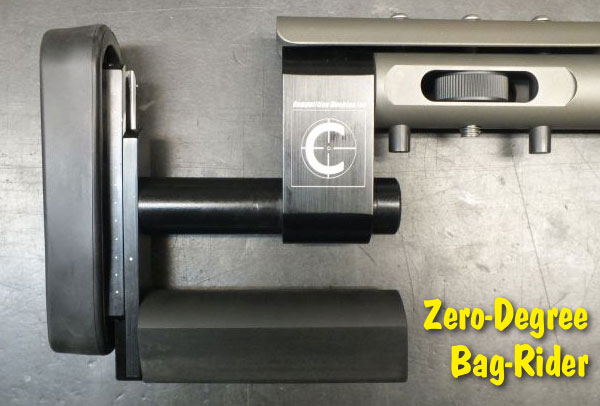
Tube-gunners take note. Gary Eliseo has just introduced a new wider, V-profile rear bag rider for his Competition Machine modular chassis systems. The new bag-rider is a wide V-shape that conforms to the shape and angle of popular rear sandbags. Gary tells us that “The new F-class rear bag rider will be available as an option in 2014. Constructed of Delrin, the new bag-rider is reversible with 0 degree and 5 degree mounting ends. The bottom of the bag-rider is sized to fit 3/4″-wide ear spacing.”
Editor’s Comment — This Kind of Bag Rider Really Works
We have tested a prototype, V-shaped bag-rider on an Eliseo 6mmBR Tubegun. The profile on our wooden prototype is very similar to Gary’s final design crafted from Delrin. We were really surprised at how much better the gun behaved with the wide, V-shaped bag rider, compared to a standard slab-sided skid. With the “V-Rider” the gun felt more “locked-in” with less side-to-side play. There also seemed to be less vertical bounce when shooting F-TR style with a bipod. But mostly the gun felt much more stable, with less tendency to roll. There was noticeably less side to side wobble, and the gun did track better.
The most important thing, is that the V-shaped bag-rider definitely made the gun easier to shoot — at least in the opinion of our three trigger-pullers. When we switched to our wide, V-shaped bag-rider, three different shooters were able to hold smaller groups with tighter horizontal. We saw fewer left/right shot impacts (away from the group center) that may have been attributable to little, last-micro-second movements of the rifle. The gun seemed to settle in the rear bag better, and after each shot, it seemed we could get back on target more quickly. The gun “locks in” to the rear bag faster and more solidly, so you spend less time fiddling with horizontal. With less wobble, the TubeGun feels less top-heavy. Understand that a V-shaped bag rider will not make your rifle more inherently accurate. However, it may help you steer the gun more consistently, and it make help the rifle track more consistently.
Product find by EdLongRange. We welcome reader submissions.


 A 7mm Snake for Santiago


 Rifle Chassis Builder Moves to Arizona