If you hand-load pistol ammunition, you should definitely have a case gauge (aka “gage”) for each cartridge type you reload. Caliber-specific, precision-machined cylindrical gauges perform many important functions. They will instantly reveal if your rounds are too long or have excessive headspace. They will also show if your case is bulged or otherwise too fat to chamber easily. You can use the gauge with sized brass as well as loaded rounds.
Case gauges are a “must-have” for anyone loading handgun ammunition, particularly if you crank out large quantities of pistol ammo with a progressive press. An oversize round can cause a misfeed, jam, or other problem. That can ruin your day if you are in the middle of a shooting match. If you are relying on your handgun for self-defense, the last thing you want is a malfunction of any kind. This Editor personally runs every pistol round through a gauge before it goes into the ammo box.
UltimateReloader.com Video Shows How to Use Pistol Case Gauges:
Our friend Gavin Gear of UltimateReloader.com has prepared an excellent video that explains the benefits of pistol case gauges and shows how to use them. Gavin uses the quality gages produced by L.E. Wilson. These are available for the most popular handgun cartridges, both autoloader cartridges, and rimmed revolver cartridges. Gavin demonstrates gage use with .40 SW and .44 magnum cases.
Gavin states: “Using a case gage is very simple, and I would recommend that you add one of these gages to your reloader’s tool chest for each of the pistol cartridge types you reload. It may just save you a lot of time and hassle. Peace of mind is hard to put a price on!”
For today’s Saturday Movie showcase we present six videos with .22 LR rimfire ammunition testing. Most of the videos include a wide variety of ammunition types, from bargain ammo, to high-end .22 LR match ammo. If you want to learn more about the properties of .22 LR rimfire ammo, you’ll find a good .22 LR ammo analysis on the Widener’s Blog. That article discusses .22 LR Bullet Design/Stability, Primer Ignition, Velocity Consistency, and Quality Control. In addition, 100-yard test results are provided for five (5) ammo types: Norma Xtreme LR-22, SK Rifle Match, ELEY Match, Lapua Long Range, and CCI Standard.
Big .22 LR Rimfire Ammo Comparison Test
This Backfire Channel Video features an accuracy comparison test of 13 .22 LR ammo types from multiple manufacturers. This includes low-priced ammo, such as Aquila, as well as more costly match ammo from ELEY, Lapua, and SK. Various types of ammo were tested in an outdoor range with three different NRL22-suitable rifles with slightly different chamber specs. Take note — this was NOT a benchrest rifle test conducted indoors. The most accurate ammunition overall was Lapua Center-X. NOTE: Different ammo may shoot better or worse in different rimfire guns. For example a round that works in an Anschutz rifle may not be the best choice for a .22 LR revolver. But this review can help you get started in ammo selection.
Testing Rimfire Ammo at New Whidden Gunworks Test Center
Last month Whidden Gunworks launched an impressive new Rimfire Test Center in Nashville, Georgia. In this video, long-range champion John Whidden shows the Whidden Gunworks test range developed with ELEY Ammunition. The new facility features two testing lanes — one for testing ELEY ammo and a second for testing other brands. Initially, the ELEY lane will offer 50m testing, with plans to expand to 100m in the future. On the second test lane, customers can test Lapua, SK, Norma, and RWS. Testing on this lane occurs at 50 meters and 100 meters simultaneously, registering results for BOTH distances. For more info, visit Whiddengunworks.com/ammunition-testing.
CLICK HERE to schedule a test at the Whidden facility.
.22 LR Ammo Buyers Guide
The Pursuit of Accuracy YouTube Channel has 270 videos, nearly all involving .22 LR rimfire rifles. The host tests different ammo in a variety of rimfire rifles. In this particular video, the host explains the key considerations in selecting .22 LR ammunition — how to choose the most cost-effective ammo for your rimfire rifle and discipline. You don’t need $14/box ammo to hit large steel plates at 20 yards. But you do need very consistent high-quality ammo for .22 LR Rimfire ELR Matches.
Testing Lapua Long Range Ammo at 400 Yards
With the emergence of long-range .22 LR rimfire matches, with targets at 100, 200, and 300 yards, the long-range capabilities of .22 LR have been pushed to the limits in recent years. In 2023 Lapua announced two new .22 LR rimfire ammo types — Long Range and Super Long Range. These are both specifically designed to optimize .22 LR performance past 100 yards. In this video, Gavin Gear of UltimateReloader.com tests the new Lapua ammo types on his range, with steel targets placed at 400 yards.
Subsonic vs. Supersonic .22 LR Ammunition
Here is another Pursuit of Accuracy Channel .22 LR ammo test. This specifically compares the performance of supersonic ammunition vs. subsonic ammo. What offers better accuracy? What is the best option for long range? The video addresses these questions.
Cheap .22 LR Ammo Tested with a $4000 Custom Rifle
Can relatively inexpensive ammo shoot well in $4000 rimfire rifle? This Midwest Long Range video seeks to answer that question. The results are interesting, with some surprisingly good results with CCI (8:03 time-mark) and Fiocchi (11:25 time-mark) Standard Velocity ammo. If you’re shooting NRL22 or PRS Rimfire matches on a tight budget, this video may steer you to some accurate yet affordable ammo options.
BONUS — Rimfire Ammunition Test with 31 Types
If watching today’s showcased videos has wet your appetite for .22 LR ammo comparison testing — here’s a “must-read” related article. The October 2018 issue of Shooting Sports USA (SSUSA) includes a great article with data on thirty-one (31) different types of popular .22 LR rimfire ammunition. The line-up includes low-speed, standard, and Hi-Velocity types, plus choices for plinking, varminting, and target applications. Brands tested include: Aguila, American Eagle, CCI, Federal, Fiocchi, Lapua, Remington, and Winchester. The ammo types ranged in speed from 727 FPS to 1735 FPS.
For each ammo type, SSUSA lists the bullet weight, velocity (FPS), and average of two, 5-shot groups at fifty yards. The most accurate ammo was Lapua Center-X LRN, with a 0.37″ average 50-yard group size. Second best was Lapua X-ACT LRN at 0.42″. Ammo was tested from a bench with a Cooper Model 57-M rifle fitted with 3-9x33mm Leupold VX-2 scope. The ammo offerings were grouped into three categories: (1) Varmints/Small Game; (2) Target; and (3) Plinking.
There was huge news in the reloading world this week. Hodgdon Powder Company (Hodgdon) has acquired RCBS from Revelyst, a division of of Vista Outdoor (VSTO). Most operations of RCBS will remain in Oroville, California for now, and the full product line will stay in production — presses, dies, powder measures, case prep tools, priming tools, scales and more. But this is still big news, with a leading reloading gear maker being acquired by a leading powder maker/distributor.
Today’s Saturday Showcase feature some of the most popular and noteworthy RCBS products including single-stage, turret, and progressive presses, plus powder dispensers and other tools.
RCBS ChargeMaster Link Scale/Dispenser with Bluetooth
Having a modern, electronic powder scale/dispenser makes the hand-loading process vastly more efficient. The latest generation of powder dispensers are very accurate, and they can store charge settings for multiple cartridge types. The latest RCBS ChargeMaster Link dispenser has a modern interface, plus Bluetooth technology that “talks” to a handy App on your mobile device. This is available now for $299.99 at Cabelas.com.
RCBS Combo Kit — Good Choice for Getting Started in Reloading
You can definitely save money by buying multiple reloading gear items in one combo package. RCBS offers a variety of Reloading Combo Kits which feature reloading press, powder measure, scale, priming tool, and other items. These range in price from $265-$620 on Amazon. This video reviews an RCBS Rebel Master Kit. This is a very complete starter set-up, sold for $499.99 at Midsouth.
Along with the press, we like many of the components in the Rebel Master combo kit. The powder measure works well as does the trickler, and the hand primer tool is reliable, with good feeding and plenty of leverage.
RCBS Partner Press
We think all serious reloaders should have a small, secondary single-stage press for repetitive tasks such as decapping primers. In addition, a small, compact press can be transported easily to the range. Load development can be done more efficiently when loading at the range, as you can easily modify seating depth and other variables. The RCBS Partner Press (#ad) is a great choice for a secondary press. This UltimateReloader video shows the key features of the Partner Press.
RCBS 6-Station Turret Press — Operation Tips
This editor has owned and used an RCBS Turret Press for over two decades. While certainly not as versatile/sophisticated as the Area 419 XERO turret press, this six-station RCBS press does its job handily. It is a good choice if you load multiple pistol cartridges. With six stations, you can install both a sizing and a seating die for three different cartridge types, such as 9mm Luger, .357 Magnum, and .45 ACP.
RCBS Brass Boss Case Prep Center
The RCBS Boss is a powered case prep center that performs multiple tasks efficiently. Priced at $198.99 on Amazon (#ad), the RCBS Boss boasts six variable, high-speed rotating stations (four at <350 RPM; two at <550 RPM). This unit is great for initial case prep (chamfering/deburring) and regular brass maintenance.
RCBS Summit — Set-UP and Field installation on Vehicle
The RCBS Summit Press (#ad) is a very unique, small footprint press that operates differently than most reloading presses. The cast-iron Summit has a large-diameter center column and die moves up and down to meet the cartridge. With this small footprint, the Summit can be used in the field. As you can see in the second video, one of our testers actually mounted a Summit Press on his vehicle (with a special pedestal) so he could load anywhere.
RCBS Bench-mount Priming Tool (Two Short Videos)
If you need to prime large numbers of cases, the RCBS bench-mount Auto Priming Tool can do so efficiently at a modest cost (currently $155.09 on Amazon #ad). It attaches to your bench so it is secure and stable. A vertical tube holds dozens of primers that feed into the pusher as you can see in these videos. Older guys who experience pain when gripping hand primer tools have praised this bench-mounted RCBS unit.
Choosing a Case Cleaning System
Here Kent Sakamoto of RCBS looks at the three main types of brass cleaning systems: Vibratory Tumbler, Wet Tumbler (with media), and Ultrasonic Cleaning Machine. Kent reviews the pros and cons of each system. Most gun owners can benefit by having an ultrasonic machine for parts cleaning as well as a tumbler for cleaning fired brass.
As an Amazon affiliate, this site can earn revenues through sales commissions.
Gavin Gear of UltimateReloader.com recently tested the impressive Henderson Gen 3 (V3) Trimmer. There is a full write-up on Gavin’s website, and you can watch Gavin’s 18.7-minute video review below.
Gavin states: “I met Todd Henderson at SHOT Show and it’s clear that quality control and customer experience are extremely important to him. The Henderson Gen 3 case trimmer is built on an adjustable tri-trim 3-way cutter with different pilots to accommodate different case necks. Three way cutters trim to length and chamfer the inside and outside all at once. This trimmer has a 1700 RPM spindle and a custom DC motor made in the USA. It is made of billet aluminum and has a taper-lock cutting head and is consistent to 0.002″” at least with the same brand of brass. The collets are Brown & Sharpe style collets and are interchangeable with Forster case trimmer collets. Henderson currently offers four collets, and one is supplied with each machine.”
Gavin explains the trimming process: “I had some 6mm Dasher brass I’ve fired a few times and wanted to take down 5-10 thousandths. The Henderson trimmer works much like a milling machine. You do not need much torque because of the way the taper works.”
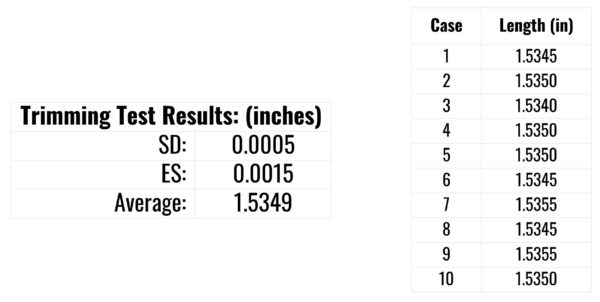
The Henderson Gen 3 trimmer delivered outstanding cartridge length consistency after trimming: “I was careful to ensure my trimming process was as consistent as possible. I measured the first ten cases I ever trimmed on the unit and found a standard deviation of 0.00047. The extreme spread is actually less than advertised. This trimmer is fast and easy to use and most importantly, returns consistent results.”
F-Class John Review of Henderson Gen 3 Trimmer
Our Editor F-Class John has also reviewed the Henderson Trimmer. He liked the product so much he purchased one, and he uses it regularly now to trim his .284 Win cases for F-Open competition.
John liked the precision of the Henderson trimmer and the overall design of the machine, which offers good ergonomics and very precise alignment of the cases. Cycling is smooth and positive, as you can see from the videos. Fit over the pilot was fine for John’s .284 Win brass, but he notes that other users may need to expand their case necks appropriately to fit their pilot.
Watch the video to see the Henderson trimmer in action. The dual, parallel horizontal support shafts provide precise alignment of the case as it moves inward toward the cutter blade. The Taper-Lock cutter provides a 14-degree inside chamfer and 30-degree outside chamfer. The trimming process is very consistent case after case, and the Henderson’s design captures brass shavings effectively.
UltimateReloader.com offers some of the most thorough firearms and reloading tool tests on the internet. And UltimateReloader’s YouTube Channel has over 1040 great videos that showcase reloading tools, accurate firearms, precision optics, gunsmithing methods, and top-tier reloading components. For today’s Saturday at the Movies feature, we showcase five videos recently created by Gavin Gear and his UltimateReloader team. These videos highlight a superb Long-Range Target Camera, the remarkable AMP Press, the new Hornady PRC cartridges, and other interesting topics.
Since starting his channel in 2007, Gavin has released over 1040 videos showcasing reloading products, gunsmithing, and gun testing. Thanks to Gavin’s movie-making skills and hard work, his YouTube Channel now has 335,000+ subscribers. And over the years Gavin’s videos have received over 73.8 million views. Gavin’s videos have benefited shooting enthusiasts and hand-loaders around the globe.
Multiple Muzzle Brake Performance with .224 Bullets
This video includes some serious testing of muzzle brakes in three bore sizes. One each designed for .224 caliber, 6.5mm caliber, and .308 caliber. The goal of the project was to see how brake bore affected recoil reduction, and accuracy. Gavin’s team uses two rifles, one AR and one 22-250 bolt action. Gavin’s testing equipment allows him to plot recoil force with great precision. What did they find: “With optimized clearance [.224 brake] we got the lowest recoil”.
New LongShot Ranger and Ranger Plus Target Cameras
Longshot offers superb, reliable, high-resolution target cameras favored by top shooters around the world. Now LongShot is introducing a new Ranger series of target cameras starting at just $199.00 for the basic Ranger which runs at 100 yards. For those who regularly shot at longer distances, the new Ranger Plus reaches out to 1000 yards. Right now you can get the impressive Ranger Plus for a $299.00 “Pre-Order” sale price. The features of these two systems are compared in the graphic below:
Bergara Premier Competition Rifle in 6GT
The 6GT is a popular new cartridge originally developed for the PRS/NRL discipline. It has a case capacity and case length between the 6 Dasher and the 6mm Creedmoor. This allows it to rival the accuracy of the 6 Dasher with less recoil than a 6mm Creedmoor, and potentially longer barrel life because less powder is burned with each shot. In this video Gavin tests the new Bergara factory precision rifle chambered in 6 GT. This rifle is based around the Bergara Premier action with a stainless No. 7 taper 1:7.5″-twist barrel, set in an MPA BA chassis. CLICK HERE for full test article on UltimateReloader.com.
AMP Mark II DB and RAMP Bipod at SHOT Show 2024
Top Benchrest, F-Class, Palma, ELR, Silhouette, and PRS/NRL shooters use AMP annealers. These impressive, computer-controlled annealing machines allow you to get optimal, consistent neck tension. In addition, regular AMP annealing can significantly extend the life of cartridge brass. With good brass now running $130-$160 per 100 cases, you definitely want your brass to last as long as possible.
Shown above is the innovative RAMP Bipod from the New Zealand team that created the revolutionary AMP Annealing machine. This new RAMP Bipod allows easy yet secure elevation changes with the front bipod.
Caldwell Flash Bang Target Impact Indicators
We like reactive targets for the instant gratification that comes with a hit. When shooting steel it’s great to get that rewarding “ping” on impact. But sometimes it’s hard to hear, especially when the targets are far away. Caldwell’s Flash Bang target hit indicators solve this problem, providing visual feedback for the shooter, spotter, and spectators. Gavin notes that: “These small units will mount to any steel target and are incredibly affordable. At $37, replacing them if they are accidentally shot is not a huge loss. In fact, Caldwell is the first company to bring a hit indicator to market that doesn’t eat a hole in your wallet.”
Our friend Gavin Gear of UltimateReloader.com often gets to test the latest and greatest reloading tools before they hit the market. He does a good job showing the features of new products with informative videos. Today we present three interesting products that Gavin has reviewed. First off is the impressive new RCBS Rebel reloading press. Next is the versatile three-head Case Prep Trio machine from Hornady. Third, Gavin reviews new Die Lock Rings and Breech Lock Die Bushings from Lee Precision.
RCBS Rebel Single-Stage Reloading Press
Most hand-loaders have used an RCBS Rock Chucker press at one time or another. Recently RCBS unveiled its new Rebel single-stage press. Like the Rock Chucker, the Rebel has a Cast Iron frame, but with a bigger base and taller arch (for a larger opening). The most important change is that this new Rebel press ejects primers out the bottom of the ram. This a big deal — just put a bin under the press to collect spent primers. However — take note — the Rebel has no on-press priming. You need to prime your cases separately. That’s not really a major issue, as we know the majority of our readers prime separately using hand or bench priming tools.
In this video Gavin loads ammo on the new the Rebel single-stage press and explains its notable features, including the primer ejection through the ram.
Currently Midsouth Shooters Supply is running a major RCBS Products Sale, with significant savings. The RCBS Rebel Press is now on sale for $219.99 at Midsouth, $30 off the regular price — a good deal for a press that can last a lifetime.
Hornady Lock-N-Load Case Prep Trio
Hornady’s compact Case Prep Trio machine (item 050160) packs a lot of functionality in a small package. This triple-threat tool has a small footprint, yet it can perform three tasks as well as much more expensive, tower-style case prep units.
Gavin Gear does a nice job explaining the features of the Case Prep trio. Watch this video to see how it can help you perform chamfering, deburring, and pimer pocket uniforming tasks more efficiently.
With three active stations, you can chamfer, deburr and clean primer pockets without having to change tools. The Case Prep Trio ships with inside chamfer, outside chamfer, and deburr tools. You can also use the machine with other optional 8/32 threaded accessories such as primer pocket reamers and case neck brushes. We’ve used this machine and it works well. The only negative is that you will get metal shavings on your bench (unlike some of the larger case prep centers). We’ve seen some guys put a small pan under the power head — then you can just dump the shavings out of the pan.
Lee Die Lock Rings and Spline Drive Breech Lock Bushings
New basic lock ring in left hand. Older non-splined ring in right hand.
In this video Gavin Gear reviews three types of die accessories from LEE. These work for virtually all standard dies, not just LEE-brand reloading dies. The new LEE basic silver-finish die lock rings now feature splines for enhanced grip and compatibility with LEE’s new die lock ring wrench (photo right). They still boast a rubber 0-Ring that helps “float” the die for improved cartridge concentricity.
LEE’s latest Ultimate Die Lock Rings have two major improvements — a colorful anodized finish, and a split-ring design with a tensioning screw, that allows these rings to be clamped securely to your dies. Available as a set, this package includes three ultimate die lock rings, and a plastic die lock ring wrench.
Gavin also reviews Lee’s Spline Drive Breech Lock Bushings for use with presses fitted with LEE’s Breech Lock system. These new Breech Lock bushings allow rapid change-out of dies without modifying the setting. The colorful new bushings feature splines on top that work with the new Lee Lock ring wrench shown above. In addition, the Breech Lock Bushings have a clamp to preserve die depth setting.
With the high cost of factory ammo, more shooters are loading their own ammo. When good 9mm pistol ammo was $10/box, it might be hard to justify handloading. Now that 25 rounds of factory 9mm JHP ammo can run $25 or more it certainly makes sense to reload. The same is true with rifle ammo if you shoot large quantities, or if you simply can’t find your preferred ammo for sale these days.
To increase productivity when reloading large quantities of ammunition, many shooters are thinking of getting a progressive press. Because multiple operations take place with a single pull of a lever, a progressive press can produce way more ammo in a given period of time than any single stage press. With a progressive, on the ram up-stroke, the multiple stations can simultaneously remove spent primer, full-length size case, drop powder, seat bullet, and crimp (if desired). Most progressives are also set up to prime cases with the ram in the lower position — though some guys prefer to prime manually.
Progressive presses aren’t just for high-output pistol ammo or bulk rifle ammunition. Good progressives can be adapted to do certain reloading tasks for top-of-the-line match ammo. You might use a progressive for decapping, priming, and sizing, then throw powder and/or seat bullets separately. Some Champion shooters do use progressives to load their match ammo! For example 5-Time National Long Range Champion John Whidden and 2020 Berger SWN F-Open Champion Jay Christopherson both use progessive presses for some (but not all) operations.
To help you get started with progressive presses, here are six videos from UltimateReloader.com that cover seven popular machines, from the elite Mark 7 Evolution to the affordable Lee Loadmaster. With many of these machines you can add separate vertical bullet feeder systems that further increase loading efficiency. Machines Covered: Lyman Mark 7, Dillon XL-650, Dillon XL-750, Dillon RL-550c, RCBS Pro Chucker 7, Hornady Lock-N-Load AP, and Lee Load Master.
Mark 7 Evolution Press — Distributed by Lyman
Dillon XL-650 vs. Dillon XL-750 (Two Press Review)
RCBS Pro Chucker 7 with Bullet Feeder
Dillon 550C with 6mm Creedmoor and 9x19mm
Hornady Lock-N-Load AP Progressive
Lee Load-Master Features and Loading 9mm
SAFETY BONUS — Why You Need a Lock-Out Die
The RCBS Lock-Out Die can also be used with some Dillon and Hornady progressive presses.
If you load pistol or rifle ammo with a progressive press, we strongly recommend you get a Lock-Out Die from RCBS. This unique reloading die will prevent your progressive press from advancing if the dispensed powder charge is more or less than about 0.3 grains too high or too low. The Lock-Out Die really works.
The Lock-Out Die works by using a central die detection rod that sets its vertical position based on the height of the powder column in the case. Through an ingenious design, if the powder column height is too low or too high, the rod locks in place as you start to pull the press handle. This halts the press before the ram can lift and the cartridge plate can advance. Unlike a beeping alarm system (which can be ignored or defeated), the Lock-Out Die physically stops the movement of the press ram and prevents a bullet being seated in the “problem” case.
It takes a bit of tweaking to get the Lock-Out Die detection rod setting just right, but once it is correctly positioned, the Lock-Out Die works smoothly in the background. The Lock-Out Die won’t interfere with the loading process unless it detects a high or low charge — and then it positively stops the progressive loading cycle.
While crafted for use in RCBS progressive presses, the RCBS Lock-Out Die can also be used on a Dillon XL Progressive or Hornady Lock-N-Load progressive — though it does take up one station which could otherwise be used for a final crimp die (after the seating die). This Editor has used the RCBS Lock-out die very successfully on an RCBS 2000 progressive press for many years.
The RCBS Lock-Out Die can also be used with some Dillon and Hornady progressive presses.
If you load pistol or rifle ammo with a progressive press, we strongly recommend you get a Lock-Out Die from RCBS. This unique reloading die will prevent your progressive press from advancing if the dispensed powder charge is more or less than about 0.3 grains too high or too low. The Lock-Out Die really works. Your Editor uses it on his RCBS 2000 progressive press. I can affirm that a Lock-Out Die has “saved my bacon” a half-dozen times over the years when there was an over-charge (which could cause a Kaboom) or a low charge (which could cause a squib load).
The Lock-Out Die works by using a central die detection rod that sets its vertical position based on the height of the powder column in the case. Through an ingenious design, if the powder column height is too low or too high, the rod locks in place as you start to pull the press handle. This halts the press before the ram can lift and the cartridge plate can advance. Unlike a beeping alarm system (which can be ignored or defeated), the Lock-Out Die physically stops the movement of the press ram and prevents a bullet being seated in the “problem” case.
It takes a bit of tweaking to get the Lock-Out Die detection rod setting just right, but once it is correctly positioned, the Lock-Out Die works smoothly in the background. The Lock-Out Die won’t interfere with the loading process unless it detects a high or low charge — and then it positively stops the progressive loading cycle.
While crafted for use in RCBS progressive presses, the RCBS Lock-Out Die can also be used on a Dillon XL Progressive (see video below) or Hornady Lock-N-Load progressive — though it does take up one station which could otherwise be used for a final crimp die (after the seating die). The RCBS 2000 has one more station than a Dillon 550/650, so it’s an ideal platform for using the Lock-Out Die.
Learn More at UltimateReloader.com
On the UltimateReloader.com website, run by our friend Gavin Gear, you’ll find an excellent two-part series on the function and set-up of the RCBS Lock-Out Die. Part One explains how the Lock-Out Die functions, using cut-away illustrations. Part Two shows how to install and adjust the Lock-Out Die on various progressive presses. The Ultimate Reloader video at the top of this article shows setup of the RCBS Lock-Out Die on the Dillon XL-650 progressive press, while the Reloading Bench video below shows the Lock-Out Die on a Hornady LnL progressive.
We are coming to the end of another fall hunting season. If you are pursuing big game, such as Elk in the Rockies, you want a powerful cartridge that is also highly accurate. We like the 7mm for big game hunting as there are a wide variety of options — from the 7mm-08 up to the very large 7mm magnums. And Hornady’s new 7 PRC has quickly earned a following among hunters. In today’s Saturday Movie Showcase, we feature seven videos covering a wide selection of 7mm cartridge types including: 7mm-08 Rem, 7×57 Mauser, 7mm PRC, 7mm WSM, 7mm SAUM (aka RSAUM), 7mm Rem Mag, and 28 Nosler.
7mm PRC in Custom Rifle
The 7mm PRC was created by Hornady as part of the PRC series which includes the 6.5 PRC and 300 PRC. With a modern, non-belted magnum case design the 7mm PRC offers excellent power with good ballistics. The 7mm PRC can drive high-BC 175 grain bullets at 3000 FPS, making it very effective at putting down large game. This Precision Rifle Network video features a high-end custom 7mm PRC rifle built with a Terminus Zeus action, 29″ barrel, Grayboe stock, Triggertech trigger and Athlon scope. This 7mm PRC rig shows impressive accuracy.
7mm Remington Magnum vs. 7mm PRC
In this video, UltimateReloader’s Gavin Gear tests the classic belted 7mm Remington Magnum vs. the relatively new 7mm PRC. Testing is done with two hunting-type rifles shot from bipod. Gavin notes that both cartridges shoot very well, with impressive down-range energy. But he concludes that the non-belted 7mm PRC does have some advantages.
7mm Remington Magnum SAKO S20
This rifle review video features real world testing of a SAKO S20 hunting rig chambered for the 7mm Remington Magnum cartridge. The SAKO S20 is offered with multiple stock types. Here the thumbhole Hunter version with slim fore-end is featured. The testers observe that the 7mm Rem Mag factory ammo shoots very well, making the cartridge a good choice for large game.
Most Popular 7mm Cartridges
This Ron Spomer Outdoors video covers a variety of the most popular 7mm cartridges. The video covers 7mm cartridge history, ballistics, and recommendations for hunting use. Starting at the 6:45 time-mark there is a detailed ballistics comparison of the Hornady 175gr ELD-X (Extremely Low Drag eXpanding) bullet in three different chamberings: 7×57 Mauser, 7mm-08 Rem, and 7mm Remington Magnum.
7mm SAUM vs. 7mm WSM
This 17-minute video compares two modern 7mm short magnum cartridges — the 7mm SAUM (Short Action Ultra Magnum) and the 7mm WSM (Winchester Short Magnum). Both these cartridges have been adapted for F-Class Open Division use over the years. In this video, factory ammo for both cartridge types was tested with a modern chassis rifle shot prone with bipod.
7mm-08 Remington
The 7mm-08 Rem is a popular cartridge derived from the .308 Winchester necked down to 7mm. In 1980, Remington Arms popularized the cartridge by applying its own name and offering it as a chambering for their Model 788 and Model 700 rifles. Of cartridges derived from the original .308 Win, the 7mm-08 is the second most popular after the .243 Winchester.
Other than neck diameter, the 7mm-08 is virtually the same dimensionally as the .308 Win. But when you compare heavy bullets, grain for grain, the 7mm-08 offers better ballistics. Thus a 168-grainer fired from a 7mm-08 has less drop and less windage than a 168gr bullet fired from a .308 Win. The 7mm-08 enjoys most of the advantages of the .308 (inherent accuracy, long barrel life, great terminal performance) while offering better ballistics grain for grain. These qualities make the 7mm-08 a very popular deer-hunting round.
7mm Multi-Cartridge Comparison
Do you want a 7mm rifle, but haven’t chosen a cartridge yet? This lengthy 30-minute Ron Spomer video looks at a host of 7mm cartridge types. There is special emphasis with comparison data for the 7mm-08, 7mm Rem Magnum, and 28 Nosler (see 19:40 time-mark). Ron explains how to efficiently zero a rifle with these 7mm cartridges and how hunters can evaluate Maximum Point Blank Range (MPBR).
Progressive reloading presses offer shooters speed and efficiency in producing custom-tailored rifle and pistol ammunition. However, there is a wide choice of Progressive Presses and a bewildering array of options to consider. In this video, the 6.5 Guys and UltimateReloader.com’s Gavin Gear provide an overview of the leading Progressive Presses on the market along with key considerations for precision rifle shooters. If you are considering getting a Progessive for rifle ammo reloading, you should watch this informative, 25-minute video.
10 Tips for Reloading Rifle Ammo on a Progressive Press:
1. Make sure the brass is very clean. Don’t mix old range pick-up brass with newer brass.
2. Apply a thin, spray lube to all cases before the sizing/loading cycle.
3. Consider priming your brass separately (with a hand or bench tool) before the operation. Then inspect the primers before loading powder and bullets.
4. Always wear eye protection when loading with the Progressive, particularly if you are priming cases.
5. With masking tape, mark the powder measure/dropper with the powder type and cartridge charge weight. Check the charge mass multiple times (see below).
6. Cycle a few cases, sizing and adding powder but NOT seating bullets. Weigh the powder charges to ensure the powder measure is dispensing the correct charge. Sometimes this will change a couple tenths as it “settles down” after the first few charges.
7. Check the brass for shoulder bump and bullet seating depth carefully for the first few rounds, then check again periodically.
8. Try to maintain a steady pace and operate the handle the same way every time.
9. Visually inspect the powder charge in each case (before bullet seating), and use a lock-out die if your Progressive Press has enough stations.
10. Never, ever mix pistol and rifle powders! If you have previously loaded pistol ammo with your Progressive, make sure ALL the powder (every flake and kernel) is removed from all parts of the powder-dropping system before you add rifle powder.
Visit these sites for more Reloading and Precision Shooting Videos:




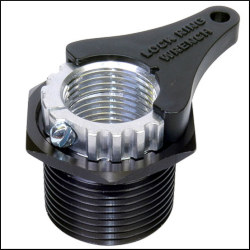 In this video Gavin Gear reviews three types of die accessories from LEE. These work for virtually all standard dies, not just LEE-brand reloading dies. The new LEE basic silver-finish die lock rings now feature splines for enhanced grip and compatibility with LEE’s new die lock ring wrench (photo right). They still boast a rubber 0-Ring that helps “float” the die for improved cartridge concentricity.


 If you load pistol or rifle ammo with a progressive press, we strongly recommend you get a Lock-Out Die from RCBS. This unique reloading die will prevent your progressive press from advancing if the dispensed powder charge is more or less than about 0.3 grains too high or too low. The Lock-Out Die really works. Your Editor uses it on his RCBS 2000 progressive press. I can affirm that a Lock-Out Die has “saved my bacon” a half-dozen times over the years when there was an over-charge (which could cause a Kaboom) or a low charge (which could cause a squib load).


 The 7mm-08 Rem is a popular cartridge derived from the .308 Winchester necked down to 7mm. In 1980, Remington Arms popularized the cartridge by applying its own name and offering it as a chambering for their Model 788 and Model 700 rifles. Of cartridges derived from the original .308 Win, the 7mm-08 is the second most popular after the .243 Winchester.


