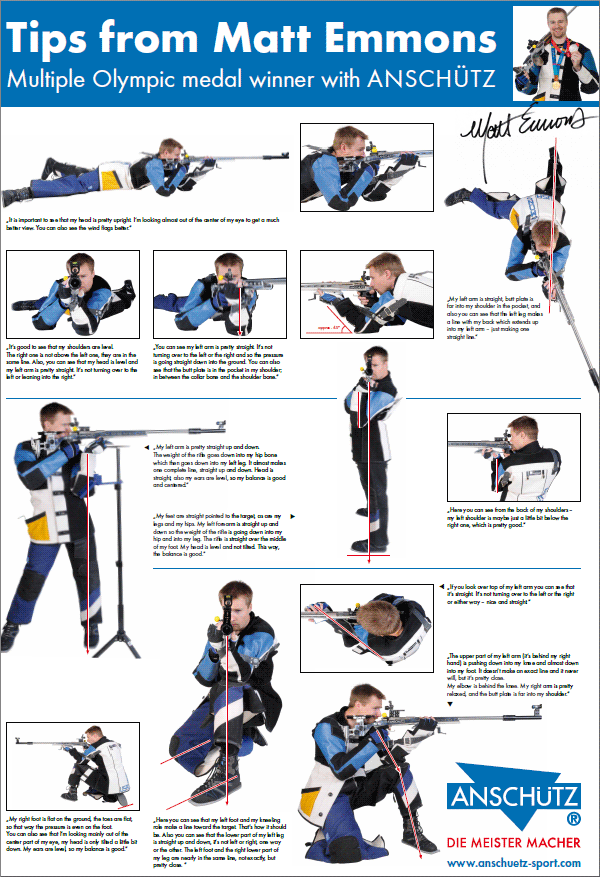
The U.S. Army Marksmanship Unit (USAMU) has produced an excellent series of videos covering the Basic Rifleman’s Course. If you are getting started in High Power shooting, or want to improve your position shooting skills, this series is well worth watching. And these videos are not just for service rifle shooters — even bench shooters can benefit from these videos, particularly Part 5, which explains how to estimate wind speed and direction. The lead instructor for these videos is SFC Brandon Green, three-time National High Power Champion, and 2017 Service Rifle Champion. When SFC Green talks, you should listen.
SFC Brandon Green is a shooting superstar. Green won his third NRA National High Power Rifle Championship in 2018 at Camp Atterbury, Indiana. He dominated the HP Championship cycle, finishing eight points and ten Xs ahead of his nearest competitor. Brandon also won High Power National Championships in 2015 and 2013. One of the greatest marksmen in the nation’s history, SFC Green excels at all positions, both rapid-fire and slow-fire.
Part 5 — Wind and Weather Estimation (Very Useful for All Shooters)
Note: This video includes a hit location “target analysis” in the first 6 minutes.
Part 4 — Minute of Angle Explained
Part 3 — Ballistics and Zeroing
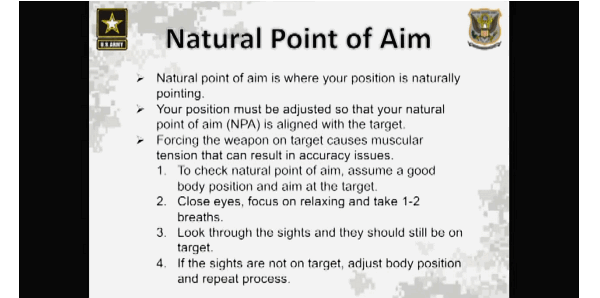
Part 2 — Positions, Sight Alignment, and Natural Point of Aim (Very Useful)
Part 1 — Aiming and Sight Picture
SFC Brandon Green (left above) has set multiple National Records at Camp Perry.
In the archives of The First Shot (the CMP’s Online Magazine), SGT Walter E. Craig of the USAMU discusses physical conditioning for competitive shooters, particularly High Power competitors. Fitness training is an important subject that, curiously, is rarely featured in the shooting sports media. We seem to focus on hardware, or esoteric details of cartridge reloading. Yet physical fitness also matters, particularly for High Power shooters. In his article, Craig advocates: 1) weight training to strengthen the Skeletal Muscle System; 2) exercises to build endurance and stamina; and 3) cardiovascular conditioning programs to allow the shooter to remain relaxed with a controlled heart beat.
SGT Craig explains: “An individual would not enter a long distance race without first spending many hours conditioning his/her body. One should apply the same conditioning philosophy to [shooting]. Physical conditioning to improve shooting skills will result in better shooting performance[.] The objective of an individual physical training program is to condition the muscles, heart, and lungs thereby increasing the shooter’s capability of controlling the body and rifle for sustained periods.”
In addition to weight training and cardio workouts (which can be done in a gym), SGT Craig advocates “some kind of holding drill… to develop the muscles necessary for holding a rifle for extended periods.”
For those with range access, Craig recommends a blind standing exercise: “This exercise consists of dry-firing one round, then live-firing one round, at a 200-yard standard SR target. For those who have access only to a 100-yard range, reduced targets will work as well. Begin the exercise with a timer set for 50 minutes. Dry-fire one round, then fire one live round and without looking at the actual impact, plot a call in a data book. Continue the dry fire/live fire sequence for 20 rounds, plotting after each round. After firing is complete, compare the data book to the target. If your zero and position are solid, the plots should resemble the target. As the training days add up and your zero is refined, the groups will shrink and move to the center.”
Fitness training and holding drills help position shooters reach their full potential.
Training for Older Shooters
Tom Alves has written an excellent article A Suggested Training Approach for Older Shooters. This article discusses appropriate low-impact training methods for older shooters. Tom explains: “Many of the articles you will read in books about position shooting and the one mentioned above are directed more toward the younger generation of shooters in their 20s. If you look down the line at a typical high power match these days you are likely to see quite a few folks who are in their middle 30s and up. Many people in that age range have had broken bones and wear and tear on their joints so a training program needs to take that into account. For instance, while jogging for an extended period for heart and lung conditioning may be the recommended approach for younger folks, it may be totally inappropriate for older people.”
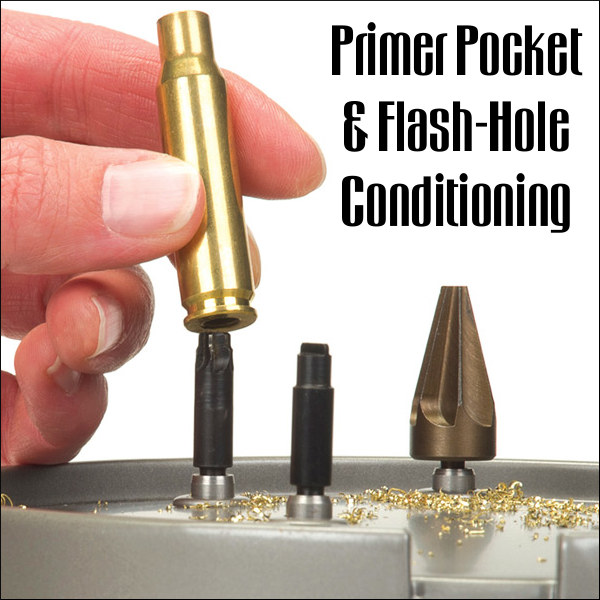
Each Wednesday, the U.S. Army Marksmanship Unit publishes a reloading “how-to” article on the USAMU Facebook page. One “Handloading Hump Day” article covered two basic case prep chores — uniforming primer pockets and deburring flash-holes. Visit the USAMU Facebook page for other tips.
Primer Pocket & Flash-Hole Conditioning
This week, we’ll address a question that frequently arises: “Do you uniform primer pockets and deburr flash-holes?” As we tailor our handloading methods to the specific needs of each instance, the answer, not surprisingly, is “Sometimes!” However, don’t flip that dial just yet, as what determines our approach may be helpful in deciding how to address one’s own techniques. Moreover, we have a buried “Easter Egg” morsel that may bring a chuckle, as well as useful safety information!
Generally, the USAMU Handloading Shop does not uniform primer pockets (PP) or deburr flash holes (FH) of our rifle brass. We’re certainly not against it… Rather, this reflects the very high volume of ammunition we load, the fact that very few cases are ever re-loaded for a second firing, and the types of brass we use. However, as a need is perceived, we DO deburr flash holes. Of interest, we have fired many very small, 1000-yard test groups and aggregates using weight-selected, domestic brass that had not had PPs uniformed or FHs deburred.
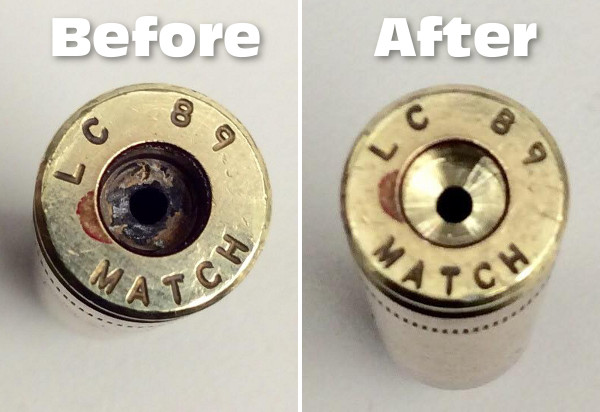
Before and After — On the left is a fired, deprimed 7.62×51 case with primer residue intact. On the right the primer pocket has been uniformed to SAAMI specs. Note the shiny finish at the bottom of the pocket — evidence of the the removal of metal when uniforming the primer pocket.
As to the type cases we use, many thousands of our long-range 5.56mm cases come to us from the arsenal with the primer of our choice pre-installed and staked-in, per usual practice. Obviously, we cannot uniform either FHs or PPs on this live, primed brass. However, after careful sorting, inspection and preparation, we do obtain match-winning results with it.
Shooters who reload their brass several times may decide to uniform PPs and deburr FHs, especially on their “300-yard and beyond” brass. Here, they will use the cases many times, while the uniforming is performed only once. Also, most handloaders only process moderate amounts of brass, compared to our multi-thousand round lots.
Having high quality Long Range (LR) brass helps. Many of the better brass manufacturers [make] their flash holes so that no burrs are created. Still, it does pay to inspect even THESE manufacturer’s products, as occasional slips are inevitable. Very rarely, some of the best makers will have a significant burr in, say, 1 per 1000 or 2000 cases, and it’s worth catching those.
Exceptions can always be found. Recently, we began processing a large lot of match brass from a premier manufacturer. We were startled to find that every case had a significant burr in the FH — something we’d never before seen from this maker. We then broke out the FH deburring tools and went to work.
Some observers have noted that it can be difficult to truly verify the contribution to accuracy of these procedures — particularly when firing from the shoulder, in conditions. Members of this staff, as individual rifle competitors, do often perform these operations on their privately-owned LR rifle brass. One could ascribe this to the old High Power Rifle maxim that “if you think it helps, then it helps.”
However, a World Champion and Olympic Gold/Silver medalist here commented on his own handloading (for International competition, which demands VERY fine accuracy). He noted that he did seem to see a decline in accuracy whenever he did not uniform FHs, deburr FHs and clean primer pockets before each reloading. (One might be tempted to counter that only a truly World Class shooter could reliably detect the difference.) However, with the wisdom of decades experience, our Champion also remarked that “It could have been that I just wasn’t shooting as well that day.”
For those who do opt for these procedures, note that various tool models may have adjustable depth-stops; pay attention to the instructions. Some FH-deburring tools (which enter the case mouth, not the primer pocket) are dependent upon uniform case length for best results.
Above is a flash-hole deburring tool on an RCBS powered case-prep unit. These case prep machines can save a lot of pain and misery, helping one perform various functions quickly and efficiently.
This video from the U.S. Army Marksmanship Unit focuses on two key fundamentals of marksmanship: 1) Sight Alignment; and 2) Trigger Squeeze. This video can assist any Service Rifle or metallic sights shooter. The USAMU instructor explains: “You’ve probably heard a lot about fundamentals — Breathe, Relax, Aim, Squeeze… Well that gives a shooter a lot to think about. Here we teach two main firing tasks: 1) align the sights, and 2) squeeze the trigger without moving the rifle. This allows the shooter a much more simplified format.”
The following tips are transcribed from the video:
Task One: Sight Alignment
Sight alignment is the process of putting the tip of the front sight post, the rear aperture, and the shooter’s eyeball all on the same plane. It’s very important to maintain the tip of the front sight post centered in the rear aperture. Just .002″ of deviation can cause a miss at 300 meters. Allow your eye to do its job. While firing, the focus should remain on the tip of the front sight.
Task Two: Trigger Control
Your second firing task is [to] fire the rifle without moving it. This is done through proper trigger control. You’ve probably heard a lot of words about trigger control — “surprise break”, “snatch”, “pull”, “squeeze”… well we teach one thing here: “smooth”. No matter the speed at which I engage the trigger, it’s always going to be smooth. Imagine trying to pull the trigger straight through the rear of the buttstock, holding it to the rear while the gun recoils. It’s important to constantly engage the trigger, never letting your trigger finger disengage from the trigger while firing. This is achieved through natural trigger finger placement.
SFC Emil Praslick III is now retired from the U.S. Army, but he left a great legacy as one of the USAMU’s greatest coaches and team leaders. A highly-respected wind expert, Praslick also was known for his ability to help his shooters master the “mental game”, which is so important at the highest levels of competition. Here is an article from the CMP Archives in which Praslick explains how to focus your mind to achieve greater success.
Thinking Your Way to Success by SFC Emil Praslick III (Ret.)
Why does it seem that the same small group of shooters wins the majority of the matches? Within the Army Marksmanship Unit’s Service Rifle Team, the same effect applies. On a team filled with uncommonly talented shooters, the same two or three are consistently at the top of the final results bulletin. What is the difference among shooters who are technically equal? Confidence. A confident shooter is free to execute his shots without the fear of failure, i.e. shooting a poor shot.
Negative thoughts (can’t, won’t be able to, etc.) will destroy a skilled performance. The mind’s focus will not be on executing the task, but on projecting fear and self-doubt. Fear is the enemy, confidence is the cure.
How does a shooter on the eve of an important match (the President’s or NTI, for example) attain the confidence needed to perform up to his potential? A pre-competition mental plan can assist in acquiring that positive mental state. The plan can be broken down into a few phases.
Build a feeling of preparedness. Developing and executing a plan to organize your equipment and pre-match routine will aid you in feeling prepared on match day.
Avoid negative and stressful thoughts. Focusing on “winning” the match or shooting for a specific score (like making the “cut” or making the President’s 100) can cause undue stress. Good shooters focus on aspects that are within their control: their sight picture, their sight alignment, their position. Each shot should be treated as an individual event.
Train stage-specific tasks during your practice sessions. Instead of shooting matches or practice matches only, include some drills that focus on your problem areas. Training in this manner will assist your level of confidence.
As part of your pre-match routine, imagine yourself shooting perfect shots. Visualize getting into the perfect position, acquiring a perfect sight picture, and perfect trigger control.
Let a feeling of calm and well-being wash over you. Spend a few minutes alone thinking positive thoughts. Many shooters use their favorite music to help build the mood.
Once you develop your pre-competition mental plan, stick with it. Through your training you will develop the physical skills to shoot higher scores. The confidence you will need to apply them in match conditions will grow as you develop into a complete shooter; both physically and mentally.
The USAMU’s article archives are a great resource for competitive shooters. Click HERE for more excellent instructional articles by Emil Praslick and other USAMU Coaches and shooters. You’ll find articles on Wind-Reading, Fitness, Equipment, Shooting Positions, Shooting Techniques, Match Strategies and much more.
Emil Praslick III is widely recognized as one of the greatest wind wizards on the planet — a master at identifying wind value and direction, and predicting wind cycles. As coach of the USAMU and top civilian teams, Emil has helped win many high-level championships. In the three videos we feature today, Emil, who works with Capstone Precision Group (Berger, Lapua, SK, Vihtavuori) and Team Applied Ballistics, explains how to determine wind direction and velocity using a variety of indicators. Praslick, now retired from the U.S. Army, was an 18-time National and 2-time World Champion coach with the USAMU.
Video ONE: Wind Theory Basics — Understanding “Wind Values”
In this video from UltimateReloader.com, Emil explains the basics of modern wind theory. To properly understand the effect of the wind you need to know both the velocity of the wind and its angle. The combination of those variables translates to the wind value. Emil also explains that the wind value may not be constant — it can cycle both in speed and velocity. Emil also explains some of the environmental conditions such as mirage that can reveal wind conditions.
Video TWO: Determining the Direction of the Wind
Key Point in Video — Find the Boil
Emil explains how to determine wind direction using optic. The method is to use spotting scope, riflescope, or binoculars to look for the “Boil” — the condition in mirage when the light waves rising straight up. The wind will generate that straight-up, vertical boil in your optics when it is blowing directly at you, or directly from your rear. To identify this, traverse your scope or optics until you see the boil running straight up. When you see that vertical boil, the direction your optic is pointing is aligned with the wind flow (either blowing towards you or from directly behind you).
Video THREE: The No Wind Zero Setting
In this second video, Emil defines the “No-Wind Zero”, and explains why competitive shooters must understand the no-wind zero and have their sights or optics set for a no-wind zero starting point before heading to a match. In order to hit your target, after determining wind speed and direction, says Emil, “you have to have your scope setting dialed to ‘no wind zero’ first.”
Coach of Champions — Emil Praslick III
SFC Emil Praslick III, (U.S. Army, retired) works with Berger Bullets and Applied Ballistics. Emil served as the Head Coach of the U.S. National Long Range Rifle Team and Head Coach of the USAMU for several years. Teams coached by Emil have won 33 Inter-Service Rifle Championships. On top of that, teams he coached set 18 National records and 2 World Records. Overall, in the role of coach, Praslick can be credited with the most team wins of any coach in U.S. Military history.
This week Shooting USA TV has a great show, well worth watching. This episode features the history of U.S. military service rifles. Starting with the Trapdoor in 1873, and ending with the M14 in the 1960s, this episode traces 90 years of battle rifle development. This history lesson ends right before the general adoption of the M16 5.56x45mm infantry rifle.
In addition to history, today’s show talks about using Tripods in Precision Rifle Competition. PRS and NRL shooters can learn multiple ways to use a tripod for support during stages. These methods are explained by Staff Sergeant Tyler Payne from the USAMU Action Shooting Team.
Shooting USA airs Wednesday 9:00 PM Eastern and Pacific, 8:00 PM Central on the Outdoor Channel. You can also watch Shooting USA any time online via Vimeo.com. Subscribe for $3.99 per month or pay just $0.99 per episode.
History of American Service Rifles
The Trapdoor was the first cartridge-firing service rifle, replacing cap and ball rifles. Then came the evolution to better, faster-cycling service rifles used in two World Wars, Korea, and the early Vietnam era. Those rifles were the Krag Jorgensen, 1903 Springfield, M1 Garand, and M14.
The Krag Jorgensen Served 1892 to 1907. First Smokeless Cartridge Rifle.
Caliber: 30-40 Krag
The 1903 Springfield Served as Primary Service Rifle 1903 to 1936.
Cartridge: .30-06 Springfield
The M1 Garand Served 1936 to 1958. First Semi-Auto Service Rifle.
Cartridge: .30-06 Springfield
The M14 Served 1959 to 1964. First Select Fire Primary Service Rifle.
Cartridge: 7.62x51mm NATO (.308 Winchester)
Tripod Tips for Precision Rifle Shooters
This week’s Shooting USA episode has a great USAMU Pro Tips Segment showing how to use a tripod for rifle support. Along with clamping the rifle on the top of the tripod, you can used the deployed legs for support in multiple ways.
SSG Tyler Payne explains: “If you’re presented with a barricade where you can support the front of the gun, the tripod really shines as a rear support. With the front of the gun and the rear of the gun both supported, it’s like shooting off of a bench.”
Shooting USA is available On Demand via Vimeo.com. Watch a single episode for $0.99, or get a full-month subscription for $3.99 and watch as many shows as you like with limited commercial interruptions.
Top to bottom – Remington firing pin assembly with ISS, Tubb SpeedLock alloy-composite system without ISS (current versions have dual, opposite-wound springs), and Remington short action firing pin assembly without ISS.
The U.S. Army Marksmanship Unit regularly publishes technical articles on the USAMU Facebook page. One informative USAMU article covered mechanical issues and related ignition irregularities that can cause vertical fliers even with good ammunition in an otherwise excellent rifle. We highly recommend you read this article, which offers some important tech tips.
Vertical Dispersion: Mechanical/Ignition Issues?
Poor or inconsistent ignition has long been known to be one of the “usual suspects” when one encounters vertical fliers that just shouldn’t be there. By having a sense of some of the basic principles involved, and a few basic areas to check, the shooter may avoid colsiderable frustration, not to mention time, expensive loading components and barrel wear.
Is your well-built rifle of high-quality components plagued with vertical fliers across more than 1-3 handload combinations? Consider the bedding, crown and scope/sight mounts. Are they correct? If so, then you might check for ignition issues before boldly undertaking an extensive, expensive, and quite possibly fruitless quest for the “magic handload”.
SEEING IS BELIEVING: While the author had been aware for many years that poor ignition should be considered and ruled out when dealing with vertical fliers in an otherwise-excellent rifle, actually seeing the problem and its almost instantaneous cure really drove the lesson home.
He was working with a “dot” rifle – a .22 LR match rifle that really stacked bullets into little piles at 50 yards and beyond. With one lot of ELEY Tenex, it produced consistent “bughole” groups at 50, but with another, selected lot of Tenex, similar groups were regularly ruined by single, vertical fliers that did not appear in other rifles. Rather than spending days burning up expensive, select ammunition looking for “magic lots”, he contacted a well-respected rimfire gunsmith and explained the situation.
Without so much as batting an eye, the highly-experienced ‘smith tore into the rifle’s action, and quickly found the cause(s) of the problem. He discovered a demonstrably weak firing pin spring, plus a chip out of the face of the firing pin where it contacted the cartridge rim.
After replacing and tuning the offending parts, the rifle immediately began shooting tiny, bughole groups with the previously “unacceptable” lot of Tenex. Centerfire rifles can also benefit from ensuring positive, consistent ignition. A wise riflesmith is literally worth his weight in gold!
So, what are some issues we as shooters can inspect in our rifles to help determine if ignition woes could be part of our problem? At the club level, ask yourself if that “experienced” Remington, Winchester 70, or even Springfield-based match bolt gun you’re using is still running its’ original 40-80 year-old factory striker spring? If so, a new replacement is cheap insurance against current or future problems. (And BTW, it might be best to stick to the normal, factory-spec spring weight. A super-powerful spring can cause vertical, just as a weak one one can.) Along with that, a routine check for proper firing-pin protrusion is a quick preventive measure that can rule out potential issues.
Other areas to consider are the centering and consistency of the firing pin’s operation in the bolt. Admittedly, with the increasing use of precision-machined custom actions, this is becoming less an issue every day. Below is the firing pin assembly from a custom BAT action:
However, particularly with factory actions, a very quick and easy check is to remove the bolt, let the firing pin go forward, and look at the firing pin tip through the firing pin hole. Is the tip off-center in the hole, and possibly striking it as it moves forward? Is the hole out-of-round or burred from being struck repeatedly? If so, a trip to the riflesmith is likely in order.
Similarly, machining issues in the bolt/firing pin system can lead to rough and erratic firing pin movement, in which the firing pin drags against an internal surface of the bolt. In high-quality rifles these issues are relatively rare, but not unheard-of, and it takes mere minutes to rule them out. It may be worthwhile to remove the cocking piece/firing pin/spring assembly and look for any unusual gouges, dings, peening, burrs or signs of abnormal wear.
This task is especially easy with Winchester 70s, Springfields, and the similar Mauser 98s, involving little more than the push of a button and unscrewing the cocking piece assembly. This is just one of the many reasons these tried-and-true actions have earned such a loyal following in the field, among hunters who must maintain their rifles away from a shop.
Particularly with older rifles, watch for and remove excess grease (or even Cosmoline!) from both the firing pin assembly and inside the bolt. This can help improve firing pin speed and consistency. Other bolt-action designs may need a take-down tool or other measures.
As part of this inspection, AFTER ENSURING THE RIFLE IS UNLOADED, slowly cock the rifle, dry-fire, and repeat several times. Listen carefully near the action for inconsistency in the sounds it generates. Does the striker falling make the same sound each time? Do you hear or feel grinding upon operation? If so, where?
Be sure to check the operation of the cocking piece (bolt shroud), firing pin within the bolt shroud, the cocking piece cam and the rear of the bolt body where the cocking piece cam operates. As with our examination for abnormal wear marks discussed above, look for marks indicating roughness or a possible need for light polishing. Then, clean and lightly grease the bearing surfaces while you’re at it.
Remington 700 bolt shroud and cocking cam
These are relatively easy checks that shooters can undertake to perform a preliminary inspection on their own. Other mechanical issues can also cause ignition issues, chiefly centered around the action of the trigger, sear and sear spring. If these are suspected, a trip to an experienced, qualified riflesmith for diagnosis is recommended. We hope you find this information helpful! Join us again next week, and in the meantime, enjoy the shooting sports safely!
Here are three videos from the U.S. Army Marksmanship Unit (USAMU). On Tuesdays, the USAMU regularly releases a new Training Video. Most of these Training Tuesday Videos cover match rifle shooting, but there are also tips on pistol marksmanship and shotgun shooting. You will find all the latest Training Tuesday videos on the USAMU YouTube Page.
Getting Set-Up for Prone Shooting with Mat and Spotting Scope
SGT Forrest Greenwood of the USAMU Service Rifle Team explains how to set up service rifle gear for a slow-fire, 600-yard course of fire. This video offers some helpful tips for all prone shooters — even F-class competitors. SGT Greenwood explains how to place the mat, set up the spotting scope stand, lay out the log book and ammunition, and then get ready to shoot. SGT Greenwood has earned the Distinguished Rifleman Badge and the President’s One Hundred Tab.
Rifle Shooting from the Sitting Position with SFC Brandon Green
SFC Brandon Green, three-time NRA National High Power Champion, is one of America’s greatest marksmen. In this video Brandon explains the sitting position while SGT Benjamin Cleland demonstrates. This video was filmed at the 2019 Eastern Games Rifle Small Arms Firing School (SAFS) in Butner, North Carolina. The USAMU Service Rifle Team soldiers helped run the SAFS Class hosted by the CMP.
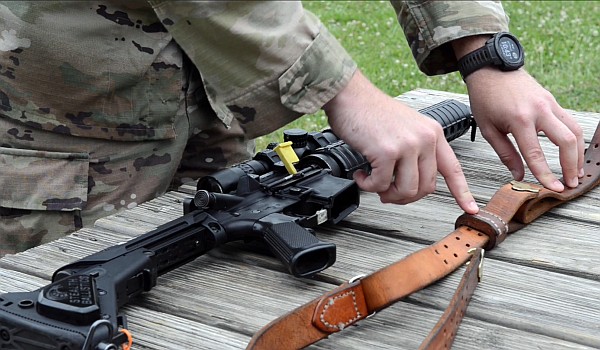
Setting Up a Sling for High Power Service Rifle Standing Position
SPC Kade Jackovich with the USAMU Service Rifle Team offers clear advice on how to set up a sling for the standing portion of a service rifle match. The sling must be adjusted to a shorter length. Kade shows the most efficient method to do this.
Even with the COVID-19 Pandemic, it is great to see talented young shooters attending competitions — honing their skills with the goal of competing in the next Olympic Games. While few of us have the dedication to become competitive 3-position shooters, soldiers from the U.S. Army Marksmanship Unit (USAMU) are putting in the hours in the hopes of representing the USA in the World Cup and Olympics.
The USAMU reports: “With the Smallbore Olympic Trials (Part II) still yet to happen, going to competitions now is even more critical for Olympic hopefuls to prepare. So with added safety precautions, the U.S. Army Marksmanship Unit International Rifle Team recently competed at the American Smallbore Shooting Association (ASSA) National Championships in Bristol, Indiana.”
After all the .22 LR rounds were sent downrange, USAMU soldiers took up the top four spots in both the Prone and Three-Position individual championships. And the USAMU won a Gold and Silver in the Team Championships. SPC Tim Sherry seized the ASSA National Prone Champion title with the score of 6393-515X. SGT Patrick Sunderman took Silver just one X behind — 6393-514X.
In the Prone Team Championships (shown below), USAMU Soldiers swept the podium. SGT Sunderman and SPC Jared Desrosiers combined for 1600-116X to win the Gold and top honors.
USAMU Shooters Host Training Clinics
Between all the matches, USAMU Soldiers also conducted two separate junior athlete clinics to help young shooters advance their marksmanship skills. We commend the USAMU team members for helping to bring up the next generation of position shooters.
USAMU shooters on the firing line at a past championship in Bristol, Indiana.
In the Three-Position Rifle Championship, USAMU soldiers again claimed the top four spots. SPC Sagen Maddalena won the ASSA National Three-Position Rifle Champion title with a 2324-102X. First Lt. Sarah Beard took Silver with a 2320-101X.
The Hardware — High-Tech Rigs with Fully Adjustable Stocks
Here is a modern Anschutz .22 LR Smallbore 3P Match Rifle.



 In the archives of



 Is your well-built rifle of high-quality components plagued with vertical fliers across more than 1-3 handload combinations? Consider the bedding, crown and scope/sight mounts. Are they correct? If so, then you might check for ignition issues before boldly undertaking an extensive, expensive, and quite possibly fruitless quest for the “magic handload”.



 The USAMU reports: “With the Smallbore Olympic Trials (Part II) still yet to happen, going to competitions now is even more critical for Olympic hopefuls to prepare. So with added safety precautions, the U.S. Army Marksmanship Unit International Rifle Team recently competed at the American Smallbore Shooting Association (ASSA)