|
|
August 19th, 2009
 USAMU shotgun ace SPC Vincent Hancock won the gold medal in men’s skeet at the 2009 International Shooting Sports Federation (ISSF) Shotgun World Championships held in Maribor, Slovenia August 6-12. Hancock’s victory came exactly one year to the day after Hancock won the gold medal at the 2008 Summer Olympics in Beijing. The world and Olympic record-holder hit 149 out of a possible 150 targets in the qualification round and scored a perfect 25 in the finals. USAMU shotgun ace SPC Vincent Hancock won the gold medal in men’s skeet at the 2009 International Shooting Sports Federation (ISSF) Shotgun World Championships held in Maribor, Slovenia August 6-12. Hancock’s victory came exactly one year to the day after Hancock won the gold medal at the 2008 Summer Olympics in Beijing. The world and Olympic record-holder hit 149 out of a possible 150 targets in the qualification round and scored a perfect 25 in the finals.
Hancock and Sgt. 1st Class Shawn Dulohery, along with U.S. teammate Frank Thompson, made up the gold medal-winning men’s team, setting a new world record with a score of 366 out of 375. Overall, the Americans did well in the team events, securing seven team medals — three gold, three silver and one bronze — out of the possible nine team events at the World Championships.

File photo shows Vincent Hancock at 2008 Beijing Olympic Games
July 20th, 2009
 Army Sgt. 1st Class James Henderson won the 2009 NRA National Pistol Championship with a 2646-141X score, followed by Philip Hemphill (2642-131X), and Brian Zins (2637-131X). SFC Henderson, who shoots for the USAMU, also won the Regular Service Champion Title. For his victories, Henderson received the Harrison Trophy, a new firearm, and $550 in Visa gift cards. Below are other winners by category: Army Sgt. 1st Class James Henderson won the 2009 NRA National Pistol Championship with a 2646-141X score, followed by Philip Hemphill (2642-131X), and Brian Zins (2637-131X). SFC Henderson, who shoots for the USAMU, also won the Regular Service Champion Title. For his victories, Henderson received the Harrison Trophy, a new firearm, and $550 in Visa gift cards. Below are other winners by category:
Civilian Champion: Brian Zins, 2637-131x
Woman Champion: Judy Tant, 2566-72x
Grand Senior Champion: John Farley, 2538-77x
Senior Champion: Ron Steinbrecher, 2607-99x
Junior Champion: Bryan Layfield, 2545-81x
Collegiate Champion: John Gunn, 2442-45x
Police Champion: Philip Hemphill, 2642-129x
Army Reserve Champion: SFC Keith Sanderson, 2623-109x
National Guard Champion: SFC Ralph Young, 2565-65x
CLICK HERE to download NRA Pistol Championship Results.
SFC Henderson put in a truly dominant performance. Henderson swept every major individual award, breaking national records along the way and establishing himself as the standard bearer in service pistol. He is the first active-duty Soldier to win the national championship in 24 years. Henderson won every event he was entered in and also led his team to a championship. The Soldier’s dominance commenced at the NRA’s Pistol Championship when he won the Harrison Trophy as the top individual with a score of 2646. He also finished in first-place in the individual .22-caliber and center-fire events.
Next up was the National Trophy Individual Pistol Match, where Henderson won the General Cluster Trophy for the third time. In the process, Henderson set a new national record with a score of 297 out of 300, breaking a record that had stood since 1978.
“What Sgt. 1st Class Henderson accomplished this season is best left undescribed, as there are no words that can put it in a context that does the feat justice,” said Sgt. 1st Class Jason St. John, service pistol team noncommissioned officer-in-charge. “Imagine that never in the history of marksmanship competition that dates over 100 years has anyone done this. No one ever has or probably ever will.”
Congratulations to all of the Champions from the 2009 NRA National Pistol Championships! Complete match standings (with scores) are available in .pdf format from the NRA Championship Results webpage.
This report courtesy the NRA BLOG.
May 18th, 2009
 Mark your calendars for Wednesday, May 20th, when a “must-watch” episode of ShootingUSA television is broadcast. On the 20th, Sergeant Grant Singley and other members of the USAMU Service Rifle Team explain wind-reading for long range competition. This should be a very informative segment, enhanced with on-screen graphics illustrating key points. Mark your calendars for Wednesday, May 20th, when a “must-watch” episode of ShootingUSA television is broadcast. On the 20th, Sergeant Grant Singley and other members of the USAMU Service Rifle Team explain wind-reading for long range competition. This should be a very informative segment, enhanced with on-screen graphics illustrating key points.
Sgt. Singley notes: “A 5-mph crosswind at 600 yards will move an 80gr .223 bullet about 15 inches. You can see that being able to accurately read the wind will greatly enhance your success on the rifle range.” The USAMU uses a clock method to estimate wind value based on the direction. Then you add in the measured (or estimated) velocity for the vector value (wind strength and angle).
Sgt. Singley recommends the use of a wind meter, such as a Kestrel, to gauge wind speed. But observed conditions will also indicate wind velocity. Sgt. Singley explains: “Zero-to-three mph, is hardly felt on the shooters face, but smoke will drift. Three-to-five mph is felt lightly on the shooter’s face. Five-to-eight mph keeps leaves in constant movement. Eight-to-12 mph will blow dust and loose paper, and 12-to-15 mph winds cause small trees to sway.”
Using Mirage to Estimate Wind Speed and Direction
Long-range shooters also need to learn how to read mirage. Mirage is the reflection of light through layers of air that have a different temperature than the ground. These layers are blown through by the wind, and can be monitored through a spotting scope, to detect direction and speed. You can see what appear to be waves running across the screen. This is the mirage. The waves appear to be running right to left, which indicates a wind coming out of the right. To clearly see the mirage through a spotting scope, you bring the target into focus, then adjust the focus about a quarter turn counter-clockwise.”
Graphics copyright 2009 ShootingUSA, used with permission.
April 8th, 2009
 On today’s broadcast of ShootingUSA television, Jim Scoutten and his crew feature a recent Three-gun Challenge Match at Fort Benning, Georgia. In this event, hosted by the U.S. Army Marksmanship Unit (USAMU), both Army and civilian shooters compete with pistol, rifle, and shotguns in a multi-stage, timed course of fire. ShootingUSA airs Wednesdays on the Outdoor Channel at the following times: On today’s broadcast of ShootingUSA television, Jim Scoutten and his crew feature a recent Three-gun Challenge Match at Fort Benning, Georgia. In this event, hosted by the U.S. Army Marksmanship Unit (USAMU), both Army and civilian shooters compete with pistol, rifle, and shotguns in a multi-stage, timed course of fire. ShootingUSA airs Wednesdays on the Outdoor Channel at the following times:
* Eastern Time: 4:30 PM, 8:30 PM, 12:00 Midnight
* Central Time: 3:30 PM, 7:30 PM, 11:00 PM
* Mountain Time: 2:30 PM, 6:30 PM, 10:00 PM
* Pacific Time: 1:30 PM, 5:30 PM, 9:00 PM
Stages Re-Create Medal of Honor Scenarios
Each of the eight stages in the three-gun match recalls the actions of a Medal of Honor recipient with portions of each citation read to the competitors as the explanation of the course of fire. This annual three-gun match helps advance the Army Marksmanship Unit’s mission of improving skills throughout the Army, according to AMU Commander, LTC Frank Muggio, “This type of competition is exactly what we want our soldiers to be able to do in the field. They identify a target, they choose the right weapon system to engage the target, and they take out the target, and not anything around the target.”
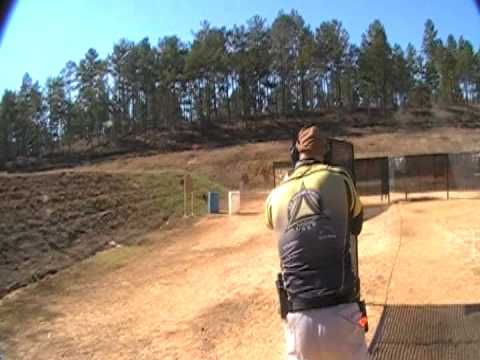
The video clip below (not from ShootingUSA) shows Erik Lund’s Stage 5-winning performance at the 2008 Fort Benning 3-Gun Challenge.
February 11th, 2009
On the ShootingUSA television show, today’s episode will feature the Infantry Team Match at Camp Perry. In connection with that segment, Sgt. First Class Kyle Ward of the U.S. Army Marksmanship provides guideslines on how to properly fit a shooting sling, and how to best use the sling in various shooting positions.
CLICK HERE to read Sgt. Ward’s step by step Sling Instructions.


|
Proper Sling Adjustment
Once the sling is linked together properly, Sgt. Ward explains: “The next step is attaching the sling to your arm. Attaching the sling to your arm is simply done by creating slack in the sling, turning the sling a quarter turn clockwise if you’re a right handed shooter, or a quarter turn counter clockwise if you’re a lefty. You know that your sling is set to the proper length when you can easily and comfortably get into position, when you can take your firing hand off the rifle, and the rifle remains in your shoulder. To get the most of your sling, setting it to its proper length, and where you place it on your arm is critical. There are some general rules to follow when setting up your sling. You want it tight enough that it’s providing maximum support, but not so tight that you have to fight to get it into position.
Proper Sling Placement
Sling placement on your arm is also critical. In the sitting position, you want to place the sling toward the inside of the arm. Place the sling too far to the outside, and it will likely introduce pulse into your position. It’s not uncommon to have to adjust the length of the sling for different firing positions. While using the sling in the prone position, you should place the sling in the outside of the arm. Placing the sling too far towards the inside will reduce the sling’s effectiveness and likely generate pulse.
Try these techniques the next time you’re on the rifle range. Proper use of the leather sling will definitely increase you scores, and decrease the amount of perceived movement when looking through the sights.” |
August 18th, 2008
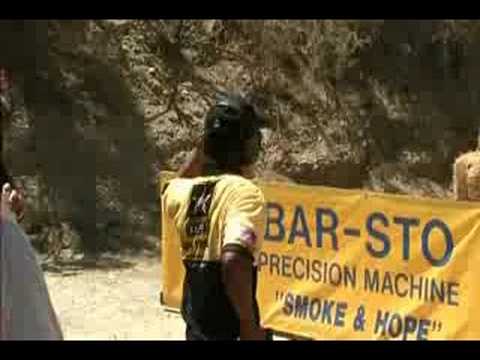
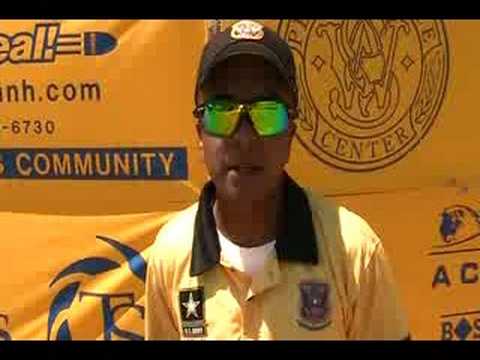
Army Specialist K. C. Eusebio of the United States Army Marksmanship Unit (USAMU) edged out B. J. Norris to win his second Steel Challenge World Speed Shooting title in Piru, California. Eusebio finished with a record time of 79.16. K.C. first won the Steel Challenge while still in High School — an amazing performance for such a young shooter. K.C. has set speed-records for many of the Steel Challenge’s stages, including “Smoke & Hope” shown in the video. Eusebio’s win is the third time an Army Marksmanship Unit member has taken the title in the past four years. Staff Sergeant Max Michel took the title in 2005 and 2007. Below is exclusive video taken by AccurateShooter.com at the Steel Challenge on August 16.
CLICK HERE or on screen to WATCH VIDEO.
In the women’s division Kay Clark-Miculek took her seventh Women’s Steel Challenge title with a time of 105.85. Miculek now has twice as many titles as any other female shooter. In the Limited Category, Phil Strader of the US Shooting Academy’s 93.49 time was good enough to defeat 2006 World Champion JJ Racaza by just over 9 tenths of a second.
July 28th, 2008

The 2008 Interservice Rifle Match was held recently in Quantico, Virginia. Shooters of the U.S. Army Marksmanship Unit (USAMU) won EVERY team match of the competition. More than 125 shooters from the Army, Navy, Marine Corps, Reserve and National Guard competed in the rifle championships at Quantico Marine Corps Base.
 The Army Marksmanship Service Rifle Team won the prestigious Interservice Rifle 10-Man Team Match, winning the Service Rifle Interservice Championship Trophy. Team coaches were Sgt. Walter E. Craig Jr. and Sgt. 1st Class Emil Praslick III. Shooters were Sgts. 1st Class Lance D. Dement, Grant L. Singley and Kyle A. Ward, Staff Sgts. Joel S. Micholick and Tobie L. Tomlinson, Sgt. Brandon K. Green, Spcs. Tyrel L. Cooper, Calvin G. Roberts, Matthew T. Sigrist and Nathan J. Verbickas. Ward shot highest score of 495 points out of a possible 500. The Army Marksmanship Service Rifle Team won the prestigious Interservice Rifle 10-Man Team Match, winning the Service Rifle Interservice Championship Trophy. Team coaches were Sgt. Walter E. Craig Jr. and Sgt. 1st Class Emil Praslick III. Shooters were Sgts. 1st Class Lance D. Dement, Grant L. Singley and Kyle A. Ward, Staff Sgts. Joel S. Micholick and Tobie L. Tomlinson, Sgt. Brandon K. Green, Spcs. Tyrel L. Cooper, Calvin G. Roberts, Matthew T. Sigrist and Nathan J. Verbickas. Ward shot highest score of 495 points out of a possible 500.
The USAMU Team coached by Praslick beat 12 teams to win the Marine Corps Infantry Trophy Team Match. Team shooters were Cooper, Dement, Green, Pace, Singley and Ward. A second USAMU team coached by Tomlinson took second place.
ARs and 6.5×284 Bolt Guns for Long Range
In the 1,000-Yard Team Match, Praslick’s team won in the Any Rifle Any Sights Division by 52 points. Staff Sgt. Daniel J. Peters captained the team made up of Cooper, Green, Tomlinson, Dement, Roberts and Pfc. Sherri Jo Hurd. In the long-range matches, USAMU soldiers shoot modified M-16A2 rifles and the 6.5×284 match rifles with scopes or iron sights to hit a 10-inch X-ring target from the prone position at 800, 900 and 1,000 yards.
The USAMU also took home some individual trophies as well. Green won the Interservice Long Range Championship in the Any Rifle Category and Sigrist took the Service Rifle Category. Green was the winner in the Interservice 1,000-Yard Match. In the 600-Yard Match, Dement won the Any Sight Category while Craig won the Service Rifle Category.
|


