|
|
July 9th, 2017
Richard Franklin (who operated Richard’s Custom Rifles prior to his retirement), has built scores of varmint rifles, in many different calibers. One of Richard’s all-time favorite varmint rifles is a 14-twist, 22BR built on his model 11 stock in laminated Black Walnut and fiddleback maple. Richard says the rifle is versatile and deadly accurate out to 400 yards. Richard uses a Leupold 8.5-25x50mm LRT with varmint reticle.

“This is my light walking varminter. It’s built on a blueprinted SS Remington 700 short action and chambered as a no-turn 22 BR for Lapua brass. The bolt handle is a Dave Kiff replacement and I’ve fitted a Jewel BR trigger with bottom safety. Barrel is a Lilja, 1:14″ # 6 contour with a muzzle diameter of .750″. I shoot the 40gr V-Max in the rifle at 4000 FPS. Its tough on hogs if you don’t try them too far. 400 yards is about the max with it. Accuracy is outstanding and with Roy, Mike, my grandson and myself shooting this rifle I don’t believe it has missed more than 3 hogs out of over 100 shot at this summer. This rifle is carried in a ceiling rack in the truck where its handy and is used by the first person that grabs it when a hog is sighted if we are moving between setups. The Varmint reticle on the Leupold is nice for quick hold-overs as you change distances.”

Detail of Model 11 Stock (Different Rifle in Birdseye Maple)

22BR Rivals 22-250 Performance
With bullets in the 40gr to 60gr weight range, the 22BR gives up very little in velocity to a 22-250, despite burning quite a bit less powder (30-32 grains for the 22BR vs. 35-38 grains for the 22-250). With a match-quality chamber, the 22BR will probably have an edge in accuracy over a 22-250, and you should experience longer barrel life. Here are some recommended 22BR loads for 40-60gr bullets:

For more info on the 22BR for varminting, read our 22BR Cartridge Guide
April 1st, 2017

In the world of varmint cartridges, it’s all about speed. Higher velocity delivers flatter trajectories, and more dramatic impacts on critters. To achieve higher speeds, handloaders have experimented with many extreme wildcats — big cases necked down to a smaller calibers. Here we present what may be the most extreme wildcat cartridge of all, the .17 Incinerator — a .50 BMG necked down to .17 caliber. Created by Ammo-One, a custom cartridge company, the .17 Incinerator offers blistering performance. The special lathe-turned 33gr projectiles* exit the barrel at 5883 Feet Per Second — that’s over Mach 5, five times the speed of sound.
Mach 5 is 3836.35 mph at sea level, which equates to 5626.64 Feet Per Second (FPS). The remarkable .17 Incinerator achieves this stunning velocity by burning over 230 grains of powder in a highly modified .50 BMG case. The velocity of this cartridge (still well over Mach 5 at 100 yards) delivers an incredible amount of energy on target. A hit literally vaporizes a varmint, as you can see from the image below.

For more dramatic varmint images, visit www.FogAmmo.com.
It takes a special barrel to shoot the .17 Incinerator. Kent Wilson of Ammo-One, who helped develop this extreme wildcat, explains: “The speeds are so great we had to use a custom 3-groove, polygonal-rifling 1:20″-twist barrel to keep the bullets from disintegrating on launch. The polygonal land/groove geometry reduces bullet engraving, which also helps keep the bullets in one piece. Also we must use solids — regular jacketed bullets can’t handle these speeds”.
Even More Speed — the .17 Incinerator Improved
While the .17 Incinerator is commercially available, there is an even more extreme “Improved” version of this case, with a radical 50-degree shoulder that yields even greater case capacity. The .17 Incinerator Improved (17 IN-IMP), shown below, can hold 20 grains more powder, promising velocities approaching Mach 5.5 or 6189.3 FPS. Now that’s really cookin’!

*Because of the ultra-high velocity generated by the .17 Incinerator, solid bullets must be used. Conventional jacketed projectiles would disintegrate before they reached the target.
January 23rd, 2017

At the request of our readers, we provide select “Deals of the Week”. Every Monday morning we offer our Best Bargain selections. Here are some of the best deals on firearms, hardware, reloading components, and shooting accessories. Be aware that sale prices are subject to change, and once clearance inventory is sold, it’s gone for good. You snooze you lose.
1. Natchez — Special 5 Reloading Press Kit, $199.99
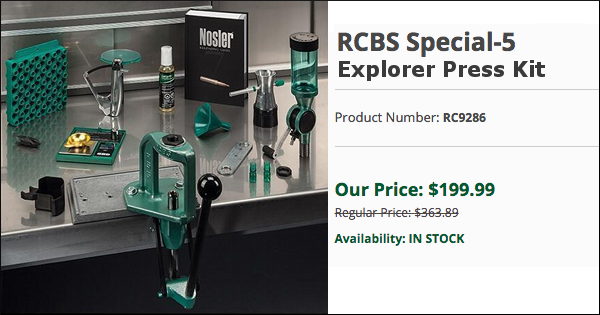
This RCBS Kit has everything a new reloader needs: single-stage press, powder measure, scale, powder trickler, priming tool, cartridge tray, “rocket” chamfer tool, case lube and more. This is an excellent entry-level reloading kit, on sale for just $199.99 at Natchez Shooters Supplies. We like the relatively compact Special 5 press for most reloading duties. Eventually you may want to add an additional, large heavy press, but this will get the job done. For the combined package, with all the tools one needs to hand-load quality ammo — this is a stunningly good deal at $199.99.
2. Powder Valley — Reloder 16 Powder, 1-pound and 8-pound

Powder Valley now has Alliant Reloder 16 (RL16) in stock in both 1-lb ($23.95) and 8-lb ($178.95) containers. If you’re not familiar with this relatively new propellant, we can tell you that RL16 may be the best replacement yet for hard-to-find Hodgdon H4350. Burn rate is very similar to H4350, and RL16 is extremely temp-stable. Most importantly, our Forum members are reporting outstanding accuracy with Reloder 16. It is well suited for mid-sized cartridges such as 6XC, 6mm Creedmoor, 6.5 Creedmoor, 6.5×47 Lapua, and .260 Remington. If you like H4350, we recommend you try a pound of Alliant’s impressive Reloder 16.
3. EuroOptic.com — Tikka T3 Liquidation Sale, Huge Discounts

Looking for a great price on an excellent hunting rifle? Here is the Tikka Deal of the Decade. EuroOptic.com has received nearly 3,500 Tikka T3 rifles, which will be sold at deep discounts as part of an inventory clearance program by Beretta, Tikka’s parent company. The Tikka T3 is a good, stout rifle with a smooth action, crisp trigger, and quality barrel. Accuracy is typically well under 1 MOA (for three shots). T3 barreled actions also are a good “core” for a tactical build. The strong T3 action handles detachable magazines, and fits a variety of third-party stocks.
4. Amazon — Discovery Scope Level $13-$16 (1″, 30mm, 34mm)

If you shoot long range, you need a scope level. This Discovery scope level is fully CNC-machined to close tolerances for a good fit. It is available with three inner diameters to fit scopes with 1″, 30mm, or 34mm main tubes. The 1″ version is just $12.95 while the 30mm model is $13.95 and the large 34mm version is $15.95. You could easily pay $35.00 or more for a 30mm scope level. Purchasers have praised this product: 89% of verified buyers rated this five stars.
5. CDNN Sports — Savage 17 WSM B.MAG Sporter, $289.99

Our friend Eric, Editor of Varminter.com, says the 17 WSM is probably his favorite rimfire option for small varmints. The modern Winchester Super Magnum Rimfire (WSM) cartridge is accurate, and it flies faster and hits harder than the 17 HMR. Right now you can get a nice Savage B.MAG rifle chambered in 17 WSM for just $289.99 at CDNN Sports. This rimfire rifle boasts features typically reserved for centerfire rifles. In order to maximize acuracy, Savage offers a thread-in barrel headspacing system, rear-locking lugs, and cock-on-close bolt.
6. Midsouth — Complete Case Tumbling Kit, $73.70

This brass tumbling system contains everything you need to clean your cartridge brass: Vibratory Case Tumbler, Rotary Media Separator, 6 lbs. of Corn Cob Media, and 8 oz. of Brass Polish. Right now this whole system is on sale at Midsouth for just $73.70. The case tumbler, which holds 450 .223 Rem cases or 1000 9mm cases, has a three-year motor warranty. This is a good deal for the package. You could pay $65.00 for a good vibratory Tumbler by itself.
7. Bullets.com — Norma .22LR Ammo (Match 22 & Tac 22)

Need quality .22 LR rimfire ammo at an affordable price? Consider Norma. Most folks think Norma only produces centerfire ammo and cartridge brass. As a result, people haven’t been looking for Norma rimfire ammo. Their loss is your gain. Accurate, reliable Norma .22 LR ammunition is in-stock right now at leading online vendors. This is good quality ammo, made in Europe. Bullets.com has Norma Tac-22 ammo in stock at $5.25 per 50-rd box (SKU: BL7819). In addition, Bullets.com offers Norma Match-22 ammunition at $7.50 per 50-rd box (SKU: BL11887).
8. Midsouth — Lyman Bleacher Loading Blocks

Lyman’s new Bleacher Block stepped cartridge holders are great. Use the different levels for sorting brass. Or, migrate the brass from top to bottom as you proceed through case prep stages. Made of durable polymer, Bleacher Blocks are molded in three sizes. The smallest size (with 0.388″-diam holes) fits .223 Rem-size case heads. The middle size (with 0.485″-diam holes) fits .308 Win-size case heads. The biggest Bleacher Block has 0.565″-diameter recesses for magnum-size cases. All three cartridge block sizes hold fifty (50) rounds. Purchase any size for just $5.90 per Block at Midsouth.
August 4th, 2016

The Burris Eliminator III is an impressive piece of electro-optical technology. With a push of a button, a built-in laser rangefinder senses the distance to your target and the Eliminator’s microprocessor instantly calculates the required hold-over based on your load’s ballistics. The calculated aiming point is then displayed in the reticle with an illuminated red dot on the vertical cross-hair. Just put the bright red dot on the target and make the shot. We’ve used this scope out to 600 yards on small steel targets and it worked flawlessly.

If you ever wanted to get one of these advanced scopes for your next hunt or prarie dog safari, now is a great time to buy. Burris is now offering $100 off Burris Eliminators: “Our most popular rebate ever has returned for 2016, so if you missed out last year, this time you’ve got no excuses.” Eliminator III LaserScopes (Item # 200116 or 200120) purchased between August 1st and December 31st, are eligible for a $100 mail-in rebate. CLICK HERE for Rebate Form and Full Instructions.

To Receive Your Rebate:
Fill out the coupon with your name and shipping address and send proof of purchase the original UPC barcode from box and a copy of your sales receipt to:
Burris 2015 Eliminator III Rebate
MPS Dept. No. 446 – ELIMINATOR
P.O. Box 3250
Cinnaminson, NJ 08077
July 22nd, 2016

Now there is a new type of “lead-free” rimfire ammo that can be used in areas where lead is prohibited. CCI’s new .22 LR Copper-22 ammunition features hollow-point bullets made from a compressed copper + polymer matrix. This is a speedy round — Muzzle Velocity (MV) is a blistering 1850 FPS, very fast for a .22 LR round. CCI claims accuracy is excellent. We look forward to testing this new Copper-22 rimfire ammo to confirm CCI’s speed and accuracy claims. Running at 1850 FPS, this looks like it could be a very effective varmint round.
Copper-22 Ammo Features & Benefits:
- Non-lead bullet suited for plinking, target-shooting and small game hunting.
- 21-grain hollow-point bullet, with compressed copper-polymer construction.
- Legal to use in California and other zones where lead is prohibited.
- 1,850 FPS muzzle velocity with excellent accuracy.
The Copper-22 projectile is constructed from a unique mix of copper particles and polymer compressed into a potent, 21-grain bullet. This non-lead bullet is suited for plinking, target-shooting and small game hunting. Shipments of this Copper-22 ammo (CCI part No. 925CC) are now being delivered to dealers. For more info, visit www.cci-ammunition.com.
June 11th, 2016

Barrel-maker Dan Lilja’s website has an excellent FAQ page that contains a wealth of useful information. On the Lilja FAQ Page as you’ll find informed answers to many commonly-asked questions. For example, Dan’s FAQ addresses the question of barrel life. Dan looks at factors that affect barrel longevity, and provides some predictions for barrel life, based on caliber, chambering, and intended use.
Dan cautions that “Predicting barrel life is a complicated, highly variable subject — there is not a simple answer. Signs of accurate barrel life on the wane are increased copper fouling, lengthened throat depth, and decreased accuracy.” Dan also notes that barrels can wear prematurely from heat: “Any fast varmint-type cartridge can burn out a barrel in just a few hundred rounds if those rounds are shot one after another without letting the barrel cool between groups.”
Q. What Barrel Life, in number of rounds fired, can I expect from my new barrel?
A: That is a good question, asked often by our customers. But again there is not a simple answer. In my opinion there are two distinct types of barrel life. Accurate barrel life is probably the type most of us are referencing when we ask the question. But there is also absolute barrel life too. That is the point where a barrel will no longer stabilize a bullet and accuracy is wild. The benchrest shooter and to a lesser extent other target shooters are looking at accurate barrel life only when asking this question. To a benchrest shooter firing in matches where group size is the only measure of precision, accuracy is everything. But to a score shooter firing at a target, or bull, that is larger than the potential group size of the rifle, it is less important. And to the varmint hunter shooting prairie dog-size animals, the difference between a .25 MOA rifle or one that has dropped in accuracy to .5 MOA may not be noticeable in the field.
The big enemy to barrel life is heat. A barrel looses most of its accuracy due to erosion of the throat area of the barrel. Although wear on the crown from cleaning can cause problems too. The throat erosion is accelerated by heat. Any fast varmint-type cartridge can burn out a barrel in just a few hundred rounds if those rounds are shot one after another without letting the barrel cool between groups. A cartridge burning less powder will last longer or increasing the bore size for a given powder volume helps too. For example a .243 Winchester and a .308 Winchester both are based on the same case but the .308 will last longer because it has a larger bore.
And stainless steel barrels will last longer than chrome-moly barrels. This is due to the ability of stainless steel to resist heat erosion better than the chrome-moly steel.
Barrel Life Guidelines by Caliber and Cartridge Type
As a very rough rule of thumb I would say that with cartridges of .222 Remington size you could expect an accurate barrel life of 3000-4000 rounds. And varmint-type accuracy should be quite a bit longer than this.
For medium-size cartridges, such as the .308 Winchester, 7×57 and even the 25-06, 2000-3000 rounds of accurate life is reasonable.
Hot .224 caliber-type cartridges will not do as well, and 1000-2500 rounds is to be expected.
Bigger magnum hunting-type rounds will shoot from 1500-3000 accurate rounds. But the bigger 30-378 Weatherby types won’t do as well, being closer to the 1500-round figure.
These numbers are based on the use of stainless steel barrels. For chrome-moly barrels I would reduce these by roughly 20%.
The .17 and .50 calibers are rules unto themselves and I’m pressed to predict a figure.
The best life can be expected from the 22 long rifle (.22 LR) barrels with 5000-10,000 accurate rounds to be expected. We have in our shop one our drop-in Anschutz barrels that has 200,000 rounds through it and the shooter, a competitive small-bore shooter reported that it had just quit shooting.
Remember that predicting barrel life is a complicated, highly variable subject. You are the best judge of this with your particular barrel. Signs of accurate barrel life on the wane are increased copper fouling, lengthened throat depth, and decreased accuracy.

Benchrest Barrel Life — You May Be Surprised
I thought it might be interesting to point out a few exceptional Aggregates that I’ve fired with 6PPC benchrest rifles with barrels that had thousands of rounds through them. I know benchrest shooters that would never fire barrels with over 1500 shots fired in them in registered benchrest matches.
I fired my smallest 100-yard 5-shot Aggregate ever in 1992 at a registered benchrest match in Lewiston, Idaho. It was a .1558″ aggregate fired in the Heavy Varmint class. And that barrel had about 2100 rounds through it at the time.

Another good aggregate was fired at the 1997 NBRSA Nationals in Phoenix, Arizona during the 200-yard Light Varmint event. I placed second at this yardage with a 6PPC barrel that had over 2700 rounds through it at the time. I retired this barrel after that match because it had started to copper-foul quite a bit. But accuracy was still good.

May 5th, 2016

 Never had a chance to hunt prairie dogs in the American west? Then check out this video. Dan Eigen (aka “Walleye Dan”), host of the We Love It Outdoors Television series, head to South Dakota for some varmint hunting. Dan teams up with Varmint Hunter Association President Jeff Rheborg to patrol some South Dakota Dogtowns where things get serious. In the video, you’ll see p-dog hits at distances from 70 yards to roughly 450 yards. The hunters were shooting from portable, wood-topped swivel rests, using AR-platform rifles on X-type sandbag rest. (Rifle zeroing session is shown at the 5:30+ mark.) Never had a chance to hunt prairie dogs in the American west? Then check out this video. Dan Eigen (aka “Walleye Dan”), host of the We Love It Outdoors Television series, head to South Dakota for some varmint hunting. Dan teams up with Varmint Hunter Association President Jeff Rheborg to patrol some South Dakota Dogtowns where things get serious. In the video, you’ll see p-dog hits at distances from 70 yards to roughly 450 yards. The hunters were shooting from portable, wood-topped swivel rests, using AR-platform rifles on X-type sandbag rest. (Rifle zeroing session is shown at the 5:30+ mark.)
Multiple cameras were employed so you can see both the shooter’s POV and close-ups of the prairie dogs downrange. Watch the shooters having fun with a prairie dog cut-out and some Tannerite at the 9:00-minute mark. This guys are having a grand old time sending critters to Prairie Dog Heaven — we think you’ll enjoy the video.
Prairie Dog Hunting Starts at 2:00 Time-Mark in Video:
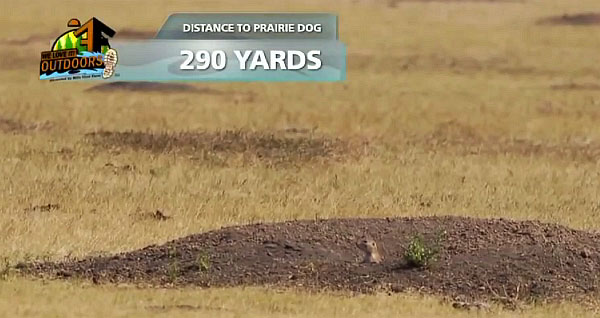

NOTE: This video actually covers three sequences: 1) Three-gun training; 2) Prairie Dog Hunting; and 3) Coyote Hunting. We’ve embedded the video so it plays back the Prairie Dog segment from 2:00 to 15:15. If you wish, you can slide the controls forward or back to watch the other segments.
Video found by EdLongrange. We welcome reader submissions.
May 2nd, 2016
Will you be heading to the varmint fields this summer? Proper planning is key to a safe, satisfying, and productive varmint holiday. Of course you’ll be busy reloading, but you should make a check-list of all the gear and supplies you need. Bring a variety of rifles if possible — you’ll need to switch off as one barrel gets hot, and the chambering that works best for your close shots may not be ideal for those longer shots out past 400 yards. Here are some tips from our Forum members that can help you shoot more effectively, and avoid problems on your varmint hunt. Here’s one key tip: at your shooting station, put a strip of surveyor’s tape on a tall stake to show the wind direction. Then shoot in the direction the wind blows. This will minimize the effect of cross-winds.

From PatchHound: “The gear you bring will make or break a trip out to Prairie Dog land. A lot has to do with where you going and how far you are from [civilization]. For starters, bring lots of water. It will be hot in Wyoming in a few more weeks but it don’t hurt to bring warm clothes in case it snows. It’s best to wear leather boots unless you’re real good at dodging cactus while walking around. Good sunsceen will save the day too. [What you need to bring] really depends on whether you’re shooting on some friendly ranch or 100 miles in the middle of [a wilderness area]. Good survival gear is a good thing to have for the latter!”
From Stoner25mkiv: “I’d suggest an adjustable bipod if you are going to do any walking. A laser rangefinder is a huge asset. Have a fanny pack or backpack for extra ammo, water, bore-snake, etc. when you go on your walkabouts. We also take a couple pivoting benches, heavy movers’ pad/blanket, sandbags (Uncle Bud’s Bulls Bag) for shooting from near the vehicle. Boonie hat for blocking the sun, sun glasses, sunscreen. High leather boots.

Anyway, on to the rifles…consider bringing a 17 HMR, .223 Ackley bolt gun, .223 Ackley AR, and a 243 WSSM. Some years the 17 HMR isn’t removed from its case. We had a couple windless days and the 17 was lots of fun. I’d walk into the dogtown and then lay down and wait. After five minutes or so I’d have dogs within easy rimfire range, and out to as far as I’d care to stretch the rimfire. 275 yards was about it.”
From CTShooter: “The .204 [Ruger] is a laser beam and good to 400 yards easy. Forget the rimfire! Do you have a portable bench that pivots? Bring bipod, binocs. Bring a LOT of water. I have a milspec sniper shooter’s mat/drag bag with shoulder straps. It is good to carry everything when you want to wander off and shoot prone with bipod. Here’s a view through my 6BR in ND.”

From RJinTexas: “In most of the locations that we’ll be shooting we’ll usually set up a minimum of 200 yards from the edge of a major dog town. We’ll start by working over the close-in dogs and shooting our way out, some of these towns may run in excess of 500/600 yards deep. I believe that a rimfire will put you at a distinct disadvantage. The only rimfire that will somewhat work is the 17 HMR and you can reload for your 204s for close to the cost of HMR ammo and you’ll be less apt to be under-gunned. Your 204 will work well out to 300/400 yards unless the wind is blowing hard. We classify a 10-mph crosswind as a very calm day and what makes it a little more challenging is that it is usually also gusting. I only took my 17 HMR once, I’ve since even quit taking my 17 Mach IV because when the wind blows hard it range is limited to around 200 yards. Gusting wind will play havoc with 25gr pills.”
 From Wes (P1ZombieKiller): “[For my first PD trip] there are so many things I was not ready for. The one thing that I did bring (that no one told me about) was a canopy. I’m glad I did. Even though the weather was [near perfect], I know that sun can humble you real fast. With my pop-up canopy, I could shoot all day without getting killed by the sun. You had to tie the canopy down real well or the wind would blow it across the pasture. From Wes (P1ZombieKiller): “[For my first PD trip] there are so many things I was not ready for. The one thing that I did bring (that no one told me about) was a canopy. I’m glad I did. Even though the weather was [near perfect], I know that sun can humble you real fast. With my pop-up canopy, I could shoot all day without getting killed by the sun. You had to tie the canopy down real well or the wind would blow it across the pasture.
We sat on shooting benches that pivot 360°, and are fast and easy to set up. Most all shots were 175-250 yards. I just felt comfortable at that range. It was more fun for me to be able to film the hits, and the camcorder I was using just did not get good video past 350 yards. The digital zoom distorted the image too much. I knew I would only get this one chance to film my first P-dog outing, and I wanted to get it on film for [posterity].” To learn more about P1’s first Prairie Dog Trip, visit his Website.
March 14th, 2016

No doubt you’ve heard the term “reticle” before, but it probably brings to mind the cross-hair you see through a rifle-scope. This term “reticle” can also describe an optical aid used to score targets. This story discusses a new scoring reticle with precisely-defined circles etched on clear plexiglass. This scoring reticle (as attached to a magnifying crystal) is used to determine whether bullet holes fall inside or outside the scoring circles on targets. This unique new scoring reticle allows match scorers to “equalize” the shot placements of all popular calibers from .204 up to .308. This way, there’s a “level playing field” for all calibers, and any caliber rifle can compete on an equal basis with the 30s.
New ‘Equalizer’ VFS Scoring Reticle
by Ron Goodger
The ubiquitous controversy over the advantage of larger caliber bullets in VFS (Varmint for Score) matches still rages, but there is a simple solution that is being embraced by all to whom I have shown it. The concept is simple, and it accomplishes the same thing the UBR (Ultimate Benchrest) targets do with the advantage that it can be used on any target a club happens to have on hand.
I had heard shooters complain about the advantage that larger calibers have many times and wish there was a fair way to score targets that would level the playing field for all calibers. The UBR concept came along and I read up on it. When a match was held close enough that I could enter, I did so and observed first hand what it was all about. The UBR targets essentially make the distance from the bullet hole center to the scoring ring edge the same for each caliber by using different-sized rings on the caliber-specific targets. After seeing the accompanying disadvantages of using this method (the chief one being the large number of targets required by UBR rules and the resulting increased time required to hold a match), I began searching for a simpler way to accomplish the same thing. I was aware of a number of mid-West clubs wanting to make scoring fair but unwilling to use the UBR method because of the disadvantages.

I came up with an idea late in 2015 and designed a scoring reticle that would do the job. The following diagrams graphically explain how UBR and my scoring reticle accomplish the same thing. The illustration above shows how different caliber bullets hitting the same center point of impact will each just score the 10 ring edge on the different-sized, caliber-specific UBR 10 Rings . It is clear that it is the distance from the center of the bullet to the scoring ring that is made uniform by the different 10 Ring sizes.

The illustration below shows how my VFS scoring reticle accomplishes the same thing by scoring every shot with an .308-equivalent ring that circumscribes the inner caliber-specific ring. The dotted line shows that the center of each bullet hits the same distance from the edge of the scoring ring. It is clear that, using current VFS scoring techniques, the .224, .243, and .257 bullets would score misses. However, scoring each bullet with the .308 ring around the hole illustrates that all calibers would be scored the same.
Scoring Reticle Converts Any Caliber Shot to a .308-Equivalent Hole

The above photo of an IBS 100-yard target has a 6mm hole that is clearly a nine (9), using current scoring methods. But consider that, if a .308 bullet from a 30 BR hit in the very same location, that .30-caliber shot would score in the Ten Ring. Why should the 6mm bullet, whose center was just as close to the middle of the target, be penalized because of the bullet diameter? The image on the right shows the scoring reticle with the 6mm scoring ring centered on this hole. With this scoring reticle, the .308 ring around the 6mm hole clearly scores the 10 Ring, just as a 30-caliber bullet centered in the same spot would do. That is as fair as it can get.

The above image (two shots per frame) from a Hillsdale Michigan varmint target has two 6mm holes that scored a 16. Score values are 10 points for a shot in the white, 5 points for a shot in the orange, and 1 point for hitting the center dot. This was a match that had 30BRs shooting in it. The next photo shows how scoring this frame with the VFS reticle would have resulted in a 21 because the left side of the reticle’s .308 circle just extends into the 10-point white bulls-eye region. So, in effect, there were two (2) shots in the white for 2×10 points (based on the .308 equalizer effect of the reticle). This shows how the reticle will level the VFS playing field regardless of what target is being used.
VFS Scoring Reticle Features and Specifications
The 6mm circles have been placed in the center of the reticle because it is expected to be the most commonly-used caliber, and that makes it easier to see in the crystal. Any of the ring sets can be used for a .308. The sizes of the circles are guaranteed accurate to within .001″ on the outside edge of the circle by the reticle’s manufacturer. I have found the best magnifier crystal to use is a genuine Badash crystal that measures 3.25″ in diameter. They are available from several eBay sellers and are easily attached using a piece of packing tape about 3/4-inch wide around the edge of the reticle (visible on the crystal in the lower part of the photo). That makes the Plexiglas reticles easy to replace in the event they become scratched up from frequent use.
A number of Midwest rifle clubs have already purchased these scoring reticles. The Plexiglas reticles are available for $15.00 each plus $2.04 shipping from the author (does not include the crystal). Email him at LRGoodger [at] gmail dot com for more information.
December 2nd, 2015

Want something more interesting than black-on-white bullseye targets? Champion Targets recently released a new series of game-theme targets. You can blast aerial drones, hunt dinosaurs, play a game of “H-O-R-S-E”, or shoot ducks in a Carnival Shooting Gallery. These new targets, which cost $7.49 per 12-pack, make great Christmas Gifts for the younger shooters in your family. What kid wouldn’t like a Dinosaur Target? And “kids of all ages” can enjoy the Shooting Gallery and Junkyard Plinker targets. The Know Your Limits target is good for tactical practice. These targets are available now from major retailers such as Amazon.com and OpticsPlanet.com.


In addition to these new game-theme fun targets, Champion offers a wide selection of conventional targets, including (left to right below) VisiColor (Impact Halo) Targets, Varmint Targets, NRA Targets, and Sight-In Targets. Champion also sells Hi-Viz Adhesive (stick-on) Target Dots.

|


