When we first ran this story a couple years ago, it proved immensely popular with our readers. In case you missed it the first time around, check out what can be done with a factory Savage 110 BA at extreme long range — 1760 yards (one mile). Shooter Mark Dalzell did a great job with the video, which features multiple camera views so you can see the shooter and the target at the same time. Enjoy!
This video by Mark Dalzell demonstrates the long-range capabilities of the Savage 110 BA chambered in .338 Lapua Magnum. Mark took his “BadAss” rig out to the southwest Nevada desert just north of Jean Dry Lakes. He placed a 2’x3′ target way, way out there — a full mile (1760 yards) away. At that range, flight time to target was 3.75 seconds! Sighting with a Nightforce 5-22x50mm NXS scope, Mark needed a few shots to get on target, but eventually made multiple hits, using 67 MOA of elevation and 2.25 MOA left windage. You can view the hits starting at 1:56 time-mark on the video. (Mark had a second camera set up closer to the target — this displays frame in frame in the video, and if you watch carefully you can see the strikes.) The ammo was HSM 250gr HPBT match with a 3.600″ COAL. The shooting was done at 8:13 in the morning, with clear conditions, very light winds. Temp was 57°, humidity 24.5, Density Altitude 3666. Video soundtrack is La Grange by ZZ Top.
PLAY BUTTON
LISTEN TO MARK TALK about One Mile Shooting:
CLICK Play Button to hear Mark Dalzell TALK about his .338 LM Savage 110 BA and how he scored hits at 1760 yards.
Good Shooting Mark. That’s darn good for a factory rifle. You also had the elevation dialed in real close before the firing started! That shows a good knowledge of your ammo’s long-range ballistics. We also noticed how effective that muzzle brake was. Recoil looked about the same as an un-braked .308 Win.
If you thought Mark’s 1760-yard shooting was impressive, Mark has produced another video that shows a session at even greater distances — out to 2300 yards. Watch Mark Dalzell Shoot at 2300 Yards.
PrecisionRifleBlog.com recently reviewed several video-based rifle training DVD sets. While instructional DVDs will never replace live “hands-on” training, they can be cost-effective ways to sharpen your skills. Watched periodically, these training DVDs can help reinforce the fundamentals.
PRB’s Editor Cal Zant has purchased several rifle training DVDs over the years. His recent Precision Rifle Blog DVD review looks at four different options:
Long Range Made Easy, Two-Volume Set, from Accuracy 1st The Art Of The Precision Rifle, with Todd Hodnett (Magpul Dynamics) Putting Rounds On Target, with Bryan Litz (Applied Ballistics) Rifles Only — Precision Rifle Instructional DVDs, with Jacob Bynum
Cal reports that each of these four titles offers a slightly different approach, with each instructor displaying his own focus, based on his background and expertise.
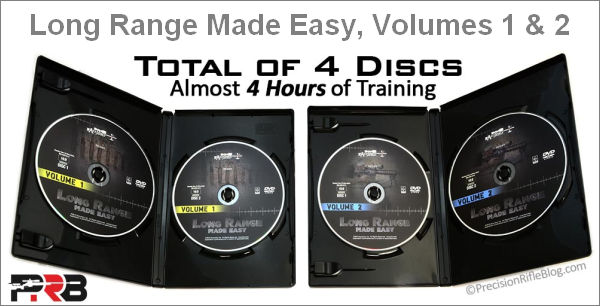
Accuracy 1st’s Long Range Made Easy Two-Volume Set seemed to win PRB’s Editor’s Choice Award. The tagline on the DVD is: “Go from basic to advanced with the guy that has trained our best military snipers for the past 10 years.” That’s a pretty good description. Todd Hodnett is the primary instructor, and Bryan Litz joins him in several segments.
It’s the best of both worlds. Todd Hodnett’s pragmatic “the-bullet-cannot-lie” approach (field-proven by hundreds of the world’s best snipers), is combined with Bryan Litz’s engineering approach and vast knowledge of external ballistics verified with carefully recorded live-fire experiments. The two styles complement each other well, and provide an extremely well-rounded and comprehensive overview.
The DVD set is split into two volumes, each of which includes two discs. All together there are almost four hours of instruction from the most respected guys in the industry. And they cover a lot of ground — you’d never be able to cover this much in a one- or two-day live class. Plus with the DVD you can easily repeat an important point, and watch the whole program more than once.
Cal paid $76.95 out-of-pocket for the Long Range Made Easy, Vol. 1 & 2 Bundle, so his review wasn’t a paid advertisement. He thought this set provides a ton of value, and could help a lot of shooters. Here are key topics covered in Long Range Made Easy:
■ Advice for Gear Purchases
■ Optimal Gun Setup
■ Technique for Position
■ Simple & Quick Wind Formula
■ Using the Applied Ballistics Kestrel
■ Truing Ballistic Algorithms, Drag Scale Factoring, and Custom Drag Models
■ WEZ Analysis
■ Wind Course
If you’re new to the long range game, or you’ve been doing it for a few years and want to learn directly from some of the most sought-after instructors in the world, then check out Cal’s write-up over at PrecisionRifleBlog.com. CLICK HERE for PRB Review of Training DVDs.
Today, September 24th, is National Hunting and Fishing Day. To help mark that event, we’re reprising a story from Europe that showcases the beauty of nature that can be experienced on a hunting trip.
If you need a break from your hum-drum day at the office, how about taking a virtual vacation to Norway, where you can explore the scenic mountains in the Fjord region?
Forum member Kenneth Skorpen (aka “Sal”) has created a cool video of a deer-hunting trip he took in Norway. He didn’t bag a buck on this trip, but the walk in the Fjordland mountains took Kenneth through some spectacular scenery. (At the 11:25 time mark you’ll see an amazing sunset over the Fjord.) Kenneth did encounter a doe that had fallen down the mountain, and apparently broken its neck (14:35 time mark). The terrain is very steep, and Kenneth observed that: “I feel fortunate to be able to do this, but I also feel very tired in my legs. Did you know that the hares around here have shorter left legs due to the steep hills?”
More Hunting/Shooting Videos from Norway
You can watch more interesting hunting and shooting videos from Norway on Kenneth Skorpen’s Streken Vertebrae YouTube Channel. Here are some links:
And here is another Skorpen video showcasing beautiful Norwegian landscapes. This was filmed during a February rifle testing session with targets at 1100 and 1400 meters. You’ll see some stunning snow-capped scenery here, starting at the 4:30 time mark.
Here’s a very cool 3D Animation showing pistol rounds being fired. Computer-generated graphics provide a look inside the cartridge at the moment of ignition as the primer fires and the flame front moves through the ignited powder. It’s really kind of mesmerizing. If you’ve every wondered just what happens inside your cartridges the moment that firing pin strikes, then watch this video…
Watch Video to See Handgun Ammo Being Chambered and Fired:
This animated video from German ammo-maker GECO (part of the Swiss RUAG group of companies) reveals the inside of a pistol cartridge, showing jacket, lead core, case, powder and primer. Employing advanced 3D rendering and computer graphics, the video shows an X-ray view of ammo being loaded in a handgun, feeding from a magazine.
Then it really gets interesting. At 1:32 – 1:50 you’ll see the firing pin strike the primer cup, the primer’s hot jet streaming through the flash-hole, and the powder igniting. Finally you can see the bullet as it moves down the barrel and spins its way to a target. This is a very nicely-produced video. If you’ve ever wondered what happens inside a cartridge when you pull the trigger, this video shows all. They say “a picture’s worth a thousand words”… well a 3D video is even better.
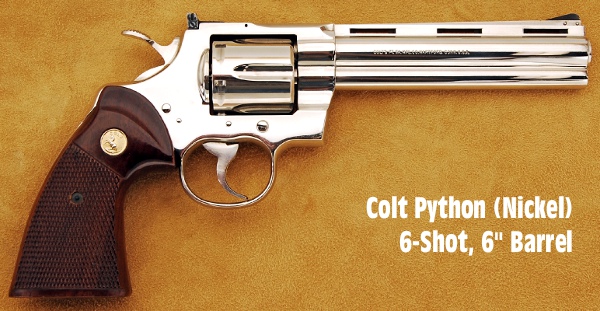
If you are considering acquiring a revolver for fun shooting, self-defense, or competition, you should definitely watch this YouTube video. In this 23-minute presentation, legendary shooter Jerry Miculek puts three .357/.38 SPL wheelguns through their paces. Jerry, one of the greatest revolver shooters in history, hosts a “Revolver Showdown” with three popular wheelguns: 1) S&W L frame (3″ bbl); 2) Colt Python (6″ bbl); and 3) Ruger Speed Six (2.75″ bbl).
Smith & Wesson Model 686 Plus, L-Frame, 7-rd .357 Magnum/38 SPL, 3″ Barrel.
Testing at 10 Yards and 50 Yards
In the video, Jerry shoots all three revolvers rapid-fire, double-action at 10 yards. Then he shoots the three guns single-action, slow-fire at 50 yards (starting at time mark 7:19).
After his range session, Jerry examines nine medium frame revolvers, comparing and contrasting design features. Jerry considers these factors:
1. Accuracy
2. Balance and Handling
3. Speed and Sureness of Trigger Return (watch video at 3:45″ re Colt.)
4. Reliability
5. Barrel Twist Rate
6. Strength of Construction/Durability
Do you have a friend or family member who is just getting started in handgunning? The NSSF has created five Handgun 101 videos that cover the basics of handgun shooting, starting with key principles of firearms safety. Hosted by Top Shot Season 4 Champion Chris Cheng, these videos explain the important fundamentals of pistol shooting. If you will be taking a youngster (or novice adult) to the range for the first time, it would be a good idea to have him or her watch one or both of these videos. CLICK HERE to view all Handgun 101 videos.
Handgun 101: Rules for Safe Firearm Handling
Handgun 101: Single Action vs. Double Action Explained
22Plinkster Tours CCI/Speer Idaho Factory
Trickshot artist and YouTube host 22Plinkster recently got a chance to tour the CCI/Speer production facility in Lewiston, Idaho. This large plant produces both rimfire and centerfire ammunition. While touring the plant, 22Plinkster was allowed to capture video showing the creation of .22 LR rounds from start to finish. This is a fascinating video, well worth watching.
This revealing video shows all phases of .22 LR ammo production including cupping, drawing, annealing, washing, drying, head-stamping, priming, powder charging, bullet seating, crimping, waxing, inspection, and final packaging. If you’ve got ten minutes to spare, we really recommend you watch the video from start to finish. You’ll definitely learn some new things about rimfire ammo.
.22 Plinkster was literally up to his neck in ammo while touring the CCI/Speer Idaho ammo plant. He says: “This was truly a dream come true for me. I can’t thank the people at CCI and Speer enough for allowing me to do this. I couldn’t possibly show everything that went on at the factory. However, hopefully I showed you enough for you to grasp the concept of how rimfire [ammo] is made.”
Speer Brothers Brought Ammo Production to Lewiston
Here is an interesting historical footnote. Today’s large CCI/Speer operation in Idaho can be traced back to the companies founded by the Speer brothers. After settling in Lewiston in 1944, Vernon Speer started Speer Bullets. A few years later, in 1951, Vernon’s brother Dick (with partner Arvid Nelson) started Cascade Cartridges Inc., a producer of small-arms ammunition and primers. Yes, as you may suspect, Cascade Cartridges Inc. is now CCI, a Vista Outdoor company, and one of the largest manufacturers of primers and loaded ammunition. Today, the CCI/Speer Lewiston plant produces both Speer bullets and CCI-branded ammunition and primers. Vista Outdoor’s predecessor, ATK, acquired the plant in 2001. Vernon Speer died in 1979, and Dick Speer died in 1994.
In this video, Bryan Litz of Applied Ballistics explains how to choose a bullet for long-range shooting and explains what you should be looking for when developing a long-range load. Bryan notes that, with a new rifle build, the bullet you select may actually dictate your gun components. When starting from a “clean slate”, once you select a bullet, you will then pick a barrel, twist rate, and cartridge that are appropriate for that bullet. In choosing a long-range projectile, Bryan recommends you choose a high-BC bullet “that is known for precision”. Then you need to find an ultra-consistent, reliable load.
This video is worth watching. Bryan Litz makes some very good points.
Load Development — Why Consistency is Key (and Half-MOA May Be Good Enough)
After choosing a bullet for your long-range project, then you need to develop a load through testing. Bryan explains: “Once you’ve selected a bullet … and you have selected the components around that bullet, the most important thing to remember in hand-loading is consistency. You’re going to do some testing to see what combination of powder charge, powder type, and seating depth give you the best groups and lowest standard deviations in muzzle velocity.”
Bryan says that if you develop a load that can shoot consistent, half-minute groups in all conditions, you should be satisfied. Bryan says that many long-range shooters “spin their wheels” trying to achieve a quarter-MOA load. Often they give up and start all over with a new bullet, new powder, and even a new cartridge type. That wastes time, money, and energy.
Bryan cautions: “My advice for hand-loaders who are long-range shooters, is this: If you can get a load that is reliable and can shoot consistent, half-minute groups with low MV variation and you can shoot that load in any condition and it will work well, then STICK with THAT LOAD. Then focus on practicing, focus on the fundamentals of marksmanship. The consistency you develop over time by using the same ammunition will mean more to your success in long range shooting than refining a half-minute load down to a quarter-minute load.”
Bryan notes that, at very long range, shooting skills and wind-calling abilities count most: “Your ability to hit a 10″ target at 1000 yards doesn’t improve very much if you can make your rifle group a quarter-minute vs. a half a minute. What’s going to determine your hit percentage on a target like that is how well you can calculate an accurate firing solution and center your group on that target. A lot of people would be more effective if they focused on the fire solution and accurately centering the group on the target [rather than attempting to achieve smaller groups through continuous load development].”
Editor’s Note: We agree 100% with the points Bryan makes in this video. However, for certain disciplines, such as 600-yard benchrest, you WILL need a sub-half-MOA rifle to be competitive at major matches. Well-tuned, modern 600-yard benchrest rigs can shoot 1/4-MOA or better at 100 yards. Thankfully, with the powder, bullets, and barrels available now, 1/4-MOA precision (in good, stable conditions) is achievable with a 17-lb benchgun built by a good smith with premium components.
What goes into a £77,500.00 ‘Royal’ model hand-crafted shotgun? Watch this remarkable video from Holland & Holland to find out. Filmed in the Holland & Holland factory, this nine-minute video shows all the key stages in the creation of H&H’s prized shotguns and rifles. The video shows barrel-making, stock checkering, metal engraving and more…
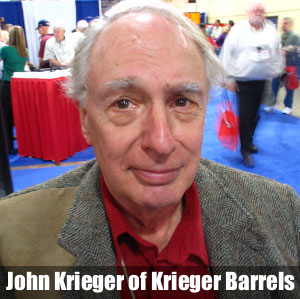
At SHOT Show 2013 we had the chance to chat with legendary barrel-maker John Kreiger of Krieger Barrels. In this wide-ranging interview, John addressed a number of questions our readers often pose…. What is better for a 6mm, 0.236″ land or 0.237″ land? What are the pros/cons of various barrel types: 3-groove, 4-groove, 6-groove, 8-groove, and 5R? What types of land/groove configurations clean up more easily? (John says the 5R might be the winner there).
John also discusses barrel cleaning and he explains why it’s unwise to pull a dirty brush back across your delicate crown: “The problem comes from the fact that abrasive materials — powder and primer residues in particular — get embedded in the brush. Essentially that is how a lap works.”
When we suggested that Krieger Barrels might want to offer three-groove barrels in the future, John surprised us by revealing that he has been considering putting a 3-groove design into production. John says that, in theory at least, a canted-land 3-groove holds a lot of promise. John hopes to build some prototype 3-grooves to test. Krieger Barrels has a 300-yard underground tunnel where barrels with various land/groove configurations and calibers can be tested using a return-to-battery fixture. John admits that tunnel testing of barrels is “on the back burner” as his company focuses on filling orders. But he says that he has a strong personal interest in testing different land/groove configurations, different amounts of choke, and different internal dimensions. We hope we’ll be able to share some results from the Krieger Barrels test tunnel in the near future.



 If you need a break from your hum-drum day at the office, how about taking a virtual vacation to Norway, where you can explore the scenic mountains in the Fjord region?
 This animated video from German ammo-maker



 Testing at 10 Yards and 50 Yards
 Do you have a friend or family member who is just getting started in handgunning? The NSSF has created five Handgun 101 videos that cover the basics of handgun shooting, starting with key principles of firearms safety. Hosted by Top Shot Season 4 Champion Chris Cheng, these videos explain the important fundamentals of pistol shooting. If you will be taking a youngster (or novice adult) to the range for the first time, it would be a good idea to have him or her watch one or both of these videos.


 At SHOT Show 2013 we had the chance to chat with legendary barrel-maker John Kreiger of


