Eurooptic vortex burris nightforce sale


teslong borescope digital camera barrel monitor


As an Amazon Associate, this site earns a commission from Amazon sales.


January 13th, 2024

Saturday Movies: Six Valuable Videos from Keith Glasscock

Winning in Wind Keith Glasscock video showcase reloading barrel ES SD Accuracy

Keith Glasscock is one of America’s greatest F-Class shooters, as well as a highly respected wind coach. A High Master, Keith finished second overall at the 2021 NRA F-Class Long Range Championship in F-Open division. He also finished second at the 2020 F-Open Nationals, and second at the 2019 F-Open Nationals. His consistency is unrivaled, which means he definitely knows the secrets of competition shooting and loading ultra-accurate ammo. Recently Keith has started PRS/NRL competition, bringing his shooting skills to those popular tactical disciplines.

Keith has a great YouTube Channel with new content every week. On Keith’s Winning in the Wind channel, Keith offers 190+ informative videos on a wide range of topics including wind reading, reloading, component selection, load development, and training. For today’s Video Showcase, we offer four of our favorite Keith Glasscock videos. Each video has important points that can benefit any competitive rifle shooter, whether you shoot in local 100-yard fun matches or compete at the National Level in F-Class, LR Benchrest, Palma, or High Power.

How to Reduce Extreme Spread (ES) and Standard Deviation (SD)

Having minimal Extreme Spread (ES) does not necessarily guaranteed optimal accuracy. Some PPC shooters accept a relatively high ES for a load that shoots best at 100/200 yards. But very low ES — i.e. having bullets all exit the muzzle at virtually the same FPS speed — can definitely reduce vertical dispersion at long range (assuming consistent bullet BCs). In this video, Keith talks about various methods to reduce ES and SD. This can include seating depth, primer choice, powder charge weight, brass prep, bullet seating methods and more. Our tip is to have good smoothly-chamfered case mouths, use a quality arbor press with seating force measurement, measure powder loads very precisely, and use the highest-quality brass you can find.

Keith notes that, to achieve the lowest ES, you need to look at multiple processes, including precision powder weighing, careful seating, brass annealing, and primer selection. Another factor is bullet selection. Not all bullets of the same nominal caliber and weight class have exactly the same bullet diameter or shape. Sometimes you can get better accuracy AND lower ES by trying a different brand of bullet. We have found bullet diameters, of the same stated caliber, can vary by up to .0008″ (eight ten-thousandths). Some barrels like the fatter bullets, while other barrels may favor the skinny bullets.

Top 10 Methods to Improve Your Shooting Accuracy

To shoot top scores, you need great skills and great hardware. This video covers 10 things that can improve accuracy, starting with the most important. The #1 item, notes Keith, is rifle shooting skill — you need to be able to hold on target properly and run the rifle consistently shot after shot. The second most important thing is an accurate rifle — you need a rifle with an excellent barrel, quality components, and top-tier inherent accuracy. Third, you need very accurate ammo, and this means you need to perfect your reloading skills. You need precise powder measurement and good, consistent bullet seating. Fourth in the list is related to ammo — you need the ability to do effective load development to pick the best load for your particular barrel. Number 5 is the “right bullet”. You need a high-quality, ultra-consistent bullet that is a good match for your particular barrel and discipline. Watch the video for the other five items.

Balance Beam vs. Advanced Electronic Scale with AutoTricker

Here Keith evaluates the performance of ammo loaded with a conventional balance beam scale vs. ammo loaded with a precision, electronic force-restoration scale fitted with an AutoTrickler V4. It turns out that the balance-beam loaded ammo was actually quite accurate and consistent. Keith concluded that balance-beam ammo may well be good enough for PRS/NRL competition. However for other disciplines, such as benchrest and F-Class, Keith suggest it may be worth the investment. But the key factor is also time — with the precision scale and AutoTrickler Keith can load large quantities of competition-grade ammo much, much faster. Keith points out he puts value on his time, reminding us that, indeed, “time is money”.

Barrel Break-In Procedure for Match Barrels

In this video, Keith explains his procedure for breaking-in his match barrels. He starts by bore-scoping the barrel and cleaning it. If he finds some burrs he may use some JB Bore Paste, a patch, and a worn brush and “give that throat a little scrub” (See 1:30 time-mark). He used different stroke lengths to avoid putting a “step” in the throat. When he’s satisfied he goes to the range. He fires the first five rounds, then cleans. He then fires quite a few rounds before cleaning the barrel again and beginning load development (See 8:25 time-mark).

Bullet Sorting Methodology — Effective Methods

Bullet sorting can improve scores and accuracy, particularly for long-range competitions. There are various methods for sorting — weight, base-to-ogive measurement, bearing surface length, tip condition, and max diameter. In this video Keith explains the pros and cons of various methods. The best choice can also depend on the brand, design, and caliber of each bullet. Some bullets show significant base to ogive variance, other bullets (such as Lapua Scenars), have been extremely consistent. Overall, if you are a long-range competitor, is it probably useful to bullet sort, and you can use outliers for fouling shots.

Tripod Options for PRS/NRL Competition

Over the past two seasons, Keith has added PRS/NRL shooting to his competition resume. Along with his stellar F-Class skills, Keith now has considerable experience with tactical competitions. And he’s learned that having a good tripod will make a difference over the course of a match. In this video, Keith looks at various tripod options and explains the ways you can use a tripod for PRS/NRL centerfire and rimfire competition. While the tripod can obviously be used to support the rifle, it can also be used for various other functions, as shown in the video.

Winning in Wind Keith Glasscock video showcase reloading barrel ES SD Accuracy

Permalink - Videos, Bullets, Brass, Ammo, Gear Review No Comments »
October 24th, 2021

Sunday Gunday: Wind-Reading with Keith Glasscock

Keith Glasscock winning wind youtube channel f-Class f-Open wind reading

Keith Glasscock is one of America’s very finest F-Class shooters. This talented trigger-puller took second in F-Open division at the F-Class National Championships three years in a row. A smart engineer with aviation knowledge, Keith is a master wind reader, who has served as the wind coach for top F-Class teams. In fact Keith is in Arizona right now coaching a team at Ben Avery.

Keith shares his wind-reading expertise on his popular YouTube Channel — Winning in the Wind. This channel provides intelligent advice on multiple topics including reloading, load development, shooting strategies, and yes, reading the wind.

Keith has the credentials to back up the advice he offers in his video lessons. A High Master, Keith finished second overall at the 2021 NRA F-Class Long Range Championship in F-Open division. He also finished second at the 2020 Nationals, and he took second place at the 2019 Nationals. His consistency is unrivaled, which means he definitely knows the secrets of long-range wind calling and loading ultra-accurate ammo.

Today we feature two of Keith’s latest YouTube videos, both focused on wind reading.

Wind Direction vs. Wind Speed — Which is More Important

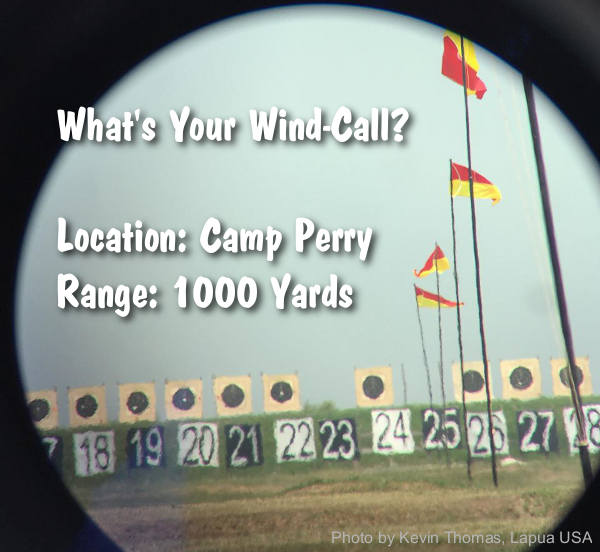
Most shooters find wind reading somewhat intimidating. That is understandable. The wind can change constantly during a match, with variations in both wind velocity and angles. Sometimes you think you have a cycle figured out, but then there can be an unexpected lull. Or you may start a string in what you think is a stable condition, but then a surprise shift changes everything. In addition, wind flows can be influenced by terrain features, such as berms, which have varying effects depending on wind angle (e.g. a tailwind hitting a berm will act differently than a 90-deg crosswind). That is why a good wind reader needs to identify both the wind speed AND the wind angle. In this video, Keith explains when to focus primarily on direction and when to pay most attention to velocity. With headwinds and tailwinds, Keith notes, you should monitor angle changes carefully. With crosswinds, speed is the key variable to watch.

KEY Points to Remember
— Small changes in wind direction changes alter POI drastically at long range
— During head or tailwinds, focus on wind direction
— During crosswinds, focus more on wind speed
— The wind is cyclic — always be aware of the pattern

Keith Glasscock wind reading video winnning spotting scope flag angle kestrel

Determining Wind Direction with Precision

Keith Glasscock winning wind youtube channel f-Class f-Open ES SD loading

Many shooters try to read the wind merely using whatever wind flags might be aloft on the range. Flags are important of course, but there are other vital factors that a wise wind-watcher will monitor. You want to watch mirage, and the movement of grass and trees. In looking for angle changes, Keith says the spotting scope is a very important tool. His tripod is equipped with angle markings on the rotating tripod head. This allows him to ascertain wind angles with great precision.

In the video below, Keith shows how to use a spotting scope to read the wind. He explains how he uses his spotting scope in his role as a wind coach. But a spotting scope can also be used effectively by competitors shooting prone or from a bench. Many top shooters use their spotting scopes to watch mirage during their relays. Keith notes that smart competitors can also use their spotters BETWEEN relays to scout natural wind indicators (moving grass, trees etc.), check for boils, watch mirage, and estimate wind velocity cycles.

KEY Points to Remember
— Wind flags leave a lot to be desired in precision wind direction reading
— Precision wind direction can be obtained with a spotting scope
— There is a boil both directly upwind and directly downwind
— Angle indicator on your tripod helps with angular precision in wind readings
— Scouting with a spotting scope before your turn to shoot can be fruitful

Keith Glasscock winning wind youtube channel f-Class f-Open ES SD loading

Questions and Answers with Keith Glasscock

Keith Glasscock winning wind youtube channel f-Class f-Open wind reading

Q. How did you get started as a wind coach, and what were the most important stages in your progress in wind-reading?

Keith: I started coaching this team in 2017. I was looking for a team to shoot on, but they needed a wind coach. I’ve been a backseat driver ever since. I learned the most about reading the wind from shooting when the conditions are absolutely miserable – flags popping, wind switching, people missing the targets entirely, and there I was, having to make the big call. I learn from my own mistakes, and it shows. I still make mistakes, but try to limit them to ones I haven’t already made. In essence, I am in the most important stage now. Humbly looking at the wind knowing its power and mystery, while learning new things every day.

Q. What are the most common wind-reading mistakes you see people make at matches?

Keith: The most common, in a word, is UNDER-confidence. Most shooters can make that wind call with accuracy. But their fear prevents them from doing that, and prevents them from learning or taking advantage of smooth, solid conditions. The second common mistake is failure to anticipate changes. That comes from not gauging the wind pattern. It’s all about patterns in a sport where wind changes so small have such profound impacts on score.

Q. What’s more important — wind flags, or mirage (or maybe the unexpected horizontal that appears on the last shot recorded on target).

Keith: Both flags and mirage lie. The only thing that tells the truth is a bullet. Unfortunately, the wind can switch faster than you can shoot in most cases. I take a fluid approach. I look for what on the range right now tells me what the wind is doing.

Q. When are conditions so bad/unpredictable that it is necessary to just stop shooting and wait for things to get better?

Keith: This is situational, and comes down to what you are observing. I never like to shoot in the top of a gust condition, even when I know what the hold is. The drop off is what gets you that surprise 8.

Q: What type of wind meters do you recommend?

Keith: While Kestrels are inexpensive and quite serviceable, they are directional in nature. If I want absolute wind speed, an omnidirectional style unit is preferred.

Q. Are there ways to practice reading the wind (and judging wind speeds) when one is away from the range?

Keith: I really concentrate on seeing mirage any time I’m outside, without optics. I can, many times, see the boil of the mirage, and wind direction with the naked eye. My time in aviation has my eye tuned to see things like shear zones and venturis in the airflow. I take a moment, anytime the air is moving, to feel the air on my skin, see the trees and grass moving, and areas where the wind does funny things. Trees and grass tend to get too much credit as precision wind indicators. I use them as wind change indicators. It also gives me an opportunity to humble myself and realize how dependent I am on mirage and flags.

Keith Glasscock winning wind youtube channel f-Class f-Open ES SD loading

Permalink - Articles, - Videos, Competition, Optics, Tech Tip No Comments »