Q: What’s more important — wind speed, or direction?
A: Obviously they both matter, but they do trade dominance based on direction. For example, a 10 mph wind between 2:30 and 3:30 is only changing its value from 9.7 to 10 to 9.7 mph (bracket of 0.3 mph). However a 10 mph wind between 11:30 and 12:30 is changing its cross wind component value from 2.6 mph left to zero to 2.6 mph right (bracket of 5.2 mph). There is the same 30° change in direction, but this results in a massively different bracket.
Point being, in this case, a direction change is far more critical if it’s near 6 or 12 o’clock. A small direction change when it’s close to 3 or 9 o’clock is negligible.
On the contrary, a change in wind SPEED when it’s near 3 or 9 affects your crosswind component directly. But for a near head or tail wind, a fluctuation in wind speed only causes a small fraction of a change to the crosswind component.
SUMMARY: If you’re in a near full-value wind, pay more attention to wind SPEED. If you’re closer to a head- or tail-wind, nailing the exact DIRECTION will be more important.
Get More Tips on Bryan Litz Ballistics Facebook Page
This post is from the new Bryan Litz Ballistics Facebook Page. FB users should check that page regularly for more tips from Bryan, American’s leading ballistics expert and founder of Applied Ballistics LLC.
Retro is back — at least in the CMP’s Standard Modern Military Rifle AR class. Though Service Rifle competition has evolved to allow optics and heavy barrel profiles, the Standard Modern Military Rifle (AR category) is truly a “blast from the past”. Overall weight is limited to 7.5 pounds, and the rifle must be equipped with iron sights (Rule 5.2.3). In addition, the rifle must “be based on the M-16 rifle or be based on an AR design” with “exterior configuration similar [to] the original military or military-type rifle”. See Rules.
With this in mind our friend Dennis Santiago has put together his own AR-platform Standard Modern Military Rifle for matches run under CMP Games Competition Rules. This is not quite a classic AR, as it has a metal free-float handguard (vs. plastic handguards), but it IS light (7.3 pounds), and it does have iron sights — a key requirement for Standard Modern Military class rifles. CMP Rulebooks — All Classes.
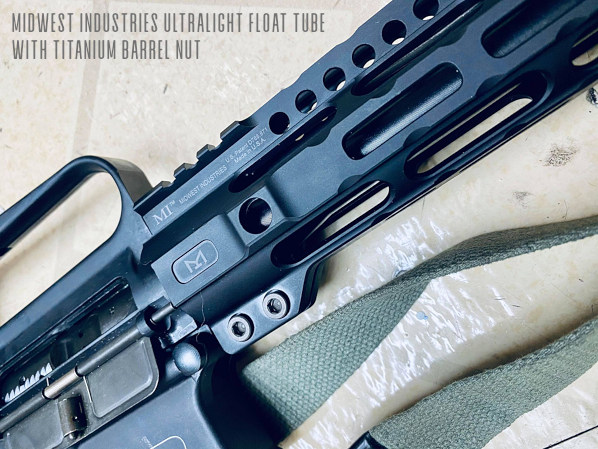
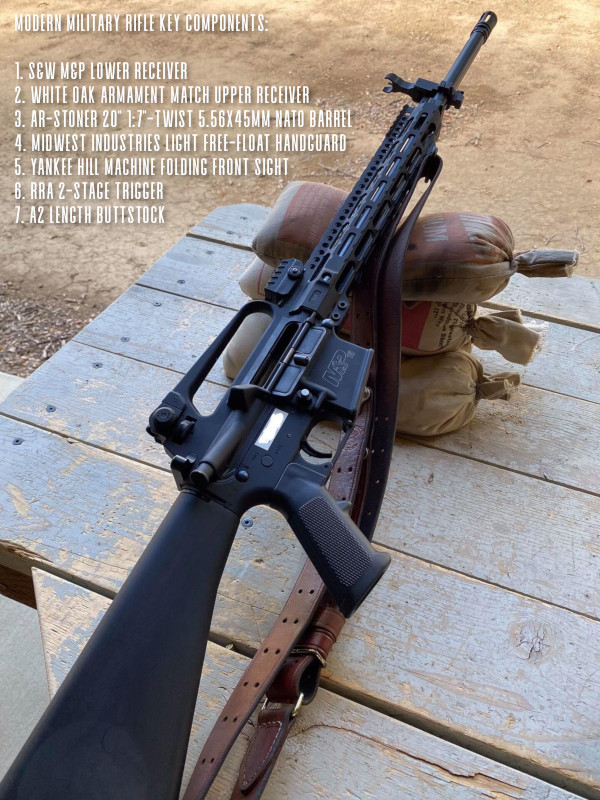
Here is Santiago’s CMP Modern Military Rifle (Standard Class) with an ultralight free float tube that has a titanium barrel nut, and mechanical, center-able front sight. The barrel is an AR-Stoner brand 20″-long 1:7″ Government contour chambered in 5.56×45 NATO. Dennis says: “This makes the 7.5-lb weight limit with a few ounces to spare. We’ll see how well it drives soon enough.”
Dennis explains: “The Standard Modern Military (AR) is a category of military-style rifle that shoots the 200-yard, 30- or 50-shot courses alongside the M1 Garands, Springfields, Vintage, and M1 Carbines. This one boasts a Midwest Industries (MI) ultralight Free-float Handguard and a Yankee Hill folding front sight. Any Government contour or thinner profile rifle-length gas tube barrel with a 0.750″ gas block will work.” Colt makes a suitable Government Contour 20″-long, 1:7″-twist barrel, sold by MidwayUSA.
To test the accuracy of his rifle, Dennis fitted a Mantis-X unit on the top of the float tube. The Mantis-X records the movement of the rifle to interpolate shot placements. Dennis reports: “I spent some extra time at the range grabbing a decent zero for my Modern Military rifle. I stuck a Mantis-X on it to record a few shots shooting offhand at the plates at 200 yards. It drives very easily even with no shooting coat or glove.” The Mantis-X is attached just forward of the carry handle, on top of the MI free-float handguard. The Mantis-X works with live fire as well as dry fire. It communicates via BlueTooth to a smartphone App.
Rifle Shoots Well with 77gr Sierra MatchKings
The gun is presently zeroed with 77gr Sierra MatchKing ammunition. Dennis reports his rifle “can easily hold the X-Ring on an SR target for both 100-yard and 200-yard CMP Modern Military Games matches. And it’s fun to shoot!”
CMP Standard Modern Military Rifle (AR Class)
This rifle is built from carefully selected and fitted parts to conform to the CMP’s 7.5-pound weight limit iron-sighted rifle rule. Officially, this is a CMP Standard Modern Military Rifle, Class “A” (AR type).
1. S&W M&P lower receiver
2. White Oak Armament match upper receiver with 1/4×1/4-MOA pinned rear sights
3. AR-Stoner 20″ 1:7″-twist 5.56x45mm NATO Government contour barrel from MidwayUSA*
4. MidWest Industries ultralight free-float handguard with a Titanium barrel nut
5. Yankee Hill Machine folding front sight with a 0.072″ square front pin
6. RRA 2-stage trigger
7. A2 length buttstock
Easy Rifle Build Using Mostly Existing AR Parts, Plus New Barrel and Free-Float Handguard
Dennis was able to put his Modern Military AR together using components he had collected over the years: “Most of these parts were already in my bin of old AR parts available to be recycled. The barrel and free-float handguard were the only new acquisitions.” And with the AR’s modular format, this was an easy build: “Assembly time was about 30 minutes. I’ve done these parts swaps so many times now.”
Key Rules for Standard Modern Military Rifle (AR Type)
Dennis Santiago’s new AR rifle was built as a “Standard U.S. Modern Military Rifle”, Class A (AR Type), as specified in the CMP Games Competition Rules.
5.2.3 Standard U.S. Modern Military Rifles, Class A
Category A Standard Modern Military Rifles must comply with these requirements:
a) Rifles must be based on the M-16 rifle or be based on an AR design;
b) Rifles must be manufactured by a USA manufacturer;
c) Rifles must be equipped with issue-type metallic front and rear sights; rear sights with adjustments finer than one minute of angle are permitted;
d) Total rifle weight, with sights and without sling, may not exceed 7.5 pounds;
e) Rifles may be fitted with a float tube or free-floating handguard. A nonadjustable sling swivel may be attached to the forward end of the handguard; and…
f) The rifle must be chambered for the 5.56x45mm or .223 Remington cartridge.
Also, from Rule 5.2.2:
a) The exterior configuration of the rifle must be the similar to that of the
original military or military-type rifle;
b) The trigger pull may not be less than 4.5 lbs.;
Comments from other Modern Military Rifle Shooters:
“I built a Modern Military [Standard]. It was tough getting below the 7.5-lb [limit]. I had to carve off a bunch of the 20″ barrel diameter but wanted to stay with it for sight radius (over a 16″). I would just as soon shoot that little iron-sighted rifle at 200 yards as my 15-lb Nightforce-scoped Service Rifle. I love that little rifle.” — Kenneth S.
“I’m building one of these that will make 7.5-lb [Standard Modern Military] weight limit, with the long barrel and long sight radius. This has been on my list this winter.” — Tom K.
“We found that turning down a National Match barrel and taking a few inches off of it made a very accurate rifle.” — Jack A.
“My old (complete) A2 upper has been sitting forlorn on a shelf for a couple of years now. Perhaps I need to do a [Standard Modern Military] build of my own.” — Derek D.
Dennis Santiago replied: “Derek — that’s the reason I was attracted to this. I had bought a brand new WOA A2 pin upper receiver to make a new upper then the scope rule was adopted and it was all flat tops. This gives new purpose to the old parts.”
CMP Rules Defining Modern Military Rifles
Standard vs. Unlimited, Class A vs. Class B
There are actually two different classes of Standard Modern Military Rifles, Class A for AR-type rifles and Class B for other military-style rifles, such as the M1A and FN-FAL. Ok, got that? Now, in addition, there is also a second division for UNLIMITED Modern Military Rifles, again with two classes (Class A — AR-type and Class B — other military rifles). These unlimited rifles can have optics, heavier weights, modern-design adjustable-length stocks, and other upgrades. Here is Rule 5.2.2 from the current CMP Games Rifle and Pistol Competition Rules:
Erik Cortina of Team Lapua has won the 2024 Texas State Long Range Championship for an unprecedented fifth time. Loading Berger 7mm 180 Gr Hybrid Target bullets in his own 7mm PRCW cartridge (formed from Lapua 6.5 PRC cases) Cortina outshot all F-Open competitors and scored a 993-51X. Erik has his own company, Cortina Precision, which produces barrel tuners, tuner/brakes, dies, and other products.
The Texas State Long Range Championship hosted by Bayou Rifles, took place April 12-14 at the Juliff Rifle and Pistol Range in Rosharon, Texas. The Texas Long Range Championship hosted the top shooters from around the USA, competing in both F-Open and F-TR disciplines.
“This year, the Texas State Long Range Championship adopted the Bisley pair fire format. This format requires shooters to alternate shots rather than string fire. Time limit is 45 seconds per shot. Reading the wind and staying focused is essential, so I decided I was going to ignore my partner’s shots and shoot my own match the entire weekend”, commented Cortina. “It worked out and I secured my 5th Texas State Championship with a five point margin. It’s one of the most fun matches I have ever attended.”
The F-Open category requires a rifle weighing no more than 22 pounds and chambered in any caliber .35 and under. Rifles are fired from the prone position with rear sandbag and adjustable front rest.
This F-Class John video shows the Texas match and includes an interview with Erik Cortina.
One of the world’s best F-Class competitors, Erik has won many other major F-Open titles in recent years, including the 2023 Southwest Nationals (see below), and the 2023 South African Championships held right before the F-Class World Championships last year. Below is a photo of Erik at the Southwest Nationals in 2023 with his winning rifle:
Great Shooter Interviews on Erik Cortina’s YouTube Channel
Erik also has a popular YouTube Channel with gear reviews and excellent long-format interviews with talented competitive shooters. CLICK HERE to see the videos on Erik’s Believe the Target Channel.
Lapua is a part of the Capstone Precision Group, exclusive U.S. distributor for Berger, Lapua, Vihtavuori and SK-Rimfire products. For more information, visit Lapua.com.
Share the post "Erik Cortina Wins Texas State Long Range Championship"
Here’s something all shooters need — a smartphone App that calculates bullet-hole group sizes from your own photos. The Ballistic-X App is simple to use. Take a photo of your target, set some values (such as bullet diameter and distance to target), then use the touchscreen to place circles around each hole. The App will calculate group size (in MOA or Mils), distance to point of aim, and provide all the info in an overlay. Then click “save” to record your group for posterity!
This App works well, is relatively easy to set-up, and costs just $7.99. It is available for both Android devices and iOS (Apple) devices. There are other ways to measure group sizes from target images, such as the excellent On-Target program, which we have used for years. However On-Target requires a software installation on a Windows platform desktop or laptop. Ballistic-X is a simple, easy-to-install App with versions for both Android and iOS (Apple) Mobile devices.
The Ballistic-X App has a relatively easy-to-use interface. Of course you can choose either MOA or Milrad group values, and Inch or Metric dimensions. There are various labeling options that provide useful info for Load Development. There is even an ATZ (Adjustment To Zero) feature for adjusting your turrets.
How to Use Ballistic-X App
1. Select Photo Source — Choose Camera to take new photo or get image from Photo Library.
2. Set Reference Values — Select Bullet Diameter and enter Distance to Target.
3. Establish Scale on Image — Mark two points on target photo to set scale. For example, if the target has a 1″-square grid lines, mark two points on grid for 1″ distance.
4. Mark Point Of Aim — Put the central X on the aim point.
5. Designate Shot Locations — Place the green circles around each shot.
6. Finalize Data Display — Position Overlay, select size/color options, and export file.
Android Options — Range Buddy FREE App
Along with Ballistic-X, there is another Mobile App, Range Buddy, that also measures shot groups. Range Buddy is currently offered for Android devices only. It is FREE, but has adverts. Range Buddy isn’t bad, but users complained about the program crashing, and there are compatibility issues with newer phones. We recommend you pay $7.99 and stick with Ballistic-X.
Share the post "Measure Group Sizes Precisely with Ballistic-X SmartPhone App"
In 2024, the CMP Pistol Matches at Camp Perry will include Air Pistol Nat’l Championships, Small Arms Firing School, M9 EIC Match, Rimfire Pistol Matches, Centerfire Pistol Matches, Revolver EIC Match, .45 Pistol Matches, National Trophy Matches, GSSF Glock Nat’l Challenge, Military/Police Pistol Match, and 1911 As-Issued Match.
Since the turn of the 20th century*, Camp Perry has hosted major marksmanship events. While the rifle competitions get the most coverage, the National Matches also include bullseye pistol competition. Bullseye pistol shooting can bring nearly a thousand competitors to Camp Perry each summer, as part of the CMP National Championships. For these Camp Perry pistol matches, targets are set at 25 and 50 yards. The shooting position is standing, with most events firing one-handed in slow fire, timed fire, and rapid-fire.
Since their inception over a century ago, the National Matches have become a major shooting sports festival with over 4,500 annual participants. Held at the Camp Perry Nat’l Guard Training Base, the National Matches now include both indoor and outdoor events. Adult and junior athletes are welcome.
Camp Perry Bullseye Pistol Competition
Camp Perry is synonymous with the oldest and most prestigious annual trophy matches in our nation’s history. And in a venue renowned for service rifle matches, the sport of precision pistol is no less important, no less challenging, and no less respected. The National Trophy Pistol Matches is all about traditional handgunning — the stance, the intense concentration, and of course, the one-handed grip. It’s all unmistakable as the game of Bullseye Pistol. Every year there are no fewer than 24 separate match trophies for the top Bullseye Pistol shooters, both military and civilian. And the very best will claim National Match Trophies and receive the President’s 100 Tab.
This video shows .45 ACP centerfire pistol competitors at Camp Perry
Civilians and military shooters competed together at the 2019 NTT Pistol Match.
* The first National Matches at Camp Perry were held in 1907. SEE: A Short History of Perry and the National Championships by Hap Rocketto.
This content is Copyright 2024 AccurateShooter.com. No reproduction on any other website is authorized. Use of this content without payment of licensing fees is a violation of Federal law.
Share the post "Pistols at Perry — Registration INFO for 2024 Nat’l Pistol Matches"
Vihtavuori Powders, a leading choice of competitive target shooters and long-range hunters, returns as the title sponsor of the F-Class Points Series V2 Finale. The 2024 V2 Finale will be held May 23-26, 2024 and at the Bayou Rifles Juliff Range in Rosharan, Texas.
“We’re thrilled to extend our partnership with Vihtavuori for the 2024 V2 Finale event! As one of our original sponsors, their direct support has been instrumental in bringing this event to life and supporting its growth, commented Tod Hendricks, F-Class Point Series member. “Now serving as the lead sponsor, Vihtavuori’ s continued generosity ensures that events like ours can flourish, offering fresh and exhilarating experiences in the competitive shooting sports arena.”
The F-Class Points Series is a yearlong F-Class points system and leaderboard, that culminates in the V2 Finale, which pits F-Class competitors against each other in a bracket-style double elimination match. Sixty-four competitors, 32 for each class (F-Open and FT/R), are invited to the Finale based on their series ranking. Since the V2’s inaugural series in 2021, partnerships have begun in Canada, South Africa, Italy, and Australia. The 2024 Finale will be held May 23-26 at Bayou Rifles in Rosharon, TX.
CLICK HERE for V2 Finale and F-Class Points Series rules. For more information on the F-Class Points Series and V2 Finale, visit FClassPointSeries.com.
This new-format match pits F-Class competitors against each other in a bracket-style double elimination match. The elite field (32 per class) is selected via a preceding Points series. In the past targets were placed at 1000 yards. In something unusual for an American F-Class match, in the V2 Finale all shooting will be done via PAIR FIRING, with shooters going head-to-head with alternating shots. The listed course of fire for 2024 is:
3.1. 2 CONVERTIBLE SIGHTERS AND 15 SHOTS FOR RECORD AT 1000 YARDS, PAIR FIRE
3.2. 2 CONVERTIBLE SIGHTERS AND 10 SHOTS FOR RECORD AT 1000 YARDS, PAIR FIRE
3.3. 5 SHOTS FOR RECORD AT 1000 YARDS, PAIR FIRE
Share the post "Vihtavuori Returns as Title Sponsor for the 2024 V2 Finale"
What’s a “Wallet Group”? It’s a singularly spectacular proof target that entitles its bearer to bragging rights. The wallet group may or may not have been shot in competition, and, by definition, it may not be repeatable. But it exists as incontrovertible proof that, at least once, the stars aligned, and the wind gods smiled on the shooter.
Five Shots in 0.178 MOA at 1000 Yards
A few years ago, Forum member and F-Class shooter Gary Wood was testing his 6.5-284 rifle at the 1000-yard range in Coalinga, California, getting ready for an upcoming long range match. In practice, Gary nailed a witnessed 1.859″ five-shot group, with four of the five shots well under an inch. Use this as proof to win those club-house arguments about whether it is possible to shoot “in the ones” at 1000 yards. Gary’s group worked out to 0.178 MOA!
Gary reports: “I was load testing with 5-shot groups. Each group was shot on a new F-Class center and pulled by Ret. Master Chief Jerry Pullens and spotted by an other long-range shooter. The second 5-shot load group looked really small … by our reckoning four out of five shots measured under an inch. I was amazed. What’s more, when I shot the group, the 4th shot blew the spindle out of the 3rd shot. My spotter saw that in his scope and Jerry Pullens told me about it afterwards”.
As measured with the OnTarget Software, using a scan of the target, Gary plotted the group size at 1.859″ total for five shots, or 0.178 MOA. Gary noted: “I had everyone sign the target which I saved and photographed.” Yes, Gary, this may be the wallet group to end all wallet groups. You should have that target framed.
Gary’s Load and 6.5-284 Rifle Specs
Gary was running a stout load of Hodgdon H4350 and CCI BR-2 primers, pushing moly-coated 142gr Sierra MKs, in Lapua 6.5-284 brass. The rifle features an F-Class, single-shot Surgeon action with a Bartlein 5R barrel chambered with a no-turn neck. Gary says “The barrel only has 70 rounds through it… yep, I think it will shoot.” Gary did all of the gunsmithing and barrel work himself.
Did Gary have any special reloading tricks? Apparently not: “Other than weighing the cases and the powder very carefully, there really were no magical reloading secrets used. The Sierra 142s were moly-coated straight from the box of 500, but they were not weighed or checked for bearing surface. The powder was dropped with a RCBS ChargeMaster then checked with an Acculab scale (to under a tenth). The Lapua cases were not neck-turned, but I did weight-sort them. The five cases for the small group weighed: 195.05, 195.03, 195.03, 195.03, 195.01.”
Share the post "Best Wallet Group Ever? Five Shots in 1.859″ at 1000 Yards"
The 2024 NRA World Shooting Championship took place April 3-6 at Camp Atterbury in Edinburgh, Indiana. This major 12-stage, multi-gun event offered over $250,000 in cash and prizes. All firearms, ammunition, optics, and equipment were supplied by the NRA, Walther, and additional industry sponsors.
We congratulate this year’s winners: Brian Shanholtz, Nils Jonasson, and Gregory Jordan. Congratulations are also extended to Lanny Barnes for capturing the High Lady title, and to Cole Shanholtz for winning the High Junior title to complement his father Brian Shanholtz.
“We offer our congratulations to not only the winners, but to everyone who competed in the NRA World Shooting Championship this year,” said Jens Krogh, V.P. of marketing and product development for Walther Arms. “To witness such talent, determination, and marksmanship from each participant at each stage of the competition was impressive, especially given the elements everyone had to deal with.”
The NRA World Shooting Championship
This championship is designed to test individuals through multiple different disciplines over a period of three days of shooting. Competitors compete in Professional and Amateur categories for cash and prizes of over $250,000. Walther and other sponsors supplied ALL firearms equipment and ammunition required for the 12 stages of competition.
To do well, competitors must be highly proficient in all shooting skills — rifle, pistol, shotgun, both rapid fire and precision. The stages were: Sporting Clays, Precision Standing Air Gun, NRA Americas Rifle Challenge, NRA Precision Pistol, FITASC, 3-Gun, Mid-Range AR-Tactical, Biathlon, SASS (Cowboy Action), PRS, Scholastic Action Shooting, and USPSA.
Dennis DeMille shows a young competitor at the CMP Western Games how to adjust his leather sling.
If you want to learn more about setting up your sling properly for position shooting, here are some tips from Dennis DeMille, a past Service Rifle Champion. Dennis explains how to choose a sling, and how to adjust it to fit properly.
The Benefits of Dry-Fire Training
Once you know how to set up your sling properly, you’ll want to practice. Dennis DeMille stresses the importance of dry-fire practice with sling and shooting coat. Dry-Fire training is essential to the sling disciplines. Dennis DeMille, a national Service Rifle Champion, told us that, for every minute he spent in actual competition, he would spend hours practicing without ammunition. While in the USMC, Dennis would practice in the barracks, working on his hold and dry-firing:
“The most important thing is to spend time off the range practicing. Most of what I learned as a High Power shooter I learned without ammunition — just spending time dry firing and doing holding exercises. Holding exercises will really identify the weak parts of your position. The primary purpose of dry firing is to get you used to shooting an empty rifle. If you can shoot a loaded rifle the same way you shoot an empty rifle then eventually you will become a High Master.”
SFC Brandon Green, 2018 Nat’l High Power Champion. Brandon, one of the nation’s best “hard-holders”, demonstrates proper use of sling in prone position.
Setting-Up a Leather Service Rifle Sling for Competition
So you made the mistake of disassembling your leather service rifle sling, or are intimidated about how to use one? In this Creedmoor Sports InfoZone video, former Creedmoor G.M. Dennis DeMille explains how to set up and use a sling. The covers the basics — Dennis starts with a totally disassembled leather service rifle sling and shows you how to set it up properly.
Tip: “Many shooters shy away from using a leather sling because they have never been taught how to use one. That’s unfortunate. In my opinion a leather sling offers more support than a web sling, which is important when competiting with the heavier than normal rifles.”
Configuring the Sling for the Standing (Offhand) Position
In this second in a series of Creedmoor InfoZone videos on the setup and use of the leather service rifle sling, Dennis DeMille details how to configure and best utilize the leather service rifle sling while shooting from the standing position.
Tip: “Putting the Frogs in different hole will change the amount of added elevation a sling provides.”
Looking at Sling Types — Comparing the Features
In this video Dennis showcases a large variety of shooting slings. He explains the strong points of each type so you can choose the sling best suited to your discipline and shooting style.
Share the post "Expert Advice on How to Set Up Slings for Competition"
The NRA World Shooting Championship was held April 3-6, 2024 at Camp Atterbury, Edinburgh, Indiana. Presented by Walther, this challenging event involved rifle, pistol, and shotgun shooting with a dozen disciplines — from short-range action pistol to long-range rifle. Topping the field among lady shooters was the talented Lanny Barnes, a 3-Time Olympic biathlete and professional 3-Gun competitor. We congratulate Lanny for her great 2024 performance at the NRA Championship, which earned Lanny the title of NRA World Shooting Lady Champion!
Lanny provided this report on the NRA World Shooting Championship event:
“This match definitely is challenging. I was fortunate to shoot with the greatest shooters on the planet and we battled challenging weather, tough stages, foreign to us firearms while shooting 12 different disciplines that tested your skills in picking up a firearm and making the most of it. We shot rifles, pistols, and shotguns and anything from short range to long range to speed to accuracy to shooting on the move to moving targets and everything in-between.
If you want to see how well rounded a shooter you are, come out and give this match a shot. Congrats to all who competed and survived this tough event. I want to especially give a shout out to my squad. I learned so much from your guys. My shooting sisters Dianna Muller, Becky Yackley, and Gabby Franco who despite working their tails off with life’s challenges, they are out there pushing themselves hard. Awesome to shoot with Tristin Burris who is just a beast and is really improving her shooting and then there is the guys, Jerry Miculek and Bruce Piatt among many legends who are not only great guys and incredibly humble, they are a rare breed of champions that has set themselves apart and will go down in the history books as the greatest shooters in the world.
I also don’t think I’ve laughed as much in the last year as I did the last few days with my squad. Thank you guys. Thank you to the NRA for bringing this match back and focusing on shooting sports and to all those you volunteered and put those into this match. Huge shout out to Walther Arms for putting so much effort and great guns into this match.”
Above Lanny (aka “Lanny Oakley”) is shooting a stage at the NRA World Shooting Championships. Lanny notes: “It was a PRS Stage using a Ruger Precision .308 shooting 8 targets at 411 yards. You were allowed 3 sighted shots but couldn’t touch the scope. I ended up using all 10 shots but was happy to get the hits. Thanks to Ruger for sponsoring the match. I actually won one of their precision rifles from this match[.]”
Share the post "Lanny Barnes Wins Lady Division at NRA World Championships"
If your local shooting club wants to attract new members, and provide a new form of competition, consider starting a series of groundhog (varmint) matches. These can employ paper targets, metal silhouette-style targets, or both. Groundhog matches are fun events with straight-forward rules and simple scoring. You don’t need to bring windflags or load at the range, so a Groundhog match is more “laid back” than a registered Benchrest match. Normally there will be three or four rifle classes, so you can compete with a “box-stock” factory gun, or a fancy custom, as you prefer. Many clubs limit the caliber or cartridge size allowed in varmint matches, but that’s just to protect reactive targets and keep ammo costs down. In this article, Gene F. (aka “TenRing” in our Forum), provides a basic intro to Groundhog matches, East-Coast style.
Groundhog Matches Are Growing in Popularity
Though Groundhog matches are very popular in many parts of the country, particularly on the east coast, I’ve found that many otherwise knowledgeable “gun guys” don’t know much about this form of competition. A while back, I ordered custom bullets from a small Midwest bullet-maker. He asked what type of competition the bullets would be used for, and I told him “groundhog shoots”. He had not heard of these. It occurs to me that perhaps many others are unfamiliar with this discipline.
Groundhog matches have grown rapidly in popularity. There are numerous clubs hosting them in Pennsylvania, Maryland, and Delaware, as well as other venues. They are usually open to the public. Most Eastern clubs have five to twenty cement benches, and overhead roofs. At this time, there is no central source for match schedules. If you’re interested in going to a groundhog match, post a query in the AccurateShooter Forum Competition Section, and you should get some info on nearby opportunities.
How Matches Are Run — Course of Fire and Scoring
Unlike NRA High Power Matches, there is no nationwide set of standard rules for Groundhog matches. Each club has their own rules, but the basics are pretty similar from club to club. Paper groundhog targets are set at multiple distances. There are normally three yardages in the match. Some clubs place targets at 100, 200, and 300 yards. Other clubs set them at 200, 300, or 400 yards. At my club in Shippensburg, PA, our targets are placed at 200, 300 and 500 meters.
The goal is to score the highest total. The paper targets have concentric scoring rings. The smallest ring is normally worth ten points while the large ring is worth five points. The course of fire varies among the various clubs. Most clubs allow unlimited sighters and five shots on the record target in a given time period. Only those five shots on the scoring rings are counted, so that with three yardages, a perfect score would be 150 points. Tie breakers may be determined by total number of dead center or “X” strikes; or, by smallest group at the farthest distance.
Types of Rifles Used at Groundhog Matches
The same benchrest rigs found at IBS and NBRSA matches can be utilized (though these will typically be put in a ‘custom’ class). Though equipment classes vary from club to club, it is common to separate the hardware into four or five classes. Typical firearm classes can include: factory rifle; deer hunter; light varmint custom (usually a limit of 17 lbs.with scope); and heavy varmint custom (weight unlimited). Some clubs allow barrel tuners, others do not. Scope selection is usually unlimited; however, some restrict hunter class rifle scopes to 20 power. Factory rifles usually cannot be altered in any way.
Good, Simple Fun Shooting — Why Groundhog Shoots Are Popular
Forum member Danny Reever explains the appeal of groundhog matches: “We don’t have a governing organization, or have to pay $50 a year membership just to compete in matches. Sure the rules vary from club to club, but you adapt. If you don’t like one club’s rules, you just don’t shoot there. It’s no big deal.
There are no National records, or Hall of Fame points — just individual range records. If you want to shoot in BIG matches (with big prizes), there is the Hickory Ground Hog Shoot among others. If competition isn’t your bag, many clubs offer mid-week fun matches that you can shoot just for fun. You shoot the same targets but with a more relaxed atmosphere with no time limits.
The best part is you don’t have to shoot perfect at every yardage. You always have a chance because in this sport it really isn’t over until the last shot is fired. Typically ALL the entry money goes to the host club, with much of the cash returned back to the shooters via prizes. Junior shooters often shoot for free, or at a reduced rate. The low entry cost also encourages young guys to get involved who don’t have $4000 custom rifles or the money to buy them.
There isn’t a sea of wind flags to shoot over or to put up and take down. If the range has a couple of flags so much the better, but after all it is a varmint match. No pits to spot shots and slow things down either. If you can’t see your hits through your rifle scope or spotting scope well you are in the same boat as everybody else. That’s what makes it interesting/ sometimes frustrating!
Share the post "Club Groundhog Matches are Fun — Tips on Competition"
AccurateShooter’s Target Page provides over 50 FREE downloadable targets. You’ll find all types of targets — sight-in targets, varmint targets, rimfire targets, bullseye targets, tactical targets, load development targets and more. CLICK HERE for all our free targets, including our popular LOAD DEV target.
On this load development target, all your load data fits neatly in the boxes under each target. The diamonds have 1/2″ sides and you can align your cross-hairs on the horizontal and vertical lines. When we test, we crank in a little elevation, setting the point-of-impact higher. That way our shots fall in the gray circles, leaving the red diamonds intact for precise aiming.
Storm Tactical Targets — Hundreds of FREE, Printable Targets
If you want an even greater selection of targets, specialized for PRS and NRL shooters, Storm Tactical offers a vast collection of tactical targets, available in three different versions: MOA, MIL Yards, and MIL Meters. These target sets were created with input from Sniper’s Hide. Storm Tactical also created a great rimfire target set. This includes side-by-side target blocks for fun, one-on-one competition. If you shoot NRL22 or just enjoy shooting with a buddy, we highly recommend the rimfire target set.
Overall there are 299 Storm Tactical Targets in four sets.
CLICK links to launch each Storm Tactical target collection. Then you can click the download icon to save to your hard drive. OR, you can scroll up and down to select the target(s) you like which you can tell your printer to print. We do recommend downloading the complete archives. File sizes are listed.
Here’s a Tikka T3 in Third Eye Tactical cerakoted chassis.
Rimfire Twin Target, for One-on-One Shooter Challenges
You’ll find this fun target on the third page of the Rimfire Target Pack. Just download the PDF file and instruct your printer to deliver page three. Or print out all six (6) rimfire targets if you like.
Share the post "GET FREE MIL or MOA Precision Targets Plus Rimfire Fun Targets"






 The CMP has opened


 Five Shots in 0.178 MOA at 1000 Yards


 The Benefits of Dry-Fire Training


 Groundhog Matches Are Growing in Popularity


 If you want an even greater selection of targets, specialized for PRS and NRL shooters,