Here’s a clever new product that will be appreciated by PRS/NRL shooters and some hunters. American Defense Manufacturing (ADM) has crafted a scope ring upper unit that includes a Picatinny rail on the top of the front ring. That allows you to mount various devices above your scope, such as a compact laser rangefinder. This is currently offered in a 34mm version, but will be offered in 30mm version “in a few weeks”. This unit only works with ADM scope mounts. However, Nightforce has a similar Rail Accessory Platform (RAP-i) that works with NF 30mm or 34mm rings. The innovative ADM ring cap unit, officially dubbed the AD-Delta Scope Mount Ring Cap-Picatinny Rail, costs $120.00.
ADM posts: “We are now offering alternate ring caps for the Delta Series Mounts featuring picatinny rails to accommodate the ever growing use of accessories and laser rangefinders on scoped carbines. The 5-Lug (Low-Red Dot) version can be used to mount a Red Dot or low profile laser sight. The 5-Lug (Low-Red Dot) version can be used to mount a Red Dot or low-profile laser sight. The 7-Lug (Tall-Laser Rangefinder) can be used for laser rangefinders such as the Vortex Impact 4000. The 7-Lug Version is currently available in 34mm, the 30mm version will be available in the near future. The ADM Ring Cap product includes 1 replacement ring cap and 4 mounting screws.”
NOTE: This ring cap WILL ONLY fit ADM Delta Series Mounts, it is NOT compatible with other manufacturers’ scope mounts. Also ADM cannot guarantee height compatibility with all optics as turret heights vary between different makes and models. Price is $120.00 for all versions.
Share the post "Scope Ring Cap with Built-In Picatinny Rail — Clever Innovation"
We like Howa rifles. They have smooth-running actions, and very good 2-stage triggers. In addition, accuracy is typically better than with most sub-$1000 factory rifles. Howa says these new Howa 1500 Super Deluxe rifles should group sub-MOA for 3 shots.
Now there is a new Howa option for fans of walnut stocks. For 2024, Legacy Sports International is now selling Howa 1500 Super Deluxe Walnut-stocked rifles. Both Short and Long Action models are available in Blue or Stainless standard and magnum caliber options. These rifles have hammer-forged 22″ or 24″ barrels, and a life-time guarantee. For the price, as low as $799.00, these would be a very nice choice for a hunting rifle. Weight is 7.2 pounds for a standard action, before optics.
These Howa 1500 Super Deluxe offerings feature High Grade Turkish Walnut stocks with a laminate forend cap and grip cap. Prices are very affordable — MSRPs start at $799.00 for Blued and $859.00 for Stainless.
HOWA 1500 Super Deluxe Walnut-Stocked Rifle Features:
• Howa 1500 Barreled Action in Short or Long Action offerings
• Sub-MOA 3-shot groups with premium factory ammo
• Machined Receiver and Hammer Forged Barrel
• Reliable M-16 Style Extractor/Ejector
• High Grade DLX Turkish Walnut Stock
• Laminated Forend and Grip Cap
• Standard and Magnum Calibers
• Blue and Stainless Options
• 2 Stage Match Trigger
Share the post "New Howa 1500 Super Deluxe Rifles with Wood Stocks"
The Burris Eliminator 6 Rangefinder scope has earned Ballistic Magazine’s award for “Best Hunting Optic”. Even at $3000.00 MSRP, this is a pretty amazing optic. It incorporates a laser rangefinder plus a set of environmental sensors. Plus it communicates, via BlueTooth, with the Burris Connect App which holds ballistics data for multiple loads. Basically, just range your target, and the Eliminator 6 does the rest — the digital DOPE card works with the scope’s illuminated X177 reticle to display the precise holdover aiming point for the ranged distance.
The Eliminator 6 impressed testers: “[We] had a chance to try out the Burris Eliminator at Athlon Outdoors’ Rendezvous event”, said Linas Cernauskas, Content Director. “The Eliminator made getting on target, every single time, so stupid easy. This is a true game changer scope for the shooting industry, hence why it won Ballistic’s Best Editors’ Select Awards for Hunting Optic. Congratulations Burris!”
“The Eliminator 6 is, indeed, a game-changer for western game hunters and anyone who demands fast and accurate firing solutions,” said Burris Mktg. Director, Jordan Egli.
NEW Burris Eliminator 6 Laser Rangefinder Riflescope
The new, compact 4-20x52mm Burris Eliminator 6 combines a powerful laser rangefinder with multiple environmental sensors. It has easy-to-use turret controls and sharp ED glass. Hunters who are familiar with the previous Burris Eliminators will instantly recognize the Eliminator 6 as “something different,” and they would be correct. It is smaller, and lighter, and it looks like a regular scope.
How does it work? Using the Eliminator 6, simply range your target, hold the illuminated aiming point on your target, and hold wind if necessary using the hold-off points in the reticle. You don’t have to carry around a separate Laser Rangefinder, or dial elevation with knobs.
See how the parallax and illumination adjustments are now conveniently located on a conventional turret-style knob that also contains the range activation and brightness button array.
Burris states that the “Eliminator 6 [has] the most comprehensive and advanced integrated technology ever delivered in a hunting riflescope.” Remarkably, this new Eliminator 6 includes multiple sensors, along with the laser rangefinder. The Eliminator 6 features a built-in thermometer, barometer, and inclinometer, and it automatically measures density altitude (which can also be manually selected). This allows the Eliminator 6 to provide extremely accurate ballistics solutions. The key features are:
• Integrated laser rangefinder capable of ranging out to 2,000 yards (reflective)
• BurrisConnect App compatible for quick programing and precise ballistics
• X177 Reticle with 177 1/5 MOA illuminated aiming points
• Angle Sensor informs ballistics calculator
• Built-In Environmental Sensors
• HUD with 11 data zones
• Shotcall Marker
To minimize chromatic aberration, Burris uses extra-low dispersion (ED) glass for the Eliminator 6. Other optical features include 4-20X magnification, +2.0 to -3.0 diopter adjustment range, and side focus/parallax adjustment from 25 yards to infinity. Parallax and illumination adjustments are located on a turret-style knob that also contains the range activation and brightness button array. Key features include:
Laser Ranging – 2000+ yards on reflective targets and 1400 yards on deer hide with a press of the ranging button.
Environmental Monitoring – Eliminator 6 has built-in thermometer, barometer, and inclinometer, plus density altitude measure.
Ballistic Compensation – Built on the BurrisConnect mobile App and uploaded to the scope, the Eliminator 6 combines ranging, environmental, and ballistic data to achieve the perfect shot.
Precise Aiming Solutions – The digital DOPE card works with the scope’s illuminated X177 reticle to display the precise holdover aiming point for the ranged distance.
Shot Call Marker – Available for display in the HUD is bullet velocity and bullet energy at the ranged distance. Embodying the “Hunt Responsibly” ethic, bullet velocity and bullet energy at the ranged distance allow the shooter to recognize when the shot distance may be too far and the velocity/energy too low to ensure an ethical kill.
GunGoddess.com features a variety of products and shooting accessories especially chosen for lady shooters. You’ll find colorful apparel, carry purses, holsters, and even jewelry crafted from bullet castings.
GunGoddess.com was started by Athena Means, an active IDPA and USPSA pistol shooter. Athena, whose husband Mike served 20 years in the military, was inspired to create the site after searching in vain for shooting apparel and accessories in colors other than black, green, and tan. Athena wanted something with more appeal to the feminine eye: “I set out to find fabulous products that women shooters would love, and bring them all together here. Ladies who love to shoot will find all the traditional gear they need, but in neon pink and leopard print instead of traditional black!”
GunGoddess.com Has Gift Items for All Members of the Family
Though it specializes in products for women, GunGoddess.com also offers gift selections that will work for gun guys as well. If you’re looking for a gift for a guy, you’ll find unisex holsters, range bags (for pistols), compact gun safes, ear muffs, shooting glasses, indoor concealment furniture, and more. There are many unique items on the GunGoddess webstore that will make great holiday gifts.
Share the post "Concealed Carry Items and Gun Accessories for Ladies"
Enjoy the Shooting Sports USA Archives
As we head into spring, many Americans will be spending more time at the range. And competitors will be shooting in rimfire and centerfire rifle matches throughout the country. Here’s an opportunity to learn competition skills, gun tuning methods, and reloading techniques from leading experts. A vast resource of great gun-related content available online for FREE. Check out the Shooting Sports USA Articles Archive. SSUSA maintains a vast digital library with hundreds of articles going back to June 2009.
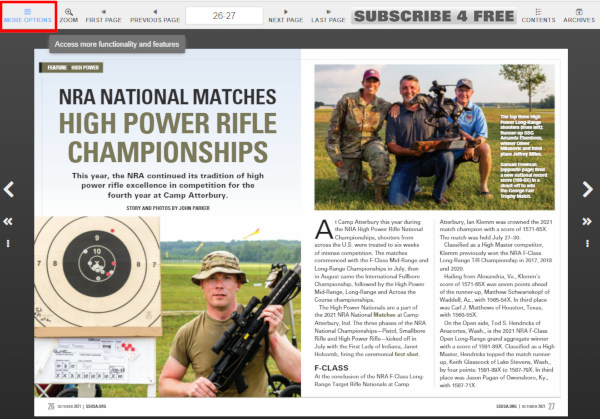
It’s easy to find back issues of Shooting Sports USA magazine. Here’s how: First, navigate to the latest SSUSA Online Issue (March 2024). Then click on the “ARCHIVES” icon in the upper right area (indicated with red arrow). When you click on “ARCHIVES”, a window will open with a selection of Shooting Sports USA magazine covers/dates in a vertical column. The most recent issue (March 2024) will appear at the top left. You can then scroll down — use the vertical scroll bar to go from March 2024 all the way back to June 2009. Click any issue cover to read.
How to Find and Save Articles
To search back issues, select “MORE OPTIONS” from the toolbar (top left). Then click the “SEARCH” button. When that opens, select either “Search Archives” for ALL back issues or “Search Only this Issue”. When you’ve made your choice, enter your search term(s). For example, you can search for “Camp Perry” or “Palma” or “F-Class Championship”. You can also save any archived issue as a PDF for viewing offline. Just click “SAVE” to download the article you’re currently viewing/reading.
Read Sample Articles
Here are a three of our favorite SSUSA feature stories from recent years. There are hundreds of other informative articles worth reading.
F-Class fans will enjoy the coverage of the 2023 F-Class World Championships in the June 2023 issue of Shooting Sports USA. On the cover is our friend and Forum member Erik Cortina.
Share the post "Access 15 Years of Shooting Sports USA Articles for FREE"
This 600+ page resource covers rifles, shotguns, handguns, muzzleloaders, airguns, optics and more. We like the print edition, but there is also a Kindle eBook version for $19.99 on Amazon. Both paperback and Kindle versions provide hundreds of photos plus new product roundups, in-depth product tests, and scores of articles and stories. FYI, the upcoming Gun Digest 2025 (79th Edition) will be released in late August 2024. Pre-order price is $39.63.
There are dozens of photo-illustrated feature articles. Among the notable stories are a guide to the new Hornady 7 PRC cartridge, a detailed history of .45-70 Gov’t rifles (from 1878 to the present day), an extensive review of single-shot falling block rifles, and a feature on custom and engraved rifles.
Gun Digest 2024 Editor-in-Chief Phil Massaro has assembled a large team of respected industry authors for the new book, including Kristin Alberts, Joe Arterburn, Craig Boddington, Joe Coogan, Rick Hacker, Jay Leyendecker, Robert Sadowski, Ron Spomer, Patrick Sweeney, Wayne van Zwoll, and many more.
Gun Digest 2024 covers hunting, personal defense, target shooting, gunsmithing, and collecting. There are Updated Ballistics Tables, and the catalog section shows off the newest offerings in rifles, handguns, shotguns, muzzleloaders and air rifles. The new 78th Edition has a vast collection of gun histories, in-depth reviews, and new product roundups. Written by top gun writers, the feature stories cover every aspect of guns and shooting — hunting, personal defense, target practice, gun making, and collecting. In addition to this, the Gun Digest 2024 book includes gun field tests, ballistic tables and more.
Reports from the Field cover the newest firearms and accessories. A Testfire section brings readers up to date on product performance. And there are over 30 feature stories, including the Guns of Western Movies/TV, Rimfire Handguns, and Hunting rifles.
Other Good Books from Gun Digest Media
Gun Digest Media produces numerous other quality books for rifle, pistol, and shotgun owners. Here are four books we recommend. These are offered in both paperback and eBook versions:
Share the post "2024 Gun Digest Annual is a Great 600+ Page Resource"
The Gathering is a special event presented by Palmetto State Armory that allows gun writers and regular shooters to try out a variety of firearms and accessories. The Gathering 2024 runs March 22-23, 2024 in Clinton, SC. There will be live-fire demonstrations along with opportunities to try various products. Guns on display included firearms from SIG Sauer, Glock, Springfield Armory, Taurus and more.
The Gathering is a Firearm Range Day and Expo presented by Palmetto State Armory. The Gathering brings together the firearms community, media and public to showcase new and existing firearms, optics, and accessories. This year’s event is held at The Clinton House Plantation, a 2000-acre facility that houses 17 live-fire shooting bays, two clay courses, a 1000-yard range, and a mile-long range.
At The Gathering 2024, Silencer Central will have live-fire demonstrations suppressors. CEO of Silencer Central, Brandon Maddox notes: “We’ve reinvented the process of buying a silencer and are thrilled to showcase… our products at The Gathering[.]” Attendees will be able to purchase a silencer, have required ATF ID logged, generate their free NFA Gun Trust, and digitally sign their ATF application all at the event.
The pandemic-caused cancellation of the 2021 SHOT Show range day inspired Palmetto State Armory to launch its own Industry Range Day called The Gathering. The first Gathering was a big success in 2021. In 2022, PSA had its second Gathering which was even bigger and better — see the video above. And last year, the 2023 edition of The Gathering was held with great success. See the video below:
Share the post "The Gathering Event in South Carolina March 22-23, 2024"
UltimateReloader.com offers some of the most thorough firearms and reloading tool tests on the internet. And UltimateReloader’s YouTube Channel has over 1040 great videos that showcase reloading tools, accurate firearms, precision optics, gunsmithing methods, and top-tier reloading components. For today’s Saturday at the Movies feature, we showcase five videos recently created by Gavin Gear and his UltimateReloader team. These videos highlight a superb Long-Range Target Camera, the remarkable AMP Press, the new Hornady PRC cartridges, and other interesting topics.
Since starting his channel in 2007, Gavin has released over 1040 videos showcasing reloading products, gunsmithing, and gun testing. Thanks to Gavin’s movie-making skills and hard work, his YouTube Channel now has 335,000+ subscribers. And over the years Gavin’s videos have received over 73.8 million views. Gavin’s videos have benefited shooting enthusiasts and hand-loaders around the globe.
Multiple Muzzle Brake Performance with .224 Bullets
This video includes some serious testing of muzzle brakes in three bore sizes. One each designed for .224 caliber, 6.5mm caliber, and .308 caliber. The goal of the project was to see how brake bore affected recoil reduction, and accuracy. Gavin’s team uses two rifles, one AR and one 22-250 bolt action. Gavin’s testing equipment allows him to plot recoil force with great precision. What did they find: “With optimized clearance [.224 brake] we got the lowest recoil”.
New LongShot Ranger and Ranger Plus Target Cameras
Longshot offers superb, reliable, high-resolution target cameras favored by top shooters around the world. Now LongShot is introducing a new Ranger series of target cameras starting at just $199.00 for the basic Ranger which runs at 100 yards. For those who regularly shot at longer distances, the new Ranger Plus reaches out to 1000 yards. Right now you can get the impressive Ranger Plus for a $299.00 “Pre-Order” sale price. The features of these two systems are compared in the graphic below:
Bergara Premier Competition Rifle in 6GT
The 6GT is a popular new cartridge originally developed for the PRS/NRL discipline. It has a case capacity and case length between the 6 Dasher and the 6mm Creedmoor. This allows it to rival the accuracy of the 6 Dasher with less recoil than a 6mm Creedmoor, and potentially longer barrel life because less powder is burned with each shot. In this video Gavin tests the new Bergara factory precision rifle chambered in 6 GT. This rifle is based around the Bergara Premier action with a stainless No. 7 taper 1:7.5″-twist barrel, set in an MPA BA chassis. CLICK HERE for full test article on UltimateReloader.com.
AMP Mark II DB and RAMP Bipod at SHOT Show 2024
Top Benchrest, F-Class, Palma, ELR, Silhouette, and PRS/NRL shooters use AMP annealers. These impressive, computer-controlled annealing machines allow you to get optimal, consistent neck tension. In addition, regular AMP annealing can significantly extend the life of cartridge brass. With good brass now running $130-$160 per 100 cases, you definitely want your brass to last as long as possible.
Shown above is the innovative RAMP Bipod from the New Zealand team that created the revolutionary AMP Annealing machine. This new RAMP Bipod allows easy yet secure elevation changes with the front bipod.
Caldwell Flash Bang Target Impact Indicators
We like reactive targets for the instant gratification that comes with a hit. When shooting steel it’s great to get that rewarding “ping” on impact. But sometimes it’s hard to hear, especially when the targets are far away. Caldwell’s Flash Bang target hit indicators solve this problem, providing visual feedback for the shooter, spotter, and spectators. Gavin notes that: “These small units will mount to any steel target and are incredibly affordable. At $37, replacing them if they are accidentally shot is not a huge loss. In fact, Caldwell is the first company to bring a hit indicator to market that doesn’t eat a hole in your wallet.”
Share the post "Saturday Movies: New Product Features by Ultimate Reloader"
This Week on Shooting USA – The 2024 SHOT Show
SHOT Show 2024 is featured on Shooting USA today on the Outdoor Channel. SHOT stands for “Shooting Hunting and Outdoor Tradeshow”. This is a huge event attracting over 2,500 exhibitors. This year was the biggest ever, with exhibits occupying 800,000+ square feet in the Venetian EXPO and Caesars Forum. If you watch just one episode of Shooting USA TV this year, this might well be a top choice. This episode has very good coverage of products from leading manufacturers including Colt, Smith & Wesson, Hogue, Hornady, Ruger, Mossberg and more. CLICK HERE for 3/6/24 SHOT Show episode highlights.
Shooting USA SHOW TIMES: This Shooting USA Episode airs Wednesday, February 14, 2024 at 9:00 PM Eastern and Pacific; 8:00 PM Central on the Outdoor Channel. If you miss the regular broadcast, you can stream the show online at any time on Vimeo for $0.99 per episode.
More SHOT Show 2024 Videos
Interested in more SHOT Show 2024 product coverage? Here are videos that cover new guns, plus the VelociRadar Chronograph and AMP Annealer displayed at SHOT Show 2024.
Share the post "SHOT Show 2024 on Shooting USA TV Today"
Day 2 of the IWA Outdoor Classics event (aka “Euro SHOT Show”) is underway. There will be two more days, with the show concluding on Sunday, March 3, 2024. This year’s event has been very popular, with high attendance. The show directors say there are over 1080 exhibiting companies from 53 nations at this year’s event. CLICK HERE to see hundreds of hi-rez photos from manufacturers’ displays at the 2024 IWA Outdoor Classics.
European Market for Civilian Firearms is Thriving
Europe’s civilian firearms industries are thriving, based on data from the European Institute of Hunting and Sporting Arms (IEACS). “Global production of civilian firearms has increased in recent years, as has European production, which recorded 3.6 million firearms produced in 2020, of which 2.7 million were pistols and 900,000 were shotguns and rifles. Compared to the previous year, this represents a 34% increase in European firearms production,” said Nicola Perrotti, IEACS president.
You’ll find over 130 new products on the IWA Outdoor Classics NEW Product Showcase. Product names are listed alphabetically, and you can also search by product type and/or country. Along with the new products you can also access ALL Products at the show. Here are three notable new products we found:
AZ-P1 Giant .38 Special Match Pistol from ARMA ZEKA s.r.o.
Ares LRF Thermal Scope from Thermtec
FZ-8 Hardshell Eco-Leather Full-Length Gun Case from Acropolis
IWA Outdoor Classics Special Programs
There are some cool special programs at this year’s IWA Outdoor Classics. Along with the expert speaker program, there is a Knife Demo Area, an Airsoft Shooting Range, and a very cool Optics Testing Area. We’d like to see that at SHOT Show in the USA.
New Product Showcase Video (English and German)
This video covers a variety of pistols and rifles on display at the 2024 IWA Outdoor Classics event. NOTE: This runs in English for 17 minutes, then the second half of the video is in German language.
This video shows Hornady’s AR-compatible, 22 ARC cartridge and Hornady’s new polymer-tipped ELD-VT bullet.
This video shows new Victrix model Tactical Bolt-action rifles suitable for PRS/NRL matches.
Blast from the Past — Eye-Catching Guns from 2023 IWA
If you like high-grade wood and handsome engraved metal, then watch this video compiled at the 2023 IWA Outdoor Classics. Similar eye-catching firearms are on display this year as well. In a world of polymer pistols and bland black MSRs it’s great to see classic high-grade wood and beautiful metal work.
The IWA Outdoor Classics show is very much about hunting. Here’s a display of the latest and greatest camo and Hi-Viz (day-glo) apparel for hunters.
Share the post "New from Nuremberg — Products at 2024 IWA Outdoor Classics"
Smith & Wesson Brands, Inc. (NASDAQ: SWBI) is selling a matched set of its new model 1854 Lever-action rifle and a matching Model 29. Both firearms feature handsome engraving with 22-karat Gold Inlay. These are great-looking guns as you can see. Just 100 copies of this matched pair, both chambered for .44 Magnum, will be sold. NOTE: We don’t have a price yet for the matched pair of engraved guns, but we expect it will be over $5000.00 as a limited edition Model 1854 Rifle is $3499.00 by itself.
In addition, S&W is now auctioning off the special Commemorative Edition engraved Model 1854 rifle and matching Model 29 revolver, set number 001. This Gunbroker Auction ends March 10, 2024.
With just 100 units being produced, this pair of .44 Magnums is extremely rare and boasts striking engraving with 22-karat gold inlay done by Baron Engraving. The limited-edition set features a PVD gloss black finish, complemented by high-grade walnut furniture that highlights true craftsmanship, and yields a classic aesthetic. Included with the nicely-designed display case is a letter of authenticity from Smith & Wesson President & CEO, Mark Smith, offering documentation on the set’s origin and limited status. Rifle/handgun set Serial number 001 of 100 is now available for auction on GunBroker.com.
Exclusively on Gunbroker Smith & Wesson is auctioning off No. 001 of 100 of S&W’s extremely limited edition Model 1854 accompanied by a Model 29. With custom gold inlay and high-grade walnut stocks, this is a great chance to own a piece of history!
Auction Proceeds Will Go to Rocky Mtn. Elk Foundation and Safari Club International
Proceeds of the auction are being donated to the Rocky Mountain Elk Foundation and Safari Club International. The current bid is now over $25,000.00! The auction ends on March 10, 2024.
Share the post "S&W Offers Special Edition 1854 Rifle and Model 29 Revolver Set"
Right now you can get HUGE SAVINGS on Sightron competition scopes at Creedmoor Sports. Save $630 on fixed-power optics, save $680 on 8-32x56mm SIII models, and save a whopping $1440 on the latest, advanced 10-50x60mm SV ED models. Other Sightron competition scopes are discounted $680 to $740, so you can save up to 40%. Don’t hesitate — these prices are good for just ONE MORE WEEK. This Sightron SALE concludes on February 29, 2024.
Save $1440-$1500 on Outstanding SV ED Series
The Sightron SV ED 10-50x60mm SFP is a great choice for F-Class, ELR, and long range target shooting. The 34mm body tube with ED glass provides 70 MOA elevation and 60 MOA windage. Large oversized tactical turrets with 1/8 MOA clicks provide 10 MOA per revolution. The patented F.A.S.T focus system provides two focus dials; the first operates like a standard quick acquisition focus knob, and the second provides a 4 to 1 gear reduction for smooth fine focus. Models include the 10-50×60 ED Target Dot .1 and 10-50×60 ED Zero Stop Target Dot .1.
Save $630 on SIII 36X and 45X Competition Models
Sightron SIII riflescopes are high-quality, non-zoom, single high-magnification optics for competitive shooting disciplines. Choose 36 power or 45 power. These are great choice for benchrest for score and group shooting. Models with Instant Savings are the 36×45 ED with Fine Cross Hair reticle, 36×45 ED Target Dot .125 reticle, 45×45 ED with Fine Cross Hair reticle, and 45×45 ED Target Dot .1 reticle.
Share the post "Major Sightron Sale At Creedmoor Sports — Huge Savings"


 ADM posts: “We are now offering alternate ring caps for the Delta Series Mounts featuring picatinny rails to accommodate the ever growing use of accessories and laser rangefinders on scoped carbines. The 5-Lug (Low-Red Dot) version can be used to mount a Red Dot or low profile laser sight. The 5-Lug (Low-Red Dot) version can be used to mount a Red Dot or low-profile laser sight. The 7-Lug (Tall-Laser Rangefinder) can be used for laser rangefinders such as the Vortex Impact 4000. The 7-Lug Version is currently available in 34mm, the 30mm version will be available in the near future. The ADM Ring Cap product includes 1 replacement ring cap and 4 mounting screws.”