Credit our buddy Joe Friedrich for this simple yet effective accessory for your benchrest rifle. Joe shoots a .22 LR benchrest rig with a barrel tuner. When he added weights to his tuner, he found his rifle no longer balanced well. He wanted to add some weight in the rear without drilling holes in the stock. He also wanted the weight to be removable, and easily placed on another rifle in his stable. He wanted a weight that could be moved from gun to gun as needed.
At a local sporting goods shop Joe found a 1.5-lb ankle weight that comes in a padded, tubular elastic cover. It’s like a 1.5-lb sausage in a soft, stretchy nylon cover. (Imagine a really fat, heavy bungee cord). Joe simply attached a plastic zip tie at the end to make a loop that fits perfectly over his buttstock. CLICK HERE for full-screen photo.
To “tune” the rifle’s balance, Joe just slides the ankle weight fore and aft on the stock. We have tried this moveable ankle weight on a variety of different BR stocks (including a McMillan Edge) and it worked perfectly. This is a great invention, and would work with sporter rifles and ARs just as well.
NOTE: Obviously, this ring will increase the measured weight of your rifle. So, if you are competing in a registered match with weight restrictions, you have to ensure that your rifle still makes class weight limits with the ankle weight ring in place.
Share the post "Removable External Weight Improves Benchrest Rifle Balance"
Here is Ernie Bishop’s pride and joy, a specialty pistol nicknamed “Batman” because the black carbon-fiber stock looks like the Batmobile. This is one sophisticated handgun. Complete with scope, the Batman pistol weighs under 7.5 pounds, thanks to the ultra-light stock. The carbon stock is 6 inches wide at the fore-end, yet weighs just one pound. Ernie tells us: “This gun shoots amazing and is easy to shoot especially with my SEB MAX Rest.” After these photos were taken, Ernie added a “field-usable rear-grip stock so [he could] shoot it prone from a bipod as well.”
The Batman pistol is chambered for the 6mm “Long Dasher”, a 6mm 40°-shouldered variant of the 6.5×47 Lapua. Ernie loads Berger 105gr Hybrid bullets pushed by Hodgdon H4350 powder.
Gun Specifications The gun, crafted by Eric Wallance of Nawaka Firearms, features an XP-100 action, Jewell trigger, and 15″-long, Brux 1:8″-twist barrel with aluminum muzzle brake. Interestingly, this gun does not have a traditional recoil lug. Instead, gunsmith Wallace milled out a lug from the bottom of the XP-100 action to save weight. On top of the action, the rig carries a Sightron Inc S-III 6-24X56mm scope in Kelbly rings on a custom +20 MOA rail.
Long Dasher Wildcat
Shown at right is a “Long Dasher” 40° wildcat created by Forum member Sunbuilder. This is very similar to Ernie Bishop’s chambering, though there may be small variations related to reamer design (such as freebore). Sunbuilder’s 6-6.5×47 Improved (aka “Long Dasher”) reamer was made by Dave Kiff of Pacific, Tool & Gauge. This wildcat cartridge adds about 2.0 grains capacity to the 6.5×47 necked down to 6mm. The case certainly is impressive with that 40° shoulder. We’re just waiting for the tactical guys to starting run this improved cartridge with its original 6.5mm bore.
Here are three FIVE-shot groups at 500 yards, shot by Ernie’s Batman pistol:
Share the post "The ‘Batman’ Bolt-Action Benchrest Pistol in 6-6.5×47 Lapua"
.009″ — The Record That Stood for 40 Years.
In 1973 Mac McMillan shot an amazing 100-yard, .009″ five-shot group in a benchrest match. The .009″ group was measured with a 60x microscope for verification. Mac McMillan shot the group using a handbuilt prototype McMillan rifle with an early McMillan stock.
Mac’s .009″ group was the “Holy Grail” of rifle accuracy. This .009″ record was considered by many to be unbreakable, a record that would “stand for all time”. Well, it took 40 years, but someone finally broke Mac’s record with an even smaller group. In 2013, Mike Stinnett shot a .0077″ five-shot group using a 30 Stewart, a .30 caliber wildcat based on the 6.5 Grendel. Stinnett’s .0077″ group now stands as the smallest 100-yard group ever shot in registered benchrest competition.* Read About .0077″ group HERE.
Stinnett’s success doesn’t diminish the significance of Mac McMillan’s .009″ group in the history of benchrest competition. For four decades Mac’s group stood as the ultimate standard of rifle accuracy*. For those of you who have never seen Mac McMillan’s .009″ group, here it is, along with the NBRSA World Record certificate. The target now hangs in the McMillan Family Museum.
*Somebody else might claim a smaller group, but unless moving backers or electronic targets were used, it cannot be verified. Moving target backers are used at registered benchrest matches to ensure that five (5) shots are actually fired in each group. That eliminates any doubt.
Share the post "This .009″ 5-Shot Group Set a Record That Stood for 40 Years"
This impressive 15-round group was shot by Jim See of Elite Accuracy.
Different Shooting Disciplines Demand Different Levels of Precision/Accuracy
In the rapid-fire 3-Gun game, you could probably “clean” most stages with a 2-MOA rifle. By contrast, in the short-range group benchrest game, to compete with the best, you’ll need a rifle that shoots in the “ones” (i.e. 0.1-0.19 MOA) in perfect conditions. In 1000-yard F-Class competition, the top shooters want a rifle that will hold one-third-MOA of vertical at that distance.
What is your standard of accuracy? How good is “good enough”. Jim See, a skilled gunsmith and successful PRS competitor, recently answered that question for his tactical discipline. For the kind of matches Jim shoots, he likes to have a rifle that will hold half-MOA for five (5) shots, 3/4-MOA for 15 shots, and 1 MOA for twenty shots. Remarkably, Jim’s rifle can do that with factory ammo. Above is an impressive 15-shot group shot with .260 Remington Federal Premium Ammo.
“I say it all the time, my loads need to print 5 under 1/2″, 10 under 3/4″, and 20 under 1″. It’s simple, if a hot barrel will keep 20 rounds fired in succession under my standard it will be a good barrel and load for Precision Match Shooting. Federal Premium Gold Metal Match .260 with Sierra bullets made the cut for me today. 15 consecutive shots under 3/4 MOA.” –Jim See
It’s said that you “can never have too much accuracy”, but there are acceptable standards for each discipline, and they’re not the same. A 100/200 yard Benchrest shooter will be sorely disappointed with a rifle/ammo set-up that can only deliver half-MOA. On the other hand, a PRS competitor like Jim See can achieve great success with a lesser degree of precision. This means you can save time and money. You can run your barrels longer between cleanings, and you don’t have to go “full OCD” when loading your ammo. The PRS shooter does not need to weigh-sort primers, or load powder to single-kernel standards. Proof is the performance. Jim See recently took third place at the Spearpoint Shootout, and he has been a podium finisher at other events. Learn more about Jim’s gunsmithing and training operations at EliteAccuracy.com.
Download This Load Development Target
Jim’s target seemed a bit familiar. AccurateShooter.com created this Diamond and Dot Target a few years back. On each aiming point, there are high-contrast black horizontal and vertical lines for aligning your cross-hairs. The gray circle lets you see the bullet impacts above, without obliterating the red diamond, which is quite useful for precise aiming (we put fine cross-hairs on the points of the diamond). This target sheet includes data entry tables below each of the three aim points. There are many other free targets out there, but this format is very popular. We’re pleased to see Jim using it. You can download this and dozens of other FREE Targets from the AccurateShooter.com Target Page.
Share the post "How Much Accuracy Is Essential for Your Shooting Discipline?"
Last month, Orangeburg, South Carolina became the epicenter of rifle competition on November 4-5, 2023 as the Mid-Carolina Gun Club hosted the widely-acclaimed Tack Driver IV. The Tack Driver has rapidly grown in popularity and stature, becoming a yearly must-attend event. The match’s rise in popularity can be attributed to several factors, including its organizer, the spirited Jim Cline, renowned for his quick wit, larger-than-life persona, and affinity for pranks. The Tack Driver’s popularity and status is further boosted by its unique format: shooting a mix of group and score targets at 300 meters. It has a generous 22-pound rifle weight limit and extends an invitation to all precision shooting disciplines. Competitors get the opportunity to compete with some of the world’s best shooters, have a great time, enjoy fantastic food, and see if they have what it takes to earn the title of “Tack Driver”.
What is the Tack Driver Match
For the uninitiated, the Tack Driver is a 300-meter “take-all-comers” match designed to answer the age-old question of which combination of caliber and shooting discipline is the most accurate. The rules are simple: all rifles will be fired from a bench, 22-pound weight limit, caliber must be .338 or smaller, and no one-piece rest is allowed. Each competitor will alternate shooting 5 group targets and 5 score targets over the course of two days. There are a few more rules, but those are the basics.
The Tack Driver’s course of fire alternates between score targets and group targets. So competitors must demonstrate both precision and accuracy. The group targets test precision, measuring only the group size for 5 record shots. Meanwhile, the score targets demand accuracy with a goal of hitting 5 separate 1″-diameter bullseyes, each with a single shot (ideally obliterating the dot in the center). Each target has a designated area for unlimited sighters during the 7-minute match. At the end of the match, the shooter with the best combination of the highest score and smallest group aggregate wins.
Beginning of Tack Driver IV — Cool Temps and Light Winds
Bright blue skies, light winds, and cool temperatures greeted the 99 competitors in attendance to compete for the title of Tack Driver Champion. The match, since its inception, has attracted a deep list of “Who’s Who” in the world of precision shooting. In attendance are World Record Holders, National Champions, Hall of Famers, Shooters of the Year, and World Team members. Literally the “best of the best” from UBR, Score, Group, 600-yard, 1000-yard, and Ground Hog competitions, were competing in this unique contest of “precision and accuracy.”
Tack Driver IV Video — Many Images from Match
Wayne Campbell’s Tack Driver-Winning 6 PPC Rifle
Wayne Campbell won The Tackdriver IV with a modern 6 PPC rifle. The components included: BAT 3-Lug action, Bartlein 5-groove barrel, Scarborough stock, Nightforce 42x44mm fixed-power scope, Bix ‘N Andy trigger. Notably, Wayne did most of the gunsmithing himself.
Results of The Tack Driver IV — Combined Grand Aggregate
The Tack Driver IV Grand Aggregate Winner is Wayne Campbell! Congratulations to Wayne who was also the Tack Driver Group Shooting Champion with a .7028 Aggregate! This is Wayne’s second year in a row to win this honor.
The “agony of defeat” award goes to Jeff Thompson. Jeff lead in group after targets 3 and 4 and appeared untouchable. However on target 5, Jeff shot an uncharacteristic 1.031″ group, which allowed both Greg Ellis and Wayne Campbell to surge past.
Top 5 Group Results
1. Wayne Campbell .7028
2. Greg Ellis .759
3. Jeff Thompson .7758
4. Jeff Summers .794
5. Dewey Hancock .804
Fun Group Fact: Jeff Summers and Wayne Campbell were the only competitors to keep all 5 groups below an inch.
Top 5 Score Results
1. Derick Loflin 245-2X
2. Stevie Salter 244-3X
3. Rober Seeman 244-3X
4. Dave “SuperMan” Way 244-1X
5. Gavin Peinhardt 243-2X
A big congratulations goes to Derick Loflin, the new Tack Driver Score Champion with a 245-2X. Once Derick moved into 1st place (after target 4 was posted) he never relinquished the lead.
Chambering Selections of Competitors — 6 PPC Most Popular
Of the 98 recorded chambering types for participants, the 6 PPC was the most popular with 39 entries. Next was the 30 BR with 27 entries. There were a dozen 6 BRAs (aka 6mmBR Ackley), plus 11 6mmBRs. There were three 22 PPCs and two each 30 Dasher and 6.5×47, with one Grinch and one 30 WW.
Saturday Morning Tack Driver Interviews with Top Shooters
Click NAME to view YouTube Interview Video:
Jeff Peinhardt, Tack Driver I Champion Hall of Fame Member
Samuel Hall, 600-Yard Shooter 3-Time National Champion
Here is the 0.337″ group shot by George Cabrera. George was shooting a 6mmBR rifle with Panda action (right bolt, left port, no ejector), Kelbly stock, Krieger 1:10″-twist barrel, Jewell trigger, Nightforce 12-42x56mm BR scope. George loaded his 6mmBR rifle with H4895 powder and Berger 90gr HPBT bullets. At 300 meters this 0.337″ group works out to 0.098 MOA (one MOA is 3.435″ at 300 meters).
Saturday Night Cookout with Smoked Prime Rib
With the range closed and targets hung, shooters and family members began gathering at the pavilion (on top of the hill) for the 6:30 feed. With a main course of Smoked Prime Rib, it was a packed house. Previous nights the shooters were treated to a low country boil and grilled chicken. The food throughout the event, lunch and supper is simply amazing. It’s a 5-Star dining experience served with paper plates and napkins. Here is a video of folks enjoying the festivities.
Prime Rib Night Video
Prelude — Tack Driver Lite (November 2, 2023)
This year started with a new event, “The Tack Driver Lite,” held on Thursday morning. two days prior to the regular Tack Driver. The match has two goals: first, to give early-arriving competitors something to do, and second to get the match director, Jim Cline, out from behind his computer and see how he stacks up against the competition. The Tack Driver Lite format is similar to the regular Tack Driver but with a couple of twists. The match consists of 4 targets (2 Score & 2 Group) instead of the usual 10 (5 Score & 5 Group). Each competitor was allowed to put out one flag. Prior to drawing a bench the shooter had to state at what range he would put his flag. Competitors have 7 minutes to shoot one Score and one Group target. The next twist is the targets were hung sideways, one on top of the other, instead of the normal straight up and down. It really shouldn’t make a difference, but visually and mentally it did. With the temperature in the low 30s and light and variable winds, twenty shooters took to the line.
Results of Tack Driver Lite
When the dust had settled Roy “The Renaissance Man” Hunter (photo below) found himself the winner of the score portion of the match, shooting clean with a perfect score of 100. Top dog was Billy Stevens who won both the Overall Grand Aggregate (combined score and group) and the Group Aggregate with a 0.689.
Target by Target Progress of the Main Tack Driver IV Match
A while back our Aussie friend Stuart Elliot of BRT Shooters Supply recently filmed some interesting videos at the QTS range in Brisbane, Australia. Stuart told us: “I was shooting in an Air Gun Benchrest match here in Brisbane, Australia. I finished my target early and was awaiting the cease fire and took a short, slow-motion video of windflag behavior.” You may be surprised by the velocity changes and angle swings that occur, even over a relatively short distance (just 25 meters from bench to target).
Here are windflags in slow motion:
The flags show in the videos are Aussie Wind Flags, developed by Stuart Elliot. These are sold through the Bench Rest Tactical (BRT) Precision Shooting Products website, along with many other fine products.
Here is a video in real time:
Stuart says this video may surprise some shooters who don’t use windflags: “Many people say the wind doesn’t matter. Well it sure does — whether for an airgun at 25 meters or a long range centerfire at 1,000.” This video illustrates how much the wind can change direction and velocity even in a small area.
Share the post "The Whims of the Wind — Slow-Motion Windflag Video"
Barrel-maker Dan Lilja’s website, RifleBarrels.com has an excellent FAQ page that contains a wealth of useful information. On the Lilja FAQ Page you’ll find answers to many commonly-asked questions. For example, Dan’s FAQ addresses the question of barrel life. Dan looks at factors that affect barrel longevity, and provides some predictions for barrel life, based on caliber, chambering, and intended use.
NOTE: This article was very well-received when it was first published. We are reprising it for the benefit of readers who missed it the first time.
Dan cautions that “Predicting barrel life is a complicated, highly variable subject — there is not a simple answer. Signs of accurate barrel life on the wane are increased copper fouling, lengthened throat depth, and decreased accuracy.” Dan also notes that barrels can wear prematurely from heat: “Any fast varmint-type cartridge can burn out a barrel in just a few hundred rounds if those rounds are shot one after another without letting the barrel cool between groups.”
Q. What Barrel Life, in number of rounds fired, can I expect from my new barrel?
A: That is a good question, asked often by our customers. But again there is not a simple answer. In my opinion there are two distinct types of barrel life. Accurate barrel life is probably the type most of us are referencing when we ask the question. But there is also absolute barrel life too. That is the point where a barrel will no longer stabilize a bullet and accuracy is wild. The benchrest shooter and to a lesser extent other target shooters are looking at accurate barrel life only when asking this question. To a benchrest shooter firing in matches where group size is the only measure of precision, accuracy is everything. But to a score shooter firing at a target, or bull, that is larger than the potential group size of the rifle, it is less important. And to the varmint hunter shooting prairie dog-size animals, the difference between a .25 MOA rifle or one that has dropped in accuracy to .5 MOA may not be noticeable in the field.
The big enemy to barrel life is heat. A barrel looses most of its accuracy due to erosion of the throat area of the barrel. Although wear on the crown from cleaning can cause problems too. The throat erosion is accelerated by heat. Any fast varmint-type cartridge can burn out a barrel in just a few hundred rounds if those rounds are shot one after another without letting the barrel cool between groups. A cartridge burning less powder will last longer or increasing the bore size for a given powder volume helps too. For example a .243 Winchester and a .308 Winchester both are based on the same case but the .308 will last longer because it has a larger bore.
And stainless steel barrels will last longer than chrome-moly barrels. This is due to the ability of stainless steel to resist heat erosion better than the chrome-moly steel.
Barrel Life Guidelines by Caliber and Cartridge Type
As a very rough rule of thumb I would say that with cartridges of .222 Remington size you could expect an accurate barrel life of 3000-4000 rounds. And varmint-type accuracy should be quite a bit longer than this.
For medium-size cartridges, such as the .308 Winchester, 7×57 and even the 25-06, 2000-3000 rounds of accurate life is reasonable.
Hot .224 caliber-type cartridges will not do as well, and 1000-2500 rounds is to be expected.
Bigger magnum hunting-type rounds will shoot from 1500-3000 accurate rounds. But the bigger 30-378 Weatherby types won’t do as well, being closer to the 1500-round figure.
These numbers are based on the use of stainless steel barrels. For chrome-moly barrels I would reduce these by roughly 20%.
The .17 and .50 calibers are rules unto themselves and I’m pressed to predict a figure.
The best life can be expected from the 22 long rifle (.22 LR) barrels with 5000-10,000 accurate rounds to be expected. We have in our shop one our drop-in Anschutz barrels that has 200,000 rounds through it and the shooter, a competitive small-bore shooter reported that it had just quit shooting.
Remember that predicting barrel life is a complicated, highly variable subject. You are the best judge of this with your particular barrel. Signs of accurate barrel life on the wane are increased copper fouling, lengthened throat depth, and decreased accuracy.
Benchrest Barrel Life — You May Be Surprised
I thought it might be interesting to point out a few exceptional Aggregates that I’ve fired with 6PPC benchrest rifles with barrels that had thousands of rounds through them. I know benchrest shooters that would never fire barrels with over 1500 shots fired in them in registered benchrest matches.
I fired my smallest 100-yard 5-shot Aggregate ever in 1992 at a registered benchrest match in Lewiston, Idaho. It was a .1558″ aggregate fired in the Heavy Varmint class. And that barrel had about 2100 rounds through it at the time.
Another good aggregate was fired at the 1997 NBRSA Nationals in Phoenix, Arizona during the 200-yard Light Varmint event. I placed second at this yardage with a 6PPC barrel that had over 2700 rounds through it at the time. I retired this barrel after that match because it had started to copper-foul quite a bit. But accuracy was still good.
Share the post "What Determines Barrel Life — Dan Lilja Explains Key Factors"
While there are many very, very talented women shooters, it’s still a bit unusual to see many ladies on a long-range firing line. It’s even more unusual to find a women shooter who regularly beats all the “good ol’ boys”. This week we feature Katy from California, who has competed in Varmint Silhouette matches with a very stylish and accurate Stolle 6BR. Along with husband/spotter Don (who shoots a 6mm Dasher), she has been one of “Top Guns” at the popular Pala Shooting Range in North San Diego County. Here’s a view of the Pala facility, looking down-range at the rows of silhouette targets:
Pala — A Mecca for Southern California Shooters
Near the Indian Casino and Resort in Pala, California is one of the longest rifle ranges in the state. Pala hosts a wide variety of shooting matches — cowboy action, lever action silhouette, black powder silhouette, hi-power silhouette, tactical pistol and rifle matches, to name a few. The black powder buffalo and tactical rifle matches use the longest range with 900-meter targets. Katy and her husband Don have competed in Varmint Rifle Silhouette matches, which were held monthly in years past. Range Info: Range.palatribe.com.
Katy tell us: “These Varmint Silhouette matches are a lot of fun! It’s very satisfying to see the little critters fly off the rail. A good spotter will note how the target flies when hit–‘Did it turn right or left? Did it lift up or fall back?’ Steel targets reveal more about real world ballistics than just a hole in a piece of paper. And nothing beats reactive targets for fun shooting.”
For Katy and Don, shooting is a family affair: “I started shooting the varmint rifle silhouette at the encouragement of husband Don. He bought/built himself a 6mmBR to shoot the varmint rifle match and re-barreled an old Hart-sleeved Remington 700 to fast-twist .223 for me to use. I did pretty well for a beginner, winning a match after just a few months of competition. Winning with that .223 had competitors scratching their heads. Frankly, it was just a fortuitous combination of great spotter, steady hold, and a good rifle. That .223 was certainly a very accurate piece. I always expected the bullet would hit right where the rifle was aimed, if we called the wind right. But like all good things, with time the .223’s accuracy began to fade. As the barrel finally gave up the ghost, a replacement was ready–a bright red Panda bear chambered in 6mm BR.
Beating the Guys at their Own Game
With my old .223, I won five varmint matches between December 2000 and April 2002. I also won my class (Master) in June, 2001. However, with the 6BR Panda, I shoot higher scores and have now had four match wins between May, 2003 and August 2004. And I won my class twice in 2003. Over time, as our competitors’ skills and firearms have improved, the criteria for shooter classification has been upgraded. Originally, one could miss 10% of the animals and qualify as a “Master” shooter. A few years ago, the criteria was tightened to 5% misses to earn “Master” status. This 6mmBR has kept me up in Master class.
I’ve done well enough with my little Red Panda that folks have been asking me about my shooting technique. Both Don and I shoot free recoil. We keep everything off the rifle except the trigger finger and thumb. Keep your shoulder back from the butt, and make sure your cheek doesn’t contact the stock and that your shooting cap doesn’t hit the scope. Fine-tune your elevation by squeezing on the rear bag. I use a front rest forearm stop to keep the rifle in the same place on the front rest. After firing, pushing the rifle back against the front stop usually verifies rifle tracking and allows a quick check of how far off the sighter shot’s impact was from point of aim.”
The Female Perspective — Katy’s Views on Shooting
We all know women can be crack shots. The little lady in the picture proved that more than a century ago. Competitive shooting is one of the few sports where women can and do compete head-to-head with men — and often win. [Amanda Elsenboss recently won the National High Power Championship and the National Long Range Championship. And Nancy Tompkins and her daughter Sherri Gallagher have won National shooting titles.] But the fact remains shooting is still very much a male-dominated sport. Here are some of my thoughts on how that might change.
Beneficial Aspects of Shooting
The first and most important benefit of competitive shooting is learning to handle a rifle/firearm safely. We’re well past the time when women should have conquered their fears of guns. An added benefit would be increasing a woman’s ability to respond to any threats. I remember when I was in college and we took my anti-gun roommate out to the range for a shooting lesson. She had a great time shooting away. She learned that firearms are not just “scary”, but also an enjoyable tool.
How to Get More Women Involved
Since we aren’t going to get the silencer legislation changed to improve women’s enjoyment of the sport, we will have to promote other aspects of shooting. I think shooting sports can increase self-confidence, giving women a sense of accomplishment and inner strength to remain calm under stress. It is very satisfying to see a positive result (at very long distance) of your focused efforts. Developing skill at any sport can improve one’s self-image and coordination. Encourage the women in your life to join you at the range. Believe it or not fellows, your wives and girl friends like to spend time with you. At Pala, some of the wives make the best spotters, even though they don’t shoot.
I find these varmint silhouette matches ideal from the standpoint of a woman’s participation. First, you get to lay down and shoot–that’s much more relaxed than classic position-shooting. Second, the really heavy rifle is supported on front and rear rests so that all you need to do is carefully guide the rifle, concentrate on the sight picture and pull the trigger when everything lines up. And, by the way, I clean house and prepare the meals, while my husband Don cleans the rifles and prepares the ammunition.
Dealing with Noise Pollution
The first thing a women notices at the range is how much noise these rifles make. How can anyone carry on a decent conversation, much less think with all the racket? Practice days are the worst–there is just constant gunfire with very few ceasefires. Matches are fine, because there is only gunfire during warm-up and then for 8 minutes during each relay. On the firing line, I wear both fitted earplugs and ear muffs to tolerate the decibels. Being heard and understood is always a problem during the match.
Shooters’ Techno-Babble–I Guess It Really Is a “Guy Thing”
One of my fellow female shooters commented that, at the range, the guys never seem to talk about anything but firearms and their accouterments at the range. Although I am familiar with the term “minutes of angle” I have gotten sloppy in my speech and generally just report how many clicks one needs to adjust for the wind or the sighter shot. Reading Don’s equipment discussion confused me when he kept referring to MOA. I have been with non-shooting friends several times when knowledgeable shooters start talking firearms. It is as if they are speaking a different language, and my friends look to me with a puzzlement on their faces. Well, in fact it has its own language and I think I’m getting finally getting able to speak it.
Katy’s 6BR — Technical Primer by Hubby and “Loadmaster” Don
Way back in 1990 a Precision Shooting magazine “Trading Post” advertisement offered a low-mileage, Panda-actioned .262″ neck, 6mm BR rifle and all the reloading accouterments. This light-varmint class rifle was built in the mid-1980’s around an unusual round Panda action with straight-fluted bolt. As configured, the gun had performed very well indeed–shooting many groups in the zeros. The action is glued into a Lee Six thumbhole BR stock and uses externally accessible pins to hang the 3 oz. trigger. The scope is an older 36X Leupold BR model, held by Kelbly rings on a Davidson base. The original barrel was a 4-groove, 14-twist, apparently made by Pat McMillan. A hand-written information tag taped to the underside of the barrel was discovered upon its removal, and indicates the barrel was fitted by JACO, April 1986. Anyone know who that is?
The 14-twist barrel could not stabilize any bullets greater than about 80 grains. It would keep an 80-grain Starke inside 0.4″ at 200m with a velocity of 3120 fps using 31.8 grains of Varget. However, the 80-grain bullets were blown all over by the winds out to 500 meters.
Past success with Pac-Nor pre-fit barrels inspired me to order a 28″, 4-groove, 8.6″-twist barrel chambered with their .262” neck 6mm BR reamer. Pac-Nor crowned and chambered the barrel; and, in this case, threaded it to fit a Panda action. After we installed the barrel on the action, we found that the bolt nose touched the conical barrel breech face. 0.010” needed to be removed from the cone face so that the bolt closed with a perfect fit. Headspace is now just right at 1.167″.
Load Development
My experience with a couple of other fast-twist 6BRs, one also chambered with Pac-Nor’s .262″ reamer, suggested that the 95gr Berger VLDs would work well the estimated 0.060″ freebore in Katy’s rifle. The goal was to get 2800-2900 fps velocity with inherent accuracy no worse than half the smallest silhouette size. That meant we needed a load that delivered repeatable 0.4 MOA accuracy or better.
A new batch of Lapua 6mm Norma BR brass was neck-turned to 0.0083″ wall thickness to fit the chamber and fire-formed during barrel break-in, following Pac-Nor’s guidelines. We tried a bunch of different moly-coated bullets at 200 meters, most with moderate charges of H322. The results of the bullet-testing ranged from poor (over an inch) to astonishing (68-grain, flat-base Eubers over 29.7 grains of H322 went into about .25″ at 200 meters!) But these flat-based bullets lacked the high ballistic coefficient we wanted for the varmint silhouette match. So we tried the 95-grain VLD Bergers (0.5+ BC) and produced several good loads, all sparked by Federal 205m primers. The best load seemed to be 28.2 grains H322 at 2860 fps, followed by 30.4 grains N135 at 2920fps, and 31.0 grains of Varget at 2890 fps.
All loads shot better than 0.4 MOA, but the H322 seemed a little more accurate, and about twice as much H322 was on hand. So, after about 120 shots the barrel was conditioned, brass formed and a match load selected for the 95 VLD Bergers. Bullets are seated about 0.010″ into the rifling for a typical cartridge LOA of 2.325”, which puts the heel of the 95 VLD boat-tail just below the case neck-shoulder line. Cases are sized with a Wilson neck bushing die that works only the upper 2/3 of the case neck to support the bearing surface of the seated bullet.
Don’s Handy Guide to Varmint Silhouette Shooting
Varmint Silhouette–Origins and Basics
Over a decade ago, a metallic silhouette match was devised for typical varmint rifles at the North County Shootist Association range near the hamlet of Pala, in north San Diego County, California. The course of fire used the conventional rifle silhouette range with banks of 10 special varmint targets sized 0.8 to 1.0 MOA (Minute of Angle) in width. At five different yardages, ten steel “critter” targets are set as follows: 200 Meters – Field Mice (“pikas”); 300 meters – Crows; 385 meters – Ground Squirrels; 500 meters – Jack Rabbits; 600 yards – Prairie Dogs. The folks at Pala run a tight ship, cycling multiple relays efficiently, so everybody gets to shoot 50 targets (10 each at five different yardages), and the show is usually completed by 1:00 pm. There’s a one-hour sight-in period starting at 8:00 am, and the match starts at 9:00 am sharp. Newcomers should definitely arrive no later than 7:45 am, because you may need that full sight-in period to acquire solid zeros at all five yardages.
Firearms are limited to field-portable, varmint-caliber rifles in either custom or factory class, and having a maximum 6.5mm bore, but bullets must weigh no more than 107 grains. You can shoot prone or from a bench using a front rest and bag rear. For more information, visit Range.palatribe.com.
Match Rules and Shooting Procedures
Matches are fired as a team — shooter and spotter. The course of fire typically consists of 10 steel, knock-down varmint animal targets at each of the five distances. After firing a sighter, targets are taken from left to right, one shot per target. Missed targets remain standing. Any target struck out of sequence is also a “miss”. The shooter’s objective is to sequentially knock-off (clean) all 10 targets. The spotter’s duties are to support the shooter in all aspects of shot preparation. First and foremost, the spotter tries to see each shot impact and call appropriate windage and elevation adjustments for the shooter. In shifty conditions, a good spotter is vital.
Let’s start at the beginning. Before the match there is usually an opportunity to fire a few fouling shots and check sight settings for load and distance. An initial read on conditions–mostly wind direction, strength and consistency–is also made. The spotter should checklist the shooter to make sure they are set up for the relay distance and have adjusted their sights to the correct elevation and windage.
It could be argued that for the shooter, the first shot at a given distance, the sighter shot, is the most important shot fired. Since the sighter targets are fixed (don’t fall over) and freshly painted, bullet impact is obvious to both shooter and spotter. If the bullet hits where expected–point of aim–the spotter then tracks and calls observed changes (mostly wind) relative to the shooter’s initial scope settings. If point of impact shifts on subsequent record targets or the shooter misses, appropriate sight adjustments are recommended to the shooter. Admittedly, it is sometimes difficult or impossible to see the point of impact on these small, reactive targets. However, an estimate of bullet strike can be made from target behavior such as rotation and/or impact trajectory.
The Guacamole Connection
Katy and Don are avocado farmers. From time to time they’d bring a few avocados to the range to give to the other shooters. In addition, on some months, Katy would bring some home-made Guacamole made from the avocados on their ranch. Katy says “Fellow shooters appreciate a batch of guacamole so much they bring their own chips to go with the dip. I keep getting suggestions that I go into the business of making and selling guacamole. Guess I could start by selling it at the range.”
Katy’s Guacamole Recipe
4 ripe avocados, peeled and pitted
1/2 lemon squeezed (I use Meyer lemons, lime juice is also good)
1/2 cup fresh salsa — your favorite variety
1 tsp garlic salt or fresh garlic chopped
All of the above quantities can be adjusted for taste. Mash the ingredients with a potato masher. Serve with chips, fresh vegetables (carrot sticks, celery, broccoli), or as garnish for tacos, burritos, taquitos, etc., and as special treat – spread on warm buttered toast for breakfast.
Good Shooting and Bon Appetit! — Don & Katy
No reproduction of any content is allowed without advanced permission in writing.
Share the post "Sunday Gunday: Katy’s 6mmBR for Varmint Silhouette Matches"
They say that a man can never have too much money or too much time. Darrell Jones would add that a man can never have too many BR-based rifles. Darrell had a fleet of BRs, in 22 BR, 6mm BR, 6.5 BR, 7 BR, and 30 BR. But he was intrigued by the potential of a rifle in the .257 caliber. Could it shoot as well as a 6mm BR? Could it challenge the more popular calibers in the highly competitive 600-yard benchrest game? Through careful research and component selection, Darrell created a 25 BR rifle that proves the viability of the 25 BR as a competition round. Pushing 115gr high-BC Berger bullets at 2837 fps, Darrell’s 25 BR “Peppermint” won first place in its very first match.
The Barely Bigger BR — Exploring the .25 Caliber Option
Rifle Report by Darrell Jones
I decided to build a 25 BR after several weeks of deliberation and ruling out a .257 Ackley Improved. Part of my dilemma was that I wanted to shoot F-Class competition at 600 yards, and I was unsure about the accuracy potential of the 25 BR. However, I currently have several BRs chambered in 22 BR, 6BR, 6.5 BR, 7 BR, and 30 BR and they all shoot exceptionally well at 600 yards. This lead me to believe a 25 BR should deliver fine accuracy, just like its other BR siblings. Why wouldn’t a 25 BR shoot accurately provided that I built it with the right components? The feasibility saga began. I began searching diligently for custom 25-caliber bullets. Unfortunately, there are not many 25-caliber custom bullet makers. I actually found only two custom bulletsmiths who produce the 25s. I did look at Fowlers and then looked at Bergers. Both Jeff Fowler and Berger made 110-grain flat-base bullets when I was looking. [Editor — this 110gr bullet is no longer listed by Berger]. The Berger 110gr FB bullets (.414 ballistic coefficient) shot very well out of my 12-twist 25-06 Ackley. However, I wanted to shoot a heavier bullet if possible. Berger makes a 25-caliber 115gr VLD boat-tail with a high ballistic coefficient. This needs a 10-twist barrel.
Panda Action, McMillan Stock, Weaver T-36
As you can see, I went with a Panda polished action and a weighted McMillan BR stock painted metallic silver with red candy cane stripes thus the name “Peppermint”. This gun actually does double duty now as a 25 BR and 6 PPC switch barrel. When I want to run the gun as a 6 PPC for short range, I simply screw on the PPC barrel, then swap in a bolt (fitting the PPC bolt face) from another Panda action I own. That’s one advantage of owning custom Kelbly actions! Don’t even think about exchanging bolts between factory guns. Kelbly rings and a Weaver T-36 fixed-power scope handle the optical duties while a Jewell trigger set at one ounce takes care of the firing mechanism.
Chambering for the .25 Caliber BR Wildcat
I wanted a chamber that would let me shoot both the 110s and the 115s. I took some time surfing the net looking for rental reamers that had suitable throat dimensions. I found that Elk Ridge Reamer Rentals had a 25 BR pilot reamer available. I called and Elk Ridge faxed me a reamer diagram that indicated it was designed to tight SAMMI specs. I asked how often was the reamer used and was told “not very often”.
I did want a minimum no-turn neck optimized for Lapua brass. The drawing indicated that the reamer would cut a .281″ neck and a throat of 1.0315″. This was very close to ideal, though I did have to turn two thousandths off the necks of Lapua 6BR brass after I necked it up. I resized using a .277″ bushing and the loaded rounds came out to be .279″. Realizing that this was in the ball park, I decided to go with the Elk Ridge Reamer and build a 25 BR that could shoot 110gr or 115gr bullets. Now the question was where to get a match-grade 25-caliber barrel. I called quite a few of the custom barrel-makers, including BlackStar Barrels in Texas (no longer operating). I have had wonderful success with the BlackStar barrel on my 6BR “Chantilly” — it delivered great accuracy and impressive velocities. Since the 25 BR was so similar, I went with another BlackStar. I ordered a 10-twist, 6-groove, 1.250″-diameter straight-contour tube.
After chambering, the barrel finished at 1.245″ diameter and 27.5″ inches with an 11° crown. I actually had the throat lengthened to accept both Berger 110gr and 115gr bullets. The bases of the FB 110-grainers sit flush with the neck-shoulder junction, when they are seated .010″ into the lands. With the longer 115gr VLDs, the bottom of the bearing surface (i.e. start of boat-tail) is just about even with the neck-shoulder junction.
Accurate Load Development
The barrel broke in easily with just 10 shots, using a “shoot one and clean” process. The load I started with was 31.5 grains of Varget with CCI 450 primers. The Berger 110s and Berger 115s had the same Point of Impact (POI) at 100 yards. However, the 115s impacted two inches higher at 600 yards with the same load. That shows the benefits of a higher BC. Pushed by the CCI 450s and 31.5 grains of Varget, the 115-grainers were running about 2837 FPS. I boosted the load up to 32.0 grains but I noticed primer cratering, so I backed off, settling on 31.5 grains for the 115gr Berger VLD.
Peppermint Wins at 600 Yards
For her debut in competition, I took “Peppermint” to our local 600 yard F-class match. Shooting the Berger 115s with 31.5 grains Varget, she won with a perfect score of 200 with 14 Xs. At my club, we use a SR3 target. The X-Ring measures 3″ in diameter and the 10-Ring measures 7″. At the match there were some very good shooters with top-flight custom rifles in accurate calibers such as 6.5-284 and 22 Dasher. I was very fortunate to come out on top, but I give the credit to Peppermint’s good bench manners and outstanding accuracy.
As you can see from the target, “Peppermint” is a very accurate rifle that has proven herself in competition. It takes a good gun to finish “on top” in her very first match. So far, I’m very happy with the project, and more than satisfied with the accuracy of the 25 BR. This is definitely a worthy cartridge for Egg Shoots, 500m varmint matches, and the 600-yard F-Class game.
BR-Based Cartridge Comparison
CALIBER
22 BR
6mm BR
25 BR
6.5 BR
7 BR
30 BR
Bullet
80gr SMK
107gr SMK
115gr Berger
107gr SMK
130gr SMK
118gr BIB
BC
.420
.527
.522
.420
.391
na
Load Grains
31.0 H4350
30.0 Varget
31.5 Varget
32.0 Varget
34.0 AA2460
34.0 H4198
Barrel Length
27″
27″
27.5″
27.5″
28″
24″
Velocity
3100 fps
2880 fps
2837 fps
2851 fps
2719 fps
2970 fps
Comparing the BR-Based Variants
Now that I have several calibers in the BR cartridge family, (22 BR, 6mm BR, 6.5 BR, 7 BR, and a 30 BR), it is my humble opinion that they each have their own place. A varmint hunter’s dream, the 22 BR can push a bullet faster and more accurately than the 22-250. With an 8-Twist barrel, the 22 BR can send an 80gr SMK to 600 yards with extreme accuracy.
The 6 BR can do it all. The 6mm caliber offers a wide variety of quality bullets suitable for any shooting situation. All the major custom barrel makers produce outstanding 6mm barrels in a full range of twists. Moreover, since the 6 BR cartridge is so popular, there is a great store of knowledge about reloading for the 6 BR. It is easy to find a load that will shoot superbly in any bullet weight.
The 25 BR has proved to be easily tuneable, proficient and not fickle. You can obtain extreme accuracy without great effort in load development. The 115gr Berger offers a good high-BC projectile for this caliber, making the 25 BR a viable alternative to the 6 BR. As I’ve shown, it is competitive with a 6 BR in head to head competition.
Compared to the 25 BR, the 6.5 BR has a small edge in ballistics. However, there are not many light bullet choices available, especially from custom makers. The 123gr Lapua Scenar is an excellent bullet with a .547 stated BC, but it may be a bit heavy for the case capacity.
The 7 BR was designed for silhouette shooting, and it excels at that task. The 7 BR can push a 130 grain bullet fast enough to knock over the steel silhouettes at 500 meters with real consistency.
The 30 BR is nothing less than outstanding. The 30 BR is now the dominant cartridge on the benchrest Score-shooting circuit. It is also highly accurate for group shooting at 200 yards and very capable of winning a 600-yard F-Class match. Barrel life of over 6,000 rounds is realistic.
I like all the “flavors” of BR derived from the 6mm BR Norma case. However, if I could only have one BR in my safe, give me my 8-Twist, 6 BR “Chantilly” and I will be a happy camper. The final point I would make is if a cartridge is stamped BR on the case, it will shoot extremely accurately if you can.
Share the post "Sunday GunDay: 25 BR Benchrest Rig — The .25 Caliber Option"
What’s better than a super-accurate 6BR rifle? Well, two super-accurate 6BRs. This week we feature a pair of tack-drivers owned Forum member Mark Schronce. These “Brothers in Arms” share similar stocks, but otherwise the components are different. Mark’s 17-lb gray laminate Light Gun features a Hall action, HV taper barrel, and muzzle brake. The 21-lb Heavy Gun, in “Desert Camo” laminate, boasts a trick dual-port BAT action, and full-contour 30″ barrel without brake. Both guns shoot tiny groups, track like they’re on rails, and give Mark a serious hardware advantage in club competition.
Mark provides this report: “The Light Gun started as my 22-250 AI varmint gun, with a Hall action and McMillan Hunter Benchrest stock. I wanted to build a proper Egg Shoot gun, so I had Richard Franklin (Richard’s Custom Rifles) chamber a Lilja 12-twist in 6mm BR Norma, with a .262″ neck. Using Fowler 80gr FB bullets, the gun shot great right out of the gate. (See my report, Egg Shoots and 600-yard 6 BR). I was curious about the heavier 6mm bullets, so I had Richard chamber and fit a 1:8″ Krieger in 6BR. But this time we went with a .271″ no-turn neck. The Krieger holds quarter-MOA with the heavy bullets, and, to my surprise, it shot the 80s as well as the 12-twist Lilja did. For the 2005 season, I ordered one of Richard’s latest 008 F-Class stocks. This new design is very comfortable to shoot and it’s much more stable in the bags than my old Hunter stock. That added stability will be a big plus for 600- and 1000-yard benchrest matches.
A Heavy Gun for 1000-yard BR and “Belly Benchrest” (F-Class)
I’ve been active in 1000-yard Benchrest for a few years, shooting my 6mm BS and 6mm BR Light gun in both Light and Heavy classes. I wanted to build a rifle for the Heavy Gun Class yet stay within the 22-lb F-Class limit. And I wanted it to have the best hardware I could buy. On a BAT ‘MB’ action (with Jewell trigger) we fitted a 30″ 8-twist 3-groove Lilja, 1.250″ diameter, no muzzle brake. Richard cut the chamber for 6mm BR Lapua Brass, .271″ no-turn neck, throated for Sierra 107gr MKs, matching my current Light Gun. The stock is a pillar-bedded Richard’s 008 1000-yd/F-Class model, with 10 coats of auto clearcoat, all work by Richard. Burris Zee rings hold a Leupold 8.5-25×50 LRT mounted on a BAT one-piece Weaver base. The Heavy Gun weighs in at 21 lbs, much lighter than most Heavy Guns (50 to 100 lbs). But with the 6BR’s light recoil, it’ll do just fine for long range, yet still make weight for F-Class.
Why a 6mm BR Chambering in a Heavy Gun?
I toyed with the idea of going with a 6BR Improved for Heavy Gun, but I’m not convinced the Improveds are worth the extra hassle of fire-forming, not to mention the added cost of custom dies. By way of background, I used to have a Rem-actioned rifle chambered in 6BR BS (Bill Shehane), which is very similar to the 6BR Dasher. I found the 6BR BS was only about 100 fps faster than a standard 6BR. For the shooting I do, that extra 100 fps is not critical. If, in the future, I feel I need more speed, I will go to a .243 AI or a 6.5-284. To be honest, I love the 6BR cartridge. Barrels last forever, and the accuracy can’t be beat. Yes a 6BR is a little light for everyday 1000-yard shooting, but on good days it can set world records. I may move up to a 6.5-284 some day, but for now I will stay with the standard 6mm BR. If I ever do want to go to a bigger caliber, the 8.5-inch BAT Machine MB action gives me this option.
Hall vs. BAT Light vs. Heavy
Comparing the two actions’ bolt lift, lock-up, fit, and finish, I feel they are equally good. However, the BAT can run stout loads with Federal 205 primers — loads that cratered Fed 205s with the Hall. I don’t know if this is a function of the actions’ engineering, or the barrels. I’ve got a Lilja on the BAT, while the Hall wears a Krieger. I do know the BAT has a tight-fitting firing pin, and that might make a difference.
Both my actions have a built-in recoil lug — a really nice feature when you are changing barrels, and one of the main reasons I favor custom actions over a Remington. I think anyone would be pleased with either the BAT or the Hall.
There is a big difference in shooting a Light Gun vs. a Heavy Gun, as you might expect. The Heavy Gun is more stable and recoils straight back. However, even at 21 pounds, the Heavy Gun actually recoils harder into your shoulder than the muzzle brake-equipped Light Gun. But if you take the Light Gun’s brake off, and put the action back in the old Hunter bench stock, the gun would jump, torque and roll. It’s much better with the 008 stock now, but still not as rock solid as the Heavy Gun. On recoil the 21-pounder just tracks straight back, no jumping, no yaw, no rolling–very impressive.
Load Development and Accuracy Results
Developed last year, my favorite Light Gun load is 30.5 grains Varget, CCI BR4 primers, and 106gr Clinch River VLDs, running 2825 fps. The Light Gun shoots other bullets very well, but the Clinch Rivers performed best, with groups in the 0.1s to the low 0.2s at 100 yds. I use Lapua brass of course.
I began my load development for the Heavy Gun with components I had from last year: Varget, N140, and N540 powders, plus Fed 205, CCI BR4, and CCI 450 primers. I also had a good selection of bullets: 95gr and 105gr Bergers, 105gr Lapua Scenars, 106gr Clinch Rivers, and 107gr Sierra MKs.
The Heavy Gun liked the Bergers right from the start. During break-in and fire-forming (with 95gr Bergers 0.20” into the lands, 30.0gr Varget and CCI 450s), the rifle shot in the low 0.2s at 100 yds, 0.3s at 200 yds, with a 0.182″ small group at 200 yards (see photo). I then moved up to the heavier bullets and again the Bergers stole the show. Best load for the Berger 105s (seated 0.15″ into the lands) was 30.5 grains Varget and Fed 205s at 2850 fps. At 100 yards, this recipe shot in the 0.1s to the low 0.2s with a small group of 0.089″. (By the way, this same load in my Hall Light Gun would crater the Fed 205 primers. I may have to change to CCI BR4 primers for the hot summer days.) After working with the 105s I wanted to see how the Heavy Gun performed with lighter bullets. I tried my favorite Egg Shoot and 600-yard load–80gr Fowlers pushed by 31.5 grains of Vihtavuori N135 with Fed 205 primers. The results were fantastic. The big BAT produced a 100-yard aggregate (five, 5-shot groups) in the 0.2s with an 0.129″ small group. Overall, at 200 yards, both guns could agg five 5-shot groups in the 0.3s and 0.4s. Eggs Beware!
Big, Strong, and Versatile ‘MB’ Action by BAT Machine
I looked at all the custom actions, and decided on a BAT model ‘MB’, configured Right Bolt, Left Port, Right Eject. The ‘MB’ action has some pretty unique features, including an integral recoil lug on the underside, and a recessed tenon (i.e. the threads start 1″ from the front of the receiver). The action is 8.5″ long, but with a 7.5″ bolt. The extra inch is added to the front. That provides extra bedding surface and room for a third pillar. The 8.5″ action length gives me the option to go up to a 6.5-284, while the dual ports should help give me the speed I need for the 10-round strings in Heavy Class. Also I can load from either side for F-Class.
Why did I choose a BAT? First, BAT quality is second to none. Moreover, BAT will custom-configure your port(s) and bolt for the same price, no added fees. Other action-makers charge extra for anything other than your basic Right Bolt, Right Port. This makes the BAT about the same price as a Stolle or Nesika, if you want a set-up like mine. The right-side ejection port is slightly smaller than the left feed port, but I can still feed 6BR cases from either side if I wish. The MB action is so big, the little BR case runs out of ejector as soon as the case leaves the chamber, so I push the case out to the right as I load the next round from the left. The BAT will eject a loaded 6BR round just fine, but a fired case only ejects sometimes. This action would work great with a longer round, such as a .243 AI or 6.5-284. If you want completely reliable 6BR ejection, you’ll need a smaller BAT action. But then, like my Hall standard action, the port would be too small for a 6.5-284.
Richard’s #008 Stock — How it Handles
The 008 stock is the best design I’ve ever shot off the bench. I like to hold my guns, and the 008’s grip profile gives me the control I like. The trigger is close enough for my short fingers. The underside of the buttstock is flat and completely straight (parallel to the barrel), so the gun tracks straight back. During recoil, the scope stays on target, making for quicker recovery time. In the picture at left, you can see that the underside of the fore-arm is relieved in the middle with raised strips on the left and right. These “rails” make for less surface area contacting the bags, less friction, and more consistent recoil. The high comb on the stock allows better prone shooting. For now, the stock is fine for what prone shooting I do. But if I do get seriously into into F-class I may want to add an adjustable comb or cheekpad. We’ll see.
Plans for Competition — The Lure of Hickory Groundhog Shoot Dollars
Some years ago, after building this pair of accurate 6mmBR rifles, Mark Schronce told us: “I can’t wait to see how this pair perform at long range. I will also take the Light Gun to the big Hickory GroundHog match in April, but I may put the barreled action back in the Hunter stock. This year you have to use bipods or sand bags, no front rest. [Editor: that is no longer the rule.] I don’t know if want to drill into my pretty new 008 stock for a bipod mount. I’ll let you know how it goes, and hopefully I’ll come back with some loot from the Shoot.” NOTE — that year Hickory offered about $8000 worth of prizes.
Want to see the details?CLICK HERE to view full-screen photo.
Here are five targets, each with FIVE shots in essentially one hole. This amazing feat of accuracy was accomplished six years ago. We are reprising our report because this five-target Aggregate arguably represents the most impressive feat of 100-yard accuracy in the history of marksmanship on this planet.
Check out those five targets. The Aggregate (average) of all five targets is a tiny 0.0840 inches! These were shot by Gary Ocock at 100 yards in a California benchrest match on August 6, 2017. Though Gary’s amazing 0.0840 Five-Target Agg beats existing records, this was not a “sanctioned” match, so Gary’s killer Agg will NOT be submitted for IBS or NBRSA records. So, sadly, the Agg won’t appear in the record books, but this remains a spectacular, verified feat of rifle accuracy, accomplished in competition.
The argument can be made that this is the Most Accurate Gun Ever Built. As far as we can determine, no one has ever shot a smaller 5-target Agg anywhere, at any time.
The Unlimited Benchrest Record That Will Never Be (Official)
Report by Boyd Allen
Gary Ocock’s stunning unlimited Aggregate is beyond amazing. That’s an average of five, 5-shot groups of .0840. Shot under sanctioned match rules, but at an unsanctioned 100-yard fun match, this Aggregate is well under the current 100-yard official records of the IBS (.1386), and the NBRSA (.1242). The fourth of the five groups measured a minuscule .018, less than half the size of the existing NBRSA Unlimited record of .049 (also shot by Gary). Check it out:
When the top 15 shooters all post teen Aggs, conditions must be pretty favorable. However there were some light switchy winds — Gary said that he shot better in the left to right condition.
GUN SPECIFICATIONS
Ocock’s red Jay Young Unlimited Railgun features one major difference from Young’s typical Railgun designs. The bottom of the barrel block is integral with the top (moving part), of the gun. The barrel is Ocock’s usual 1:13.5″-twist Krieger chambered for the 6 PPC. The BAT Neuvo action is unusual in that its lugs are horizontal at lock-up instead of the usual vertical. With horizontal lugs, both lugs maintain contact with their abutments when the action is cocked. In the more normal configuration when cocked the top lug is forced off of its seat by a combination of the angle of the trigger cocking piece interface, the pressure of the striker spring, and bolt clearance at the rear of the action.
LOAD SPECIFICATIONS
Gary shot this remarkable Agg with well-used brass, Vihtavuori N133 powder, and self-made 66gr BT bullets* seated at “jam”. This amazing Agg was shot on the second day of a 2-day Unlimited Benchrest match. On Day 1 Gary had experimented with various loads using both surplus IMR 8208 and Vihtavuori N133, but was not satisfied with the results. For his first group on Day 2, Gary tried a light load of N133. After seeing the result, however, he decided to go to the other extreme — a super stout N133 load — with the same powder. As you can see, Gary’s willingness to experiment paid off.
Notably, Gary used light neck tension. Ocock found that for these bullets and this barrel, light neck tension worked best (contrary to “normal” N133 benchrest practice). Ocock used a bushing that only produces .001″ difference between the diameters of sized and loaded case necks.
Comment on Ocock’s Achievement
Congratulations to Gary Ocock for superb shooting (and smart loading). Even though the match was not sanctioned (so the Agg will never be a record), Ocock has raised the bar very high, and given us a new standard of ultimate accuracy.
Though this 0.0840 Aggregate and 0.018 group will never go into the record group, they are still noteworthy. There’s virtually no doubt that they would have survived inspection by any record committee. Except for the lack of fixed backers, an IBS requirement (for detecting cross-fires), all other conditions were met for an officially-sanctioned match.
Boyd Allen notes: The reason that the match was not sanctioned was that the sanctioning bodies like to have a month’s notice when scheduling a sanctioned match and because the range had been down for modifications and this was the first match after that, there was some question as to whether the work required to have stationary backers could be finished in time for the match. Rather than promise what might not be deliverable, the decision was made to hold the match under all of the usual competition rules as a non-sanctioned “fun” match. None of this diminishes Gary’s performance.
* Gary Ocock shot his own, boat-tail match bullets, made with George Ulrich-crafted dies using Hood cores. Although he said that it had been a while since he had weighed any, his best guess was that they weigh something around 66.5 grains.
Share the post "Ultimate Accuracy — The Best-Ever Five 5-Shot Targets"
This site is for and about accurate shooters. So today we feature the short-range group Benchrest game, where it’s all about shooting tiny groups in the ones and even “zeros”. Seeing the tiny groups 6 PPC aces produce, it’s easy to think the precision is all about the equipment. But there is a lot more involved. A talented human still has to watch the flags, run the gun properly, and tune his loads for the conditions. Here are some tips from one of the world’s best benchresters, Charles Huckeba.
Texan Charles Huckeba was the top individual shooter at the 2013 World Benchrest Championships (WBC) held near Sydney Australia in October 2013. In this video, 2013 WBC Two-Gun Overall winner Charles shoots a 1/8th MOA group at 200 yards — “a little bitty dot” as a fellow Team USA shooter observes. That’s impressive. If you can describe Huckeba’s style in a nutshell it would be “smooth, consistent, and rapid but not hurried”.
Charles also employed some unusual hardware. In the video, take a close look at the joystick on the Farley Coaxial front rest. There’s no knob at the end. In its place is a small, wood ammo caddy. Charles removed the standard knob from the handle of his Farley rest and replaced it with a home-made wood block that holds cartridges for the record target. The 10.5-lb Light Varmint rifle is chambered in 6PPC with a BAT Machine Action and a composite wood and carbon-fiber stock.
Watch Charles Huckeba Shoot 1/8 MOA, 200-yard group at World Benchrest Championships
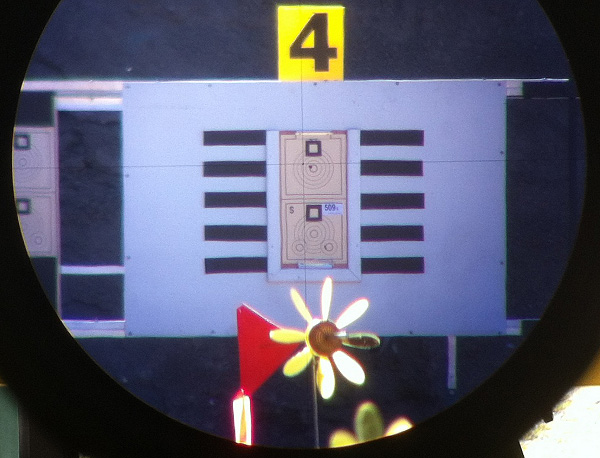
Here is the actual 200-yard, 5-shot group Charles shot in the video. Photo (by Stuart Elliot) taken through the lens of Huckeba’s 50X March scope (reticle has 1/16th MOA Dot).
Analyzing the Fine Points — What Makes Huckeba So Good
Short-range benchrest shooter Boyd Allen saw some interesting things in Huckeba’s WBC performance, as captured on video. Boyd noticed Huckeba’s smooth gun-handling and efficient loading. But Boyd also spied some interesting equipment, including an innovative joystick “handle-caddy”.
1. Low Friction Bags — When Huckeba slid his rifle, there was very little apparent friction. The front bag features the new 3M material (ScotchLite) on the sliding surfaces. The rear Protektor bag has ears of the same low-friction material.
2. Pause Before Chambering — While he was watching the flags and deciding when to start firing, Charles kept his first round in the action, but out of the barrel’s chamber, probably so as not to heat the cartridge and change the round’s point of impact.
3. Ammo Caddy on Joystick Arm – Charles shoots a Right Bolt/Left Port action, so he pulls his rounds with his left hand. Note that Huckeba’s record rounds rest in a small, wood ammo caddy attached to the end of the joystick shaft. Look carefully, you’ll see the wood ammo block in place of the normal black ball at the end of the joystick. That allows Charles to pull shots with the absolute minimum of hand movement. Ingenious! Huckeba is very fast, with a great economy of motion. I believe that because his ammo was literally at hand, Charles was better able to keep his focus on aiming and the flags.
4. Smooth-Cycling BAT Action — Note how smoothly Huckeba’s action operates. When Charles lifts the bolt handle (to extract a round and cock the firing pin), this does not disturb the rifle. Likewise, as he closes the bolt, the gun doesn’t wobble. The smooth action allows Charles to hold point of aim even when shooting relatively quickly. Huckeba’s BAT action is chrome-moly steel. Some shooters believe this metal makes for a smoother action than stainless steel or aluminum.
5. Long-Wheelbase Stock — The wood and carbon fiber stock is light, long, and stiff. Yet, importantly, the stock is also well-damped. The longer-than-average stock length (with extended forearm) seems to help the gun track well without jumping or rocking. The longer forearm allows a longer “wheelbase”, effectively shifting the weight distribution rearward (less weight on the front, more weight on the rear). This places a greater share of the gun’s weight on the rear bag, as compared to a more conventional benchrest stock. Huckeba’s stock, built by Bob Scoville, is at the cutting edge of short-range benchrest design. Its light-weight balsa wood and carbon fiber construction provides a combination of stiffness and vibration damping that allows its relatively long fore-end to be fully utilized to increase the weight on the rear bag (always an issue with 10.5-pound rifles).
To learn more about this benchrest stock design, read the comments by stock-builder Bob Scoville in our PPC with Pedigree story in our Gun of the Week Archives. Bob observed:
“There is a lot more to the structure of the stocks than meets the eye. The carbon fiber skin with which I cover the stocks creates a light, tough exterior surface. However, this contributes very little to the overall performance of the stocks. The real strength and stiffness is the result of an internal beam utilizing balsa core/carbon fiber technology.
This type construction can be found in aircraft, race cars, powerboats, and sailboats. It is interesting to note, balsa has the highest strength to weight ratio of all woods and carbon fiber is one of the lowest stretch (modulus of elasticity) relative to weight of all materials. The marriage of these two materials is common in the high-performance world. Additionally, balsa is used commercially for vibration dampening and sound reduction.”
Video find by Boyd Allen. Video by Stuart Elliot of BRT Shooters Supply, Brisbane, Australia.
Share the post "Shoot Like a Champion — How to Drill Tiny Groups at 200 Yards"


 Credit our buddy Joe Friedrich for this simple yet effective accessory for your benchrest rifle. Joe shoots a .22 LR benchrest rig with a barrel tuner. When he added weights to his tuner, he found his rifle no longer balanced well. He wanted to add some weight in the rear without drilling holes in the stock. He also wanted the weight to be removable, and easily placed on another rifle in his stable. He wanted a weight that could be moved from gun to gun as needed.

 The gun, crafted by Eric Wallance of Nawaka Firearms, features an XP-100 action, Jewell trigger, and 15″-long, Brux 1:8″-twist barrel with aluminum muzzle brake. Interestingly, this gun does not have a traditional recoil lug. Instead, gunsmith Wallace milled out a lug from the bottom of the XP-100 action to save weight. On top of the action, the rig carries a Sightron Inc S-III 6-24X56mm scope in Kelbly rings on a custom +20 MOA rail.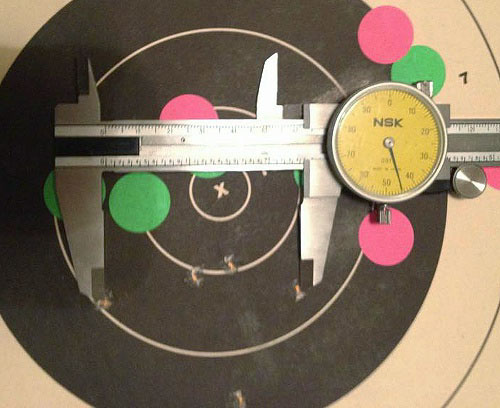

 .009″ — The Record That Stood for 40 Years.


 Click NAME to view YouTube Interview Video:


 Beating the Guys at their Own Game
 Beneficial Aspects of Shooting
 Load Development

 Firearms are limited to field-portable, varmint-caliber rifles in either custom or factory class, and having a maximum 6.5mm bore, but bullets must weigh no more than 107 grains. You can shoot prone or from a bench using a front rest and bag rear. For more information, visit
 Let’s start at the beginning. Before the match there is usually an opportunity to fire a few fouling shots and check sight settings for load and distance. An initial read on conditions–mostly wind direction, strength and consistency–is also made. The spotter should checklist the shooter to make sure they are set up for the relay distance and have adjusted their sights to the correct elevation and windage.
 Katy and Don are avocado farmers. From time to time they’d bring a few avocados to the range to give to the other shooters. In addition, on some months, Katy would bring some home-made Guacamole made from the avocados on their ranch. Katy says “Fellow shooters appreciate a batch of guacamole so much they bring their own chips to go with the dip. I keep getting suggestions that I go into the business of making and selling guacamole. Guess I could start by selling it at the range.”


 I did want a minimum no-turn neck optimized for Lapua brass. The drawing indicated that the reamer would cut a .281″ neck and a throat of 1.0315″. This was very close to ideal, though I did have to turn two thousandths off the necks of Lapua 6BR brass after I necked it up. I resized using a .277″ bushing and the loaded rounds came out to be .279″. Realizing that this was in the ball park, I decided to go with the Elk Ridge Reamer and build a 25 BR that could shoot 110gr or 115gr bullets. Now the question was where to get a match-grade 25-caliber barrel. I called quite a few of the custom barrel-makers, including BlackStar Barrels in Texas (no longer operating). I have had wonderful success with the BlackStar barrel on my 6BR “Chantilly” — it delivered great accuracy and impressive velocities. Since the 25 BR was so similar, I went with another BlackStar. I ordered a 10-twist, 6-groove, 1.250″-diameter straight-contour tube.
 After chambering, the barrel finished at 1.245″ diameter and 27.5″ inches with an 11° crown. I actually had the throat lengthened to accept both Berger 110gr and 115gr bullets. The bases of the FB 110-grainers sit flush with the neck-shoulder junction, when they are seated .010″ into the lands. With the longer 115gr VLDs, the bottom of the bearing surface (i.e. start of boat-tail) is just about even with the neck-shoulder junction.
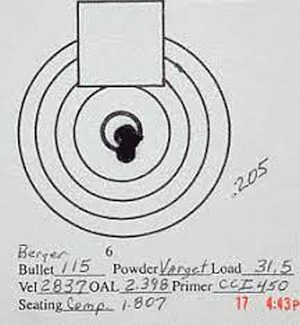 For her debut in competition, I took “Peppermint” to our local 600 yard F-class match. Shooting the Berger 115s with 31.5 grains Varget, she won with a perfect score of 200 with 14 Xs. At my club, we use a SR3 target. The X-Ring measures 3″ in diameter and the 10-Ring measures 7″. At the match there were some very good shooters with top-flight custom rifles in accurate calibers such as 6.5-284 and 22 Dasher. I was very fortunate to come out on top, but I give the credit to Peppermint’s good bench manners and outstanding accuracy.
 Now that I have several calibers in the BR cartridge family, (22 BR, 6mm BR, 6.5 BR, 7 BR, and a 30 BR), it is my humble opinion that they each have their own place. A varmint hunter’s dream, the 22 BR can push a bullet faster and more accurately than the 22-250. With an 8-Twist barrel, the 22 BR can send an 80gr SMK to 600 yards with extreme accuracy.


 Hall vs. BAT
 Load Development and Accuracy Results
 Big, Strong, and Versatile



 3. Ammo Caddy on Joystick Arm – Charles shoots a Right Bolt/Left Port action, so he pulls his rounds with his left hand. Note that Huckeba’s record rounds rest in a small, wood ammo caddy attached to the end of the joystick shaft. Look carefully, you’ll see the wood ammo block in place of the normal black ball at the end of the joystick. That allows Charles to pull shots with the absolute minimum of hand movement. Ingenious! Huckeba is very fast, with a great economy of motion. I believe that because his ammo was literally at hand, Charles was better able to keep his focus on aiming and the flags.


