Back in May, IBS shooter Rodney Wagner shot a 0.349″ (50-2X) 5-shot group that became the talk of the shooting community. This was the smallest 600-yard group shot in the history of recorded rifle competition. Rodney’s group cuts the existing IBS 600-yard record in half. Rodney put five shots under the size of a dime at the distance of six football fields. Just pause and think about that…
News of this amazing feat spread like wildfire via the internet. People were amazed at what Rodney accomplished. Here are some actual comments posted on various shooting forums:
308Nut: Simply Astounding.
Coues Sniper: That’s insanity.
PapaJohn: I strut around like a peacock if my rifles will shoot under a half-inch at 100 yards. His group was better than that at six times the distance… that’s just unfathomable. I don’t see anyone breaking that record for a loooooooooooong time!
Given the spectacular (and historic) nature of Rodney’s 600-yard group, many folks wanted to learn more about Rodney’s equipment and his shooting techniques. For that reason, we’ve compiled this follow-up report. Rodney was kind enough to provide a short video showing his equipment and shooting technique. In his video demonstration, Rodney runs off a 5-shot group in about 19 seconds. When he actually shot the 0.349″ group, Rodney estimates he got the five shots down-range in 12-15 seconds. (He slowed down a bit for the video!)
Watch Rodney Wagner Fire Five Shots in Under 20 Seconds
Rodney comments: “You’ll notice I hold the stock with my left hand while working the bolt to keep it from losing its ‘track’ (that slows me down a lot). I have just gotten into the habit of doing that because I feel tracking is one of the most important things not to take for granted. With this technique I don’t have to ‘saw’ the stock into the bags as much when I get on to the record target.”
Record-Setting Load: Varget Powder, CCI Primers, and Berger 108s Jumped
Rodney’s record 0.349″ group works out to 0.055 MOA at 600 yards. To shoot a “zero” group at 600 yards you need the finest components and insanely good reloading techniques (not to mention the grace of God.) As he does with all his 600-yard ammo, Rodney pre-loaded before the match. This particular ammo had been loaded 5-6 days before the match. Here are specs on Rodney’s load:
32.5 Grains of Hodgdon Varget Powder and CCI 450 Primers.
108gr Berger BT Match bullets seated 0.020″ away from the lands.
Lapua 6mmBR brass fire-formed to 6 Dasher and turned to 0.265″ loaded round for a 0.268″-neck chamber.
Neck-sized with a 0.262″ Redding bushing.
Note that Rodney was using Berger 108s, not the 105gr VLDs or Berger’s popular 105gr Hybrids. Rodney found his Brux barrel shot best with the 108s: “I’d get really nice 4-shot groups with the VLDs, but it seemed there would be four together and one out. The 108s seem to have less fliers.” Rodney experimented with seating depths before he settled on a .020″ jump: “I shot them for a long time 3 to 5 thousandths in the lands, just barely in the lands. But I knew Sam Hall had really good luck jumping. So I went to .020″ jump and it all came together. The 108s have shot good like that in three different Brux barrels (all chambered with the same reamer) so I just start at that setting now — twenty off the lands.”
Record-Setting Equipment
Rodney was shooting a 17-lb Light Gun. It features a BAT Machine ‘B’ action, and a 29″ Brux barrel chambered for the 6mm Dasher with a 0.268″ neck. The 0.236″-land, 4-groove barrel was fairly new when the record group was shot — it had about 300 rounds through it, and had shot 30 rounds since its last cleaning. Rodney chambered the barrel himself. The stock is a Shehane ST-1000 fiberglass tracker, inletted and bedded by Tom Meredith. A March 10-60x52mm scope is held in Burris Signature Zee rings on a +10 MOA rail. These rings are inexpensive, but they work just fine, notes Rodney: “With the inserts I can align the scope mechanically and keep the windage pretty much centered in its travel.”
Supporting his rifle, Rodney used a Farley co-axial rest up front (on Super-Feet) and a Protektor Doctor bag in the rear. The Farley features a Borden top carrying an Edgewood bag. Rodney notes: “In the front, I use the black diamond blasting sand, because it doesn’t pack as hard as regular sand. You can buy it at tractor supply stores in the welding section. It’s not as heavy as heavy sand.”
In the rear, Rodney runs a flat-top Protektor Doctor bag with Cordura ears. Rodney uses Sinclair heavy sand in his rear bag. He says “it’s got some squish — not much but just a little — call it a medium-hard fill”. Interestingly, Rodney sets up the bag so that the flat on the bottom of the stock rides on the stitches between the ears: “I like the stock to touch the top of the bag between the ears — I don’t like to see daylight.”
Conditions for the Record — You May Be Surprised
Many folks who have commented on Rodney’s 0.349″ group have wrongly assumed that the 0.349″ group was shot in “perfect” zero-wind conditions. Not so. There were switchy 5 mph winds with gusts to 10 mph. Rodney notes that on his second target of the day, he had to hold in three different places to manage a decent-sized group. So for those who think the group was shot in miraculous conditions, we have to say that wasn’t the case.
Creating Ultra-Accurate 6mm Dasher Ammunition
Rodney takes great care in loading his brass, and he employs a few tricks to get superior consistency.
Fire-Forming — To prepare his cases for fire-forming, Rodney starts by turning his Lapua brass to just past where the new neck-shoulder junction will be: “I just cut enough for the 6mm Dasher neck. A little bit of the cut shows on the shoulder after forming.” Then Rodney runs a .25-caliber K&M mandrel through the whole neck, expanding the neck diameter. After the entire neck is expanded, Rodney re-sizes the top section with a Wilson bushing, creating a false shoulder. Then, as further insurance that the case will be held firmly in place during fire-forming, Rodney seats his bullets long — hard into the lands. When fire-forming, Rodney uses a normal 6mmBR load of 29.8 grains of Varget: “I don’t like to stress my brass before it has been hardened. I load enough powder to form the shoulder 95%. Any more than that is just wasted.” Rodney adds: “When fire-forming, I don’t want to use a super-hard primer. I prefer to use a Federal 205, CCI 200, or Winchester — something soft.” Using a softer primer lessens the likelihood that the case will drive forward when hit by the firing pin, so this helps achieve more consistent “blow lengths”.
Ammo Loading — Rodney is fastidious with his brass and weighs his charges very precisely. Charges are first dispensed with an RFD manual powder measure, then Rodney trickles kernel by kernel using a highly-precise Sartorius GD-503 laboratory scale. He tries to maintain charge-weight consistency within half a tenth of a grain — about two kernels of Varget powder.
One important technique Rodney employs is sorting by bullet-seating force. Rodney batch-sorts his loaded rounds based on seating force indicated by the dial gauge on his K&M arbor press: “I use a K&M arbor press with dial indicator strain gauge. When I’m loading I pay lots of attention to seating effort and I try to batch five rounds that feel the same. For record rounds I try to make sure I get five of the same number (on the dial). When sorting based on the force-gauge readout, you need to go slow. If you go too fast the needle will spike up and down before you can see it.”
In practice, Rodney might select five rounds with a gauge value of 25, then another five with a gauge read-out of 30 and so on. He places the first five like-value rounds in one row of his ammo caddy. The next like-value set of five will go in the next row down. By this method, he ensures that all five cartridges in a five-round set for a record target will have bullets seated with very consistent seating force.
Unlike some top shooters, Rodney does not regularly anneal his cases. However, after every firing, he does tumble his Dasher brass in treated corncob media. After sizing his brass, before seating the bullets, he runs a nylon brush in the necks: “The last thing I do before firing is run a well-worn 30 caliber nylon brush in the necks, using a small 6-volt drill for power. This is a quick operation — just in and out the neck”. Sometimes, at the end of the season, he will anneal, but Rodney adds: “If I can get 10 firings out of the case I’ve done good.” He usually makes up new brass when he fits a new barrel: “If it is a good barrel (that I may shoot at the Nationals), I’ll usually go ahead and prepare 200 pieces of good brass.”
Shooting Techniques — Piloting a 600-yard Group into the Zeros Gun-handling and Rate of Fire — As you can see from the video, Rodney shoots with very minimal contact on the rifle. He normally shoots a string fast, but he remains calm and steady — almost machine-like. In the video he runs five shots in about 19 seconds, but he figures he shot the 0.349″ group in 12-15 seconds. Rodney says: “I’m not quite as fast as Sam Hall but I can usually run ‘em under fifteen seconds, sometimes closer to 10 on a good day. But when I shot the 0.349″ I couldn’t see the flags for the last shot so I dipped the joystick down between 4th and 5th shots, and that took a couple seconds. The flags had not changed, so I kept the same point of aim for 4th and 5th shot. I’d been watching that flag all morning, so to satisfy my curiosity I kind of dipped down for a second.”
Aiming for the Nine — To shoot ultra-small at long range, you must aim very, very precisely. When shooting at 600 yards, Rodney lines up his cross-hairs on the white number “9” in the blue field above the ten ring. This is visible through his rifle-scope at 600 yards, and it provides an aim point smaller than the center “X”.
Rodney explains: “I always aim for the number 9 up in the blue field. It provides for a smaller aim point. I noticed a difference when I started doing that. I learned that from some guys from South Dakota. It made sense so I’ve been doing it ever sense.”
Tips for 600-Yard Shooters New to the Game
In the course of our interview with Rodney, we asked if he had any tips for shooters who are getting started in the 600-yard Benchrest Game. Rodney offered some sensible advice:
1. Don’t try to go it alone. Find an old-timer to mentor you. As a novice, go to matches, watch and ask questions.
2. Go with a proven cartridge. If you are shooting 600 yards stick with a 6mmBR or one of the 6BR improveds (BRX or Dasher). Keep it simple. I tried some of the larger cartridges, the 6XC and 6-6.5×47 Lapua. I was trying to be different, but I was not successful. It wasn’t a disaster — I learned something. But I found the larger cases were not as accurate as a 6BR or Dasher. Those bigger cartridges are competitive for score but not for group.
3. You don’t have to spend a fortune to be competitive. Buy a used rifle from somebody and find out if you like the sport. You can save a lot with a used rifle, but do plan on buying a new barrel immediately.
4. Don’t waste weeks or months struggling with a barrel that isn’t shooting. My best barrels, including this record-setting Brux, started shooting exceptionally well right from the start.
Sixty-nine years ago today, on June 6, 1944, Allied forces stormed the beaches of Normandy as part of Operation Overlord, the largest amphibious invasion in history. The ultimate goal was the liberation of Europe. The Normandy invasion began with overnight parachute and glider landings, massive air attacks, and naval bombardments. In the early morning, amphibious landings on five beaches, code-named Juno, Gold, Omaha, Utah, and Sword commenced. During the evening the remaining parachute divisions landed. The D-Day Normandy landings were the first successful opposed landings across the English Channel in over eight centuries.
Thousands of soldiers, sailors, and aviators gave their lives on June 6, 1944, so that Europe could be liberated. We should remember those brave men, and never forget that freedom is not free — it requires continuing vigilance and sacrifice.
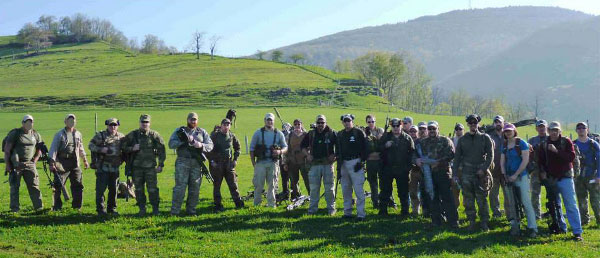
The 2013 Allegheny Sniper Challenge (ASC) took place May 17-19, in West Virginia. The ASC is a competitive tactical rifle match held in the mountains west of Seneca Rocks, West Virginia. It offers a relaxed but extremely challenging course of fire that includes high-angle and high-wind shooting with typical shots ranging between 200 and 1000 yards with varying degrees of complexity. Weather conditions can change dramatically over the course of the three-day event.
Our friends at Ashbury Precision Ordnance (APO) attended this year’s ASC match. APO’s Aaron Dearborn has posted a lengthy ASC match report on the APO Blog. Aaron writes: “We’d like to thank John and Rod from ASC for conducting yet another great practical rifle match in the beautiful mountains of West Virginia. It was three days of Magnum Rifles, Short Barrels, Heavy Bullets, and Wiley Winds! The APO shooting team had a great time and thoroughly enjoyed themselves. Our team shot custom ASW300 Winchester Magnums with Pinnacle Series 20″ barrels and Ruag 220gr Swiss-P match ammo. The average muzzle velocity [for] the two rifles is 2575 fps and they are very maneuverable!”
Aaron said the 2013 ASC lived up to expectations, and then some: “Rod and Jon outdid themselves with the selection of targets and shooting stages. They continue to push shooters out of their comfort zones and are always thinking up new ways to increase the stress during shooting in order to improve the core of shooters who compete in ASC matches. And as long as I am able to attend, I will continue to strive toward becoming a better shooter.”
Precision Reloading is having a June SALE on big-name reloading presses and powder dispensers. You’ll find good values on Redding, RCBS, Lyman, and Hornady Products. This special sale ends June 30, 2013. Note: Sale pricing is limited to quantities on hand and the discount prices cannot be combined with any other offers or promotions.
RCBS Cash-Back Rebate
In addition, RCBS is offering a Rebate for products purchased in 2013. If you buy $50 worth of RCBS hardware you can get $10 Cash Back. If you buy $300 worth of RCBS equipment you can get $50 Cash Back.
NOTE: Although the Rebate Form refers to an option of Speer Bullets (instead of cash money), due to shortages, ALL rebates will be issued in CASH. CLICK HERE for Rebate Form.
Products in the 2013 CMP catalog include: M1 Garand Rifles, Smallbore Rifles, Air Rifles, Replacement Barrels (newly manufactured), Garand Stock Sets, m1903 Stock Sets, M1 Carbine Stock Sets, Ammunition (commercial and surplus), Tools/Gauges, Rifle Cases, Shooting Coats, Shooting Gloves, Shooting Mats, and Instructional DVDs. Note: To order a rifle from the CMP, purchasers must provide proof of: 1) U.S. Citizenship (and age); 2) Membership in a CMP-Affiliated Organization; and 3) Participation in a Marksmanship or Other Firearms-Related Activity.
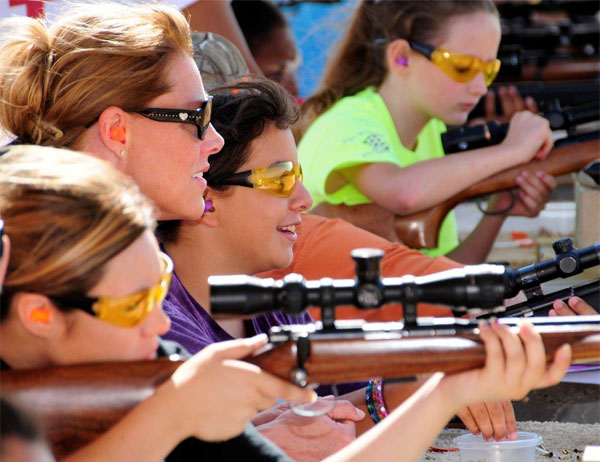
June 15th, 2013 is National Take Your Daughter to the Range Day. This is a great way to spend “quality time” with your daughter, and teach her the basics of firearms safety. At ranges nationwide, girls six and up will be able to try out a rifle, pistol, or shotgun. This event introduces young women to a sport that may become a life-long hobby, continuing a shooting tradition that helped make this country great.
Event co-founder and firearms instructor, Lynne Finch, believes it’s time to tear down the stereotypes and get those young ladies out to the range where they belong. “Boys learn to shoot in Scouts or with their Dads. Often, the girls are left behind because shooting isn’t ‘girly.’ Well, we can, and do shoot, and well. Learning to shoot gives young women confidence, helps to build self-esteem, and introduces them to a sport they can participate in their whole lives.”
The inaugural Take Your Daughter to the Range Day was held June 9, 2012, with 37 ranges in 15 states participating. The event is held each year on the third Saturday in June. Lynne Finch got the idea for the event after reading Julie Golob’s Book SHOOT, learning how Golob grew up going to the range with her father. Finch also learned from many other women how much they enjoyed going to the range with their parents during their youth. Sponsor support has made this event possible. 2013 Contributing Sponsors include: Brownells, Midway USA, Henry Rifles, Charter Arms, Front Sight Firearms Training Institute, and other organizations.
Many careful reloaders prefer to use a hand-tool for seating primers. The majority of short-range benchrest shooters seat one primer at a time, using finely-machined hand tools, such as the Sinclair priming tool Such tools offer unrivaled “feel” during the seating process, but they are slow to use and require that you handle primers with your fingers. If you’re a fumble-fingers type like this Editor, you’ll drop a primer now and then. That’s why I prefer a hand tool that keeps the primers in a strip or a tray.
We think one of the best affordable priming tools on the market is the latest RCBS hand tool. RCBS’s Universal Hand Priming Tool boasts some many nice features. The tool now shares the Universal shell-holder we liked so much in the RCBS APS (strip-priming) hand tool. An opposed set of spring-loaded jaws allows you to prime nearly all sizes of cases, without the need for conventional shell-holders. This makes the tool faster and more convenient if you load a variety of calibers. And you’re never “out-of-luck” if you can’t find the right shell-holder. However, you do have to change the “pusher” shaft when you switch from small primers to large primers or vice versa.
The universal shell-holder has another important benefit. With opposing jaws holding the casehead, this allows the case to “float” and align itself as the primer is seated. This may help primers seat more consistently every time. With most other hand-priming tools, the case is held by a conventional shell-holder. This leaves about 40% of the rim unsupported on one side. If you actually look closely at cases as you seat primers with conventional tools, you’ll see the case tilt in the shellholder as the primer is inserted. In the RCBS, by contrast, the case stays straight as the primer goes in. The new unit also shares its ergonomic grip (with plenty of leverage) with the APS model. A redesigned primer tray accommodates all brands of primer packages–you can easily load 100 primers at a time without worrying about spills. A unique Primer Safety Gate shields the primer being inserted from the remaining primers in the tray. That’s an important safety feature. The RCBS Universal Priming Tool retails for under $60.00 at major vendors such as Grafs.com, product #RCBS90201.
RCBS $10 CASH-BACK Rebate
RCBS is currently offering a $10 Mail-in Rebate good with the purchase of at least $50.00 in RCBS products. Purchase must be made between Jan. 1, 2013 and Dec. 31, 2013 and coupon must be received by Jan. 31, 2014. If you prefer, you can choose 100 Speer bullets rather than $10 cash back. CLICK HERE for RCBS $10 Mail-in Rebate Form.
Here are MidwayUSA user reviews for this tool:
“I have been reloading for 34 years and I don’t know why I didn’t buy one of these tools years ago. Everything about it is great. Changing from large primer to small primer was very easy. Ergonomic fit in the hand is good. Loading primers into the tray is no problem. The universal shell holder is a plus. I rate this product a 10″. — Keith McC., NH
“Primers flip as they should, and they are seated to a uniform depth. The universal shell holder is great! I reload .223 up to the Sharps 45-120 with no problem. Also as a few have said buy two and make each a seperate large and small primer unit. I happen to like it very much as it makes priming easy and portable.” — Tom H., NY
“This is a very well-made tool. I do not like the changing from small to large primers as it is a little bit of a time waster and a awkward. I think it is just a matter of time before one of the parts gets lost. If the price was a little lower I would just buy two. Much more substantial than the Lee which I have been using. I rate it 4 stars, deducting for price and the way you have to change between large and small. Works great however.” — Fred, FL
In late May, the U.S. District Court for the District of Columbia dismissed a lawsuit filed by the radical anti-hunting Center for Biological Diversity (CBD) and six other groups demanding that the EPA ban traditional ammunition containing lead components. NSSF filed a motion to dismiss the lawsuit last August. The court agreed with NSSF that EPA does not have the authority to regulate traditional ammunition under the Toxic Substances Control Act. EPA had already twice denied attempts by CBD to have the agency ban traditional ammunition, and the court had dismissed an earlier case brought by CBD seeking the same relief.
Traditional ammunition (with lead elements) represents 95 percent of the U.S. market and is the staple ammunition for target shooters, hunters and law enforcement, with more than 10 billion rounds sold annually.
“We are gratified that the court has found this second frivolous lawsuit, which is essentially the same as the one dismissed last year, was equally without merit,” said Lawrence G. Keane, senior vice president and general counsel for the National Shooting Sports Foundation, the trade association for the firearms and ammunition industry. In addition to NSSF, the National Rifle Association and Safari Club International intervened in the case.
“No sound science [shows that] the use of traditional ammunition has harmed wildlife populations or that it presents a health risk to humans who consume game taken with such ammunition,” said Keane. “Banning traditional ammunition would cost tens of thousands of jobs in America and destroy wildlife conservation that is funded in part by an 11 percent excise tax on the sale of ammunition. The protection and management of wildlife is properly handled by the professional biologists in the state fish and game agencies, as it has been for over a hundred years.”
Well it looks like there’s some real talent in the next generation of IBS Benchrest shooters. Watch out for those young guns — they can give seasoned veterans a run for their money — and then some. Young Kevin Donalds Jr. fired a perfect 250-25X score to win a 100-yard IBS score match at the Thurmont, Maryland range on May 18th, 2013. At just 12 years of age, Kevin is already showing he has the focus, talent, and determination to win. And, yes he managed to beat his proud father Kevin Donalds (Sr.) who finished second with a 250-23x. Like father, like son. It’s great to see a father and son who shoot together — and share the podium together.
Above, 12-year-old Kevin, match winner, is shown flanked on his left by his father (second place), and on his right by third place finisher Larry Fritz. Young Kevin was shooting a 30BR (no surprise), with a BAT action, Krieger barrel, and an affordable Sightron 8-32X scope (about $860). The rifle was smithed by Sid Goodling and stocked by Roy Hunter. The load was a stout charge of Hodgdon H4198, fired by Federal primers, pushing BIB 112gr bullets.
How would you like to lower your Extreme Spread (ES) and Standard Deviation (SD) significantly by a simple procedure that takes seconds and costs almost nothing?
Here’s all you need to do. After lubing your cases for full-length sizing, be sure to clean your hands (removing ALL residual lube) before you handle your bullets. As an extra measure to avoid lube contamination, slip on thin Latex gloves before you handle and seat your bullets. Will this make a difference? Let me tell you a story.
Keep Those Greasy Fingers Off Your Bullets
I recently loaded a couple dozen cases for a 6mm Dasher. We were in a hurry to leave for the range so I was loading faster than normal. When we started shooting the ammo I noticed that the 5-shot ES was bad — really bad — 48 fps. I was shocked because this was a known good load that had previously showed ES in the teens. This one had me stumped. What could have resulted in this high ES? What did I do different while reloading this time?
Then a lightbulb went off. I realized I had been seating bullets (round by round) immediately after lubing and sizing each case. My fingers still had some greasy lube on them which obviously got on some of the bullets, “polluting” them. My normal reloading procedure is to lube and size all cases, clean them off, then place the brass in a loading tray. Then I would clean my hands BEFORE adding powder and seating bullets. This time, in my rush, I sized a case, wiped it off, then immediately added powder and projectile. I did not take the time to clean off my fingers carefully before handling the bullets.
Big Drop in ES When I Avoided Bullet Contamination with Case Lube
The next day I went back to the loading room. I loaded the same brass with the same powder, same primer, same bullet type, same bushing — same everything. But this time, I washed my hands thoroughly with a hand cleaner, dried them with a clean paper towel, and I even put on thin latex gloves before handling the bullets. I loaded 10 rounds and fired them over the chronograph again in the same rifle. The 5-shot ES was 14 fps and the 10-shot ES was 22 fps (That’s normal for this load/rifle). Compare that to a 5-shot ES of 48 the day before. I had reduced my 5-shot ES by 70%! We were back in business. (By the way, the groups were also very small).
Lesson Learned — Keep Case Lube Off Your Bullets Your results may vary of course, but now I always make sure to remove ALL residual lube from my fingers before handling bullets or doing anything that can get unwanted lube inside the necks.
What about gloves? I don’t think the Latex gloves are essential (if your hands are dry and clean), but they just cost a few pennies when bought in bulk. You can buy a box of 100 latex gloves for under $7.00 on Amazon.com. I suggest the non-powdered type.
Use Your Common Sense
Before the critics launch a tirade, let me be the first to acknowledge that many champions have loaded perfectly good ammo (and shot great groups) without paying much attention to greasy fingers. We’ve all seen short-range benchresters loading ammo between relays. They work fast and may not take the time to clean all lube off their fingers before seating bullets. And we’ve seen some of those guys go out and shoot itty-bitty groups in the ones and zeros. So I am NOT claiming that careful “reloading bench hygiene” is essential to shooting small!
All I am saying is that I observed and recorded a significant drop in my ES when I made sure to avoid contaminating bullet jackets with case lube. This is a simple precaution that is easy to follow when loading at home. It may help you cut your ES/SD. It may help avoid that one “mystery flyer” that ruins a group. Cleaning your hands before seating bullets may seem obsessive. But the smart reloader knows that paying attention to the small details, in all respects, is the key to making ultra-accurate ammo that exhibits low ES/SD on the chronograph.


 Back in May, IBS shooter Rodney Wagner shot a 0.349″ (50-2X) 5-shot group that became the talk of the shooting community. This was the smallest 600-yard group shot in the history of recorded rifle competition. Rodney’s group cuts the existing IBS 600-yard record in half. Rodney put five shots under the size of a dime at the distance of six football fields. Just pause and think about that…


 One important technique Rodney employs is sorting by bullet-seating force. Rodney batch-sorts his loaded rounds based on seating force indicated by the dial gauge on his K&M arbor press: “I use a K&M arbor press with dial indicator strain gauge. When I’m loading I pay lots of attention to seating effort and I try to batch five rounds that feel the same. For record rounds I try to make sure I get five of the same number (on the dial). When sorting based on the force-gauge readout, you need to go slow. If you go too fast the needle will spike up and down before you can see it.”

 Aiming for the Nine — To shoot ultra-small at long range, you must aim very, very precisely. When shooting at 600 yards, Rodney lines up his cross-hairs on the white number “9” in the blue field above the ten ring. This is visible through his rifle-scope at 600 yards, and it provides an aim point smaller than the center “X”.
 Sixty-nine years ago today, on June 6, 1944, Allied forces stormed the beaches of Normandy as part of Operation Overlord, the largest amphibious invasion in history. The ultimate goal was the liberation of Europe. The Normandy invasion began with overnight parachute and glider landings, massive air attacks, and naval bombardments. In the early morning, amphibious landings on five beaches, code-named Juno, Gold, Omaha, Utah, and Sword commenced. During the evening the remaining parachute divisions landed. The D-Day Normandy landings were the first successful opposed landings across the English Channel in over eight centuries.





 Many careful reloaders prefer to use a hand-tool for seating primers. The majority of short-range benchrest shooters seat one primer at a time, using finely-machined hand tools, such as the Sinclair priming tool Such tools offer unrivaled “feel” during the seating process, but they are slow to use and require that you handle primers with your fingers. If you’re a fumble-fingers type like this Editor, you’ll drop a primer now and then. That’s why I prefer a hand tool that keeps the primers in a strip or a tray.
 In late May, the U.S. District Court for the District of Columbia dismissed a lawsuit filed by the radical anti-hunting Center for Biological Diversity (CBD) and six other groups demanding that the EPA ban traditional ammunition containing lead components. NSSF filed a motion to dismiss the lawsuit last August. The court agreed with NSSF that EPA does not have the authority to regulate traditional ammunition under the Toxic Substances Control Act. EPA had already twice denied attempts by CBD to have the agency ban traditional ammunition, and the court had dismissed an earlier case brought by CBD seeking the same relief.


 How would you like to lower your Extreme Spread (ES) and Standard Deviation (SD) significantly by a simple procedure that takes seconds and costs almost nothing?


