|
|
September 18th, 2014
Have you ever wondered how a cut-rifled barrel is made? This process, used by leading barrel-makers such as Bartlein, Border, Brux, Krieger, and Obermeyer, can yield a very high-quality barrel with a long useful life. Cut-rifled barrels have been at the top in short- and long-range benchrest competition in recent years, and cut-rifled barrels have long been popular with F-Class and High Power shooters.
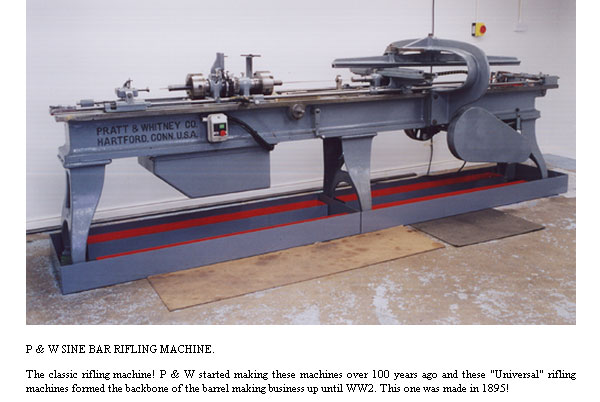
You may be surprised to learn that cut-rifling is probably the oldest method of rifling a barrel. Invented in Nuremberg around 1520, the cut-rifling technique creates spiral grooves in the barrel by removing steel using some form of cutter. In its traditional form, cut rifling may be described as a single-point cutting system using a “hook” cutter. The cutter rests in the cutter box, a hardened steel cylinder made so it will just fit the reamed barrel blank and which also contains the cutter raising mechanism.
Above is a computer animation of an older style, sine-bar cut-rifling machine. Some machine features have been simplified for the purposes of illustration, but the basic operation is correctly shown. No, the cut-rifling machines at Krieger don’t use a hand-crank, but the mechanical process shown in this video is very similar to the way cut-rifling is done with more modern machines.
Read About Cut-Rifling Process at Border-Barrels.com
Read About Cut-Rifling Process at Border-Barrels.com
To learn more about the barrel-making process, and cut-rifling in particular, visit FirearmsID.com. There you’ll find a “must-read” article by Dr. Geoffrey Kolbe: The Making of a Rifled Barrel. This article describes in detail how barrels are crafted, using both cut-rifling and button-rifling methods. Kolbe (past owner of Border Barrels) covers all the important processes: steel selection, hole drilling, hole reaming, and rifling (by various means). You’ll find a very extensive discussion of how rifling machines work. Here’s a short sample:
“At the start of World War Two, Pratt & Whitney developed a new, ‘B’ series of hydraulically-powered rifling machines, which were in fact two machines on the same bed. They weighed in at three tons and required the concrete floors now generally seen in workshops by this time. About two thousand were built to satisfy the new demand for rifle barrels, but many were broken up after the war or sold to emerging third world countries building up their own arms industry.
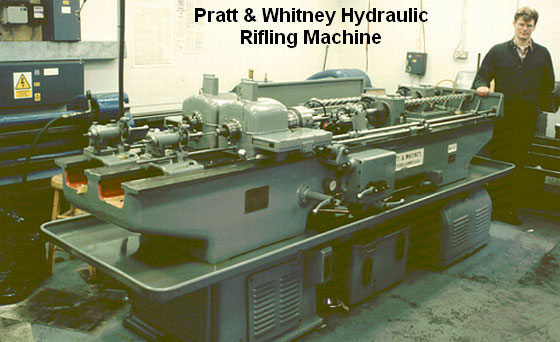
Very few of these hydraulic machines subsequently became available on the surplus market and now it is these machines which are sought after and used by barrel makers like John Krieger and ‘Boots’ Obermeyer. In fact, there are probably less of the ‘B’ series hydraulic riflers around today than of the older ‘Sine Bar’ universal riflers.
The techniques of cut rifling have not stood still since the end of the war though. Largely due to the efforts of Boots Obermeyer the design, manufacture and maintenance of the hook cutter and the cutter box have been refined and developed so that barrels of superb accuracy have come from his shop. Cut rifled barrel makers like John Krieger (Krieger Barrels), Mark Chanlyn (Rocky Mountain Rifle Works) and Cliff Labounty (Labounty Precision Reboring)… learned much of their art from Boots Obermeyer, as did I.” — Geoffrey Kolbe
Video find by Boyd Allen. Archive photos from Border-Barrels.com. In June 2013, Birmingham Gunmakers Ltd. acquired Border Barrels. Dr. Geoffrey Koble continues to work for Border Barrels, which maintains operations in Scotland.
September 17th, 2014
 Most of us are familiar with McMillan’s popular “A” series of tactical gunstocks. The original A-2 is a still-popular “tactical classic”. The A-3, a modified, lighter version of the A-2, is probably the most widely-used field sniper stock. The A-4, originally designed for the USMC, features a butthook on the underside of the stock — a feature you now see on many other tactical designs. Most of us are familiar with McMillan’s popular “A” series of tactical gunstocks. The original A-2 is a still-popular “tactical classic”. The A-3, a modified, lighter version of the A-2, is probably the most widely-used field sniper stock. The A-4, originally designed for the USMC, features a butthook on the underside of the stock — a feature you now see on many other tactical designs.
In addition to its conventional A-series stocks (A2-A5), McMillan now offers two very different tactical stock designs: the A-TH and the TPR. These stocks are designed to work well for off-hand as well as prone shooting. They offer many of the advantages of a chassis-style stock with durable, user-friendly fiberglass construction. If you are planning a tactical rifle project for the Precision Rifle Series or other application, you may want to consider the A-TH and the TPR.
 McMillan A-TH Thumbhole Stock McMillan A-TH Thumbhole Stock
The A-TH stock was created after numerous customer requests for a thumbhole stock in McMillan’s tactical line. It uses a flat, square-type forearm very similar to the popular A-3 but with textured grooves on the sides for better grip when shooting off-hand. The butt-hook also has texture and a thumb groove for enhanced grip and control when shooting off a bench or prone. The ergonomics of the pistol grip are designed to put the shooter’s hand in the most natural and comfortable position. The A-TH must be ordered with one of the integral cheekpiece options and is available in right hand only. It can be inletted for most Remington, Sako, Tikka, and Savage blind magazine type actions and for barrel contours up to a 1.250″ straight blank. Color shown: Tan, Dark tan, Olive vertical marbling.

McMillan TPR Stock
In designing the pistol grip TPR stock, McMillan came up with something completely different — not just another “A” series variant. The design evolved from a desire to create a stock that offers everything that a straight line chassis stock offers along with the enhanced accuracy, vibration damping, and recoil reduction characteristics of a fiberglass stock. Fully ambidextrous, the TPR can be inletted for most Remington 700 type actions and Savage blind magazine actions. The forearm can be inletted for most barrel contours up to a 1.350″ diameter straight contour and has enough depth for installation of a Versa-Pod bipod stud. Color shown: 50% olive, 25% black, 25% tan marble.


September 17th, 2014
So what’s in the closet in your man mansion? Here’s a well-equipped walk-in arsenal/haberdashery fit for “Bond, James Bond” (and maybe Jason Bourne as well). We really don’t need so many edged weapons, but we’re glad to see three (3) Accuracy International rifles, a half-dozen handguns, and plenty of ammo. Oh, and don’t forget the pair of umbrellas — you always need back-up, even if your adversaries are mere rain-drops.

Tip of the hat to our friend Jim de Kort for finding this photo. So, what do you think — is this the perfect set-up? How would you change/modify/augment this arrangement to suit your needs? (Post your comments below). This Editor would add a rimfire rifle, some revolvers, an F-Class rig, and a 6mm Dasher for 600 yards of course. (Plus some Hawaiian shirts and sandals — even 007 required a casual option now and then.)
September 16th, 2014
Report by Vince Bottomley
For this year, the European F-Class Championships moved from its traditional November date to mid-September. England can be smitten with some dreadful weather in November and previous Championships have suffered everything from rain and mist, to sub-zero temperatures. It proved to be a wise decision and competitors enjoyed balmy, sunny weather for the whole week, with matches on September 12-14, 2014. The event was well attended with 206 individual entries and over 20 teams. With competitors from a dozen nations, this is one of the biggest F-Class events in the world.
Congratulations to Scotland’s Des Parr, the new F-Open champion (on V-count over James Finn), and congrats to Giulio Arrigucci of Italy, who won the F-TR title. Both Parr and Finn dropped only five points over the entire two-day individual competition. For more information (and full listing of match results) visit www.GBFclass.co.uk.

| F-Open Individual Results |
F-TR Individual Results |
1. Des Parr (Scotland): 470.48V (possible 475)
2. James Finn (Ireland): 470.41V
3. Marco Been (Holland): 467.49V
4. Mik Maksimovic (GB): 465.38V
5. Daniel McKenna (Ireland): 464.40V
6. Dave Lloyd (GB): 463.36V |
1. Giulio Arrigucci (Italy): 455.30V
2. Francisco Franco Mosquera (Spain): 454.30V
3. Sergii Gorbon (Ukraine): 452.36V
4. Tom Bond (GB): 449.29V
5. Valentin Pomomarenko (Ukraine): 449.29V
6. Russell Simmonds (GB): 449.29V |
Over the past few years, numbers have increased steadily and this year, over 200 shooters assembled on Bisley’s famous Stickledown range on the Friday morning for the first of two days of individual competition, followed by Team Matches on the Sunday. The four days preceding the Championships were available for practice and informal competitions.
With near-perfect conditions for the first 800-yard stage, some excellent scores were recorded. Scotsman Paul Crosbie’s F-TR score of 75.12V not only took the stage win but also set a new GB record and equaled the top F-Open score (by Italian Gian Antonio Quaglino). Maximums were also recorded at 900 yards by both classes but at 1000 yards, Scotsman Des Parr’s 74.11V was a clear winner, with Italy’s Andrea Ceron’s recording a 72.6V in F-TR.
The Famous Stickledown Range at Bisley

At the end of Day One, Des Parr was leading Open Class by a single point and Spain’s Francisco Franco Mosquera had a two point lead in F-TR. The following day, competitors tackled the same course of fire to decide the title of European Champion.
Although a little overcast for the start of Day Two, the sun soon broke through and the fact that the top 36 Open shooters didn’t drop a single point at 800 yards gives an indication of conditions. Even the top 15 F-TR shooters ‘cleaned’ the target but, some relays experienced less favorable conditions.
 At 900 yards, again the top nine Open competitors shot ‘possibles’ but, in F-TR, Ukraine’s Sergii Gorban’s excellent 74.9V was the top score. For the final 1000-yard shoot – a 2 and 20 this time, Ireland’s Kevin Clancy’s 95.5V was a great F-TR score but Dave Lloyd’s winning Open score of 99.6V was absolutely stunning. At 900 yards, again the top nine Open competitors shot ‘possibles’ but, in F-TR, Ukraine’s Sergii Gorban’s excellent 74.9V was the top score. For the final 1000-yard shoot – a 2 and 20 this time, Ireland’s Kevin Clancy’s 95.5V was a great F-TR score but Dave Lloyd’s winning Open score of 99.6V was absolutely stunning.
In the end, Scotland’s Des Parr and Ireland’s James Finn tied on points with 470 of 475 possible, but Parr took the 2014 European F-Open title based on V-bull count: 48 for Parr vs. 41 for Finn. Italy’s Giulio Arrigucci won the F-TR Championship by one point over Francisco Franco Mosquera.

We were delighted to have American shooter Francis ‘Biff’ Conlon join us – shooting a borrowed rifle in F-TR (second from left in the above photograph). Biff shot as part of one of the F-TR Teams in the pre-Championship competitions and picked up a gold medal – note the unusual trophy! Maybe a few more Americans might think it worthwhile making the trip to shoot in next year’s Europeans.
TEAM Matches
The Championships end with the Teams Matches on the Sunday. These matches are for eight-man teams so, not all countries are able to field a team but four Open Teams and five FTR teams were fielded. Ranges are 900 and 1000 yards with 15 shots at each distance. Wind coaches are permitted.
| F-Open Team Results |
F-TR Team Results |
1. Great Britain – 1161.120V
2. Italy – 1145.74V
3. Germany (BDMP) – 1129.91V |
1. Germany (BDMP) – 1106.57V
2. Italy – 1104.68V
3. Ukraine – 1101.69V |
Report from David Lloyd, current Great Britain F-Open Team Captain
I’ve just got back from the F-Class European Championships. The minor 4-man teams match was held last Thursday afternoon and was shot over 1000 yards with 2 + 20 to count. I was part of the victorious Team March (388.26V). In second place was the Midland Precision Guns Team with 383.26V.
The conditions were good and the level of competition was very high. Team March was captained by Gary Costello the UK and European importer of March scopes. The coach was Tony Marsh and he did a superb job of coaching the team to victory (he coached me to a score of 100-6Vs). The shooters were: Gary Costello, David Lloyd, Ian Boxall, Darren Stewart. Peter Walker was reserve shooter and register keeper.
September 16th, 2014
Here’s a nice combo offer if you’re thinking about buying a laser rangefinder for the fall hunting season. Right now, if you purchase a Leica CRF 1000-R or 1600-B Laser Rangefinder you can receive a Surefire G2x-Pro flashlight worth $85.00. The rugged, dual-power G2x-Pro should last a lifetime.
This is a limited-time offer works. When you purchase a new Leica CRF Rangemaster 1000-R or 1600-B Compact Laser Rangefinder from any authorized North America Leica Dealer you can receive a Surefire G2X-Pro flashlight and lanyard ($85 value). Send in your mail-in Rebate Form, plus your CRF proof of purchase, to Leica between Sept. 15 and Dec. 31, 2014, to receive your Surefire G2X-Pro flashlight.

Leica’s CRF 1000-R Rangemaster is an easy-to-use laser rangefinder than can fit in your pocket. The wide field of view makes target identification fast and easy. The CRF 1000-R features built-in angle correction. This provides automatic point-of-aim correction for uphill or downhill shots. That’s a very valuable feature for hunters.
Leica’s CRF 1600-B Compact Laser Rangefinder boasts an integrated precision ABC (Advanced Ballistic Compensation) system. This instantly measures distance, incline, temperature, and air pressure and then calculates hold-over based on selected bullet BC. The 1600-B’s LED display has ambient-light-controlled brightness — a nice feature when you’re in the field. For more info, visit LeicaSportOptics.com
September 16th, 2014
 On the NRA’s American Rifleman website you’ll find a helpful article that provides basic tips on avoiding legal entanglements when traveling from state to state with firearms in your vehicle. The basic advice is to plan out your trip in advance, researching all state and local laws that will apply. This can be a daunting task, but a Federal law, the Firearms Owners’ Protection Act (FOPA) does provide some protection for travelers. On the NRA’s American Rifleman website you’ll find a helpful article that provides basic tips on avoiding legal entanglements when traveling from state to state with firearms in your vehicle. The basic advice is to plan out your trip in advance, researching all state and local laws that will apply. This can be a daunting task, but a Federal law, the Firearms Owners’ Protection Act (FOPA) does provide some protection for travelers.
According to the NRA: “FOPA shields you from local restrictions if you’re transporting firearms for lawful purposes. Under FOPA, notwithstanding any state or local law, a person is entitled to transport a firearm from any place where he or she may lawfully possess and carry such firearm to any other place where he or she may lawfully possess and carry it, if the firearm is unloaded and locked out of reach. In vehicles without a trunk, the unloaded firearm must be in a locked container other than the glove compartment or console.”
The NRA cautions that: “Laws vary place-to-place, and if you do anything other than pass through a state, you must obey all local laws. This is especially true when you are carrying a loaded firearm in your vehicle or on your person. There’s no shortcut here. You need to map out your trip state-by-state to be sure you stay legal during your trip.”
Resources for Travelers
The American Rifleman article also lists useful print and online resources you can consult to learn more about laws that apply when traveling with firearms:
Guide to the Interstate Transportation of Firearms (From NRA ILA.)
Federal Firearms Regulations Reference Guide (BATFE publication.)
BATFE’s State Laws and Published Ordinances — Firearms, 2010-2011
BATFE’s Answers To Frequently Asked Questions
State Gun Laws at a Glance (Includes interactive chart with info on state laws.)
State-by-State Handgun Laws (Website summarizes laws by state.)
The Traveler’s Guide to the Firearm Laws of the Fifty States (Printed handbook.)

Chrysler’s Outdoorsman Series Trucks offer an optional “RamBox” with locked rifle storage.
September 15th, 2014

Daniel Horner of the USAMU has been crowned the World Shooting Champion, and he has a $50,000 check to prove it. In the first running of the Trijicon World Shooting Championship (TWSC), 159 of the world’s top shooters competed in a grueling 4-day, multi-discipline event. To do well at the TWSC you had to be an expert with rifle, shotgun, and pistol — and you couldn’t have any real weaknesses. You needed mastery of speed pistol, trap shooting, long-range rifle shooting, cowboy action disciplines, “run and gun”, and defensive action scenarios.
SSG Daniel Horner (File photo — not from TWSC)

Horner topped the field with 966.856 points. In second place was Bianchi Cup Ace Bruce Piatt with 924.895. The legendary Jerry Miculek took third with 870.153. Jerry’s performance gave hope for us old guys. There must also be something about Miculek DNA — Jerry’s daughter Lena was the top female competitor, finishing 28th overall. We also want to acknowledge young Brian Nelson who, competing as a Junior, finished fourth overall, a great accomplishment. Other than Nelson, most of the top finishers are professional 3-Gun competitors. These folks know how to put rounds on target quickly and transition smoothly from one firearm to the next.

For four days, the shooters competed in twelve equally-weighted disciplines from various shooting sports. The match combines pistol shooting (action and bullseye), rifle shooting (action, smallbore, high-power, and F-Class), and Shotgun (Sporting Clays/trap/tactical). All firearms and ammunition were provided for each event.
Horner won the big prize through consistency. Out of the 12 shooting events, he finished in the top 10 in all but two. Writing in the Shooting Wire, Jim Shepherd reports: “Horner took outright stage wins in the Wobble Trap Doubles (100%) and NRA Action Rifle (100%) and used them to overcome his two worst scores, a 28th-place finish in F-Class rifle and a 13th-place in .22 rifle. For his achievement, Horner wins the $50,000 prize, and the dubious honor of now knowing that every competition shooter in the world has him solidly in their sights now, not just the 3-gun shooters he regularly tests … and bests.”

TWSC Complete Final Results | TWSC Stage-by-Stage Results
Big Cash Awards and Unrivaled Prize Table
Competitors came to the Peacemaker National Training Center in Glengary, WV for a chance to be crowned the “World Shooting Champion” and receive a $50,000 first place cash prize. This match carried “multi-gun” competition to a whole new level, with BIG MONEY at stake:. There were cash payouts for most stages and over $150,000 worth of hardware on the prize table.
|
First Place Overall: $50,000
Lady Champion: $5,000
Pistol Segment Winner: $5,000
Rifle Segment Winner: $5,000
Shotgun Segment Winner: $5,000 |
 |
Second Place Overall: $3,000
Third Place Overall: $2,000
Fourth Place Overall: $1,000
Stage Winner $2,000
Side Match Winner: $1,000 |
Meanwhile, in Spain — the ISSF World Shooting Championships
The next TWSC will be held October 15-17, 2015. This inaugural event went well, and it will surely grow in prestige as time passes. However, we do question the notion that this was truly a “World Championship”. The TWSC took place in West Virginia at the same time that the ISSF World Championships were being held in Granada, Spain. That means that virtually none of the world’s top shotgun aces or top prone/3P rifle shooters attended the TWSC — they were in Spain instead. Over 2000 shooters are competing at the 2014 ISSF World Championships, including hundreds of Olympians. The TWSC had less than 200 competitors, and few Olympians. TWSC was, then, more realistically, a North American Multi-Gun Championship. Let’s hope that, in the years to come, the TWSC will attract more foreign-born competitors. That way it can properly be called a “World Shooting Championship”.
September 15th, 2014
Kelly Bachand competed in the 2014 Trijicon World Championship. Here his TWSC report from Day Two, which involved a 3-Gun Nation-type stage, an F-Class rifle stage, and a .22 Rimfire rifle stage.
Report by Kelly Bachand, Kelly’s Gun Sales
3-Gun Action
Day Two included one of the more exciting events, the 3-Gun stage. My squad was just behind the squad with a bunch of 3 gun shooters in it, so I had fun watching Taran Butler, Daniel Horner, Jerry Miculek and others shoot the course. It was a pretty straight-forward course, 10 falling steel pistol targets, 8 clay shotgun targets, and six 3-Gun Nation rifle targets. We could shoot them in any order we wanted. The pro 3-gunners shot it shotgun first, pistol second, rifle last. When it was finally my turn to shoot I was pretty sure I had a plan made out in my head. I started with the shotgun and went 8 for 8 on the clay targets then burned the last round in the hill so I could just dump the shotgun into the barrel. To my extreme pleasure I went 10 for 10 on the falling steel pistol targets and then grabbed the rifle. I fumbled with the safety a bit but finally got it to fire and shot the two outside targets, one from standing and one from a high kneeling position. Then I kicked my front leg way out to a very low kneeling and shot the final 4 targets from beneath the barricade. Most folks shot those targets from prone, but I felt like it was a little quicker just to sit down into kneeling. I did that in about 36 seconds, the fastest shooters did it in about 20 seconds.
Kelly Bachand at TWSC (from Day 1)

F-Class Style Competition at 500 Yards
Next we shot an F-Class-inspired stage at 500 yards. The coolest part about this stage was the electronic scoring system (photo below). There were some other top rifle shooters (Carl Bernosky, Brandon Green, Rob Mango) here and I chatted with some as they came off of the line about the firearms and the conditions. Unfortunately they told stories of rifles that were shooting pretty tall groups, somewhat unpredictably. We shot .308 Win FN rifles with 20″ barrels and detachable box mags. There was a variable-power illuminated optic on top with a bipod and rear rest underneath. Unfortunately, I have to agree with my fellow long range shooters, the set-up wasn’t quite right for the F-Class target, and furthermore it was setup so that us long range shooters had no advantage at all in that stage.

.22 LR Rimfire — Position Shooting at 25 yards
Last stage of the day was a .22 Rimfire stage inspired by smallbore competition. We shot targets from 25 yards with the Magnum Research 22 (like a tricked out 10/22) with a Trijicon RMR on top. We shot standing, kneeling, and sitting. We got two sighter shots, but we had no spotting scopes or further feedback after those two sighter shots. I had fun with this match as this reminded me of my first introduction to competitive marksmanship, my high school air rifle team. I harnessed my inner high school self and shot a 148 out of 150, I think that put my towards the top on that stage. That was a very fun and accurate 22 rifle!
September 14th, 2014
 Product Preview by Jim Bennington Product Preview by Jim Bennington
Rifle accuracy and precision have come a long way in the past 15 years. The most recent tool to significantly improve precision is the barrel tuning system. The Rifle Accuracy System (RAS) developed by Precision Rifle Systems, LLC of Myakka City, Florida, brings a fresh approach to tuning. The RAS incorporates a precision muzzle brake with the tuner.
This system provides significant precision improvements and was the subject of a June 2012 Precision Shooting (PS) magazine article, titled “Improved Rifle Accuracy” and will also be featured in an article in the November 2012 issue of PS titled “Tuning with Confidence”.
READ MORE about RAS Tuner Tests on .260 AI, .223 Rem, and 22LR rimfire rifles.
Copies of both articles and detailed instructions on RAS installation and tuning can be downloaded from www.bostromgunsmithing.com. Eric Bostrom is the distributor for the RAS.

Accuracy is the ability of a firearm to hit what it is aimed at within the limits of the precision of that firearm. Precision is the ability of a firearm to place successive shots in or near the first shot. A firearm that delivers one minute of angle (1 MOA) precision should, at 100 yards, place the bullet within roughly one inch of where it is aimed (actually 1.047″), or a sight adjustment should correct the problem. All the improvements in optics, manufacturing and components have allowed precision expectations to go from 1 MOA to 1/2 MOA or even sub-quarter-MOA.

What is the next frontier for the precision rifle? While all the other advancements were being made, advancements in the understanding and methods of managing the barrel vibrations were also being made. Once the rifle has been built and the loads developed, it is the management of the barrel vibrations that has the final influence on the bullet as it is leaving the barrel and the final influence on precision. The RAS has demonstrated with many different rifles and calibers that significant improvements can be made with a properly tuned barrel tuner system. What does this mean? Typically, there is a noteworthy improvement. In fact group size improvements between 30% and 60% have been observed with a properly-tuned barrel tuner system. This has been demonstrated on both custom rifles and loads and factory rifles.
September 13th, 2014
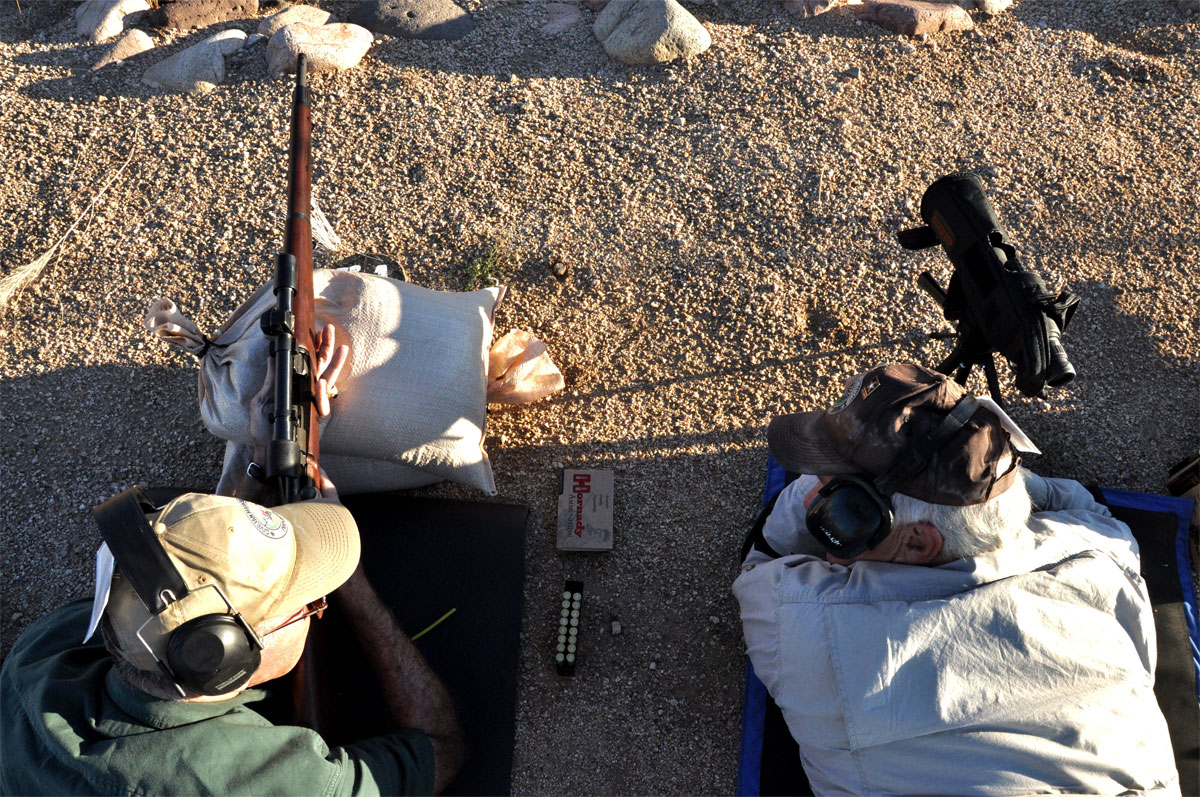
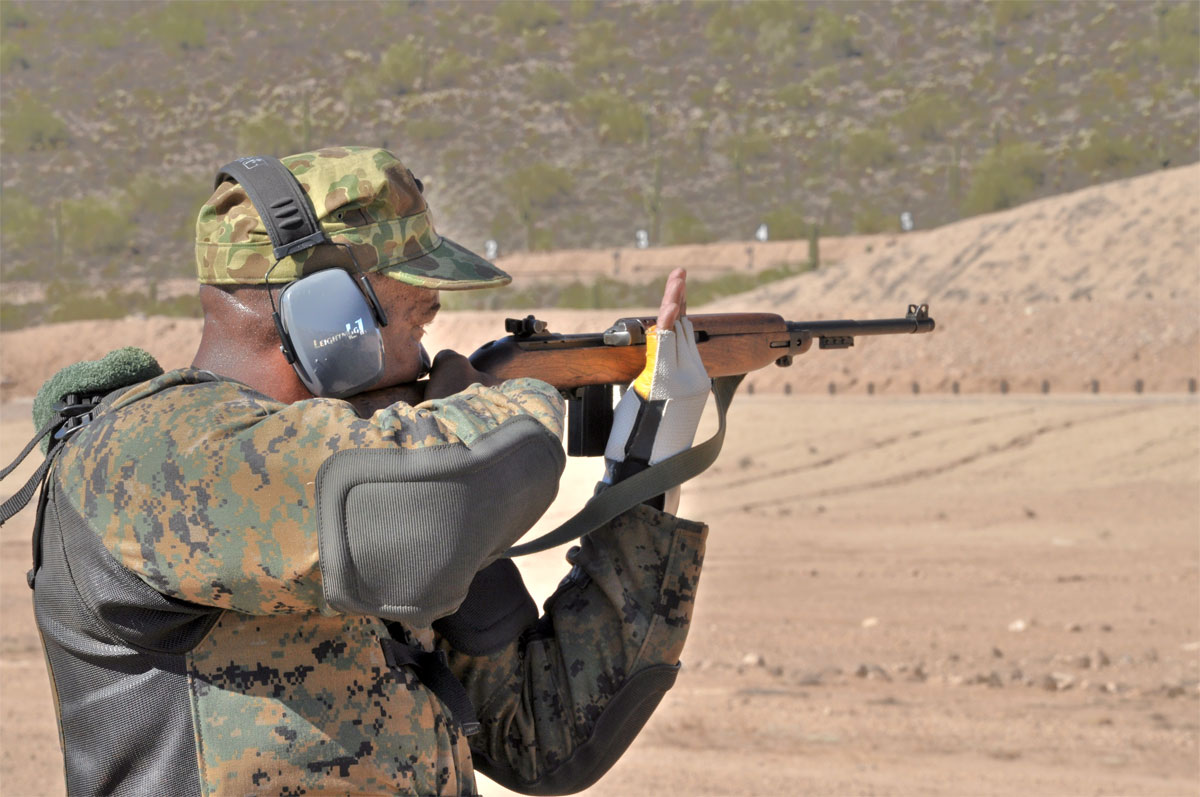
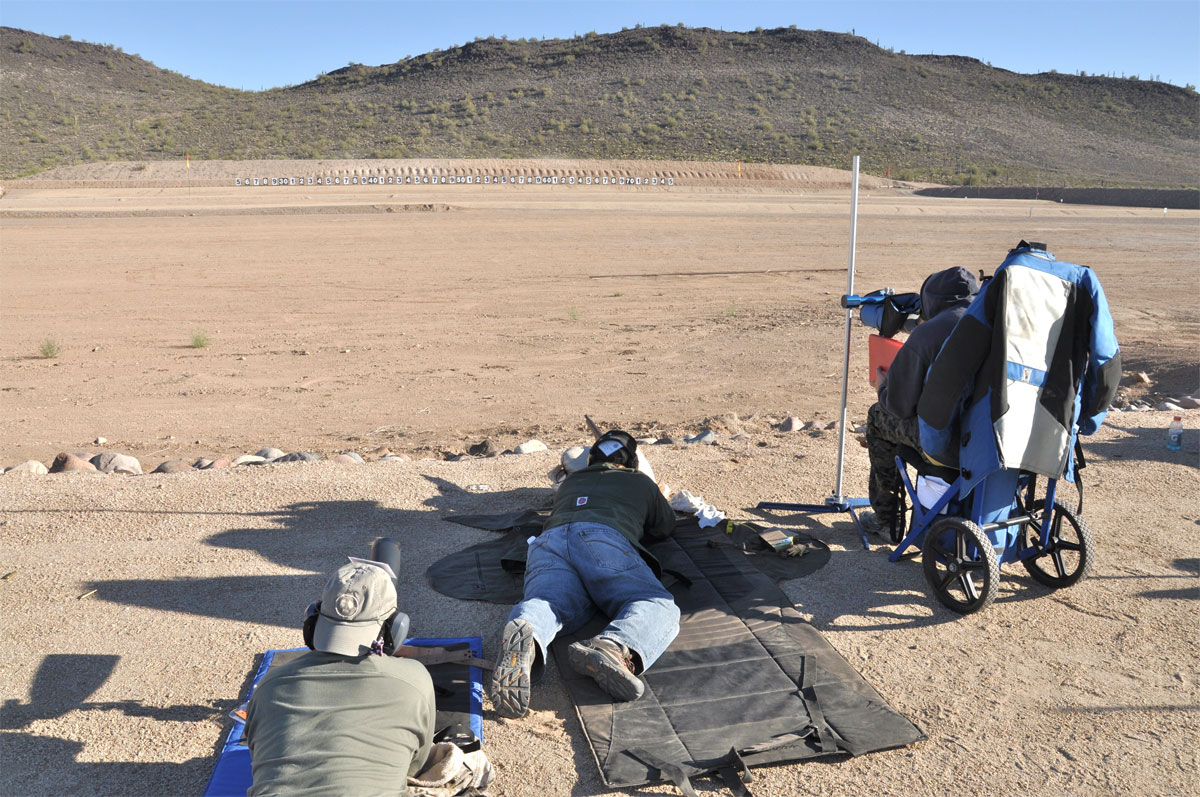
Got plans for October? If you live in the western USA, consider a trip to Phoenix for the CMP Western Games. The 11th Western CMP Games and Creedmoor Cup Matches will be held at the Ben Avery Shooting Facility in Phoenix, Arizona, on 10-19 October 2014. The Western CMP Games Matches run 10-14 October 2014. The Creedmoor Cup Matches take place on 15-19 October 2014. All interested shooters are invited to participate in these unique, national-level competitions. NOTE: Registration for the Creedmoor Cup matches must be done online via www.creedmoorsports.com.
 Western CMP Games Entry Form | Western CMP Games Online Registration
Western CMP Games & Creedmoor Cup Program | Directions to Ben Avery Range
| Western CMP Games Matches
Garand & Springfield Match Clinic
John C. Garand Match
Springfield Match
Vintage Military Rifle Match
Small Arms Firing School/M16 Match
Rimfire Sporter Match
Carbine Match
Vintage Sniper Match
Modern Military Rifle Match
|
Western Creedmoor Cup Events
High Power Rifle Clinic
Creedmoor Cup (2400 point aggregate)
4-Man Team Match
Creedmoor EIC Match
|

Small Arms Firing School
CMP Rifle Small Arms Firing School offered at during the Western CMP Games in Phoenix, AZ, Friday, October 10th. This course is recommended for all new shooters and anyone that would like to learn gun safety and sound target shooting skills, regardless of previous experience. In this course you will learn about safety, positions, how to load and clear the rifle, how to loop a sling and prepare for practice firing. Rifle SAFS students are required to use the Rock River AR15 commercial rifles issued by the school. Personal rifles are not permitted. Ammunition will be issued for use during practice fire and the M16 EIC Match and coaches will be available to assist students. Junior competitors must be at least 12 years old.

|