|
|
November 6th, 2014

Here’s an interesting video about three-position shooting. Produced by GOnra Media, this video demonstrates rifle hold and body alignment for prone, standing, sitting, and kneeling positions. Olympic Gold Medalist Jamie Gray demonstrates the proper stance and position of arms and legs for each of the positions. Ideally, in all of the shooting positions, the shooter takes advantage of skeletal support. The shooter should align the bones of his/her arms and legs to provide a solid foundation. A shooter’s legs and arms form vertical planes helping the body remain stable in the shooting position.
Olympic Gold Medalist Jamie Gray Demonstrates Shooting Positions


Images are stills from GOnraMedia video linked above.
November 6th, 2014
 In response to questions from a fellow F-Class shooter, German Salazar offered some expert advice in an article entitled: Basics: A Few Wind Reading Tips. Here are highlights from that essay. You can read the entire article on German’s Rifleman’s Journal Website. German cautions that: “I certainly am not attempting to make this short item into a comprehensive lesson in wind reading, but there may be a nugget or two in here for the newer shooter. There is, however, no substitute for range time and coaching.” In response to questions from a fellow F-Class shooter, German Salazar offered some expert advice in an article entitled: Basics: A Few Wind Reading Tips. Here are highlights from that essay. You can read the entire article on German’s Rifleman’s Journal Website. German cautions that: “I certainly am not attempting to make this short item into a comprehensive lesson in wind reading, but there may be a nugget or two in here for the newer shooter. There is, however, no substitute for range time and coaching.”
Preliminary Matters — Holding Off vs. Knob-Turning
Let’s begin by eliminating one topic altogether — I realize that the predominant method of wind correction in F-Class is holding-off with the crosshairs of your scope rather than adjusting the windage knob. I am a firm believer in aiming at the center and turning the knob as needed, but we’ll leave that for another time and focus on seeing what the wind is doing.
The Wave — Wind Cycles and Shot Timing
I find that most shooters begin to shoot immediately when the time commences rather than waiting for an appropriate moment in the cycle, this often leads to lost points early on. If you’ve been scoring prior to shooting, hopefully you’ve observing the flags and your shooter’s shot placement. It’s a very useful way of gaining some insight into the day’s wind patterns before shooting.
 My technique is based on the understanding of wind as a cyclical wave motion. That statement alone should give you plenty to think about[.] Imagine for a moment, a surfer. He waits for a gentle swell, gets moving on it and rides it through it’s growth and ultimately its crescendo and hopefully avoids being swallowed in its crash. Wind typically behaves in the same fashion as that wave and a smart shooter behaves as does the surfer — get on early in the wave, ride through the major change and get off at the right moment. Knowing when to stop shooting is every bit as important as shooting quickly through the predictable portion of the wave; getting back on to the next wave is a matter of delicate judgment and timing. My technique is based on the understanding of wind as a cyclical wave motion. That statement alone should give you plenty to think about[.] Imagine for a moment, a surfer. He waits for a gentle swell, gets moving on it and rides it through it’s growth and ultimately its crescendo and hopefully avoids being swallowed in its crash. Wind typically behaves in the same fashion as that wave and a smart shooter behaves as does the surfer — get on early in the wave, ride through the major change and get off at the right moment. Knowing when to stop shooting is every bit as important as shooting quickly through the predictable portion of the wave; getting back on to the next wave is a matter of delicate judgment and timing.
When you are on that rising (or falling) wave, the idea is to shoot very quickly to minimize the amount of change between shots and to make a small adjustment on each shot. Too many shooters waste time trying to analyze the exact amount of the change, by which time it has changed even more! Get on with it, click or hold over a set amount and fire the next shot quickly. This is the foundation of how I shoot and it is very effective as long as you know when to start, when to stop and you have a good man working the target – a slow marker is the death of this method.
Watch Shots from Other Shooters
We all watch the wind flags, of course, and the trees if your range is so blessed (ours are fairly barren), and many other small wind indicators. Watching the shots of your fellow shooter can also be a very useful tool and should be observed whenever possible. When a good shooter next to you comes up with a poor shot, it should signal you to stop and reassess conditions as they may not be what they appear.
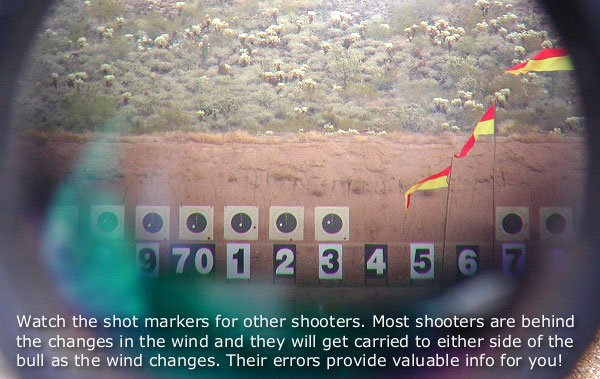
While scoring for another shooter, take a moment to scan the line of targets. You’ll be surprised at how most of the shot markers move in unison to one side and then the other. The sad truth is that most shooters are behind the changes in the wind and they will get carried to either side of the bull as the wind changes. You’ll see this in the targets as they come up, and once learned, you’ll find that the line of targets is as useful as another row of flags.

November 6th, 2014
Ok, here’s the deal. Get yourself to the Austin, Texas area this weekend, and you can shoot a bunch of new guns from numerous major manufacturers. At the first annual Texas International Firearms Festival, avid shooters can try and buy the latest guns and gear. With more than 30 dedicated gun bays and dozens of ammo and accessory retailers, the Texas International Firearms Festival proves the old adage that everything is bigger and better in Texas.
This isn’t your run-of-the-mill gunshow where you can only look at a bunch of guns indoors. At the Texas Firearms Festival this weekend you can actually “test drive” dozens of new firearms. Here are some of the big-name gun-makers offering firearms at the Festival: Barrett, Beretta, Cabot Guns, FN Herstal, Henry Repeating Arms, Sig Sauer, Tracking Point, Walther, Winchester.

The Festival isn’t free — but the price is more than reasonable considering the hours of fun you can have. A one-day pass, which includes the cost of ammo, is $59.00. A weekend pass for two full days of shooting is just $95.00 (ammo included). Purchase tickets at TexasGunFest.com.
Festival Location and Directions
The Festival will be held at the Best of the West Shooting Range in Liberty Hill, Texas. The address is 19500 W. SH 29, Liberty Hill, TX 78642. For driving directions, use this interactive Google map:
Our friend (and ace sharp-shooter) Kirsten Weiss will be at the Festival this weekend acting as a spokesperson. Maybe you can meet Kirsten and learn how she makes those amazing trick shots featured on her popular YouTube Channel.

November 5th, 2014
Want to see how some of the best rifle shooters in the world operate in high-stakes, 1000-yard competition? This video shows Team Sinclair powering to victory at the 2014 F-Class National Championships in Phoenix. Scoring an impressive 792-38X, Team Sinclair topped the field, winning the 4-man team title and setting a new 1000-yard F-TR National Team Record in the process. It was a close match, with America’s “powerhouse” F-TR teams battling it out for the top three spots: Team Sinclair (Gold), Team X-Men (Silver), and Team Michigan (Bronze). Team Sinclair’s wind coach Ray Gross did a superb job. Ray also serves as the Captain of the USA F-TR Rifle Team.

Along with the Team Sinclair shooters, this video also features Team X-Men (orange shirts), and Team Michigan. Starting at the 2:05 time-mark, you can hear Bryan Litz calling wind for Team Michigan. Watch the mirage in the video and see if you can match Bryan’s wind calls with the movement of the mirage. This is a great opportunity to see F-TR Top Guns in action. Team score cards appear in the video, starting at the 3:01 time-mark.
Watch Team Sinclair, Team X-Men, and Team Michigan at 2014 F-Class Nationals:
Warning — Video starts with loud rock music. You may want to turn down your speakers if at work.


Thanks to Paul Phillips for editing and uploading this video. Photos courtesy Nightforce Optics.
November 5th, 2014
 Would you like a target-cam system that fits in a single, compact weatherproof container, sets up quickly without tripods or external antennas, and works with smartphones, iPads, Android tablets, and Windows laptops? Well then you would like the brand new Bullseye AmmoCam Sight-In, a self-contained target-cam system in a sturdy plastic box resembling a classic military ammo can. Simply set the unit downrange, flip the “on” switch, and start shooting. The whole system weighs just 5 pounds. The manufacturer offers a 30-day unconditional money-back guarantee. Would you like a target-cam system that fits in a single, compact weatherproof container, sets up quickly without tripods or external antennas, and works with smartphones, iPads, Android tablets, and Windows laptops? Well then you would like the brand new Bullseye AmmoCam Sight-In, a self-contained target-cam system in a sturdy plastic box resembling a classic military ammo can. Simply set the unit downrange, flip the “on” switch, and start shooting. The whole system weighs just 5 pounds. The manufacturer offers a 30-day unconditional money-back guarantee.
The $349.00 wireless Bullseye AmmoCam is a stand-alone video camera/transmitter that works out to 300 yards. The built-in software identifies and flashes your last shot on the display — that’s smart. The signal can be received by a WiFi-enabled smartphone, tablet, iPad, or Windows laptop computer. It even allows multiple users to connect simultaneously (so your buddy can watch your target as you shoot). There are no wires to string or bulky antennas to set up. The whole system is simple and easy, and weighs just five pounds. The fully weatherproof container is a compact 14″ x 8″ x 10″. Daytime battery life is 12+ hours.

Bullseye AmmoCam Sight-In Edition
The AmmoCam Sight-in model works out to 300 yards with clear line of sight. With a built-in lamp to illuminate the target, the AmmoCam system works both in day-time and after dark. The 5-lb, $349.00 package includes all the following:
- Video Camera with night illumination.
- WiFi Transmitter (with built-in router).
- Rechargeable lithium-ion battery pack w/charger (12+ hour run time).
- Target Manager software package for iPhone, iPad, Windows XP, Vista, Windows 7 and 8.
- Secure, fully weatherproof 14″ x 8″ x 10″ Carrying Case.
Bullseye 1000-Yard Long-Range Edition
While we understand the appeal of the dead-simple AmmoCam, we know that many shooters want to go out way past 300 yards. For them, Bullseye Camera Systems offers a 1000-Yard Long Range Edition System, priced at $549.00. This is a complete package which includes video camera, router with high-gain antenna, tripod, carrying case, and all necessary connectors. Bullseye Target Manager software works with iPhone, iPad, Windows XP, Vista, Windows 7 and Windows 8 (and soon Max OSX).

November 5th, 2014
 Here’s a simple product that performs a very important function. Magazine Marker Bands from Faxon Firearms help you keep track of your AR- and AK-platform mags. Color-coded and marked with the cartridge type (5.56/.223, 7.62×39, 300 BLK), these bands help ensure you never load the wrong type of ammo into your semi-automatic rifle. Maybe you’re thinking “I’d never make that mistake” but remember Murphy’s law — “Anything that can go wrong, will go wrong.” The consequences of shooting the wrong type of ammunition in a rifle can be dire, if not catastrophic. Here’s a simple product that performs a very important function. Magazine Marker Bands from Faxon Firearms help you keep track of your AR- and AK-platform mags. Color-coded and marked with the cartridge type (5.56/.223, 7.62×39, 300 BLK), these bands help ensure you never load the wrong type of ammo into your semi-automatic rifle. Maybe you’re thinking “I’d never make that mistake” but remember Murphy’s law — “Anything that can go wrong, will go wrong.” The consequences of shooting the wrong type of ammunition in a rifle can be dire, if not catastrophic.
In addition to the safety benefits, these color bands also help you organize your magazines during transport and storage. If you have a variety of AR uppers in various calibers, it would be sensible to purchase a set of these color-coded bands. Price is $9.99 per set of ten (10) bands of one color (blue 5.56/.223, yellow 7.62×39, or red 300 BLK). Unfortunately, Faxon does not currently offer a “Mix and Match” option. So, if you want all three types, you’ll have to buy three different sets. That’s a bit annoying.

We’d like to see a marker band product like this for other types of magazines, including rimfire mags. We’ve seen varminters try to stuff a 17 HMR magazine into a 22LR and vice-versa. We’ve also seen shooters pick up the wrong Detachable Box Magazine (DBM) for their centerfire bolt guns. This can easily happen on a varmint hunt when you have multiple rifles in different calibers (such as .223 Rem and .204 Ruger).
November 4th, 2014

 The folks from Nightforce Optics attended the 2014 F-Class National Championships in Phoenix last week. Sean Murphy and his Nightforce colleagues snapped a ton of photos of F-TR and F-Open shooters in action. You can see over 300 images from the Nationals on the Nightforce Facebook Page. Below are some of our favorite shots, with captions. Facebook users can access the full F-Class Nationals Gallery. The folks from Nightforce Optics attended the 2014 F-Class National Championships in Phoenix last week. Sean Murphy and his Nightforce colleagues snapped a ton of photos of F-TR and F-Open shooters in action. You can see over 300 images from the Nationals on the Nightforce Facebook Page. Below are some of our favorite shots, with captions. Facebook users can access the full F-Class Nationals Gallery.
Click any image to see large-size version
Here’s winning 2014 F-TR National Champion James Crofts, with his PR&T-built rig.

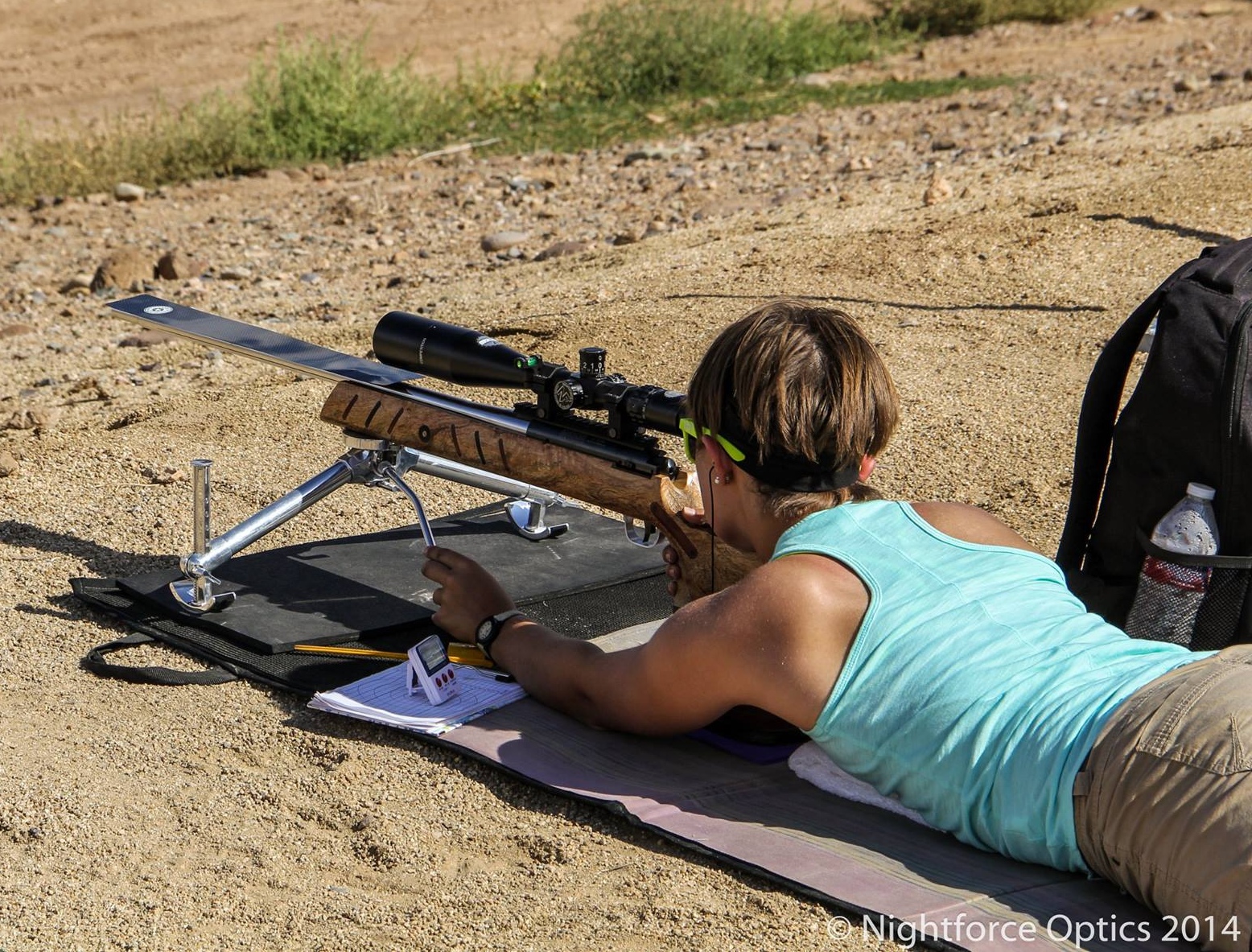
Young female shooter uses SEB JoyPod, a coaxial, joystick-actuated bipod. Yes it is F-TR legal.

Yes, you CAN shoot F-Open with a Tube-gun. This modular chassis sports a Delrin bag-rider.

With the rising popularity of F-TR compeition, shooters are adapting Benchrest-style stocks to use a bipod. Here’s a McMillan Bench stock fitted with a bipod.


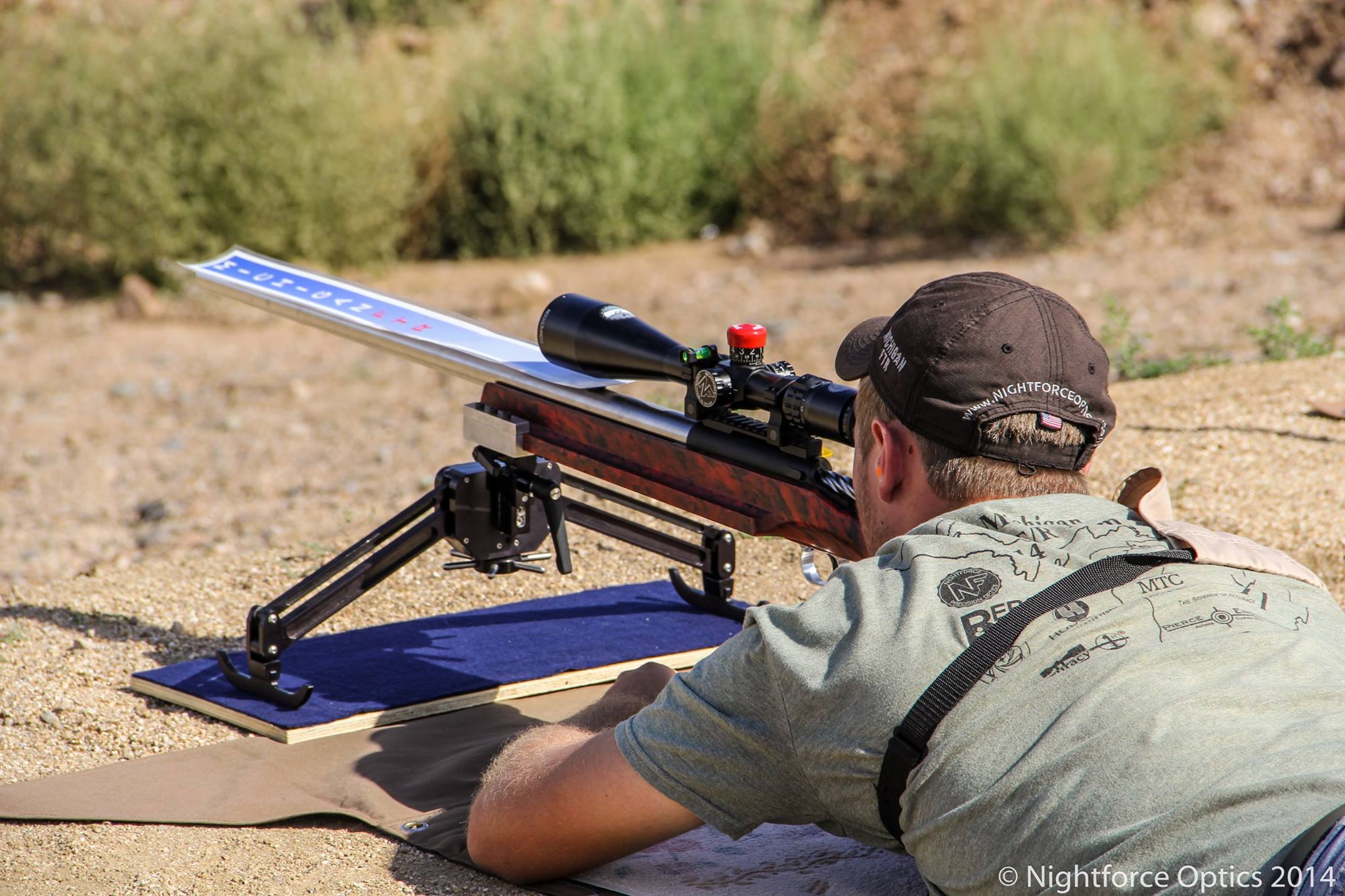
It was hot in Phoenix. Notice that the shooter covered his ammo as well as his head.
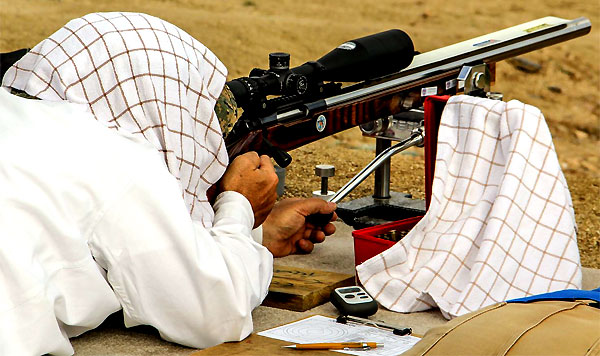
“See, Focus, Trust” — One competitor wrote his mantra on his ammo box lid.

Here ballistics Guru Bryan Litz shoots a John Pierce-built F-TR rig. This uses a low-profile, Benchrest-style carbon composite stock.

Shiraz Balolia had a very patriotic rig and a blinged-out tripod front rest.

Cactus and morning balloon ascents before the wind starts. Yes, this is Ben Avery…

All photos copyright Nightforce Optics 2014, used with permission.
November 4th, 2014
“Ready on the Left, Ready on the Right… Commence Watching!” On Wednesday, November 5, 2014, Shooting USA will broadcast coverage of the 2014 National Matches and CMP events at Camp Perry, Ohio. This is a “must-watch” episode for anyone interested in competitive shooting. The National Matches at Camp Perry are the World Series of American shooting sports, attracting the nation’s top pistol and rifle marksmen. Shooting USA’s coverage begins Wednesday on the Outdoor Channel. This week’s episode will also feature the m1903 Springfield, an historic American military weapon.

Shooting USA Wednesday Broadcast Times on the Outdoor Channel:
Eastern Time – 3:30 PM, 9:00 PM, 12:00 M
Central Time – 2:30 PM, 8:00 PM, 11:00 PM |
Mountain Time – 1:30 PM, 7:00 PM, 10:00 PM
Pacific Time – 12:30 PM, 6:00 PM, 9:00 PM |
History of Camp Perry
The National Matches have been held at Camp Perry since 1907. The range is located along the shores of Lake Erie in northern Ohio near Port Clinton. The site was first acquired in 1906, in response to the need for a larger facility for military training and the NRA’s shooting programs. In 1906 Gen. Ammon B. Crichfield, Adjutant General of Ohio, ordered construction of a new shooting facility on the shores of Lake Erie, 45 miles east of Toledo, Ohio. The original land for Camp Perry was purchased in 1906, and the reservation was named after Commodore Oliver Hazard Perry, the American naval commander who won the Battle of Put-in-Bay during the War of 1812.

On August 19, 1907, Cpl. L. B. Jarrett fired the first shot at the new Camp Perry Training Site. And that year, 1907, Camp Perry held its first National Pistol and Rifle Championship events. This location has hosted the annual NRA National Matches ever since. Today, over 4,000 competitors attend the National Matches each year, making it the most popular shooting competition in the western hemisphere.
Federal legislation originally launched the National Matches. In February 1903, an amendment to the War Department Appropriations Bill established the National Board for the Promotion of Rifle Practice (NBPRP). This government advisory board became the predecessor to today’s Corporation for the Promotion of Rifle Practice and Firearms Safety, Inc. that now governs the CMP. The 1903 legislation also established the National Matches, commissioned the National Trophy and provided funding to support the Matches.
November 4th, 2014
Here’s a reminder that today is Election Day across the nation. This morning your Editor took the time to hop in the car and go cast my vote. You should too. We live in a democracy — it’s important that all concerned, voting-age citizens participate in the process. Remember that you have no right to complain about politicians (or their policies) if you haven’t exercised your right to vote.
Not Sure Where to Vote? CLICK HERE for Directories of Polling Places, State-by-State.

.
November 3rd, 2014
Applied Ballistics has just announced Ballistic Performance of Rifle Bullets. This new book is chock full of “mission critical” data on hundreds of popular projectiles. This latest reference book from Bryan Litz contains live fire test data on 400 modern rifle bullets. The data pages contained in this book are similar to the 225 bullet data pages found in Applied Ballistics for Long Range Shooting. The Ballistic Coefficient data is based on live fire testing methods which are repeatable within +/- 1%. If you’re looking for “rock-solid” info on the ballistic performance of today’s most popular rifle projectiles, this work is the definitive print resource. Scroll down to see a sample page from the new book.
 CLICK HERE to see the full list of bullets covered in this new resource book. CLICK HERE to see the full list of bullets covered in this new resource book.
Visit the Applied Ballistics Online Store to pre-order your copy and save $5. Note: Pre-orders are expected to ship and arrive at USA destinations in time for Christmas. Retail price is $54.95, with a $5.00 pre-order discount.
More about the Book
“Modern rifles have reached an unprecedented level of accuracy. In many cases, the weak link in the chain of hitting targets is the trajectory modeling, which is based on bullet performance,” stated author Bryan Litz. Unfortunately, shooters can’t always rely on advertised Ballistic Coefficients (BCs) being accurate. Slight errors in BC modeling can be the cause of missing your target. Furthermore, a meaningful apples-to-apples comparison of bullet performance is not possible when the BCs are determined differently by various brands.
This book provides highly accurate ballistic performance data for 400 modern long range bullets from .224 to .408 caliber. By employing a common testing method for bullets of all brands, shooters are provided with consistent and accurate performance data which can be used to compare and select bullets, as well as to calculate accurate trajectories which put your shots on target at long range. It is claimed that the BC data is accurate (and repeatable) to +/- 1% for all bullets tested.
Detailed stability data is also included which can be used to determine suitable twist rates for bullets in various environments.
View Sample Page from Ballistic Performance of Rifle Bullets:

NOTE: This is a reference book which contains mostly data pages. There is a single chapter in the beginning which talks about how to use the data. For a more thorough understanding of the science of external ballistics, readers are referred to: Applied Ballistics for Long Range Shooting (2d Edition).
|