Here’s the deal of the month if you’re looking for a medium-magnification scope for hunting or gun games. The Vortex Razor HD 5-20x50mm Scope is now just $1349.00 at EuroOptic.com. These popular optics previously retailed for $1999.95. But EuroOptic purchased ALL the remaining inventory of these Vortex scopes and is blowing them out at below wholesale prices. With this special inventory reduction sale, you can save $650.00 on a very high-quality scope.
Vortex Razor HD 5-20x50mm Scope Buy Out Sale!
After buying ALL the remaining Vortex Razor HD inventory, EuroOptic is offering huge savings — $650 off the riflescopes shown above. Originally priced at $1999.95, these scopes are now being sold for just $1349.00! Supplies are limited. Call 570-368-3920 to order.
Sale tip by EdLongrange. We welcome reader submissions.
The ANSI / SAAMI group, short for “American National Standard Institute” and “Sporting Arms and Ammunition Manufacturers’ Institute”, have made available some time back the voluntary industry performance standards for pressure and velocity of centerfire rifle sporting ammunition for the use of commercial manufacturers. [These standards for] individual cartridges [include] the velocity on the basis of the nominal mean velocity from each, the maximum average pressure (MAP) for each, and cartridge and chamber drawings with dimensions included. The cartridge drawings can be seen by searching the internet and using the phrase ‘308 SAAMI’ will get you the .308 Winchester in PDF form. What I really wanted to discuss today was the differences between the two accepted methods of obtaining pressure listings. The Pounds per Square Inch (PSI) and the older Copper Units of Pressure (CUP) version can both be found in the PDF pamphlet.
Image by ModernArms, Creative Common License.
CUP Pressure Measurement
The CUP system uses a copper crush cylinder which is compressed by a piston fitted to a piston hole into the chamber of the test barrel. Pressure generated by the burning propellant causes the piston to move and compress the copper cylinder. This will give it a specific measurable size that can be compared to a set standard. At right is a photo of a case that was used in this method and you can see the ring left by the piston hole.
PSI Pressure Measurement
What the book lists as the preferred method is the PSI (pounds per square inch or, more accurately, pound-force per square inch) version using a piezoelectric transducer system with the transducer flush mounted in the chamber of the test barrel. Pressure developed by the burning propellant pushes on the transducer through the case wall causing it to deflect and make a measurable electric charge.
Q: Is there a standardized correlation or mathematical conversion ratio between CUP and PSI values?
Mahin: As far as I can tell (and anyone else can tell me) … there is no [standard conversion ratio or] correlation between them. An example of this is the .223 Remington cartridge that lists a MAP of 52,000 CUP / 55,000 PSI but a .308 Winchester lists a 52,000 CUP / 62,000 PSI and a 30-30 lists a 38,000 CUP / 42,000 PSI. It leaves me scratching my head also but it is what it is. The two different methods will show up in listed powder data[.]
So the question on most of your minds is what does my favorite pet load give for pressure? The truth is the only way to know for sure is to get the specialized equipment and test your own components but this is going to be way out of reach for the average shooter, myself included. The reality is that as long as you are using printed data and working up from a safe start load within it, you should be under the listed MAP and have no reason for concern. Being specific in your components and going to the load data representing the bullet from a specific cartridge will help get you safe accuracy. [With a .308 Winchester] if you are to use the 1% rule and work up [from a starting load] in 0.4 grain increments, you should be able to find an accuracy load that will suit your needs without seeing pressure signs doing it. This is a key to component longevity and is the same thing we advise [via our customer service lines] every day. Till next time, be safe and enjoy your shooting.
Story based on report by Lars Dalseide forNRABlog.com
I first met Anette Wachter four years ago at the NRA’s National Long Range High Power Rifle Championship in Camp Perry, Ohio. A statuesque brunette, Wachter easily stood out in the crowd. I just so happened to be a big fan of her twitter feed as well. After a quick exchange of pleasantries, we talked about shooting, life in Washington, and how she could get more involved.
Since then she has become very involved. Her 30 Cal Gal blog has become a favorite of male and female shooters alike. Due to her diligence, she was also about to earn a spot on the U.S. National Palma Travel Rifle Team. And recently, Wachter lent her voice and views to the battle for gun rights in the state of Washington.
by AccurateShooter.com
Anette Wachter, aka “30 Cal Gal”, Helps Lead Fight Against I-594
Below is a video Anette made opposing I-594, a Washington State initiative on the November ballot. This law could have drastic consequences for Washington state firearms owners. Visit www.VoteNo594.com for more information and to learn how you can help defeat this gun control initiative.
The provisions of I-594 are explained in detail on the NRA-ILA website. Here are the key reasons Washington gun owners should oppose this proposed legislation:
Here’s a cleverly-designed new product that adds versatility to any rifle with a front sling swivel stud. This new Stud Rail Adapter (SRA) allows you to mount a Picatinny Rail on a sling swivel stud. With the SRA in place, you can attach any accessories that clamp to a Pic rail, such as lights, lasers, pistol grips, or rail-affixed tactical bipods. And look carefully — the SRA’s designers included a sling swivel at the inboard end of the unit. That way you can mount Picatinny-rail accessories and still use your carry sling.
Sold by Harrisbipods.com, the SRA Stud Rail Adapter retails for $47.85. NOTE: HarrisBipods.com is a web retailer. This is NOT Harris Engineering, the manufacturer of Harris bipods. HarrisBipods.com does sell the full line of Harris bipods and most Harris accessories. However, as far as we can tell the SRA is NOT made by Harris Engineering.
Comment: We think this adapter is a useful invention, particularly for those who might want to mount a light to a varmint rifle. Most hunting rifles have a front sling swivel stud and there is now a very wide selection of Picatinny-rail-mounted accessories.
Product tip from EdLongrange. We welcome reader submissions.
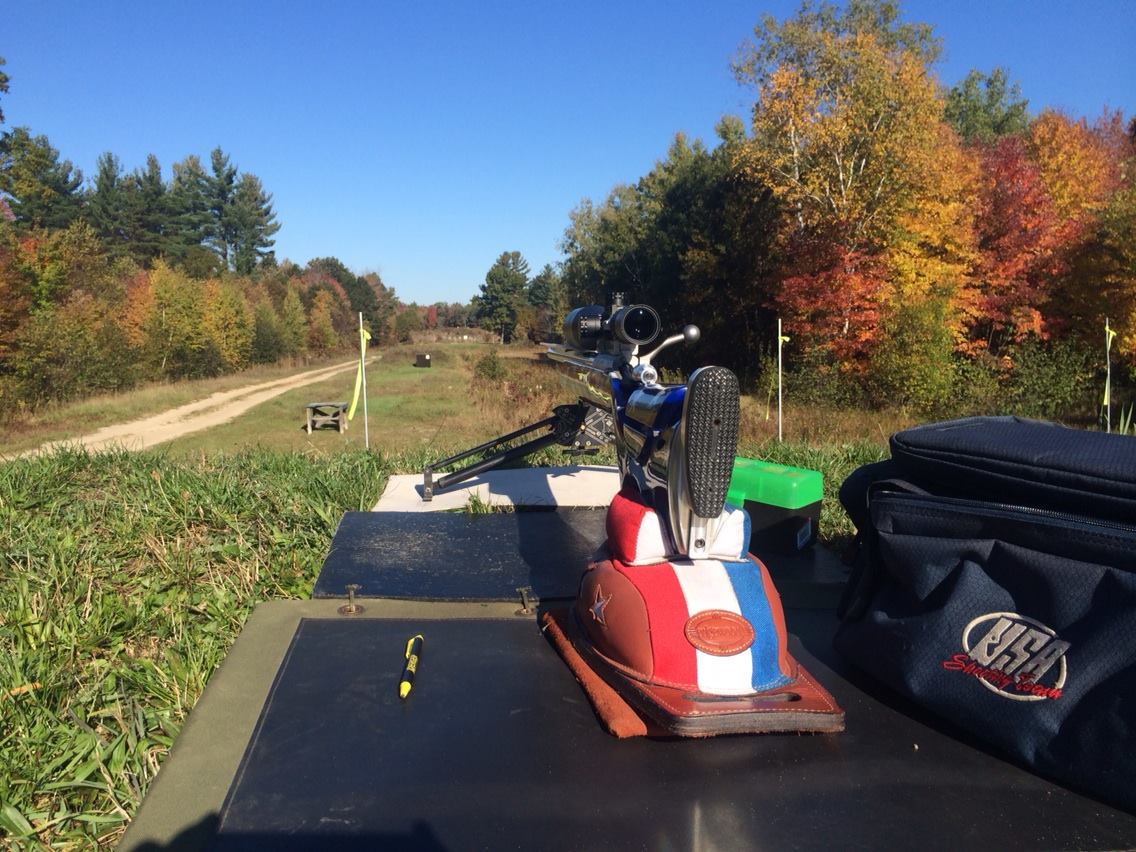
The USA F-Class National Championships will be held October 28 – November 2, 2014 in Phoenix, AZ. Many top competitors are out practicing, perfecting their technique and their loads. Here’s a photo from our friend Paul Phillips, a member of the World Championship F-TR Team USA. Paul enjoyed the colorful fall foliage at his Michigan home range: “It was a great day to practice for the Nationals. My load and rifle are shooting great. Now I need to load 300 rounds with my recipe.”
CLICK IMAGE for Desktop Wallpaper-Worthy Full-Screen Version
Under Two Inches at 500 Yards
To be competitive at the Nationals, one needs a tack-driving rifle and an ultra-accurate load. Shown below is one of Paul Phillips’s load development targets at 500 yards. The total 5-shot group size is under two inches. Impressive. That’s with 200gr Bergers, Varget powder, and large primer Lapua brass. Paul tell us: “At the upcoming Nationals we will be competing at 1000 yards. The X-Ring is 5 inches at 1000 (equivalent to 2.5 inches at 500). We strive to be all in the X-Ring. However, wind is the big obstacle. A gust of wind can move you 1-2 feet away.”
Paul Phillips at Raton in 2013
F-Class National Championship
The 2014 National F-Class Shooting Championship will be held in Phoenix, Arizona at the Ben Avery Shooting Facility. Preparations are well underway to host competitors from around the world. One of the largest events of its kind in USA, the NRA-sanctioned F-Class Nationals will be hosted by the Desert Sharpshooters Rifle Club.
The F-Class National Championship is a multi-day match with all shooting at 1000 yards. There will be a mix of individual and four-person team matches. The competition consists of two different Divisions: F- Open and F-TR (Target Rifle). Each Division is made up of five different Categories: High Master, Master, Expert, Sharpshooter and Marksman.
Entry Deadline: The deadline for entries is 6:00 PM Monday, 20 October 2014. Entries after this time are considered late entries and may be accepted to fill vacancies on existing relays only. An additional $20.00 will be charged for late entries, above the normal $200.00 Entry Fee.
Effects Of Cartridge Over All Length (COAL) And Cartridge Base To Ogive (CBTO) – Part 1 by Bryan Litz forBerger Bullets.
Many shooters are not aware of the dramatic effects that bullet seating depth can have on the pressure and velocity generated by a rifle cartridge. Cartridge Overall Length (COAL) is also a variable that can be used to fine-tune accuracy. It’s also an important consideration for rifles that need to feed rounds through a magazine. In this article, we’ll explore the various effects of COAL, and what choices a shooter can make to maximize the effectiveness of their hand loads.
Sporting Arms and Ammunition Manufacturers’ Institute (SAAMI)
Most loading manuals (including the Berger Manual), present loading data according to SAAMI (Sporting Arms and Ammunition Manufacturers’ Institute) standards. SAAMI provides max pressure, COAL and many other specifications for commercial cartridges so that rifle makers, ammo makers, and hand loaders can standardize their products so they all work together. As we’ll see later in this article, these SAAMI standards are in many cases outdated and can dramatically restrict the performance potential of a cartridge.
Bullet seating depth is an important variable in the accuracy equation. In many cases, the SAAMI specified COAL is shorter than what a hand loader wants to load their rounds to for accuracy purposes. In the case where a hand loader seats the bullets longer than SAAMI specified COAL, there are some internal ballistic effects that take place which are important to understand.
Effects of Seating Depth / COAL on Pressure and Velocity
The primary effect of loading a cartridge long is that it leaves more internal volume inside the cartridge. This extra internal volume has a well known effect; for a given powder charge, there will be less pressure and less velocity produced because of the extra empty space. Another way to look at this is you have to use more powder to achieve the same pressure and velocity when the bullet is seated out long. In fact, the extra powder you can add to a cartridge with the bullet seated long will allow you to achieve greater velocity at the same pressure than a cartridge with a bullet seated short.
Figure 1. When the bullet is seated farther out of the case, there is more volume available for powder. This enables the cartridge to generate higher muzzle velocity with the same pressure.
When you think about it, it makes good sense. After all, when you seat the bullet out longer and leave more internal case volume for powder, you’re effectively making the cartridge into a bigger cartridge by increasing the size of the combustion chamber. Figure 1 illustrates the extra volume that’s available for powder when the bullet is seated out long.
Before concluding that it’s a good idea to start seating your bullets longer than SAAMI spec length, there are a few things to consider.
Geometry of a Chamber Throat
The chamber in a rifle will have a certain throat length which will dictate how long a bullet can be loaded. The throat is the forward portion of the chamber that has no rifling. The portion of the bullet’s bearing surface that projects out of the case occupies the throat (see Figure 2).
The length of the throat determines how much of the bullet can stick out of the case. When a cartridge is chambered and the bullet encounters the beginning of the rifling, known as the lands, it’s met with hard resistance. This COAL marks the maximum length that a bullet can be seated. When a bullet is seated out to contact the lands, its initial forward motion during ignition is immediately resisted by an engraving force.
Seating a bullet against the lands causes pressures to be elevated noticeably higher than if the bullet were seated just a few thousandths of an inch off the lands.
A very common practice in precision reloading is to establish the COAL for a bullet that’s seated to touch the lands. This is a reference length that the hand loader works from when searching for the optimal seating depth for precision. Many times, the best seating depth is with the bullet touching or very near the lands. However, in some rifles, the best seating depth might be 0.100″ or more off the lands. This is simply a variable the hand loader uses to tune the precision of a rifle.
The Western CMP Games and Creedmoor Cup Matches are underway right now in Phoenix, at the Ben Avery Shooting Facility. One of yesterday’s match winners was Dennis DeMille, General Manager of Creedmoor Sports, and a past National High Power Rifle Champion (2005). In the Military Rifle Match, Dennis showed how it was done, firing a 286-9X, to win the match. Below, shooting his 7.62×51 M1A, Dennis demonstrates his flawless form in standing.
Other Western Games shooters offered these comments about Dennis DeMille:
“CWO DeMille was my former OIC at Edson Range. I was part of the MCRD Shooing Team when he was the OIC as well. This man is Marksmanship — a true Gun Slinger and good friend.” — K.S.
“I have shot along side him before. [Dennis] just plain rocks in Service Rifle.” — Mike M.
“Other than the additional grey hair, some things never change.” — Mark T. V.M.
Sierra Bullets has just added extensive load data for the 300 AAC Blackout (300 BLK) cartridge. Developed for the AR15 platform, the 300 BLK offers AR shooters a large-caliber option in both subsonic and supersonic variants. The 300 BLK can be made from modified .223 Rem brass or necked-up .221 Fireball cases. We like to form our .300 BLK brass by necking-up the excellent Lapua .221 Fireball brass.
Sierra Has 5 Pages of Load Data for the 300 AAC Blackout. Here is one sample page:
Sierra Cartridge Comments: 300 AAC Blackout
The 300 AAC Blackout (300 BLK, or 7.62x35mm) was created by Advanced Armament Corp. and Remington in order to provide the military with a way to shoot .30 caliber bullets from the M4 platform with only a barrel change. It has since become popular for a wide range of uses including hunting and home defense.
The cartridge shares case-head dimensions and body taper with the .223 Remington. Not only does this allow for compatibility with existing magazines and bolts, but it allows reloaders to form 300 BLK brass from the vast supply of 5.56mm or .223 cases. However, since .223/5.56 cases need to be cut-down and reformed, it can be simpler to neck up .221 Fireball brass.
The 300 AAC Blackout is similar to previous wildcats, such as the .30-221 and .300 Fireball, as well as the proprietary 300 Whisper®. However the 300 BLK was the first SAAMI-approved (and standardized) cartridge of this type. Moreover, any company is free to make firearms or ammunition for the 300 BLK.
300 AAC Blackout is popular with hunters, who may not be allowed to legally hunt with .223 in their state, and who prefer .30-caliber bullets for medium-sized game. It provides similar effectiveness to the 7.62×39mm or the slightly more powerful 30-30 cartridges, while working in the more up-to-date AR15 platform. Effective range for hunting is about 100-150 yards.
This article, written by Sinclair’s Phil Hoham, originally appeared in the Sinclair Int’l Reloading Press.
Forster Products’ Heritage
I toured Forster Products’ Lanark, Illinois plant with Forster owners Robert Ruch and Rod Hartman. Forster Products was founded by the Forster brothers in 1935. The company’s first production was in the basement of their home. There, the brothers crafted the famous “Forster 99” model airplane engines, establishing a reputation for quality right from the start. In 1946 the company expanded into firearms reloading products, starting with headspace gauges, universal sight-mounting fixtures, and Forster’s famous case trimmers. All of these tools are still being manufactured and sold by Forster Product today.
In the 1950s, Forster’s reputation for precision allowed it to become a Rolls-Royce subcontractor making fluid and fuel control parts used in Rolls-Royce aircraft engines. Forster also manufactured fluid control parts used at the Hoover Dam and in the United States MX missiles. With this precision background it is no wonder that Forster Products holds an ISO 9001-2008 quality certification!
Forster Acquired Bonanza Reloading Co. in 1984
Forster reloading dies and presses came into being in 1984 when Forster purchased the Bonanza Reloading Company from its owner Clarence Purdie. Mr. Purdie designed the CO-AX press with its floating jaws, easy die installation and tremendous leverage. He also held the patents on the famous “sliding sleeve” featured in the Forster “Ultra” and “Benchrest” seaters. His sizing die design positioned the expander ball high up in the full length and neck dies so the case neck is supported as it resized while it is being withdrawn from the die. This design feature is also unique to the Forster brand. All of these innovations make Forster dies a quality product for producing precision ammunition. No wonder Carl Bernosky and John Whidden (NRA High Power and Long-Range champions) swear by them! It was great seeing that “Made in the USA” quality is still alive and well and that Bob and Rod along with their staff have such a great commitment to precision manufacturing and quality customer service.
Forster’s Time-Saving 3-in-1 Case Trimming/Chamfering Tool
Forster’s CFO, Robert Ruch, demonstrates the 3-in-1 Case Mouth Cutter tool in the video below. This unit trims the case to length, puts a 14-degree chamfer on the INSIDE of the neck, AND (last but not least), it cuts a 30-degree chamfer on the OUTSIDE of the neck. As you can see, the tool turns very smoothly (no chatter) and the job is finished in a few seconds. Forster’s 3-in-1 Carbide cutting tool works with all existing Forster case trimmers and other hand lathes with a .490″ shaft diameter. The tool typically sells for about $60.00 at major vendors, and Robert says it should last for a lifetime of use. The unit fits over the Cutter Shaft and easily secures with one set screw. The 3-in-1 cutter is available for five (5) calibers: .224, .243 (6mm), .264 (6.5mm), .284 (7mm), and .308.
The Civilian Marksmanship Program (CMP) invites young men and women shooters to apply for CMP scholarships for the 2015-2016 school year. The CMP offers $1,000 one-year scholarships to current high school seniors. Since 2005, CMP has awarded over $1 million in scholarship grants.
Last year the CMP authorized 160 awards for a total of $160,000 from the CMP Scholarship fund. NOTE: In 2013, 68% of qualified CMP scholarship applicants received an award! Recipients hailed from JROTC programs, 4-H groups, and other shooting clubs. Selection is based on merit and demonstrated rifle or pistol marksmanship activity/affiliation. Applicants must provide rifle or pistol competition history, list of awards, and future goals in the shooting sports. Applicants must also provide academic GPA and an official transcript.
Applications are Being Accepted Now for 2015-2016
The CMP is now taking scholarship applications for the 2015-2016 freshman college year. Scholarships are one-year awards that may be used to fund any accredited, post-secondary education or vocational program. (Note: Students planning to enroll in a military academy are not eligible).
The deadline for CMP Scholarship Application is March 20, 2015. Learn more about the program at the CMP Website Scholarship Page. Click the links below to download Scholarship Regulations or a Scholarship Application Form (as PDF files).


 CUP Pressure Measurement




 Effects Of Cartridge Over All Length (COAL) And Cartridge Base To Ogive (CBTO) – Part 1


 — Emil P.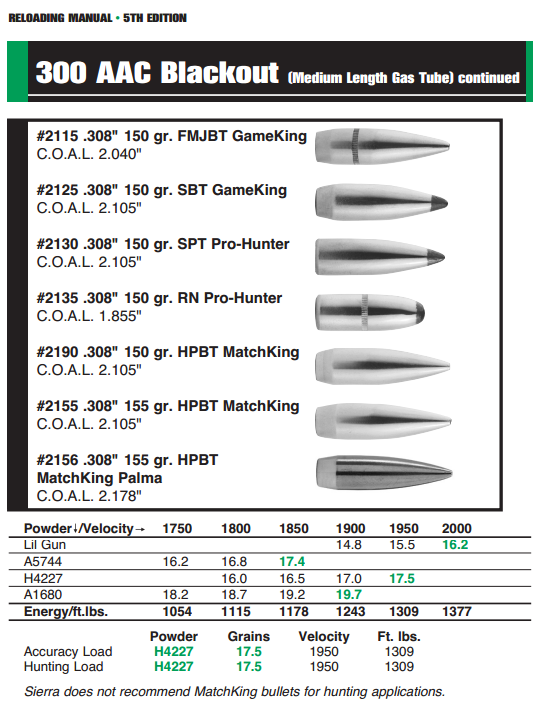

 Forster Products’ Heritage

 The Civilian Marksmanship Program (CMP) invites young men and women shooters to apply for CMP scholarships for the 2015-2016 school year. The CMP offers $1,000 one-year scholarships to current high school seniors. Since 2005, CMP has awarded over $1 million in scholarship grants.


