|
|
September 29th, 2014
“All dressed up and nowhere to go” was the comment our IT guy, Jay Christopherson, sent with this photo. This is Jay’s testing set-up at his home range, complete with PVM-21 chronograph and wireless target-cam. The camera signal is sent, via WiFi, to Jay’s laptop computer. However, even with all that high-tech electronic gear, you can’t make the shot if you can’t see the target through the rifle-scope. On this morning, heavy ground fog completely obscured the target. Jay told us: “I ended up waiting a little over an hour for the fog to burn off enough so that I could see the 600-yard target. What was funny was that I had a perfectly clear picture of the target via the target-cam and monitor. But there was no way to aim the rifle since the riflescope showed nothing but fog.”

This photo was taken by Jay at the Cascade Shooting Facility in Ravensdale, WA. The rifle is Jay’s .284 Shehane F-Class rifle. Jay was testing primers for Extreme Spread (ES) variation around 9:00 am. Nature was not cooperating. Jay was running Hodgdon H4831sc and testing various primers to see which provided the best numbers.
The chronograph is the Kurzzheit PVM-21. Equipped with infrared sensors, the PVM-21 is our “go-to” chron for most velocity testing, with an Oehler 35P for “back-up”. The PVM-21 (now updated with Kurzzheit’s BMC-19 model) sets up quickly and gives reliable results in any light conditions. But there is something even more sophisticated on the horizon — the new Labradar, a “stand-off” chronograph that uses Doppler radar to measure bullet speed.

Jay explains: “I am (somewhat) patiently waiting for the new Labradar to release. The PVM-21 works pretty well most of the time and is easy to setup. I do get odd readings out of it every so often, but they are pretty obvious when they occur.” The advantage of the Labradar (if it ever comes to market) is that the unit sits to the left or right of the rifle. The Labradar is situated out of the bullet path, so there is no chance of shooting the chronograph by accident. Another advantage of the Labradar is that you can set it up without needing to go forward of the firing line, which would require a safety break.
September 29th, 2014
As part of the Ohio Day at the Range program, CMP volunteers provided training in Air Rifle shooting and Archery for persons with disabilities. For the participants, some wheel-chair-bound, this was a special event. Though they may not be able to run or jump, they CAN shoot a rifle from a rest. This type of event gives disabled youngsters and adults a chance to enjoy a sport just as able-bodied persons do. We commend the CMP and all those who helped make the Day at the Range a memorable event.

As reported in the BCSN Blade Blog, this program gave participants a chance to learn outdoor skills: “The whole purpose of this is to show that anybody has the ability to hunt, fish, camp — do anything they want to do in the outdoors,” said Tory Thompson, Outreach Director for The Ability Center of Greater Toledo, Ohio. “We want these individuals and their family members to see that the opportunity is there. It will be very gratifying to see that moment when they get to experience something they thought they would never be able to do because of their disability — We hope this opens their eyes and lets everyone see past the stereotypes.”


September 29th, 2014
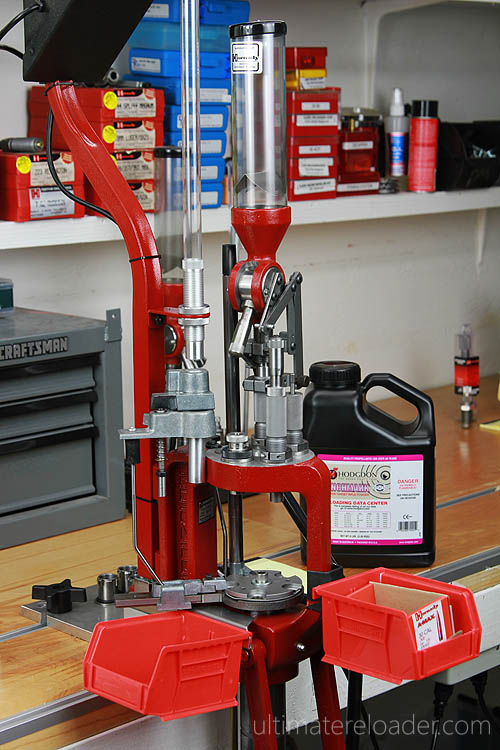
When you need ammo fast — lots of ammo, it’s hard to beat a progressive reloading press for output. We use progressive presses to load handgun ammo and .223 Rem cartridges for varmint safaris. With good dies, and proper press set-up, today’s progressive presses can produce surprisingly uniform and accurate ammo. No, you won’t see Benchrest Hall-of-Famers loading PPC cartridges on progressives. However, if you need 1000 rounds for your next prairie dog adventure, you should consider getting a progressive. Below you can see a Hornady Lock-N-Load AP configured to load .308 Winchester in bulk.
CLICK HERE to Read Full Article

UltimateReloader.com has published helpful Tips to Optimize Progressive Rifle Loading. No matter whether you have a Red (Hornady), Green (RCBS), or Blue (Dillon) progressive, this article can help you load more efficiently and produce better results. Here are some highlights:
Proper Brass Prep
Just like a good paint job requires good prep work, great rifle ammo requires good brass prep. In order to make sure your rifle loading goes smoothly, make sure to perform the following brass prep steps:
- Clean the brass (tumble, ultrasonic, etc.)
- Inspect brass for cracks, deep dents, etc.
- For military brass: de-prime, ream/swage primer pockets, size with small-base sizer die (small base usually optional).
- Measure brass length — if too long, size and then trim.
- Final inspection before loading.
- Cleaning primer pockets may be something you’ll consider (I don’t clean primer pockets except for rare cases or match ammo).
Smooth and Steady Pace
Since you’re loading rifle ammunition on a progressive, you’re already saving a load of time, so there’s no need to rush things! Attention to detail is super-important for safety and for good results. Always keep an eye on powder level (goes down FAST) and what’s happening at each station.
The Right Press and Press Setup
Look for a heavy-duty, well-built press that will stand up to rifle loading. You’ll also want to make sure your powder measure will have the proper capacity (~25 grains for .223, ~50 grains for 308). If you are bulk reloading, ensure you have enough stations for sizing, charging, powder check, bullet feed, bullet seating, and (optional) bullet crimp.
More Ultimate Reloader Resources for Users of Progressive Presses:
September 28th, 2014

Smith & Wesson is introducing a new series of ported M&P pistols. Chambered in 9mm and .40 S&W, the Performance Center M&P Ported pistols offer a factory-ported barrel and slide. Both 4.25″ and 5″ barrel configurations are offered in each caliber. A special Performance Center sear provides a crisp 4.5-pound trigger pull with faster reset. The 9mm pistol has a 17+1 round capacity while the .40 S&W variant features a 15+1 round capacity. Both handguns (9mm and 40 S&W) have an MSRP of $812 with two magazines.
The ported design should help competitors, says pistol ace Jerry Miculek: “The two biggest advantages of running a ported gun in competition involve reduced muzzle rise and less perceived recoil. This [will] help with shorter split times and more rounds on target — two things every competitor wants.”
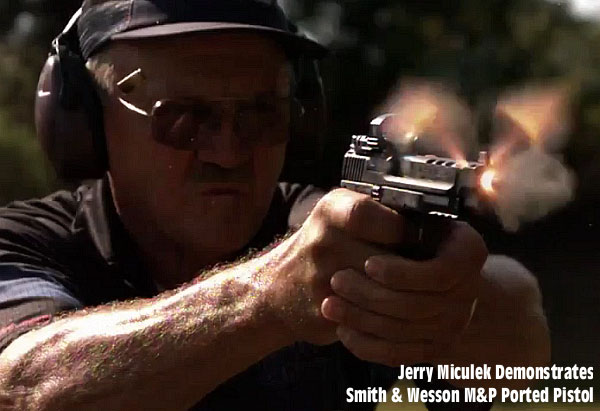
The new ported M&P pistols feature a slide-top platform for easy mounting of red-dot optics. These guns also have high-profile iron sights that can be used in conjunction with the optics. The M&P Performance Center Ported models also feature a textured interchangeable back strap. Three palmswell grips are supplied with each pistol, allowing shooters to custom-tailor grip size to their preference.
 Video Shows Ported Pistol Features and 3D CAD Views: Video Shows Ported Pistol Features and 3D CAD Views:
September 27th, 2014
Forum Member Roy B. has found a website with scores of well-researched articles about guns and shooting. The Firearms History Blog features a wide variety of posts on myriad subjects, from early black powder firearms to modern match rifles. You’ll find tons of information on gun design, barrel-making, action types, and firearms testing equipment. To access hundreds of articles, click on the Firearm History Blog Archive Menu on the left side. Click the navigation arrows to access monthly collections one by one. Some of the best articles are from 2010, so be sure to check those archives too! Here are some of our favorites:
Testing Firearms: Measuring Chamber Pressure
(Comment: Crusher Gauges were used through until the 1960s, when cheap Piezo-electric tranducers became available.)

Barrel Making: Making a Modern Steel Barrel (Two Parts)
(Comment: Barrel drilling process explained — interesting process.)
Metal Treatments: Ferritic Nitrocarburizing/Melonite/Tenifer
(Comment: Meloniting creates a super-hard surface layer; this has been used to extend barrel life.)
Barrel Making: Forming Rifling with Electric Discharge Machining (EDM)
(Comment: This advanced EDM method can also be used to cut chambers.)
History of Gun Cleaning Methods/Solvents
(Comment: Old-timers used some pretty weird concoctions such as “Rangoon Oil”.)
History and Engineering of Sound Suppressors (Two Parts)
(Comment: Interesting cut-away illustrations of suppressor baffles.)
Utility Firearms: Powder-Activated Tools
(Comment: There are construction tools that use gunpowder to drive fasteners into steel and concrete.)
Testing Firearms: History of Proof Testing (Two Parts)
(Comment: Fascinating article, worth a read.)

More Interesting Articles on RVB Precision Website
These and other articles on the Firearms History Blog will give you many interesting hours of reading — Enjoy! And while you’re cruising the web, definitely check out Roy’s own RVB Precision website. It features many interesting DIY gun and reloading projects, such as Fabricating a 17 HMR Bore Guide, Building a Swivel-Top Varminting Bench, and Fabricating a Unertl-type Scope Mount.
September 27th, 2014
We are often asked “what’s the difference between the 6×47 Swiss Match, the 6XC, and the 6.5×47 Lapua necked down to 6mm?” All three cartridges have 30° shoulders and fit a .308-sized boltface. However, alone among the three, the 6mm-6.5×47 has a small primer pocket and small flash hole. The 6×47 Swiss Match (made by RUAG), and the 6XC (produced by Norma), have a large primer pocket and large flash hole, just like a .308 Winchester.

Forum member DesertLefty has provided a line-up photo, with 6mmBR and .260 Rem cases provided for comparison. As you can see, the three mid-sized cases (6x47SM, 6.5×47 Lapua, and 6XC) are very similar.

The Swiss Match has the longest neck, while the 6XC enjoys the highest capacity. But performance is very similar among the three cartridges (with the 6.5×47 necked down to 6mm), and the same powders, particularly H4350, IMR 4007SSC, and N160 work well in the 6×47 SM, the 6XC, and the 6-6.5×47 Lapua. Alliant Reloder 17, slightly faster than H4350 but with a flatter (less “peaky”) burn curve, could also prove a good choice for both the 6XC and 6mm-6.5×47.
6XC vs. 6-6.5×47
Often the question is posed “Which is better, the 6XC or 6mm-6.5×47″. The correct answer seems to be “it depends”. Current batches of Norma-made 6XC brass are very good, while certain lots of 6.5×47 Lapua brass have somewhat disappointing neckwall uniformity, demanding neck-turning for best accuracy. Overall, however, the two cases (6mm-6.5×47 and 6XC) are nearly identical in performance. Some shooters believe the Lapua brass holds up better under full-power loads. On the other hand, Norma 6XC brass from DavidTubb.com is a bit less expensive than 6.5×47 brass.
The parent 6.5×47 Lapua case is rated at 63,090 psi, while the new CIP rating for the 6XC is 63,844 psi (4400 BAR). Though the 6mm-6.5×47 has slightly less powder capacity than the 6XC, max velocities with 105-108gr bullets are quite similar. However, you should not substitute loads from the 6XC directly to the 6mm-6.5×47 or vice-versa. Because of the different case capacities and primer sizes, you should work up loads separately for each cartridge.
September 26th, 2014
If you haven’t visited the Norma website recently, you should click over to www.norma.cc/en/ (the ‘en’ is for English version). There you will find Norma’s “Ammo Academy”, a technical resource that provides information on: Ballistics, Powder Storage, Barrel Wear, and Bullet Expansion. In addition, the Ammo Academy now links to Norma’s Reloading Data Center, where you’ll find loads for nearly 70 cartridge types including: .223 Rem, .22-250, 6mmBR Norma, 6XC, 260 Rem, 6.5-284, 6.5×55, 7mm-08, .270 Win, .284 Win, .308 Win, .30-06, 300 Win Mag, .338 Lapua Mag and dozens more.

The Ammo Academy’s Ballistics section contains some fascinating technical facts:

- After the trigger is pulled, it takes around 0.005 seconds before the firing pin reaches the primer.
- From the firing of the primer it takes 0.0015-0.002 seconds until the bullet exits the muzzle.
- When the bullet leaves the muzzle, the hot gases surround and overtake the bullet, continuing the acceleration for a few centimeters.
- Because the barrel is always angled slightly upwards, the bullet’s flight starts about 3-5 cm below the line of sight.
Norma also offers some good advice about Powder and Cartridge Storage:
To maintain the product quality for as long as possible, you have to keep the powder in a suitable place under suitable conditions. Where possible, store the powder at a constant temperature, ideally between 12 and 15°C (54°F to 59°F), and a relative humidity of 40–50%. If the air is too dry, it will dry out the powder, which will cause the pressure to be higher, thus affecting performance. Also make sure that you close the powder container properly afterwards. Cartridges should be stored under the same ambient conditions to maintain their quality.
For more info on Norma products, CLICK HERE to access Norma’s Catalog Download Page.
Story Tip by EdLongrange. We welcome submissions from our readers.
September 26th, 2014
 So, you want to put five shots through one hole at 100 yards? That may be asking a bit much, but with the right rifle, the right technique, and the right load, you might just be able to shoot “in the ones” (i.e. a group measuring 0.1 to 0.199 MOA). You could consume a lot of time and money trying to achieve this level of precision. Or you could learn from “the man”, Tony Boyer, unquestionably the most successful shooter in the history of short-range benchrest competition. So, you want to put five shots through one hole at 100 yards? That may be asking a bit much, but with the right rifle, the right technique, and the right load, you might just be able to shoot “in the ones” (i.e. a group measuring 0.1 to 0.199 MOA). You could consume a lot of time and money trying to achieve this level of precision. Or you could learn from “the man”, Tony Boyer, unquestionably the most successful shooter in the history of short-range benchrest competition.
You can literally “go inside Boyer’s brain” by reading his 323-page treatise, The Book of Rifle Accuracy. First published in 2010, this is a beautiful book, full of color photos from cover to cover. Every serious benchrest shooter should read Tony’s book. He has dominated registered benchrest in a fashion that will never be duplicated. Tony Boyer has 164 U.S. Benchrest Hall of Fame points. The next closest shooter, Lester Bruno, has 48 Hall of Fame points. (Totals current 9/21/13).
The full-color book is 323 pages long, with color photos or color illustrations on nearly every page. The hard-cover edition costs $42.50, while the soft cover version is $34.50. Purchase from Amazon.com, or you can buy directly the publisher by visiting www.RifleAccuracyBook.com. The Boyer books are also available from Bruno Shooters Supply, 1-800-455-0350.
| Paperback Edition
|
 |
Hard-Back Edition
|
The Book Of Rifle Accuracy, By Tony Boyer

September 25th, 2014
Here’s a humorous illustration that pokes fun at golf. We posted this on Facebook recently. To our surprise this generated 356 shares, and reached 22,000+ readers, making this the most popular AccurateShooter Facebook post ever. “Golf — the willful misuse of a perfectly good rifle range.”

So, what do you think — should golf courses be converted to shooting ranges? Is golf truly a “good [shoot] spoiled”? This photo was shared by our shooting buddy Jim de Kort from Holland.
 CLICK HERE to follow us on Facebook. CLICK HERE to follow us on Facebook.
Click the LIKE button to get regular updates.
Here are some comments from our Facebook fans:
“Actually golf and shooting are similar sports. Trying to shoot a small object into a small hole from long range.” — Eric A.
“You can hit a golf ball 300 yards, but I can hit a golf ball AT 1000 yards.” — Zach S.
“The game should be changed. You should hit the ball out as far as possible, then get your rifle out and hit the golf ball. The most golf balls hits… with the rifle wins!” — Hui H.
September 25th, 2014
“How do silencers work?” We hear that question often. Now, thanks to Silencerco.com, we can answer that question. Here’s a helpful infographic that illustrates the features of a suppressor (aka “silencer”, “can”, or “sound moderator”). Silencers reduce gunshot noise by providing a contained space where hot gases can dissipate and cool before exiting. Silencers are typically divided into multiple, internal expansion chambers. A quality suppressor can reduce gunshot noise by 30 decibels (db) or more. See the chart for comparative firearm noise levels (suppressed vs. un-suppressed).
In the United States, suppressors have become much more popular in recent years. In fact, the number of licensed silencers has doubled since 2011. Over 571,750 suppressors are now lawfully registered in the USA. Firearm sound moderators can now be purchased legally in 39 states, provided one obtains the requisite Federal tax stamp. (Texas is the leading suppressor state.) Seven European countries also allow suppressor ownership.
CLICK IMAGE to Load Larger Version.

 Suppressors Featured in Modern Shooter Suppressors Featured in Modern Shooter
Legal for private ownership in 39 states, suppressors are more popular than ever (though many gun owners are still not aware that silencers can be acquired without much difficulty). The Fall 2014 issue of Modern Shooter focuses on the popularity of today’s suppressors and sound-moderating technology available for handguns, rifles, and shotguns. This entire issue is dedicated to suppressors and their benefits. This comprehensive guide explains how suppressors work and how gun owners can easily (and lawfully) purchase them. The issue includes a detailed history of the suppressor, which was first patented in 1909 by the son of the inventor of the machine gun. There is also a feature story on hunting with suppressors in Europe. Modern Shooter is available on newsstands and as a digital download at GunDigestStore.com.
|


