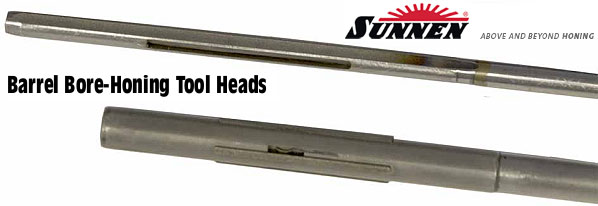
Some custom barrel makers are now honing barrels (after drilling) to improve bore diameter uniformity, smooth the interior finish, and reduce barrel lapping times. For years, large-scale manufacturers of hammer-forged barrels have employed honing. Now the process is being used by smaller, “boutique” barrel-makers. This article explains how and why barrel honing is done. Take the time to watch the video. For anyone with an interest in barrel-making, this video is an eye-opener…
Barrel Honing Process Demonstrated (Worth Watching!):
For custom barrel makers, honing is a time-saver and cost cutter. A few minutes on a honing machine can cut lapping times in half, leaving a cross-hatched surface finish in single or low double-digit Ra. Honing is the same process used to make diesel fuel injectors with bore roundness and straightness controlled to fractions of a micron (<0.000040"), with surface finish Ra ≤0.15 µm (6 µin).
A key manufacturing process used for hammer-forged barrels is now getting attention from the makers of custom button-rifled barrels. This process is precision bore-honing. Honing produces a high-quality bore surface fast, which is critical to hammer forging. (Why is honing so important with hammer forging? Surface finish is the one feature of the barrel that cannot be controlled in hammer forging. Surface imperfections in a barrel blank tend to be amplified as the blank is formed on the rifling mandrel. And if the bore is chromed afterwards, imperfections in the surface finish become even more obvious.)
Honing dramatically improves bore diameter size uniformity and accuracy, surface finish and roundness throughout the length of the barrel. It can certainly be used in place of a pre-rifling lap. The chief difference between a lapped and honed bore is the direction of the finish lines in the bore. Honing leaves fine spiraling crosshatch lines, while a lap leaves lines going longitudinally in the bore. After rifling the manufacturer can remove the crosshatch finish with a quick lap if desired. Honing is fast, accurate, and can be automated. Its surface quality and geometry can duplicate lapping, except for the longitudinal lines of the lapped finish.
Frank Green of Bartlein Barrels told us: “We worked with Sunnen and we did all the initial testing on the prototype machine for them. The machine works great! We ordered and received last year a new manufactured machine with the changes we wanted on it and we just ordered a second one a month or so ago. Should be here next month.”
Computer-Controlled Bore-Honing
Honing can be done with great precision through the use of advanced, computer-controlled honing machines. Sunnen Products Company recently introduced a new machine for .17 to .50-caliber barrels (see control panel below). The spindles on this machine can correct bore size imperfections so small only an air gauge can measure them. The consistency this allows improves bore uniformity, which, in turn, produces more accurate barrels for the precision market.
Sunnen Products Company is the world’s largest vertically-integrated manufacturer of honing systems, tooling, abrasives, coolants and gauging for precision bore-sizing and finishing. Sunnen’s customers include manufacturers of diesel and gas engines, aerospace components, hydraulic components, oil field equipment, and gun/cannon barrels. Sunnen, which just celebrated its 90th anniversary, employs more than 600 people worldwide.
The Bureau of Alcohol, Tobacco, Firearms and Explosives (ATF) is seeking to ban commonly-used 5.56 M855 “green tip” ball ammunition as “armor piercing ammunition” and is seeking public comment on the proposal. The National Shooting Sports Foundation (NSSF) urges target shooters and gun owners to contact ATF to oppose this proposed ban.
For decades, under the “sporting purposes” doctrine, commonly-available “green tip” M855 and SS109 rifle ammunition has been exempt from federal law banning armor-piercing ammunition. There is no question that this 5.56 ball ammo has been widely used by law-abiding American citizens for sporting purposes.
Winchester-brand 5.56X45 62gr NATO M855 FMJ Ammunition
The NSSF has an online form that makes it easy to voice your opinion on the proposed ban on 5.56 ball ammo. This form will direct your comments to Congress and/or the ATF. Click the button at right to navigate to the NSSF online form.
Commentary by Jim Shepherd, The Shooting Wire
Should the ATF reclassify surplus (and widely used) M855 and SS109 ammunition as armor-piercing, it would then be illegal for consumer consumption. This weekend, we received word that apparently many gun owners didn’t find this to be a compelling reason to record their objections with the federal government. With only a few days remaining in the ATF’s solicitation of comments, fewer than 6,000 shooters have registered their displeasure with the proposal.That, as one of my least-favorite instructors used to say, is simply unacceptable.”
Here’s something you don’t see every day — pistol-caliber Lapua brass. We shoot superior Lapua brass in our rifles, and now you can get the “good stuff” for your 9mm pistols too. It’s nice to know that Lapua 9mm brass is available for those guys who accept “nothing but the best”. Grafs.com received a special order of 9mm Luger (aka 9x19mm or 9mm NATO) pistol brass made by Lapua. It is available right now for $19.99 per 100-count bag or $179.99 per 1000-count box. That’s 38% off the regular 1K box price.
When It Pays to Shoot Premium Pistol Brass
Is this Lapua 9mm brass worth the price compared to the cheaper alternatives (such as once-fired police range pickups)? We think the answer depends on your application. If you shoot a 9mm pistol in Bullseye competition, yes it makes sense to get the Lapua. Or, if you have a 9mm revolver that carries the shells in a moon clip, the Lapua brass may be worth getting. With a 9mm revolver, your brass is not marred by an extractor claw and then ejected on to the ground. If we had the impressive new 8-shot, Miculek Edition Smith & Wesson model 929 9mm revolver (below), we’d definitely shoot Lapua brass.
Here’s your chance to own the guns of an American legend, Elmer Merrifield Keith, one of the best-known gun writers of the 20th Century. Keith’s firearms, including his much-modified Colt SAA “Number 5″, will be auctioned March 15-16 through James D. Julia Auctioneers. “The importance of the Elmer Keith Estate Collection cannot be overstated,” the auction house announced. “This truly represents a once-in-a-lifetime opportunity to own a piece of firearms history.”
Born in Missouri, Elmer Keith was raised in Montana, Idaho, and eastern Oregon. He had a ranch on the North Fork of the Salmon River (in Idaho), and was active as a hunting guide. His first article appeared in the American Rifleman in 1924. Over his career he wrote ten books, beginning with Sixgun Cartridges and Loads (1936) and ending with his autobiography Hell I Was There! in 1979. During his long writing career, Keith’s stories appeared in The Outdoorsman, American Rifleman, Western Sportsman, Gun, and Guns & Ammo. Called the “voice of big bore six-gunning”, Keith pioneered handgun hunting and he was instrumental in the development of the first magnum revolver cartridge, the .357 Magnum, as well as the later .44 Magnum and .41 Magnum cartridges.
A Very Unique Colt — the “Number Five”
If you know much about Colts, you’ll immediately recognize that the “Number Five” in the photo above is no ordinary Single Action Army (SAA). This famous revolver started as a Colt SAA in .44 Special, but then was heavily modified. The top strap of the frame was welded up into a flat-top target configuration, with an adjustable rear sight added. The front sight was changed on the 5 ½” barrel to a hi-visibility Patridge style. The hammer was modified with a Bisley-type target spur, and the trigger was curved and moved closer to the back of the trigger guard. The unique grip of the Number Five was created by marrying a modified Bisley backstrap to a Single Action Army trigger guard. Add contoured ivory grips and the resulting is probably the most comfortable-to-shoot revolver grip ever designed. Keith called this handgun “The last word in fine six-guns.”
Dangerous Game Rifles in Collection
Along with famous handguns, the Elmer Keith collection at auction includes prized long guns, including the legendary “Corbett Tiger Rifle”, a Jeffery boxlock .450/400 used by famed hunter Edward James “Jim” Corbett. This rifle was featured in Corbett’s book Man-Eaters of Kumaon. Two of the man-eating tigers Corbett hunted were believed to have killed over 800 humans in the Kumaon Hills of India. Other valuable long guns in the collection include English Best Quality stopping rifles from Westley Richards and Holland & Holland.
Some of our readers have questioned how to set up their body dies or full-length sizing dies. Specifically, AFTER sizing, they wonder how much resistance they should feel when closing their bolt.
Forum member Preacher explains:
“A little resistance is a good, when it’s time for a big hammer it’s bad…. Keep your full-length die set up to just bump the shoulder back when they get a little too tight going into the chamber, and you’ll be good to go.”
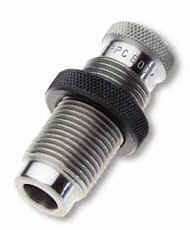
To quantify what Preacher says, for starters, we suggest setting your body die, or full-length sizing die, to have .0015″ of “bump”. NOTE: This assumes that your die is a good match to your chamber. If your sizing or body die is too big at the base you could push the shoulder back .003″ and still have “sticky case” syndrome. Also, the .0015″ spec is for bolt guns. For AR15s you need to bump the shoulder of your cases .003″ – .005″, for enhanced reliability. For those who have never worked with a body die, bump die, or Full-length sizing die, to increase bump, you loosen lock-ring and screw the die in further (move die down relative to shell-holder). A small amount (just a few degrees) of die rotation can make a difference. To reduce bump you screw the die out (move die up). Re-set lock-ring to match changes in die up/down position.
That .0015″ is a good starting point, but some shooters prefer to refine this by feel. Forum member Chuckhunter notes: “To get a better feel, remove the firing pin from your bolt. This will give you the actual feel of the case without the resistance of the firing pin spring. I always do this when setting up my FL dies by feel. I lock the die in when there is just the very slightest resistance on the bolt and I mean very slight.” Chino69 concurs: “Remove the firing pin to get the proper feel. With no brass in the chamber, the bolt handle should drop down into its recess from the full-open position. Now insert a piece of fire-formed brass with the primer removed. The bolt handle should go to the mid-closed position, requiring an assist to cam home. Do this several times to familiarize yourself with the feel. This is how you want your dies to size your brass, to achieve minimal headspace and a nearly glove-like fit in your chamber.”
We caution that, no matter how well you have developed a “feel” for bolt-closing resistance, once you’ve worked out your die setting, you should always measure the actual amount of shoulder bump to ensure that you are not pushing the shoulder too far back. This is an important safety check. You can measure this using a comparator that attaches to your caliper jaws, or alternatively, use a sized pistol case with the primer removed. See Poor Man’s Headspace Gauge.
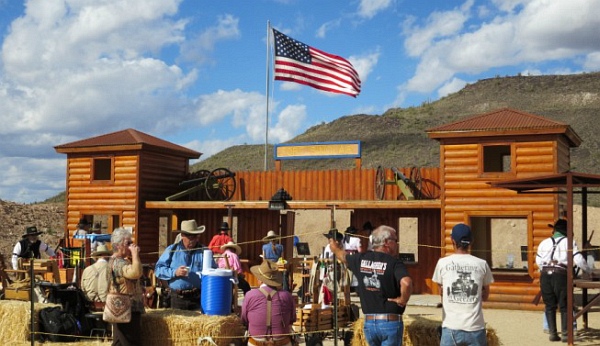
Earlier this month, the Ben Avery Range in Phoenix hosted America’s top long-range shooters at the Berger SW Nationals. This week cowboys and cowgirls take over Ben Avery during Winter Range, the SASS National Championship for Cowboy Action Shooting. Winter Range, which runs February 23 through March 1, is the second largest Cowboy Action event of the year, after End of Trail, the annual Single Action Shooting Society World Championship held each year in Edgewood, New Mexico.
Hundreds of cowboy action shooters, ages 12-80, will compete in multiple classifications based on age, and type/caliber of firearms. In addition, this year the Cowboy Mounted Shooting Association and the SASS Mounted Shooters will run an exciting 3-day mounted shooting event. This is expected to draw more than 100 competitors mounted on horses. You’ll see this kind of action:
Cowboy Action Shooting requires that contestants compete with firearms typical of those used in the taming of the Old West: single-action revolvers, lever-action rifles, and period shotguns. Participants each have a registered cowboy shooting alias (such as “Deadeye Dave”), used in SASS events. Competitors, organized in “Posses”, shoot a series of multi-gun stages. This is a fun shooting sport that draws multiple generations of the same family. In addition to the primary competitions, Winter Range 2015 will feature displays of period militaria, exhibitions of western skills and crafts, a fast-draw contest, and nearly 100 vendors selling vintage-style clothing and “sundries”.
Are you looking for a .22 LR Rimfire rifle that has the look and feel of a centerfire rig? Then check out the CZ 455 rimfire rifle featuring a black-finished, laminated wood stock. This gun, dubbed the “Varmint Tacticool” by CZ-USA, features a 5-round detachable magazine and adjustable trigger. And recently CZ added a Suppressor-Ready version fitted with a 16.5″ barrel and threaded muzzle.
The original CZ-455 Varmint Tacticool was built as an affordable tactical trainer with the ergonomics and stock profile of a full-size centerfire tactical rig. The Tacticool’s stock looks similar to the Manners Composites stock on CZ’s 455 Varmint Precision Trainer, but the wood-stocked ‘Tacticool’ version is much less expensive. The CZ 455 with Manners stock retails at $940.00 MSRP while the latest suppressor-ready ‘Tacticool’ model lists for $549.00 MSRP. The $391.00 you save will buy a lot of ammo (or a scope).
We like the looks of the CZ-455 ‘Tacticool’, and the stock has some nice features. The butt-hook stock has ambidextrous palm swells on the grip and a raised comb to provide a comfortable cheek weld for shooting with a scope. The fore-end features a wide, beavertail swell for greater stability on a front sandbag. There are two (2) sling swivel studs so you can attach both a sling and a bipod.
Here is some serious Saturday “gun glamour” from the folks at Star Shooter Precision, a bipod-builder and stock-maker based in Montreal, Canada. This stunning .308 Win F-TR rifle features a carbon-wrapped Star Shooter stock, angle-adjustable tubular bag-rider, star-shaped escutcheons, and a Kelbly Panda action. Up front is Star Shooter’s signature lightweight bipod.
Click Each Image for Large, Full-Screen Version
About the Rifle Builders Star Shooter Precision is a company located on the south shore of Montreal, Quebec, Canada. Fred Harvey is the designer. Fred says: “Our goal is to perfect the art of competition shooting the best we can with our custom bipods. The Star Shooter bipod is designed for shooters in F-Class competition, varmint hunting, load testing, tactical shooting and sighting in rifles.”
Rick Jensen, Captain of the U.S. F-Open Rifle Team, recently tested some of the new IMR 4451 powder. Rick and other team members were looking for a good powder that could replace Hodgdon 4350 which is difficult to obtain currently. The makers of IMR 4451 claim that it is not sensitive to temperature and that it delivers competitive accuracy. So far, Rick’s tests, done with a .284 Winchester and 180gr Berger Hybrids, appear to confirm those claims. Rick posts:
“I did a little informal powder comparison of H4350 versus the new IMR 4451. Rifle used was a Kelbly Panda with a 30″, 1:8.75″ twist 5R Bartlein barrel [chambered in .284 Win]. All charge weights were 50.0 grains using CCI BR2 primers. I was very impressed with this new powder and I believe it to be equal to H4350 as far as temperature sensitivity.
I did not test for accuracy but I will tell you my groups were pretty much equal between the two and all were in the .2-.3 MOA range. I will defiantly be shooting more of this powder in the weeks to come, assuming the supply chain will allow. It looks very encouraging to finally have a alternative to H4350 that we might actually be able to buy.”
Chronograph Results with Temps from 23° F to 101°
Here are chronograph results of a comparison test between IMR 4451 and H4350. Rick’s rifle was cleaned and allowed to cool between each test. Five fouling shots were fired before each test. Important: Note that for both Test #1 and Test #2, the powder order is reversed in the mid-temp fields (IMR 4451 first, then H4350). For the low and high temp entries, H4350 is listed first.
Here are the IMR 4451 fired cases, displayed Left to right, coldest to the hottest (in terms of case temp when fired). All charge weights were the same: 50.0 grains.
How would you like to “reach out and touch” someone 110 nautical miles away? Well America’s Navy may soon be able to do exactly that with an amazing new, high-tech weapon system. BAE Systems has developed (and successfully test-fired) an electro-magnetic rail gun that fires a 23-lb projectile at Mach 7 — (about 5300 mph or 7800 fps). This futuristic weapon can send its projectile 110 nautical miles (126 mi / 203 km), five times the range of the big 16″ guns on WWII-era battleships. This railgun has serious “knock-down” power — at Mach 7, that projectile carries a whopping 32 megajoules of energy. BreakingDefense.com says: “23 pounds ain’t heavy. But it sure hurts when it hits you going at seven times the speed of sound.”
Watch Video to See Navy Rail-Gun in Action:
The latest prototype of the railgun developed by defense contractor BAE, in conjunction with the Office of Naval Research, can accelerate a projectile up to Mach 7 within 10 milliseconds. The gun uses no gunpowder to generate propelling force. Compared to an item on a smaller scale, the railgun projectiles resemble crossbow darts, except they deliver such massive Kinetic Energy they don’t need to carry explosive ordnance. The railgun can strike targets 110 nautical miles away.
To prepare a charge, the ship stores electricity in the pulsed power system. Next, an electric pulse is sent to the railgun, creating an electromagnetic force accelerating the projectile. Because of its extreme speed, the projectile eliminates the hazards of storing high explosives in the ship. Each shot costs about $25,000 — but that’s cheap compared to the price of a missile.
“It’s like a flux capacitor,” chief of Naval research Rear Admiral Mathias Winter said in a video posted by Reuters Friday. “You’re sitting here thinking about these next generation and futuristic ideas, and we’ve got scientists who have designed these, and it’s coming to life.”
The Electromagnetic Railgun Innovative Naval Prototype (INP) was initiated in 2005. The goal during Phase I was to produce a proof-of-concept demonstration at 32 mega-joule muzzle energy, develop launcher technology with adequate service life, develop reliable pulsed power technology, and assess component risk reduction for the projectile.
Phase II, which started in 2012, advanced the technology to demonstrate a repeatable-rate fire capability. Thermal-management techniques required for sustained firing rates will be developed for both the launcher system and the pulsed power system. The railgun will begin testing at sea in 2016.


 The Bureau of Alcohol, Tobacco, Firearms and Explosives (ATF) is seeking to ban commonly-used 5.56 M855 “green tip” ball ammunition as “armor piercing ammunition” and is seeking public comment on the proposal. The National Shooting Sports Foundation (NSSF) urges target shooters and gun owners to contact ATF to oppose this proposed ban.


 Here’s your chance to own the guns of an American legend, Elmer Merrifield Keith, one of the best-known gun writers of the 20th Century. Keith’s firearms, including his much-modified Colt SAA “Number 5″, will be auctioned March 15-16 through


 To quantify what Preacher says, for starters, we suggest setting your body die, or full-length sizing die, to have .0015″ of “bump”. NOTE: This assumes that your die is a good match to your chamber. If your sizing or body die is too big at the base you could push the shoulder back .003″ and still have “sticky case” syndrome. Also, the .0015″ spec is for bolt guns. For AR15s you need to bump the shoulder of your cases .003″ – .005″, for enhanced reliability. For those who have never worked with a body die, bump die, or Full-length sizing die, to increase bump, you loosen lock-ring and screw the die in further (move die down relative to shell-holder). A small amount (just a few degrees) of die rotation can make a difference. To reduce bump you screw the die out (move die up). Re-set lock-ring to match changes in die up/down position.


 About the Rifle Builders

 “I did a little informal powder comparison of H4350 versus the new IMR 4451. Rifle used was a Kelbly Panda with a 30″, 1:8.75″ twist 5R Bartlein barrel [chambered in .284 Win]. All charge weights were 50.0 grains using CCI BR2 primers. I was very impressed with this new powder and I believe it to be equal to H4350 as far as temperature sensitivity.


