Need quality .22 LR rimfire ammo at an affordable price? Consider Norma. Most folks think Norma only produces centerfire ammo and cartridge brass. As a result, people haven’t been looking for Norma rimfire ammo. Their loss is your gain. Accurate, reliable Norma .22 LR ammunition is in-stock right now at leading online vendors. This is good quality ammo, made in Europe. Watch video review below.
Grafs.com has Norma Match-22 Ammo in-stock at $8.99 per 50-rd box (Item NA2318980). NOTE: Graf’s also has a wide selection of ELEY match ammo in stock, starting at $13.79 per 50-rd box.
Summary by .22 Plinkster (see 4:30 time mark): “I’m pretty impressed with it … I think it’s a really good deal. For six dollars and fifty cents [per box] you can’t go wrong with a box of this ammo. Out of a good bolt gun, this ammo will drive tacks.”
Here’s an important technology for ranges concerned with over-flight risks. Regular Bulletin readers will recall that we recently warned of the dangers of bullets launched with a high trajectory. (READ Article.) With a muzzle elevation of just 5°, a conventional bullet can fly over 3000 yards, retaining enough energy to kill. General Dynamics has come up with a solution for live-fire training programs that don’t require long-range target engagements. General Dynamics’ Short Stop® ammunition launches bullets that literally drop out of the air within 600 meters. What’s the secret to the short flight? Read on…
Short Stop 5.56x45mm and 7.62x51mm Ammunition Trajectory
This illustration shows the trajectories of 5.56 and 7.62 Short Stop bullets (yellow zone) compared to conventional rifle projectiles (black lines). You can see the “flight cycle” is completely different.
Short Stop ammunition employs advanced polymer/copper composite bullets with molded “fins”. The bullets sort of look like the end of a Phillips screwdriver (except the fins have a slight twist near their base). This “twisted fin” design causes the bullets to yaw, and that, in turn induces aerodynamic drag — a lot of drag. The molded bullets are also much lighter than conventional bullets (of the same caliber). The reduced weight/density gives them less momentum, so they lose velocity more readily than normal bullets. The combination of the low mass and high drag makes these bullets drop from the air within 600m or so, living up to their “Short Stop” designation.
In an interview with NRABlog.com, General Dynamics Bus. Dev. Manager Ruben Regalado explained how the Short Stop ammunition works. With this design, he says, “You can do a lot of the training you would do with a ball round with no fear of overflight. It’s the fin that does it. Due to the nature of its composition [the bullet] is lighter than the standard projectile, but the magic is in the fin.”
There are many potential applications for Short Stop rounds according to NRABlog Editor Lars Dalseide: “Where do these rounds come into play? Anywhere. Anywhere there’s military training, law enforcement training, or basic target shooting taking place. And with the encroachment of communities surrounding your favorite neighborhood range, [projectiles] that drop out of the air at 600 meters means the risk of overflight is significantly reduced.” The polymer-composite bullets are also frangible, so there is less penetration of objects and less chance of ricochet.
“Smurf” Bullets for .50 Caliber AA Rifles
Bryan Litz of Applied Ballistics has seen ammo similar to Short Stops used in .50-caliber rifles for training purposes. Bryan tells us: “Similar rounds have been available for .50 cal for many years. We find [the spent bullets] on the range at Camp Grayling (a Michigan National Guard training facility where we hold 1000-yard matches). The .50 cal rounds use blunt plastic things (we call them ‘Smurf’ bullets) and they use them for practicing anti-aircraft shooting. Instructors put up an RC target drone and the Guardsmen shoot at it with the .50s using the short range ammunition.”
Bryan says these “short flight” bullets have an important purpose, though the applications remain limited. “These kind of projectiles are a good tool for applications where an adequate SDZ (Surface Danger Zone) cannot be secured for the range location. I just hope the application remains confined to only those places where it’s necessary, i.e. where the SDZ presents a problem. I would hate to see our bullet options be limited to something like this under the guise of ‘range safety’, where the SDZ is properly secured.”
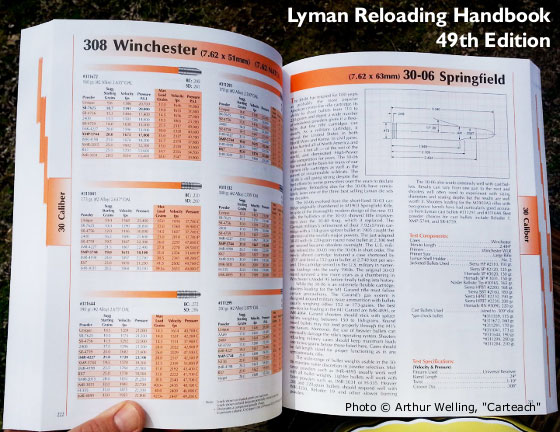
What’s the best book for folks getting started in metallic cartridge reloading? According to our Forum members, the best manual for “newbie” reloaders is the Lyman Reloading Handbook. In our Shooters’ Forum, a newcomer to reloading was looking for a basic reloading guide that also included load data. The most recommended book was the Lyman Handbook, now in its 49th Edition. Along with “how-to” advice on reloading procedures, the Lyman Manual features cartridge specifications and load data for the most popular cartridges.*
Here are some comments from Forum members:
“The Lyman book is an excellent manual with a large section describing the process of reloading. I heartily recommend it. As a beginning reloader, you may want to consider purchasing more than one book in order to get different perspectives on the reloading regimen. One can never be too careful. A ‘minor’ mistake can be costly.” — Cort
“In my opinion, the Lyman Manual is one of the best for the beginning reloader since it covers all the basics and some advanced methods. If possible, you would be also well served to hook up with an experienced reloader, preferably a target shooter or long-range varmint hunter, who can also give you some very useful pointers on precision reloading.” – K22
Editor’s NOTE: K22 echoes the advice we give to new hand-loaders. We suggest that novices find an experienced mentor who can “show them the ropes” and guide them through the basics.
Another gun blogger agrees that the Lyman Manual is a logical choice for new handloaders:
Carteach Review: The Lyman Reloading Manual
“[Lyman publishes] an excellent manual for any handloader, but especially for those new to the craft. Perhaps the best judgment of a handloader’s regard for a reloading manual is which one he chooses to give someone new to the fold. The needs of a new reloader differ from those of someone with long experience, and the right manual can set the foundation for years of safe procedures. Here is the one I choose to give a good friend embarking down the path:”
Carteach adds: “Lyman has always taken pains to provide very clear and understandable instruction on the basic process of reloading cartridges. The imaging is helpful and to the point. The load data Lyman provides is comprehensive, and [Lyman] takes the time to note special circumstances which new loaders need to be aware of. As example, the .30-06 section has some words regarding the M-1 Garand and its special needs. For someone who has never loaded for the Garand, these few sentences are golden!”
More Good Reference Books for Reloaders
Other book suggestions include The ABCs of Reloading, Glen Zediker’s Handloading for Competition, and The Book of Rifle Accuracy by Tony Boyer. The Boyer book is more for advanced handloaders, though it contains advice that can help beginners too. Forum member VTMarmot writes: “I wish I had read Tony Boyer’s book before I ever started handloading. The concept of using a bushing neck die that also sizes the body is the simplest, most accurate way to get accurate handloads and long brass life. This is true whether or not you turn necks, and whether you are loading for competition or hunting.”
*We recommend that you always double-check printed load data with the latest web-based data from the actual powder manufacturers. Powder properties can change. The most current powder data is usually found on the powder-makers’ websites.
Sierra Bullets Product Development Manager Mark Walker recently acquired a barrel with canted lands. It turns out he needed to modify his bore-cleaning methods. His brushes and patches were not following the rifling… and he was well on his way to ruining his barrel before he figured out the solution. Read about Mark’s interesting (and puzzling) experience. This article first appeared in the Sierra Bullets Blog.
Lessons Learned (The Canted Land Mystery) by Mark Walker
Sometimes when you have done something so often, you take for granted that it will work for all equipment. In this case, I had used my cleaning process and equipment for years with no problems however a new barrel on a rifle caused me to rethink how I clean.
Last year, the barrel on my mid-range benchrest rifle decided to give up the ghost. After doing some research and asking fellow shooters, I decided to purchase a barrel that had rifling with “canted” lands. The barrel arrived and after looking it over, everything looked great.
Threading and chambering went very well with the barrel indicating in very straight and cutting very smoothly. After torqueing the barrel to the action, I went about loading some ammunition to break the barrel in with. At the range, the barrel shot as good as any I have ever had. Even with loads that were thrown together with no tuning whatsoever.
During the break in, I would clean the barrel after every five shots or so just because that’s what everyone says to do. The barrel cleaned up extremely well, however I noticed that the first patches down a dirty barrel would cause the cleaning rod to vibrate as I pushed them down the tube. That was something that I had never experienced before so I was a little concerned….
After looking at the barrel with a bore scope, everything looked clean and no indication of what might have caused the vibration in the rod. I did notice some surface marks in the bore that traveled perpendicular with the bore. Usually when a barrel is lapped, all marks follow the rifling twist so these marks parallel to the bore where another phenomenon that I had never seen before. The mystery was getting deeper.
After another range session where the barrel shot lights out, I brought it home to clean it as before. The first patches down the barrel again caused the strange vibration in the rod. After stopping and thinking about the vibration and the strange marks in the bore, I checked the bearings in cleaning rod handle to make sure it was spinning freely and everything seemed to be in working order. I then decided to mark the cleaning rod to make sure it was actually turning when it went down the barrel. Bingo — this revealed the problem.
When the first patch went down the barrel and the rod didn’t even attempt to turn, the light bulb went on. The patches and even the bronze brushes were simply skipping over the tops of the rifling and not following the rifling at all. I tried tighter patches and larger brushes, but the only thing that seemed to fix the problem was pushing them down the bore as slowly as possible while watching the mark on the rod to make sure it was turning. Had I continued to clean as I normally do, I surely would have ruined the barrel!
Once I figured out the problem, the barrel shot great and my cleaning process worked just like every other barrel I have ever owned except for having to go slow with the rod. This just goes to show that even though you may have done something a thousand times before, you should always be aware of what your equipment is telling you.
Before SHOT … there was Sin City. The weekend before SHOT Show many of the nation’s best tactical riflemen came to Nevada for the 2015 Vegas Precision Rifle Challenge. This event, sponsored by Kelbly’s and hosted by the Sin City Precisision Shooters, offered plenty of challenges for competitors. George Gardner of G.A. Precision reports: “These guys put on a heck of a match. Lots of courses of fire with varying positional stuff [and] long-range out to 1400 yards. Hats off to these guys, they did a hell of a job. I can’t believe they secured this awesome place on the Air Force base to train and shoot on….”
Here’s a Sin City match highlight video that’s well worth watching. (Note: loud sound-track). The film-makers did a great job capturing the feel of shooting in Nevada’s high desert. You can almost smell the gun powder and feel the sting of blowing sand …
This looks like a lot more fun than sitting in a smokey Vegas Casino dueling one-armed bandits. For more information on this excellent tactical competition, visit SinCityPrecision.com.
Guest Article By Michelle Gallagher, Berger Bullets
Let’s face it. In the world of firearms, there is something for everyone. Do you like to compete? Are you a hunter? Are you more of a shotgun shooter or rifle shooter? Do you enjoy running around between stages of a timed course, or does the thought of shooting one-hole groups appeal to you more? Even though many of us shoot several different firearms and disciplines, chances are very good that we all have a favorite. Are we spreading ourselves too thin by shooting different disciplines, or is it actually beneficial? I have found that participating in multiple disciplines can actually improve your performance. Every style of shooting is different; therefore, they each develop different skills that benefit each other.
How can cross-training in other disciplines help you? For example, I am most familiar with long-range prone shooting, so let’s start there. To be a successful long-range shooter, you must have a stable position, accurate ammunition, and good wind-reading skills. You can improve all of these areas through time and effort, but there are other ways to improve more efficiently. Spend some time practicing smallbore. Smallbore rifles and targets are much less forgiving when it comes to position and shot execution. Long-range targets are very large, so you can get away with accepting less than perfect shots. Shooting smallbore will make you focus more on shooting perfectly center shots every time. Another way to do this with your High Power rifle is to shoot on reduced targets at long ranges. This will also force you to accept nothing less than perfect. Shoot at an F-Class target with your iron sights. At 1000 yards, the X-Ring on a long range target is 10 inches; it is 5 inches on an F-Class target. Because of this, you will have to focus harder on sight alignment to hit a center shot. When you go back to the conventional target, you will be amazed at how large the ten ring looks.
Also, most prone rifles can be fitted with a bipod. Put a bipod and scope on your rifle, and shoot F-TR. Shooting with a scope and bipod eliminates position and eyesight factors, and will allow you to concentrate on learning how to more accurately read the wind. The smaller target will force you to be more aggressive on your wind calls. It will also help encourage you to use better loading techniques. Nothing is more frustrating than making a correct wind call on that tiny target, only to lose the point out the top or bottom due to inferior ammunition. If you put in the effort to shoot good scores on the F-Class target, you will be amazed how much easier the long-range target looks when you return to your sling and iron sights. By the same token, F-Class shooters sometimes prefer to shoot fast and chase the spotter. Shooting prone can help teach patience in choosing a wind condition to shoot in, and waiting for that condition to return if it changes.
Benchrest shooters are arguably among the most knowledgeable about reloading. If you want to learn better techniques about loading ammunition, you might want to spend some time at benchrest matches. You might not be in contention to win, but you will certainly learn a lot about reloading and gun handling. Shooting F-Open can also teach you these skills, as it is closely related to benchrest. Benchrest shooters may learn new wind-reading techniques by shooting mid- or long-range F-Class matches.
Position shooters can also improve their skills by shooting different disciplines. High Power Across-the-Course shooters benefit from shooting smallbore and air rifle. Again, these targets are very small, which will encourage competitors to be more critical of their shot placement. Hunters may benefit from shooting silhouette matches, which will give them practice when shooting standing with a scoped rifle. Tactical matches may also be good, as tactical matches involve improvising shots from various positions and distances. [Editor: Many tactical matches also involve hiking or moving from position to position — this can motivate a shooter to maintain a good level of general fitness.]
These are just a few ways that you can benefit from branching out into other shooting disciplines. Talk to the other shooters. There is a wealth of knowledge in every discipline, and the other shooters will be more than happy to share what they have learned. Try something new. You may be surprised what you get out of it. You will certainly learn new skills and improve the ones you already have. You might develop a deeper appreciation for the discipline you started off with, or you may just discover a new passion.
This article originally appeared in the Berger Bulletin. The Berger Bulletin blog contains the latest info on Berger products, along with informative articles on target shooting and hunting.
You guys like saving money, right? We’ll here’s your chance to get 10% off precision reloading gear from PMA Tool. You probably know that PMA offers some of the best neck turners, priming tools, die adjusters, mandrels, and case prep accessories you can buy. PMA products feature smart design and quality craftsmanship.
To celebrate the roll-out of its updated website, PMA has announced a 10% OFF promotion. PMA President Pat Reagin tells us: “The new website is up and running. If you get a chance, take a look. Use coupon code 1B65B218A3C95ED to receive 10% off all items from now until March 1st. — Good shooting, Pat.”
Get 10% OFF PMA Products with PMA Code 1B65B218A3C95ED
Discount Code Good through March 1, 2015. Does Not Apply to Back-orders.
What lives in the Alabama backwoods and has 54 sets of ears? The answer is the new, $20 million-dollar CMP Marksmanship Park in Talladega. This new facility, set to open in May, boasts electronic Kongsberg Target Systems (KTS) at 200, 300, and 600 yards. All totaled, there are 54 Kongsberg target units, each with its own acoustic sensors — the “ears” as it were. Each KTS target has a set of acoustic sensors (very precise microphones) that plot the shot location using sound triangulation. Shot locations are accurate within a fraction of a millimeter. What’s more, because electronic targets do not expand or shrink with humidity levels, as paper does, scoring should be more consistent match to match.
Monitors Display Score and Shot Location Instantly Each target connects to a monitor that displays the hit locations to the shooter. Easy push-button controls allow the shooter to cycle through hits and options without having to change positions. The monitors employ non-glare glass protected by an aluminum frame that acts as a shade. This ensures good visibility for the shooter.
Engineered in Norway, Kongsberg target systems do more than just display shot locations to competitors. The system automatically calculate scores, and every target is networked to a central, “command” computer. This can provide updated competitor rankings, and can even display the results to event spectators on large view screens. See how it works in this animated demo video from Kongsberg:
“A well regulated Militia, being necessary to the security of a Free State, the right of the people to keep and bear Arms, shall not be infringed.”
If you’re reading this, you’re probably a firearm owner (most of our Daily Bulletin readers are). But how much do you really know about the history of the Second Amendment to the U.S. Constitution? The Second Amendment itself contains only 27 words (printed above), but those words have a rich history behind them.
To illuminate the origins of the Second Amendment, and to explain how its interpretations have evolved over the years, Arizona Attorney, the journal for the State Bar of Arizona, has published a detailed two-part “Illustrated History” of the Second Amendment by attorney Robert J. McWhirter, an expert on the Bill of Rights.* Part One was just released, and Part Two will be published next month.
We think all gun owners should read McWhirter’s article, which is both entertaining and insightful. Don’t worry — this is not a dull “law school” treatise. McWhirter’s article features dozens of illustrated footnotes (some fascinating, some merely amusing). Here are some sample footnotes — you can see this is a treasure trove of Second Amendment trivia.
*The American Bar Association has just published Mr. McWhirter’s book Bills, Quills, and Stills: An Annotated, Illustrated and Illuminated History of the Bill of Rights.
Tripods aren’t just for cameras and spotting scopes — they can be used as shooting supports as well. In this video, our friends Ed and Steve, aka The 6.5 Guys, take a look at a variety of tripod options for shooters. Steve and Ed provide a brief overview of some of the techniques they use to shoot off a tripod support from kneeling, seated, and standing positions. They also demonstrate how slings can be used to control elevation and stabilize a rifle.
Ed and Steve employ different techniques — one uses a ball head while the other doesn’t. In the video, they explain why they have adopted their respective techniques. They explain why you may want to try a variety of tripod set-ups, depending on the shooting scenario (and your personal preferences). The 6.5 Guys also discuss the differences between two popular tripod accessories — the Hog Saddle and the lower-cost Pig Saddle.
Tripod Use in the Precision Rifle Series (Anette Wachter)
I have noticed in the last year of precision rifle competitions that the tripod is a valuable asset to have. Most of the time when a stage calls for the offhand position, unless otherwise stated, people can use a tripod. Easy enough but you realize quickly that not all tripods are alike. You need to think of weight since you are carrying everything with you for 10 hours a day. And of course stability is your number one importance.This is different than a photographer’s tripod. Think of it as a tactical tripod. — Anette Wachter, The 30 Cal Gal.


 This illustration shows the trajectories of 5.56 and 7.62 Short Stop bullets (yellow zone) compared to conventional rifle projectiles (black lines). You can see the “flight cycle” is completely different.
 “Smurf” Bullets for .50 Caliber AA Rifles

 Lessons Learned (The Canted Land Mystery)
 During the break in, I would clean the barrel after every five shots or so just because that’s what everyone says to do. The barrel cleaned up extremely well, however I noticed that the first patches down a dirty barrel would cause the cleaning rod to vibrate as I pushed them down the tube. That was something that I had never experienced before so I was a little concerned….


 Position shooters can also improve their skills by shooting different disciplines. High Power Across-the-Course shooters benefit from shooting smallbore and air rifle. Again, these targets are very small, which will encourage competitors to be more critical of their shot placement. Hunters may benefit from shooting silhouette matches, which will give them practice when shooting standing with a scoped rifle. Tactical matches may also be good, as tactical matches involve improvising shots from various positions and distances. [Editor: Many tactical matches also involve hiking or moving from position to position — this can motivate a shooter to maintain a good level of general fitness.]
 You guys like saving money, right? We’ll here’s your chance to get 10% off precision reloading gear from

 Each target connects to a monitor that displays the hit locations to the shooter. Easy push-button controls allow the shooter to cycle through hits and options without having to change positions. The monitors employ non-glare glass protected by an aluminum frame that acts as a shade. This ensures good visibility for the shooter.
 “A well regulated Militia, being necessary to the security of a Free State, the right of the people to keep and bear Arms, shall not be infringed.”