CMP Board Members and a few CMP staff members enjoyed a visit to the CMP Talladega Marksmanship Park yesterday. They fired a few shots downrange from the 200-yard line. Here’s an image from the Kongsberg electronic target system. Shot impacts are precisely triangulated with sonic target sensors, then shot locations (and scores) are displayed on monitors placed next to each shooter. For more information on the CMP Talladega Marksmanship Park, visit http://thecmp.org/competitions/talladega-marksmanship-park/.
The 13,000-square-foot CMP Park Club House overlooks the 600-yard range. Panoramic windows look out towards the firing line and the Alabama woodlands beyond.
Register Now for Inaugural D-Day Match at Talladega
The first official matches at the new CMP Talladega Marksmanship Park will be fired on the weekend of June 6-7, 2015. The celebration is a two-day event which includes tours of the facility. A special John C. Garand “D-Day Anniversary” Rifle Match On Saturday, June 6th will officially open the facility. On Sunday there will be an EIC Service Rifle Match, EIC Service Pistol Match, and a CMP .22 Rimfire EIC Pistol Match. The inagural event is limited to the first 350 Competitors, so register soon via the CMP’s Competition Tracker website.
You probably know by now that the ATF is seeking comments on a proposed regulation that would ban the importation and sale of M855 steel-core 5.56x45mm ammunition. The ATF has proposed banning this “green-tip” ammo (and similar products) on the grounds that it is “armor piercing”.
Nobody knows whether the proposed ban will actually go into effect. The ATF is solicting comments through March 16, 2015. The mere possibility of a ban has spurred a feeding frenzy of ammo sales. If you are looking for genuine M855-type Green Tip ammo, suitable for use in AR-platform rifles, Creedmoor Sports recently obtained a large supply. Creedmoor just located quantities of Lake City-produced, American Eagle-brand XM855 in cardboard boxes: “Our team found another source for 5.56 mm XM855F Federal Lake City Green Tip Ammo. This ammo is becoming almost impossible to source the closer we get to the [March 16th end] of the ATF comment period.”
Lake City M855 5.56 62gr Green Tip Ammunition (300 Rounds)
Product Description
High-quality 5.56x45mm ammo made in the USA by Lake City. This is “XM855″ ball ammo with a steel penetrator in the core, surrounded by a copper jacket. The projectile is color-coded with a green-painted tip as is traditional with US-made M855.
Product Specifications:
* Manufacturer: Federal / Lake City
* Model: XM855
* Caliber: 5.56 NATO (5.56x45mm)
* Grain Weight: 62 Grains
* Type: Full Metal Jacket with Penetrator
* Units per Case: 300 (in two 150ct boxes)
More Spin, Less Drag
In this article, we look at how twist rate and stability affect the Ballistic Coefficient (BC) of a bullet. Again, this topic is covered in detail in the Modern Advancements book. Through our testing, we’ve learned that adequate spin-stabilization is important to achieving the best BC (and lowest drag). In other words, if you don’t spin your bullets fast enough (with sufficient twist rate), the BC of your bullets may be less than optimal. That means, in practical terms, that your bullets drop more quickly and deflect more in the wind (other factors being equal). Spin your bullets faster, and you can optimize your BC for best performance.
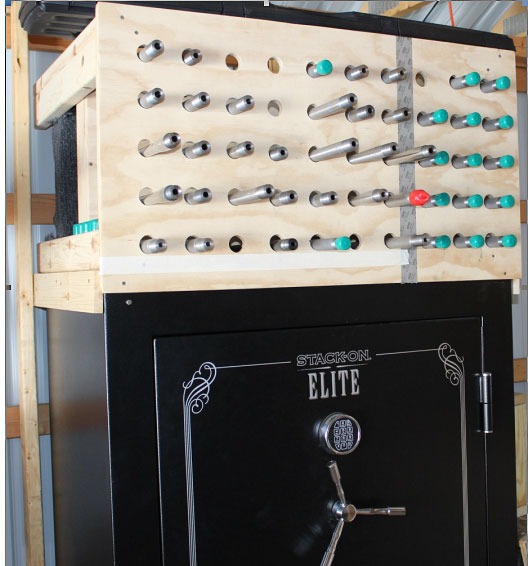
Any test that’s designed to study BC effects has to be carefully controlled in the sense that the variables are isolated. To this end, barrels were ordered from a single barrel smith, chambered and headspaced to the same rifle, with the only difference being the twist rate of the barrels. In this test, 3 pairs of barrels were used. In .224 caliber, 1:9” and 1:7” twist. In .243 caliber it was 1:10” and 1:8”, and in .30 caliber it was 1:12” and 1:10”. Other than the twist rates, each pair of barrels was identical in length, contour, and had similar round counts. Here is a barrel rack at the Applied Ballistics Lab:
Applied Ballistics used multiple barrels to study how twist rate affects BC.
“The Modern Advancements series is basically a journal of the ongoing R&D efforts of the Applied Ballistics Laboratory. The goal of the series is to share what we’re learning about ballistics so others can benefit.” –Bryan Litz
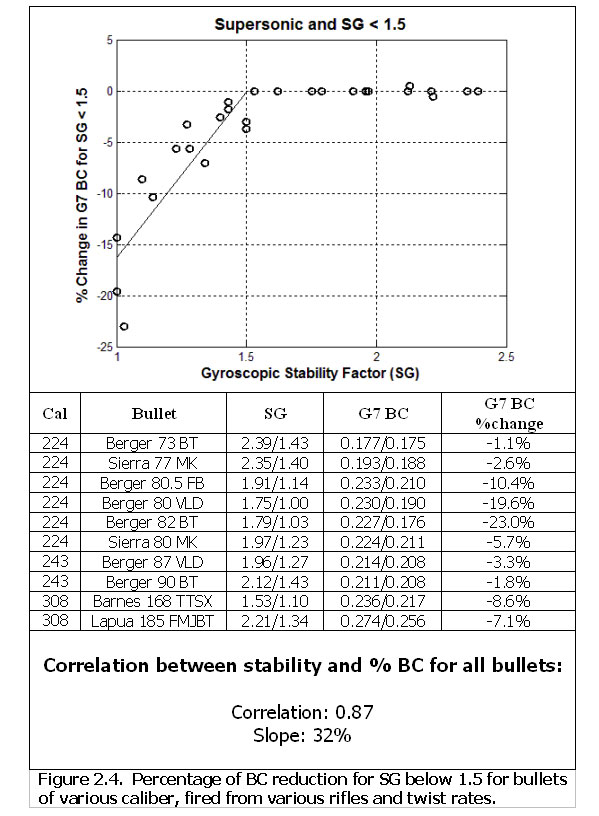
Barrel twist rate along with velocity, atmospherics, and bullet design all combine to result in a Gyroscopic Stability Factor (SG). It’s the SG that actually correlates to BC. The testing revealed that if you get SG above 1.5, the BC may improve slightly with faster twist (higher SG), but it’s very difficult to see. However, BC drops off very quickly for SGs below 1.5. This can be seen in the figure below from Modern Advancements in Long Range Shooting.
The chart shows that when the Gyroscopic Stability Factor (SG) is above 1.5, BC is mostly constant. But if SG falls below 1.5, BC drops off dramatically.
Note that the BC drops by about 3% for every 0.1 that SG falls below 1.5. The data supports a correlation coefficient of 0.87 for this relationship. That means the 3% per 0.1 unit of SG is an accurate trend, but isn’t necessarily exact for every scenario.
It’s a common assumption that if a shooter is seeing great groups and round holes, that he’s seeing the full potential BC of the bullets. These tests did not support that assumption. It’s quite common to shoot very tight groups and have round bullet holes while your BC is compromised by as much as 10% or more. This is probably the most practical and important take-away from this test.
To calculate the SG of your bullets in your rifle, visit the Berger Bullets online stability calculator. This FREE calculator will show you the SG of your bullets, as well as indicate if your BC will be compromised (and by how much) if the SG is below 1.5. With the stated twist rate of your barrel, if your selected bullet shows an SG of 1.5 (or less), the calculator will suggest alternate bullets that will fully stabilize in your rifle. This valuable online resource is based directly on live fire testing. You can use the SG Calculator for free on the web — you don’t need to download software.
Learn More About SG and BC This article is just a brief overview of the interrelated subjects of twist rate, Gyroscopic Stability, and BC. The coverage of twist rates in Modern Advancements in Long-Range Shooting is more detailed, with multiple live fire tests.
Other chapters in the book’s twist rate section include: · Stability and Drag – Supersonic
· Stability and Drag – Transonic
· Spin Rate Decay
· Effect of Twist rate on Precision
Other sections of the book include: Modern Rifles, Scopes, and Bullets as well as Advancements in Predictive Modeling. This book is sold through the Applied Ballistics online store. Modern Advancements in Long Range Shooting is also available in eBook format in the Amazon Kindle store.
Tired of paying hefty fees to Gunbroker.com? Well there’s a new auction website, GunPalace.com, that lets you sell guns and gear at low cost (basic listings are free). Notably, GunPalace.com does not charge the typical final sales fees imposed by most auction sites. (Those charges could total $70 or more for a $4000.00 rifle). On GunPalace.com it is easy to list and sell handguns, rifles, shotguns, ammo, collectible items and more.
Video Explains How GunPalace.com Works:
GunPalace.com has a simple, low-cost fee structure. Basic listings are free, while there are modest fees for “showcase listings” and other upgrades. Importantly there is no hefty “end of sale” surcharge. Scott Patey of GunPalace.com explains: “It’s simple, our site does not asses a fee when an item sells. That keeps selling expenses low for sellers and prices affordable for buyers. If you are a gun-loving American, you are welcome on our site.”
Auction categories for sellers include: all types of guns (including rare and collectibles), plus gun parts, gun accessories, ammo, optics, safes, knives, hunting gear, military items, camping gear, ATVs, motorsports, and more. It is easy to register to begin listing items for auction. GunPalace.com doesn’t eat away your profits, as you pay zero final sales fees.
If you’ve ever used a Harris Swivel Bipod, you know that, without tools, it is difficult to put enough tension on the swivel locking knob to really lock the unit solid. And, if you do manage to get the knob really tight (perhaps by using pliers), it is difficult to loosen with fingers alone.
That was why Terry Cross and the folks at KMW Long Range Solutions invented the Pod-Loc™. This system replaces the knurled swivel tension knob with a push-button adjustable handle. Using the handle you can easily set the swivel tension at any level from loose to “rock solid”. And you can release tension to adjust the bipod to different terrain just as easily. The KMW Pod-Loc™ retails for $24.99 at Brownells.com and Sinclair Int’l.
How to Build Your Own Bipod Swivel Locking System
While we use genuine KMW Pod-Locs on our rifles, readers on a tight budget, or who have a large collection of bipod-equipped rifles, can economize by putting together their own swivel locking systems from off-the-shelf components. You need two parts per installation: a push-button swivel handle and a 3/16″ spacer. Levers and spacers are both available online from www.T-Nuts.com. The spacer is part #SS1 ($1.00). T-Nuts offers a variety of suitable handles, ranging in price from $7.00 to $10.00. So, by sourcing the parts, you can outfit three bipods with swivel adjusters for the cost of one Pod-Loc.
We recommend the Nylon/Stainless BPL/NS model ($7.70), but you may prefer the all-metal BPL-Z ($8.50), or the shorter BPL-Micro model ($8.50). The compact Micro lock does not protrude past the body of the bipod, yet is still easily grasped. T-Nuts supplies one 3/16″ spacer with most of its bipod handles. T-Nuts handles are also available with a metric M6x1.0 thread for use with imported bipods such as Outers and Rockport.
Installation is Easy — With the Right Socket
To install a swivel locking system, first you’ll need a 1/4″ socket to remove the keeper nut from the threaded pivot rod. (During this process, you’ll need to keep pressure on the pivot rod retaining pin on the opposite side of the bipod.) Don’t try to remove the keeper nut with pliers or an open-end wrench. You really need the correct socket. Once that keeper nut is removed, then unscrew the knurled tension knob/ring. This is attached to the same threaded shaft as the keeper nut but you should be able to remove it without tools.
After the knurled tension ring is off, it is easy to put your handle on the bipod. First slip the 3/16″ spacer over the threaded pivot rod. Keeping finger pressure on the pivot rod retaining pin (on reverse side), then spin on the T-Nuts handle. Rotate the handle inwards until it firmly locks the bipod swivel mechanism. By pushing the button in the head of the handle, you can swing the handle left or right to set its position without altering the swivel tension.
Black Rifle Gone Bad…
Take a close look at this AR-15 bolt. Notice something missing — namely all the lugs? A healthy AR-15 bolt has seven (7) bearing lugs (plus an extractor hump). For all seven lugs to have sheared “clean off”, something serious must have happened to this bolt assembly. The folks at Brownells published this “lost luggage” image on Facebook to spur discussion. So, you AR experts out there — what do you think caused the problem here? Was it over-pressure, metal defect, headspace problem, gas system malfunction (or some combination of issues)? Post your theories in the comment section below…
They say “things are bigger in Texas”. Well shots are longer too. In this video, a shooter successfully hits a 1-MOA target at 3600 yards with a .375 CheyTac rifle. That required plenty of elevation to compensate for the bullet’s drop over its 2.045 mile trajectory. The shooter, Jim Spinella of New Jersey, needed a whopping 60.2 Mils of elevation (26.8 in rail, 22.6 in turret, 10.8 hold-over). Jim had to wait a long time to confirm the hit — with the metal gong situated more than than 2 miles from the firing line, it took the bullet 7.2 seconds to hit the target.
Big 350gr Bullets with a Wicked BC
The 3600-yard hit was made with CheyTac factory ammo using 350gr CNC-turned bullets. Spinella was impressed: “The ammo chronographed out at 3080 fps with velocity differences at no more the 7 fps, which was outstanding. We found the true BC over 3600 yards to average 0.810 (G1)”.
NOTE: You see three shots in the video, but Spinella took many more before a hit was achieved: “We peppered the 2 MOA area around the target with a couple of dozen rounds. We hit the rack the target is hanging on twice. This was a fun experience, and we took a lot of data away from it. We put a lot of work and planning into this in order to be in position to be lucky. So many things are ridiculously magnified at that distance. Every 1 mph change in wind [moves the bullet] about 6 feet. As the barrel heats up the velocity changes with it [and] 10 fps velocity differences, shot to shot, are almost 5 feet.”
This ultra-long-range adventure took place last September at the FTW Ranch in Texas. Spinella worked with a team of experts from Hill Country Rifles, builders of the custom .375 CheyTac rifle, to achieve a 3600-yard shot on a 36” round steel target. Hitting a target at 2.045 miles is no mean feat. That 36″ gong represents slightly less than 1 MOA at that range. A lot can happen to send a bullet off target during a 7.2 second flight.
Rifle: Hill Country Rifles custom .375 Cheytac, Stiller Precision action, 29″ Krieger barrel
Optics: Schmidt & Bender 5-25X56mm PM-2 scope
Actual Measured Distance: 3606.41 Yards
Target: 36″ circular steel plate
Altitude: 2000 feet
Temp: 70 degrees
Elevation: 60.2 mil
Windage: 3.5 mil left
CheyTac Caliber Comparison — .375 vs. .408
The shooter, Jim Spinella, prefers the .375 CheyTac to its .408-caliber Big Brother: “I shoot both the .408 and .375. Both are great ELR rounds and will get you out there a long way. In my experience, the .375 will get you out there a little bit further. My preference is the .375 Cheytac over the .408. This has nothing really to do with external ballistics. It has to do with fouling. My .408 will go from stellar accuracy to terrible between 40 and 45 rounds. It happens that quickly and accuracy returns after cleaning the barrel. I have never experienced this with the .375. After 100 rounds there is minimal copper fouling with the .375, but I clean around this round count. I don’t know why there is heavy cooper fouling in the .408, but it is common to this round and other shooters who shoot it regularly. That said, I lightly clean the .408 using Wipeout and go back to having fun with it after about 30 minutes.”
At ranges across the country, on any given weekend, there are probably more IDPA matches than any other type of pistol competition. And now the IDPA has its own official steel practice target: the IDPA PT (Practice Torso). The new target, crafted by Utah-Based Action Target from 3/8″-thick AR550 steel, features a regulation torso shape with scoring zones. Green-colored reactive plates provide instant feedback. Notably, the target has no exposed bolts, clamps or brackets. The completely flat shooting surface reduces the risk of ricochets coming back at the shooter.
The IDPA target’s reactive plates feature an innovative hinge design. “A lot of work went into the design of this target,” said Chris Hess, Action Target’s marketing manager. “Not only did we ensure that the torso dimensions of the target perfectly match IDPA regulation, we also created a new patent pending hinge design for the reactive plates that minimizes the number of parts needed and provides consistent reaction on every shot. This new design will soon be used on all of our reactive steel targets.”
New IDPA PT Target features innovative, Patent-pending hinge design.
Two-time national IDPA champion Tom Yost helped develop the new steel target: “As a competitive shooter, this is exactly the kind of target I want to train with. Practicing on steel helps build muscle memory for accurate shots better than anything else because it provides instant feedback that you can hear and see.”
IDPA Matches feature “real-world” type scenarios, with guns drawn from cover.
At the 2015 Berger Southwest Nationals, Forum member Erik Cortina cornered Bryan Litz of Applied Ballistics. Erik, the F-Open winner in the 600-yard Mid-Range match, was curious about bullet sorting. Knowing that bullets can be sorted by many different criteria (e.g. weight, overall length, base to ogive length, actual bearing surface length etc.) Erik asked Bryan to specify the most important dimension to consider when sorting. Bryan recommended sorting by “Base to Ogive”. Litz noted that: “Sorting by overall length can be misleading because of the nature of the open-tip match bullet. You might get a bullet that measures longer because it has a jagged [tip], but that bullet might not fly any different. But measuring base to ogive might indicate that the bullet is formed differently — basically it’s a higher resolution measurement….”
Ballistics Q & A in Shooter’s Forum
Got more questions about bullets? Our Shooters’ Forum has a special area for Bullets & Ballistics topics. There you can get your own questions about bullets and ballistics answered by Bryan Litz and other experts from Applied Ballistics.
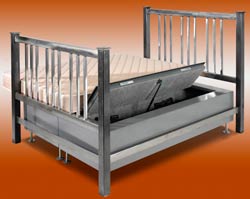
Here’s a firearms storage vault with an unique, “stealth” design. The “BedBunker” from Heracles Research Corp., provides secure storage for up to 32 rifles and 70 pistols, in side-by-side locked steel compartments. BedBunker modular safes are designed to replace the box spring under twin, queen, or king size mattresses and are compatible with most standard bed frames. The BedBunker is equipped with eight 1″-diameter threaded legs for height and leveling adjustments. NOTE, the weight of the BedBunker is supported by the eight metal legs, NOT by the bed frame.
Pros and Cons of BedBunker Design
The patented, under-mattress design of the BedBunker has many benefits. Number 1, the safe is in a “stealth” location that thieves may ignore completely. The best gun safe is one that doesn’t call attention to itself. Second, an installed Bedbunker is very large, very heavy, and very difficult to move. Third, Bedbunkers take up no extra floor space, since they fit within the “footprint” of your bedframe.
What are the negatives? First, BedBunkers are very expensive. The $6070.00 Cal-King-size BedBunker is more than twice as expensive as a typical gunsafe of equal (1500 lb.) weight. The lighter weight “LT” Bedbunker Queen is more affordable at $1998.00, but the $5470.00 price of the regular Queen Double-safe unit will easily buy you two (2) large conventional, floor-standing safes.
Standard Queen-size Bedbunker System with Key Locks
We also have concerns about the standard Bedbunker locking system. We don’t think the key locks are as secure as a typical UL Group II (or better) safe lock and we don’t think the vertical lift doors (with small cross-bolts) would withstand a pry-bar attack as well as a premium gun safe equipped with multiple, large-diameter cross-bolts on all door sides.
Bedbunker Vault Systems — More Security, More Money
If you want higher level of security, Bedbunker does offer super-deluxe horizontal safes with combination locks and twelve 1″-diameter cross-bolts. But the Queen Size Bedbunker with combo locks and cross-bolts costs a whole lot more: $9470.00. (NOTE: There is currently a $1000 off promotion on this Queen unit, giving a net cost of $8470.00).
Cal King Bedbunker with Combination Locks and Vault Doors. Click to Zoom.
For more information, visit www.bedgunsafe.com, or call Heracles Research Corp. of Spokane, WA, at (509) 624-2555.




 If you’ve ever used a Harris Swivel Bipod, you know that, without tools, it is difficult to put enough tension on the swivel locking knob to really lock the unit solid. And, if you do manage to get the knob really tight (perhaps by using pliers), it is difficult to loosen with fingers alone.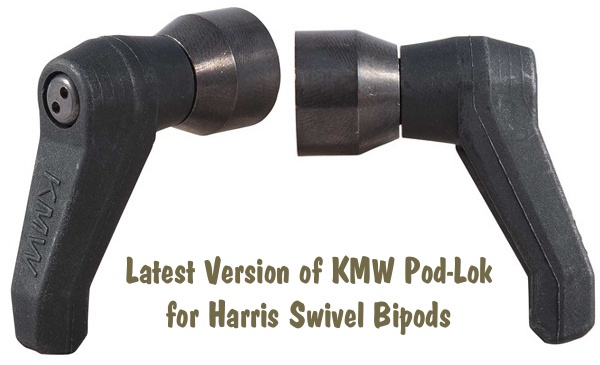


 Here’s a firearms storage vault with an unique, “stealth” design. The “BedBunker” from
  Pros and Cons of BedBunker Design


