Springfield Armory has taken the M1A into the 21st Century with an adjustable modular stock that makes this classic semi-auto rifle more versatile than ever. The adjustable stock on this Loaded M1A (MP9826, MSRP $2,021) offers many cool features. You can raise/lower the cheek-piece with a handy rotary knob. Likewise the buttplate can be moved in and out with a quick-adjusting knob, allowing length-of-pull adjustment up to 1.3 inches. The toe of the stock features a bag-rider section, making the gun more stable on a sandbag. Up front you’ll find an accessory rail plus a forward-angled swivel stud allowing easy bipod mounting. The included iron sights feature half-minute adjustments for windage and 1-MOA adjustments for elevation. The 22″ stainless steel barrel has a 1:11″ twist. Rifle weight with an empty magazine is 11.25 lbs.
At the 2015 SHOT Show, Rob Leatham runs through Springfield Armory’s new Loaded M1A Series rifle with an adjustable stock (MP9826, MSRP $2,021).
Click Image to See Full-Size Photo
MIA Match at Camp Perry is Popular
In 1974, Springfield Armory began offering a civilian-legal, semi-automatic version of the M14 known as the M1A™. M1As have enjoyed some success in Service Rifle and High Power Competition but today most Service Rifle shooters use the lighter-recoiling AR-platform black rifles. Nonetheless the M1A remains popular with American shooters and the annual M1A Match at Camp Perry offers serious, big-time prize money, thanks to Springfield Armory. In 2014 over $25,000 worth of cash and gear was awarded to Camp Perry M1A competitors, making the M1A Match the richest single rifle event at the NRA National Championships.
Nick Till in 2009 M1A Match. Nick was the 2007 Service Rifle Nat’l Champion. Photo courtesy NRA Blog.
Each Wednesday, the U.S. Army Marksmanship Unit publishes a reloading “how-to” article on the USAMU Facebook page. Yesterday’s “Handloading Hump Day” post covered preparation of once-fired 5.56x45mm brass. This article, the first in a 3-part series, has many useful tips. If you shoot a rifle chambered in .223 Rem or 5.56x45mm, this article is worth reading. And visit the USAMU Facebook page next Wednesday for the next installment.
This week, Handloading Hump-Day will answer a special request from several competitive shooters in Alaska. They asked about procedures for morphing once-fired GI 5.56mm brass into accurate match brass for NRA High Power Rifle use. The USAMU has used virgin Lake City (LC) 5.56 brass to win National Championships and set National Records for many years. In this 3-part series, we’ll share techniques proven to wring match-winning accuracy from combat-grade brass.
Preparing Once-Fired GI 5.56 Brass for Reloading (Part 1 of 3)
Assuming our readers will be getting brass once-fired as received from surplus dealers, the following steps can help process the low-cost raw material into reliably accurate components.
1. Clean the Brass
First, clean the brass of any dirt/mud/debris, if applicable. Depending on the brass’s condition, washing it in a soap solution followed by a thorough rinsing may help. [This step also extends the life of the tumbling media.] Approaches range from low-tech, using gallon jugs 1/2 full of water/dish soap plus brass and shaking vigorously, to more high-tech, expensive and time-consuming methods.
2. Wet-Tumbling Options (Be Sure to Dry the Brass)
When applying the final cleaning/polish, some use tumblers with liquid cleaning media and stainless steel pins for a brilliant shine inside and out, while others take the traditional vibratory tumbler/ground media approach. Degree of case shine is purely personal preference, but the key issue is simple cleanliness to avoid scratching ones’ dies.
If a liquid cleaner is used, be SURE to dry the cases thoroughly to preclude corrosion inside. One method is to dump the wet brass into an old pillow case, then tilt it left/right so the cases re-orient themselves while shifting from corner to corner. Several repetitions, pausing at each corner until water stops draining, will remove most water. They can then be left to air-dry on a towel, or can be dried in a warm (150° F-200° F max) oven for a few minutes to speed evaporation.
Shown below are Lake City cases after cleaning with Stainless Media (STM). Note: STM Case cleaning was done by a third party, not the USAMU, which does not endorse any particular cleaning method.
3. Inspect Every Case
Once dry, inspect each case for significant deformation (i.e., someone stepped on it), damaged mouths/necks and case head/rim damage. Some rifles’ ejectors actually dig small chunks of brass out of the case head — obviously, not ideal for precision shooting. Similarly, some extractors can bend the case rims so badly that distortion is visible when spinning them in one’s fingers. These can be used for plinking, but our match brass should have straight, undamaged rims.
Dented case mouths are common, and these can easily be rounded using a conical, tapered tool, [such as a .223 expander mandrel. A dummy 7.62 or .30-06 cartridge with a FMJ spitzer can also work.] If most of your brass is of one headstamp, this is a good time to cull out any odd cases.
4. Check the Primers Before Decapping
Your clean, dry and inspected brass is now ready for full-length sizing, decapping and re-priming. Historically, primer crimps on GI brass have caused some head-scratching (and vile language) among handloaders. Our next installment will detail efficient, easy and practical methods to remove primer crimp, plus other useful handloading tips. Until next week, Good Shooting!
NOTE: The USAMU Handloading (HL) Shop does not RE-load fired 5.56 brass. We use virgin LC brass with our chosen primer already staked in place. However, our staff has extensive personal experience reloading GI brass for competition, which will supplement the Shop’s customary steps. In handloading, as in life, there are many ways to accomplish any given task. Our suggestions are note presented as the “only way,” by any means. Time for loading/practicing is always at a premium. Readers who have more efficient, alternative methods that maintain top accuracy are invited to share them here.
At SHOT Show 2015, SIG Sauer showcased a host of new optics products. SIG’s new Electro-Optics division will market a complete line of riflescopes, battle sights, red dot/reflex sights, rangefinders, binoculars, and spotting scopes. For ALL the new Electro-Optics products, SIG will be offering a lifetime transferable warranty. That’s impressive. SIG’s new electro-optical offerings, which are named after radio alphabet words (such as “Bravo” and “Tango”), are revealed in this video:
The “Whiskey” riflescope series is marketed as a rugged, affordable optical solution for hunters. Designed for law enforcement and tactical shooters, the “Tango” series of riflescopes feature 6X zoom ratios and meet MILSPEC requirements. Shown below is the 3-18x44mm Tango.
The “Bravo” series of prismatic battle sights (illustration below) are pretty remarkable. An innovative new lens design provides an exceptionally wide field of view. SIG claims that Bravo battle sights offer a 50 percent greater field-of-view than similar battle sights.
The “Romeo” series of red dot sights are designed for tactical carbines. The miniature “Romeo1″ Reflex Sight is designed to be slide-mounted on a pistol, and SIG will offer several pistols with the Romeo1 pre-installed. For big game hunting or extreme long-range shooting, SIG developed the “Kilo” rangefinder series, the “Victor” spotting scope line and the “Zulu” binocular series. The “Kilo” rangefinder (bottom photo) can reach out to 1600 yards and features an auto-dimming display. It is about the same size as a Leica CRF, but it is easier to hold. There are molded, rubberized finger grooves on the top and the whole unit has a nice feel in the hand.
To learn more about other SIG Sauer products for 2015, visit the Shooter’s Log, presented by Cheaper than Dirt. For 2015, along with new handguns and rifles, SIG Sauer has rolled out a branded line of suppressors. SIG’s new cans should be popular with both tactical shooters and hunters (where suppressor use is allowed).
Our friends Ed and Steve, aka the 6.5 Guys, were prolific last week in Las Vegas, visiting dozens of vendors at SHOT Show. Here are Ed and Steve’s video reports for Ashbury Precision Ordnance (APO), Vortex Optics, and Thunderbeast Arms. (If you’re thinking about buying a suppressor definitely check out the new Ultra series from Thunderbeast, featured in the third video below). You can see more SHOT Show videos by Ed and Steve at 6.5Guys.com.
Ashbury Precision Ordnance
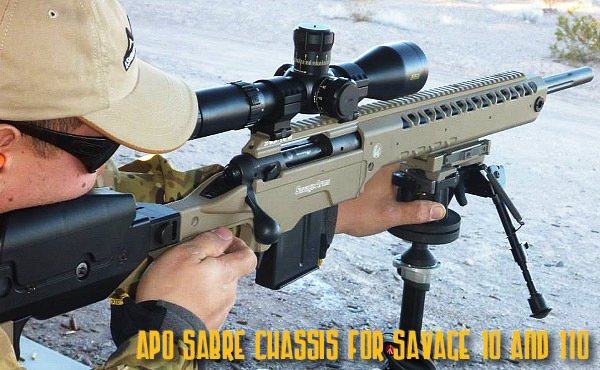
Here Precision Rifle Series (PRS) Competitor Melissa Gilliland talks about the modular chassis systems offered by Ashbury Precision Ordnance (APO). With adjustable buttplate, cheekpiece, and grip, these systems can be adapted for a variety of shooting disciplines. APO even offers a modular chassis for Savage barreled actions. Melissa shoots a tricked-out 6.5 Creedmoor rig with a Titanium APO action.
New Precision Rifle from APO
SABRE Chassis System for Savage Actions
Vortex Optics
Vortex continues to grab a larger share of the tactical and long-range hunting markets. This video features the Vortex Razor HD Gen II 4.5-27x56mm and 3-18x50mm scopes. These Gen II Razors feature apochromatic objective lenses, rugged 34mm single-piece aluminum main tubes, and versatile 6X zoom range. Both MOA-based and Milrad-based reticles are offered. Vortex scopes have large, user-friendly controls, and a good feature set for the price.
Thunder Beast Arms
Thunder Beast Arms’s suppressors, built by shooters for shooters, are tough yet light. Thunder Beast developed a strong following for its titanium cans that offered excellent performance with light weight. In this video, Thunder Beast unveils its new “Ultra” series of suppressors. Compared to Thunder Beast’s previous CB-series suppressors (of like size), these Ultras are 4 to 5 ounces lighter, yet provide 4 to 5 decibels of additional noise reduction. That represents a major gain in suppressor performance.
Shooting reactive targets is fun, especially when you get to use ultra-accurate benchrest rifles. To see how the “Varmint Silhouette” game is played, tune in to Shooting USA tonight on the Outdoor Channel. Tonight’s episode features a long-range varmint benchrest silhouette match at the Ridgway Rifle Club in Pennsylvania. This is silhouette like you’ve never seen it, with targets placed from 850 to 1,000 yards, and shooters using precision rifles, high-end optics, and advanced rests. This new sport combines the knock-down fun of silhouette with the high-tech precision of benchrest shooting. At Ridgway’s first Bench Rest Silhouette match 28 shooters participated. Five years later, nearly 120 shooters attend regular monthly matches. CLICK HERE for Match Info.
Varmint Benchrest Silhouette Basics
In 2010, the Ridgway Rifle Club combined Metallic Silhouette and 1000-yard Bench Rest into one exciting new discipline. Steel targets are arrayed in banks of five at four distances. The targets are set up as follows: Crows at 850 yards, Ground Hogs at 900 yards, Bobcats at 950 yards, and Coyotes at 1000 yards. Just dinging a target is not enough — to count as a “hit”, the target must fall down.
Ridgeway allows two classes of guns, Heavy Class with a maximum weight of 17 pounds, and Standard Class with a maximum weight of 12 pounts. Both classes must otherwise conform to the Light Gun rules for the Original 1000-Yard Bench Rest Club in Williamsport, PA.
Varmint Silhouette West of the Mississipi
Clubs in other states also host Varmint Silhouette matches (or some variant thereof). One of the longest-running and most popular Varmint Silhouette matches is held the first weekend of every month at the Pala Range, in San Diego County, California. At Pala, competitors shoot at “critter” targets placed at five yardages: 200 Meters – Field Mice (“pikas”); 300 meters – Crows; 385 meters – Ground Squirrels; 500 meters – Jack Rabbits; 600 yards – Prairie Dogs
Fun Weekend for the Whole Family At Pala, there’s a deluxe Indian Casino/Spa nearby. So don’t hesitate to bring the wife. If she’s not a shooter, she can enjoy a fancy brunch or spa treatment while you’re having fun mowing down metal critters. Pala is a 30 minutes from the Pacific Ocean and beautiful beaches, so you can make this a weekend holiday for the whole family — kids love sand and surf.
Many of us dream about taking (and making) a one-mile shot someday. To accomplish this feat, you need a very accurate rifle, ultra-consistent ammo, good logistics, and, of course, the proper location. In their quest to make the mile shot, Kerry Stottlemyer and his uncle Ron headed to the California desert. There they would attempt to “reach out and touch” a target 1760 yards distant. Here is their story….
Shooting at a Mile with a .300 Win Mag (from Sierra Bullets Blog)
My uncle, Ron Stottlemyer, was serious about this trip and this mile shot. He was sparing no expense and assured me that everything would be ready in December to make this shot, the only thing left to risk was the weather. The area we were planning on has some unpredictable winds, but in December it’s pretty calm so we hoped for the best.
After a year of planing, my uncle arrived at the airport with his Remington Sendero in tow, a .300 Win Mag with a Leupold Mk4 LR scope on it. We went to my place to tear down the rifle, thread the barrel and install the muzzle brake I made for him. We worked hard to bed the scope base and remount and bore sight the scope before the weekend.
The rifle: a Remington Sendero in .300 Win Mag with a Leupold Mk4 8.5-24X LR TRM scope, on Talley rings and a badger base. I threaded the barrel and installed the brake that we designed and I made, bedded the action, and bedded the scope base. Bore sighted it, reassembled it and tested everything for function and safety. The powder, primers, brass and bullets (220 gr HPBT Sierra MatchKings #2240) were all purchased online.
With everything packed, we headed out to the California desert to some Bureau of Land Management (BLM) land that would give us enough room to safely stretch the Sendero’s legs (see the photo below). Friday was spent reloading a few rounds at a time to get his scope zeroed, then on to working up loads for the next day’s attempt at 1760 yards (1 mile) (See Photo below).
Photo shows the camp from the target, GPS-located 1.00 miles away. That’s 1760 yards.
Saturday morning arrived and it was time to make breakfast and coffee. Mountain man breakfast in a dutch oven cooked over a camp fire. Bacon, sausage, potatoes, green peepers, onions, eggs, and cheese. Better then any breakfast made at home.
I set up my spotting scope get it dialed in and could immediately see that the wind was going to be an issue. My uncle got the rifle up on the bench, got the bags positioned, dialed the magnification all the way up to 25X on the scope and asked me for the come-ups. I told him to come up 150 clicks and give me two mils right windage.
Walking in the Shots at One Mile
He got set while I watched the wind see it settle into a rhythm and say “send it.” He let one fly and it landed about ten feet left and about 100 yards short. I scratched my head, the wind was doing something funny. I said, “Give me two more mil elevation and another mil right windage.” He let another one fly and this time the bullet struck within feet of the target. Ok, we were getting there – a little more windage and 1/4 mil more elevation. He let another one fly but said he pulled that one.
We battled the wind for the next seventeen shots, getting within a few feet of the target each time. Turned out where the bullet was at its highest point of its path is where the worst of the wind was. He let go of the 19th shot and put that one right at the base of the target! Then he said, “I got this one.” (Meaning he needed no more corrections from me.)
The 20th shot (at a range that the .300 Win Mag has one hell of a time hitting) nailed the target just low and left of center! He did it! He nailed it at one mile with loads I built that day!
To say he jumped for joy is an understatement. He pushed that round further then anyone would have any good excuse to do so. Most would not attempt a shot like that without stepping up to the .338 Lapua, but no, he had it in his head he was going to do it, and he did.
Kerry Stottlemyer loading up the 220 gr boat tail Sierra MatchKings.
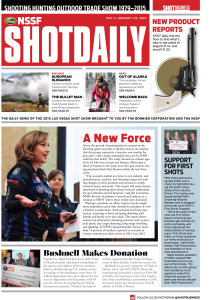
Digital editions of all four issues of SHOT Daily, the magazine printed each day of the SHOT Show, are available free in both Web eZine and downloadable PDF formats. You’ll find many product features plus articles that can benefit shooting club directors and range managers. SHOT Daily is produced for NSSF by Bonnier Corp., publishers of Outdoor Life, Field & Stream, and many other magazines.
Highlights Day 1: New Handguns Lead Story, Footwear, Legal Defense of Traditional Ammo, Women of Outdoor Channel, Midnight 3-Gun. Highlights Day 2: New Optics Lead Story, New Ammunition, Outerwear, Christensen Arms, Volquartsen Custom, CZ Factory, SilencerCo.
Highlights Day 3: New Knives Lead Story, Shooting Accessories, Hunting Rights, Women Shooters, Proof Research, Ultra Light Arms. Highlights Day 4 eZine: Walt Berger Profile, Steyr Scout, Lena Miculek, Sara Palin Q&A, New Remingtons.
Are you feeling lucky? Willing to take a chance to help a good cause? Then consider participating in the U.S. F-Class Open Rifle Team Raffle. The grand prize package, valued at $9,500.00, is darn impressive. The winner gets a Custom rifle with Kelby action, Manners stock, and Krieger barrel. Add to that a Nightforce scope and a set of Vortex Binoculars. But that’s just the hardware — in addition to the complete rifle (with high-quality optics), the raffle winner will recieve a fully-guided Whitetail deer hunt (all expenses paid except transport to Oklahoma). That is pretty enticing — heck we’d buy a raffle ticket just for a chance at that rifle. Raffle tickets cost $5 each, or you can get five for $20. The winning ticket will be drawn on March 1, 2015.
To purchase tickets, contact rickjensen[at]tds.net, (918) 520-1388.
Our friends Ed and Steve, aka the 6.5 Guys, were in Las Vegas last week, checking out new products at SHOT Show. On Day 2, Ed and Steve tracked down some cool products from Bushnell, McRee’s Precision, Timney, and TargetVision. Here are Ed and Steve’s Show product preview video reports. You can see more SHOT Show videos by Ed and Steve at 6.5Guys.com.
Bushnell
Laser RangeFinder with BlueTooth: Here Bushnell showcases the brand new Elite CONX Rangefinder. Using a Bluetooth connection, this “networkable” rangefinder can communicate with a smart-phone (and certain Kestrels). This allows you to push range/angle data directly into a ballistics App on your phone. We will certainly see more of this kind of inter-device connectivity in the future. The CONX can work with both iOS (Apple) and Android OS devises.
McRee’s Precision
Chassis Systems and Prefit Kits: The 6.5 guys interviewed Top Shot Season 2 Champion Chris Reed at the McRee’s Precision booth. McRee’s offers chassis systems as well as turn-key pre-fit barrel kits using Criterion barrels. Chris Reed reviews the “Remage” pre-fit barrel system for Remington actions at 5:25 in the video.
Timney Triggers
New Double-Sear Trigger: The 6.5 Guys checked out Timney’s new “Calvin Elite” double-sear trigger. This versatile trigger adjust from 8 ounces up to 2.5 pounds. It allows you to shoot a rifle with a low trigger pull weight for competition, then raise the pull weight to 2.5 pounds for field use or hunting.
TargetVision
Wireless Target Camera: If you want to see bullet holes reliably, in all conditions, past 400 yards, you need some kind of digital camera system, preferably wireless. TargetVision sells a reliable system that works through common WiFi technology, so you can view your shooting session on a smart-phone, iPad, or Android tablet. The TargetVision system includes proprietary software that can highlight the last shot fired. You can even take snapshots or record videos of your shooting sessions.
Nosler has just introduced a new cartridge, the 28 Nosler. This new 7mm hunting round delivers magnum-class velocities in a cartridge that fits a standard action. The 28 Nosler is capable of launching a 160gr Accubond at 3300 fps. The 28 Nosler uses the same parent case as the 26 Nosler, introduced in 2014. Designed for a maximum COAL of 3.340″, the 28 Nosler will operate in a standard action that is lighter (and more compact) than a magnum action.
The 28 Nosler offers serious knock-down power for the long-range hunter. The factory 185gr Accubond load retains over 2000 ft/lbs. of energy at 600 yards, and remains supersonic well past 1000 yards. Nosler factory ammo will be offered with 160gr and 185gr bullet-weight options.
Previewing the 28 Nosler:
For hand-loaders, Nosler will also offer 28 Nosler cartridge brass. It will be interesting to see whether some F-Class competition shooters experiment with the 28 Nosler (and heavy match bullets) as an alternative to the .284 Winchester or short magnums (WSM or RSAUM).



 Preparing Once-Fired GI 5.56 Brass for Reloading (Part 1 of 3)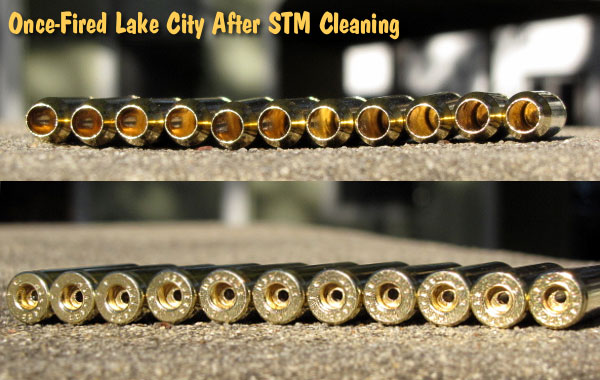




 At Pala, there’s a deluxe Indian Casino/Spa nearby. So don’t hesitate to bring the wife. If she’s not a shooter, she can enjoy a fancy brunch or spa treatment while you’re having fun mowing down metal critters. Pala is a 30 minutes from the Pacific Ocean and beautiful beaches, so you can make this a weekend holiday for the whole family — kids love sand and surf.




 Nosler has just introduced a new cartridge, the


