Forum member Erik Cortina recently launched his own YouTube Channel dedicated to precision reloading and accurizing. Erik’s videos demonstrate the proper use of specialized reloading tools and provide helpful hints. Erik’s latest video is about the “mother of all brass trimmers”, the Giraud powered case trimmer. Erik says: “It you do volume reloading… this is the only trimmer to get. It not only trims to length but it also chamfers your case mouth inside and out.” In his video, Erik offers some very clever and useful tips that will help you get the most from your Giraud.
The Giraud trimmer is very precise. When set up correctly, it can trim brass with amazing consistency. In the video, Erik trims 5 pieces of brass in 15 seconds (6:32 mark). He then measures all five with precision calipers (7:00-8:08). All lengths are exact within .0005 (half a thousandth). Erik notes that the Giraud trimmer indexes off the case shoulder. As long as you have fire-formed brass with consistent base-to-shoulder dimensions, you should get very consistent trim lengths.
The secret to the system is a 3-way cutting head. This cutter can be swapped in and out in a couple minutes with wrenches provided with the kit. Erik has three different heads; one each for 6.5mm, 7mm, and .30 caliber. The video shows how to adjust the cutting heads to match caliber diameter (and to get the desired amount of inside/outside chamfer).
This is a manufacturer’s photo showing an older model.
To trim and chamfer cases, you simply insert them nose-first into the cartridge-specific case-holder. Erick offers a smart tip — He uses a die locking ring to position the cartridge holder (3:15). This can be locked in place. Erik says die locking rings work much better than the hex-nuts provided by Giraud (with the hex-nut, one must re-set cut length each time you change case-holders.)
The Giraud can be used in either horizontal or vertical modes. Erik prefers to have the trimmer aligned vertically, allowing him to push cases down on the trimmer head. But the trimming unit has twin sets of rubber feet, allowing horizontal or vertical orientation.
Improved Case-Holder Made with Chamber Reamer:
For his .284 Shehane, Erik had to create his own case-holder (Giraud does not make one for that wildcat cartridge). Erik used his chamber reamer. To his surprise, Erik found that the brass was easier to trim in the custom case holder (compared to the Giraud-made spring-loaded holders). With a perfect fit, trimming and case extraction went more smoothly and the process was easier on his hands. (See 9:00-10:00). Based on Erik’s experience, you may want to create your own custom case-holder.
Trim Bullet Meplats Also
With a special bullet-holder fitting and meplat cutter head, the Giraud power trimmer can be used to trim bullet meplats. Trimming meplats can help make the Ballistic Coefficents of a batch of bullets more consistent. Uniforming meplats is also often done as a first step in the process of “tipping” bullets to improve BC.
SHOT Show kicks off in exactly one week. What were some of the more unusual items unveiled at last year’s show? Well how about a convincingly authentic 1911-style pistol made entirely of wood. That’s right, every component — frame, barrel, slide, hammer, grips, trigger, even the functional beavertail grip safety — are made from wood. The gun shouldn’t be used with live, full-power ammunition of course, but otherwise it operates just like a real 1911. It will feed dummy rounds, the slide racks, and the trigger causes the hammer to fall — just like on a real 1911 made from metal. Somehow, we think John Moses Browning, father of the 1911, would have been proud….
This unique all-wood pistol is a “tour de force” of craftsmanship. NRA Blog Editor Lars Dalseide was so impressed with the “all organic” wood 1911, that he named it as his favorite story subject for 2014:
#1 – A Fully Functional 1911 Pistol Made from Wood
When walking the SHOT Show floor last January I spotted what I thought was an incredible carving. But it was more than a carving – it was a fully functional 1911 pistol made out of wood.
From the Wood Caliber workshop in Davidson, Michigan, this beauty acts and feels just like a regular 1911. For the pure beauty of it, the 1911 wooden pistol is my top story for 2014.
Are you re-barreling a match rifle and need to know if you will still make weight? Or perhaps you want to select the right contour to hit an optimal carry weight for a new varmint rifle? Dan Lilja offers FREE software that will calculate barrel weight for straight contour, straight taper, and radius-tapered barrels. Dan’s software even calculates how fluting alters barrel weight.
For general info on barrel weight calculation for straight and straight tapers, read this article on Lilja’s website. Click HERE for another article explaining weight calculation with barrels that have a radiused (curved) contour section.
Here are the free software programs offered by Dan Lilja. Right click and “Save As”:
Here’s an item for the tactical operators out there. On the new SnipersHide Forum you’ll find a thread titled AX AICS: The New Hotness. This is a very thorough Owner’s Review of the Accuracy International AX Chassis by “TriggerMonkey”. With eight large, detailed photos, this “show-all, tell-all” thread does a great job of describing and illustrating the AX chassis system. Here’s a short sample:
2014 AX AICS Chassis
A couple of years ago I took a chance and purchased my first Accuracy International chassis, specifically the AX AICS, for my Remington 700. I say I took a chance because there was the possibility that I wouldn’t like it, I’ve never really considered myself a chassis system type of guy beforehand but it had features that appealed to me. I had nothing to worry about as it turns out because I got great accuracy out of the rifle without having to bed it and the adjustability of the stock made it very comfortable to shoot. When I saw that Accuracy International was rolling a new version of the AX AICS last year I knew that I had to have one for an upcoming build. Well now that I have one in hand I can see that the differences go far beyond just the addition of a right-hand folding stock. Nearly every part has been revised from the previous generation so let’s go through some of them.
The 2014 AX AICS comes in a pretty non-descript cardboard box in two pieces, neatly packaged in closed cell foam to protect of dings and such in transit. I would say this is a step up from my first AX AICS where the packaging was sufficient but not nearly as nice.
Sierra BulletsBallistic Technician Gary Prisendorf has written a nice essay about how reloading can become a life-time hobby, a rewarding pastime that can bring together a father and son…
by Gary Prisendorf
For as long as I can remember I have been around reloading. I have tons of childhood memories of my father reloading and shooting. I remember how he would let me help him load his ammunition, by letting me clean primer pockets or wipe the sizing lube off of his cases. I really thought I was doing something. Well, I guess I was, I was spending quality time with my father doing something that would become a great hobby and eventually land me a great job working for Sierra Bullets.
I remember watching my father sizing cases on his Herters press, dropping his powder charges with a Belding & Mull powder measure and weighing powder charges with his Texan scales. Heck, I can even remember when he would buy powder at a local pawn shop, and they would weigh it out and put it in a paper sack. He would save his empty powder cans, wrap them with masking tape and write what the powder was on them with a black magic marker.
When I was in Junior High, I got my first shotgun, a 20 gauge Mossberg 500 and within a couple of weeks my father came home with a 20 gauge Lee Load-All and a pound of Blue Dot. He gave me a crash course on how to use it, and got me up and running with a couple of safe loads. I put a lot of shells through that old 20 gauge.
From that day forward I was hooked. If I got a new gun, I was loading ammunition for it. I don’t buy factory ammunition unless I just want to shoot it up so I can get some once fired brass. I reload everything that I shoot, except for rimfire stuff, and if I could figure out how to do that safely, I would probably load that too.
Through the years I have learned to appreciate things — such as once-fired military .30-06 cases that can be converted to obscure cartridge types. And I know the value of a five-gallon bucket of lead wheel weights that will be melted down and cast into bullets.
I remember finding 19 once-fired Norma 7.7×58 Arisaka cases laying on the ground at a public shooting range, and it was like Christmas came early. I must have looked for that 20th case for about thirty minutes, but I never did find it.
I can’t thank my father enough for getting me started in reloading, he gave me a great hobby, many wonderful memories and taught me the skills that gave me a career doing something that I love.
If you are a reloader, teach someone. You may just give them a hobby for the rest of their life and who knows, you could help them find an enjoyable career, doing something that they love.
If you are planning to attend SHOT Show but haven’t registered yet, don’t delay! Registration fees DOUBLE after January 13, 2015. To take advantage of the early-bird registration discount, go to SHOTShow.org/apply and complete your application. You have just two (2) more days to take advantange of the discounted pricing, so don’t miss out. NSSF-member buyers and manufacturer reps using this discount pay $35, and other qualifying non-buyer attendees pay $175. After January 13, registration fees will move to $70 for NSSF-member buyers and manufacturer reps, while all other qualified attendees will incur a registration fee of $350.
Hotel Rooms Are Hard to Find… It seems like Las Vegas is almost completely booked out for SHOT Show week this year. Finding an affordable room is harder than in years before. The reason is simple. There are THREE major industry conventions in Las Vegas this same week, including the Kitchen & Bath Industry Show (24,000 attendees) and International Builders Show (49,000 attendees), which run simultaneously in the Las Vegas Convention Center. If you haven’t booked a room yet, expect to pay a premium. And expect it to be harder than ever to find a taxi.
Preview SHOT Show
with Online Show Tracker
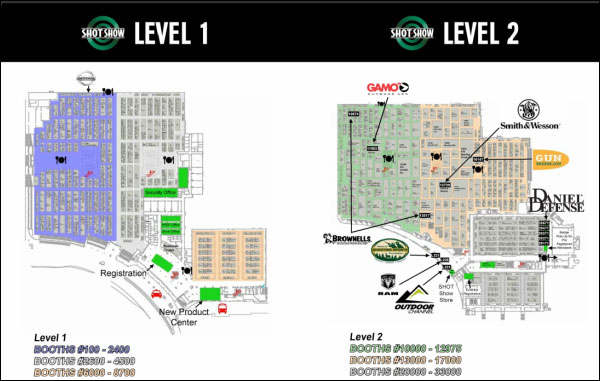
To see a list of exhibitors, locate booths, research seminars, and even get shuttle bus schedules, visit the 2015 SHOT Show Tracker. This handy online show guide helps you plan your visit to Vegas. With the help of the Tracker, you can map out your SHOT Show experience in advance. The Tracker contains a list of all exhibitors, and also has a handy map of the Sands Expo & Convention Center, marked with booth locations.
Just another YouTube video … NOT. This video is a winner. If you want to see state-of-the-art 21st Century rifle-building, with advanced CNC milling operations, watch this clip. It shows how man and machine combine to create a fine custom rifle.
One of the best short features of its kind, this video shows the creation of a high-end, 22-250 varmint rifle from start to finish. All aspects of the build are covered. The rifle was crafted by Chad Dixon for O’Neill Ops. Once the build is complete, the video shows the rifle being tested at 440 yards. With the camera filming through the scope, you can even watch the trace, starting at the 2:36″ time mark (this is very cool).
Watch this Video in HD!
Any person with an interest in gunsmithing should watch this video. It shows barrel profiling, tenon-thread cutting, chambering, CNC stock inletting, bedding, and stock painting.
For this build, Chad Dixon of LongRifles, Inc. teamed up with O’Neill Ops. The video shows the “Coyote Rifle” build, step by step, from the cutting of the tenon threads, to the 440-yard field test at the end of the build. To learn more about this rifle’s components and its performance in the field, contact James O’Neill, www.oneillops.com, (605) 685-6085.
Chad Dixon of LongRifles, Inc.
Chad Dixon’s introduction to firearms began in 1991 as a marksmanship instructor and competitive shooter in the U.S. Marine Corps. Chad began building rifles in 2000 at the Anschutz National Service Center, where he worked with U.S. Olympic shooters. In 2003 Chad took a position with Nesika Bay Precision/Dakota Arms. After leaving Nesika, Chad deployed to the Middle East as a security contractor for the U.S. Dept. of State. On his return to the USA, Chad started LongRifles Inc., a custom rifle-building company.
Dixon-built rifles combine modern CNC manufacturing methods with traditional expert craftsmanship. Chad’s rifles have won major int’l and national level competitions in Smallbore, Smallbore Silhouette, High Power, and Long Range Palma disciplines.
Georgia-based PolyCase Ammunition has developed innovative polymer-based composite cartridge cases and injection-molded bullets. With a patent-pending design, the polymer cartridge cases are lighter than brass or steel cases, yet are heat-tolerant, and relatively easy to manufacture. These cases will be initially produced for .223 Remington, plus a variety of pistol cartridge types (.380 ACP, .38 SPL, 9mm Luger). PolyCase cartridge cases blend patented heat-resistent polymers with metal elements in the case base. According to the manufacturer, “the net effects are greatly reduced weight (compared to comparable loaded ammunition), durability… and competitive pricing.” Other companies have experimented with polymer cartridge cases in the past — none have successfully perfected the technology in a commercially successful product. Could PolyCase be the first?
PolyCase Ammunition — Material Characteristics
– PolyCase Pistol Cartridge Cases are 11.5 to 20% lighter than brass-cased ammunition.
– PolyCase Rifle Cartridge Cases are 23 to 60% lighter than brass-cased ammunition.
– PolyCase Cartridge Cases are self-lubricating — a positive factor compared to brass or steel cases.
PolyCase Bullets — Injection-Molded Blend of Copper and Plastic
PolyCase has developed its own unique bullets for use in pistol ammunition. PolyCase Cu/P™ bullets are precision injection-molded from a cutting-edge copper-polymer compound. These molded bullets will be offered in both polymer cases and conventional brass cases. (Early in the design process, PolyCase determined that molded bullets work well in both brass and plastic cases). PolyCase co-owner Paul Lemke (Lt. Col. U.S. Army, Ret.) says: “We are able to use essentially the same molds to produce bullets for brass casings and bullets for our polymer casings”.
PolyCase Pioneers Injection-Molded Bullet Technology
Powdered metal has been around for decades, but blending powdered metal with polymers and injection molding precise parts is a fairly modern process. While processes like sintered metal bullets and pressure-formed shotgun pellets have become commonplace, PolyCase is the first American company to produce and sell a completely injection-molded bullet.
For over a century most bullets have been mass-produced with a process called cold-forming. Lead and copper were shaped with brute force in punches and dies to create projectiles. While this is still a viable and effective way to produce bullets, other manufacturing methods are now available. By applying injection-molding technology, Polycase has developed a new type of bullet that has many advantages, as least for handgun applications. Bullets weigh approximately 70% as much as lead bullets with similar profiles. Lighter weight means higher velocities and less recoil. In addition, PolyCase bullets are lead-free, and low ricochet — two qualities important for indoor and close-range training. The injection-molding process also reduces weight variations (compared to cast lead bullets), and ensures excellent concentricity. Molding also allows unique shapes that are impossible to produce with conventional bullet-making methods (see photo).
High-contrast targets make aiming (and seeing your bullet impacts) easier. EZ2C Targets, a family business in Pennsylvania, has developed a series of very bright, high-contrast targets printed with eye-popping fluorescent red/orange and Deep Black Inks. These are available from the EZ2C online store. A set of forty (40) 11″x17″ targets printed on quality bright white paper costs $7.50. A wide variety of designs are available: Bulleyes, Grids, Silhouettes, and Diamonds as well as many specialty targets.
EZ2C’s Battleship Target (Style 22) would be great for precision rifles at 100 or 200 yards. The red circles are about 3/4″ in diameter. That’s 0.36 MOA at 200 yards. That’s a good test for an accurate rifle (and for any shooting pals who boast that their guns can shoot “1/4 MOA all day long”.)
Here are four other Fun Targets. EZ2C’s lastest design is new Tic-Tac-Toe Target. This would be a great precision rifle target at 100 yards, if you tried to hit the actual printed Xs and Os (not just the boxes). You could shoot this with a buddy — one guy shoots Red-zone Xs while the other shoots White-zone Os. The Dartboard target is also great for a two-man shooting competition. The pistol diagnosis target (lower right) shows how to correct your aim and hold, based on where your errant shots fall.
EZ2C Sample Fun Targets:
Get Customized Targets for Your Club or Business
EZ2C targets can be customized with the name/logo of your gun club or business. This is an excellent way to promote your organization or store. Here’s a suggestion — have your gun club print up customized targets to award as prizes at shooting matches. This video explains the custom printing options.
Werner Mehl of Kurzzeit.com produced a 10-minute video for the 2010 SHOT Show. This amazing video became a huge hit on YouTube, with over 45,600 “likes”. With the 2015 SHOT Show coming up, we thought you’d like another view. This super-slow-motion video has been watched over 10 million times, making it one of the most popular shooting-related videos in history. Employing cameras recording at up to 1,000,000 (one million) frames per second, Mehl’s bullet flight video has been called “astounding”, “mesmerizing”, and a “work of art.” If you haven’t seen it yet, sit back and enjoy!
LINK: Kurzzeit.com Video System and BMC-19/PVM-21 Chronograph
Click the link above to learn more about Werner Mehl and his super-sophisticated camera systems that can record at 1,000,000 frames per second. On the same linked page you can learn about the advanced PVM-21 chronograph (now sold as the BMC-19) designed by Werner. Operating “all-infrared, all the time”, the PVM-21 is the best optical chronograph we have tested for very low light conditions, or very tricky light conditions.


 Are you re-barreling a match rifle and need to know if you will still make weight? Or perhaps you want to select the right contour to hit an optimal carry weight for a new varmint rifle? Dan Lilja offers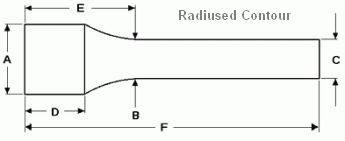


 Preview SHOT Show

 Just another YouTube video … NOT. This video is a winner. If you want to see state-of-the-art 21st Century rifle-building, with advanced CNC milling operations, watch this clip. It shows how man and machine combine to create a fine custom rifle.


