Hey guys, you’ll probably want to download this new Powder Burn Rate Chart issued by Hodgdon/IMR. This new table shows the latest IMR powders including the Enduron series (IMR 4166, 4451, 4955, 7977), shown in green below. This chart provides useful information for all hand-loaders. When doing load development, and testing one powder versus another, it’s generally wise to choose propellants that share the same relative burn rate, as least for starters. NOTE: Hodgdon powders are shown in blue, while IMR standard powders are shown in yellow. DOWNLOAD Chart HERE.
If you have ever turned a large quantity of case-necks using power assist, you know that a carbide mandrel can make the job go easier, with better end results. In our experience, when using carbide mandrels (as opposed to ordinary steel), the cases move more smoothly with less heat build-up. Pat Reagin of PMA Tool explains why carbide neck-turning mandrels work better:
Carbide offers several advantages over conventional steel and stainless steel when making any tooling, specifically neck-turning mandrels:
Dimensional Stability — Carbide maintains its dimensions indefinitely during heating and cooling. This eliminates the need to allow the mandrel time to cool every few cases.
Coefficient of Friction and Wear-Resistance — Carbide exhibits a low coefficient of friction value as compared to all steels and wears up to 100 times longer. This reduces (but does not eliminate) the amount of lubricant required.
Galling Resistance — Carbide has exceptional resistance to galling and welding at the surface. This basically eliminates the chance of getting a case stuck on a mandrel due to insufficient lubrication.
Given the benefits of carbide neck-turner mandrels, you may be asking “where can I get one?” Sinclair Int’l offers carbide mandrels for Sinclair neck-turners for $49.99, in a full range of calibers: 17, 20, 22, 6mm, 25, 6.5mm, 270, 30, and 338.
$49.95 Carbide Mandrels from PMA Tool
PMA Tools now also offers carbide mandrels in a full variety of sizes. At $49.95 each, PMA’s carbide mandrels are priced competitively with Sinclair’s mandrels. PMA offers carbide mandrels in .17, .20, .22, 6mm, 6.5mm, 7mm and .30-caliber. These will work with Sinclair Int’l and 21st Century neck-turners, as well as PMA neck-turners. PMA tells us: “We now have carbide neck-turning mandrels in stock. These mandrels are made with high-tech CNC grinding-machinery, and should give you excellent results. We hope to be add other larger-caliber carbide mandrels to our lineup in the future.”
SHOT Show in Las Vegas is just two weeks away. Here are some of the interesting new products that will debut at SHOT Show. You can find these items and hundreds more new-for-2016 products at the SHOW Show New Product Center.
The Newcon Optik Spotter LRF is a combined spotting scope and laser rangefinder — the first of its kind. This unique piece of equipment integrates a Newcon Optik Laser Rangefinder with a 15-45X Spotting Scope with etched mil-dot reticle. Newcon Optik claims a 5500m maximum range for the LRF. The integrated scope/LRF is housed in a rugged yet light-weight MIL-SPEC housing. We like the idea of a combined Spotter/LRF. Will other companies try to copy Newcon Optik’s innovative design?
Mason Target Systems — AR500 Steel Target With Shot Sensor
The MTS Target System “Pescadero” unit combines a rugged AR500 steel target with a durable electronics and sensor package that allows shooters to view their shots on a mobile App. With on-board power and wireless communication technology, the system will display shot location to the shooter positioned hundreds of yards away. So you can hear the “ding” of steel and then see your exact shot location on your smart phone or tablet. To aid aiming, the Pescadero target can mount self-healing polymer targets to the AR500 steel plate. Visit MasonTargetSystems.com for more information.
Schweitzer Optics — First-Ever Double FOV Scope
Here is a very innovative new hunting scope that actually displays a 3.5 X view AND and 1.0 X view simultaneously. Schweitzer claims this is the first and only double Field of View (FOV) sports optic in the world. This innovative optical technology doesn’t come cheap — Schweitzer’s Eagle Eye 3.5 dual POV scope retails for $2500.00.
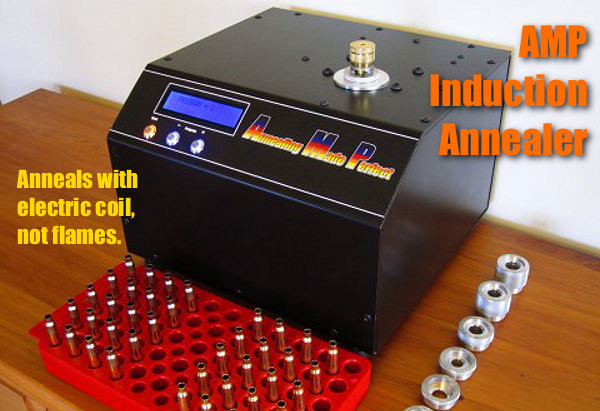
Annealing Made Perfect — Induction Annealing Machine
No more flaming torches (and burned fingers). The AMP Annealing system anneals through electrical induction. This micro-processor controlled, precision-calibrated induction annealer provides exact and repeatable neck hardness. With the various AMP-made pilot inserts, the machine will handle popular cartridge types from .17 Caliber all the way up to 460 Weatherby. Anneal times are pre-programmed for optimal results.
Accu-Tac — SR-5 Tactical Bipod
The Accu-Tac SR-5 Bipod is crafted from high-quality billet aluminum. The SR-5 mounts quickly and securely to a 1913 Picatinny rail. The bipod’s wide stance provides good stability. Ratcheted leg extensions adjust to five different heights, and then retract quickly with a one-button retraction lever. Legs can be deployed in a conventional 90-degree orientation, or at a 45-degree angle either forwards or rearwards.
Lyman Products — Cyclone Rotary (Wet) Tumbler
Lyman is introducing a new Rotary Tumbler for 2016. Designed for use with stainless (pin-type media) and liquid, this Cyclone Tumbler gets brass thoroughly clean inside and out. The large capacity drum holds up to 1000 pieces of .223 Rem brass and features a rubber lining to protect brass and greatly reduce operating noise. The included two-piece sifter pans make separating cases and pins easy.
Swiss+Tech Products — Tac20 Firearms Multi-Tool
This new multi-function gun tool contains 4 driver bits, 2 Torx drivers, 2 Allen drivers, gun pin punch, sight wrench, castle nut wrench, flat screwdriver, bottle opener, knife, and LED flashlight. It even contains a fitting with a male thread connection for attaching cleaning rods. That’s clever. All totaled, the Tac20 multi-tool offers 20 features — that’s a lot of functionality in a small, compact package from Swiss+Tech Products.
Hearing loss is a terrible thing. Protect your hearing while you can. Permanent damage can occur in a single shooting session. For maximum protection, we recommend that you “Double up”, i.e. wear ear plugs under muffs. Between shooting, riding motorcycles, and working with gas-powered yard equipment, your Editor probably has foam plugs in his ears 8-12 hours a week. I’ve tried many different varieties of ear plugs, both the foam variety and the soft plastic flange-type plugs.
I now favor the Howard Leight MAX-1 plugs. Rated at NRR33, these are, quite simply, the best ear-plugs I’ve ever tried. No BS — these things really work. Among all disposable plugs I’ve tried, the MAX-1s are definitely the most effective at blocking noise, and they are also more comfortable than most other foam plugs I’ve used. In my experience at the range, these plugs block sound way better than most muffs (when worn without plugs underneath).
The first thing I noticed about these plugs is how much more effective they were than muffs alone. With muffs in place, a rifle report is still quite audible. With the red MAX-1 plugs, the noise from a shot is much, much quieter. Proof of the “real world” effectiveness of these plugs came when talking. The plugs work so well that I had trouble hearing words spoken by a colleague from just four feet away. With conventional (non-electronic) muffs I can hear a normal speaking voice from many yards away.
These MAX-1 plugs insert easily (if you roll them first), and the wide, flared outer bell makes them very easy to remove. Subjectively, these plugs seem more comfortable than most other foam plugs I have tried. They are certainly way more comfortable than the cheap, non-tapered ear plugs. MAX-1 plugs are available in both standard configuration and corded versions. These are cheap to buy — 20 pairs of non-corded MAX-1s cost just $4.85 on Amazon.com. I just bought another 20 pairs today.
These ear plugs deserve all the raves they’ve received. They’re by far the best I’ve used and among the least expensive. They hold up very well when used repeatedly. This is the only brand I’ll buy from now on. — Joe
These things are as soft and gentle as they come and they block the noise out very well. I highly recommend them[.] — Byron
They are the best ear plugs I’ve ever used — and I’ve used many over the years. These are the only ear plugs I will ever use in the future. — Rhoda
Here’s a handy training option for F-Class shooters. Forum member SleepyGator is an F-Class competitor, but it’s not convenient for him to shoot at long ranges close to home. Accordingly, he wanted some “reduced-distance” targets he could use at 300 yards for practice. There is an official reduced-distanced standard for 300-yard F-Class matches. This utilizes the NRA No. MR-63FC – F-Class Target Center which is pasted over the MR-63 target. It provides a 1.42″ X-Ring, 2.85″ 10-Ring, and 5.85″ Nine-Ring. (The dimensions of F-Class targets are found in the NRA High Power Rules, Sec. 22, part 4, page 70 — see sample below.)
To duplicate the 300-yard target, SleepyGator has prepared a printable version of the MR-63FC Target Center, along with a pair of training targets with two bulls and five bulls. The two-bull and five-bull targets mirror the scoring rings on the MR-63FC, but they display only the innermost three rings and two rings respectively. All three targets are Adobe Acrobat (PDF) files that can be easily printed. You may need to adjust the scale (sizing) on your printer to get the dimensions exactly correct. As noted above, when printed, the 10-Ring on all three targets should measure 2.85″. This should provide some handy practice targets you can use between matches. Thanks to SleepyGator for providing these targets. You can download all three as a .Zip archive. After downloading the .Zip file, just click on the .Zip archive to extract the individual targets.
This important video shows what really happens when loaded ammunition burns. You will probably be surprised. Contrary to Hollywood notions, the ammo doesn’t ignite in a massive explosion. Far from it… basically the rounds “cook off” one by one, and the bullets release at relatively low velocity. We’ve featured this SAAMI research project before, but it is worth reprising for those who have not yet seen the burn tests.
A couple years back, SAAMI released an important video concerning ammo and fire. With professional fire-fighters standing by, over 400,000 rounds of ammo were incinerated in a series of eye-opening tests. If you haven’t had the chance to view this video yet, you should take the time to watch it now
The Sporting Arms and Ammunition Manufacturers’ Institute (SAAMI) has produced an amazing 25-minute video that shows what actually happens to sporting ammunition involved in a fire. This video shows the results of serious tests conducted with the assistance of professional fire crews. We strongly recommend you watch this video, all the way through. It dispels many myths, while demonstrating what really happens when ammunition is burned, dropped, or crushed.
Watch SAAMI Ammunition Testing Video
Video Timeline
2:10 Impact Test (ignited outside firearm)
3:40 65-foot Drop Test
5:08 Bullet Impact (.308 Win firing)
7:55 Blasting Cap Attacks
9:55 Bulldozer and Forklift Tests
12:20 Boxed Ammo Bonfire
15:37 Bonfire without Packaging
17:21 Retail Store Simulation Burn
20:55 Truck Trailer Burn
Over 400,000 rounds of ammunition were used in the tests. Some of the footage is quite remarkable. Testers built a bonfire with 28,000 rounds of boxed ammo soaked in diesel fuel. Then the testers loaded five pallets of ammo (250,000 rounds) in the back of a semi-truck, and torched it all using wood and paper fire-starting materials doused with diesel fuel.
The video shows that, when ammo boxes are set on fire, and ammunition does discharge, the bullet normally exits at low speed and low pressure. SAAMI states: “Smokeless powders must be confined to propel a projectile at high velocity. When not in a firearm, projectile velocities are extremely low.” At distances of 10 meters, bullets launched from “cooked-off” ammo would not penetrate the normal “turn-out gear” worn by fire-fighters.
We are not suggesting you disregard the risks of ammo “cooking off” in a fire, but you will learn the realities of the situation by watching the video. There are some amazing demonstrations — including a simulated retail store fire with 115,000 rounds of ammo in boxes. As cartridges cook off, it sounds like a battery of machine-guns, but projectiles did not penetrate the “store” walls, or even two layers of sheet-rock. The fire crew puts out the “store fire” easily in under 20 seconds, just using water.
Additional Testing: Drop Test, Projectile Test, Crush Test, Blasting Cap Test
Drop Test
The video also offers interesting ammo-handling tests. Boxes of ammo were dropped from a height of 65 feet. Only a tiny fraction of the cartridges discharged, and there was no chain-fire. SAAMI concludes: “When dropped from extreme heights (65 feet), sporting ammunition is unlikely to ignite. If a cartridge ignites, it does not propagate.”
Rifle Fire Test
SAAMI’s testers even tried to blow up boxes of ammunition with rifle fire. Boxes of loaded ammo were shot with .308 Win rounds from 65 yards. The video includes fascinating slow-motion footage showing rounds penetrating boxes of rifle cartridges, pistol ammo, and shotgun shells. Individual cartridges that were penetrated were destroyed, but adjacent cartridges suffered little damage, other than some powder leakage. SAAMI observed: “Most of the ammunition did not ignite. When a cartridge did ignite, there was no chain reaction.”
Bulldozer Crush Test
The test team also did an amazing “crush-test” using a Bulldozer. First boxes of loaded ammo, then loose piles of ammo, were crushed under the treads of a Bulldozer. A handful of rounds fired off, but again there was no chain-fire, and no large explosion. SAAMI observed: “Even in the most extreme conditions of compression and friction, sporting ammunition is unlikely to ignite. [If it does ignite when crushed] it does not propagate.”
Blasting Cap Test
Perhaps most amazingly, the testers were not able to get ammunition to chain-fire (detonate all at once), even when using blasting caps affixed directly to live primers. In the SAAMI test, a blasting cap was placed on the primer of a round housed in a large box of ammo. One cartridge ignited but the rest of the boxed ammo was relatively undamaged and there was no propagation.
You can now purchase an exact reprint of Howell’s classic book for $59.98. This 600-page hardcover (8 1/2″ x 11″) resource features 450 pages of diagrams, all drawn to the same 1.5x scale. The collection of cartridge diagrams includes many “cartridge blueprints” available nowhere else, including many obscure wildcats. Howell’s book includes sections on: case specs, use of forming dies, fire forming, cartridge annealing, case capacity variables, chamber pressure variables, and powder selection. CLICK to ORDER.
Here are reviews from two book purchasers:
“This is an absolutely incredible [book] for wildcatters, ballistic students and serious cartridge handloaders. It provides the critical dimensions (imperial and metric as well as displacement) for about 1840 cartridges[.] The first 100 pages explain the mechanics of cartridge forming. The cartridge drawings are in B&W, very legible and easy to copy or scan[.] Especially on the metric side there are a few notable cartridge ommissions… but it does not detract from the overall importance of this magnificent work, which I consider the best of the genre. A great buy for serious cartridge students at any price.” — Pierre Van W.
“This book has earned the reputation of being THE authority in the field of reliable dimensions for small arms cartridges. The author [lists] which cases are useful in making other cases which may not be available. This is the bedrock technical book for this subject area and is a necessity for any hardcore reloader. It is worth more than the price asked.” — Gene C.
Editor’s Note: A couple of guys who had the original edition of this book said they found a few errors in dimensions when comparing Howell’s diagrams with SAAMI specs. Before you spec a reamer or invest in dies, you may want to double-check dimensions found in this book.
Book tip from EdLongrange. We welcome reader submissions.
Happy New Year to all our readers worldwide, and especially the nearly 30,000 members of our AccurateShooter Forum. We hope 2016 brings you happiness in your lives and success in your endeavors. And we wish for small groups, good scores, and successful hunts in the New Year.
We have upgraded our site for 2016, making our Forum mobile-friendly with new faster, more modern software. We hope you’ll continue to enjoy our feature articles, our Daily Bulletin, our match reports, and our Free Forum Classifieds. The formula seems to be working — our audience is bigger than ever and it just keeps growing, with over 550,000+ unique users visiting the site every month.
Forum Membership Grows 12% in 2015
Our Shooters’ Forum grew significantly in 2015. Membership grew by 12% as Forum ranks swelled to nearly 30,000 members! More people are successfully buying and selling in our FREE Forum Classifieds section than ever before. Remember, user donations help make our Free Classifieds possible.
Check Out Our Recently Upgraded Shooters’ Forum
Now Fully Responsive and Mobile-Friendly!
We need your support. For over 12 years the site has relied largely on volunteer efforts by dedicated shooters. But as the site grows, serving a larger audience, we need the assistance of freelance writers and video producers, plus help from expert computer and software techs. Those guys don’t work for glory alone.
Consider this — what do you pay for a movie ticket these days? Probably nine bucks for 90 minutes of escapism. For a buck a month ($12 a year) you can help this site provide a YEAR’s worth of info, tests, and shooting news that you won’t find anywhere else.
In the past quarter about 140 site users have donated. We thank all those who have generously contributed. But that still leaves tens of thousands of users who access the site regularly without contributing. With more donations we can deliver more premium content and offer more services to our members.
Here’s our proposal. First, if you have used our FREE Classifieds to successfully sell your rifles or shooting gear, consider sending in $10.00 from your sale proceeds. Second, for those who use the site regularly, consider donating One Dollar a Month. That’s less than the price of a cup of coffee.
How to Contribute
Making a donation to the site is simple and easy. Just click on the orange “Donate” button at right. If you have a credit card, you don’t need a Paypal account to contribute. Any sum is welcome — donations need not be large.
Help Support this Site by Making a Secure Donation.
If you don’t like Paypal, you can send a check. Make the check payable to our “Answerman” Jeff Williams. Please list your Forum Log-In Name (if any), and mail the check to:
Jeff Williams
P.O. Box 240
Solon Springs, WI 54873
Sharpshooter (and competitive smallbore shooter) Kirsten Joy Weiss tried a special New Year’s trick shot for 2015. In keeping with the festive New Year’s spirit, Kirsten attempted to shoot the cork off a champagne bottle. After a few unsuccessful tries, she managed to hit the cork with at least two shots. But alas the cork did not fly. She actually hit the cork, but it did not release. That was surprising…
Undaunted, Kirsten changed her strategy, aiming for the neck of the bottle. This duplicates the process of “sabering” a champagne bottle — a method of liberating the bubbly by slashing off the end of the neck with a blade. Aiming for the neck of the bottle, Kirsten successfully blew off the top of the bottle. (Apparently, when “sabering” it is actually the pressure within the champagne bottle which does most of the work).
You knew it was just a matter of time until modern Bluetooth wireless technology was harnessed for precision shooting. Now weather data from a Kestrel and range info from a Vectronix rangefinder can be shared to a remote PDA with GPS capability. The system works via the common Bluetooth networking protocol used for smartphone accessories and computer peripherals. Ballistic solutions are calculated using Field Firing Solutions software. Composed of weathermeter, rangefinder, and hand-held processor (PDA), this three-part TALON Wireless Ballistic Targeting System was developed for Ashbury Precision Ordnance (APO). The Talon System will be introduced by APO at SHOT Show 2015 where pricing and availability will be announced.
Here’s how it works — dual Bluetooth feeds (from Kestrel and rangefinder) communicate with a Trimble T41 Juno or NOMAD PDA. The dongle is set up for any Vectronix Laser Rangefinder equipped with a RS232 data port. The enabling technology, a nicely packaged Bluetooth dongle, was developed by a team of U.S. SpecOps personnel. Their goal was enhance operational capabilities by getting rid of wires and cables. They succeeded.


 $49.95 Carbide Mandrels from PMA Tool




 Hearing loss is a terrible thing. Protect your hearing while you can. Permanent damage can occur in a single shooting session. For maximum protection, we recommend that you “Double up”, i.e. wear ear plugs under muffs. Between shooting, riding motorcycles, and working with gas-powered yard equipment, your Editor probably has foam plugs in his ears 8-12 hours a week. I’ve tried many different varieties of ear plugs, both the foam variety and the soft plastic flange-type plugs.
 These ear plugs deserve all the raves they’ve received. They’re by far the best I’ve used and among the least expensive. They hold up very well when used repeatedly. This is the only brand I’ll buy from now on. — Joe


 The Sporting Arms and Ammunition Manufacturers’ Institute (
 We are not suggesting you disregard the risks of ammo “cooking off” in a fire, but you will learn the realities of the situation by watching the video. There are some amazing demonstrations — including a simulated retail store fire with 115,000 rounds of ammo in boxes. As cartridges cook off, it sounds like a battery of machine-guns, but projectiles did not penetrate the “store” walls, or even two layers of sheet-rock. The fire crew puts out the “store fire” easily in under 20 seconds, just using water.


 In the past quarter about 140 site users have donated. We thank all those who have generously contributed. But that still leaves tens of thousands of users who access the site regularly without contributing. With more donations we can deliver more premium content and offer more services to our members.
 Sharpshooter (and competitive smallbore shooter) Kirsten Joy Weiss tried a special New Year’s trick shot for 2015. In keeping with the festive New Year’s spirit, Kirsten attempted to shoot the cork off a champagne bottle. After a few unsuccessful tries, she managed to hit the cork with at least two shots. But alas the cork did not fly. She actually hit the cork, but it did not release. That was surprising…


