|
|
July 17th, 2016
Have you been bitten by the PRS Bug? Our friends, Ed Mobley and Steve Lawrence, aka the “6.5 Guys”, have written an excellent article on getting started in practical/tactical competition. If you are new to the game, these tips can help you save money, progress faster, and have more fun. Here are article highlights, but we recommend you read the full story, 5 Tips for Attending Your First Precision Rifle Match, on www.65guys.com.

We often meet people who are new to long range precision shooting, and want to improve their knowledge and skill level. However, they aren’t sure if they are ready to sign up to compete in a match. They often ask, “What knowledge or skills are necessary to compete in a match?” Others may state, “I need to purchase this gear or that gear before I can attend a match”. For those guys who have a strong interest in precision rifle shooting, and who wish to check out a precision rifle match, below are Five Tips to make it a positive experience.
TIP ONE: Make Plans and Commit to Go
First you need to start by finding a match to attend. This may entail a little bit of research and investigative work on your part to find what matches are scheduled in the next few months. We recommend starting with any match that may be within a reasonable driving distance. This may likely be a local “club” match, many of which are held on a regular basis. These make great venues because it will provide an opportunity to meet some of the regular attendees as well as shooters that are from your geographic area. Additionally, most of the smaller matches are a little more relaxed in terms of level of competitiveness.
Once you decide on the match you want to attend, do your homework. This means finding out if you need to pre-register or pre-pay the match fee. Commit to going by registering for the match and putting it on your schedule. Be sure to find other useful information for questions such as:
— What time should I arrive?
— Is there a mandatory safety briefing for new shooters at that venue?
— What is the travel time required to get to the match site?
— How many stages will there be?
— Is there a description of the stages available before the match?
— How many rounds should you bring?
— Are there special equipment requirements? (E.g. do you need chamber flags, is there a pistol stage?)
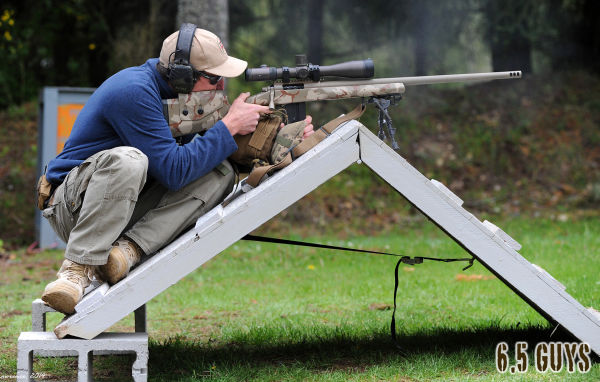
TIP TWO: Bring What You Have
(Don’t Spend a Fortune at the Start)
Some new shooters often assume they need a custom match rifle or all of the miscellaneous shooting gear associated with long range precision shooting to compete in match. While having a Kestrel weather meter and a high quality laser range finder and other shooting accoutrements are invaluable kit, you will find other shooters at your first match that will provide you with the information and coaching you need to get on target.
In fact, the only gear you really need to bring is a scoped rifle with a bipod and ammo capable of consistently shooting within one MOA. Also, be sure to know the ballistic drops or have a ballistic drop table prepared for your rifle/ammo to dial the correct DOPE on your scope for different target ranges. Many of the other participants at the match will be willing to let you borrow a support bag, bipod, tripod or other gear if you need one — just ask. Don’t use the excuse of not having the right gear to delay getting out to a match!
One reason not to make a big initial investment in a new rifle and assorted gear before competing, is we’ve seen a number of people come into the sport and try it for a year and then make the decision to move on to something else.
TIP THREE: Be Prepared to Learn
As a new shooter at a match, there is no better opportunity to learn. We often look to our local club matches as a group ‘training’ session to prepare for the bigger matches. You will find competitors at all levels of skill and many of your fellow shooters will enthusiastically provide helpful advice once they learn you are new to the sport. Take advantage of the opportunity to ask questions if you would like ideas for how to engage a stage, but also be sure to do more listening than talking as you receive guidance and tips from more experienced competitors.
Watch and observe other shooters and how they approach and ‘game’ a specific stage or course of fire. You’ll begin to recognize which shooting positions work best for different scenarios, and maybe even come up with some new ones that no one has thought of before.
Seeing what the better shooters do is an invaluable instructional tool. You can use your smart phone’s video camera to record other shooters (with their permission). When you’re ready to shoot, ask another shooter to record your performance. Watching yourself will point out needed areas of improvement.

After each match conduct an informal after action review and summarize for yourself the things that went well and what you should continue to do. You should also identify the specific shooting skills you should develop and make a plan to integrate the appropriate practice drills into your practice sessions. Finally, if you maintain a shooter’s data book or journal you’ll want to note things such as:
After Action Review – How you did, what went well, things you need to work on in practice.
Stage Observations – Successful methods used for specific courses of fire. Note barricades, positions used, specific gear used for stages.
Gear Observations – How your rifle/gear performed, what new items you should add to your “buy list”.
TIP FOUR: Be Safe and Have Fun
You’ve all heard a parent or teacher say, “It’s all fun and games until someone loses an eye.” The same can be said of the shooting sports. Safe handling of firearms is the number one rule at any match, and comes before the FUN part in terms of importance.
Before all matches start there will always be some form of a mandatory safety briefing. Make sure you know, understand, and follow any unique safety protocols for the match you attend. Some matches require all rifles have chamber flags inserted and are stowed in bags/cases while not on the firing line — other matches may not. If you run afoul of any safety rules, you risk the chance of being disqualified from a stage or worse, the entire match.

The second rule is simply have fun. This starts with having a good attitude throughout the day. Keep in mind that as a new competitor you should think of a match as a solid day of practice and training. If you blow a stage, use it as an opportunity to diagnose what you could have done differently or what you need to improve on — then smile and drive on.
Any day at the range or shooting is a good day. A match is an opportunity to hang out with like-minded people who are passionate about shooting and impacting targets far-far away. Life is great when you are doing what you enjoy!
TIP FIVE: Make Friends
There is no better way to meet lots of precision rifle shooters and make friends than at a match. The people that attend the tactical precision matches on a regular basis are those that have ‘fallen into the deep end of the pool’ and are really into the sport. As a result, they have become part of the local precision shooting community. As you strike up conversations at the match, find out if your new-found friends visit specific forum boards or social media outlets, or if there are other matches they attend.
Precision shooters tend to congregate and share information in different corners of the Internet. It will serve you well to meet some of the guys in person at matches and be able to connect a face to a screen name. As you develop your friendships and develop a level of trust, you will find opportunities become available to shoot with others in your local area, or get ‘read-in’ on a secret honey-hole of a spot to shoot long distance. Additionally, the local shooting community will often find it more convenient to sell or trade gear and equipment locally than deal with buyers/sellers that are out of state.
July 16th, 2016

After a rip-roaring Opening Ceremony, the 2016 National Matches at Camp Perry commenced with the handgun Small Arms Firing School (SAFS) on July 11th, followed by Excellence-In-Competition (EIC) pistol matches on July 12th. The SAFS was led by USAMU, Military Team, and CMP instructors. Following classroom instruction and practice on the range, SAFS participants fired a true M9 EIC Match with the goal of earning points towards the prestigious Distinguished Badge.
On July 12th, the CMP .22 Rimfire and Service Pistol EIC matches were held. These matches were hugely popular — with 480 Rimfire competitors and 400 Service Pistol shooters. This year, there was plenty of talent on the firing line. Of the top 50 Service Pistol shooters, 46 were Distinguished, including the top 18 competitors.
See All National Trophy Pistol Matches Results | View Camp Perry EIC Match Photos
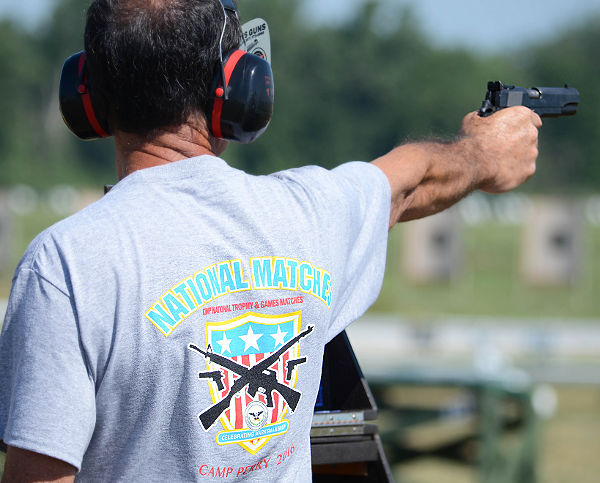
The USAMU’s SSG Greg Markowski won the Service Pistol EIC Match with a score of 293-11X. Fellow USAMU team members SFC Lawrence Cleveland (286-5X) and SFC James Henderson (284-9X) finished second and third respectively.
In the .22 Rimfire EIC Pistol Match a USAMU shooter again took top honors. SFC Michael Gasser shot 293-5X to become the overall winner. Close behind, with identical 292-11X scores, were Jonathan Shue and SGT Ryan Franks. It’s notable that both Shue and Franks had many more Xs than SFC Gasser, the overall winner.
Talented shooters stood shoulder to shoulder on the firing line…

The license plate says it all — perfection at Perry is a 10X.

There were 480 registered competitors in .22 Rimfire EIC match.

USAMU Shooters won both EIC pistol matches (.22 Rimfire and Service Pistol).

Many U.S. Military Service Personnel attended the EIC Matches

It took decades of competition to acquire all those patches — that’s dedication to the sport.

July 16th, 2016

Every month, Shooting Sports USA offers a prize for the best photo caption supplied by a reader. See the photos on the Shooting Sports USA eZine. To be considered for the upcoming August 2016 issue, submit a witty/clever photo caption to shootingsportsusa [at] nrahq.org no later than July 20, 2016. The winning caption earns its author a Nikon Spot-On Wind Meter. This handy, high-tech device connects to your smart phone, providing wind data and ballistics solutions with Nikon software. This month’s photo-to-be-captioned is shown below, along with the June winner. See future contest photos in the Shooting Sports USA eZine or the monthly print magazine.

Nikon’s new Spot On™ Ballistic Wind Meter plugs directly into the headphone port on most popular smart phones. The Spot On Wind Meter reads both wind speed and direction and inputs the data directly into Nikon’s free Spot On Ballistics Mobile App (available for iOS and Android). This allows you to quickly determine and calculate wind drift corrections without needing a separate, dedicated wind meter. When not in use, the Nikon device easily fits in a pocket.

July 15th, 2016

 The AccurateShooter.com Shooters’ Forum hit another membership milestone. We’ve surpassed 32,000 registered members. Now we hope to reach 35,000 members in the next few months. If you have considered joining our Forum, but haven’t done so yet, there’s no better time than now. We have recently installed new “mobile-friendly” Forum software that works great with smart phones and tablets. You can now stay in touch when you’re on the go. Log in with your iPhone or Android phone. The new software also makes it much easier to add photos to your posts and classified adverts. The AccurateShooter.com Shooters’ Forum hit another membership milestone. We’ve surpassed 32,000 registered members. Now we hope to reach 35,000 members in the next few months. If you have considered joining our Forum, but haven’t done so yet, there’s no better time than now. We have recently installed new “mobile-friendly” Forum software that works great with smart phones and tablets. You can now stay in touch when you’re on the go. Log in with your iPhone or Android phone. The new software also makes it much easier to add photos to your posts and classified adverts.
As a Forum member, you’ll be part of an active community of serious shooters. You can get valuable advice on shooting and reloading from top shooters such as National Champions Larry Bartholome, Sam Hall, and Derek Rodgers. As well, many top experts visit the Forum, such as Bryan Litz (Applied Ballistics), Shiraz Balolia (Bullets.com), Frank Green (Bartlein Barrels), and John Perkins (21st Century Shooting).
 Visit Forum.AccurateShooter.com to check out our Forum features. You’ll find a wealth of information shared by thousands of knowledgeable members. The boards are tightly moderated to prevent the ego battles common to some other internet forums. Our Shooters’ Forum maintains a high “signal to noise ratio”, with courteous and respectful exchange of ideas. Visit Forum.AccurateShooter.com to check out our Forum features. You’ll find a wealth of information shared by thousands of knowledgeable members. The boards are tightly moderated to prevent the ego battles common to some other internet forums. Our Shooters’ Forum maintains a high “signal to noise ratio”, with courteous and respectful exchange of ideas.
Sell Your Gear with FREE Classifieds
Along with our informational Forum areas, we offer FREE CLASSIFIEDS for all registered Forum members. You’ll find some great values in the Classifieds, and we provide a feedback system for buyers and sellers. Published feedback helps you buy and sell with greater confidence.

July 14th, 2016


Next week the NRA Black Powder Target Rifle Championship will be held at the Whittington Center in Raton, NM. From July 19-24, top Black Powder Cartridge Rifle (BPCR) shooters from around the country will test their skills during a week-long event with targets set from 200 to 1000 yards. On the firing line you’ll see many handsome, custom-built BPCRs (Sharps, Ballards, Browning High Walls, Rolling Blocks) with exquisite wood, hand-checkering, and color-case-hardened receivers.


The Black Powder Championship starts with mid-range matches from 200 to 600 yards. Then competitors set their sights for long range, with 800-1000 yard Creedmoor matches at the end of the week. Interestingly, for safety reasons, there are minimum bullet weight and muzzle velocity requirements for the Creedmoor matches. These BPCR shooters launch some seriously heavy projectiles downrange:
| Caliber |
Minimum Bullet Weight (Grains) |
Minimum Bullet Velocity (FPS) |
| .38 Cal |
408 (375) |
1300 (1375) |
| .40 Cal |
408 |
1280 |
| .44 Cal |
450 |
1240 |
| .45 Cal |
510 |
1200 |
| .50 Cal |
600 |
1200 |

July 14th, 2016

Here’s a new barrel option for Savage shooters. Proof Research, a leader in composite barrel production, now offers “Pre-Fit” barrels for Savages. These barrels come chambered and threaded for Savage actions. Pre-Fits are easy to install — just spin them on, set the headspace with gauges, and tension the barrel nut. (Proof Research does recommend enlisting a gunsmith to help with the process.)
With a finished weight under three pounds, these new Pre-Fit barrels are much lighter than conventional all-steel barrels. Proof Research claims that they are “less than half the weight of comparably-sized steel barrels.” But you will pay dearly for that weight savings. As sold by Stocky’s Stocks, these Proof Research Pre-Fits cost $846.99, more than twice what all-steel Pre-Fit barrels from Criterion or Pac-Nor cost. Criterion Barrels currently charges $370.00 for a 26″ Savage or Rem/Age Pre-Fit.
Proof Research claims that its carbon-wrapped barrels shed heat faster than an all-steel barrel. Jason Lincoln, Proof Research’s VP of Engineering, claims that his company’s composite barrels can cool 50% faster than steel barrels, offering reduced point-of-impact shift during extended strings of fire. Is this marketing hype? We have yet to see a definitive test that validates the claims of enhanced cooling…
Proof Research Savage Pre-Fit Options Available
Initially the Pre-Fit barrels will be offered in a “Sendero” profile, very similar to an M24 contour. Available barrel lengths (up to 28″) vary by caliber/chambering (in some cases 24″ is all you can get). The following chamberings and twist rates are currently offered by Stocky’s Stocks:
|
.223 Rem, 1:8″ Twist
.22-250 Rem, 1:8″ Twist
.243 Win, 1:8″ Twist
6.5 Creedmoor, 1:8″ Twist
6.5×284, 1:8″ Twist
|
280 Ackley, 1:9″ Twist
7mm Rem Mag, 1:9″ Twist
.308 Win Match, 1:10″ Twist
.300 Win Mag, 1:9.4″ Twist
|
Proof Research Carbon Technology

Product Tip from EdLongrange. We welcome reader submissions.
July 14th, 2016

Tactical ace Zak Smith of Thunder Beast Arms employs a simple, handy means to store his elevation and wind dift data — a laminated data card. To make one, first generate a come-up table, using one of the free online ballistics programs such as JBM Ballistics. You can also put the information in an Excel spreadsheet or MS Word table and print it out. You want to keep it pretty small.
Above is a sample of a data card. For each distance, the card includes drop in inches, drop in MOA, drop in mils. It also shows drift for a 10-mph cross wind, expressed three ways–inches, MOA, and mils. Zak explained that “to save space… I printed data every 50 yards. For an actual data-card, I recommend printing data every 20 or 25 yards.” But Zak also advised that you’ll want to customize the card format to keep things simple: “The sample card has multiple sets of data to be more universal. But if you make your own data card, you can reduce the chance of a mistake by keeping it simple. Because I use scopes with MILS, my own card (photo below left) just has three items: range, wind, drop in MILS only.”
Once you have the card you can fold it in half and then have it laminated at a local office store or Kinko’s. You can keep this in your pocket, tape it to your stock, or tie the laminated card to your rifle. If you regularly shoot at both low and high elevations, you may want to create multiple cards (since your ballistics change with altitude). To learn more about ballistic tables and data cards, check out the excellent Practical Long-Range Rifle Shooting–Part 1 article on Zak’s website. This article offers many other insights as well–including valuable tips on caliber and rifle selection.
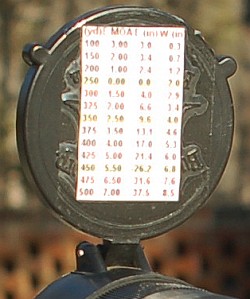 Scope-Cover Mounted Ballistics Table Scope-Cover Mounted Ballistics Table
Another option is to place your ballistics card on the back of the front flip-up scope cover. This set-up is used by Forum member Greg C. (aka “Rem40X”). With your ‘come-up’ table on the flip-up cover you can check your windage and elevation drops easily without having to move out of shooting position.
Greg tells us: “Placing my trajectory table on the front scope cover has worked well for me for a couple of years and thought I’d share. It’s in plain view and not under my armpit. And the table is far enough away that my aging eyes can read it easily. To apply, just use clear tape on the front objective cover.”
July 13th, 2016

With the increased interest in the 6.5 Grendel cartridge and Grendel-based wildcats (such as the 6mmAR and 30 Major), today we’ve re-released a review by Robert Whitley.
Robert Whitley of AR-X Enterprises, LLC builds match-grade uppers for AR-platform rifles. Many of Robert’s favorite chamberings are based on the 6.5 Grendel case necked-down to 6mm. Until 2011, Lapua was the only source for 6.5 Grendel brass. As you’d expect, Lapua’s Grendel brass is truly excellent, but it is also pricey, and sometimes hard to find. Now Hornady is producing USA-made 6.5 Grendel brass. Robert Whitley has worked with the Hornady 6.5 Grendel brass for over a year now and he is able to assess its performance compared to the original Lapua version. Writing in our Shooters’ Forum, Robert reveals: “It’s decent brass but hot loads will loosen the primer pockets fast. With moderate loads you will get good case life and service from the brass and it can deliver excellent accuracy as well. Not Lapua but not bad either.”
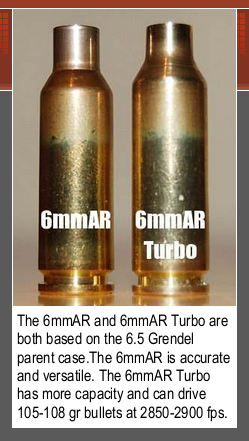 Robert reports: “I was able to get my hands on some of Hornady’s 6.5 Grendel brass. My big question was how it would measure up, particularly the loaded necks, and whether it would be compatible with our existing 6mmAR and Turbo 40 die sets. As it turns out, this brass looks like a perfect fit for our existing die sets (and obviously 6.5 Grendel die sets too). Accordingly, folks with existing die sets will be able to use the Hornady brass without any issues.” However, as the loaded neck on the Hornady brass is .001″ (one-thousandth) slimmer than Lapua brass, you may want to try a smaller bushing when sizing Hornady Grendel brass. Robert reports: “I was able to get my hands on some of Hornady’s 6.5 Grendel brass. My big question was how it would measure up, particularly the loaded necks, and whether it would be compatible with our existing 6mmAR and Turbo 40 die sets. As it turns out, this brass looks like a perfect fit for our existing die sets (and obviously 6.5 Grendel die sets too). Accordingly, folks with existing die sets will be able to use the Hornady brass without any issues.” However, as the loaded neck on the Hornady brass is .001″ (one-thousandth) slimmer than Lapua brass, you may want to try a smaller bushing when sizing Hornady Grendel brass.
The Hornady 6.5 Grendel brass has a LARGE Flash Hole, about .078″ versus .0591″ for Lapua brass. Dimensionally, the biggest difference is the shoulder diameter, with the Hornady brass measuring 0.428″ vs. 0.424″ for the Lapua brass. The Hornady is actually a better fit for 6mmAR chambers which are about 0.432″ at the shoulder. Interestingly, case H20 capacity is virtually identical. Water capacity of new, unfired Hornady 6.5 Grendel brass is 35.1 grains, while new, unfired Lapua Grendel brass holds 35.0 grains of H20. Both brands of Grendel brass increase to about 36.0 grains H20 capacity after firing and full-length sizing.
Here are some of the particulars of the Hornady cases:
| Hornady 6.5 Grendel Brass |
Lapua 6.5 Grendel Brass |
|
Flash hole diameter: ~ .078″
OAL of brass: Average 1.515″
Weight of cases: 111.7 to 113.0 grains
Web diameter, unfired: 0.4375″
Shoulder diameter, unfired: 0.428″
Loaded neck diameter: 0.2895″
6mmAR loaded neck: 0.270″ |
Flash hole diameter: 1.5mm (0.0591″)
OAL of brass: Average 1.515″
Weight of cases: 111.0 to 112.5 grains
Web diameter, unfired: 0.4385″
Shoulder diameter, unfired: 0.424″
Loaded neck diameter: 0.290″
6mmAR loaded neck: 0.271″ |
July 12th, 2016

Can you hunt small varmints with an air rifle? Indeed you can. At reasonably close ranges, a .177 pellet has sufficient “knock-down” power, and the near-silent operation of the air rifle keeps your prey from being alerted. Our friends at Varminter.com recently tested the Anschütz 8002 S2 Black Air Hunter, which features an integral, custom-tuned moderator. Overall, this is a very accurate, very high-tech solution to pesky squirrels (and other small furry pests).
Here’s the report: “We spent a couple of hours out in the field with the Anschutz Black Air Hunter, and took seven ground squirrels that NEVER heard the shot. This rifle is unbelievably quiet, and VERY accurate. I simply put the crosshair on the back of the eyeball, touched the super light trigger, and dropped them in their tracks. Tomorrow, we hunt a small orchard near some farm animals, and I think this rifle will really shine. Tom got some decent video, but we need a bit more out in the field for the full hunt report, so there will be more to come!”
The Anschütz 8002 Black Air Hunter is a PCP (Pre-Charged Pneumatic) air rifle in .177 caliber. This nice rig features a very comfortable, ergonomic stock with adjustable cheekpiece and buttplate. Best of all, the Black Hunter is wicked accurate. Varminter.com reports: “It took [just] three shots to sight-in, and proceeded to shoot bug holes at 25 yards the next 10 rounds.”

Anschutz Black Air Hunter Product Description
The new Anschütz 8002 S2 Black Air Hunter is designed for varmint hunters and target shooters who want an accurate, quiet, versatile, and urban-friendly air rifle. Based on the 8002 S2 match rifle, the Black Air Hunter boasts the excellent balance/ergonomics of a world-class 10 meter match rifle. But the Black Air Hunter has other key features you won’t find on typical competition airguns.
The match barrel is fitted with an advanced moderator made by Tactical Solutions. This non-removable unit is smaller, lighter, and considerably quieter than the counterparts from Europe. Tactical Solutions engineered this moderator to control the sharp crack associated with pre-charged pneumatics. And yes, it works — the Black Air Hunter is VERY QUIET.
As shown here with Leupold scope, the rifle weighs just under 10 pounds:

The fully-adjustable beech stock has a moisture-resistant rubberized coating that provides a secure grip in cold or damp conditions. An aluminum accessory rail under the fore-end allows sling or bi-pod mounting. The cheek piece and butt plate offer a wide range of position options, and can also be upgraded or changed to suit the shooter’s preferences.
The Black Air Hunter runs a .177” caliber pellet at 580 fps, which allows for quiet yet precise training and target shooting in an urban environment. There are more powerful air rifles, but they will be noisier and you may have concerns with down-range energy. With its ultra-low noise signature, the Black Air Hunter is well-suited for use in urban settings.

July 12th, 2016

The Talladega Marksmanship Park boasts Kongsberg electronic targets at 200, 300, and 600 Yards.
The CMP’s Talladega Marksmanship Park — the most impressive (and high-tech) shooting facility in North America, will be featured on this week’s episode of Shooting USA television. The show tours the Talladega facility and spotlights Talladega’s first-ever competition, the inaugural D-Day Memorial match last year. (Talladega recently held its second D-Day match on June 4-5, 2016).
| Shooting USA Television Air Times (Wednesday/Thursday) on the Outdoor Channel: |
Eastern Time: 9:00 PM, 12:30 AM, 3:00 AM (Th)
Central Time: 8:00 PM, 11:30 PM, 2:00 AM (Th) |
Mountain Time: 7:00 PM, 10:30 PM, 1:00 AM (Th)
Pacific Time: 6:00 PM, 9:30 PM, Midnight
| |
John C. Garand Match — Part of D-Day Memorial Event

Talladega is known for NASCAR and its super-speedway, but now there is another destination for sports enthusiasts, thanks to the Civilian Marksmanship Program (CMP). Congress created the CMP in 1903 with an original mission to promote civilian marksmanship, but in its 110-year history, the CMP never had its own range. So, the organization built the CMP Talladega Marksmanship Park, a $20 million sports facility, one of the most advanced shooting sports facilities in the world.


“You won’t find another place like this in the United States, and I think in most of the world,” says Rep. Mike Rogers of Alabama. “You know, I brag on the Talladega 500 all the time, being the fastest NASCAR track, and now I’ll be able to brag about having the best, if not the most world-class marksmanship facilities in the world here in the same neck of the woods.”
|


