At the request of our readers, we provide select “Deals of the Week”. Every Monday morning we offer our Bargain selections. Here are some of the best deals on firearms, hardware, reloading components, and shooting accessories. Be aware that sale prices are subject to change, and once clearance inventory is sold, it’s gone for good. You snooze you lose.
The Leica CRF1000-R is an excellent choice for a hunter. The small Leica fits in a shirt pocket, and is easy to hold with one hand. That lets you range a prize buck quickly. This unit can range line-of-sight targets effectively out to 1,000 yards. In addition the CRF1000-R accounts for angle of inclination/declination, to provide Equivalent Horizontal Range (EHR) from as little as 10 yards out to 600 yards. This makes it ideal for many rifle shots taken in steep, mountainous terrain. The waterproof CRF1000-R features a 24mm optical lens with 7X magnification. Field of view at 1000 yards is 347 feet. Europtic’s $449.00 SALE price is the best we’ve found on this unit.
The LabRadar is the most advanced chronograph on the market. When it was first released, you had to wait months to get one of these Doppler Radar units. Now they are in-stock and ready to ship at Bruno Shooters Supply for $559.95. Once you learn how to position and adjust the LabRadar, you should find the machine reliable and versatile. We do recommend getting a separate battery pack. If you are considering purchasing a LabRadar Chronograph, we strongly suggest you read the very thorough and informative LabRadar Review by Ray Gross, Captain of the USA F-TR team. NOTE: If the LabRadar sells out at Bruno’s, you should be able to get it from MidwayUSA, for the same $559.95 price.
3. CDNN Sports — Savage 64 TR-SR, $239.99
Th Savage 64 TR-SR is great for Rimfire Tactical matches or general rimfire cross-training. The tactical-style wood stock features a vertical grip and a low-angle rear toe that works well in a rear bag. The Savage TR-SR comes complete with a Picatinny-style rail for mounting optics, and the muzzle is threaded 1/2-28 for suppressors. This .22 LR rifle, now just $239.99 on sale at CDNN, works well shooting prone from bipod or rest. With this low price you can afford lots of .22 LR ammo for training.
4. Midsouth — Nikon ProStaff Scopes Starting at $149.95
If you need a good, basic zoom scope for a hunting rifle or general-purpose rifle, this deal is hard to beat. Right now Midsouth has Nikon ProStaff scopes on sale started at just $149.95 for a 3-9x40mm. And there’s free shipping to boot! The ProStaff scopes on sale feature Nikon’s patented BDC reticle and are backed by Nikon’s no-nonsense, lifetime warranty. CLICK HERE to see this offer at Midsouth Shooters Supply.
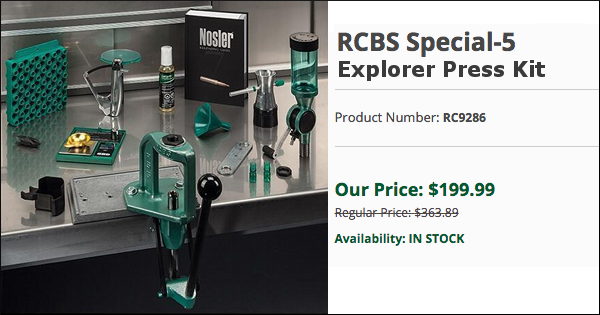
5. Natchez — Special 5 Reloading Press Kit, $199.99
This is an excellent entry-level reloading kit, which is on sale for $199.99 at Natchez Shooters Supplies. We like the relatively compact Special 5 press for most reloading duties. Eventually you may want to add an additional, large heavy press, but this will get the job done. This kit includes an RCBS Powder Measure, Digital Scale, Powder Trickler, Hand Priming Tool, Load Manual, Loading Tray, and more. It’s hard to beat this combination of tools for under $200.00.
6. Amazon — Plano 42″ All-Weather Hard Case, $59.99 Shipped
Here’s a rugged hard case that compares well with a Pelican case, yet is less than half the cost. Plano’s GunGuard All Weather™ 42″ tactical gun case features heavy-duty, dual-stage lockable latches, a user-configurable foam interior, and a watertight/airtight closure with built-in pressure valve. The interior size is 43″ X 13″ X 5″, while the pluckable foam zone is 39.25″ X 10.25″. This is a very tough case that can withstand hard handling. The very attractive $59.99 sale price includes FREE shipping.
7. Grafs.com — MagnetoSpeed Sporter $179.99
If you have been waiting to get a MagnetoSpeed… wait no longer. Priced at just $179.99 at Grafs.com, the MagnetoSpeed Sporter model costs less than half as much as Magnetospeed’s V3 models. This chronograph attaches directly to your barrel so you don’t have to go downrange to position tripods and set up skyscreens. For most people the Sporter Model contains all the features they need. Using MagnetoSpeed’s XFR adapter (sold separately), data can be transferred easily from the display module to your mobile device. READ Magnetospeed Sporter Review.
8. Amazon — RAVPower 22000 mAh Battery Bank, $31.99
This is one of the most powerful, fast-charging USB-type power banks you can buy. Rated at 22000 mAh, it has 50% more “juice” than many units selling for around $35.00. This RAV Power machine charges up quickly and boasts three “intelligent” ports for optimal charging of smartphones, iPads, tablets, and other devices. Your Editor bought this RAVPower 22000 mAh unit to charge his own phone and iPad. It can deliver a total current output of 5.8A (2.4A max per port), allowing it to charge two iPads and one iPhone 6s at optimal charging speeds. This unit can also power a LabRadar Chronograph for a full weekend of shooting (6-7 hours per day). This is a very good deal — the price was just dropped from $39.99 to $31.99 with free shipping on orders over $49.99.
Ever wondered what caused a particular bulge or marking on a case? And more importantly, does the issue make the case unsafe for further use? Sierra Bullets Ballistic Technician Duane Siercks offers some insight into various issues and their causes in this article from the Sierra Blog.
Diagnosing Problems with Cartridge Brass
by Duane Siercks, Sierra Bullets
I was handed a small sample of .223 Rem cases the other day and was asked if I could comment on some marks and appearances that had been noticed as they were sorting through the cases. I will share what was observed and give you what would seem to be a cause for them. These were from an unknown source, so I have no way of knowing what type of firearm they were fired in or if they were factory loaded or reloaded ammunition.
Example ONE: Lake City 5.56, Unknown Year
Case #1 was seen to have a very rounded shoulder and split. Upon first look it was obvious that this round had been a victim of excess pressure. The firearm (perhaps an AR?) was apparently not in full battery, or there was possibly a headspace issue also. While taking a closer look, the primer was very flat and the outside radius of the primer cup had been lost. High pressure! Then I also noticed that there was an ejector mark on the case rim. This is most certainly an incident of excessive pressure. This case is ruined and should be discarded. See photo below.
Example TWO: Lake City Match 1993
Case #2 appears very normal. There was some question about marks seen on the primer. The primer is not overly flattened and is typical for a safe maximum load. There is a small amount of cratering seen here. This can be caused by a couple of situations.
Cratering is often referred to as a sign of excess pressure. With safety in mind, this is probably something that should make one stop and really assess the situation. Being as there are no other signs of pressure seen with this case, I doubt that pressure was unsafe. That leads us to the next possibility. This can also be caused by the firing-pin hole in the bolt-face being a bit larger than the firing-pin, and allowing the primer to flow back into the firing-pin hole causing the crater seen here. This can happen even with less-than-max pressures, in fact it has been noted even at starting loads. Always question whether pressure is involved when you see a crater. In this situation, I lean toward a large firing-pin hole. This case should be safe to reload.
Example THREE: R-P .223 Remington
Case #3 appears normal with one exception. There are two rings seen about one half inch below the base of the shoulder. These rings are around the circumference of the case, one being quite pronounced, and the other being noticeably less.
As we do not know the origin of the firearm in which this case was fired, it does seem apparent that the chamber of the firearm possibly had a slight defect. It could have been that the reamer was damaged during the cutting of this chamber. I would suggest that the chamber did have a couple of grooves that imprinted onto the case upon firing. This firearm, while maybe not dangerous should be looked at by a competent gunsmith. In all likelihood, this case is still safe to use.
Example FOUR: R-P .223 Remington
Case #4 has no signs of excess pressure. There is a bulge in the case just ahead of the case head that some might be alarmed by. This bulge is more than likely caused by this case being fired in a firearm that had a chamber on the maximum side of S.A.A.M.I. specifications. There is actually no real issue with the case. Note that the primer would indicate this load was relatively mild on pressure.
If this case was reloaded and used in the same firearm numerous times there might be a concern about case head separation. If you were going to use this case to load in an AR, be sure to completely full-length re-size to avoid chambering difficulties. This case would be safe to reload.
It is very important to observe and inspect your cases before each reloading. After awhile it becomes second nature to notice the little things. Never get complacent as you become more familiar with the reloading process. If ever in doubt, call Sierra’s Techs at 1-800-223-8799.
If you like 3-Gun shooting, definitely check out this video, a complete 22-minute episode of the Hot Shots TV series. This Hot Shots Season Three episode features three of the greatest action shooters in the world: Max Michel, Jerry Miculek, and Clint Upchurch. This superstar trio demonstrate their skills with a variety of rifles, pistols, and shotguns. You’ll see the latest “full-race” ARs, ultra-high-capacity scatterguns, and high-end pistols.
Click to Watch Full 22-Minute Episode from Hot Shots Season Three:
In this game it’s all about speed on target — matches are decided by fractions of a second. You’ll see Max Michel training with a pistol — and his speed is truly amazing. He gets six shots on target in under 4 seconds including draw. This season-opening episode of Hot Shots finds Max in Arizona tuning up against his fiercest rival, Jerry Miculek and family. You’ll also see competition footage from the West Coast Steel Championship and Clint playing host to a hometown 3-Gun match.
Our good friends Ed and Steve (aka “The 6.5 Guys”) have just released an in-depth product review of the AMP Annealing system. Produced in New Zealand, the AMP (Annealing Made Perfect) unit is a sophisticated, microprocessor-controlled annealing machine that achieves ultra-consistent results through an electrical INDUCTION process.
AMP Annealing Machine Review by the 6.5 Guys:
Ed was so impressed with the AMP annealer that he purchased his own AMP to replace a carousel-type, dual-torch annealer he previously used. Ed tells us that “once you have the correct setting for your brass the AMP’s results are repeatable every time.” By contrast, Ed explained, “with butane torch systems you have to adjust the system when the ambient temperature changes, or even if your butane fuel is slightly different.” Ed says that, with his AMP system, he can anneal a case every few seconds. Yes it does require manually handling each case but “the actual annealing process is so fast, this really isn’t a big issue.”
If you want to extend the useful life of your precious cartridge brass, then you should definitely consider annealing. And if you are in the market for an annealer, the new AMP machine deserves serious consideration. Though not inexpensive, it achieves excellent results according to the 6.5 Guys.
6.5 Guys’ AMP Annealer Review Key Points:
1. The AMP machine provides complete peace of mind that you are annealing properly — there is no guesswork. With a propane machine you have to calibrate dwell times which can be error prone. Even if you don’t change out your cartridge, dwell times will vary with temperature changes as this affects the propane pressure.
2. We noticed that the AMP machine produces brass that is more like factory brass from a hardness standpoint. Despite all our efforts and research around calibrating our propane machines, brass never seemed returned to factory condition and shoulder spring-back would increase with each reloading so we had to adjust our sizing dies. When a cartridge comes out of the AMP it is very, very close to new condition.
3. One of the things we dreaded was setting up our propane machine for different cartridges. With Ed’s OCD he would spend a good 30 minutes making sure everything was perfect. With the AMP machine you simply change out the pilot and select the proper program. It’s really straight-forward.
NOTE: We strongly recommend you read the Full AMP Annealer Review on 65guys.com. It contains a detailed explanation of the machines’ operation and the reviewers explain the pros (and cons) or the machine compared to flame-type annealers.
The current price for the AMP Annealer, with three pilots of your choice, is $995.00 USD. Additional pilots are $20.00 USD. For more info, visit www.AMPAnnealing.com.
Guys — honestly, if you do anything today on this site, watch this video. You won’t be disappointed. Guaranteed. This is a very informative (and surprisingly entertaining) video. Every serious hand-loader should watch this video to see how cartridge cases are made. Your Editor has watched the video 5 times now and I still find it fascinating. The camera work and editing are excellent — there are many close-ups revealing key processes such as annealing and head-stamping.
VERY Informative Video Show Cartridge Brass and Ammunition Production:
Norma has released a fascinating video showing how bullet, brass, and ammunition are produced at the Norma Precision AB factory which first opened in 1902. You can see how cartridges are made starting with brass disks, then formed into shape through a series of processes, including “hitting [the cup] with a 30-ton hammer”. After annealing (shown at 0:08″), samples from every batch of brass are analyzed (at multiple points along the case length) to check metal grain structure and hardness. Before packing, each case is visually inspected by a human being (3:27″ time-mark).
The video also shows how bullets are made from jackets and lead cores. Finally, you can watch the loading machines that fill cases with powder, seat the bullets, and then transport the loaded rounds to the packing system. In his enthusiasm, the reporter/narrator does sometimes confuse the term “bullets” and “rounds” (5:00″), but you can figure out what he means. We definitely recommend watching this video. It’s fascinating to see 110-year-old sorting devices on the assembly line right next to state-of-the art, digitally-controlled production machinery.
Video suggestions by Boyd Allen and EdLongrange. We welcome reader submissions.
We’ve done some bullet casting in the past, both for handgun bullets, and the large, heavy (400gr+) projectiles used with Black Powder Cartridge Rifles. We can say, unequivocally, that newbies should seek out the assistance of a skilled, experienced mentor, who is familiar with the important safety procedures that must be employed. Working with molten lead can be dangerous. And it also takes some skill to get good results (without visible casting flaws), particularly with very large bullets.
That said, there are valuable resources that can help you get started with the casting process. Wolfe Publishing offers two DVDs that cover the bullet casting process from start to finish. Bullet Casting 101 takes you through the basics: showing you how to choose the correct alloy for your application, prep molds, maintain the optimal temperatures, and lube and size bullets. The important steps are laid out clearly. In addition, Bullet Casting 101 helps you select the right equipment and preferred molds for your particular application. (To create uniform rifle bullets that shoot accurately, you really do need high-quality molds.)
Wolfe Publishing offers a companion DVD, Casting Premium Bullets for Handguns, that covers more advanced techniques for high-volume pistol bullet production. This DVD covers both single-cavity molds and multiple-cavity “gang” molds. (Gang molds can be frustrating at first; it is harder to maintain perfect temp control and mold separation is more complex). The DVD also reveals the sources of most common casting flaws, and explains how to detect cracks, voids and other problems.
You’ll save considerable time and effort if you really understand how to avoid common mistakes before you start pouring lead. And you’ll get the best results if you learn how to “blend” the optimal alloy for the job. Maintaining the right mold temperature is also critical for good results. These topics and more are covered in these two DVDs, priced at $16.99 each from Sinclair International.
If you enjoy our stories and would like to get daily News Updates and Tech Tips, go to www.facebook.com/accurateshooter and click the “LIKE” button.
We’ve learned that many first-time visitors to AccurateShooter.com may come in via a link to the Daily Bulletin rather than through our home page. As a result, they may not be aware that there is a wealth of other content available to our readers. Our Shooters’ Forum, with nearly 33,000 registered members, is one of the best places on the web to discuss precision shooting and advanced reloading. We also offer FREE Forum Classifieds. On the editorial side, AccurateShooter.com offers hundreds of pages of content, with thousands of photos. Our Cartridge Guides are definitive one-stop resources for popular match calibers, while our Guns of the Week articles spotlight outstanding custom rifles, most with competition pedigrees. In addition, we offer videos, gear reviews, book reviews, gunsmithing tips, and even FREE downloadable targets.
If you’re a new visitor to AccurateShooter.com, you should check out all that we have to offer. There are hundreds of informative articles to read … and they’re all FREE.
The new 15th Edition of Cartridges of the World is slated for release on October 24th, 2016, but you can pre-order now via Amazon.com. This massive 680-page reference contains illustrations and basic load data for over 1500 cartridges. If you load for a wide variety of cartridges, or are a cartridge collector, this book is a “must-have” resource. The latest edition (release date 10/24/2016) includes 50 new cartridges and boasts 1500+ photos. This important reference guide can be pre-ordered now through Amazon.com for $21.20. Order now and you’ll get the new 15th Edition hot off the press.
Cartridges of the World, the most widely-read cartridge reference book, has been totally updated, with a newly expanded, full-color 64-page color section featuring essays from some of today’s most prominent gun writers. The 15th Edition of Cartridges of the World includes updated cartridge specs, plus essays by leading writers on the topics of SAAMI guidelines, wildcatting, and new cartridge design trends. In scope and level of detail, Cartridges of the World is the most complete cartridge reference guide in print.
Cartridges of the World by author Frank C. Barnes was first published in 1965. The 15th Edition is edited by W. Todd Woodard, Editor of Gun Tests magazine and author of several firearms reference books. Frank Barnes (1918-1992) began collecting information on handgun cartridges at the early age of 12, thanks to his father, a police officer. Frank Barnes was an innovative cartridge designer, who invented the original 308 x 1.5″ Barnes, predecessor of the 30BR case.
Before Frank began a law enforcement career, he was a college professor. Frank was also a pilot, and a race-car driver. Learn more about Cartridges of the World (15th Ed.) at www.gundigest.com.




 Norma has released a fascinating video showing how bullet, brass, and ammunition are produced at the

 Wolfe Publishing offers a companion DVD,


