Creedmoor Sports has released a series of helpful “how-to” videos in its new InfoZone web page. In the latest InfoZone video Bill Gravatt shows how to seat bullets using L.E. Wilson Hand Dies and an Arbor Press. The basic process is simple, particularly with a micrometer-top seating die. That makes it easy to adjust and set seating depth. Before you start seating bullets, you want to adjust the height of the arbor so the stroke is appropriate to the height of your die.
Bill Gravatt Shows How to Use Hand Seating Dies — Creedmoor INFOZONE
ARBOR PRESS TECHNIQUE: When using an arbor press, smooth is good. You don’t want to slam the handle down quickly. Try to repeat the same motion each time. You can also experiment by seating the bullet part way, then rotate the cartridge (in the die) and do the final seating with a second stroke. If your arbor press has a force gauge, note both the max value of the gauge needle and how it moves as you seat the bullet. If the needle spikes too rapidly, or bounces back and forth irregularly, set that cartridge aside and/or mark it. You could have neck tension issue with that case or some other fault. You might even have a bad bullet. That’s rare, but can happen. The key to success is moving the press arm in a smooth motion every time, maintaining the same down-pressure with each cartridge.
Here Bill Gravatt Offers a Simple Tip for Adjusting Wilson Seating Dies
One of our Forum readers asked “How can I get a custom in-line seater for my new rifle?”. First, we would say that, if you are not shooting an unusual Wildcat, check first to see if L.E. Wilson makes a stainless Micrometer Seater Die for your rifle. These dies are a joy to use, and we’ve found the fit to be exceptionally good with many calibers. Typically priced from $90-$100, Wilson stainless micrometer-top seaters are available for dozens of cartridge types: .204 Ruger, 20 BR, .222 Rem, .223 Rem, 22 PPC, 22 BR, .22-250, .223 WSSM, 6 PPC, 6mmBR, 6XC, 243 Win, .243 WSSM, 25 WSSM, 6.5×47 Lapua, 6.5 Creedmoor, 6.5-284, 26 Nosler, .270 WSM, 7mm-08, .284 Win, 28 Nosler, 7mm RUM, 30 BR, 30 IHMSA, .308 Win, .300 WinMag, .338 Edge (and MORE).
If you do want a custom seater die, the process is relatively simple. Purchase a die blank from Wilson and have your gunsmith run the chambering reamer in. Forum member Gunamonth explains: “I start with a Wilson seating die blank. They’re available from Sinclair and other vendors. Just run the reamer in. For some of my rifles, where I wanted the stainless die with the micrometer adjustment, I bought a smaller die and had the smith ream it with the chamber reamer. That’s how I had my 6 Dasher and 6mm AI seaters made. With the Dasher I stared with a 6mmBR Micrometer die.”
SEATER STEM TIP: If, on your seated bullets, you are seeing a sharp line around the jacket near the ogive, you may want to smooth out the leading edge of the Wilson seater stem (see above left). Do this by putting a little lapping compound on one bullet and manually spin this around in the stem. Without much effort you’ll have a smooth bullet/stem interface.
Micrometer Top Add-on
We really like micrometer tops on a seating die. But what if Wilson doesn’t make a micrometer top seater for your chambering? Don’t despair, Sinclair Int’l sells a $39.99 micrometer top that can be added to Wilson standard seaters or to a custom seater die made from a Wilson die blank.
The F-Class World Championships (FCWC) in Canada are just one week away. This August 11-17, the world’s top F-Class shooters will gather at the Connaught Ranges outside Ottawa, Ontario. The vast majority of F-Open shooters will be running some kind of 7mm (.284 Caliber) cartridge, with the .284 Winchester, .284 Win Improveds, and 7mm RSAUMs being popular.
For those of you who plan to compete but who haven’t loaded your ammo yet, you may want to consider a very good 7mm match bullet from Sierra, 183 grain MatchKing (item #1983). We have found the 183gr MK, which comes “pointed” from the factory, to be very consistent in weight and base-to ogive measurement. Top F-Open shooters have told us that these bullets shoot exceptionally well, with minimal vertical dispersion at 1000. “Holding waterline” at long range is a reliable indicator that the BC is very uniform from bullet to bullet.
Sierra’s popular 7mm 183 grain MatchKing boasts an impressive 0.707 G1 Ballistic Coefficient (BC) at 2300+ fps. These bullets also have very consistent bullet-to-bullet BC, thanks to very uniform jackets and the tips being “pointed” at the factory. Sierra explains: “A final meplat-reducing operation (pointing) provides an increased ballistic coefficient for optimal wind resistance and velocity retention.”
Insight Into Sierra’s New 7mm MatchKing® by Sierra Product Development Manager Mark Walker
In late 2015, Sierra introduced a new 7mm MatchKing® bullet with a different type of ogive. As part of the introduction, I had the opportunity to use them at the F-Class Nationals held in Phoenix with very good results. While at the match, several people had questions about what exactly was different about the ogive on this bullet as opposed to our tried and true blended tangent ogive. So with that in mind, hopefully this blog will answer those questions.
In the past, Sierra has typically used a tangent radius ogive design on our MatchKing® bullets. This is one of the most forgiving ogive designs due to its ability to shoot extremely accurately when jumped, as well as, jammed into the rifling. On rare occasions, some of our MatchKing® bullets have used a secant ogive due to design constraints. However, this ogive is much more sensitive to changes in seating depth than the tangent ogive so we tend to shy away from it. When we decided to work on this new bullet, we wanted to see if we could improve on the accuracy of even our best shooting tangent ogive bullets.
One of the main factors of what makes an accurate shooting bullet is how it aligns itself with the bore when fired. If a bullet is slightly crooked when entering the bore, it will cause inaccuracy on the target. We set out trying to think of ways to make sure that the bullet has no choice but to align itself with the bore perfectly.
The first part of the barrel to encounter the bullet is the leade in the chamber. The leade is an angle that is cut into the leading edge of the rifling which helps to guide the bullet into the bore. To illustrate how current bullets fit into the leade, picture a cone (leade) with a ball (bullet) sitting inside it. The ball can be rotated in all directions and the cone cannot force the ball to orientate itself in any particular direction. When a bullet with a radius encounters the leade, it behaves in a similar way. Now this of course is a very simple example and of course advanced shooters use tight necks and brass that is perfectly formed to the chamber to make sure the bullet is aligned as perfect as possible. However, there is always a small element of misalignment that is possible even with all this precise preparation.
This brings us to the ogive on the new 7mm MatchKing®. We thought instead of using the typical ogive radius that can allow slight misalignment, why not use the same straight angle that is used in the chamber leade on the bullet ogive to force itself to always align with the bore? Imagine the same cone as above (leade) with an identical cone (bullet) sitting inside of it. The cone inside has no choice but to align itself perfectly with the cone that it is sitting in every time. With that in mind, we designed the area of the bullet which contacts the leade in front of the bearing surface using a straight 1 1/2 degree angle instead of the typical radius. Once past that area, we use a traditional high caliber ogive radius to provide a very sleek, high BC bullet.
I hope that explains our thought process behind this new bullet. In our testing, it is one of the most forgiving high-BC bullets we have ever made.
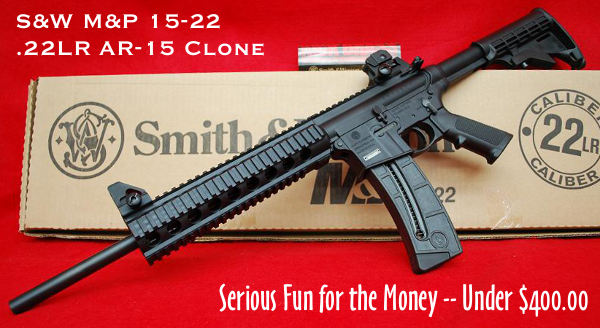
For affordable, low-recoil shooting fun it’s hard to beat a semi-auto .22 LR. While Ruger’s 10/22 is the most popular semi-auto .22 LR rifle, manufacturers are now offering AR-style self-loading rimfire rifles. We like AR-style .22LR rigs for Rimfire Tactical Matches and 3-Gun cross-training. With an AR-style rimfire rifle you can train with low-cost ammunition while enjoying the same ergonomics, controls, and sighting systems found on your centerfire ARs.
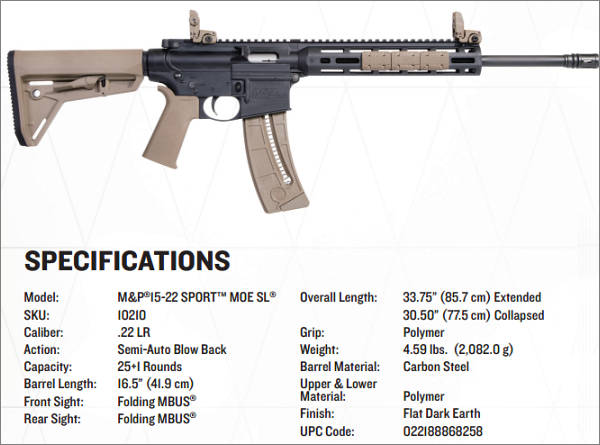
Smith & Wesson has upgraded its M&P 15-22, a fun rifle that we’ve praised in the past. The new M&P 15-22 Sport MOE SL model (Magpul Original Equipment Slim Line) features a more comfortable handguard, an improved grip, and an adjustable Magpul buttstock. The dedicated .22 LR M&P rifle retains the look and features of the company’s popular M&P rifle line, with the enhanced ergonomics of Magpul furniture. It’s offered with Flat Dark Earth (tan) furniture or dressed in matte black.
These rimfire versions of the AR-15 are excellent training tools for 3-Gun and service rifle shooters. You can practice with less expensive rimfire ammo, and save wear and tear on your centerfire ARs. Rimfire AR clones also work great for Rimfire Tactical Matches.
Field Testing the Smith & Wesson M&P 15-22
Smith & Wesson’s 15-22 is a nice little rifle. The M&P 15-22 is designed and built as a true .22 LR semi-auto from the ground up, with ergonomics (and most controls) identical to a centerfire M&P 15 rifle. NRA reviewer Colon Noir tested the M&P 15-22 and was impressed: “This gun is unbelievably fun to shoot. There is virtually no recoil. The non-existent recoil makes shooting fast a breeze. Yeah, the magazine is a little quirky… but in the grand scheme of things, this gun feels like a full-out AR-15. The M&P 15-22 makes for a great training companion. I would place this gun in the ‘Fun Box’ — it’s reliable enough that you can have a fun time shooting. I’m picking one up, because it’s guns like these that make you truly realize how fun shooting is.”
Here’s a Video Review of the M&P 15-22 by the NRA’s Colin Noir
The Kahles 10-50x56mm MOAK Long Range Riflescope By James Mock
The Kahles company of Austria is very old — dating back to 1898. With its long history, Kahles (two syllables, pronounced “Kah – less”) claims to be the oldest rifle scope manufacturer in the world.
What are the features of this scope that endear it to the discriminating long range shooter? First, it offers serious magnification — a true 10X-50X. It has a rather unique, centrally-mounted parallax adjustment control integrated with the elevation turret (i.e. they share the same axis). Included with the scope is a large ring which can be attached to the parallax control to facilitate adjustments without removing one’s head from the stock. Another unique feature is a small red and white pin that indicates how many revolutions one has made. If one red band shows, the scope is in the first revolution; with a one red and one white band, it is in the second revolution, and so on.
This scope has a 56mm lens, fast-focus eyepiece, and 1/8th MOA adjustments. This is an expensive scope ($2799.00 at Brownells), but there are no short cuts in its construction. The lenses have a proprietary “AMV” multi-layer coating that’s claimed to transmit almost 100% of the light. Also, there is an oil-phobic coating to resist scratches and contaminates such as oil or dirt from sticking to the lens. The scope is nitrogen-filled and features hardened steel mechanisms for adjustments.
Kahles 10-50x56mm Specifications:
Magnification: 10X to 50X
Objective lens: 56mm
Reticle: Second Focal Plane with MOA subtensions at 40X power
Tube diameter: 30mm, Nitrogen filled
Length: 16.9 inches
Weight: 31.4 ounces
Click Value: 1/8 MOA with 20 MOA per revolution
Range of adjustments: 5.3 ft. elevation/ 3.6 ft. windage @ 100 meters
Field of view at 100m: 8.7 feet @10X and 3.6 feet @ 50X
Parallax Control: Parallax ring is centrally mounted on same axis as elevation knob.
Parallax Range: 8m to infinity
Eye relief: 3.74 inches
I first got to test the Kahles in competition at a 300-yard match. The scope performed flawlessly with spot-on, positive adjustments. The central-mounted parallax ring worked perfectly, giving me parallax-free viewing with the ring set on 300. The quick focus ocular adjustment also brought the image into sharp focus. We had some mirage today, but I had no problem seeing bullet holes with the scope set at 40x. The MOA reticle served me well by allowing me to know how many 1/8 MOA clicks to adjust from the sighter target. I shot my Bartlein 1:13.5″-twist 6mm PPC barrel with N133 and Bart’s 65gr Super Man BT bullets. I shot 296-4X out of 300 possible. The 65gr BT seems to be at its maximum range and I was edged out by an excellent 297/?x by a 6mm Dasher. The scope certainly did its part, but I didn’t.
Shooting the Kahles 10-50X at 200 yards before 300-yard match. The quality of this scope makes zeroing it a pleasure. The clicks are positive and audible.
Kahles Performs Superbly Shooting the Square
With every new scope that I test, I shoot the “square” (a box test). This target below above has ½ inch squares and my aim point was the small square in the lower right quadrant. I shot two shots at it then moved the windage knob 5 MOA left and fired one. I then moved 5 up and fired again; moved 5 right and fired; followed by my final shot after clicking 5 MOA down. This last shot went through the hole made by the original two shots! That’s amazing. These were shot at 100m without wind flags.
Shooting with the Kahles in 600-Yard Competition
On the 3rd Saturday of the month, we shoot a 600-yard match consisting of four, 5-shot targets on the IBS target. The 600-yard match demands a scope that is very reliable and “spot on” in its adjustments. Since I don’t have a 600-yard range on which to zero, I simply zero at 100 yards and click up 11 MOA. At our matches we shoot steel gongs for sighting in. There is NO sight-in period before the match — all competitors are expected to be “on target” upon arrival. I had to put my faith in the Kahles click values.
Our 600-yard match was my first opportunity to use the Kahles at that distance. I shot the scope set at 40X all day. The crisp adjustments allowed me to get on target quickly and in the first match, I shot a respectable 48/50 with 1X. NOTE: for this 600-yard match I replaced my 6 PPC barrel with an 8-twist 6mm Dasher. I use 32.8 grains of Varget pushing a Bart Sauter 105gr rebated boat tail bullet.
Testing with Hood Scope Checker
Many shooters’ primary concern with scopes used for competitive shooting is their ability to hold point of aim (POA). To test the Kahles, I mounted it on the Hood Scope Checker alongside my 36X Valdada. By aiming both scopes at a given point on the paper and firing several shots, one can determine if either of the scopes’ POA is moving. I don’t have a “frozen” scope to use, but the Valdada has been rock solid for me during many competitions over the last eight years. Pictured below is the setup that I used to test the scopes.
It is a pleasure to test a scope of this quality. Everything works as advertised and there are no unpleasant surprises. Many premium scopes fail the POA test outlined above. If a scope holds point of aim, has repeatable crisp adjustments, and sharp clear images, what more could a person ask?
Summary: A Quality Optic with Great Performance
Although I am still evaluating this scope, there are some definite conclusions that I have reached. This scope is for the person who will not compromise his demands for quality, regardless of price. This is not the most expensive large scope on the market at $2799.00, but it represents an extremely high-quality product for those willing to pay a premium for a premium product.
Are there things that I do not like about this scope? Yes, the primary one is the weight (31.4 ounces). This is not a problem for those shooting long range with 17- or 22-pound limits, but the weight is a consideration for those shooting short range benchrest varmint classes (10.5 or 13.5 pounds). Also, I would appreciate screw-on lens caps rather that the large bulky cover. I know that both of these are minor things and do not reflect the quality of the instrument.
If I had to offer any type of critique, it would be for a lower price and lighter weight. I cannot fault the price or weight too much however because quality costs and the scope has large objective lens and a sturdy tube. All in all, I can recommend this scope without reservation to all who want the best and have the ability to pay for same. — James Mock
Here’s a helpful, time-saving tool for handgun owners. MidwayUSA’s new online Holster Finder lets you quickly find the right holsters for popular makes and models of pistols and revolvers. The wide variety of carry styles, materials, and features can make finding the right holster difficult or confusing. Drawing on a database of over 125,000 gun/holster combinations, the MidwayUSA Holster Finder turns that complex task into an easy three-step process.
The selection process is simple: 1. Choose Pistol or Revolver; 2. Select Make and Model of Handgun (and barrel type/length); 3. Click to view results. Just choose your gun type, select your make, model and barrel, then view the results. All major holster types are included: Ankle, Belly Band, Belt (outside waistband), Chest, Competition, Drop Leg, Inside Waistband (IWB), Paddle, Pocket, and Shoulder. Test the MidwayUSA Holster Finder by visiting www.MidwayUSA.com/holster-finder.
Jeff Larkin, Vice President of Marketing. “Our team built the Holster Finder so our Customers could find all holsters we offer for their specific firearm without sorting through thousands of search results. Finding the perfect holster is now easier than ever — just a few clicks, and we’ll show you everything that fits!”
Non-member price is $1499.99. The “Members price” is $1349.00. Using CODE SK1772 at checkout knocks the final price to $1249.00 (plus tax and shipping).
Here’s a super deal if you need a high-quality, high-magnification zoom scope for F-Class and long-range target shooting. Right now, the Vortex Optics Golden Eagle 15-60x52mm ECR-1 is on sale at Sportsmans Guide for $1249.99 (member price) with Coupon Code SK1772. That Code gives you a “double discount”. However, it will cost you $39.99/year to join the Buyer’s Club to get member pricing. You can cancel Buyer’s Club membership anytime.
IMPORTANT: The $1249.99 Price is for BUYER’s CLUB only. And you MUST use CODE SK1772!
Still a deal if you’re not yet a member? You bet. This same scope sells elsewhere for around $1500.00. For example the price today, 8/1/2017, at Amazon.com is $1499.00 (see below). If you figure you’ll pay at least $1490.00 elsewhere for this scope and you net out the $39.99 membership cost, we calculate you’ll still save $200.00+ by taking advantage of this deal.
Here is the price on Amazon.com on August 1, 2017:
The Golden Eagle has earned good reviews from our Forum members. This scope features 60X max magnification, sharp lenses, low-dispersion glass, 1/8-MOA clicks, and a reticle that features MOA-based hold-offs and hold-overs subtensions are MOA-based at 40X magnification:
The latest Crime Prevention Research Center (CPRC) study on concealed handgun permits reveals that over 16.3 million Americans now have them, and that the ranks of permit holders are becoming more diverse, with more women and minorities getting permits than ever before. The major findings of the 2017 CPRC report are summarized below. A copy of the report is available for download here.
There are now over 16.3 million gun permit holders, a record 1.83 million increase in permits since July 2016. Nationwide, 6.53% of adults have a concealed handgun permit. That’s roughly one in 15 adult citizens. Outside of California and New York, 8% of adults have a permit. The permit issuance numbers for women, Blacks, and Asians are increasing at faster rate than for men and Caucasions.
More guns, less crime — that’s the conclusion of the latest report from the Crime Prevention Research Center (CPRC). The CPRC Concealed Carry Report attributes some of the drop in crime rates to the fact that more Americans than ever before are carrying handguns for protection. In the past eight years, the number of concealed handgun permits has soared, growing from 4.6 million in 2007 to over 16.3 million this year. Overall, 6.53% of the U.S. adult population, i.e roughly one in fifteen American adults, now has a concealed carry permit.
Here are some interesting findings in the 2017 CPRC Report:
6.53% of the total adult U.S. population has a weapons carry permit.
Last year, the number of permit holders grew by a record 1.83 million. This is more than the previous record increase of 1.73 million, set just the year before.
In 11 states, more than 10% of adults have permits. Alabama has the highest rate — 20%. Indiana is second with 15.8%.
In 14 states, a permit is no longer required to carry in all or virtually all of the state. This is a major reason why legal carrying handguns is growing so much faster than the number of permits.
In 2016, women made up 36% of permit holders in the 14 states that provide data by gender. Eight states had data from 2012 to 2016 and they saw a 326% faster increase in permits among women than among men.
From 2012 to 2016, in the five states that provide data by race over that time period, the number of black people with permits increased 30% faster than the number of whites with permits. Asians appear to be the group that has experienced the largest increase in permitted concealed carry.
Regression estimates show a significant association between increased permit ownership and drops in murder and violent crime rates. Each one percentage point increase in rates of permit-holding is associated with a roughly 2.5 percent drop in the murder rate.
States with the largest increase in permits have seen the largest relative drops in murder rates.
Carry Permit Holders are Law-Abiding
Interestingly, Concealed handgun permit holders are extremely law-abiding. In Florida and Texas, permit holders are convicted of misdemeanors and felonies at one-sixth of the rate at which police officers are convicted. From 2014 data, police officers commit crimes at rate of 103 per 100,000 (national average) compared to 12.8 per 100,000 for permit holders in Florida and 22.8 per 100,000 for permit holders in Texas.
Even with high-quality brass from Lapua, Norma, and RWS, occasionally you may find one or two cases per box which have a small flake or obstruction in the flash-hole. This will appear like a thin crescent on one side of the flash hole (see photo). You should inspect ALL new brass before loading to identify any pieces with a partially-obstructed flash hole. It’s a good idea to remove any flake or thin crescent left as an artifact of the flash-hole forming process. Because the flash-hole itself is normally centered and of the correct diameter, it is not necessary to ream the flash-hole to a larger diameter. All you really need to do is remove the small obstruction(s). This can be done quickly with inexpensive tools.
Use a Small Pin Vise to Remove Flash-Hole Obstructions
Folks have asked if there is a tool that can remove obstructions from a Lapua small, BR-sized flash hole without opening the hole size. The Lapua PPC/BR flash hole is spec’d at 1.5mm, which works out to 0.059055″. Most of the PPC/BR flash-hole uniforming tools on the market use a 1/16″ bit which is nominally 0.0625″, but these often run oversize — up to 0.066″.
If you want to just clear out any obstructions in the flash hole, without increasing the flash hole diameter, you can use an inexpensive “pin vise” with an appropriate drill bit. For $0.99, eHobbyTools.com sells a 1.5mm drill bit, item 79186, that matches the Lapua flash hole exactly. Other vendors offer a #53 pin vise drill bit that measures .0595″ or .060″ (depending or source). An 0.0595″ bit is close enough. You can find pin vises and these small-diameter drill bits at hobby stores.
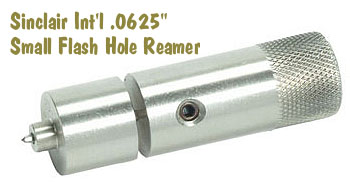
For quite some time, Sinclair Int’l has sold a similar device for small (PPC and BR-size) flash holes. Like the 07-3081 unit for large flash holes, the 073000 Reamer for small flash holes works from the outside, so it can index off the primer pocket. It reams to .0625″, and also costs $39.99. The standard dimension for Lapua 220 Russian and 6mmBR flash holes is 1.5mm or .0590″. This tool will permit standard-size decapping rods with .0625″ tips to work without binding. However, note that both Forster and Redding normally supply .057″ decapping pins with their PPC and BR dies. So, it is NOT necessary to ream your Lapua BR/PPC flashholes, unless you prefer to do so for uniformity. It IS, however, a good idea to check BR/PPC flash holes for burrs before loading the first time.
NOTE: If you purchase either the 073081 or 073000 Sinclair Flash Hole Reamer tools, we recommend you mic the cutter tip before you process a bunch of cases. Sometimes a tip comes through that is oversize. This will ream the flash holes larger than you may intend.


 One of our Forum readers asked “How can I get a custom in-line seater for my new rifle?”. First, we would say that, if you are not shooting an unusual Wildcat, check first to see if L.E. Wilson makes a stainless Micrometer Seater Die for your rifle. These dies are a joy to use, and we’ve found the fit to be exceptionally good with many calibers. Typically priced from $90-$100, Wilson stainless micrometer-top seaters are available for dozens of cartridge types: .204 Ruger, 20 BR, .222 Rem, .223 Rem, 22 PPC, 22 BR, .22-250, .223 WSSM, 6 PPC, 6mmBR, 6XC, 243 Win, .243 WSSM, 25 WSSM, 6.5×47 Lapua, 6.5 Creedmoor, 6.5-284, 26 Nosler, .270 WSM, 7mm-08, .284 Win, 28 Nosler, 7mm RUM, 30 BR, 30 IHMSA, .308 Win, .300 WinMag, .338 Edge (and MORE).