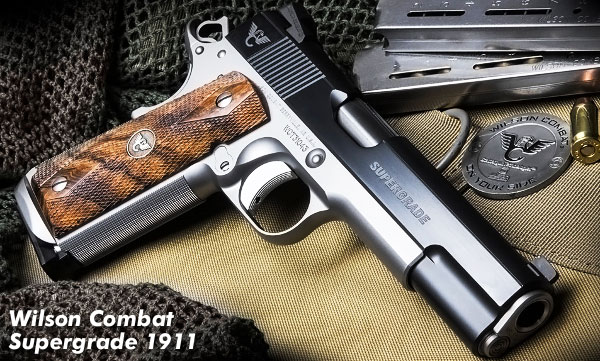
Do you shoot a .45 ACP? We love this short, fat cartridge because it is inherently accurate, it makes big, easy-to-see holes in paper, and because it it works so well in the classic 1911 series of pistols. It is hard to beat a good, tuned model 1911 when it comes to trigger pull/reset and natural pointing ability.
Once you get the hang of it, 1911-type pistols are also easy to field strip for cleaning. Here is a video showing how to disassemble and reassemble your model 1911:
Model 1911 Field Stripping and Reassembly
.45 ACP Ammunition Loading Guide
If you “roll your own” .45 ACP cartridges, there are many good powder choices. Our favorites are Vihtavuori N320, AA No. 5, and Hodgdon TiteGroup, but there are many other good choices. You’ll find these three recommended powders (plus seven others) in this .45 ACP Reloading Guide from Nosler:
The latest issue of Shooting USA magazine has a detailed EIGHT-page feature on the Kestrel wind meter. This story covers the development of the Kestrel and explains the advanced technologies now offered with the hand-held Kestrel systems.
The eZine version of Shooting Sports USA (SSUSA) is available for free online. In the latest December 2017 issue you’ll find two excellent articles of interest to all serious rifle shooters. One covers the development of the Kestrel weather meter, which has evolved to serious levels of sophistication. Now premium Kestrels include built-in ballistic calculators and they can “talk” with mobile devices, sharing command functions and data. The second article covers shooting skills. In the first of a three-part series, Glen Zediker talks about NRA High Power rifle competition. Glen spotlights the skills you must master to move from the beginning level, Marksman, to higher levels.
Kestrel Technology Today
The December SSUSA issue features the origin of ballistics-enabled Kestrel weather meters. SSUSA’s Editor John Parker covers the history of the Kestrel, and explains how more and more features were packed into the handheld device as it evolved. Today’s Kestrel is so much more than an impeller with wind speed/direction read-outs.
The impressive Kestrel 5700 Elite with Applied Ballistics software is the latest model of a product that revolutionized long-range shooting by combining ballistic computer and weather meter in one portable device. Shooters can select either G1 or G7 ballistic coefficients, or to be even more specific they can select bullets from the Applied Ballistics custom curves library. With the Kestrel and its software, shooters can plot very precise trajectories, even to extreme long ranges.
Marksman to High Master
High Power Rifle competition originally evolved from the U.S. military course of fire. Climbing the classification ranks in NRA High Power Rifle can be daunting — it requires focus, practice and commitment to move up the ladder from Marksman all the way to High Master.
In Glen Zediker’s three-part series, “Climbing the High Power Ladder”, Glen shares his tips for competitors that are looking to improve their skills beyond the intermediate level. The first installment focuses on stepping past Marksman classification to Sharpshooter. Read PART ONE HERE. In the months ahead, look for parts Two and Three in future SSUSA issues. These will cover the next stages in the climb: Expert, Master, High Master.
DVD Resource for High Power Training
If you’re serious about improving your High Power skill set, we suggest you view a DVD by David Tubb, 11-time National High Power Champion. David’s instructional DVD, “The Art & Technique of the Modern Match Rifle”, is a great resource for any High Power or position shooter. This 2-disc DVD provides over 4.5 hours of instruction and shooting demonstrations. We can confirm that this video is packed with great information — novice High Power and prone shooters who apply David’s methods should definitely improve their scores.
David has included highlights from that DVD in a shorter promo video. While the shorter video is a sales tool, it’s very informative in its own right. Watch the video and you’ll learn a great deal just by watching how David shoulders his rifle, and how he adjusts and maintains his shooting position. David shows examples of prone, sitting, and standing positions. In the short “trailer”, David also provides helpful tips on adjusting sights, and placing the spotting scope.
If you shoot Service Rifle, High Power, or prone, you can benefit from watching this short sampler video. The full 2-disc DVD is available for $49.95 from Creedmoor Sports. With over 4.5 hours of content, the DVD covers all the across-the-course positions, the set-up and use of aperture sights and diopters, High Power and long range targets, the approach method in offhand, proper placement and use of spotting scopes. The DVD includes bonus footage of David shooting strings in all of the across-the-course positions.
What do you get for the shooter “who has everything”? How about a custom-crafted, laser-engraved ammo display case. Technoframes produces a series of ultra-sleek Ammo display units, and high-tech pistol racks. The CNC-machined display boxes, fitted to your choice of cartridge, look great. There are many varieties to choose from, including wood, metal, and Plexiglas. We like the fact that many of the boxes are lockable.
Technoframes’ impressive billet-aluminum pistol racks, with magazine-style gun holders (fitted with Neodymium magnets in their bases) put ordinary plastic or wire-framed racks to shame.
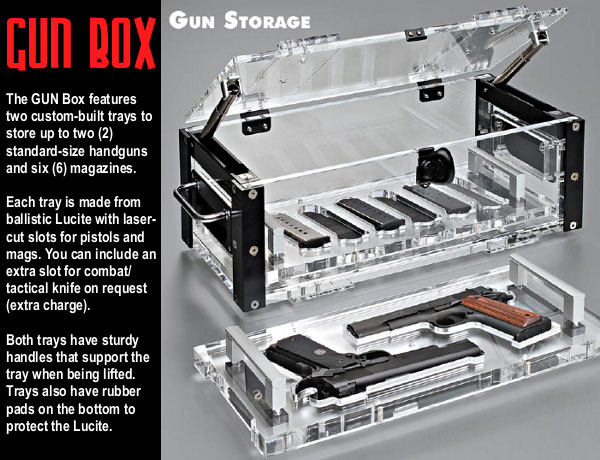
Last but not least, Technoframes also makes a plexiglas-sided gun transport box and a double-tiered, two-pistol/six-magazine gun display box with removable inner tray. These units look like they were produced by “M” for James Bond.
Technoframes is the world’s leading producer of high-end CNC-machined ammo and handgun storage solutions. Along with display cases, Technoframes offers Snap Caps and historical replica ammunition. For more info, visit Technoframes.com.
There are tough times ahead for Remington. Fox News reports that: “Privately-held Remington Outdoor is now at risk of declaring bankruptcy after a collapse in sales and profits. Saddled with debt, the historic gun manufacturer is short on avenues for escape.” (LINK). Fox News adds:
“The rifle and shotgun manufacturer’s third-quarter sales plunged 41% as demand for firearms dried up. That led Remington to report adjusted earnings before interest, taxes, depreciation, and amortization that were 78% lower year over year. Over the first nine months of 2017, the company has produced a $60.5 million net loss, compared to a $19.1 million gain in the prior-year period.
And with its credit rating in the trash bin, the future is bleak for ‘America’s oldest gunmaker’. Today, debt on the company’s books has ballooned to almost $1 billion[.]”
Financial analysts report that Remington’s earnings decline will further harm the company’s already poor corporate credit rating. That means Remington must pay even higher interest rates to borrow money, further bleeding cash and decreasing profitability. This, in turn, accelerates the momentum towards filing bankruptcy. Fox explains: “With the firearms and ammunition manufacturer burning through cash as a result of falling sales, S&P expects it will undertake a restructuring within the next year.”
Other large American gun industry companies have seen their stock value drop dramatically this year. Vista Outdoor (Savage, RCBS, CCI etc.) is down 62% since December 9, 2016, while American Outdoor Brands (Smith & Wesson) has dropped 36%.
Remington Has a Storied History
Founded in 1816, Remington is the oldest continuously-operating gun manufacturer in the United States, and remains one of the USA’s oldest commercial enterprises. Even with its present difficulties, Remington still sells more sporting rifles and shotguns than any other American company. Remington has developed more cartridges than any other U.S. company. And it is the only American company that sells firearms AND ammunition under its own name.
The Remington enterprise was founded in 1816 by Eliphalet Remington in Ilion, New York, as E. Remington and Sons. In 2016 Remington celebrated 200 years of history. American Rifleman TV explored the history of Remington Arms Company in a TV special which focuses on many of the company’s most noted firearms. Here is a preview:
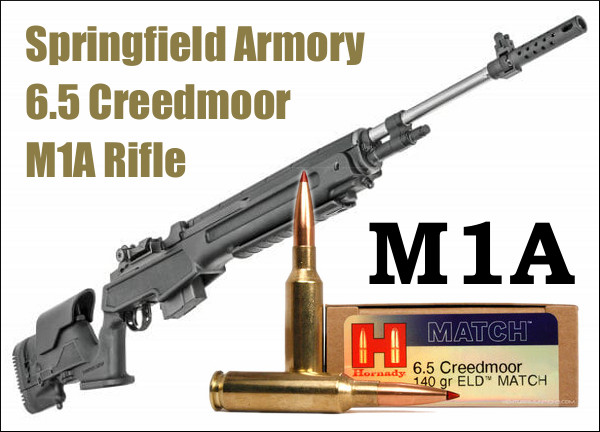
The 6.5 Creedmoor craze goes one step further. Soon you can buy a Springfield M1A chambered for this mid-sized cartridge popularized by PRS shooters. Both bolt-action and AR-platform rifles chambered for the 6.5 Creedmoor have been available for quite some time, but this is a new direction for the M1A, which has traditionally been chambered for the 7.62×51 NATO/.308 Winchester round. As chambered for the 6.5 Creedmoor, Springfield’s M1A should be easier on shooters’ shoulders. The 6.5 Creedmoor M1A has 28% less recoil than the .308 Winchester version.*
The new 6.5 Creedmoor M1A features a 22″ medium-contour, 1:8″-twist stainless barrel with factory muzzle brake. The rifle comes with iron sights: .062 post front sight and .0520 aperture rear sight adjustable for ½ MOA windage and 1 MOA elevation. Springfield ships the rifle with a 2-stage trigger tuned to 4.5 – 5 pounds. A Springfield Armory Optics mount is available to fit a magnified optic, but, to be honest, we haven’t been very impressed with that mount.
Two stock options are offered: a basic black polymer stock (not recommended — it’s weak and flexy) or a deluxe “precision” stock with adjustable cheekpiece and adjustable LOP. The deluxe precision stock, shown above, is much more rigid, and can be configured with front underside Picatinny rail (see video). Rifle Specs HERE.
With the basic polymer stock, the 6.5 Creedmoor weighs 11.4 pounds (unloaded) and has a $1985.00 MSRP. With the adjustable precision stock, the gun is a bit heavier and retails for $2045.00 in either matte black or Flat Dark Earth (FDE).
“Having a 6.5 Creedmoor caliber in the M1A lineup gives long-range shooters more choices with the precision and accuracy they require,” says Springfield Armory CEO Dennis Reese. “They can choose the round they prefer…”, i.e. .308 Win or the 6.5 Creedmoor. Excellent factory ammo is available for both chamberings.
Photo of 2009 M1A Match at Camp Perry. Shooter is Nick Till, 2007 Service Rifle Champion.
If you are looking for a robust semi-auto rifle that has an interesting legacy (the M1A was derived from the U.S. Military’s M14), this new M1A may suit your tastes. Every year at Camp Perry, Springfield Armory sponsors a very popular M1A match which attracts marksmen from around the country. We can’t say for sure that the 6.5 Creedmoor M1As will be allowed in M1A matches, but we would expect they will, though perhaps competing in a separate division.
The max weight of any Zanotti safe section is 175 pounds. This allows the safe to be installed more easily in upstairs rooms. It also makes the safe much easier to move to a new dwelling.
Gun Safe Arrives in Section — Bolt Together on Site
We bolt together bridges and pre-fab houses, so why not gunsafes? It fact there is a modular safe that ships in pieces and bolts together on site. Modular design allows a big, full-size safe to be transported much more easily than a conventional safe (that might weigh 1200 pounds or more). The Zanotti modular safe arrives in sections, none weighing more than 175 pounds. It is assembled in place, then can be dis-assembled when you need to move. The Zanotti is also well-suited for a gun-owner who lives in an apartment up many flights of stairs.
One Person Can Move All Sections with a Hand Dolly | Assemble in 30 Minutes with No Special Tools
Zanotti Safes from 350 to 825 Pounds Assembled Zanotti Armor safes are ideal for gun owners who need to move frequently or who live in a location where it is difficult to position a conventional safe. Zanotti safes arrive in three or four discrete shipping boxes. The safe is assembled by the owner, on site, in six steps. The heaviest component is the door, weighing 110 pounds in the 16-gun ZAI safe, and 175 pounds in the largest 52-gun ZAIII model. Five safe models are offered, ranging from 350 to 825 pounds assembled weight, without interior. Zanotti safes are popular with military personnel and others whose jobs force them to re-locate often. The safe can be assembled in under 30 minutes with no tools other than a hammer, and all you need is a hand dolly to move any component.
Guns Magazine reports: “The panels are interlocked by 3/8 inch, nickel-plated steel “L” shaped pins that slip into steel tubing sections welded to the interior surfaces of the panels. The slip fit is held to a tolerance of .003 inch, and the safes are completely assembled and hand-fitted at the factory to insure the panels will align properly. The body is made from 1/8 inch and 3/16 inch steel; the door from 3/16 inch steel; the locking bolts are 3/4 inch steel.” This is heavier gauge steel than you’ll find on most conventional gun safes.
Zanotti offers many deluxe interiors including a system of roll-out sliding drawers in the bottom of the safe. We think the sliding drawers are ideal for storing handguns and expensive items such as cameras and binoculars that you want to keep out of plain view. Mark Zanotti, the innovative creator of these modular safes, can also customize any interior to suit the customer’s particular needs.
To learn more about gunsafe features and fire-proofing, read our Gunsafe Buyers’ Guide.
Editor’s Note: For most applications, a conventional safe is probably still the best choice for most gun owners. Bolted down in place, a conventional safe with welded walls will provide the best security and a conventional safe can provide increased fire protection. Zanotti safes do not employ a separate layer of sheet-rock or ceramic fire lining. The Zanotti is a special product for gun-owners with special needs. The units are well-made and Zanotti offers many nice custom interior features that you won’t find even on much more expensive conventional safes.
Christmas is coming soon. Books have always been popular holiday gifts. If you haven’t completed your holiday shopping, here are some recommended titles that should please the serious shooters and firearms enthusiasts on your shopping list. For shooting clubs, books also make great end-of-season member awards. Most of us would rather have a useful book than one more piece of wood to toss in a box in the closet.
Here Are TEN BOOKS Recommended for Serious Shooters:
Glen Zediker’s latest book, Top-Grade Ammo, is a great resource for all hand-loaders — beginners through advanced. This 314-page guide covers every aspect of the reloading process — component sorting, priming, sizing, bullet seating and more. With 430 photos, Top-Grade Ammo is a richly-illustrated, step-by-step guide to producing high-quality handloads. Unlike many reloading books, Top-Grade Ammo is current and up-to-date, so it covers modern practices and the latest precision reloading tools. While Zediker focuses on producing match-grade ammo for competition, this book will also help novice reloaders on a budget. This book features a special “lay-flat” binding so it’s easy to use as a benchtop reference. To view Chapter List and sample pages visit ZedikerPublishing.com.
If you’re a serious long-range shooter, consider adding this book to your library. Relying on extensive ballistics testing, Modern Advancements contains some fascinating research results, including the effects of twist rate on muzzle velocity, BC, and precision. Other sections detail the evolution of modern rifle, bullet, and optics designs. And there is an important comparison test of chronographs. Laser rangefinders and wind measurement devices are explained in detail by contributing author Nick Vitalbo. This book is a valuable resource for anyone who wants to understand the current “state of the art” in today’s shooting world. There is a ton of “hard science” in this book — not just opinions.
Thinking of getting started in the Practical/Tactical shooting game? Looking for ways to be more stable when shooting from unconventional positions? Then you may want to read Marcus Blanchard’s Practical Shooter’s Guide (A How-To Approach for Unconventional Firing Positions and Training). Unlike almost every “how to shoot” book on the market, Blanchard’s work focuses on the shooting skills and positions you need to succeed in PRS matches and similar tactical competitions. Blanchard provides clear advice on shooting from barricades, from roof-tops, from steep angles. Blanchard says you need to train for these types of challenges: “I believe the largest factor in the improvement of the average shooter isn’t necessarily the gear; it’s the way the shooter approaches obstacles and how they properly train for them.”
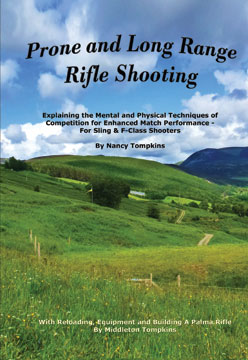
Nancy Tompkins is one of the greatest long-range shooters in American history. She has won five National Long-range Championships. Tompkins’ treatise is a must-read for serious Palma, F-Class, and High Power shooters. The revised Second edition includes F-Class equipment and techniques, and newly updated information. Color pictures. Topics include Mental & Physical training, Reading Wind & Mirage Shooting Fundamentals, International Competition, and Loading for Long Range. Nancy Tompkins is a 4-time winner of the National Long Range Championships, and has won countless other major events. Nancy has been on six Palma Teams (as both a shooter and a coach).
Ryan Cleckner is noted for his ability to explain complex topics in an easy-to-comprehend manner. Now Cleckner has authored a book, the Long Range Shooting Handbook, which expands on the topics covered in Cleckner’s popular NSSF video series. The Long Range Shooting Handbook is divided into three main categories: What It Is/How It Works, Fundamentals, and How to Use It. “What It Is/How It Works” covers equipment, terminology, and basic principles. “Fundamentals” covers the theory of long range shooting. “How to Use It” gives practical advice on implementing what you’ve learned, so you can progress as a skilled, long range shooter. You can view Sample Chapters from Ryan’s Book on Amazon.com.
Tony Boyer, the most successful shooter in the history of short-range benchrest competition, shares many of his match-winning tips in this 323-page book. The book covers all aspect of the benchrest discipline: loading, windflags, rest set-up, addressing the rifle, and match strategies. This is a high-quality publication, filled with valuable insights. Every serious benchrest shooter should read Tony’s book. Boyer has dominated registered benchrest in a fashion that will never be duplicated, having amassed 142 U.S. Benchrest Hall of Fame points. The next closest shooter, Allie Euber, has 47 Hall of Fame points. This handsome, full-color book is 323 pages long, with color photos or color illustrations on nearly every page.
This book should be on the shelf of every short-range benchrest shooter. (Shooters in other disciplines will find the book helpful as well.) Butch Lambert says Mike’s book is “far and away the best Benchrest book written. Very comprehensive, it touches on every aspect of our game.” Mike’s 368-page book is dedicated to getting the most from modern rifle accuracy equipment with an emphasis on shooting 100-200-300 yard group benchrest tournaments. This book covers the most popular hardware plus new equipment offerings are covered, including external mount scopes, actions, triggers, stocks, wind flags, and more. Also covered are rifle handling techniques, note taking, tuning, bullet selection, goals, and match strategies. Mike provides many tips that will help active competitors update their own competitive program.
This book by 11-time National High Power Champion David Tubb focuses on position shooting and High Power disciplines. Section One covers fundamentals: position points, natural point of aim, breathing, triggering mechanics and follow-through, sling selection and use, getting started, getting better, avoiding obstacles. Section Two covers mechanics of offhand, sitting, and prone positions. Section Three covers shooting skills, including wind reading and mental preparation. Section Four covers the technical side of shooting, with extensive disuctions of rifle design, load development, reloading barrel maintenance, and rifle fitting. We consider this book a “must-read” for any sling shooter, and there is plenty of good advice for F-Class shooters too.
Bullseye Mind (Mental Toughness for Sport Shooting) by Dr. Raymond Prior, $14.00 (Softcover).
Having a Bullseye Mind means thinking in ways that create confidence and consistency, even under pressure. A “must-read” for competitive shooters, Bullseye Mind is a mental training book written specifically for the shooting sports. The book is well-organized, with handy highlighted lists and key “talking points”. Each chapter concludes with examples from a world-class shooters such as: Matt Emmons, 2004 Olympic Gold Medalist; Vincent Hancock, 2-time Olympic Gold Medalist; Jamie Corkish, 2012 Olympic Gold Medalist; Petra Zublasing, 2014 World Champion/ISSF Shooter of the Year; and Nicco Campriani, 2012 Olympic Gold Medalist, 2010 World Champion. This book has earned rave reviews from competitive shooters who found it really helped their “Mental Game”. One recent purchaser states: “This book is as though you had a coach in your back pocket…”
Cartridges of the World (15th Edition, 2016), belongs in every serious gun guy’s library. This massive 680-page reference contains illustrations and basic load data for over 1500 cartridges. If you load for a wide variety of cartridges, or are a cartridge collector, this book is a “must-have” resource. The latest edition includes 50 new cartridges and boasts 1500+ photos. The 15th Edition of Cartridges of the World includes cartridge specs, plus tech articles on Cartridge identification, SAAMI guidelines, wildcatting, and new cartridge design trends. In scope and level of detail, Cartridges of the World is the most complete cartridge reference guide in print. Cartridges of the World now includes a 64-page full-color section with feature articles.
This photo was taken from my driveway at 12:23 am on December 5th. The fire was one mile away. In the darkness I packed essentials and valuables, and prepared to leave my house to its fate.
This past week this Editor was near a major fire zone in California, a few hundred yards from the mandatory evacuation line. In preparation for the evacuation order, I packed my station wagon with important items, including some valuable rifles and scopes. When I finished loading, there was over $7000 worth of optics in the car — more than the blue-book value of the vehicle itself. That made me think carefully about gun cases and how one would want to transport high value, optics-equipped rifles both on the road and by air. Here are two gun cases that offer excellent protection at a very good price. Both these Plano cases are strong enough to survive rough airport baggage handlers, while cushioning your firearms in customizable, thick foam interiors. No they are NOT fire-proof, but they’ll help cradle your precious rifles and scopes while you get to a safe zone.
Plano 52″ Double Rifle Case with Wheels, $112.74
This Plano Double Scoped Rifle Case is an Amazon Best Seller for good reason. It offers the functionality and durability of an SKB-type hard case for HALF the money. This is under $115.00, while the equivalent SKB is around $240.00, so you can buy two Planos for the price of one SKB. The 51.5″ interior will fit most scoped competition rifles up to about 29″ barrels (measure your own rifle to make sure). If you separate the barreled action from the stock you can transport even ultra-long ELR rifles. The handles are convenient and beefy and the wheels make this case easy to move through airports and parking lots. This is a very tough, roomy case for the money (plus there’s Free Shipping for Amazon Prime members).
Exterior Dimensions: 54.625″ x 15.5″ x 6″
Interior Dimensions: 51.5″ x 12.63″ x 5.25″
Pluckable Interior Dimensions: 46″ x 10″
Features: Wheels, Secure Draw-Down Latches, O-Ring Seal, Pressure Relief Valve, Customizable Foam
Plano 43″ All-Weather Tactical Gun Case (43″ Interior), $45.80
This is one of the best available medium-sized, hard gun cases under $100.00. But with Amazon’s sale price now just $45.80 (with free Prime shipping), you can get TWO cases for under $100.00. MidwayUSA is also selling this case for $45.80, but shipping is extra. While designed for AR15s and tactical-style rifles, you can also fit longer-barreled rifles inside if you separate the barreled action from the stock (which, by the way, may be a good practice for airline travel.) This case is very tough and strong — offering protection like an SKB case for less than half the cost. The foam in the 43″-long interior is “pluckable” so it can be configured to fit your rifle. This case is a favorite with Amazon buyers, earning a full FIVE STARS with over 1600 buyer reviews. Here is a recent verified review: “Awesome case for the money $$. As good as other manufacturers wanting 4X the money. Highly recommend.” Strong enough for air travel, this case is pretty heavy for regular trips to the range. Consider the lighter-weight, top-opening Plano Air-Glide Case for basic transport of your rifle from home to the range.
Exterior Dimensions: 46″ x 16″ x 5.5″
Interior Dimensions: 43″ x 13″ x 5″
Features: Secure Draw-Down Latches, O-Ring Seal, Pressure Relief Valve, Customizable Foam
Other Emergency Evacuation Tips
When you must leave your home in an emergency, you need to be able to collect key records and valuables quickly. I wasted time locating important documents in three different rooms. So, I recommend you have a small, totable fire-resistant safe for your most vital items. This could normally be kept inside a larger Gun Safe, but always ready to “grab and go”. Here are some of the items you’ll want to keep in the smaller safe/security box:
Passports and IDs
Birth Certificates
Medical Plan ID Cards
House Insurance Documents
Vehicle Titles/Registrations
Important Prescriptions
Recent Tax Returns
Cash and Travelers’ Checks
Valuable Jewelry/Watches
Family Photos
Flash Drive with Photos
I strongly recommend that you walk through your house and take photos of all the valuable furniture, electronics, and heirlooms. This will be proof for your insurance. Even better, make a video with your smartphone as you walk through the house. Narrate descriptions of your valuable possessions/furniture in each room. For example I have one antique desk that is worth more than my car. You need evidence of ownership and quality. If possible, copy these photos/video to a flash-drive, which is kept in your “getaway” file safe.
The U.S. House of Representatives passed the Concealed Carry Reciprocity Act of 2017 (H.R. 38) in a 231-198 vote on Wednesday, December 6th. The legislation will next proceed to the U.S. Senate. If a joint version of the Bill is approved by both House and Senate, the new legislation would then go to the President for signature.
Story Based on Report by NRA-ILA.org
The National Rifle Association applauded House Members for passing the most far-reaching expansion of self-defense rights in modern American history. “This vote marks a watershed moment for Second Amendment rights,” said Chris W. Cox, executive director, National Rifle Association Institute for Legislative Action. “The Concealed Carry Reciprocity Act is the culmination of a 30-year movement recognizing the right of all law-abiding Americans to defend themselves, and their loved ones, including when they cross state lines.”
Next Stop — the U.S. Senate
“This bill ensures that all law-abiding citizens in our great country can protect themselves in the manner they see fit without accidentally running afoul of the law. We now call on the Senate to take up and pass this critical legislation,” Cox concluded.
H.R. 38 — What This Legislation Does and Does Not Do
The Concealed Carry Reciprocity Act of 2017 ensures that those Americans who can legally carry a concealed firearm in one state will legally be able to do so in every other state. It eliminates the confusing patchwork of state laws that have ensnared otherwise law-abiding gun owners.
While the bill allows recognition of concealed firearms permits from one state to the next (reciprocity), it does NOT create a federal licensing or registration system or establish national standards for concealed carry. Moreover, H.R. 38 will NOT override current state laws governing the time, place, and manner of carrying concealed weapons.
The bill also makes improvements to the National Instant Criminal Background Check System, NICS. This bill incentivizes states and government agencies to update the NICS with legitimate records of prohibited persons.
Summary of H.R. 38 — Concealed Carry Reciprocity Act of 2017
This bill amends the Federal criminal code to allow a qualified individual to carry a concealed handgun into or possess a concealed handgun in another state that allows individuals to carry concealed firearms. A qualified individual must: (1) be eligible to possess, transport, or receive a firearm under federal law; (2) carry a valid photo identification document; and (3) carry a valid concealed carry permit issued by, or be eligible to carry a concealed firearm in, his or her state of residence.
Additionally, the bill specifies that a qualified individual who lawfully carries or possesses a concealed handgun in another state: (1) is not subject to the federal prohibition on possessing a firearm in a school zone; and (2) may carry or possess the concealed handgun in Federally-owned lands that are open to the public.
Ask most gun guys about the Precision Rifle Series (PRS), and they’ll tell you it’s a discipline for bolt-action “tactical” rifles. Yes that’s true, but PRS now has a “Gas Gun” series as well, and many local PRS-style matches also allow gas guns to compete in their own division.
Capitalizing on the success of the bolt-gun competitions, this year the PRS approved a new Gas Gun series for semi-auto rifles such as AR15s and AR10s. The inaugural 2017 PRS Gas Gun Series competition took place February 17-19, 2017 at the CORE Shooting Solutions range in Baker, Florida. This article explains the basics of the Gas Gun Series and offers some factory hardware options.
PRS Director Shawn Wiseman Explains New Gas Gun Series in this Video:
Gas Gun Series Basics — Interview with PRS President Shooting Sports USA interviewed PRS President Shawn Wiseman.
SSUSA: What will be the format of the 2017 PRS Gas Gun Series matches?
Wiseman: The matches will be a two day format with 8 to 10 stages per day. There are three Divisions; Tactical Light for 5.56x45mm NATO/.223 Rem. rifles, Tactical Heavy for 7.62x51mm NATO/.308 Win., and Open for everything else up to .30 cal. The maximum distance will be 800 yards.
SSUSA: What guns do you expect to be popular?
Wiseman: In the Open Division, I expect to see a lot of 6.5 Creedmoors for two main reasons; it’s an inherently accurate cartridge and Hornady makes great ammo for the folks that aren’t into reloading. I think the Tactical Light Division will probably be the most popular. It is hard to say specifically what rifles will be the most popular but there are a few AR companies that are known for the accuracy. Armalite, GA Precision, LaRue and Seekins will all be very popular rifles in this Series. I think we will continue to see high-end optics with 5X to 6X zoom range on the rifles. Bushnell, Kahles, Leupold, Nightforce and Vortex will continue to be the most popular.
PRS Gas Gun Series Factory Firearm Options
While you can compete in the Gas Gun Series with an AR15, many Open Division competitors are favoring the larger AR10-platform rifles that can shoot the 6.5 Creedmoor and 6mm Creedmoor cartridges. Both Savage and Smith & Wesson offer AR10-type rifles optimized for this competition.
Smith and Wesson M&P 10, 6.5 Creedmoor
S&W’s AR10-platform rifle is a leading choice for the PRS Gas Gun Division. The M&P 10 in 6.5 Creedmoor shows good build quality and good accuracy with factory 6.5 Creedmoor ammo. If you’re a fan of the 6.5 Creedmoor cartridge, the M&P 10 is a smart gas gun option. S&W offers good customer service and a rock-solid warranty. This rifle features a 2-Stage Match Trigger, Magpul MOE Stock, 15″ M-LOK handguard, and a 20″ barrel with 1:8″-twist 5R Rifling. MSRP is $2035.00.
Savage MSR-10 Long Range, 6.5 Creedmoor and .308 Win
The updated Savage MSR-10 Long Range is available now in .308 Win and 6.5 Creedmoor. Next month (January 2018), Savage will also release a 6mm Creedmoor version. This rifle features a Magpul PRS Gen3 Stock, Blackhawk 2-stage trigger, non-reciprocating side charging handle, and QPQ-treated heavy barrel (1:8″ twist for 6.5 Creedmoor; 1:10″ for .308 Win). MSRP for all chamberings is $2284.00.
New .224 Valkyrie for AR15 Platform
Another option would be the smaller AR15 chambered for the new .224 Valkyrie cartridge. This brand new offering from Federal is basically a 6.8 SPC necked down to .224 caliber. With the 90gr Sierra MatchKing, it offers ballistics comparable to a 6.5 Creedmoor, with less recoil.
PRS Gas Gun Series Rules
For the new PRS Gas Gun Series, a committee of top PRS shooters, Multi-Gun shooters, and Match Directors developed the PRS Gas Gun Series Rule Book. Highlights of the Rules are listed below.
For the new PRS “Gasser” Competition, the PRS developed rules on gun types, scoring, match timing, penalties, safety and other key topics. CLICK HERE for Full PRS Gas Gun Series Rules.
Open Division: The Open Division rifles will not exceed a caliber of .30 or a velocity of 3,200 fps. A match DQ will result any rounds over the speed limit of 3,200 fps (+/- 32 fps for environmental factors and equipment discrepancies). Match Officials may request at any point during a match that a competitor fire their rifle through chronograph. If the bullet exceeds the 3,200 fps speed limit, the shooter will receive an automatic match DQ.
Tactical Light Division: Intended to allow competitors the opportunity to compete using traditional military and law enforcement caliber (.223/5.56). This promotes Active Duty military and law enforcement competitors use of their Service and Department-issued rifles. Tactical Light Division rifles are restricted to 5.56 NATO/.223 Remington chamberings only. Bullet weight cannot exceed 77 grains and muzzle velocity cannot exceed 3,000 fps.
Tactical Heavy Division: Intended to allow competitors the opportunity to compete using traditional military and law enforcement caliber. This promotes Active Duty military and law enforcement competitors’ use of their Service and Department issued rifles. Tactical Heavy Division rifles are restricted to 7.62 NATO/.308 Winchester calibers only. Bullet weight cannot exceed 178 grains and muzzle velocity cannot exceed 2,800 fps. No modified wildcat rounds permitted to shoot in the Tactical Divisions Anyone discovered violating this rule will receive an automatic Match DQ. Tactical Division shooters will shoot the exact same COF as Open Division shooters.




 Marksman to High Master
 DVD Resource for High Power Training






 Zanotti Safes from 350 to 825 Pounds Assembled






 This photo was taken from my driveway at 12:23 am on December 5th. The fire was one mile away. In the darkness I packed essentials and valuables, and prepared to leave my house to its fate.


