At long range, small bullet holes are much easier to see “in the white” than in the black center of the normal High Power target. When you’re practicing at long range using a scoped rifle, one way to enhance your ability to see your bullet holes is to print a “negative” version of the regulation bullseye target so that your black center is now white.
How do you create a “negative” of a target image? Many image programs, including the FREE Irfanview software, have a “Negative” function in the pull-down menu. If you don’t see a “Negative” menu option in your program, look for a “substitute colors” option. Many printers also have a “reverse colors” function. If you can’t find a solution with your computer or printer, just take a normal bullseye target to a copy shop, and the staff can easily print you a set of targets with white centers in black fields.
Forum member Watercam has a Pentax PF-80ED spotting scope that allows him to see 6mm bullet holes in the white at 600 yards. However, 6mm holes in the black are only visible out to 400 yards or so. Accordingly, Watercam uses a modified “reversed” black-to-white target for 600-yard practice. Watercam explains: “[Using the Pentax] With my 6mm and limited mirage I see defined, 6mm holes in the white out to 600. In the black, however, I can see bullets holes at about 400. I now use reverse-color targets for training without a pit partner at the 600-yard line.”
The Hi-Viz Solution — Day-Glo Pasters
If you’re not concerned with official scoring rings, you can use an all-white target with a bright, fluorescent target dot in the middle. A 2″- or 3″-diameter stick-on target dot is highly visible at 600 yards. Birchwood Casey Target Spots® assortment #33928-TSA offers neon orange target dots in 1″, 2″, and 3″ diameters.
TARGET TIP — Use Chart Paper
For practice backers for the Day-GLo pasters at long distance, use Flip Chart Paper (aka Easel Pads) marked with graph lines at 1″ intervals. Available either regular or self-stick, one sheet can hold 4-8 pasters and the white paper allows for easy spotting of the holes and quick estimation of group size. Get Flip Chart Paper at Amazon.com, Staples, or Office Depot.
Brits Use White-Field Target for F-Class
In the UK, some ranges are now using a “reverse-style” target with a mostly white area. Laurie Holland says this allows shooters to see shots much more easily. Laurie reports: “Here’s a photo of the 500/600 yard F-Class match target we use in PSSA comps at Diggle Ranges with club members Chris Hull (L) and Terry Mann (R). We now use this target form at all ranges up to 1K for F-Class, and, yes you can often see your hits at 600 yards on the target before the markers pull it. Regards from England — Laurie”.
The 9th Edition of the Firearms Guide has just been released. This is the MOTHER LODE of GUN INFO. If you’d like to have instant access to 8,000 gun schematics and descriptions of 73,000 types of guns and ammo from 1,110 manufacturers, then check this out. The Firearms Guide is a humongous online database that is regularly updated. You can access all this info for pennies a day. The basic annual subscription is on sale right now for just $29.95. If you only need the info for a month or two, get a monthly membership at $6.50 per month, and cancel any time.
You can also get a DVD or Flash Drive add-on that lets you access the database even without a web connection. A 1-year Online Edition PLUS Firearms Guide 8th Ed. DVD for Mac & Windows is $34.95, including shipping. Alternatively, the 1-year Online Edition PLUS Firearms Guide 8th Ed. Flash Drive for Mac & Windows is $44.95. This lets you access the data from laptops and most tablets with a USB port.
You may be familiar with the Firearms Guide when it was distributed as a DVD. Now the 9th Edition is a fully interactive, subscription-based online database of firearms and ammo, which is also the most complete guide to global gun values on the web. The amount of imagery is amazing — there are tens of thousands of photos and over 8000 schematics, which help you work on a firearm or identify key components/parts. The Firearms Guide permits detailed searches of antique and modern guns and side by side comparisons of search results. Guns are cross-referenced with the ammunition database.
Database Includes Printable Targets: This resource even includes printable targets. You’ll find practice targets, sight-in targets, silhouette targets, special shapes and, yes, even Zombie targets.
Guns and ammo are presented with prices, specifications, features, ballistics, and up to 12 high-rez color pictures. NOTE: The Ammo information includes bullet BCs and velocities. GUN VALUES are provided for dealers and gun collectors. You can access thousands of printable and zoom-able GUN SCHEMATICS (diagrams or exploded views) with parts lists and blueprints for professional gunsmiths. Here’s an example of the schematicsL
The online database’s search capability lets you search by gun caliber, manufacturer, and key features (e.g. “.223 Rem, Colt, folding stock”). There are 14 different search criteria — this allows you to “drill down” precisely to find the gun you want in seconds. Shown below are typical profiles of listed products:
If you are a gun collector, or just an information junkie, you’ll find the Firearms Guide to be an invaluable resource. The scope is truly worldwide, with coverage of gun makers in Western Europe, Eastern Europe, South America, South Africa, and Asia as well as North America.
About the Firearms Guide Database Firearms Guide has been published from 2009 to 2015 on DVDs and sold through Cabelas, Bass Pro Shop, the NRA and other vendors. In 2016 Firearms Guide was transformed into a subscription-based, online searchable guns and ammo reference and gun value guide for industry professionals and enthusiasts. Along with the web subscription, you can purchase a supplemental DVD or Flash Drive which contains the same information for off-line access.
Sometimes everything comes together — a great barrel, the right load, good bullets, and, of course, a gifted trigger-puller. Check out this target from Forum member Mike Ezell. That’s five (5) shots at 100 yards from Mike’s 30 Major benchrest rifle. When this group was shot a while back, Mike reported: “I fired a few groups in the great weather. No surprises — it did VERY well! My little wildcat, the 30 Major, has always been a shooter. That target was not a fluke — I shot a few groups today and Agg’d a high One.” Mike is a Kentucky gunsmith who builds his own rifles.
30 Major is Based on 6.5 Grendel
What’s a “30 Major” you ask? This is Mike’s own wildcat, a 6.5 Grendel necked up to .30 caliber. Mike writes: “The 30 Major is essentially a .070″-long 30 PPC. With the great 6.5 Grendel brass available from Lapua, all you need to do is neck-up and turn the necks to prep the brass.” Mike says it is very much like a 30 BR, but you just start with 6.5 Grendel brass instead of 6mmBR brass.
The cartridge has one major benefit — it utilizes a PPC-diameter bolt face. That makes it easy to convert your group-shooting 6 PPC to shoot score with .30-cal bullets. Mike explains: “If you have a PPC, to shoot score, all you have to do is chamber up a [.30 caliber] barrel and screw it on your PPC.”
From 7.62×39 Russian to 30 Major — Full Circle
Arms expert Neil Gibson has an interesting perspective on the lineage of the 30 Major. He reminds us that this wildcat has returned to its roots: “Start off with the 7.62×39 Russian [cartridge]. The Russians then modify it, necking it down to .223 for deer hunting. The U.S. benchrest guys then modify that, necking it up to 6mm and blowing the case out making the 6mm PPC. Someone takes that case, necks it out to 6.5 mm, making the 6.5 PPC. Alexander Arms takes that and makes the 6.5 Grendel. Then finally Mike Ezell takes the Grendel and necks it up to 30 caliber, making the 30 Major. From 30 caliber, back to 30 caliber. OK, the original uses .31 caliber bullets, but the bore is still .300. Talk about almost coming round full circle!”
7.62×39 Russian
v
.220 Russian
v
6mm PPC
v
6.5 PPC
v
6.5 Grendel
v
30 Major
The 7.62×39 Russian was the Grand-Daddy of the 30 Major…
Great Accuracy Restored after Solving Mystery Problem
To get his 30 Major rig shooting this well, Mike had to solve a mysterious problem that cropped up last year. Mike explains: “Two years running, I have finished in the top 15 in IBS points shooting [the 30 Major], but last year’s benchrest season was tough.” Mike was having some accuracy issues that defied explanation. But he figured it out: “The front action screw was bottoming out against the barrel extension – just barely. A simple fix brought the gun back to life. It’s a Stiller Viper Drop Port. The action is screwed and glued into the stock, so I was a bit surprised … especially after having checked for [that issue] while looking for the problem. I’m just glad to have found the trouble so I can begin to re-instill some confidence in the gun and myself, after last year.”
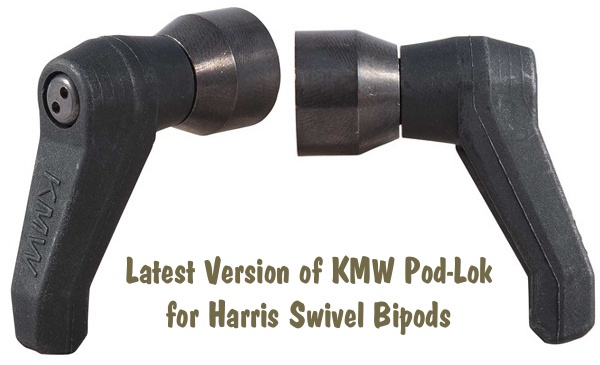
If you’ve ever used a Harris Swivel Bipod, you know that, without tools, it is difficult to put enough tension on the swivel locking knob to really lock the unit solid. And, if you do manage to get the knob really tight (perhaps by using pliers), it is difficult to loosen with fingers alone.
That was why Terry Cross and the folks at KMW Long Range Solutions invented the Pod-Loc™. This system replaces the knurled swivel tension knob with a push-button adjustable handle. Using the handle you can easily set the swivel tension at any level from loose to “rock solid”. And you can release tension to adjust the bipod to different terrain just as easily. The genuine KMW Pod-Loc™ retails for $26.99 at Brownells.com.
How to Build Your Own Bipod Swivel Locking System
While we use genuine KMW Pod-Locs on our rifles, readers on a tight budget, or who have a large collection of bipod-equipped rifles, can economize by putting together their own swivel locking systems from off-the-shelf components. You can buy suitable levers from www.T-Nuts.com. This vendor offers a variety of appropriate handles, ranging in price from $7.00 to $10.00. So, by sourcing the parts, you can outfit three bipods with swivel adjusters for the cost of one Pod-Loc.
We recommend the Nylon/Stainless BPL/NS model ($7.70), but you may prefer the all-metal BPL-ZS ($8.50), or the shorter BPL-Micro model ($8.25). The compact Micro lock does not protrude past the body of the bipod, yet is still easily grasped. T-Nuts supplies one 3/16″ spacer with most of its bipod handles. T-Nuts handles are also available with a metric M6x1.0 thread for use with imported bipods such as Outers and Rockport.
Installation is Easy — With the Right Socket
To install a swivel locking system, first you’ll need a 1/4″ socket to remove the keeper nut from the threaded pivot rod. (During this process, you’ll need to keep pressure on the pivot rod retaining pin on the opposite side of the bipod.) Don’t try to remove the keeper nut with pliers or an open-end wrench. You really need the correct socket. Once that keeper nut is removed, then unscrew the knurled tension knob/ring. This is attached to the same threaded shaft as the keeper nut but you should be able to remove it without tools.
After the knurled tension ring is off, it is easy to put your handle on the bipod. First slip the 3/16″ spacer over the threaded pivot rod. Keeping finger pressure on the pivot rod retaining pin (on reverse side), then spin on the T-Nuts handle. Rotate the handle inwards until it firmly locks the bipod swivel mechanism. By pushing the button in the head of the handle, you can swing the handle left or right to set its position without altering the swivel tension.
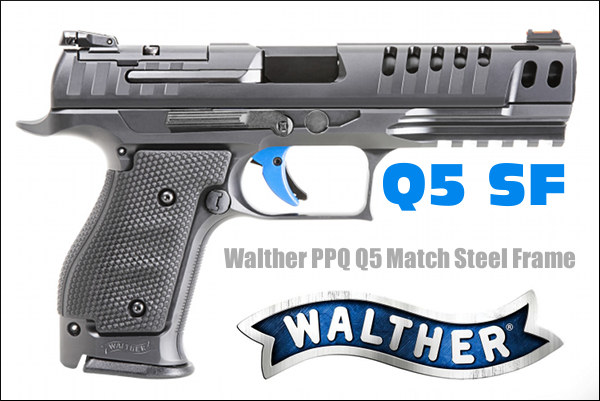
What was old is new again — metal pistol frames. Walther, which has focused on polymer-framed pistols in recent decades, has come out with a metal-framed version of its flagship Q5 model, chambered in 9x19mm (9mm Luger). We like this pistol, official called the Walther PPQ Q5 Match Steel Frame (SF). The metal frame adds mass to the gun, and lowers the center of gravity. That reduces muzzle flip somewhat, as you can see in the comparison video below. Ergonomics are very good, reports early tester Graham Baates, who tested the “optics ready” Q5 SF pistol with red dot sights.
It’s puzzling though — we wonder why Walther didn’t increase the slide weight too, by simply doing away with all the superfluous ports in the slide. That would increase gun weight, reduce muzzle flip (and perceived recoil) even more, and presumably the gun would be cheaper to produce. But maybe Walther thinks the slide cuts are a defining Q5 styling feature that needs to remain, like the Q5’s distinctive Blue Trigger. We guess styling trumps logic…
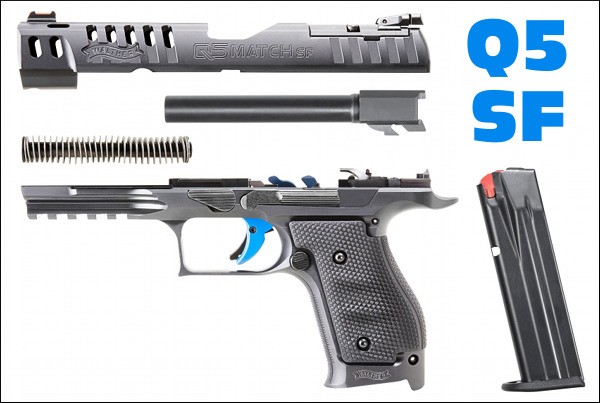
The Q5 Match SF features an optics ready slide that comes with a Trijicon RMR, Leupold Delta Point, and Docter Optics compatible mounting plate in addition to the standard competition iron sights. Along with a ported slide and the Carl Walther signature ergonomics, and a blue quick defense trigger, the Q5 SF is the flattest shooting model to date.
TECHNICAL DATA Walther PPQ Q5 Steel Frame Mod. 283001
All Steel Construction
Optics Mounting Plate
Extended Frame Rails
Ported Slide
Model: 2830001
Caliber: 9x19mm
Finish: Tenifer
Magazines Included: 3
Hand-loaders have never had so many great choices in single-stage presses, with many different configurations and features. There are classic O-Frame presses, Coax-style presses, Open-front presses, Pyramid presses, and compact C-Frame presses. Here is our 2019 Single Stage Press Showcase with products from Forster, Frankford Arsenal, Hornady, Lee, Lyman, MEC, and RCBS. We’ve included short videos showing the features of these reloading presses.
If you are shopping for a new press you should look at the various features of each. You may prefer something classic like a Rock Chucker, or the innovative open-front MEC. If you are looking for a compact press to use at the range, the new Lyman C-Frame is very impressive for the price. And the Forster Co-Ax remains a great addition to any loading room.
MEC Marksman Single-Stage Press
If you are looking for a new, full-size single-stage reloading press, definitely consider the MEC Marksman. Created by the makers of the popular MEC shotshell reloading systems, the MEC Marksman combines a sturdy cast-iron frame with a modern open-front design. With a $189.99 street price the Marksman press cost roughly $20 more than an RCBS Rock Chucker, but the MEC offers some distinct advantages — such as an open front plus a floating shell-holder system.
Our friend Gavin Gear of UltimateReloader.com got his hands on a MEC Marksman press and put it through its paces. He came away impressed with the product, saying it delivers excellent performance, and has many impressive features. Gavin tells us: “Cast iron tools and machines are a lifetime investment. The made-in-USA MEC Marksman features ductile cast-iron construction, an open-front frame design for easy cartridge access, a new floating shell-holder design with a unique retention system, and ambidextrous handle setup.” MEC also offers a wide selection of accessories for the Marksman press, including a press riser/mount, shell-holder caddy, and die trays.
Frankford Arsenal M-Press Coaxial Reloading Press
Sorry, this new Frankford Arsenal coaxial M-Press has not started shipping yet so we don’t have a video. But MidwayUSA says it should arrive by mid-February 2019. We think this new M-Press should interest Forster Co-Ax fans. While the operation is similar to the Forster Co-Ax, there are some important differences. The new M-Press mounts on a flat surface, with nothing protruding below. That is significantly different than the Forster Co-Ax. The die block is different. It also appears that the shell-holder system is different. But this still self-aligns like a Forster Co-Ax. “A free-floating design allows the die and shellplate to move on two axis, so the case is always perfectly centered in the die, minimizing bullet runout.” The way the arms move is also different. In the Forster Co-Ax, the rods slide within the press frame and the part that holds the shell is fixed to them. In this design the rods are stationary and the part that holds the shell slides on them. However, the overhead handle certainly does copy the distinctive Forster design. NOTE: According to MidwayUSA, this M-Press does NOT have priming capability, unlike the Forster Co-Ax. Credit Boyd Allen for design analysis.
Forster Co-Ax Press
If you are not yet familiar with the many unique features of the Forster Co-Ax, we recommend you watch the video above, a very thorough video review by Rex Roach. This shows how the press operates and highlights the design elements which set the Co-Ax apart from every other reloading press on the market. This 14-minute video shows the key Co-Ax features, explaining how the floating case-holder jaws work (3:30 time-mark), how the dies are held in place (4:40 time-mark), how spent primers are captured (6:10 time-mark), and how to set the primer seating depth (10:00 time-mark). We’ve used a Co-Ax for years and we still learned a few new things by watching this detailed video. If you are considering purchasing a Co-Ax, definitely watch this video start to finish.
In recent years, Forster Co-Ax® presses have been somewhat hard to find, as demand has out-stripped supply. The Co-Ax has many dedicated fans, given its unique features, such as the floating case-holder jaws, and easy, rapid slide-in/slide-out die placement. We’ve also found that Co-Ax presses load very straight ammo and we like the ability to switch between short handle (good for bullet seating) and long handle (ideal for heavy case-sizing tasks). We also think the Forster Co-Ax has one of the best spent primer capture systems on the market — a straight drop into a removable plastic cup. Simple and it works.
Lyman Brass Smith Victory Single-Stage Press
Lyman’s New Victory Single-stage Press competes with the RCBS Rock Chucker Press. With beefy cast iron construction, the Victory’s strength and leverage rivals the Rock Chucker. If you like to prime on a press, this Victory has a priming system that’s much easier to use than the Rock Chucker system. The priming tube is right up front. Simply push the shuttle at the button of the tube to advance the primer into place. The entire primer-loading system can also be removed so it doesn’t interfere with case and bullet-handling operations. We generally prefer to prime cases separately using a dedicated hand- or bench-mounted tool, but the Victory press does the job nicely. Overall, the Victory is a great value in a full-size “O-Frame” press. It’s on sale now for $154.99 at Midsouth.
RCBS Rock Chucker Supreme Single-Stage Press
Nearly every serious hand-loader has owned or used the RCBS Rock Chucker press. This Editor still uses a Rock Chucker passed down by his brother 20 years ago. And yes, it is still going strong. The latest Rock Chucker Supreme single-stage press features an improved “upside-down Y-path” dual-bin spent primer catcher. Otherwise the Rock Chucker Supreme remains big, strong, versatile and sturdy. It has very strong linkages, with a compound leverage system providing plenty of power — FL-sizing is a breeze even with large, magnum cases. The 1″-diameter ram has 12.5 sq. inches of ram-bearing surface.
Some people may not know that the Rock Chucker offers a secondary 1 1/4″ x 12 thread for shotshell reloading dies and Piggyback 3 upgrade. The Rock Chucker Supreme retails for under $180.00 ($167.50 now at Bruno’s). The RCBS Rock Chucker is definitely a quality product that can last a lifetime. For heavy-duty sizing chores this remains one of the best choices in single-stage presses. We do recommend shopping around. You can sometimes get a pretty big discount on Rock Chuckers and RCBS has regular rebate programs.
Lyman Brass Smith Ideal C-Frame Compact Press
The Lyman Brass Smith Ideal Press is a very affordable, cast iron C-Frame reloading press. We think it is the new “class leader” in compact presses. This works great as a secondary press for your reloading room or a small press you can take to the range. The large front opening allows you to access the shell holder without hitting the support bar on other types of presses. Unlike other compact presses made from aluminum, Lyman’s Ideal press is cast iron so it is rigid and strong. The high-quality steel ram is one inch in diameter. The Brass Smith is a true ambidextrous press that can be accessed from either side and mounted the same. This is a great choice for a second, auxiliary press for depriming and bullet seating.
Hornady Iron Single Stage (Open-front) Press
In this “Reloading with Rosie” video, the attractive female host loads some ammo using the Hornady Iron Press. With a beefy, pyramid-style cast-iron frame with an open front, this press offers some advantages over a traditional “O-Frame” type press. Access is considerably easier, for one thing. And the top of the press includes slots to hold dies and tools — that’s really a very nice feature that saves time. Also an optional “automatic” priming system shuttles primers from a vertical tube in the back to the shell-holder in the front. That’s clever. Over all the Iron Press is a nice piece of engineering — good job Hornady.
Lee Classic Cast (Iron) Breech Lock Press
The Lee Classic Cast Breech Lock Press offers excellent value for the money ($112.00 at Midsouth). Based on the proven design of the Classic Cast press, the updated Breech Lock series adds the quick-change die bushing and an improved primer drop system. This press is strong, with cast iron frame, all-steel linkage, and 12 square inches of ram bearing surface.
Lee says this press has the “largest opening and the longest stroke in the industry” among O-frame type presses. The handle can be mounted on either side. We love the fact that the handle angle can be adjusted, as well as the lever arm length — that allows you to adjust travel and leverage to suit your preference. Smart engineering.
The new spent primer drop features a large-diameter hollow ram with clear hose that drops primers straight to a bin — that’s simple and effective. The press is very rigid and the base is wide enough for good stability. We have one of these Classic Cast Breech Lock Presses in our reloading room and it works well.
A while back, RifleShooter online magazine published a list of the purported Ten Best Bolt-Action Rifles of All Time. Ten classic rifle designs (including the Remington 700 and Winchester Model 70) were featured with a paragraph or two explaining their notable features.
“Best” Lists Stir Controversy…
These Top 10 lists are always controversial. While most readers might approve of half the entries, there are always some items on the Top 10 list that some readers would challenge. Here is RifleShooter’s Top 10 list. What do you think? Are there some other bolt-actions that are more deserving?
1. Springfield M1903
2. Mauser 98
3. Winchester Model 70
4. Remington Model 700
5. Weatherby V
6. Sako L61/AV
7. Savage Model 110
8. Ruger M77
9. Tikka T3
10. Mannlicher-Schonauer
How is a modern, metal-chassis rifle built? This very cool video from Masterpiece Arms answers that question. The nicely-edited video shows the creation of a Masterpiece Arms tactical rifle from start to finish. All aspects of the manufacturing process are illustrated: 3D CAD modeling, CNC milling of the chassis, barrel threading/contouring, chamber-reaming, barrel lapping, laser engraving, and stock coating. If you love to see machines at work, you will enjoy this video…
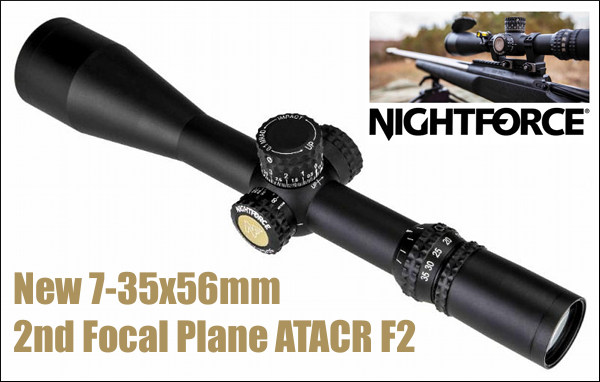
Nightforce Optics has introduced a second focal plane version of the popular ATACR™ 7-35×56 F1 scope. The First Focal Plane (FFP) 7-35X ATACR scope is very popular among PRS/NRL competitors. In fact, according to the Precision Rifle Blog, the 7-35x56mm F1 ATACR is a top choice among surveyed PRS/NRL shooters: “The Nightforce ATACR 7-35×56 F1 was on more rifles than any other scope. 20% of them to be exact. It has only been out a couple of years, but has quickly become a favorite among this crowd.” This scope offers ED glass, very good resolution, excellent reliability and stout construction.
Seeing the popularity and success of the FFP 7-35x56mm ATACR, Nighforce decided to bring out a Second Focal Plane (SFP) version. “The F1 first focal plane-version has been so successful, that we wanted to make the same … performance available to those who prefer a second focal plane reticle”, said Nightforce’s Alan Stillwell. We think that’s a good option. For slow-fire target shooting, at known distances, we often prefer the visual “stability” of a Second Focal Plane reticle, which stays constant (in the circle of view) with any magnification (meaning the reticle lines do not grow or shrink as you zoom in or out). MSRP for the new SFP 7-35x56mm ATACR F2 is $3,100.00.
The ATACR™ 7-35x56mm F2, built on a 34mm tube, provides 100 MOA/29 MRAD of elevation adjustment and 60 MOA/17 MRAD of windage adjustment. Nightforces claims that this scope “delivers superb clarity at every power setting, allowing detailed rendering and identification of small targets at extreme ranges”. The new 7-35X ATACR F2 is offered with either the MOAR-T™ or MIL-C™ proprietary Nightforce reticles. DigIllum reticle illumination and ZeroStop elevation are standard.
New Nightforce MIL-XT Reticle
Nightforce has a new illuminated MIL-XT™ reticle, available in 16X, 25X and 35X ATACR™ F1 (first focal plane) riflescopes. It is designed for precision rifle competition (PRS and NRL). By providing precise hold-over and hold-off points, this reticle helps competitors engage targets rapidly without needing to dial windage or elevation, allowing faster hits “on the clock”. Main lines feature .2 Mil-Radian holds, while each whole Mil-Radian is numbered for fast reference.
Below center, there are .2 Mil-Radian-spaced floating dots at every vertical Mil-Radian. Whole Mil-Radians dots are larger in size for fast counting. Numbers below center vary in size and are placed on each side for easy counting and verification of appropriate hold points. Nightforce says: “The MIL-XT™ provides excellent range estimation, rapid target engagements and precise first-shot placement.”
Happy New Year to all our readers worldwide, and especially the 43,200 members of our AccurateShooter Forum. We hope 2019 brings you happiness in your lives and success in your endeavors. And we wish for small groups, good scores, and successful hunts in the New Year.
Forum Members — Upgrade Your Membership to Get Unlimited Classifieds for 12 Months.
Looking Forward to 2019
Every year, we work to improve AccurateShooter.com. In 2016 we completely overhauled the Forum, making it faster and mobile-friendly. In 2017 we upgraded our servers to improve speed and security. In 2018 we started vetting every new sign-up to prevent scammers. And we have continued our popular Deals of the Week and launched a weekly Video Product Showcase. We hope you’ll continue to enjoy our feature articles, our Daily Bulletin, our match reports, and our Forum Classifieds. The formula seems to be working — our audience is bigger than ever.
Forum Membership Grows 14% in 2018
Our Shooters’ Forum grew significantly in 2018. Our membership grew by 14% as Forum ranks swelled to 43,200 members! More people are successfully buying and selling in our Forum Classifieds section than ever before. Silver and Gold members get unlimited Classifieds for 12 months. Gold members also get custom Avatars and other privileges.
We need your support. For 15 years the site has relied largely on volunteer efforts. But as the site grows, we need the assistance of Forum moderators, product testers, web gurus, and computer software experts. Those guys don’t work for glory alone.
Consider this — you’ll pay $20 for a couple movie tickets these days. For the same twenty dollars you can become a Silver Forum member for a YEAR and help this site provide info, tests, tech tips, bargains, and shooting news.
And consider the benefits — Silver or Gold Members get unlimited classifieds for 12 months. If you were to sell just one, single $1500 rifle through Gunbroker.com, just one, you would pay $58.75 in fees! For one sale!
In the last quarter of 2018 about 430 site users have donated or upgraded their Forum membership to Silver or Gold Levels. We thank all those who have generously contributed. But that still leaves tens of thousands of users who access the site every week without contributing. With more donations we can deliver more premium content and offer more services to our members.
How to Contribute
If you are a Forum member, you can help the site by UPGRADING your membership. CLICK HERE to UPGRADE.
If you’re not a member, making a donation to the site is simple and easy. Just click on the orange “Donate” button at right. If you have a credit card, you don’t need a Paypal account to contribute.
IMPORTANT: After you click on the orange button a PayPal screen will load. You’ll also see a field that says “0.00”. For desktop users that field will be on the right (with other pre-set amount buttons on the left). Fill in the amount you want to give. For example, to give $25, type 25.00 in the amount field.
Help Support this Site by Making a Secure Donation.
If you don’t like Paypal, you can send a check.
Make the check payable to: Jeff Williams. Please list your Shooters’ Forum Log-In Name (if any), and mail the check to:
Jeff Williams
P.O. Box 240
Solon Springs, WI 54873


 Forum member Watercam has a Pentax PF-80ED spotting scope that allows him to see 6mm bullet holes in the white at 600 yards. However, 6mm holes in the black are only visible out to 400 yards or so. Accordingly, Watercam uses a modified “reversed” black-to-white target for 600-yard practice. Watercam explains: “[Using the Pentax] With my 6mm and limited mirage I see defined, 6mm holes in the white out to 600. In the black, however, I can see bullets holes at about 400. I now use reverse-color targets for training without a pit partner at the 600-yard line.”


 If you’ve ever used a Harris Swivel Bipod, you know that, without tools, it is difficult to put enough tension on the swivel locking knob to really lock the unit solid. And, if you do manage to get the knob really tight (perhaps by using pliers), it is difficult to loosen with fingers alone.



 If you are not yet familiar with the many unique features of the Forster Co-Ax, we recommend you watch the video above, a very thorough video review by Rex Roach. This shows how the press operates and highlights the design elements which set the Co-Ax apart from every other reloading press on the market. This 14-minute video shows the key Co-Ax features, explaining how the floating case-holder jaws work (3:30 time-mark), how the dies are held in place (4:40 time-mark), how spent primers are captured (6:10 time-mark), and how to set the primer seating depth (10:00 time-mark). We’ve used a Co-Ax for years and we still learned a few new things by watching this detailed video. If you are considering purchasing a Co-Ax, definitely watch this video start to finish.
 Nearly every serious hand-loader has owned or used the RCBS Rock Chucker press. This Editor still uses a Rock Chucker passed down by his brother 20 years ago. And yes, it is still going strong. The latest Rock Chucker Supreme single-stage press features an improved “upside-down Y-path” dual-bin spent primer catcher. Otherwise the Rock Chucker Supreme remains big, strong, versatile and sturdy. It has very strong linkages, with a compound leverage system providing plenty of power — FL-sizing is a breeze even with large, magnum cases. The 1″-diameter ram has 12.5 sq. inches of ram-bearing surface.

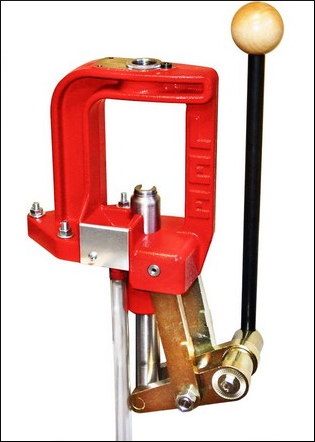 The Lee Classic Cast Breech Lock Press offers excellent value for the money (