This shocking Revolver Kaboom resulted from “user error”. Our friends at Midsouth Shooters provided this cautionary tale, noting that you must ALWAYS be careful when hand-loading any ammo. Check your loads and don’t have multiple powder containers in your reloading area.
“Ever wonder what happens when you don’t pay attention to detail? A word of advice from the reloader who brought this in — always double-check the load data.
Thankfully, the shooter was unharmed in the explosion. A live round we recovered from the remaining portions of the cylinder contained 12.8 grains of powder. The shooter had multiple powders on his bench and was unable to recall which one had been used while loading.” — Midsouth Shooters
How to Avoid Kabooms
1. Never have more than one powder container open on your reloading bench at the same time — when you are finished with a powder, seal the bottle and put it away.
2. If there is already powder sitting in your dispenser, and you’re not 100% sure what it is — throw it out. We suggest, whenever you fill a powder hopper, put a piece of paper in the powder hopper with the name of the powder and the date.
3. When loading a new cartridge or when using a new powder, get load data from more than one source. Always load conservatively to start!
4. Always double-check your Load Data before starting the loading process.
5. In short handgun cases, bullet seating depth can make a BIG difference in pressure levels. Be sure to check your Cartridge OAL.
During shooting season, there are probably 400 or more club “fun matches” conducted around the country. One of the good things about these club shoots is that you don’t have to spend a fortune on equipment to have fun. But we’ve seen that many club shooters handicap themselves with a few common equipment oversights or lack of attention to detail while reloading. Here are SIX TIPS that can help you avoid these common mistakes, and build more accurate ammo for your club matches.
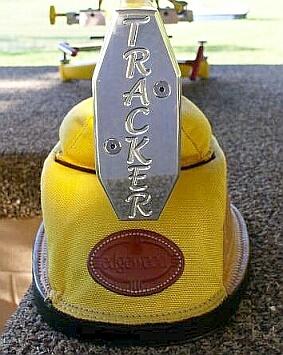
1. Align Front Rest and Rear Bags. We see many shooters whose rear bag is angled left or right relative to the bore axis. This can happen when you rush your set-up. But even if you set the gun up carefully, the rear bag can twist due to recoil or the way your arm contacts the bag. After every shot, make sure your rear bag is aligned properly (this is especially important for bag squeezers who may actually pull the bag out of alignment as they squeeze).
Forum member ArtB adds: “To align my front rest and rear bag with the target, I use an old golf club shaft. I run it from my front rest stop through a line that crosses over my speed screw and into the slot between the two ears. I stand behind that set-up and make sure I see a straight line pointing at the target. I also tape a spot on the golf shaft that indicates how far the back end of the rear bag should be placed from the front rest stop. If you don’t have a golf shaft, use a wood dowel.
2. Avoid Contact Interference. We see three common kinds of contact or mechanical interference that can really hurt accuracy. First, if your stock has front and/or rear sling swivels make sure these do NOT contact the front or rear bags at any point of the gun’s travel. When a sling swivel digs into the front bag that can cause a shot to pop high or low. To avoid this, reposition the rifle so the swivels don’t contact the bags or simply remove the swivels before your match. Second, watch out for the rear of the stock grip area. Make sure this is not resting on the bag as you fire and that it can’t come back to contact the bag during recoil. That lip or edge at the bottom of the grip can cause problems when it contacts the rear bag. Third, watch out for the stud or arm on the front rest that limits forward stock travel. With some rests this is high enough that it can actually contact the barrel. We encountered one shooter recently who was complaining about “vertical flyers” during his match. It turns out his barrel was actually hitting the front stop! With most front rests you can either lower the stop or twist the arm to the left or right so it won’t contact the barrel.
3. Weigh Your Charges — Every One. This may sound obvious, but many folks still rely on a powder measure. Yes we know that most short-range BR shooters throw their charges without weighing, but if you’re going to pre-load for a club match there is no reason NOT to weigh your charges. You may be surprised at how inconsistent your powder measure actually is. One of our testers was recently throwing H4198 charges from a Harrell’s measure for his 30BR. Each charge was then weighed twice with a Denver Instrument lab scale. Our tester found that thrown charges varied by up to 0.7 grains! And that’s with a premium measure.
4. Measure Your Loaded Ammo — After Bullet Seating. Even if you’ve checked your brass and bullets prior to assembling your ammo, we recommend that you weigh your loaded rounds and measure them from base of case to bullet ogive using a comparator. If you find a round that is “way off” in weight or more than .005″ off your intended base to ogive length, set it aside and use that round for a fouler. (Note: if the weight is off by more than 6 or 7 grains you may want to disassemble the round and check your powder charge.) With premium, pre-sorted bullets, we’ve found that we can keep 95% of loaded rounds within a range of .002″, measuring from base (of case) to ogive. Now, with some lots of bullets, you just can’t keep things within .002″, but you should still measure each loaded match round to ensure you don’t have some cases that are way too short or way too long.
5. Check Your Fasteners. Before a match you need to double-check your scope rings or iron sight mounts to ensure everything is tight. Likewise, you should check the tension on the screws/bolts that hold the action in place. Even on a low-recoiling rimfire rifle, action screws or scope rings can come loose during normal firing.
6. Make a Checklist and Pack the Night Before. Ever drive 50 miles to a match then discover you have the wrong ammo or that you forgot your bolt? Well, mistakes like that happen to the best of us. You can avoid these oversights (and reduce stress at matches) by making a checklist of all the stuff you need. Organize your firearms, range kit, ammo box, and shooting accessories the night before the match. And, like a good Boy Scout, “be prepared”. Bring a jacket and hat if it might be cold. If you have windflags, bring them (even if you’re not sure the rules allow them). Bring spare batteries, and it’s wise to bring a spare rifle and ammo for it. If you have just one gun, a simple mechanical breakdown (such as a broken firing pin) can ruin your whole weekend.
Walmart is yielding to anti-gun forces one step at a time. First the national retail chain stopped selling handguns in 1993. Next in 2015, Walmart stopped selling “black rifles” — AR-15 platform firearms. Then in 2018 Walmart raised the age for gun purchases from 18 to 21. And the latest restrictions involve ammunition. Walmart announced it would not longer sell ANY pistol ammunition. And Walmart now won’t sell .223 Rem (5.56×45) ammunition commonly used in ARs and “modern sporting rifles”. What comes next? If a criminal uses a shotgun in a multiple-death incident, will Walmart stop selling shotguns?
1993 — Walmart halts sales of all handguns.
2015 — Walmart halts sales of AR-15 type rifles.
2018 — Walmart raises minimum age for firearm purchase from 18 to 21 years.
2019 — Walmart halts sales of all pistol ammunition.
2019 — Walmart halts sales of all .223 Rem (5.56×45) ammunition.
Walmart has been steadily rolling back its support of the Second Amendment since 1993 when it stopped the sale of all handguns in every state except Alaska. Then, in 2015 it ended the sale of AR-15 style MSR rifles, and any toy or airgun resembling any “military-style rifle used in mass shootings”. Last year, Walmart raised the minimum age for gun purchases from 18 to 21, two weeks after the Parkland, Florida school shooting. And Walmart rolled out another set of restrictions after the recent shooting at a Walmart Super Center in El Paso, Texas.
“Walmart may not sell the ammo you need, and more companies beholden to the pressure of the vocal minority may follow suit. Effectively, Walmart has been bullied into kowtowing to the social justice warriors, and woke-ninjas in the vocal minority.” — Midsouth Blog
In a memo to employees, Walmart CEO, Doug McMillon, stated: “After selling through our current inventory commitments, we will discontinue sales of short-barrel rifle ammunition such as the .223 caliber and 5.56 caliber that, while commonly used in some hunting rifles, can also be used in large capacity clips on military-style weapons.”
Walmart has also stated that it will no longer sell handgun ammo. McMillon previously said Walmart was responsible for 2% of firearm sales in the U.S. and 20% of ammunition sales. Walmart expects its share of ammunition sales to drop to between 6% and 9% as a result of the newly-announced changes. The company will continue to sell shotguns and rifles [But for how long? — Editor].
“In a complex situation lacking a simple solution, we are trying to take constructive steps to reduce the risk that events like these will happen again,” McMillon said in a memo. “The status quo is unacceptable.” In this 2015 video, McMillon explained the decision to stop selling AR-platform rifles.
Changes to Walmart Gun Carry Policies
Another rider on the new Walmart policy affects customers who open-carry in their stores. If shoppers openly carry guns into Walmart stores going forward, store managers may ask the shopper to leave and safely secure their gun in their vehicle before returning to the store. “The policies will vary by location, however, and shoppers who are openly carrying guns may not always be asked to leave the store,” a Walmart spokesman said.
“As long as a Hornady is at Hornady, we will never sell direct to Walmart. They are no friend of the industry.” — Jason Hornady, 2007
Walmart CEO Calls for More Gun Control
“We encourage our nation’s leaders to move forward and strengthen background checks and to remove weapons from those who have been determined to pose an imminent danger,” McMillon said. “We do not sell military-style rifles, and we believe the re-authorization of the Assault Weapons Ban should be debated to determine its effectiveness.”
Commentary from Midsouth Shooters
Walmart may not sell the ammo you need, and more companies beholden to the pressure of the vocal minority may follow suit. Midsouth will continue to sell the ammunition and reloading supplies you need, regardless. Our Second Amendment right is a sacred right, and for you to protect your family with the tools available, you need access to fairly priced ammunition and firearms.
Midsouth Shooters was founded on the tenants of honesty, family, and fairness, rooted in American and God. For a company, or organization, to be swayed by knee-jerk reactions sets a precedent of allowing the mob to dictate overreaching policies which put many in harms way. Effectively, Walmart has been bullied into kowtowing to the social justice warriors, and woke-ninjas in the vocal minority.”
This could be big news for F-TR and Palma competition, where cartridge options are limited to .223 Rem and .308 Win. Berger is introducing a NEW, very high-BC, 22-caliber Long Range Hybrid Target Bullet. Stated Ballistic Coefficents (BCs) are: 0.524 G1 and 0.268 G7. That’s near the top among .22-cal bullets and makes this 85.5 grain projectile a very viable long-range option. Want to try some? These should be available very soon. Pre-order now from Creedmoor Sports, MidwayUSA, and other vendors.
This new 85.5gr bullets boast smaller, more uniform meplats, giving them a higher long-range BC. The meplat enhancement is achieved with “Meplat Reduction Technology” (MRT). Berger Engineer Garett Stoddard, who spearheaded the MRT project, explains: “Every bullet nose is formed with optimal swage pressure determined by force instead of length. In addition to reducing a projectile’s drag by shrinking its meplat diameter, this technique takes the inherent meplat inconsistencies that plague OTM style projectiles and brings them closer to the rotational axis. This is a key factor to the consistent balance of the bullet in flight.” The new 85.5s, like all other Berger projectiles, are made with precise Berger/J-4 bullet jackets which boast +/- .0003″ jacket TIR (total indicated runout).
7-Twist Barrels Recommend for new 85.5gr MRT Berger
The 85.5gr Long Range Hybrid Target Bullet’s G7 BC of .268 is achieved with optimal stability from a 1:7″-twist barrel. Berger says “Excellent accuracy may also be attained with 1:8″-twist rifle barrels, resulting in a slightly decreased BC value”.
Initial Test Results Are Very Positive
A third party tester, shooting the new 85.5-grainer in Arizona, reported excellent performance at 1000 yards: “The projectile performed extremely well at 1000 yard in spite of only being driven to ~2800 to 2850 fps. This projectile is clearly competitive at 1000 yards in a Palma rifle as tested. With a slightly longer throat and a faster-twist barrel, I am confident the 85.5 Hybrid would be a viable option for those looking to shoot .223 Rem in Long Range competitions.”
Meplat Reduction Technology Enhances Shot-to-Shot Consistency
Berger says: “Utilizing advanced and proprietary manufacturing processes, Berger’s innovative Meplat Reduction Technology (MRT) System applies controlled pressure along the projectile nose, producing a homogeneous and repeatable bullet profile for the industry’s most consistent Ballistic Coefficients (BC). While a high BC is desirable to competitive shooters, shot-to-shot BC consistency is critical when engaging targets to 1000 yards and beyond.”
The Tactical Rifle Shooters Facebook Group recently showcased tools used to measure case headspace before and after “bumping” the shoulder. After a case is fired, hand-loaders who full-length size their cases will typically bump the shoulders back anywhere from .001″ to .0035″, depending on the rifle and application. With our 6mmBR and Dasher cases we like about .0015″ bump.
You want the amount of case sizing and bump to be the same for all your brass. To ensure uniformity, it makes sense to measure your cases before and after the FL sizing process. When we have time, we check every case. Other folks will simply check the first 3-4 cases coming out of the FL sizing die to ensure the FL die setting is correct and delivering desired headspace/bump.
1. Whidden Gunworks Shoulder Bump Gauge
There are a variety of tools that can be used to measure shoulder bump. Our favorite is a special cartridge-specific bushing made by Whidden Gunworks. The Whidden Shoulder Bump Gauge enables you to adjust your sizing die to the desired measurement. The bump gauge is attached to your calipers with a set screw and determines the measurement from the base to the shoulder of the case. The photo below, from Tactical Rifle Shooters, shows the Whidden Bump Gauge for the .375 CheyTac cartridge.
2. Dave Manson Vertical Comparator with Dial Read-Out
Dave Manson states: “This tool was designed to make life easier for the advanced shooter and re-loader by allowing precise measurement of ammunition, case, and chamber headspace. With this information, the re-loader will be able to fine-tune clearances and fits between his ammunition and chamber, with resultant improvements in accuracy and case life.” The functions of the Comparator are:
1. Measure headspace of factory or reloaded ammunition
2. Quantify chamber headspace by measuring headspace of a fired case
3. Ensure minimal shoulder set-back when setting up re-loading dies
4. Compare base-to-ogive length to ensure consistent bullet-to-rifling relationship.
In addition to the Dial Indicator and Stand, the $130.00 Vertical Comparator is supplied with multiple Datum Blocks of precise length and inside diameter (.3300″/.3750″/.4000″/.4375″). MORE INFO HERE.
3. Hornady L-N-L Headspace Comparator System
Hornady makes comparator gauges matched to the red comparator holder that mounts on your caliper. These Lock-N-Load Headspace Gauges are inexpensive. You can get a set of five gauges for $31.99. Hornady explains: “The Lock-N-Load® Headspace Comparator… gauge measures variations in brass before and after firing or re-sizing. It allows for headspace comparison between fire-formed brass and re-sized brass.” IMPORTANT: Hornady states: “To determine the proper bushing diameter for your cartridge, simply add the neck diameter and the shoulder diameter and divide that number by two. Use the bushing closest to that number.” Hornady offers five: .330″, .350″, .375″, .400″, and .420″.
One tip — We have found the Hornady gauges may vary a little from unit to unit even with the same nominal size. If you have more than one gauge for the same cartridge, test each on your brass — you may then note a slight difference in your bump measurements.
4. Pistol Brass Case DIY Bump Gauge
Last is a “field expedient” set-up if you do not have any of the comparator tools shown above. A sized .45 ACP case (or other suitable pistol case) can be used to measure shoulder bump. The mouth of the pistol case sits on the shoulder of your rifle cartridge brass.
Make sure the .45 ACP case is trimmed square and that it is round. We recommend you first run it through an expander, then size it, trim it and chamfer. Next, take the .45 ACP case and slip it over the neck of a fired, unsized rifle case with the primer removed. Align the two cases between the jaws of your calipers and note the length from rim to rim (See left photo below).
OK, now you have the length for a fired rifle case BEFORE sizing. Next, take a full-length sized rifle case (without primer) and do the same thing, placing the .45 ACP case over the neck of the FL-sized case (Right Photo). The difference between the two numbers is the amount of “bump” or set-back you are applying to the shoulder. Here the difference is .0015″. The amount of bump you need varies with your chamber and your load, but .0015-.002″ is a good initial setting.
MasterPiece Arms (MPA) has a new chassis system — the “MPA Matrix”. Derived from the MPA BA Chassis, the MPA Matrix Chassis offers a “multitude of configurations in grips, thumb rests, and trigger finger supports”. MPA claims the grip and hand area has over 100 different variations. The MPA Matrix has a fore-end two inches longer than the standard BA or BA Competition Chassis. Overall, the Matrix is fairly heavy, at 6.4 pounds, and pretty expensive, with a $1250-$1450 MSRP (depending on options). By contrast the MPA BA Hybrid Chassis costs $925.00 and weighs 3.5 pounds (without recoil pad).
CLICK Image for large MPA Matrix Photo:
There are significant design differences between the MPA Matrix and MPA BA Hybrid (below). The Matrix, at 6.4 pounds, is also much heavier than the 3.5-lb BA Hybrid. Given that many PRS/NRL competitors favor heavier rifles for greater stability (and less felt recoil), the Matrix’s extra mass is probably a good thing.
The MPA Matrix features five different grip options (3 swept and 2 vertical), three different thumb-rest designs and four different trigger finger supports. That’s great for shooters who like to keep their thumb forward on the bolt side of the action. However, looking at the chassis, we’re really not sure we like the way the Matrix encircles the grip area. You’ve got hard metal behind the grip. The Matrix appears set up for resting the thumb of the trigger hand alongside the action. That can work for sure, but we think some shooters will prefer a more conventional vertical grip you can wrap your thumb around. A conventional grip will also have recoil cushioning for the web of the hand. See the BA Hybrid chassis for comparison. This Matrix is really VERY different in the grip area. But if you don’t like the Matrix, there are certainly other stock options available.
The new Matrix Chassis is designed for Remington Short Actions and Rem clones. The Matrix does offer good adjustability — the buttstock has an adjustable cheek riser and length of pull adjusts from 13.5 to 14.75 inches. Plus, the recoil pad adjusts for height and cant. You can get either an adjustable rear monopod or a bag-rider configuration. As you’d expect, the MPA Matrix has M-LOK slots along the fore-end sides and barricade stop holes along the bottom.
What was the concept behind the Matrix chassis? MPA’s President, Phil Cashin, states: “One of the things that we have seen in precision rifle shooting over the past couple of years is how many different methods a shooter used to engage a stock or chassis. Due to variations in hand size, finger thickness and length, as well as shooter preference on how they want to engage the chassis or stock, we’ve seen a lot of inconsistencies among the shooters in how they engage the rifle and where they position the pad of the trigger finger with the shoe of the trigger. This inspired us to create a system that would provide a more custom fit procedure for our customers by creating a chassis with more customized configurations.”
The MPA Matrix Chassis (MSRP $1250-$1450) is available in eight Cerakote colors: Graphite Black, Flat Dark Earth, Burnt Bronze, Tungsten, Gunmetal, Sniper Green, NRA Blue, and USMC Red. Custom H Series Cerakote colors are an additional $135, while camo patterns are $450 extra.
Over 100 Top Shooters Competed at the 2019 IBS 1000-Yard Nationals.
Match Report by Blake Wilson, IBS Match Editor
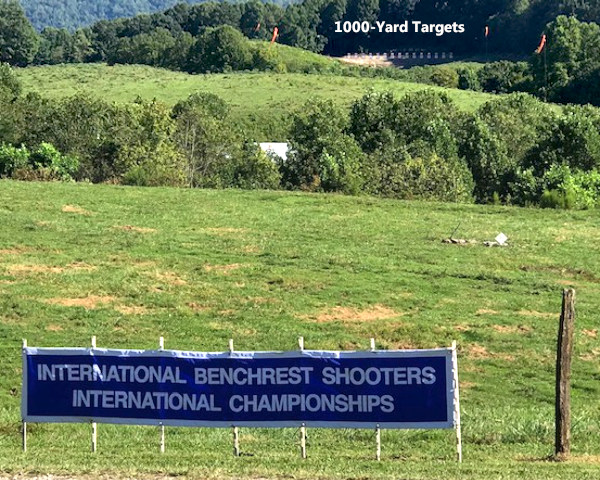
The International Benchrest Shooters (IBS) 1000-Yard Nationals were, once again, a success. The Hawk’s Ridge Gun Club in Ferguson, North Carolina, hosted a flawless event over Labor Day Weekend. Over 100 of the nation’s top shooters, from 19 states, gathered to compete for the crown of “National Champion”. Events such as this take an army to make work and the 2019 IBS Nationals were no different. But the event was a big success, despite some challenging conditions on Day One. We congratulate Glenn Hiett, who shot superbly to win BOTH the Two-Gun Overall AND Light Gun Overall 2019 Championships. Well done Glenn! We also recognize IBS Heavy Gun Overall Champion Sam Edwards.
Ideal Conditions Change Quickly on Saturday
Hawk’s Ridge is a very beautiful range. But “The Ridge” can sometimes have very tricky, unfriendly winds. Labor Day weekend 2019 was no different. Conditions started near perfect early Saturday morning — the day began with mild temps and wind flags hanging low. Things then changed for the worse. The great conditions only lasted a handful of relays as winds became unpredictable, showing the competitors how tough Hawk’s Ridge can be. Tiny groups and high scores quickly become scarce and shooters began to feel the effects of switching, hard-to-read winds.
2019 IBS 1000-Yard National Championships Top Competitors
Two-Gun Overall Champion: Glenn Hiett
Light Gun Overall Champion: Glenn Hiett
Heavy Gun Overall Champion: Sam Edwards
Highest-Placing Female: Donna Matthews
Junior Champion: Hunter Hall
Light Gun Group Winner: Scotty Powell
Light Gun Score Winner: Robert Banner
Heavy Gun Group Winner: Sam Edwards
Heavy Gun Score Winner: Tod Soeby
1000-Yard Nationals Course of Fire
IBS 1000-Yard Nationals is a 6-target Aggregate event over a two-day period for Light Gun and Heavy Gun. Light Guns must not exceed 17 lbs. weight and shoot 5 rounds per target. Heavy Guns have no weight limit and shoot 10 rounds per target. At the Nationals each shooter gets three Light Gun targets and three Heavy Gun targets. The results are aggregated together to determine Two-Gun Overall, Light Gun Overall, Heavy Gun Overall. There are also separate awards for Light Gun Group and Score and Heavy Gun Group and Score.
Day 1 included a Light Gun target, Heavy Gun target and ended with a second Light Gun target. After two Light Gun targets, several shooters were feeling great about their chances — Robert Banner, Brian Buttrick, and Dan Pantinski all had 99 scores, just one from perfect. Jerry Powers had the best Day 1 Light Gun Agg, a 3.472″ average (0.33 MOA). Justin Morrow shot the smallest Light Gun Group — 2.604″. That works out to a very impressive 0.249 MOA at 1000 Yards!
Donna Matthews shot this excellent 50-2X, 3.257″ LG target on Saturday.
Participants Rewarded with Famous Hawk’s Ridge BBQ
As Saturday came to an end, the smell of chicken had taken over the range. Range owner Mike McNeil is known for his famous secret sauce BBQ chicken. From the comments of the crowd as they sunk their teeth into chicken, potato salad, fresh baked desserts — they had no complaints whatsoever. Bellies full, guns cleaned, everyone headed to their rooms for some much anticipated rest.
More Readable and Consistent Conditions on Day 2
Feeling refreshed and excited for the challenge and anticipation for the final day, shooters showed up raving about the BBQ chicken and ready to shoot. For the most part, Day 2 was much more forgiving and calm than Day 1. The format was the opposite of Saturday — Heavy Gun relays were conducted first and last with Light Gun in the middle.
Perfect scores, small groups and everything in between was shot. Shooters made adjustments and for the most part they worked. But some made the wrong choices and the price was paid.
IBS 1000-Yard Nationals Equipment List (CLICK to Zoom): CLICK PHOTO to view LARGE Equipment List.
Editor’s Comment: Looking at the Two-Gun Top 20 Equipment List above, we see the Light Gun Ranks were dominated by 6mm Dashers, and 6 BRAs (BR Ackleys), most using Hodgdon H4895 powder. There were quite a few 300 WSMs among the top Heavy Guns. Krieger, with 10 selections, was the most popular barrel choice, followed by Bartlein (4), and Brux (3).
More than Marksmanship — Competitors Appreciate the Camaraderie
These events are always a pleasure to attend. You get to put faces with the names you’ve heard, compete against the best across the country, and see how you stack up to them. It’s fun to shake hands with the likes of Tom Jacobs (Vapor Trail Bullets past National Champion), Bart Sauter (Bart’s Bullets and current holder of 600-yard records), Mike Wilson (Current Light Gun Group and score record holder), the Hornady Team and many more.
This wonderful sport has no shortage of great men and women from many different states and cultures. Match director David Matthews, as well as Robert Smithey and the entire Hawk’s Ridge Gun Club staff, definitely showed how to put on a nearly flawless event. We cannot forget Kent Bratten for his tireless efforts in finding prize donations for the match. The IBS gives a special thanks to all our great sponsors who make the prize tables so abundant. Thanks for your generosity!
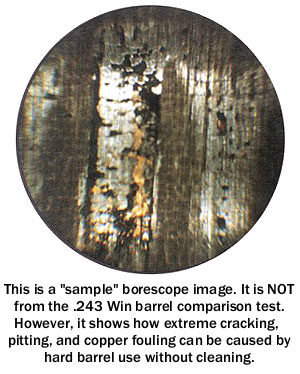
Can sustained rapid-fire shooting with no cool-down period wear out a quality barrel more quickly? The answer is “Yes” according to Forum member LCazador, who did an interesting comparison test with two .243 Winchester barrels. He started off with two, identical, match-grade HV taper stainless barrels. Both were NEW at the start of testing, and LCazador shot the same load through each: 95gr match bullets with 38 grains of Hodgdon Varget. After giving both barrels the same, gentle 20-round break-in, 300 rounds were then fired through each barrel — in very different ways. Barrel condition and wear were monitored with a borescope.
Barrel One — Slow Fire, Cool Down Periods, Cleaning Every 50 Rounds
At the end of the 300-round test, Barrel One looked brand new. There was none of the severe fire cracking found in Barrel Two. This barrel was shot no more than 10 times without a cool down and firing was done at a much slower pace. Cleaning for this barrel was done every 50 shots.
Barrel Two — Fast Firing, No Waiting, Cleaning Every 100 Rounds
The second barrel, which received hard use and minimal cleaning, was severely damaged with severe fire cracking at the leade and throat. As a result, the barrel had to be re-chambered. This barrel was shot 100 rounds at time without cleaning and was shot up to 20 times in succession without a cool down.
LESSON LEARNED — Heat Kills Barrel Life
Don’t let your barrel get too hot, and keep it clean. One afternoon can ruin a barrel!
Monitoring Barrel Wear with Borescope
Some folks worry too much about what their borescopes reveal — many barrels do not have to be “squeaky clean” to perform well. In fact some barrels run better after ten or more fouling shots. However, a borescope can be very helpful when your barrel starts losing accuracy for no apparent reason. Forum member FdShuster writes:
“A borescope is a positive way of backing up your suspicions when the rifle starts to throw an occasional (soon followed by more frequent) wild shot. Using the scope is also an excellent way to determine that the cause is barrel wear and not simply a need for a concentrated cleaning session to remove built up copper and more importantly, carbon fouling.
I’ve had a few barrels that gave every indication of being shot out. But I ‘scoped them out and found the cause to be nothing more than requiring a good cleaning. They then returned to their usual performance. There’s no guessing involved when you are able to get ‘up close and personal’ using the scope. The borescope also provides an excellent view of the all-important condition of the crown. My borescope is one of the most valuable investments I’ve ever made.”
At the request of our readers, we provide select “Deals of the Week”. Every Monday morning we offer our Best Bargain selections. Here are some of the best deals on firearms, hardware, reloading components, optics, and shooting accessories. Be aware that sale prices are subject to change, and once clearance inventory is sold, it’s gone for good. You snooze you lose.
1. CDNN — Ruger American .30-06 Hunting Rifle, $319.99
Even with so many new cartridge types, the venerable .30-06 Springfield remains a trusted and effective hunting round. Moreover, you can find good .30-06 hunting ammo at most any sporting goods store. Whether you’re looking for an affordable hunting rifle or perhaps a first rifle for a family member, check out this .30-06 Ruger American Rifle with Wolf Camo finish. CDNN’s current sale price is just $319.99 — a great bargain. Ruger offers a great warranty.
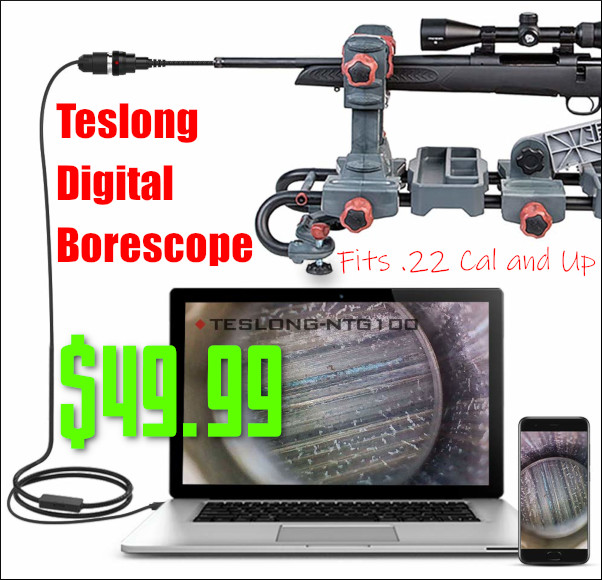
2. Amazon — Teslong Digital Borescope, $49.99
The impressive Teslong digital borescope offers capabilities that rival optical systems costing $700 or more. This compact, electro-optical, cable-type borescope outputs sharp, high-resolution images and VIDEO to desktop computers, laptops, as well as Android tablets and smartphones. Check out our Full Teslong Review complete with inside-the-barrel videos. At $49.99 this is a great value. NOTE: This unit does NOT currently work with iPhones and iPads.
3. Amazon — Custom Damascus Hunting Knife, $59.99
Having a good hunting knife on your hip when you’re out in the field is a necessity. Whether dressing your game, making kindling, or getting out of dangerous situations, the importance of having a good knife can’t be overstated. If you’re looking for new one or maybe a gift for that new young hunter in your life, take a look at this custom Damascus hunting knife complete with leather sheath. It can do a myriad of tasks while looking great with that Damascus steel blade.
4. Caldwell — 30% Off FieldPod Magnum, TreePod, & ChairPod
Caldwell makes some excellent, adjustable field supports for hunters and varminters. Right now AccurateShooter readers can save 30% on Caldwell’s Fieldpod Magnum, Treepod, and Chairpod shooting rests. The Treepod is ideal for treestand hunters. The versatile Fieldpod Magnum is stable and sturdy yet can be easily carried into the field. The ChairPod provides comfortable seating with adjustable rifle rest. You can save big with this special 30% off discount for AccurateShooter.com readers and Forum members.
For example, the excellent Fieldpod Magnum is reduced from $179.99 down to $125.99 — that’s a GREAT deal. The 30% discount appears when you add an item to the Caldwell shopping cart and then proceed to check-out.
5. Natchez — ChargeMaster Lite Powder Dispenser, $199.99
Precise powder dispensing is critical for accurate loads. Among the many electronic scale/dispensers on the market, RCBS’s ChargeMaster Lite is a very good choice. This week Natchez is selling the ChargeMaster Lite for only $199.99. That’s a great price — almost $40 cheaper than Amazon. If you’ve been waiting for the right time to buy, don’t delay.
For a safe (and ethical) hunt, you should know the precise distance to your prey. We recommend a laser rangefinder. Thankfully, you don’t have to spend a small fortune for a good LRF these days. The Vortex Ranger 1500 is rated to 1500 yards, with built-in Angle Correction. The Range 1500 is also great for ranging targets during UKD tactical matches. Right now this Vortex LRF is on sale for just $329.00 on Amazon. And for $20 more ($349.00) you can pick up the Vortex Ranger 1800 rated to 1800 yards.
7. Bullet Central — Bix’N Andy TacSport Triggers
Bix’N Andy competition triggers are considered superior for good reason. However they’re not always the best for PRS matches where it can get wet and dirty. That’s why Bix’N Andy introduced the TacSport Series Triggers which feature a durable housing built for extreme environments. These are better for shooting in wet or dusty conditions. Choose from a variety of Bix’N Andy trigger shoes.
8. Grafs — Browning Hunting Ammo Sale
It’s hunting season so you’ll want to grab some effective hunting ammunition at attractive prices. Head over to Grafs.com for the current Browning Hunting Ammo Sale. The sale includes nearly all Browning hunting ammunition types, so you should find good options for all popular calibers/chamberings.
Most shooters clean their barrels and bolts but many fail to properly clean their chambers. Don’t make this mistake — clean your chambers regularly on both hunting and match rifles. We recommend a dedicated chamber cleaning kit. The Sinclair Chamber Cleaning Tool Kit provides everything you need to properly get debris, powder and grease out of the chamber. That helps ensure every round loads and extracts properly.
10. Amazon — 12″ x 12″ Splatter Grid Targets, 10 for $9.99
This 12″x12″ Splatterburst Target combines splatter shot marking with a grid background, with five aiming points. The bright neon shot circles make it easy to see your shots. And the handy grid lets you quickly estimate your group size. Get a 10-pack for $9.99, or a 25-pack for $17.99 (better deal). This particular target has earned rave reviews — 87% of verified buyers gave this a FIVE-Star rating.
Gavin Gear of UltimateReloader.com has been testing the AutoTrickler V3, a microprocessor-controlled powder-dispensing system that works with super-precise force restoration scales. Combining an automated powder measure with a motorized trickler, the AutoTrickler can deliver a full powder charge, with single-kernel precision, in a few seconds.
AutoTrickler inventor Adam MacDonald has developed numerous enhancements to his powder-dispensing system, which will be incorporated into the latest AutoTrickler V3 production version. Gavin Gear reviews all these important new features in a new video released on October 6, 2019. Check it out:
Key Enhancements for AutoTrickler V3 Production Version:
1. Improved, Larger-Capacity Clear Powder Hopper
The new clear plastic powder hopper is much larger than the old Lee red-colored hopper it replaces. That’s good news for folks loading large magnum cartridges.
2. Taller Glass Powder Cup and Improved Diffuser
When the main powder charge comes down from the hopper, it passes through a plastic “diffuser” into a glass cup. Both these products have been enhanced.
3. New Simple V-Shaped Stop for Powder Cup
With the V3, it is easier to center the powder cup on the scale unit. Gavin explains: “Instead of a ramp and ‘landing pad’, the cup stop is now a super-simple angled back stop. If you push the cup back towards the center of the pan, it will guide itself into the centered position every time.”
Here is the original AutoTrickler V3 Video Report from UltimateReloader.com:


 1. Align Front Rest and Rear Bags. We see many shooters whose rear bag is angled left or right relative to the bore axis. This can happen when you rush your set-up. But even if you set the gun up carefully, the rear bag can twist due to recoil or the way your arm contacts the bag. After every shot, make sure your rear bag is aligned properly (this is especially important for bag squeezers who may actually pull the bag out of alignment as they squeeze).
 3. Weigh Your Charges — Every One. This may sound obvious, but many folks still rely on a powder measure. Yes we know that most short-range BR shooters throw their charges without weighing, but if you’re going to pre-load for a club match there is no reason NOT to weigh your charges. You may be surprised at how inconsistent your powder measure actually is. One of our testers was recently throwing H4198 charges from a Harrell’s measure for his 30BR. Each charge was then weighed twice with a Denver Instrument lab scale. Our tester found that thrown charges varied by up to 0.7 grains! And that’s with a premium measure.
 5. Check Your Fasteners. Before a match you need to double-check your scope rings or iron sight mounts to ensure everything is tight. Likewise, you should check the tension on the screws/bolts that hold the action in place. Even on a low-recoiling rimfire rifle, action screws or scope rings can come loose during normal firing.



 1000-Yard Nationals Course of Fire


 Monitoring Barrel Wear with Borescope




 Caldwell makes some excellent, adjustable field supports for hunters and varminters. Right now AccurateShooter readers can save 30% on Caldwell’s Fieldpod Magnum, Treepod, and Chairpod shooting rests. The Treepod is ideal for treestand hunters. The versatile Fieldpod Magnum is stable and sturdy yet can be easily carried into the field. The ChairPod provides comfortable seating with adjustable rifle rest. You can save big with this special 30% off discount for AccurateShooter.com readers and Forum members.


