Hard work and tenacity do pay off. Smallbore/Air Rifle ace Katie Ezell is proof.
Story based on article by Serena Juchnowski, CMP Feature Writer
Hailing from Denver, North Carolina, Katie Ezell, 18, is a rising talent. Katie graduated Summa Cum Laude from High School in 2019 and now attends Ohio State University, where she competes on the OSU Rifle Team. At the age of 10, Katie’s parents introduced her to marksmanship, wanting their daughter to have hands-on instruction in firearm safety. Thus began a love affair that has only evolved since then.
“The first time I ever went shooting, I knew this was something that I would want to continue to do.”
One of Katie’s match rifles is a Walther LG400 Alutec Competition Air Rifle:
Since she was so young and unable to join the teenage pistol team at her club, Katie applied to the women’s team, which had no specific age restrictions, and proceeded to compete with those far older and more experienced. Katie accredits much of her competitive drive and how she handles match pressure to pursuing the competition venture at such a young age.
After pistol came skeet, in which Katie traveled to national and international competitions. Thinking about the future, Katie soon realized that a shooting scholarship would allow her to continue in the shooting sports while funding her education. Precision rifle appeared to be the best avenue for this, leading Ezell to move into rimfire sporter for four months before making the jump into precision air rifle.
Ezell cites her greatest accomplishment as “getting accepted to be on The Ohio State [University’s] rifle team after shooting for a year and a half”. While Ezell had been shooting for eight years, she had only been training and competing in precision rifle for 18 months when she was accepted onto the team, where she made her dream a reality.
After joining the Ohio State team, Katie’s first competition was the Junior Olympics, which added some extra pressure to the already prestigious event. This was not the only special part of the occasion. Katie’s father, a deployed military member, was in town, and this was the first time he could watch her compete in person, since his deployment makes attending matches difficult.
Katie Ezell at the Colorado Springs Olympic Training Center in 2018 for Winter Air Gun.
Katie notes that after she set the nervousness aside, she found herself excited and shot a personal best in smallbore. She had hoped to shoot better with her air rifle, but she knows that being part of a college team will help her to improve her skills.
Katie excels at Smallbore. Here she aims a .22 LR Walther rifle at the 2018 Nationals at Fort Benning, GA. She shot a personal best at the Junior Olympics.
With Coaching, Katie Has Achieved Personal Bests in Both Ari Rifle and Smallbore
Katie is nearing the end of her first semester at Ohio State and has surpassed her previous bests in Smallbore and Air Rifle. Her coach has changed some of Katie’s positions, and she is improving.
“Marksmanship has taught me a lot about self-control. If the shot does not look right, then I reject it and try again. I have learned that failure is okay….” Katie recognizes that failure can inspire one to do better and to learn. She advises competitors “to not be afraid to fail”. Katie started into precision shooting at a much later age than most, especially those who end up with a college shooting career. Though it took time, she learned to appreciate the experience and to not bury herself in expectations.
Walther LG400-E Expert with Electronic Trigger
The E-trigger ensures wear-free operation and exact trigger settings for many shots. The LED-indicator and the installed rechargeable battery ensure readiness to fire as well as easy and quick loading.
· Trigger pull weight can be reduced to 15 grams
· Wear-free operation and exact trigger settings over many years
· Choice between two-stage mode and direct trigger mode
· Realistic dry-firing conditions (dry-firing trigger)
· Rechargeable battery via mini-USB
· LED indicators for system readiness and battery charge level
· Automatic e-trigger turnoff when not in use
Credit The First Shot CMP Newsletter, story by Serena Juchnowski, CMP Feature Writer.
We love shooting reactive targets — the instant gratification of hearing the “clang” and seeing the target fall or spin is addictive. However, there are some significant downsides of steel targets. They are heavy/cumbersome to move around. With steel targets you must be careful with ricochets and bullet splatter. Finally, to keep them looking good, you have to re-apply surface paint time after time.
Newbold Targets sells self-sealing reactive polymer targets that work like steel, but have none of the major disadvantages. Seven times lighter than steel, they are easy to transport and set-up. Though they can “react” like steel, bullets pass right the self-sealing polymer, so you don’t have to worry about ricochets or bullet “splashback”. Finally, you never have to paint them.
Newbold polymer targets come in bright colors that last the life of the target. They are affordable — small auto-reset polymer targets start at $1.49, KD-Pivot Silhouettes run $3.99 – $8.99, 3″ Rifle targets run $8.99 while the larger competition series Knock-Down “plates” (shown below) are $18.99 each. Dozens of different polymer targets are available. There are standing targets, hanging targets, and pivoting targets.
Newbold’s KD Competition Series targets can be reset with a simple string.
Newbold offers a variety of self-sealing reactive targets, such as the KD-Pivot plate rack targets above, hanging targets, 3-Gun targets, and the 42″ popper targets shown in the video below. Many of the Newbold targets have reset systems — simply pull a lanyard and the targets pop back up.
Gunwriter Tom McHale has tested Newbold Polymer Targets and likes them: “There’s one more significant advantage over steel. You can shoot them at any distance, including point-blank range. Since the bullets pass through… there’s no fragmentation or splash as there is with steel targets.”
Ever wondered what caused a particular bulge or marking on a case? And more importantly, does the issue make the case unsafe for further use? Sierra Bullets Ballistic Technician Duane Siercks offers some insight into various issues and their causes in two Case Diagnostic articles from the Sierra Blog.
Incipient Case-Head Separation
This is a Winchester .308 Win case that has a real issue. This case has a very obvious incipient case head separation in the process of becoming a complete failure.
This is most commonly caused by over-sizing the case causing there to be excess headspace on the case. After a few firings and subsequent re-sizing, this case is just about ready to come completely apart. Proper die adjustment is certainly a requirement here. Of course this case is not safe to reuse.
Excessive Pressure (Load Too Hot)
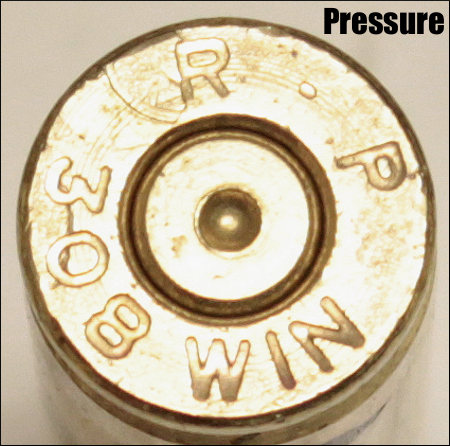
If you will notice in the picture of the case rim, there are two pressure signs to notice. First, look at the primer. It is basically flattened to about the max of what could be considered safe. If this was the only pressure sign noted, I would probably be fine with this load, but would constantly keep an eye on it especially if I was going to use this load in warmer temperatures. This load could easily cross into the “excess pressure” realm very quickly.
There is another sign of pressure that we cannot ignore. If you’ll notice, there is an ejector mark apparent that is located over the “R” of the R-P headstamp. This absolutely tells us that this load would not have been in the safe pressure range. If there were any of these rounds loaded, they should not be fired and should be dis-assembled. This case should not be reloaded.
Split Case-Neck
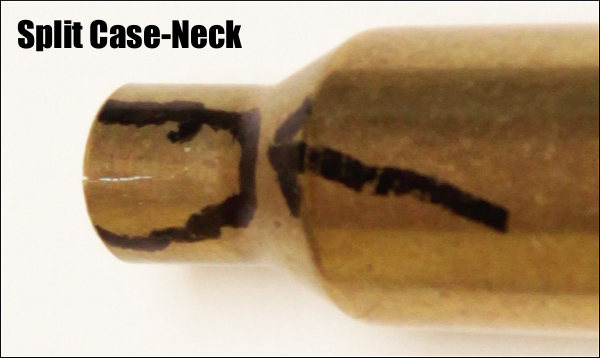
Here we have an R-P .22-250 case that has died the death. Everything looks fine with this case except the neck is split. This case must be tossed.
A split neck is a normal occurrence that you must watch for. It is caused by work-hardening of the brass. Brass cases get harder with age and use. Brand new cases that are stored for a period of time can become hard enough that they will split like this case within one to two firings. I have had new factory loads do the same thing. Then as we resize and fire these cases repeatedly, they tend to get harder and harder. Eventually they will split. The life of the case can be extended by careful annealing practices. This is an issue that would need to be addressed in an article by itself. Of course this case is no longer usable.
In the classes that I teach, I try to use examples like this to let the students see what they should be looking for. As always, if we can assist you, whether you are new to reloading or very experienced, contact us here at Sierra Bullets by phone at 1-800-223-8799 or by email at sierra@sierrabullets.com.
Dented Case Body
Here we have a Lake City 7.62×51 (.308 Win.) case with two heavy marks/dents in the case body.
This one may be a bit of a mystery. It appears as if this case may have been caught in the action of a semi-auto rifle when the firearm jammed or the case failed to clear during the cycling process. I probably would not reload this case just to prevent any feeding problems. This also appeared to be a factory loaded round and I don’t really see any pressure issues or damage to the case.
Multiple Problems — Lake City 5.56×45 unknown year.
This case has suffered multiple failures and cannot be re-used. First its has have a very rounded shoulder that is split. Upon first look it was obvious that this round had been a victim of excess pressure. The firearm (perhaps an AR?) was apparently not in full battery, or there was possibly a headspace issue also. While taking a closer look, the primer was very flat and the outside radius of the primer cup had been lost. High pressure! Then I also noticed that there was an ejector mark on the case rim. This is most certainly an incident of excessive pressure. This case is ruined and should be discarded.
It is very important to observe and inspect your cases before each reloading. After awhile it becomes second nature to notice the little things. Never get complacent as you become more familiar with the reloading process. If ever in doubt, call Sierra’s Techs at 1-800-223-8799.
You’d like to protect your hearing, and maybe you’re a little curious about how your rifle might shoot suppressed. So you’re thinking of buying a suppressor (aka “can”, “moderator”, “silencer”). You can’t just get one off the shelf at Walmart. Acquiring a suppressor requires filling out paperwork and paying a Federal $200 Tax Stamp. Plus there is typically a pretty long wait. However, the good news is that suppressor ownership is now legal in 42 of the 50 American states — that’s 84%! For most American adults, getting a suppressor is legal, provided pass the required background checks.
States Where Suppressor Ownership is Allowed
Currently, the following 42 states allow private ownership of suppressors: AL, AK, AZ, AR, CO, CT, FL, GA, ID, IN, IA, KS, KY, LA, ME, MD, MI, MN, MS, MO, MT, NE, NV, NH, NM, NC, ND, OH, OK, OR, PA, SC, SD, TN, TX, UT, VT, VA, WA, WV, WI, WY.
Note: Even if you live in one of the states listed, you should still verify that owning a suppressor is legal in your area. Some states may have municipal- or county-based restrictions.
States Where Suppressor Ownership is Prohibited
Unfortunately, there are still eight (8) States that forbid private ownership of suppressors. The eight No-Go States are: California, Delaware, Hawaii, Illinois, Massachusetts, New Jersey, New York, Rhode Island. In these eight states, private ownership of suppressors (aka “silencers”) is forbidden. Hopefully that a few of those eight hold-out states will change their laws in the months ahead.
Looking Inside a Suppressor in Action
Popular YouTube Channel Smarter Every Day recently released a cool video featuring rifle suppressors with see-through acrylic sleeves. The team filmed shots through the suppressors using ultra-high-speed (110,000 frame per second) cameras. When played back in super-slow-motion, you can see the flame propagate through the suppressor and the bullet move through each baffle before it exists the muzzle. Watch the results in the video below — it’s mesmerizing:
See Through Suppressor in Super Slow Motion (110,000 fps) — Click Arrow to Watch:
Suppressors, On Average, Reduce Noise Levels about 30 Decibels
In an article for Ammoland, gunwriter Sam Hoober says that you can expect about 30 decibels (dB) of noise reduction from the average suppressor: “Looking at a few different products, SilencerCo attests their suppressors reduce the sound pressure of a 9mm gunshot to anywhere from 125.7 dB to 131.5 dB, depending on the model. Advanced Armament Co, another popular supplier, attests a 23 dB to 33 dB reduction or down to 127 dB. Liberty Suppressors, another manufacturer, attests a reduction of 24 dB to 38 dB, depending on model and other factors. In short, we can presume something on the order of 30 dB of attenuation as an average.”
Using that 30 dB number you can quickly discern that you’ll still need hearing protection — good hearing protection — when shooting any suppressed firearm (even a .22 LR). “Spikes of 130 dB and more can result in permanent hearing damage instantly”. Source: NRA Blog.
Story idea by Boyd Allen. We welcome reader submissions.
Readers — if you reload with Accurate-brand 2495, 4064, or 4350 powders, check your containers now! Accurate Powder is recalling certain lots of these powders in both 1-lb and 8-lb containers. This is serious. The manufacturer says: “The use or storage of this product may result in combustion, fire damage, and/or possible serious injury or property damage.” The problematic powders being recalled were manufactured for Western Powders Inc. prior to 10/1/2016, but they may have been sold anytime after that.
Check the Lot Number on the back or bottom of the containers. The lot number is the last digit or last two digits (right-most digits). Here are the recalled lots:
Accurate 2495 Lots 2-17 | Accurate 4064 Lots 2-16 | Accurate 4350 Lots 2-22
If you have any of the affected powder you should fill the container immediately with WATER. Then contact Western Powders at 406-234-0422 or customerservice@westernpowders.com .
Accurate Powders Recall Notice for 2495, 4064, 4360 Powders
Recall tip from EdLongrange. We welcome reader submissions.
Thanksgiving is less than a week away. Looking for culinary inspiration for your holiday gatherings? The NRA Blog offers three special (and delicious) Wild Game Recipes for your family feasts: Honey Mustard Planked Wild Turkey Breast, Mushroom-Stuffed Wild Boar Roast with Black Truffle Sauce, and BBQ Brined Pigeon. These recipes come from some of the country’s best chefs, and they all seem mouth-watering. You’ll find a full list of ingredients plus step-by-step cooking tips.
One of the many advantages to hunting is the assortment of game you can gather that lasts for an extended period of time. Just because it’s Thanksgiving doesn’t mean you have to stick with a whole turkey from the store and a ham hock.
We have three unique spins on wild game recipes that will suit your dining table perfectly. Even if you’re one of those hunters who enjoys a quick hunt the morning of Thanksgiving, these recipes will make your holiday more delicious than ever. — NRABlog.com
What would you do if you had a LIVE Round stuck in a chamber? Well, don’t hammer a wood dowel in the barrel, that’s for sure. Here is a tale of stupidity that could have injured the rifle owner. This account appeared on the Facebook Page of Brock & Norris Custom Rifles, a gunsmith shop in the United Kingdom.
Live, Loaded Round Stuck in Chamber — What NOT to Do!
Commentary by gunsmith Mike Norris
Here is a cautionary tale. A client came into the workshop with a problem which could have had very serious [even deadly] consequences. And it is not the first time we have seen this. Firing neck-sized-only ammunition, the client attempted to load a round which then jammed solid in the chamber. The bolt would not close and the round was unable to be extracted.
The problem was compounded by various attempts to push the loaded round from the chamber with cleaning rods and the assistance of a hammer (I kid you not!). All of which damaged the bore and the crown, culminating in a wooden dowel being hammered into the barrel which subsequently broke off in the bore. The end result was a barrel that was totally wrecked.
One Facebook friend posted: “Fortunate avoidance of a ‘Darwin Award’. I can hear it: ‘Go on hammer the bolt, she’ll go!’. We’re missing a ‘face palm’ emoji here.”
The Problem Started with a Neck-Sized Case
The moral of this story is DO NOT NECK SIZE cases. Mike advises: “Full-length size cases correctly. You only move the shoulder back 1 to 1.5 thousandths and the case will feed and extract EVERY TIME. Yes you will have to trim cases occasionally but it is one hell of a site cheaper and safer than jamming a live round in the barrel and wrecking the barrel trying to remove it. Not to mention the risk to life and limb!”
What Should Have Been Done in this Situation?
Mike was asked the best method for removing a stuck round. He stated: “The Grease Gun Method on a threaded barrel works*. However, in this case, this was not remotely possible due to 20 inches of wooden dowel being broken off in the bore as well. The live round (yes it was live!) was attempted to be removed by hammering on a brass cleaning rod (an actual hammer was used) to try to dislodge it. That brass rod broke, so then a wooden dowel was employed, and THAT broke as well.”
Mike cautions that, when a live, loaded round is involved you must be very careful: “Do not be taking chances with your own safety or others around you. When it is safe to do so, get the rifle to a professional. By the way he WILL [chide you] for being daft in the first place and then bringing the problem into his premises. Expect to be charged for the expertise to remove said obstruction, In the past I even had a client send me a loading die with a live .338 Lapua round in it through the Post no less!”
* This YouTube Video shows the successful removal of a jammed FIRED (not live) case from an AR15 barrel. You can see the fired case eject at 15:35 time-mark, after the primer pops out first. But note, this was NOT a live, loaded round. Extreme caution must be excercised with live rounds.
Former Army Ranger sniper instructor Ryan Cleckner is the author of the best-selling Long Range Shooting Handbook. Cleckner hosts a series of videos that cover shooting techniques appropriate for tactical and PRS-type disciplines. Here are five short videos that cover various aspects of shooting techniques and rifle set-up. We think PRS/NRL competitors (and long-range hunters) can benefit from these videos.
“Consistency is the key to accuracy.
You need to think about a system of how you’re going to shoot that is not only comfortable, but [is] repeatable when you’re shooting.” — Ryan Cleckner
In this first video, Cleckner explains proper scope position. Ryan finds that some shooters place the scope too far forward or too far rearward. If the scope is too far back you may have issues with eye relief and stock reach to shoulder. If it is too far forward, you may have cheek-weld problems or get neck strain.
Cleckner offers a simple method to check your scope position: “To see if your scope is set up properly … close your eyes, lay your head on your gun, get completely comfortable, and only when you are set-up, then open your eyes. If you can’t see clearly through your scope, CHANGE something [such as comb height or scope position]”. “When you open your eyes, if you see some scope shadow [i.e. the black ring around the edge of the scope picture], figure out which way you need to move your head to get rid of that shadow, and then make adjustments to either your position, the rifle, or the scope.”
Cleckner prefers shooting off a bag when in the prone position, when that is practical. The bag provides a more stable support than a small Harris-type bipod, doesn’t require pre-loading the rifle, and there is less bounce or hop on recoil.
Former Army Ranger sniper team leader Ryan Cleckner explains how important it is to keep your rifle straight up and down when long-range precision shooting. Cleckner demonstrates with an AR-10 modern sporting rifle how slight cant to your rifle can cause a miss over long distances.
Here Cleckner covers some of the basic points of trigger control on tactical-style rifles. These basic principles apply to both single-stage and two-stage triggers. NOTE: For benchrest rigs, with ultra-light pull weights, more refined techniques may be appropriate.
In tactical events, when you’re shooting on the clock and loading from a detachable magazine, you should manipulate the bolt smoothly but strongly. Here Cleckner demonstrates how to cycle a tactical-type rifle. He says, “You should be running the bolt on your rifle with authority. Run it like you mean it!” NOTE: Completely different techniques are appropriate for custom benchrest rifles that manually feed.
Long Range Shooting Handbook — A Good Resource
Cleckner’s Long Range Shooting Handbook covers a wide range of topics important for precision marksmanship — both shooting skills and technical matters. You can view Sample Chapters from Ryan’s Book on Amazon.com. Cleckner’s book is designed as an intro to key concepts such as MOA vs. Mils, External Ballistics, and Environmental Effects. Included are personal tips and advice based on Cleckner’s years of experience as a sniper instructor and special operations sniper.
The Long Range Shooting Handbook is divided into three main categories: What It Is/How It Works, Fundamentals, and How to Use It. “What It Is/How It Works” covers equipment, terminology, and basic principles. “Fundamentals” covers the theory of long range shooting. “How to Use It” gives practical advice on implementing what you’ve learned, so you can progress as a skilled, long range shooter.
Each day, on Facebook, the NRA National Firearms Museum showcases something special from the Museum collections. A while back the Museum displayed a very special Beretta pistol — a gold-plated .32 ACP belonging to legendary airman Chuck Yeager.
This engraved, gold-washed Beretta Model 1935 pistol was presented in 1950 to Brigadier General Chuck Yeager, U.S.A.F., by the Cuban Minister of Defense. (This was before Castro seized power in 1959). Three years before receiving the gun, in 1947, Yeager — piloting the Bell XS-1 — was the first person to successfully break the sound barrier. Yeager was one of the legendary airmen profiled in the book (and Hollywood movie) “The Right Stuff”.
Though this historic, elaborately-engraved sidearm is a “one-of-a-kind” treasure, the Beretta Model 1935 was actually produced in great numbers. Chambered in .32 ACP, more than 500,000 Beretta Model 1935s were made over a 32-year time-span.
View hundreds of other historic firearms on the National Firearm Museum website, www.NRAMuseums.com. Or, if you’re lucky, you can see the collections in person. The NRA now operates three Museum locations: the NRA National Firearms Museum in Fairfax, Virginia; the NRA National Sporting Arms Museum (at BassPro) in Springfield, MO; and the Frank Brownell Museum of the Southwest in Raton, NM.
A hot new 6mm match bullet has arrived — the impressive Berger 109-grain Hybrid. This new 109-grainer, officially called the Long Range Hybrid Target (LRHT), features a formed meplat (bullet tip) for more consistent Ballistic Coefficient (BC). Berger tells us that the new 109gr LRHT boasts a high-BC, “jump-tolerant” hybrid ogive profile along with an extremely consistent BC. In fact, Doppler Radar testing confirms less than 1% BC variation from bullet to bullet. While a high BC is of course desirable for competitive shooting, shot-to-shot BC consistency is most critical when engaging targets to 600 yards and beyond. The 109’s BC numbers are very impressive for a 6mm bullet: 0.568 G1 and 0.292 G7.
AccurateShooter.com plans to test these new 109s very soon — we’re getting them into the hands of some championship-level shooters. The new 109s should prove very popular. These bullets are optimized for leading accuracy cartridges such as 6mm Creedmoor, 6mmBR, 6BRA, 6mm Dasher, 6BRX, 6GT, 6XC, and 6×47 Lapua among others. NOTE: Berger states that the new 109gr LRHT offers the same stability factor as Berger’s outstanding 105gr Hybrid Target. Accordingly, the new 109 can be considered a “direct replacement” for the 105s. And YES, the 109gr LRHT will work in 1:8″-twist barrels.
“The 6mm 109 offers several advantages,” said Bryan Litz, Berger’s Chief Ballistician. “Its ultra-sleek profile provides a higher Ballistic Coefficient (BC) resulting in less wind drift at all ranges. Using the proprietary MRT technology also results in a higher and more consistent BC, which is important for reducing dispersion at long range.”
Meplat Reduction Technology for More Consistent BCs
Berger’s new 6mm 109-grain Long Range Hybrid Target™ Bullets is designed to provide Benchrest, F-Class, and PRS enthusiasts a class-leading level of precision and consistency. Utilizing advanced/proprietary manufacturing processes, Berger’s Meplat Reduction Technology™ (MRT™) System applies controlled pressure along the projectile nose, producing a homogeneous and repeatable bullet profile. This yields what Berger claims are “the industry’s most consistent Ballistic Coefficients (BC)”.
The Berger 6mm 109 Grain Long Range Hybrid Target™ Bullets will be available very soon at authorized Berger Retailers. Use the Berger Dealer Locator to find a store near you.