Brownells is running a huge St. Patrick’s Day Sale right now. There are over 1000 items on sale, with big discounts on reloading tools, AR uppers/lowers, ammunition, triggers, optics and much more. Six notable sale items are previewed above, but that’s just a small sample — there are 1020 products on sale now through March 17 at 11:59 pm CDT. CLICK HERE to shop all 1020 Sale items.
Other sale items include Lapua Brass, Federal Primers, Vortex Scopes, RCBS Chargemasters, Rem 700 Actions, Howa Barreled Actions, Redding Dies, Redding Reloading Presses, CCI and SK Rimfire Ammo, 9mm Pistol Ammo (many brands), Winchester Powder, Lyman Case Prep Centers, and much more. TIP: When you get to the SALE Page, set the “Per Page” display to show 96 Items. That will speed up your shopping.
Many shooters, particular those who shoot vintage military rifle matches, reload once-fired military cartridge brass. This brass may be high-quality and stout, but you may encounter a primer crimp* that interferes with the seating of a new primer. There are a variety of dedicated, military-crimp tools on the market, such as Dillon’s excellent Super Swage 600 tool that “rolls the crimp away”. But the Dillon tool costs $114.99 and takes quite a bit of room on your reloading bench. If you don’t want to drop a C-note and give up valuable bench space — here’s another (much cheaper) solution.
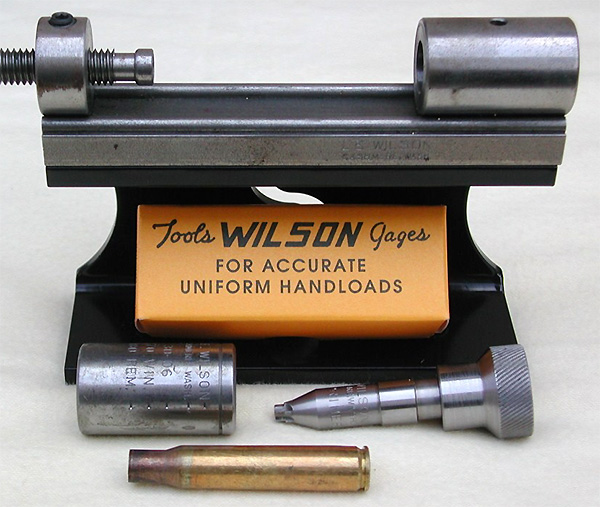
If you already have a Wilson case trimmer set-up, you can ream away those military crimps using an affordable Wilson accessory — the Primer Pocket Reamer (large #PPR210, small #PPR175). This $32.65 accessory is used in conjunction with a Wilson case trimmer and case-holder as shown above.
In the respected Riflemans Journal website, the Editor, “GS Arizona”, showed how to use the Wilson primer pocket reamer to remove military crimps on Lake City .30-06 cartridge brass. He explains: “The case goes into the Wilson case-holder, the same one used for case trimming, and the reamer replaces the trimmer head in the tool base. The threaded rod on the left side, which is normally used to regulate trim length has no use for this operation and it is simply backed out. Hold the case-holder as you turn the reamer into the primer pocket, it cuts easily and quickly. The reamer will stop cutting when the proper depth is reached.”
Do you really need to do this operation with military-crimped brass? Yes, and here’s why: “Any attempt to prime the case without removing the crimp will simply result in a mangled primer that cannot be expected to fire and certainly won’t fire reliably.”
Vintage Military Rifle shooters often utilize surplus military brass with primer pocket crimps.
*Why does military brass has a primer crimp? GS Arizona answers: “The crimp is nothing more than an intentional deformation of the case around the primer pocket, the purpose of which is to retain the primer in the case despite high pressure situations in machine guns and other automatic weapons where a loose primer may cause a malfunction. As reloaders, our task is to get rid of the remnants of the crimp in order to allow re-priming the case.”
Looking to acquire a handgun for personal protection of home and family? There are countless options on the market. Your buying decision may be simplified by seeing what other consumers have chosen, as revealed by nationwide sales trends. You can now check firearms sales figures using “Gun Genius”, a new data-crunching service of Gunbroker.com. On GunGenius.com you can select any type of firearm (handgun, rifle, shotgun)* and see the top sellers for that category. Here are the top-selling semi-auto handguns, new and used. There are separate listings for wheelguns.
Here are the five (5) top-selling NEW semi-auto handguns for February 2020:
Here are the five (5) top-selling USED semi-auto handguns for February 2020:
*Chose semi-auto pistols, revolvers, semi-auto rifles, bolt-action rifles, lever-action rifles, single-shot rifles, semi-auto shotguns, pump shotguns, and more. You can also filter for sales trends (upwards and downwards). Drill down to see detailed product specifications and current prices.
Due to public health concerns related to COVID-19, the Coronavirus, the National Rifle Association (NRA) has cancelled the April 2020 NRA Annual Meetings and Exhibits. A new, rescheduled event date has not been announced. The NRA event was originally slated for April 16-19 in Nashville, Tennessee.
In cancelling the 2020 NRA Annual Meeting, the NRA issued this statement on Friday, March 13th:
NRA Annual Meeting Cancelled
With our 149th Annual Meeting scheduled for next month in Nashville, we realize many NRA members and meeting guests have questions about the coronavirus (COVID-19) and the potential impact on our convention.
We have been closely monitoring updates from the Centers for Disease Control and Prevention and Tennessee Department of Health. In fact, earlier today, a State of Emergency was declared in Tennessee.
Therefore, we have reluctantly decided to cancel this year’s NRA Annual Meeting, planned for April 16 – 19 in Nashville. This applies to all events and scheduled programs, including the NRA-ILA Forum. We sincerely regret the need for this action, particularly for our many loyal members who join us for this annual celebration of the NRA and our constitutional freedoms. Details regarding a rescheduled NRA Members’ Meeting will be forthcoming.
Under the direction of NRA President Carolyn Meadows, the NRA Board of Directors is working with the Office of the Secretary in relation to board elections, meetings, and the like.
Please know that we did not reach this decision lightly. We were ultimately guided by our responsibility to help ensure the safety and well-being of our NRA members, guests, and surrounding community. Please coordinate directly with any hotels, airlines or others who have assisted with your travel arrangements. Most companies have announced plans to accommodate travelers dealing with event cancellations.
Please visit NRAAM.org for additional news and information regarding NRA activities. Thank you for your understanding and continued support.
Competitors take note — The CMP Western Games will continue as scheduled at Ben Avery in Phoenix this week, from March 13 (today) through March 22, 2020. However, the CMP has cancelled some other events scheduled this spring due to concerns over the Coronavirus (COVID-19) (see below).
Regarding the Western Games, the CMP states: “The Western CMP Games and HP Matches at Ben Avery Shooting Facility, AZ [are] to be Conducted as Scheduled. Participants need to be mindful of sound general health practices to help prevent communication of the virus (frequent hand washing, social distance with others, etc.).”
The Western Games begin Friday, March 13 and conclude Sunday, March 22.
CMP Event Cancellations
1. CMP National JROTC Championship — Camp Perry, OH (March 19-21)
Changed to Postal Match.
This championship event will continue as a postal match with finals. Details will be emailed to teams and coaches as soon as they are finalized.
2. CMP 3-P Regional Airgun Championships — Camp Perry, OH – Sandy, UT – Anniston, AL (March 26-28 and April 2-4)
Changed to Postal Matches.
These regional events will continue as postal matches with finals. Details will be emailed to teams and coaches as soon as they are finalized.
3. CMP 3-P Air Rifle Junior Summer Camps and Clinics Program — Multiple Locations (June, July and August). CANCELLED Completely.
On the Watch List:
CMP 3P Air Rifle National Championship — Camp Perry, OH
(Sporter – June 25-27 and Precision July 11-13)
At this point the CMP is planning to conduct the CMP National 3-P Championship in June and July, but will be monitoring the situation and will announce additional cancellations if needed.
Probably the most popular centerfire rifle round in the Western Hemisphere is the .223 Remington and its metric match, the 5.56x45mm. Though many folks use “.223 Rem” and “5.56×45″ interchangeably, there are some meaningful differences in specifications for the original .223 Rem and the 5.56x45mm cartridge, as adopted by the U.S. military and NATO armies. The default chamber throats are slightly different and the .223 Rem is rated at 55,000 PSI vs. 62,366 PSI for the 5.56x45mm.*
.223 Rem vs 5.56x45mm — Key Differences
There is a truly outstanding, very thorough article on the subject, published by LuckyGunner.com.** This involved extensive testing, with pressure monitors, of 5.56x45mm ammo in .223 Rem chambers. Those tests revealed the peak pressures. Here is one of the ammo test charts:
NOTE: “The observed chamber pressure for Federal XM855 5.56mm ammunition in a .223 Rem chamber exceeded .223 maximum pressures, but not by a massive amount. The ninth shot (the red line) was an underpowered cartridge which exhibited significantly lower velocity and pressure than the other rounds, so it was excluded from the average velocity and pressure numbers for this chamber.”
And if you’re curious, LuckyGunner also fired .223 Rem ammo in a 5.56x45mm NATO-chambered AR15 rifle. As you would expect, the peak pressures were significantly lower, but the .223 Rem ammo still cycled the semi-auto AR-platform rifle perfectly well:
UltimateReloader.com Explains .223 Rem vs. 5.56x45mm
To explain the key differences between the .223 Rem and 5.56x45mm cartridges our friend Gavin Gear of UltimateReloader.com has created a very thorough 12-minute video. This covers the cartridge specifications and explains key considerations for hand-loaders. Gavin also addresses the oft-asked question “Can I shoot 5.56x45mm ammo in my .223 Rem chamber?” Gavin’s video is definitely worth watching. In fact, this is one of the most popular videos Gavin has ever created — it has been watched over 300,000 times on YouTube.
What Exactly Is the 5.56x45mm NATO Cartridge?
The 5.56×45mm NATO is a rimless bottle-necked intermediate cartridge family standardized by NATO with development work by FN Herstal. It consists of the SS109, SS110, and SS111 cartridges. Under STANAG 4172, it is a standard cartridge for NATO forces as well as many non-NATO countries.
Bullet diameter: 5.70 mm (0.224 in)
Maximum pressure (EPVAT): 430.00 MPa (62,366 psi)
Maximum pressure (SCATP 5.56): 380.00 MPa (55,114 psi)
Case length: 44.70 mm (1.760 in)
Rifling twist: 178 mm or 229 mm (1 in 7 in)
Parent case: .223 Remington (M193)
Ammo-Maker Federal Premium Compares .223 Rem and 5.56x45mm
Here is a video from ammo-maker Federal Premium explaining the difference between .223 Remington and 5.56x45mm NATO. Federal states that you may experience excessive pressures when firing a 5.56x45mm in a standard .223 Remington chamber:
One leading gunwriter has addressed the question of shooting 5.56x45mm ammo in .223 Rem chambers. He advocates caution (for more info, SEE pressure tests by LuckyGunner.com):
“I have received a slew of questions — many from first time AR-type rifle buyers — about the .223 Rem and the 5.56×45 mm NATO cartridges. Can I shoot 5.56×45 mm NATO in my .223 and vice-versa? Are these the same cartridge?
Externally, the two cartridge cases are identical. The main differences are that 5.56×45 mm NATO operates at a higher chamber pressure (about 60,000 PSI versus 55,000 PSI on the .223 Rem.) and the 5.56’s chamber is slightly larger than that of the .223 Rem. Also, the throat or leade is longer in the 5.56×45 mm chamber. What does this mean? You should not shoot 5.56×45 mm NATO out of a rifle that is chambered in .223 Rem. And be aware that some .223 Rem. ammunition will not reliably cycle through some AR-style .223 Rem. rifles, but it usually does. As a matter of fact, I have not encountered any difficulty with current .223 Rem. loads cycling through a 5.56 mm AR-style rifle.” – Mark Keefe, Editor, American Rifleman
* According to the official NATO proofing guidelines, the 5.56×45mm NATO case can handle up to 430.0 MPa (62,366 psi) piezo service pressure. The U.S. SAAMI lists Maximum Average Pressure (MAP) for the .223 Remington cartridge as 55,000 psi (379.2 MPa) piezo pressure with deviation of up to 58,000 psi (399.9 MPa). The chamber for military 5.56×45mm NATO has a longer throat prior to the bullet contacting the rifling which results in lower pressures when firing 5.56×45mm NATO ammunition. If 5.56×45mm NATO is used in rifles chambered for .223 Remington the bullet will be engraving the rifling when chambered. which can increase pressures past SAAMI Max levels. NOTE: The C.I.P. standards for the C.I.P. civilian .223 Remington chamber are much closer to the military 5.56×45mm NATO chamber.
** The full-length LuckyGunner article is well worth reading. It even provides specifications for a number of .223 Rem reamer types, and compares the original .223 Rem, the 5.56x45mm NATO, and the modern .223 Wylde chamberings.
This popular video, viewed over 3.3 million times on YouTube, provides a clear explanation of Minute of Angle (MOA) and how that angular measurement is used. Among novice shooters, there is much confusion over this term. In this NSSF Video, Ryan Cleckner, a former Sniper Instructor for the 1st Ranger Battalion, defines the term, “Minute of Angle” (MOA) and explains how you can adjust for windage and elevation using 1/4 or 1/8 MOA clicks on your scope. This allows you to sight-in precisely and compensate for bullet drop at various distances.
For starters, Ryan explains that, when talking about angular degrees, a “minute” is simply 1/60th. So a “Minute of Angle” is simply 1/60th of one degree of a central angle, measured either up and down (for elevation) or side to side (for windage). At 100 yards, 1 MOA equals 1.047″ on the target. This is often rounded to one inch for simplicity. Say, for example, you click up 1 MOA. That is roughly 1 inch at 100 yards, or roughly 4 inches at 400 yards, since the target area measured by 1 MOA increases in linear fashion with the distance.
Firing an “off-the-rack” M1903 Springfield that he had never shot before, using GI-issue “tin-plate” ammunition, George Farr shot 71 consecutive bullseyes at 1000 yards (70 for record), setting a marksmanship record that has never been broken.
This is not the typical Daily Bulletin feature. It is an historical account of one of the greatest performances by a marksman in the history of the National Matches at Camp Perry. We think any competitive shooter will find this amazing narrative worth reading from beginning to end. This story is provided courtesy the NRA Blog with photos supplied by the NRA Museums.
An Old Man at the National Matches:
‘Dad’ Farr’s Golden Afternoon at Camp Perry by Doug Wicklund, NRA Museums Senior Curator
It was 1921. Warren Harding was President of the United States, and “The War to End All Wars” was less than three years past. The nation was getting back to a normal routine, and for competitive shooters, that meant an annual pilgrimage through the state of Ohio to the shores of Lake Erie, where the National Matches had been held since 1907 at Camp Perry. In those lighter days of the “Roaring Twenties”, marksmen from states banded together to make the journey, housing together in tent clusters on green lawns well behind the firing points.
The silver plate affixed to George Farr’s M1903 Springfield states: “With this rifle and using issued ammunition Mr. G.R. Farr of Seattle Wash in the Wimbleton Match, 1921, Camp Perry O., made 71 consecutive bulls eyes at 1000 yards”.
But one man at the 1921 National Matches stood out amongst the rest. George “Dad” Farr was a 62-year-old man from the state of Washington, and this was his first time heading east to shoot in the “big leagues”, as some of his fellow Evergreen State friends termed the annual competitions.
Aptly nicknamed, “Dad” was a good bit older than the average shooter during that late summer season, striding forward hesitantly clad in a khaki shirt and dungarees. He wasn’t a practiced High Power shooter — he showed up at Camp Perry without a rifle, and relied on a crude monocular for a spotting scope that he had fashioned from a pair of French opera glasses.
At the previous day’s shooting, he had experienced issues with the initial .30-06 rifle he had chosen from the rack, a Model 1903 Springfield that didn’t seem to hold a consistent zero. This day, he chose a different gun, just another off-the-rack rifle no different from the one next to it. Though he didn’t realize it, George Farr had just made the best selection of his life.
Farr readied his bolt-action and prepared a clip of five rounds of Government Issue ammunition, then went to his position. He was ready to fire on a 1,000-yard target with a rifle he had never shot before.
Perhaps he had resigned himself somewhat to the outcome — after all, it was the last relay of the day on September 9. Off to the west, the sun was beginning its slow trip down to the horizon. But Farr shouldered his Springfield and prepared to fire. The time was 4:30 p.m. Shooters nearby were puzzled by this shooter who squirmed and shifted repeatedly, but were amazed as he made his first hits on paper. Farr was shooting Frankford Arsenal tin-plate ammunition, the standard G.I. .30-06 rounds. More experienced marksmen, like Marine Sgt. John Adkins — who had just won the Wimbledon Cup — were using commercial Remington match ammunition and had spurned the government ammo.
The Historic String of Bullseyes
At that distant 36-inch target, Farr scored two hits for his two sighters, with the last sighter being a bullseye. He then prepared to fire 20 shots for record. Each of those 20 shots went into the center. Each scored as a “5”. At the end of this amazing string, Farr gathered up his monocular and prepared to depart. His fellow shooters quickly advised that match rules required him to continue firing until he missed “the black”, the inner 5-Ring bullseye at the center of the target. Farr had only brought one box of ammunition with him to the firing line, and had run out. As he waited for more of the tin-plate ammo he had been using, the sun continued its retreat. Farr continued his shooting, racking up growing strings of bullseyes – 30, 40 50, 60 – each impact on target being carefully recorded on his scorecard in the growing darkness.
Then, at the 71st shot with daylight completely gone, the bullet strayed outside the target center, and Farr’s incredible string came to its conclusion. But counting his second sighting shot, George Farr had fired 71 consecutive bullseyes at 1,000 yards using an unfamiliar rifle plucked from an ordnance rack earlier that day. It was an amazing feat, one immediately recognized by those in attendance. His fellow shooters quickly took up a generous collection, contributing in recognition of Farr’s natural skill and enabling him to purchase that bolt-action Springfield he had worked magic with on that distant target. Enough funds remained that a silver presentation plate, inscribed with the names of the states whose competitors had contributed, was ordered and mounted on the side of the rifle’s buttstock.
The next year, the Civilian Team Trophy was re-designated as the Farr Trophy, and George Farr’s record, fired on the old target system, was never beaten. Farr’s rifle went home with him to Washington and remained there, never again traveling eastward to Camp Perry. In 2011, The Farr family donated this legendary piece of shooting history to the NRA National Firearms Museum collection.
In 2013, as NRA Museums curators began assembling the collection for display at the NRA National Sporting Arms Museum at Bass Pro Shops in Springfield, Missouri, the museum staff created a unique exhibit featuring George Farr’s Model 1903 Springfield rifle and its special place in competitive shooting history. Alongside the rifle rests Farr’s simple monocular, another mute witness to Camp Perry history made on that September evening in 1921.
Farr’s Springfield… is one of thousands of historically significant firearms found in the NRA Museums collections on display across three locations. To view the collection and learn more about the incredible stories behind each gun, visit the NRA Museums in person or browse the NRA Museums website.
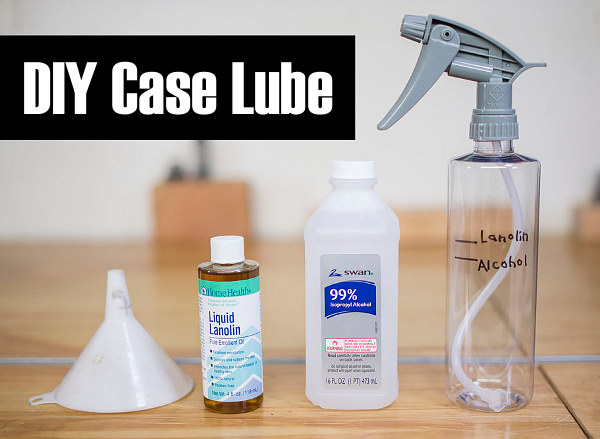
Tired of spending $15-$25 for a can of spray lube that doesn’t last that long? For about the same price as a single 10 oz. can you can make your own effective spray lube that should last for multiple seasons and lube thousands of cases quickly and easily.
In the YouTube video embedded below, our friend Gavin Gear of UltimateReloader.com shows how to make your own case lube using simple, inexpensive ingredients. As recommended by the 6.5 Guys, this Liquid Lanolin + Isopropyl Alchohol mix works well and is very cost-effective. You can make a pint of this home-brew Lanolin case lube that will lube thousands of cases — many more than a typical commercial aerosol spray can (that’s mostly compressed air).
Gavin describes the exact mixing process on his Ultimate Reloader website. Gavin says this lube mix is a good complement to the Hornady One-Shot (pistol) and Dillon DCL (rifle) lubes he has used for pistol and rifle reloading sessions. CLICK HERE to read more.
The new generation Berger LRHT Match bullets come with Meplat Reduction Technology™ (MRT) for more consistent BCs. Essentially they are “pointed” at the factory. Likewise, many of Sierra’s most popular MatchKing bullets are now factory-pointed in a final production stage. However, for most other bullet types, you can benefit from using a bullet pointing system to make the meplats more consistent.
Gear Review by GS Arizona
This article originally appeared in the Rifleman’s Journal website.
Many of you have doubtlessly read Bryan Litz’s articles in our Daily Bulletin and on his Applied Ballistics website about various current long-range bullets. Bryan’s work carries a great deal of weight in the world of ballistics, so his comments (and mathematical proofs) regarding the benefits of bullet pointing certainly caught my attention. Bullet pointing, like meplat trimming, is an effort to reduce the ballistic inconsistency created by the somewhat jagged tip of the jacket where the bullet forming dies bring it to a point in the manufacturing process. Of course, we could eliminate this problem altogether by shooting closed-tip, open-base bullets like the Lapua D46, but that merely shifts the jacket problem to the other end of the bullet.
In any event, hollow point bullets rule the accuracy world today, so John Whidden, multi-time National Long Range Champion and a talented gunsmith to boot, came up with a very handy tool to let us make those hollow points pointier. Let’s have a look at John’s tool and see how it works.
The Whidden Bullet Pointing Die System uses a Forster bullet seating die body as its basic structure and that’s a good choice given the quality machining Forster does on these. The real heart of the tool comes in two parts: the caliber sleeve and the pointing die that fits inside the sleeve. In fact, to point up different caliber bullets, you only need to change the caliber sleeve, everything else remains the same. The last item is the bullet base that slips into a standard .308 shellholder and supports the bullet as it goes into the die body.
It took me less than five minutes to get everything set up, including changing the caliber sleeve from 6mm to .30 caliber. John’s instruction sheets are well illustrated and clearly written; you should have no problem getting up and running.
Pointing the bullets is as easy as sizing a piece of brass. You can see in the second photo above the difference between a few pointed bullets and a few un-pointed ones. The innermost pointed bullet in the picture was my first attempt and I adjusted the die a little after that, you can see that the others are closed a little more. John even includes a couple of sample bullets so that you can see one done right and one done wrong. That is a nice addition that can help you achieve the desired results.
This YouTube Video Shows the Whidden Bullet Pointing Die in Action
I think Bryan’s work supports the validity of this concept and John’s tool puts it into practice in a simple-to-use manner that makes it just about impossible to do any damage to the bullet. I have shot pointed bullets in various calibers at many matches now. Pointing is not a “miracle cure”, but I believe that pointing bullet tips can produce long-range accuracy gains, through reduced vertical dispersion, for many popular types of match bullets. The Whidden Bullet Pointing Die System retails for $220.00 (with one insert). Additional die inserts are $42.00 each. Extra caliber sleeves are also $42.00. You can purchase directly from Whidden Gunworks, or from Sinclair International.



 In the respected Riflemans Journal website, the Editor, “GS Arizona”, showed how to use the