August is National Shooting Sports Month. The goal this month is to celebrate the fun and challenge of shooting, AND, most importantly, to introduce new shooters to the sport. The NSSF encourages all experienced firearm owners to invite a new shooter to the range this month. At the range, act as a mentor for the new person, teaching him or her about safety and the various shooting disciplines he/she can try.
To encourage new shooters, the NSSF has created a special target. With this fun target, you shot five bulleyes, with three different scoring challenges. Download printable PDF targets with the links below.
Win Valuable Prizes with +ONE Gear Giveaway Contest
To promote National Shooting Sports Month, the NSSF is running a +ONE Gear Giveaway contest. You can enter to win one of an impressive collection of +ONE GEARBOX prize packages. These prize collections include rifles, pistols, shotguns, RCBS presses, carry cases, tools, hearing protection, support bags, steel targets, ultrasonic machines, clothing, and more. Guns come from SIG Sauer, Mossberg, Glock, and Primary Arms. Check out the Gear Giveaways below. IMPORTANT: You have to enter separately for each prize package. CLICK HERE to ENTER Gear Drawings.
NSSF 2020 Gear Giveaway — Six +ONE GEARBOX Prize Packages
Jeff Quinn, founder of GunBlast.com, was a good-hearted, southern country boy who loved firearms. Sadly he passed away on July 27, 2020. He will be missed. His reviews were always honest and thoughtful. Notably, Jeff was a true internet pioneer. With help from his brother Boge Quinn, Jeff created Gunblast.com back in 2000. He was one of the first independent writers publishing gun reviews on the internet. And he also was one of the very first to release gun test videos on YouTube. Over the past two decades the GunBlast YouTube channel has racked up over 64 million views. Jeff Quinn led the way for popular YouTube video hosts such as 22Plinkster and Hickok 45.
This Sunday Gunday, to mark Jeff’s passing and recognize his influence in the world of firearms videos, we are reprising six of his videos from the past decade. There are a wide selection here — both rifles and pistols, rimfire and centerfire. We’ve even included a special video where Jeff tests a pre-WWI era Maxim machine gun.
The Patriot — Accurate .22-250 AI Benchrest Rifle
While Jeff Quinn focused on factory handguns, hunting rifles, and defensive shotguns, he did occasionally sample accurate custom rifles. Here he tested a unique “Patriot” .22-250 AI rig built on a sleeved Remington 700 action. This handsome rifle boasts a custom-painted, thumbhole benchrest stock with a stars-and-stripes motif. One side says “In God We Trust”, while the other side carries the message “The Right to Keep and Bear Arms”. This “Patriot” rifle delivered three-shot ragged-hole groups at 100 yards.
Tales from the Vault — Winchester 1895 Lever Gun
Along with his regular field tests, Jeff hosted videos that focused on the historical heritage of some of his favorite firearms. In the “Tales from the Vault” episode, Jeff showcases a prized example from his personal gun collection. This is an original Winchester Model 1895 lever-action rifle chambered in 30 Army, also known as 30-40 Krag.
Smith & Wesson Performance Center M629 .44 Magnum
Smith & Wesson builds some of the best wheelguns on the planet, and Performance Center models are the top of the S&W lineup. This Editor owns two S&W Performance Center revolvers, and they are both outstanding, with great triggers and accuracy that puts most semi-auto handguns to shame. In this video, Jeff Quinn tests a Performance Center six-shot Model 629 Hunter Revolver with a 8 3/8″ fluted barrel. S&W includes a Weaver-type optics rail with this capable wheelgun.
Shooting the Savage A17 in 17 HMR
The Savage model A17 delayed-blowback semi-auto in .17 HMR is one of our favorite budget varmint rifles. It is affordable, reliable, and surprisingly accurate with good .17 HMR ammo. Here Jeff Quinn tests the basic A17. We like the upgraded version with a laminated thumbhole stock, shown below. But both versions utilize the same well-designed action. This is a good choice for small varmints, such as ground squirrels, out to 200 yards.
Ruger GP100 .22 LR 10-Shot Revolver
We believe every gun enthusiast should have a good rimfire revolver, and Jeff Quinn would concur. The small size of the .22 LR cartridge allows modern wheelguns to have 10-round cylinder capacity. That’s great for target shooting, fun plinking, and gun games. Here Jeff reviews the sturdy .22 LR GP100 from Ruger. Jeff says this pistol offers “a good tight barrel/cylinder gap” and “positive ejection that kicks spent cases out really well.” He noted that this pistol was “amazingly accurate”. He tested 9 different ammo types and got 1.5″ average TEN-shot groups at 25 yards. (See video at 2:40 for targets.)
BONUS Video — Maxim Machine Gun (1914 Vintage)
The Maxim machine gun was one of the earliest successful fully-automatic weapons. Many of its revolutionary design features are still used in modern machine guns. Here Jeff Quinn tests a belt-fed, wheeled-carriage Maxim with Joe Meaux of Aklys Defense from Aklys Defense.
Have you ever expanded a .22 or 6mm cartridge all the way up to .30-caliber? If so, you know this can be a difficult procedure that stresses the case necks and neck-shoulder junction. A significant neck-size expansion done in one big jump can increase run-out, cause doughnuts, or worse yet, even split the brass. Therefore you want to proceed in increments, increasing the neck diameter in stages. One smart way to do that is to use a Progressive Press. This article explains how…
The most successful short-range benchrest-for-score cartridge is the 30 BR. That cartridge, as well as 30 BR variants such as the 30 BRX, all start with the 6mmBR Norma parent cartridge, typically with Lapua 6mmBR brass. To get a nice 30 BR case you want to expand in stages, increasing the inside neck diameter incrementally from .243 to .308.
Darrell Jones of DJ’s Brass Service creates thousands of 30 BR cases each year. He has found a clever way to speed up the process — Darrell uses a Progressive Press. He runs his 6BR brass through four (4) separate Hornady neck-sizing dies with expander mandrels. First there is a .257 die, followed by .264 (6.5mm), .284 (7mm), and then .308. Then a fifth and final K&M die provides one last, slight expansion so the newly-fashioned 30 BR cases perfectly fit the arbor of Darrell’s neck-turning tool.
So to repeat, the case starts as .243 (6mm), then moves in up stages .257, .264, .284, and .308, with a final “finishing” step prior to neck-turning. You can see the expansion in this video, which starts with 6mmBR brass that was first hydro-formed to 6 BRX:
Watch 6mm Cases Expanded to 30-Caliber (6BRX to 30 BRX)
For this demo video, Darrell expands just one case at a time. However, he can also put multiple cases in the progressive — one per station. This takes a little more effort, Darrell says, but the results are still excellent. Darrell tells us: “I do put multiple cases in the progressive to save time. The results are the same — I just wanted to show a single-step process and how it reduces run-out by not stressing the shoulder with one big expansion from 6mm straight to 30 caliber. Doing the operation in multiple stages avoids binds and helps keep the shoulders concentric.”
This same multi-stage procedure can be use to expand other cartridge types. For example you could take .221 Fireball brass in stages up to .308 to create 300 Blackout brass.
Darrell uses caliber-specific, Hornady neck-sizing-only dies with elliptical expanders. Darrell tells us: “The Hornady elliptical expander has a reduced bearing surface that puts less strain on the brass when expanding the necks to the next size.” The fitting at the bottom of the die is the Lock-N-Load die bushing that allows fast die changes.
These particular cases used in the video were first hydro-formed to 6BRX then expanded to 30 BRX before neck turning. DJ’s Brass offers hydro-forming for many popular wildcat cartridges such as 6 PPC, 6mm Dasher, and .284 Shehane.
What is Parallax?
Parallax is the apparent movement of the scope’s reticle (cross-hairs) in relation to the target as the shooter moves his eye across the exit pupil of the riflescope. This is caused by the target and the reticle being located in different focal planes.
Why is it Important?
The greater the distance to the target and magnification of the optic, the greater the parallax error becomes. Especially at longer distances, significant sighting error can result if parallax is not removed.
How to Remove Parallax
This Nightforce Tech Tip video quickly shows how to remove parallax on your riflescope.
While keeping the rifle still and looking through the riflescope, a slight nod of the head up and down will quickly determine if parallax is present. To remove parallax, start with the adjustment mechanism on infinity and rotate until the reticle remains stationary in relation to the target regardless of head movement. If parallax has been eliminated, the reticle will remain stationary in relation to the target regardless of eye placement behind the optic.
Above is a 26-year-old hand-loaded .300 Winchester Magnum case that failed to fire. After the misfire, the shooter used an inertial (impact) bullet puller to pull the bullet. In the process the case-neck sheared off.
Here’s a cautionary tale from the Tactical Rifle Shooters Facebook group. This real-world example explains why you should be cautious of old ammunition. Here serious internal corrosion was discovered.
Old Ammunition — Why You Should Be Careful
Commentary byTactical Rifle Shooters
The subject often comes up as to whether it is safe to shoot old ammunition. Historically my answer has always been yes, since over the years I have shot military surplus ammo dating back to World War II (1939-1945) and never had a problem. With over 40 years in competitive shooting, I’ve also had boxes of factory ammo that were 30+ years old and all worked flawlessly.
But I had an interesting experience this week shooting some .300 Winchester Magnum (WinMag) that I had loaded for competition with Reloder 22 back in 1993. I was breaking in a new barrel so just shooting any old ammo that I had. Of the 20 rounds, 15 shot perfectly, three had a fraction of a second hang-fire, and two didn’t shoot at all.
SMART TIP: If you have old ammunition, pull one bullet to see what’s going on inside.
So I pulled the bullets using a hammer-type impact (inertial) bullet puller. What I found was verdigris-like corrosion inside the necks, with one neck completely separating. One reason for this could be that dissimilar metals (copper and brass) can set up a reaction resulting in corrosion. Like I said, this is the first time I’ve seen this, but will definitely be more aware when shooting old hand-loads in the future.
Above is one of the 26-year-old reloaded .300 WinMag cartridges which had failed to fire. To check the internal condition, the bullet was removed using an impact (inertial) bullet puller. Note the verdigris-like corrosion and crack in neck.
Here’s a close-up of the same .300 Winchester Magnum hand-load from 1993 showing serious corrosion inside the neck. (This was a fail-to-fire.) The powder was Alliant Reloder 22. If you have old ammo, it wouldn’t hurt to pull one bullet to see what’s going on inside.
Right Click and “Save as” to download printable PDF versions of target.
In the hit Hollywood movie “The Patriot”, the hero Benjamin Martin (played by Mel Gibson), tells his sons: “Aim small, miss small”. That advice was given to help his sons survive encounters with the British redcoats, but the “aim small, miss small” mantra can benefit target shooters as well.
We have found that novice and intermediate shooters can often improve their accuracy simply by using targets with smaller, more precise aiming points. Inexperienced shooters can benefit by starting with a large-size aiming circle, and then progressing to smaller and smaller target dots. This lets the shooter increase the challenge as his gun-handling becomes more steady and his aim improves.
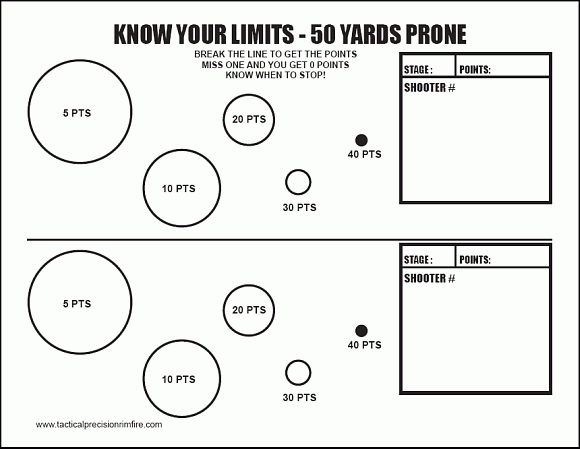
Here are two rimfire training targets with “big to small” target circles. Start with the largest circles, then move to the smaller ones in sequence. This systematic drill provides increasing challenge shot-by-shot. Novices often are quite surprised to see their accuracy improve as they move from bigger to smaller aiming points. That provides positive feedback — always a good thing.
Right Click and “Save as” to download printable PDF versions of target.
The sound of bullets ringing steel were heard all over the country over a three week period in July, during the 2020 Scholastic Action Shooting Program (SASP) National Virtual Championship. Over 248,000 rounds were sent down range as SASP athletes competed from their home ranges around the country. Photo and match results were posted on social media. Scores were then tallied and compared among hundreds of entrants. The ability to compete at Nationals from their home range gave teams all over the country the opportunity to finish the season as a team, competing for the national title.
Just last year, the SASP National Championship surpassed the Glock Shooting Sports Foundation (GSSF), to become the largest Action Shooting Match in history. Despite a heavily altered 2020 season, the SASP community continued to break records for participation with 1,656 event entries for the 2020 SASP National Championship.
“Virtual” Championship Held at Multiple Locations throughout the USA
Traditionally held at the Cardinal Shooting Center in Marengo, Ohio, the 2020 SASP Nationals were instead conducted in a multi-location “virtual” format. This arrangement was made “in order to protect the safety of our athletes, coaches, and familie” according to SASP National Director, Rick Leach. “The nature of our sport puts athletes and range officers in close proximity, which we could not in good conscious do with thousands of athletes in Ohio this year. We received hundreds of photos and videos from teams competing in Nationals from their home range.”
You can see SASP 2020 National Championships Results online. Just select the firearm category and class of shooters. For example, here are Centerfire Pistol Men’s results for all categories. Click image to zoom.
“This year we saw participation grow to states that are not always able to make the journey to Ohio each year for Nationals,” said SASP Director of Development, Kelvin Walton. “Although the spectacle of teams converging on the Cardinal Center to compete is part of the Nationals experience, the SASP community made the most out of an unusual season.”


 In the hit Hollywood movie “The Patriot”, the hero Benjamin Martin (played by Mel Gibson), tells his sons: “Aim small, miss small”. That advice was given to help his sons survive encounters with the British redcoats, but the “aim small, miss small” mantra can benefit target shooters as well.