To support the growing community of new shooters and hunters, Nosler has released a useful, informative video that can help prepare beginners for their first experience at a shooting range. This video was filmed at the Redmond Rod & Gun Club in Central Oregon.
Editor: Regular readers — if you have a friend or family member who is new to shooting, have them watch this video. It does a good job outlining important range etiquette along with safe practices.
Training at a gun range is critical to building foundational firearms skills. Unfortunately, this process can be intimidating for new shooters who are unsure of what a trip to the range fully entails. In this video Randy Newberg (Nosler Pro-Staffer) illustrates key points to help shooters feel safe and confident at any range.
The 7-minute First Trip to the Shooting Range video covers key considerations that apply to all ranges: necessary equipment, firearm safety, range commands, and range etiquette. Differences between indoor and outdoor ranges, as well as range restrictions to consider before your visit are also covered. Newberg also notes: “Before you leave your house, double-check to make sure your firearm is empty”. (Editor: Yes we’ve seen people open their gun cases only to discover their rifle, pistol, or shotgun WAS loaded!)
Important Firearms Safety Rules at the Range
Treat every firearm as if it were loaded.
Always keep your gun pointed in a safe direction.
Never point your firearm at anything you do not intend to shoot.
Always keep your finger off the trigger until your sights are on the target and you are ready to fire.
Always be sure of your target and what is beyond it. (Do NOT shoot unless you know exactly what your shot is going to strike.)
Always comply with ALL Range Commands (and make sure you can hear commands).
Experienced Shooters Should Help Newcomers Learn Safe Procedures
Nosler’s video includes a call-to-action for experienced hunters and shooters to help mentor those new to the sport. As a seasoned shooter you can accompany a new shooter to the range, showing him or her the right procedures. This includes placing rifles on the bench, setting up targets during cease-fires, and properly unloading and clearing weapons. As a mentor, you can also share educational resources that benefit newcomers, and share your effective/safe reloading methods.
A while back, Cal Zant at PrecisionRifleBlog.com did a big muzzle brake comparison test. Along with measuring recoil reduction, Cal’s team recorded sound levels in PRB’s exhaustive muzzle brake field test. In the PRB archives you’ll find comprehensive muzzle brake sound test results, with hard data on 20 different muzzle brakes.
Sound can be a tricky subject, but Cal Zant, the editor of PrecisionRifleBlog.com, presents everything an informed shooter should know about muzzle brake noise in a straightforward and practical way. Most sound tests are measured from the side of the muzzle, in accordance with mil-spec standards, and Cal did that. But he also measured the sound level of each brake from behind the rifle, closer to the shooter’s position. This provides a more accurate indicator of the actual sound levels firearms operators will encounter while shooting.
Muzzle brakes ARE really loud — that’s something most active shooters have observed. But this study finally gives us some hard data and makes objective comparisons. The difference between brakes was quite significant. Some brakes were ear-splitting — more than twice as loud as other brakes tested.
As a bonus, Cal also provides data on how the new Ultra series suppressors from Thunder Beast Arms Corp (TBAC) compare in terms of sound level behind the rifle.
Is The Challenge Of Big Bore Extreme Range Shooting Right For You? By James Patterson
This article originally written for the Sinclair Reloading Press
Handling a .50 BMG Rig
Is a .50 BMG caliber rifle difficult to shoot? Not at all. The relatively heavy weight of a standard rifle at 30 pounds or more combined with a very efficient muzzle brake makes it a pleasure to shoot. The typical recoil can be compared to a .243 rifle or a 12 gauge trap load. On the other hand, the burning of a typical load of 230 grains of powder combined with that muzzle brake makes the muzzle blast experience exhilarating. A first time shooter will fire, pause for a moment in awe at the muzzle blast, and then break out into what has become known as “The 50 Caliber Grin”, almost impossible to wipe from ones face. My daughter started competing with the .50 BMG at 18 (115 lbs of tall skinny girl) and happily shoots 100+ rounds in the course of a match, her grin on the last round is as wide as on the first! Many members and competitors in the FCSA are women and many have distinguished themselves as excellent marksman having set world records on numerous occasions.
Cost of Big-Bore Shooting
Is owning and shooting a .50 BMG caliber rifle expensive? Relatively speaking yes, but one must put it into perspective. Rifles may run from $2500 to $7000, maybe even more for a top of the line custom rifle. A good scope will set you back $1000 to $3500. And while excellent commercial ammo is made, it is hard to find these days and runs from $4 to $6 a round. Most serious shooters start reloading for the rifle as soon as practical, not only for the economics of reloading but also for the ability to fine tune custom ammo for their specific rifle. It’s a very rare match that is won shooting commercial ammo. I recently compared the cost of my hobby — owning, shooting, and competing with the 50 BMG — with a friend whose hobby is snowmobiling. Factoring in the cost of equipment, licensing, gasoline, clothing, etc. it was soon obvious that my hobby was significantly less expensive than his.
Getting Started So how does one get started? You could do as I did, purchase a rifle not knowing what you were really getting into; or you could come out to a FCSA-sponsored event, shoot a number of different rifles, rub shoulders with those who have already taken the plunge, and see if this sport is right for you. While membership in the Fifty Caliber Shooters Association (FSCA) is required to compete at a FSCA event, membership is not required to come and experience first hand what is going on. If you have any inclination that you are interested in the extreme sport of long rang, big bore shooting then a year’s membership in the FCSA is only $60 ($20 for active duty military) a significant bargain if it helps you make just one well-informed equipment choice. In addition one of the primary functions of the FCSA is helping to identify active members near you who can help you understand just what is involved and help you ‘get your feet wet’ in this challenging sport.
“The press is the heart of the handloading operation, also traditionally the most expensive single tool employed…” — Laurie Holland
British competitive shooter Laurie Holland has reviewed three popular, single-stage reloading presses for Target Shooter Magazine (targetshooter.co.uk). Laurie bolted up a Forster Co-Ax, RCBS Rock Chucker Supreme, and RCBS Summit to his reloading bench and put the three presses through their paces. These three machines are very different in design and operation. The venerable Rock Chucker is a classic heavy, cast-iron “O”- type press that offers lots of leverage for tough jobs. The smaller RCBS Summit press is an innovative “upside-down” design with a large center column and open front. It offers a small footprint and easy case access from the front. The Co-Ax is unique in many respects — dies slide in and out of the upper section which allows them to “float”. The cartridge case is held in the lower section by spring-loaded jaws rather than a conventional shell-holder.
If you are considering purchasing any one of these three presses, you should read Laurie’s article start to finish. He reviews the pros and cons of each press, after processing three different brands of brass on each machine. He discusses ergonomics, easy of use, press leverage, smoothness, priming function, and (most importantly), the ability to produce straight ammo with low run-out. The review includes interesting data on case-neck run-out (TIR) for RWS, Federal, and Norma 7x57mm brass.
Review Quick Highlights:
RCBS Rock Chucker Supreme
“My expectations of the antediluvian RCBS Rock Chucker Supreme’s performance weren’t over high to be honest as I mounted it in the place of the Summit. As soon as I sized the first of the stretched RWS cases though, I saw why this press has been such a long-running favorite. The workload was considerably reduced compared to the other two presses and doing 40-odd cases took no time at all with little sweat — it just eats hard-to-size brass.”
RCBS Summit Press
“Despite its massive build and long-stroke operating handle, [the Summit] took more sweat than I’d expected, even if it was somewhat less work than with the Co-Ax. Although the Summit is apparently massive, I noticed that the die platform would tilt fractionally under the heaviest strains[.] It is nevertheless a very pleasant press in use and bullet seating was a doddle — the few examples tried proving very concentric on checking them afterwards. The optional short handle would be valuable for this task.”
Forster Co-Ax
“[On the Co-Ax], the operating handle is above the machine, located centrally here [with] twin steel links at the top end of the press dropping down to the moving parts. The Co-Ax incorporates a number of novel features, principally its automatic and multi-case compatible shell-holder assembly with spring-loaded sliding jaws, very neat spent primer arrangements that allow hardly any gritty residues to escape and foul the moving parts and, the snap-in/out die fitment that allows rapid changes and also sees the die ‘float’ in relation to the case giving very concentric results. I own this press and it meets my handloading needs very well.”
Useful reloading gear does not have to be costly. Here are ten handy (and very inexpensive) items that belong on your loading bench or in your range kit.
• Magnifying Glass – We use a flat, 2″x2″ pocket 4x-8x magnifier. This folds up on itself. Very handy, we use it to inspect bullets and brass. Use this to check your flash holes for burrs, and check the meplats of your bullets before loading.
• Clear 35mm Film Cannister – Use this to transfer the thrown powder charge to the little measuring cup that sits on your scale. That way you don’t get any kernel splash. Also if the charge weight is obviously off, it’s easy to dump back in the measure. A film canister works pretty well as a trickler too.
• Compressed Air in a Can -- Get these at office supply stores. Use the can (with tube attached) to blow crud out of cases after cleaning the neck with a brush, and blast loose debris out of primer pockets.
• Pin Vise – A simple pin vise with a #53 bit is perfect for deburring Lapua PPC and BR flash holes without reaming the flash-holes any larger. The Lapua PPC/BR flash-hole diameter is 1.5 mm, or 0.059″. Amazon.com sells a handy $8.99 pin vise kit with 10 bits, including the ideal 1.5mm bit. Other vendors offer a #53 pin vise bit that measures .0595″ or .060″ (depending or source). You can find pin vises and bits at hobby stores — here’s an example below with ten bits including 1.5mm. Pin vise sets can be found from $7 to $15.
• Bounce Dryer Sheets – The common dryer sheets eliminate “static cling” on your plastic reloading parts such as powder measure cylinders, powder funnels, and reloading press plastic bins. Thanks to Doc76251 for this tip.
• Ballistol Aerosol – Try using this versatile lubricant/solvent for full-length sizing. Spray some on a patch and you can wipe the carbon off your case necks. Then, continue to apply a very small amount of Ballistol on the case bodies — just thin sheen is all you need. Ballistol is super slippery, and easy to remove. For general full-length sizing (on small cases) it works great and doesn’t leave a gooey, waxy, or chalky residue. For heavier case-forming jobs, we recommend Imperial Die Wax.
• Shotgun Mop – Stick this in the chamber when using Wipe-Out foaming bore cleaner. This will seal off the chamber so the foam doesn’t flow into your action. For long chambers screw on one section of cleaning rod to aid extraction.
• Colored Sharpie Marking Pens – Mark your bullets ahead of the bearing surface, and the color transfers to the target. This way you can shoot multiple loads at the same point of aim and discern which load shoots the tightest. (Recommended for 300 yards and beyond). With colored bullet tips you can test multiple loads “round robin” to equalize wind effects. When testing seating depths for example, you can mark the longer-seated set of bullets red and the shorter-seated set green and shoot them during the same sequence. Just look at the colored marks on the target to see which grouped better.
• Thin Latex Gloves – You should keep a box of inexpensive, disposable latex gloves (the kind doctors use) in your loading room. These will prevent contamination of primers or powder kernels that you handle directly. Also, use the gloves when handling fine blued tools or firearms to prevent transfering body oils and salts that promote rust.
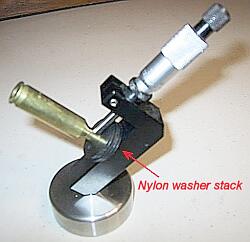
• Plastic Washers for Neck Mic – If you use a Sinclair Neck-wall Micrometer Gauge with integral stand, you can use thin plastic washers to adjust the height of the case on the mandrel. This makes it much easier to measure the same point on the case neck every time. Thanks to MikeCR for this tip (and photo).
Big Green is Back — Remington Ammo Production Resumes
Following the bankruptcy of Remington Arms, Remington’s ammunition business was acquired by Vista Outdoor, parent of CCI, Federal, RCBS and other major shooting/outdoor industry brands. Vista Outdoor took over Remington’s ammunition production facilities, including the main Remington Ammo plant in Lonoke, Arkansas. Federal Ammunition President Jason Vanderbrink was installed as President of Remington, and he has lead a team that has worked hard to get the Remington plant running at full capacity.
Vista Outdoor Takes Over Remington Ammunition Business:
“The Big Green is back [and] it’s stronger than ever. Remington is synonymous with America itself. It is a 205-year-old brand, founded in 1816. ” — Jason Vanderbrink, President of Remington Ammunition
American Rifleman reported: “Remington Ammunition is back in operation[.] Following Remington Outdoors’ bankruptcy in 2020, Vista Outdoor … purchased the Remington ammunition facility in Arkansas, along with most of Remington’s trademarks. Immediately following the acquisition, Vista sent a number of experienced managers down to the Lonoke facility to get production back on track. Remington, one of the largest ammunition facilities in the United States, had difficulty obtaining the raw materials needed to fill its capacity. As a result, employees were laid off, machines were idled, all while domestic ammunition demand reached unprecedented heights. With Vista Outdoor’s management, production is flowing.”
The Remington Plant is now “back in business”, with production output increasing daily. Vanderbrink reviews the situation in this video. Vanderbrink tours the plant, talking about plans to dramatically ramp up production, overcome supply chain issues, work overtime to help meet the current demands of consumers for quality ammunition.
Remington has been working 24/7 to retool and reopen the plant, hiring hundreds of skilled American workers. “Today marks a historic milestone for our industry … I [join] the hard-working crew at Remington Ammunition, the entire team at Vista Outdoor and… shooting sports enthusiasts across America in celebrating the rebirth and resurgence of Remington Ammunition”, said Vanderbrink.
Vanderbrink added that the vastly enhanced flow of raw materials coming to the plant now allows production to be ramped up: “Our workforce is doing fantastic, and our raw material suppliers have really come through. So now, Remington’s going 24/7, and everyone will get to enjoy the quality ammunition that Lonoke, Arkansas makes.”
The National Matches at Camp Perry are a great American tradition. Over the past 114 years, hundreds of thousands of competitors have enjoyed the rifle and pistol matches at Perry on the shores of Lake Erie. Today’s story, from an avid shooter now in his 80s, recounts the halcyon days of pistol competition at Camp Perry, when thousands of shooters competed on the pistol firing lines each summer.
My Camp Perry Experience…
More than 40 National Pistol Matches since 1963
by Don Weihl, 83, Swansea, Illinois
Shooting at Camp Perry has been the experience of a lifetime….
Best Camp Perry times were in the Sixties
The 1963 through 1967 years were the best…
There were more than 2,000 competitors each year. There were 600 targets — numbered 1 through 600, from left to right — across the ranges and grouped into six ranges, 100 targets wide. The matches ran like a well-oiled machine. There was a print shop on the base. All competitors could get a printed match report for each match, not too long after scores were in.
Most nights in those years, there were movies for the competitors and their families in the base theater. The mess hall in those years served three meals a day to over 3,000 hungry mouths – every day.
Favorite memory of Camp Perry — A Record Performance
My favorite memory of Camp Perry [was] in 1966. I was on the line firing next to the Army Team when MSGT Ralph O. Thompson (shown above) fired a 100 on the first .22 cal. pistol target. R.O. then fired another 100 on the second target, setting a National Record of 200×8. That is still unforgettable.
What I like Best about Camp Perry…
Each morning, the day begins with the roar of the cannon and colors. The National Anthem is played as the smoke clears and all stand at attention. Only first relay shooters are on the line, but many second and third relay shooters are there, as well as the match support community – all to observe the colors. Other matches begin with the National Anthem, but at Camp Perry, it is better.
What Was My Favorite Perry Pistol Match?
Actually, There is no favorite match in bullseye shooting. At Camp Perry, you are there to compete against yourself and everybody else. You also compete against the elements, where a slight breeze can turn into a gale, while the grass beneath your feet turns into a muddy obstacle.
What have I Learned on the Firing Line with Other Competitors over the Years?
Everyone learns they are among friends. If there is a problem, the shooter next to you or the shooter next to him will help. If your pistol breaks, the back-up pistol of a nearby competitor will be offered quickly, and the match will proceed.
Advice for First Time Camp Perry Competitors?
Learn to concentrate on something unique to YOUR target. With so many targets so close together, cross-fires are common. Don’t let it be you.
National Matches at Camp Perry Returns in 2021
The National Trophy Pistol and Rifle Matches have been an honored American tradition for generations. The National Trophy Matches have been held at Camp Perry, Ohio, since 1907, 114 years ago. Participants in the 2021 National Pistol Matches can choose from a number of competitions, as well as attend the Pistol Small Arms Firing School. There, trainees will receive classroom instruction before heading to the range for live firing and one-on-one match training.
Civilians and military shooters competed together at the 2019 NTT Pistol Match.
The 2021 National Matches will feature multiple pistol competitions, including a Centerfire Pistol 900 Aggregate, a .45 Pistol 900 Aggregate, and a CMP Revolver Match. To learn more about the CMP’s scheduled events at the upcoming 2021 National Matches at Camp Perry, visit the CMP Nat’l Matches Website. Registration is NOW OPEN.
It took decades of competition to acquire all those patches — that’s dedication to the sport.
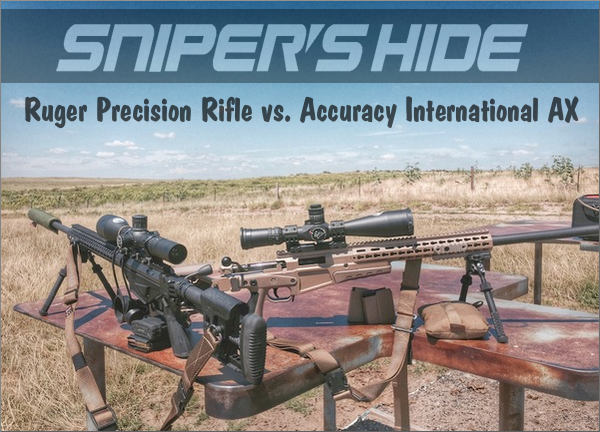
Can a $1300 Ruger compete with a $7000 high-end sniper rifle from the UK? That was the question posed a few years back by Frank Galli, Head Honcho of Sniper’s Hide. Galli, aka “Lowlight”, conducted an interesting comparison test, running the $1300 Ruger Precision Rifle (RPR) vs. a $7000 Accuracy International AX in a 450-yard “mad minute” drill. The goal was to see how many shots could be put on a 12″ steel target in one minute. Both rifles were chambered for the 6.5 Creedmoor and were fed with Hornady 140gr Amax ammo. The much cheaper Ruger did surprisingly well, though the AI AX did come out on top. Galli got 19 rounds on target in one minute with the AI AX compared to 14 rounds with the Ruger.
Watch the “Mad Minute” face-off in this video:
Galli notes: “The target is 450 yards away, and, as noted in the video, we have winds gusting anywhere from 10 to 18 mph out on the Front Range of Colorado today. So my job is to not only hit the target as fast as possible, but to also manage the conditions.”
In Summary
Frank Galli says the Ruger offers a lot of bang for the buck:
“For those looking to get into competitive tactical shooting, like a PRS Event, there is absolutely no excuse. This rifle will allow you to be competitive, the only thing that would hold a person back is themselves. The more this rifle is shot, the more impressive it is. Would I trade my Accuracy International for one? Well, odd question, but no. However for those on a budget I would recommend the Ruger in a heartbeat.”
Upgrades for Ruger Precision Rifle — RPR Enhancements
After conducting this test, Galli added some upgrades to his first-generation RPR, with bolt-on parts. Improvements included new barrel, stock, grip, and handguards. The first video below runs through the selection and installation of parts, while the second video shows the upgraded RPR being tested in the field. These two videos have been watched over half-a-million times combined. Note, the current-generation RPR has different handguards than shown in the photos.
Magpul MOE Grip
Magpul PRS Stock
Seekins Precision “Triangle” Handguards
LongRifles Inc. (LRI) Aluminum Bolt Shroud
Custom K&P “Pre-Fit” Barrel from LRI (chambered in 6.5 Creedmoor)
On the Applied Ballistics Facebook page a few seasons ago, Ballistician Bryan Litz posed a “Tuesday Trivia” question about ballistics. This being Tuesday we thought we’d bring back this interesting brain-teaser — a true/false question about bullet stabilization. On shooting forums you often find heated arguments about “over-stabilization”. Bryan wants readers to consider the issue of over-stabilization and answer a challenge question…
Is This Statement TRUE or FALSE?
“The problem with ‘over-stabilizing’ a bullet (by shooting it from an excessively fast twist rate) is that the bullet will fly ‘nose high’ on a long range shot. The nose-high orientation induces extra drag and reduces the effective BC of the bullet.”
True or False, and WHY?
Click the “Post Comment” link below to post your reply (and explain your reasoning).
Bullet Movement in Flight — More Complicated Than You May Think
Bullets do not follow a laser beam-like, perfectly straight line to the target, nor does the nose of the bullet always point exactly at the point of aim. Multiple forces are in effect that may cause the bullet to yaw (rotate side to side around its axis), tilt nose-up (pitch), or precess (like a spinning top) in flight. These effects (in exaggerated form) are shown below:
Yaw refers to movement of the nose of the bullet away from the line of flight. Precession is a change in the orientation of the rotational axis of a rotating body. It can be defined as a change in direction of the rotation axis in which the second Euler angle (nutation) is constant. In physics, there are two types of precession: torque-free and torque-induced. Nutation refers to small circular movement at the bullet tip.
At the request of our readers, we provide select “Deals of the Week”. Every Sunday afternoon or Monday morning we offer our Best Bargain selections. Here are some of the best deals on firearms, hardware, reloading components, optics, and shooting accessories. Be aware that sale prices are subject to change, and once clearance inventory is sold, it’s gone for good. You snooze you lose.
1. Sportsman’s WHSE — C. Daly 12ga Pump Shotgun, $199.99
⏺ No frills, reliable Self-Defense 12ga Shotgun under $200
If you’ve been searching for a no-nonsense defense shotgun at a bargain price, then check out the Charles Daly 301 Tactical 12 Gauge 3in Black Pump Action Shotgun. It has an aluminum action with a steel barrel and comes with a Beretta/Benelli Modified Choke. It is chambered for 3″ (max) 12 gauge shells. Actual buyers were impressed with this shotgun: “Purchased for value. First day at range fired multiple types of 2 3/4 bird and buck shot with no issues to report.” and “Looks and functions great. Short and handy also.”
⏺ Sophisticated, sturdy, versatile gun vise great for many tasks
Having a stable rifle vise is critical for doing any kind of work, especially mounting optics. One of our favorites is the Tipton Ultra Vise . It features different modules that can be quickly moved, rearranged or removed anywhere along the rail. Leveling feet are situated on all corners making leveling easier, and dual clamp technology rigidly holds any gun shape into place. The best part of this package is that it comes with a FREE Wheeler Scope Leveling System to help mount your scope properly.
The Tipton Ultra Gun Vise’s modular, interchangeable design can hold nearly any type of long gun. Ball and socket articulating clamp pads adapt to any surface. The front and rear clamps are both height and length adjustable with fast-turn knobs for quick clamping.
3. EuroOptic — Trijicon Tenmile Scope Sale — Huge Savings
⏺ These Trijicon optics compare well with NF for much less
Trijicon Tenmile scopes have quickly become popular with F-Class, PRS, and ELR competitors. Check out the Trijicon Tenmile scope sale where you can pick up any of these innovative scopes that feature lit reticles, large 34mm diameter tubes, and many other good features. These are really good scopes for the money. And now’s the time to buy with massive discounts during this sale. For example the Tenmile 3-18x44mm FFP with MRAD ranging is marked down from $2199.99 to $1475.99 (Save $724). And the Tenmile 5-50x56mm Extreme LR SFP scope is marked down from $2700.99 MSRP to $1810.99 — Save $890!
⏺ Strong, well-designed AR 30rd Mags at good price
You can’t watch the news without wondering how long it’ll be before high-capacity magazines are banned nationwide. Avoid price gouging and regret by picking up an AR-15 30-Round Steel 5.56 Magazine 10-Pack. For $139.99 you’ll get TEN 30-round steel 30-Rd magazines with a well-designed anti-tilt follower. The follower is also self-leveling to ensure proper feeding of ammo in your AR15-type firearm.
5. Natchez — 400 Rds Federal XM193 5.56x45mm Ammo, $399.99
⏺ Quality Federal NATO-spec ammo for your AR-15 Platform rifles
Good factory loaded ammo remains hard to find, particularly for popular calibers such .223 Rem (5.56×45). Ammo prices seem to be on a constant rise. One of the best deals we’ve see on in-stock ammo is this Federal XM193 NATO Rifle Ammunition 5.56mm 55gr FMJ, 400/ct. While it’s not the cheapest we’ve seen, it’s good ammo and comes in a military-style ammo box. Nobody has a crystal ball but we may look back and wonder why we didn’t grab more ammo like this before prices rose even higher.
6. Brownells Armory — Everything AR at good prices
⏺ AR-focused product center: Uppers/Lowers/Mags/Triggers and more
More people than ever are looking to pick up some form of an AR-15 and for good reason. If you’re one of those people and don’t know where to look or how to get all the parts you need, check out the Brownells Armory. They’ve made it easy to build one by putting all the categories in an easy-to-navigate menu taking nearly all the guess work out of the process making for a one stop shop.
⏺ Quality Cannon safe at huge discount right now — Save $200
Cannon makes good safes for the money — and this big 27.8 cubic-foot safe is on sale this week. Save $200 on the Cannon Landmark 27.8 Cubic-Foot Executive Safe with Electronic Lock and 60-minute fire rating. This safe is big, measuring 64.33″ Tall x 35.5″ Wide x 25.33″ Deep. The safe is rated to hold 47 guns (NOTE: This capacity figure is based on thin, unscoped rifles, such as lever guns. Nonetheless this is a very capacious safe.) NOTE: The $799.99 SALE price includes curbside delivery to your location.
⏺ Precision-molded ammo blocks are stackable, versatile, affordable
We’re all probably spending a little more time loading these days, but sometimes prep work can be slowed down when you don’t have anywhere to put your brass. Save money and increase your capacity to load by picking up a Universal Reloading Ammo Tray Loading Blocks 10-Pack for just $11.99. These are universally sized, allowing for just about any type brass. NOTE These blocks are designed to stack securely, so you can use them for both short pistol cases (using one block) and taller rifle cartridges (using two or three blocks). These are cheap enough that you can also use them for general storage in crates or ammo boxes.
9. Amazon — EZ-Aim Bullseye Paper Target, 13-pack $3.90
⏺ Great, high-contrast Bullseye Targets just 30 cents each
Why spend a ton of money on targets that just get shot up and thrown away? Check out these EZ-Aim Paper Shooting Range and Archery Targets. They’re bright white with easy to see aiming points, and numbered Ring values. We like these because they resemble match targets. At $3.90 for 13 targets, your per target cost is just $0.30 (thirty cents)! NOTE: Allen also sells many other paper and reactive shooting targets — everything from sight-in sheets to prairie dog targets and spinners.





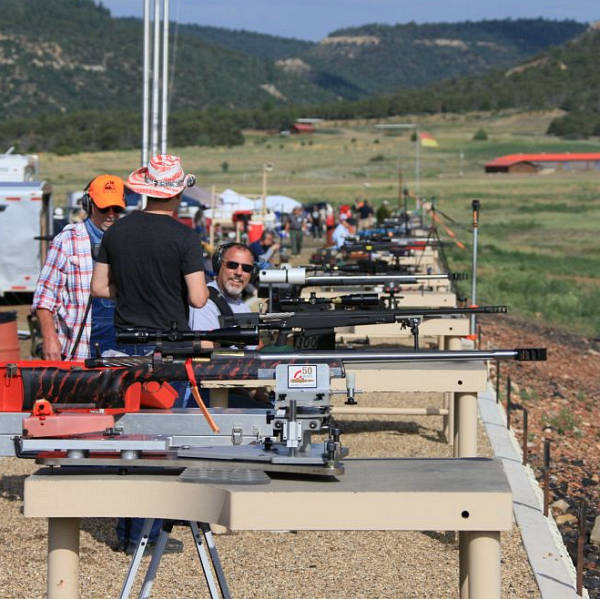


 So how does one get started? You could do as I did, purchase a rifle not knowing what you were really getting into; or you could come out to a FCSA-sponsored event, shoot a number of different rifles, rub shoulders with those who have already taken the plunge, and see if this sport is right for you. While membership in the

 Review Quick Highlights:
 • Magnifying Glass – We use a flat, 2″x2″ pocket 4x-8x magnifier. This folds up on itself. Very handy, we use it to inspect bullets and brass. Use this to check your flash holes for burrs, and check the meplats of your bullets before loading.
 • Ballistol Aerosol – Try using this versatile lubricant/solvent for full-length sizing. Spray some on a patch and you can wipe the carbon off your case necks. Then, continue to apply a very small amount of Ballistol on the case bodies — just thin sheen is all you need. Ballistol is super slippery, and easy to remove. For general full-length sizing (on small cases) it works great and doesn’t leave a gooey, waxy, or chalky residue. For heavier case-forming jobs, we recommend Imperial Die Wax.


 What have I Learned on the Firing Line with Other Competitors over the Years?


 On the


