Many barrel-makers mark the twist rate and bore dimensions on their barrel blanks.
Does muzzle velocity change with faster or slower barrel twist rates? Absolutely, but much less than you might think. Faster twist rates do slow down bullets somewhat, but the speed loss is NOT that significant. With Bartlein .308 Win barrels of identical length and contour, a 1:12″-twist barrel was only 8 fps faster than a 1:8″-twist barrel. That was the result of testing by Applied Ballistics.
The Applied Ballistics team tested six (6) same-length/same-contour Bartlein barrels to observe how twist rate might affect muzzle velocity. This unique, multi-barrel test is featured in the book Modern Advancements in Long Range Shooting, Vol. 1. That book includes other fascinating field tests, including a comprehensive chronograph comparison.
Barrel Twist Rate vs. Velocity — What Tests Reveal by Bryan Litz
When considering barrel twist rates, it’s a common belief that faster twist rates will reduce muzzle velocity. The thinking is that the faster twist rate will resist forward motion of the bullet and slow it down. There are anecdotal accounts of this, such as when someone replaces a barrel of one brand/twist with a different brand and twist and observes a different muzzle velocity. But how do you know the twist rate is what affected muzzle velocity and not the barrel finish, or bore/groove dimensions? Did you use the same chronograph to measure velocity from both barrels? Do you really trust your chronograph?
Summary of Test Results
After all the smoke cleared, we found that muzzle velocity correlates to twist rate at the average rate of approximately 1.33 FPS per inch of twist. In other words, your velocity is reduced by about 5 FPS if you go from a 1:12″ twist to a 1:8″ twist. — Bryan Litz
Savage Test Rifle with Six Bartlein Barrels
Most shooters don’t have access to the equipment required to fully explore questions like this. These are exactly the kinds of things we examine in the book Modern Advancements in Long Range Shooting, Vol. 1. In that book, we present experiments conducted in the Applied Ballistics lab. Some of those experiments took on a “Myth Buster” tone as we sought to confirm (or deny) popular pre-conceptions. For example, here’s how we approached the question of barrel twist and muzzle velocity.
Six .308 Win Barrels from Bartlein — All Shot from the Same Rifle
We acquired six (6) barrels from the same manufacturer (Bartlein), all the same length and contour, and all chambered with the same reamer (SAAMI spec .308 Winchester). All these barrels were fitted to the same Savage Precision Target action, and fired from the same stock, and bench set-up. Common ammo was fired from all six barrels having different twist rates and rifling configurations. In this way, we’re truly able to compare what effect the actual twist rate has on muzzle velocity with a reasonable degree of confidence.
Prior to live fire testing, we explored the theoretical basis of the project, doing the physics. In this case, an energy balance is presented which predicts how much velocity you should expect to lose for a bullet that’s got a little more rotational energy from the faster twist. In the case of the .30 caliber 175 grain bullets, the math predicts a loss of 1.25 fps per inch-unit of barrel twist (e.g. a 1:8″ twist is predicted to be 1.25 fps slower than a 1:9″ twist).
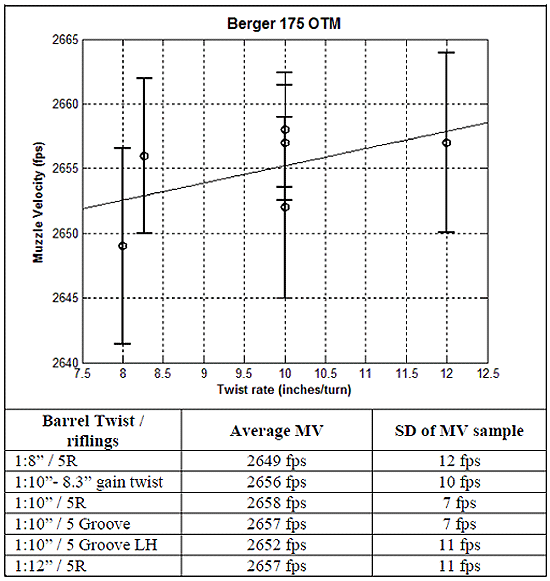
Above, data shows relationship between Twist Rate and Muzzle Velocity (MV) for various barrel twist rates and rifling types. From fast to slow, the three 1:10″ twist barrels are: 5R (canted land), 5 Groove, 5 Groove left-hand twist.
We proceeded with testing all 6 barrels, with twist rates from 1:8″ to 1:12″. After all the smoke cleared, we found that muzzle velocity correlates to twist rate at the average rate of approximately 1.33 fps per inch of twist. In other words, your velocity is reduced by about 5 fps if you go from a 1:12″ twist to a 1:8″ twist. [Editor: That’s an average for all the lengths tested. The actual variance between 1:12″ and 1:8″ here was 8 FPS.] In this case the math prediction was pretty close, and we have to remember that there’s always uncertainty in the live fire results. Uncertainty is always considered in terms of what conclusions the results can actually support with confidence.
This is just a brief synopsis of a single test case. The coverage of twist rates in Modern Advancements in Long-Range Shooting Vol. 1 is more detailed, with multiple live fire tests. Results are extrapolated for other calibers and bullet weights. Needless to say, the question of “how twist rate affects muzzle velocity” is fully answered.
Other chapters in the book’s twist rate section include: · Stability and Drag — Supersonic
· Stability and Drag — Transonic
· Spin Rate Decay
· Effect of Twist rate on Precision
Other sections of the book include: Modern Rifles, Scopes, and Bullets as well as Advancements in Predictive Modeling. This book is sold through the Applied Ballistics online store at thescienceofaccuracy.com. Modern Advancements in Long Range Shooting is also available as an eBook in Amazon Kindle format.
Guys — honestly, if you do anything today on this site, watch this video. You won’t be disappointed. Guaranteed. This is a very informative (and surprisingly entertaining) video. Every serious hand-loader should watch this video to see how cartridge cases are made. Your Editor has watched the video 5 times now and I still find it fascinating. The camera work and editing are excellent — there are many close-ups revealing key processes such as annealing and head-stamping.
VERY Informative Video Show Cartridge Brass and Ammunition Production:
Norma has released a fascinating video showing how bullet, brass, and ammunition are produced at the Norma Precision AB factory which first opened in 1902. You can see how cartridges are made starting with brass disks, then formed into shape through a series of processes, including “hitting [the cup] with a 30-ton hammer”. After annealing (shown at 0:08″), samples from every batch of brass are analyzed (at multiple points along the case length) to check metal grain structure and hardness. Before packing, each case is visually inspected by a human being (3:27″ time-mark).
The video also shows how bullets are made from jackets and lead cores. Finally, you can watch the loading machines that fill cases with powder, seat the bullets, and then transport the loaded rounds to the packing system. In his enthusiasm, the reporter/narrator does sometimes confuse the term “bullets” and “rounds” (5:00″), but you can figure out what he means. We definitely recommend watching this video. It’s fascinating to see 110-year-old sorting devices on the assembly line right next to state-of-the art, digitally-controlled production machinery.
Video tip by EdLongrange. We welcome reader submissions.
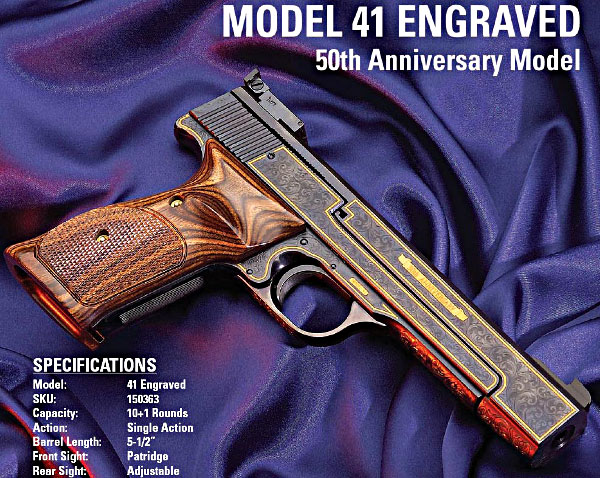
The Smith & Wesson Model 41 is a classic American rimfire target pistol. Beautifully crafted, the Model 41 boasts a superb trigger, comfortable grip, and excellent accuracy. New or used, a Model 41 is a fine addition to any firearms collection. We’ve shot a few Model 41s, and they will spoil you if you go back to a lesser rimfire pistol. First released commercially in in 1957, a special 50th Anniversary Model (shown above top) came out in 2007 (hitting the market in 2008). Perhaps it should have been named the 60th Anniversary edition, as the first prototypes of the Model 41 were crafted way back in 1947. READ American Rifleman article about Model 41.
The Model 41 is one of those classic American designs that has stood the test of time. Many feel the Model 41 represents the apex of American .22 LR pistol design, much like the Colt Python is the “crown jewel” of double-action revolvers. One YouTube poster noted: “After [65] years the Model 41 is still near the top of the game in precision .22s. Very few if any of the current day pistols can match the workmanship, fit, and balance that makes having a Model 41 so enjoyable to own.”
The Stunning 50th Anniversary Edition Model 41
Probably the most sought-after Model 41 is the handsome, machine-engraved 50th Anniversary Model, released in 2007. This was offered in a hardwood, glass-covered case. This would be a prized addition to any gun collection. For $2000.00 to $3700.00 you can find the fully engraved, 50th Anniversary Model 41 in presentation case on various auction websites. First released in 2007, the engraved model 41 combines superior accuracy with stunning appearance.
The 50th Anniversary Model was machine-engraved with Class A+ coverage, 24 carat gold striping, and special serial number range FYA0001 – FYA0500.
Smith & Wesson Model 41 — An American Classic Rimfire Pistol
The Smith & Wesson Model 41 is an American classic — one of the great, iconic .22 LR target pistols. Accurate, well-balanced and built-to-last, model 41s have been in production for over 50 years. The Model 41 remains one of the most accurate pistols ever produced by Smith & Wesson.
Model 41 photo by Mightymoo01, creative commons released CC BY-SA 3.0.
Beautifully crafted, the Model 41 boasts a superb trigger, comfortable grip, and excellent accuracy. Whether an older classic or a newer model, the S&W Model 41 is something every gun owner would prize for target shooting. And “like new” high-grade models are now appreciating in value!
Field Test of Current Generation S&W Model 41
So how do modern production Model 41s shoot? Very well indeed, based on the results from popular gun Vlogger 22plinkster. He took a new Model 41 to his test range and tested it for handling and accuracy. Watch the 22plinkster video below:
22plinkster runs of the most popular gun-centric YouTube channels. His videos have been watched by hundreds of thousands of firearms fans. Some of .22 Plinkster’s videos involve trick shots, but he’s actually a very competent marksman who has shot a vast collection of .22 LR/22 WMR pistols and rifles, making him a qualified rimfire expert.
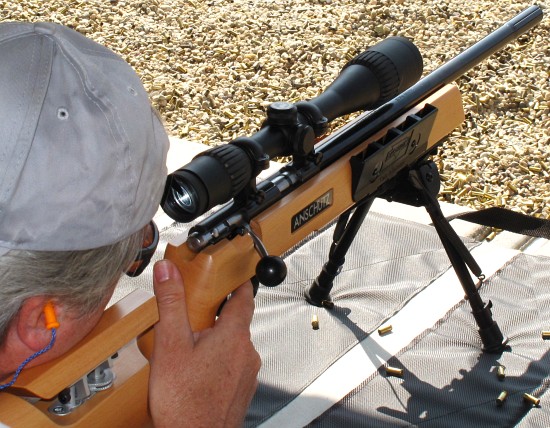
AccurateShooter’s Editor trains with .22 LR Anschutz model 64R back in 2008.
Rimfire Tactical Matches Aren’t Really New
NRL22 and PRS 22 rimfire shooting disciplines are fun, affordable forms of competition. We’re pleased to see the rapid growth of NRL22 and PRS rimfire. However, the concept of a rimfire tactical/practical match is not new — at least on the West Coast. Way before anyone every heard of PRS, California shooting clubs conducted “Rimfire Tactical” matches. These matches were first fired nearly two decades ago. CLICK HERE to read our comprehensive Rimfire Tactical report from way back in 2008. That article includes free targets, ballistics charts, and a complete run-down on suitable rimfire rifles.
The Concept Behind the Rimfire Tactical Match by Bill Erwin
Many guys who shoot long-range tactical matches practice with .22 LR rifles of similar configuration. Rimfire ammo is way more affordable than centerfire, you do not need a big range facility, and shooting rimfire saves wear and tear on your centerfire rifle. Further, for learning how to read the wind, there really is no better training tool than a 22 LR, even as close as 50 yards. Check out this table showing how a .22 LR ballistics compare to .308 Win:
.22 LR vs. .308, Distances for Equal 10 MPH Wind Drift
This table shows the corresponding distances at which a 10 mph full-value crosswind pushes a .22 LR bullet and .308 projectile the same amount. Values are based on 0.130 BC for a 40gr .22 LR bullet, and 0.496 BC for 175gr .308 bullet.
22 LR 40gr 1050 fps
50 yd Wind 1.0″
75 yd Wind 2.2″
100 yd Wind 3.8″
125 yd Wind 5.8″
150 yd Wind 8.2″
175 yd Wind 11.0″
200 yd Wind 14.3″
.308 Win 175gr 2650 fps
130 yd Wind 1.07″
180 yd Wind 2.15″
230 yd Wind 3.68″
280 yd Wind 5.63″
330 yd Wind 7.98″
380 yd Wind 10.71″
440 yd Wind 14.56″
This table shows how the .22 LR can be an effective substitute for a .308 Win during training. Because the smaller bullet drifts more in the wind, a .22 LR rimfire shooter will experience roughly the same crosswind effects as if he was shooting a 175gr .308 Win twice as far out. So, rimfire work can teach you to dope the wind like a .308 Win, but at less than half the distance. Shooting a .22 LR at 100 yards is like shooting a .308 Win (with 175gr SMK) at 230 yards.
SPECIAL BONUS–Rimfire Tactical Precision Targets
These FREE targets by DesertFrog are offered in Adobe Acrobat format for easy printing. CLICK HERE to download all six targets as a .ZIP archive.
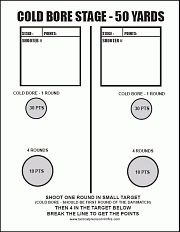
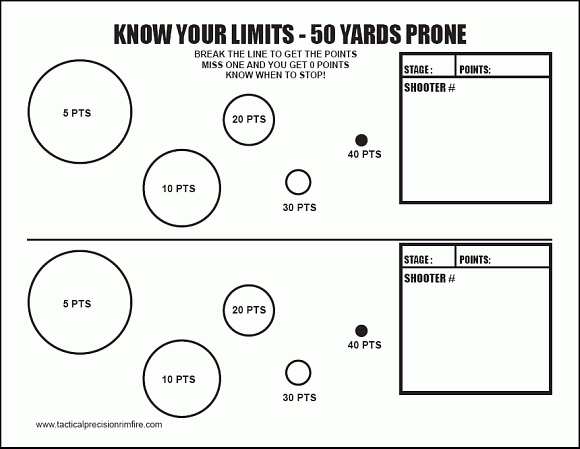
Rimfire Training Target for Fun Matches
Here’s a rimfire training target with “big to small” target circles. Start with the largest circles, then move to the smaller ones in sequence. This systematic drill provides increasing challenge shot-by-shot. Novices often are quite surprised to see their accuracy improve as they move from bigger to smaller aiming points. That provides positive feedback — always a good thing.
Right Click and “Save as” to download printable PDF versions of target.
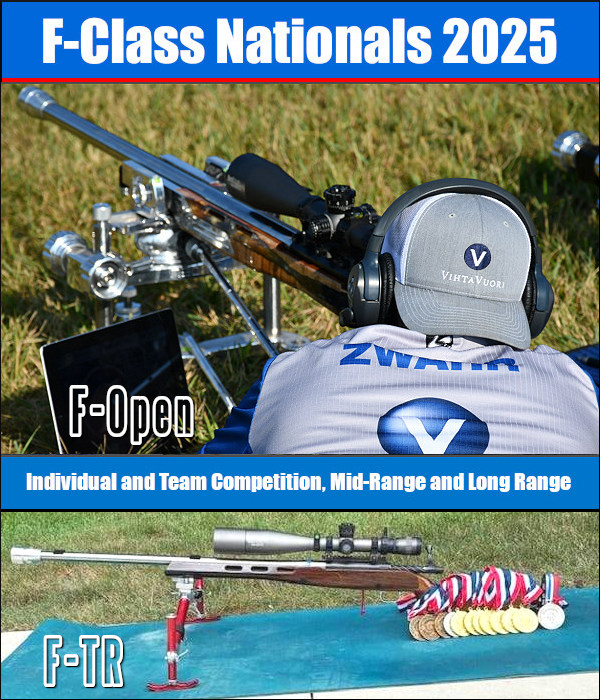
The 2025 F-Class Nationals took place recently at the Winnequah Range in Wisconsin. The match was run superbly with an excellent target system. Competitor John Masek, who finish 10th in F-Open, noted: “Congrats to all the winners in both Mid and Long Range — there were no ‘gimme’ matches the whole week. It was an awesome match and the folks at Winnequah put on a hell of a match. We had hundreds of devices on the Shotmarker system at one time and I don’t remember it ever going down because of it. Great weather and a tricky tricky range led to all kinds of shake-ups each day especially as long range went on.” The winds did become challenging on the final day said Winnequah staffer Kevin Liebetrau.
The Winnequah Gun Club in Lodi, Wisconsin, hosted the NRA F-Class National Championships from August 2nd to 9th, attracting top-tier competitors. This premier event has two main categories: F-Open and F-TR, each with specific equipment and caliber rules. The championship employed ShotMarker Electronic Target Systems for real-time scoring at both Mid-Range (600 yards) and Long-Range (1000 yards).
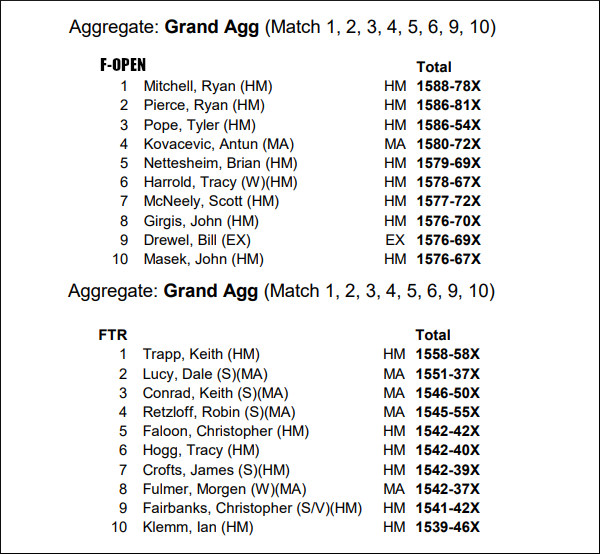
F-Class Long Range Nationals Top 10 Finishers, F-Open and F-TR
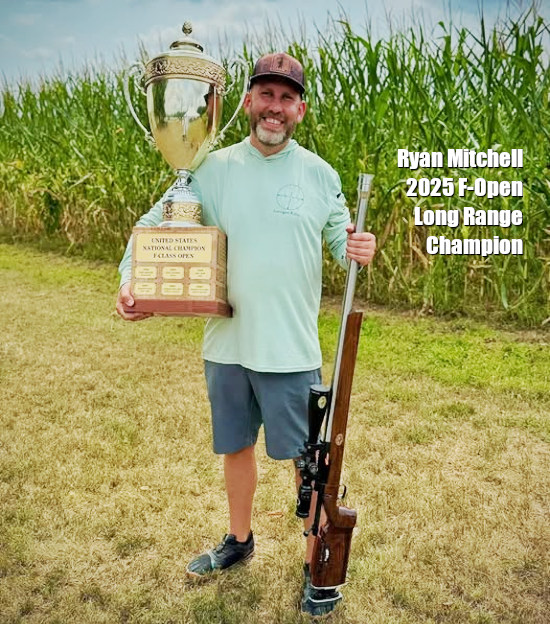
Congratulations to Ryan Mitchell for winning the 2025 F-Open Long-Range Nationals.
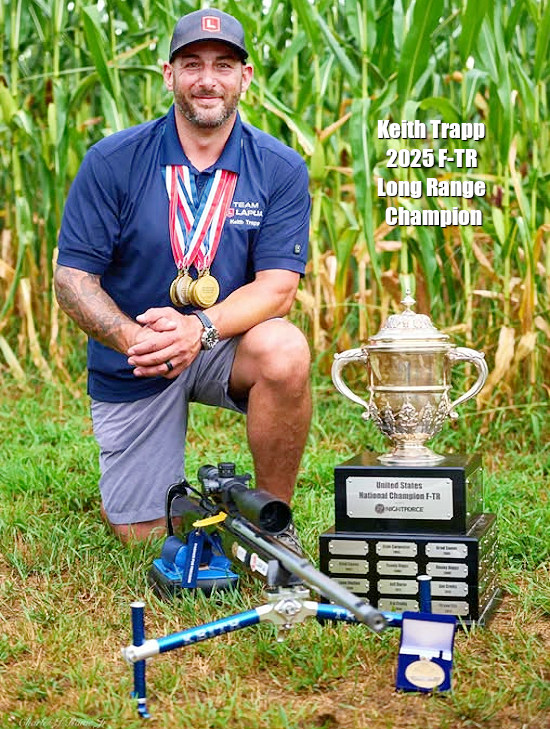
Congratulations to Keith Trapp for winning the F-TR Long-Range Nationals for the second time!
Team Competition at the F-Class Nationals
Here is a video from the Long Range Teams Match.
In Team Competition, the Bayou Boys won F-Open with a 1578-72X score with Team Lapua just six Xs behind with 1578-66X. In F-TR division, Team USA F-TR Berger took the title with a 1542-33X score. In second was Team USA F-TR Vihtavuori with a 1527-36X score.
SEE: F-Open Team Results; F-TR Team Results.
Keith Trapp Wins F-TR LR National Championship
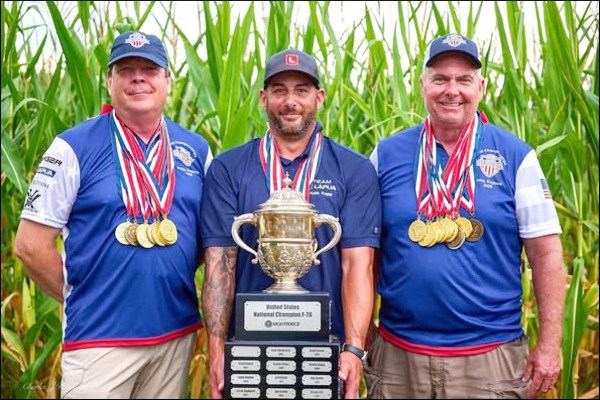
Team Lapua’s Keith Trapp won the F-TR division of the USA F-Class Long Range National Championship, with an impressive 1558-58X Aggregate score. This marks Trapp’s second F-Class National Championship win. Trapp won his first F-Class Long Range title in 2022, and his first Mid-Range title in 2023.
“I’m incredibly proud of this win,” said Trapp. “The competition was fierce, but my equipment, particularly the Berger bullets, Vihtavuori powder, and Lapua cases, performed flawlessly, giving me the confidence I needed to perform at my best. It’s truly an honor to win this title for a second time.”
Keith Trapp’s confidence was significantly aided by his choice of ammunition. He relied on Berger 200.20X bullets, propelled by Vihtavuori N150 powder, loaded into Lapua .308 Win Palma cases. Trapp is set to compete this September on the international stage at the upcoming European F-Class Nationals.
Top F-TR finishers in the Long Range Competition. Dale Lucy on left, and Keith Conrad on right. First-place finisher Keith Trapp holds the trophy. Keith won the title the hard way, overcoming a crossfire on Day One. This was a great performance.
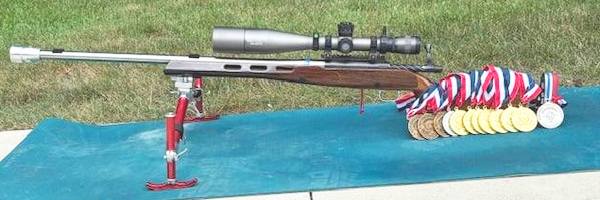
Dale Lucy’s F-TR Rifle with Barrel Tuner and SEB Joy-Pod front joystick-adjustable bipod.
Competitor Mike Cateena noted that there was “challenging weather this week for the 2025 US F-Class National Championship and amazingly the rain held off until the finish of the last day.” Mike added: “And congratulations to all the winners and a huge congratulations to the USA F-TR Rifle team — you guys absolutely crushed it at Nationals this year! And thank you Winnequah Gun Club for doing an amazing job at hosting this year’s F-Class Nationals and thank you Criterion Barrels, Inc., Krieger Barrels and Brux Barrels, LLC for supporting the match.”
Competitor F-Class John, who finished 10th in the Long Range event, said the match was run really well and the support services provided to competitors were excellent.
2025 Mid-Range F-Class Nationals Results
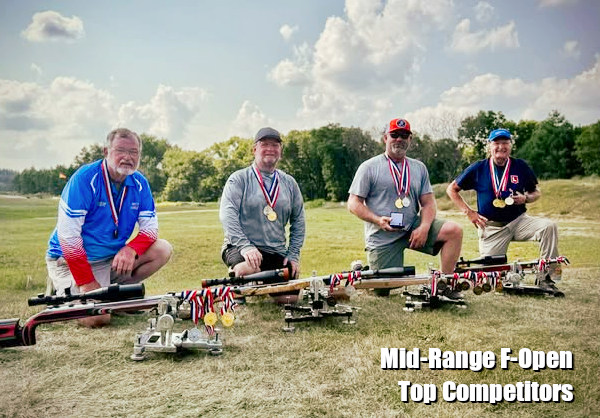
The 2025 F-Class Mid-Range Nationals were held August 2-5 at the Winnequah Range. Remarkably, the top five F-Open shooters all finished with 1796 points, dropping only 4 points in nine stages, earning 1796 out of 1800 possible points. Randy Snook won the F-Open Class shooting a 6BRA with a 1796-127X score, winning the title on X-count. Here are the scores for the top five Mid-Range F-0pen shooters: Randy Snook 1796-127X; Brad Johnson 1796-118X; Johnny Ingram 1796-117X; Andy Amber 1796-116X; Dave Lyons 1796-106X.
The top five Mid-Range competitors all finished with 1796 points, dropping just 4 points on 180 targets!
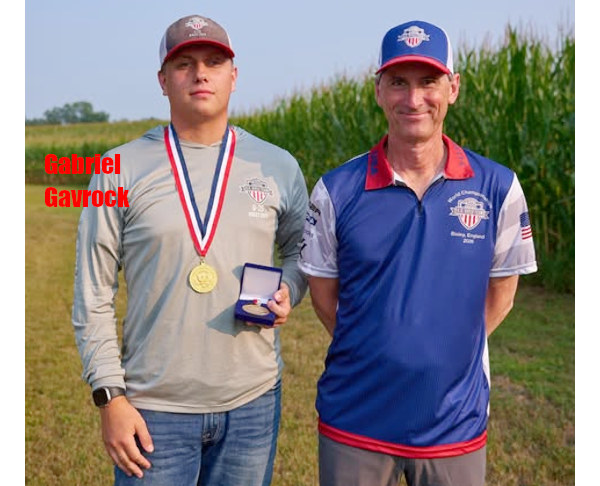
In the F-TR Division (limited to .223 Rem and .308 Win), Gabriel Gavrock secured the 2025 Mid-Range Title with a 1785-100X Score. In second was Lusty Leo Cebula with a 1782-94X score. Finishing third was David Schmidt with 1781-97X. It’s notable that Gabe Gavrock (below left in photo) is just 19 years old — so this is a great start to his marksmanship career. Gabe is a member of the Under-25 United States Rifle Team. He is the only junior to ever win a USA F-Class Nationals event.
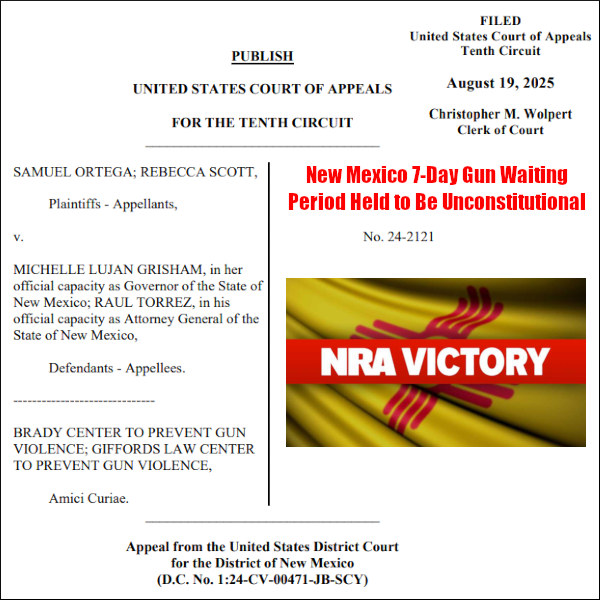
A three-judge panel of the 10th U.S. Circuit Court of Appeals blocked New Mexico’s 7-day waiting period on firearm purchases. In the Ortega v Grisham case, the 10th Circuit panel ruled that the law infringes on Second Amendment rights. Judge Tymkovich, writing for the court, determined that the right to keep and bear arms necessarily includes the lawful acquisition of firearms and, therefore, “cooling off” waiting periods infringe on Second Amendment-protected conduct. The court noted that waiting periods are a modern invention that are unsupported by our nation’s historical tradition of firearm regulation. The case has been sent back to a lower court for injunction specifics. CLICK HERE for full 10th Circuit Decision.
Background: New Mexico enacted a law requiring a 7-day waiting period for firearm purchases. The law was challenged by the NRA and Mountain States Legal, arguing it infringed on the Second Amendment. The lawsuit cited concerns about delayed access to firearms for victims of domestic violence and other crimes.
After the Second Amendment victory in Ortega v. Grisham, John Commerford, NRA-ILA Executive Director, released the following statement:
“In courtrooms across America, the NRA is successfully leading the charge to protect law-abiding Americans’ Second Amendment rights. The 10th Circuit has sided with the NRA and held that radical waiting period laws are indeed unconstitutional. This decision not only impacts gun owners in New Mexico, Colorado, Utah, Wyoming, Kansas, and Oklahoma, but serves as a key piece in dismantling similar gun control laws across the country.”
History of the case
On May 15, 2024, the NRA, in coordination with the Mountain States Legal Foundation, filed Ortega v Grisham, a lawsuit challenging New Mexico’s radical seven-day waiting period law.
On Monday, July 22, 2024, the U.S. District Court for the District of New Mexico denied the plaintiffs’ motion for a temporary restraining order and preliminary injunction against New Mexico’s law requiring individuals to wait seven days before taking possession of any firearm they purchase.
Today, August 19, 2025, the 10th Circuit Court reversed and remanded this decision, ruling the law is unconstitutional and ordered a preliminary injunction to ensure the rights of law-abiding citizens are no longer infringed. The full ruling can be found HERE.
This ruling was based on the landmark NRA-backed Supreme Court case New York State Rifle & Pistol Association v. Bruen, which held that gun control laws are unconstitutional unless they are consistent with our nation’s historical tradition of firearm regulation.
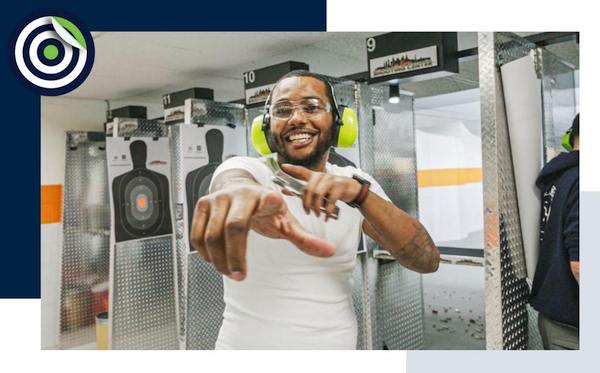
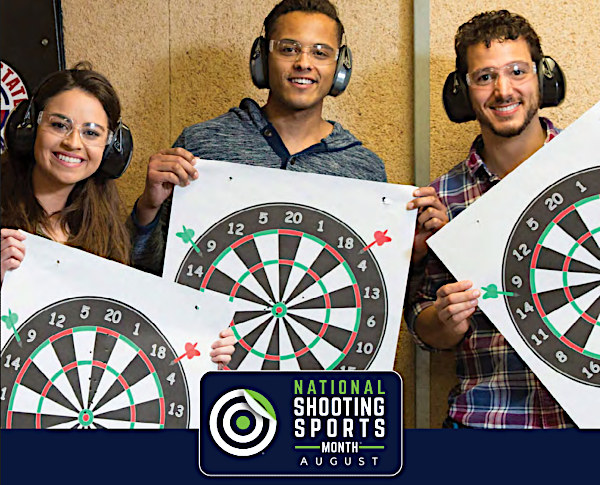
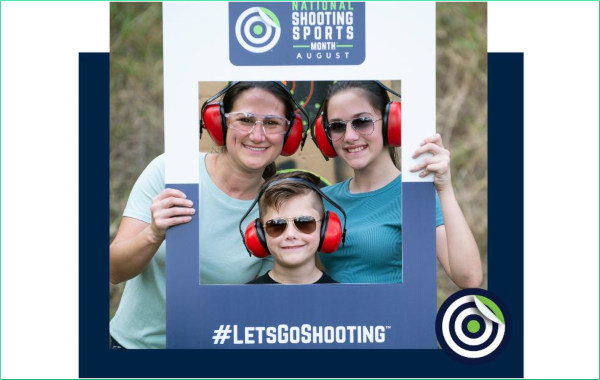
August is officially National Shooting Sports Month, sponsored by NSSF, the National Shooting Sports Foundation. This month, head to the range, and bring a newbie to introduce him or her to the sport. NSSF’s +ONE Movement encourages experienced shooters to mentor newcomers, so bring a friend to the range, teach firearms safety, and have fun together. More than 63 million adults and youth participate in target shooting sports, and NSSF invites you to give shooting a try!
1. Rediscover Shooting
Haven’t shot in a while? Dust off your shooting gear. Always check to see if firearms are loaded when removing them from storage. And call an old shooting buddy or family member to join you.
2. Try a Drill or Competition
There are many ways to build shooting skills, but two of the most rewarding ways of self-improvement often come from timed drills, accuracy drills or competitions. Find a drill for you or a local pistol, rifle or shotgun competition. There many even be a multi-gun competition.
3. Take Your First Shots
Safety orientation, range rules, range officers… there are things you need to know about if you haven’t tried target shooting before. Learn about range safety and etiquette and consider taking an introductory class like First Shots.
4. Take a Date to the Range
Make it a date! Ask your spouse/partner to go target shooting with you. You’ll have a great time together. Don’t have someone to go with? Call the range and ask about shooting events and training classes.
5. Be a Mentor
The right teacher makes all the difference when learning a new activity. The +ONE initiative inspires experienced shooters and hunters to guide newcomers and novices on how to safely handle firearms and learn marksmanship skills.
6. Brush Up on Safety
Enroll in a firearm training course or review the rules of firearm safety. Responsible gun owners safely handle their firearms and securely store them when not in use. Check with your local retailer of range for in-person training opportunities.
7. Tune Up for Hunting Season
Hunting is fun and can provide the ability to harvest healthful food. A trip to a firearms retailer or range can help you prepare for hunting season. You can enroll in a hunter education course, find the right gear, and get your rifle sited properly for the fall hunting season.
8. Take Advantage of August Deals
Retailers and ranges will be offering specials during National Shooting Sports Month at thousands of events nationwide. Find a participating business near you to take advantage of these notable offers at ShootingSportsmonth.org.
9. Have A Fun Target Match with Friends
With pistols and rimfire rifles you can have fun shooting indoors, and many ranges are open after work. This is an opportunity to have funs with friends and co-workers. NSSF offers a variety of nice targets you can print out.
10. Share #LetsGoShooting with Friends and Social Media
#LetsGoShooting is the official theme of National Shooting Sports Month. Share your shooting experience on social media networds and encourage other to go to the range for fun, socializing, and training.
Whether you’re new to target shooting, a first-time gun owner or experienced, see what National Shooting Sports Month has to offer at your shooting range or firearm retailer. America’s firearm owners will find National Shooting Sports Month in August a great time to spend a day at the range enjoying their favorite target-shooting sports with friends and family members. It’s also a time for millions of first-time gun owners to check out all that the shooting sports have to offer.
Wind effects are complex. In trying to access wind speeds and angles, you’ll want to watch multiple indicators — mirage, dust, wind-flags, grass movement, and more. You’ll also need to be concerned about wind cycles. In the video below, Bryan Litz talks about variable wind speed along a bullet’s flight path. A respected ballistics guru, Bryan is the founder of Applied Ballistics and a designer of Berger’s Hybrid Match projectiles. He is also a past F-TR National Champion and a High Master Palma ace.
In this video, Bryan discusses how wind effects can vary in intensity at different points along the bullet’s flight path to the target. Sometimes the firing line is sheltered, and the strongest winds come into effect in the middle of the trajectory. Bryan concludes: “Wind matters everywhere … but the best thing you can do is try to get a handle on the wind [velocity and angle] where you are. That may or may not represent the wind down-range — that’s when you have to look downrange and make a judgment[.]”
Litz Competition Tip: Select your wind shooting strategy carefully. For beginners and veterans, most points are typically lost to wind. Successful shooters put a lot of thought into their approach to wind shooting. Sometimes it’s best to shoot fast and minimize the changes you’ll have to navigate. Other times it’s best to wait out a condition which may take several minutes. Develop a comfortable rest position so you have an easier time waiting when you should be waiting.
More Wind Tips from Wind Wizard Emil Praslick
In these two short videos, Emil Praslick III, former coach of the USAMU and USA National long range teams, explains how to find the wind direction and how to confirm your no-wind zero. Praslick is widely considered to be one of the best wind coaches in the USA.
When Winds Are EXTREME — Near Gale Force at Ben Avery
This video shows INSANE winds at NBRSA 100/200 Benchrest Nationals. This was filmed at the Ben Avery Range in Phoenix, AZ during the recent NBRSA 100/200 yard National Championships. Extreme to say the least. Based on what we’re seeing here, there are 20-25 mph crosswinds, with gusts to 35 mph — near Gale Force. Video by Hall-of-Fame Benchrest competitor Gene Bukys, whom we sadly lost to COVID last year. RIP Gene.
Texas gunsmith Mike Bryant reports: “This video shows the Unlimited Class 200 at the Nationals in Phoenix. I had three 10-shot groups in the low 2″ range with a 2.228″ being my big group and was glad they weren’t bigger. Thursday and Friday were the worst of the windy days. Unfortunately those were the days for the UL 200 and it was about as windy through most all of the Sporter 200.”
Excellent Wind Reading Resource
The Wind Book for Rifle Shooters covers techniques and tactics used by expert wind-readers. The authors provide a wind-reading “toolbox” for calculating wind speed, direction, deflection and drift. They explain how to read flags and mirage, record and interpret your observations, and time your shots to compensate for wind. Here are two reviews:
This is a must-have book if you are a long-range sport shooter. I compete in F-Class Open and when read it from cover to cover, it helped me understand wind reading and making accurate scope corrections. Buy this book, read it, put into practice what it tells you, you will not be disappointed. — P. Janzso
If you have one book for wind reading, this should be it. It covers how to get wind speed/direction from flags, mirage, and natural phenomenon. This is the best book for learning to read wind speed and direction. — Muddler
At the request of our readers, we provide select “Deals of the Week”. Every Sunday afternoon or Monday morning we offer our Best Bargain selections. Here are some of the best deals on firearms, hardware, reloading components, optics, and shooting accessories. Be aware that sale prices are subject to change, and once clearance inventory is sold, it’s gone for good. You snooze you lose.
NOTE: All listed products are for sale to persons 18 years of age or older. No products are intended for use by minors.
1. Graf & Sons — Forster CO-AX Reloading Press, $334.79
⏺️ » Excellent versatile press with good discount
The Forster Co-Ax Reloading Press is one of our favorite presses. With an open front, the Co-Ax features dual floating guide rods. These provide perfect alignment of the die and the case because the shell holder jaws float with the die, thereby permitting the case to center precisely in the die. And as the die slides in a slot with the lock ring (rather than screwing down in a threaded hole), it is fast and easy to change dies. Right now you can save $37 with this Grafs.com sale.
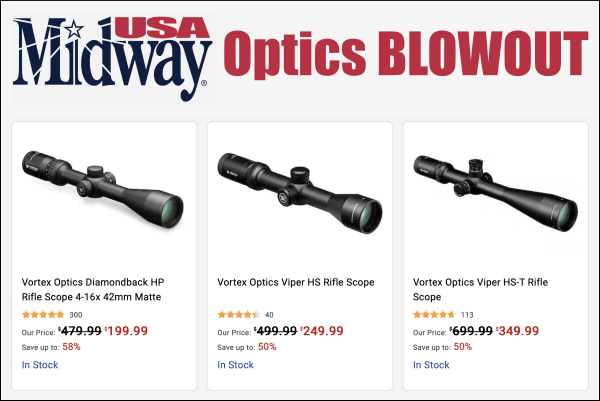
2. MidwayUSA — Major Brands Optics Sale, Huge Discounts
⏺️ » Save on great scopes from Zeiss, Vortex, Leupold, SIG Sauer, Burris
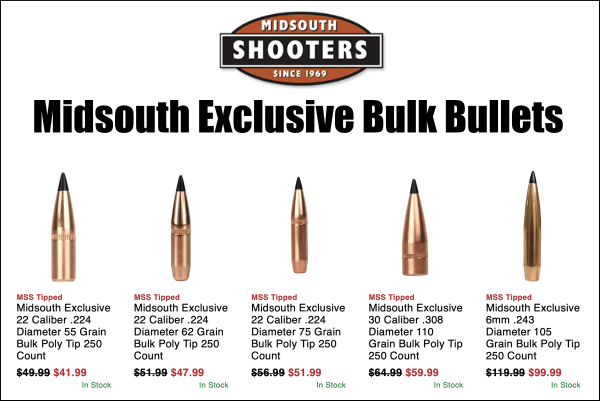
⏺️ » Save big bucks on major-brand target and hunting bullets
Need bullets? Check out Midsouth’s Bulk Bullets Sale. A major U.S. bullet-maker made these poly-tipped bullets for Midsouth using proven designs for hunting, varmint, and target applications. The varmint bullets’ thin jackets allow for rapid expansion, even at lower velocities. These bullets are packaged into polymer bags. That reduces the price by eliminating factory packaging. NOTE: Buyer reports are very positive.
4. Amazon — Derraco PCPS Priming Tool, $199.95
⏺️ » Innovative precision priming tool mounts to press
Turn your standard single-stage reloading press into a precision priming system with the Derraco PCPS Precision Priming die/Primer Seating Tool (#ad). This advanced tool is compatible with any reloading press that accommodates 7/8-14 reloading dies and standard T-shaped shell holders. For a wide variety of single-stage presses, this unique precision priming tool will consistently deliver high-precision results thanks to the precision adjuster and micrometer hard stop.
⏺️ » Good quality, large, rugged rifle case at attractive price
When flying or driving it’s vital to protect your rifles. A good hard case option (at a great price) is the APACHE 9800 Weatherproof Protective Rifle Case. On sale for $149.99, this 53″-long case is $190.00 less than an equivalent-size Pelican case. Constructed from durable polypropylene, this quality hard case can protect long guns from from impact, moisture, and dust. The built-in purge valve equalizes pressure so you can open the case after changing elevations. NOTE: Case interior dimensions are 50⅜” by 13⅝”.
⏺️ » Excellent tool for fast, reliable base-to-ogive measurement
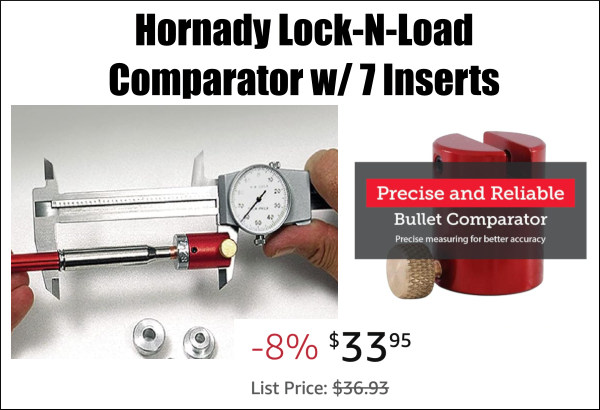
When loading precision ammo, you need to accurately measure the base-to-ogive of loaded rounds. A good tool for this task is the Hornady Lock-N-Load Comparator Kit. This can measure seating depth of loaded ammunition quickly and precisely. Attached to calipers, this measures from the cartridge base to the bullet ogive, ensuring consistent seating. This basic set includes the comparator body, plus 7 inserts covering .224, .243 (6mm), .257, .264, .277, .284 (7mm) and .308 bullet diameters.
⏺️ » Great transport case holds 5 handguns plus magazines.
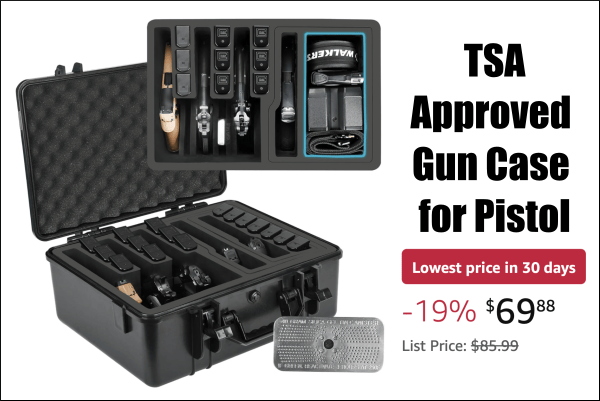
If you often transport multiple pistols, this is a great travel case. The LOTOCASE TSA-Approved Handgun Case holds 5 handguns, plus 16 magazines and features a rechargeable, moisture-absorbing silica gel canister to prevent gun rust. Well-designed with slots for pistols and mags, this rugged hard case is a good option for handgun competitors. NOTE: For long-term storage, put your handguns in anti-rust fabric sleeves and store in a good gun safe.
8. Amazon — Coobeast 38pcs Digital Torque Screwdriver, $59.98
⏺️ » Advanced, modern tool measures proper torque
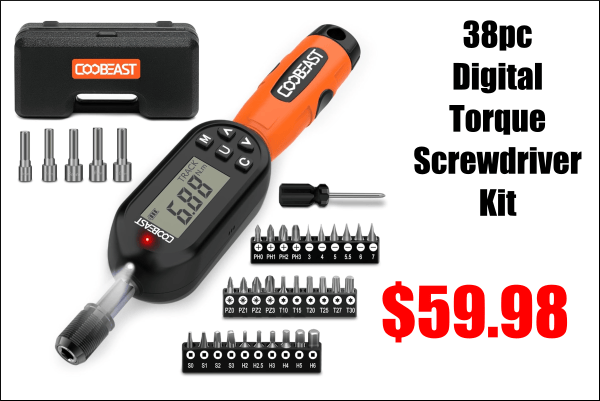
Setting proper torque on rings, actions and more is critical to precision shooting. For precise torqueing jobs, we like the Coobeast 38pcs Digital Torque Screwdriver. With a power drive with digital display (and certified calibration), this electric torque screwdriver offers precise torques. The drivers are made of hardened chrome vanadium steel.
9. Midsouth — Primer Sale w/ CCI, Federal, Rem, Magtech & more
⏺️ » Large supply of magnum, large, and small primers at good prices
Over the last few years premium brand primers have been pricey and hard to source. Thankfully, things are getting much better. And right now Midsouth is running a major Midsouth Primer Sale with significant savings on CCI, Federal, Winchester, Magtech and other brand primers. Yes there are large rifle primers along with hard-to-find Federal 205M small rifle primers — popular with competitive shooters. Both 1000ct and 5000ct packages are on sale.
10. Amazon — 52″ Rifle Soft Case, $21.98
⏺️ » Very low price for handy case for long-barrel rifles
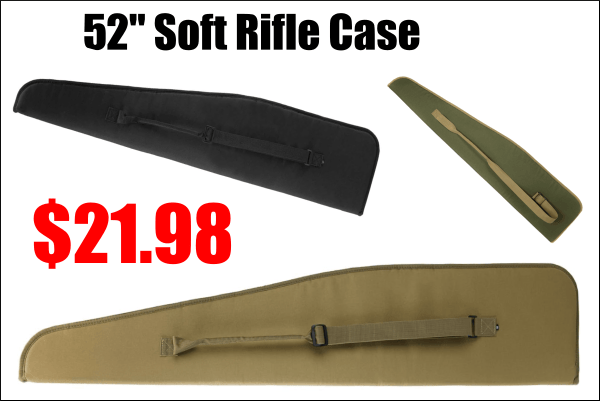
Sometimes you just need a simple, basic gun case for taking your rifles to the range in your vehicle. This 52″ Soft Rifle Case can handle those duties and is big enough for competition F-Class and Full-bore rifles. This gun case has decent padding, a water-resistant nylon shell (green, tan, or black), and comes with a handy adjustable shoulder strap. Choose either 52″ case for $21.98 or 42″ version for $19.99.
11. Amazon — Frankford Arsenal Digital Caliper, $37.19
⏺️ » Good features and measures both inches (SAE) and millimeters
Accurate measurement of cartridges and components is critical for precision reloading. All hand-loaders should have a good set of digital calipers. These Frankford Arsenal calipers are accurate to within .001” when measuring case length, neck and base diameters, overall length. These calipers also can show both SAE (inch) and Metric (mm) measurements.
As an Amazon affiliate, this site can earn revenues through sales commissions.
Many short-range Benchresters have thought about converting their 6 PPC to shoot a 30BR for score matches, or a Dasher for mid-range (or even 1000-yard) games. That way you have a rifle that does double duty, giving you the most bang for your buck. Though an action with a PPC bolt won’t normally work with 30BR/6BR/Dasher cases with their larger .308-class rim (0.4728″ diameter), there is a pretty easy solution that allows you to cycle these bigger cartridges with a 6PPC-style bolt (designed to fit .220 Russian rims).
“Rebating case rims … lets you shoot a 30BR in score matches using your PPC action. All you need is a new barrel. This saves buying another bolt, receiver, or rifle.” — Butch Lambert
Butch Lambert of ShadeTree Engineering provided this tip. Butch notes that many 6 PPC benchrest group shooters also enjoy shooting in score matches. But to be really competitive in the BR for score game, that means shooting a 30BR, which has a wider, .308-class rim (0.4728″ diameter). Likewise, if you want to compete in 600-yard registered BR events or in varmint matches, you probably want to run a bigger case, such as the 6BR, 6mm Dasher, or 6-6.5×47. Those cartridges also have the larger 0.4728″ rims.
Rebate Your 30 BR Rims
To convert a PPC-boltface action to shoot bigger cases you can spend a ton of money to buy a new bolt. That can cost hundreds of dollars. The simpler solution is to turn down the diameter of the larger cases on a lathe. Butch explains: “We’ve seen plenty of interest in rebating case rims. This lets you shoot a 30BR in score matches using your PPC action. All you need is a new barrel. This saves buying another bolt, receiver, or rifle if you have a PPC boltface. Anyone who has access to a lathe can do this job pretty easily. Yesterday I turned 150 case in about an hour.”
At right is the lathe form tool Butch uses to rebate the case rims.


 This is just a brief synopsis of a single test case. The coverage of twist rates in Modern Advancements in Long-Range Shooting Vol. 1 is more detailed, with multiple live fire tests. Results are extrapolated for other calibers and bullet weights. Needless to say, the question of “how twist rate affects muzzle velocity” is fully answered.
 Norma has released a fascinating video showing how bullet, brass, and ammunition are produced at the