Eurooptic vortex burris nightforce sale


teslong borescope digital camera barrel monitor


As an Amazon Associate, this site earns a commission from Amazon sales.


October 12th, 2025

Sunday GunDay: Pride & Joy Rifles from Our Shooters’ Forum

pride joy 6.5x55 Ackley Borden Action Robertson Stock F-Class F-Open, Bartlein Barrel
Forum member Rardoin’s handsome F-Open rig features the Borden BRM-XD action.

One of the most popular items in our Shooters’ Forum is the ongoing “Pride and Joy” thread. Since 2009, Forum members have posted photos and descriptions of their most prized rifles. Here are some of the most recent “Pride and Joy” rifles showcased in our Forum. Do you have a gun you’d like to see featured there? Just Register for the Forum and you can add your favorite gun to the list.

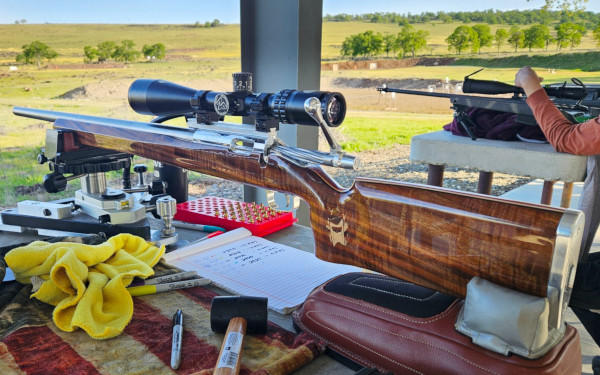
Modern 6BRA Bench Rifle
6BRA Bra wood 600 benchrest

This handsome benchrest rig belongs to Forum member Tillroot1. It boasts a Kelbly Panda action and a Krieger cut-rifled barrel chambered for the excellent 6BRA wildcat cartridge. The 6BRA is an improved version of the 6mmBR which retains the long neck. The 6BRA is easy to fire-form and very accurate, and can achieve the really good 2950 FPS node with 105-108gr bullets. This cool rig features a Jason Avila-made stock (Wheeler F-Open), with finish work by Brett Childress. Barrel was chambered by Dave Witt.

Bill Goad’s 6PPC Hunter “Ranch Rifle”

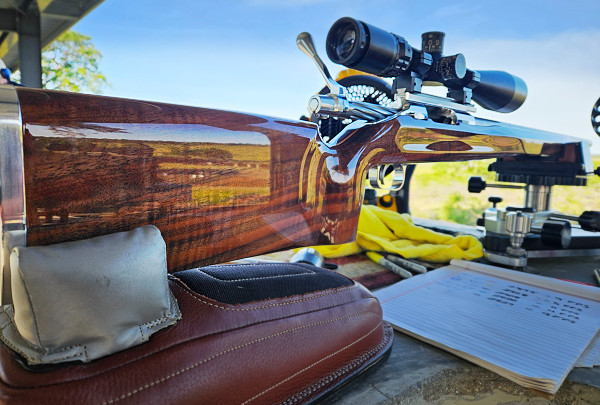
pride joy Bill Goad Hunter 6mm PPC benchrest

Forum member Grimstod tells us: “This is the personal rifle of Bill Goad. He has been experimenting with it on several levels. It is shooting great and has several matches on it now. Please enjoy these photos. More can be found on the website www.PremierAccuracy.com. We like the subtle barbed wire effect on the stock.

Twin-Upper AR with Custom Wood Furniture

pride joy AR Sporting Rifle Maple Walnut Furniture AR Platform

This very unique AR belongs to Forum member Nuto-BR. He tells us: “Here are the two uppers I built. The top one is am X-caliber in 20 Practical with 24-inch, 1:11″-twist barrel. The bottom one is a WOA in .223 Rem, with 20″, 1-12″ twist barrel. They both shoot 1/2 MOA or better. Both stocks are laminated Maple and Walnut. I reversed the order of the two woods to tell them apart.”

Two Dashers and a Rimfire for Fun

pride joy 6mm Dasher Anshutz

Courtesy Forum member Dan H., here are two red-stocked Dashers plus an Anschutz 54.30 (Benchrest Stock) to make it a trio. Dan says: “The Anschutz provides good practice in trigger-pulling. It’s amazing what you can learn from a rifle that is as sensitive as this one.”

Dream Hunting Rifle with Custom Camo

pride joy Hunting stock camo custom paint 6.5-280 Ackley Improved

Here is Forum member TyDaws’s “Dream Hunting Rifle” in 6.5-280 Ackley Improved. We love the custom paint work by by Melodie Yarbrough. Smithed by West Texas Ordnance, this rifle features a Rem 700 action with fluted bolt, PT&G tapered recoil lug, and Timney 510 2-lb trigger. The barrel is a fluted 26″ 1:8″-twist Bartlein 5R #3 contour. On top is a Huskemaw Blue Diamond 4-16x42mm optic in Warne Maxima rings. That’s an Atlas bipod up front.

Three Guns for Mr. Big
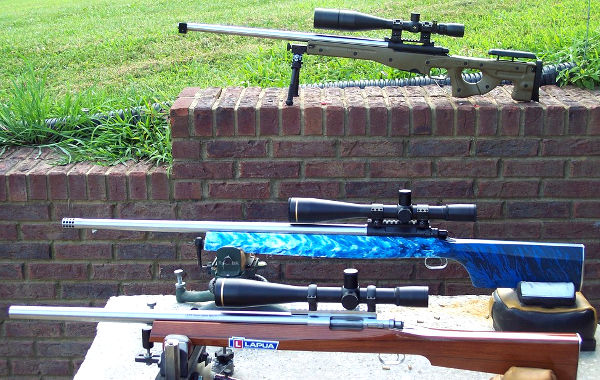
pride joy .243 Win Stiller Rem 700 Tactical Farley 6.5x47 Lapua 6PPC

Forum Member Mr. Big offered up another trio of rifles — two bench guns and a tactical rig. Mr. Big says: “Here are the rifles I shoot most: Farley 6mm PPC, Stiller .243 Win, and Rem 6.5×47 Lapua. They will do just about anything I ask them to…” Challenge: Can you identify the makers of the three different stocks shown in this picture (and the different materials used in each)?

Classic M1917 Enfield Action in Hand-Carved Maple Stock

Pride Juy AccurateShooter hunting benchrest rifles wheelgun Ruger Revolver hunter

This impressive rifle features an “antique” 1917 Enfield action chambered for the .338 Win Magnum cartridge. The lovely Maple stock was hand-carved by Forum member Spitfire_ER. He tells us: “I found this piece of wood as a return at a lumber yard about [many] years ago. I asked the guy in the yard about it and he said it had been returned because it had too much figure for the job the customer was working on. First thing I thought was, ‘That would make a nice stock’.”

6mm Dasher in Robertson Spider Web Stock

pride joy 6mm Dasher Robertson Stock

Here is Forum member Vahena’s 6mm Dasher. It has a no-turn-neck chamber in a 28″, 1:8″-twist barrel with 1.25″ straight contour. This has an original Robertson fiberglass stock with spider web graphics. This rifle was originally built as a 6.5×284 with a fluted barrel. Now it sports a bigger barrel for a smaller cartridge. The front rest is a SEB Neo with counterweight up front.

Permalink Competition, Gear Review, Gunsmithing 1 Comment »
October 12th, 2025

Watch How Primers Are Made in Federal Factory Video

Federal Primer Priming Tool Magnum primers foil anvil primer construction reloading powder CCI

Do you know how gun primers are made — how the explosive elements are applied into those tiny cups? Find out by watching this video filmed at a Federal ammunition factory. It starts out with empty primer cups loaded, 1000 at a time, into trays using vibration (0:05 time-mark). While much of the process is automated, there is still a significant role played by production workers who apply a green, paste-like charging compound to the inside of hundreds of primer cups.

At the 0:17-second time-mark you can see the factory worker “charging” the primers with the priming compound. After the cups are filled, then the plate of cups “mates up with a plate of anvils” (0:40 time-mark). Then the primers are unloaded from trays and inspected.


Federal Primer Priming Tool Magnum primers foil anvil primer construction reloading powder CCI

Primer “Mysteries and Misconceptions” Article

There is an excellent article about primers on the Shooting Times website. This authoritative Shooting Times article explains the fine points of primer design and construction. The author reveals some little-known facts about primers and corrects common misconceptions. Here are some highlights:

Primer Priming Tool Magnum primers foil anvil primer construction reloading powder CCISize Matters
Useful Trivia — even though Small Rifle and Small Pistol primer pockets share the same depth specification, Large Rifle and Large Pistol primers do not. The standard pocket for a Large Pistol primer is somewhat shallower than its Large Rifle counterpart, specifically, 0.008 to 0.009 inch less.

Magnum Primers
There are two ways to make a Magnum primer — either use more of the standard chemical mix to provide a longer-burning flame or change the mix to one with more aggressive burn characteristics. Prior to 1989, CCI used the first option in Magnum Rifle primers. After that, we switched to a mix optimized for spherical propellants that produced a 24% increase in flame temperature and a 16% boost in gas volume.

Foiled Again
Most component primers have a little disk of paper between the anvil and the priming mix. It is called “foil paper” not because it’s made of foil but because it replaces the true metal foil used to seal early percussion caps. The reason this little disk exists is strictly a manufacturing convenience. Wet primer pellets are smaller than the inside diameter of the cup when inserted and must be compacted to achieve their proper diameter and height. Without the foil paper, the wet mix would stick to the compaction pins and jam up the assembly process.

Read Full Primer Story on ShootingTimes.com

Video find by Boyd Allen. We welcome reader submissions.
Permalink - Videos, Bullets, Brass, Ammo, Reloading No Comments »
October 12th, 2025

How to Kill a Barrel in One Afternoon — Firing Rate and Heat

barrel life test rapid fire cooling

Can sustained rapid-fire shooting with no cool-down period wear out a quality barrel more quickly? The answer is “Yes” according to Forum member LCazador, who did an interesting comparison test with two .243 Winchester barrels. He started off with two, identical, match-grade HV taper stainless barrels. Both were NEW at the start of testing, and LCazador shot the same load through each: 95gr match bullets with 38 grains of Hodgdon Varget. After giving both barrels the same, gentle 20-round break-in, 300 rounds were then fired through each barrel — in very different ways. Barrel condition and wear were monitored with a borescope.

Barrel One — Slow Fire, Cool Down Periods, Cleaning Every 50 Rounds
At the end of the 300-round test, Barrel One looked brand new. There was none of the severe fire cracking found in Barrel Two. This barrel was shot no more than 10 times without a cool down and firing was done at a much slower pace. Cleaning for this barrel was done every 50 shots.

Barrel Two — Fast Firing, No Waiting, Cleaning Every 100 Rounds
The second barrel, which received hard use and minimal cleaning, was severely damaged with severe fire cracking at the leade and throat. As a result, the barrel had to be re-chambered. This barrel was shot 100 rounds at time without cleaning and was shot up to 20 times in succession without a cool down.

LESSON LEARNED — Heat Kills Barrel Life
Don’t let your barrel get too hot, and keep it clean. One afternoon can ruin a barrel!

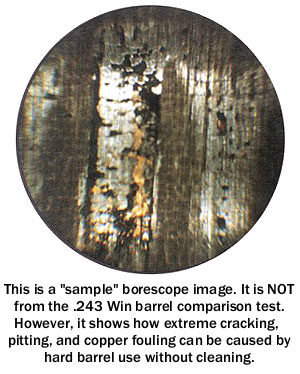
Hawkeye Borescope imageMonitoring Barrel Wear with Borescope
Some folks worry too much about what their borescopes reveal — many barrels do not have to be “squeaky clean” to perform well. In fact some barrels run better after ten or more fouling shots. However, a borescope can be very helpful when your barrel starts losing accuracy for no apparent reason. Forum member FdShuster writes:

“A borescope is a positive way of backing up your suspicions when the rifle starts to throw an occasional (soon followed by more frequent) wild shot. Using the scope is also an excellent way to determine that the cause is barrel wear and not simply a need for a concentrated cleaning session to remove built up copper and more importantly, carbon fouling.

I’ve had a few barrels that gave every indication of being shot out. But I ‘scoped them out and found the cause to be nothing more than requiring a good cleaning. They then returned to their usual performance. There’s no guessing involved when you are able to get ‘up close and personal’ using the scope. The borescope also provides an excellent view of the all-important condition of the crown. My borescope is one of the most valuable investments I’ve ever made.”

Permalink Gunsmithing, Tech Tip 3 Comments »