Today Shooting USA TV features the 2021 Bianchi Cup, hosted May 24-28, 2021 at the Green Valley Rifle & Pistol Club in Hallsville, Missouri (near Columbia). The 2020 Bianchi Cup was cancelled due to COVID. In 2021 the four stages of fire are back, but without international competitors, who were locked out due to pandemic travel restrictions. But there was still plenty of superb marksmanship.
This episode of Shooting USA airs Wednesday, March 23, 2022 at 9:00 PM Eastern and Pacific, 8:00 PM Central on the Outdoor Channel. Shooting USA is also available On Demand via Vimeo.com.
Officially, the annual competition is known as the National Championship of NRA Action Pistol. But its is generally called the Bianchi Cup — from the trophy named for one of the founders, John Bianchi. In the past 30 years the match has become the richest handgun tournament in the world.
The Bianchi Cup has been called the most prestigious pistol tournament in the world. After the cancellation of the 2020 Bianchi Cup due to COVID-19 restrictions, bringing the match back for 2021 involved challenges given health and safety protocols. In 2021 the NRA turned the organization and management of the match over to a new group from the Green Valley Rifle and Pistol Club.
Due to the high accuracy required in each stage of the Bianchi Cup, the tournament is considered one of the most difficult handgun championships on the planet.
Bianchi Cup — the Richest Handgun Match on the Planet
Over the past 30+ years the Bianchi Cup has become the richest handgun event in the world, with cash and prizes for the best scores on four stages of fire for both revolver and semi-auto pistol divisions.
Bianchi Cup — Classic Course of Fire
The Bianchi Cup is a combination of Speed and Accuracy. Competitors shoot from both standing and prone positions and are also required to shoot with both strong and weak hands at various stages. Stages may combine stationary and moving targets. The Course of Fire consists of four separate matches:: Practical, Barricade, and Moving Target, and Falling Plates. Each of the four events requires 48 shots to complete. 480 points are possible on each event. Three of the four are scored on the NRA tombstone P1 target. You must hit in the 10-ring or inner X-Ring on EVERY shot to shoot a “clean” 1920.
Take a good look at this black-stocked, rimfire benchrest rifle. This just might be the most sophisticated (and accurate) Ruger 10/22 on the planet. This 10/22 was originally acquired as a used “donor gun” for just $98.00. Then its owner Les (aka “Scasa” in our Forum) completely upgraded the rifle from stem to stern. He added a rear lug to the receiver, threaded the receiver, installed a new barrel, and upgraded the trigger. Then he crafted the handsome benchrest stock from wood. He even designed and crafted the barrel tuner AND built the sophisticated shooting rest himself.
Overall, Les imagines he has over 1000 hours of design, fabrication, and fitting in this project. But the hard work paid off — this one-of-a-kind Ruger 10/22 shoots tiny groups. Is this the most accurate 10/22 on the planet? Possibly. But without question, it is the most sophisticated, do-it-yourself Ruger 10/22 project gun ever created.
$98 Ruger 10/22 Transformed into Tack-Driving Bench Gun
Report from Les E. (aka “Scasa” in our Forum)
I long thought I’d someday put an upgraded Ruger 10/22 together but the big hold-up was the receiver. I really wanted a threaded barrel/receiver and a rear lug for two-point mounting. They do make a rear lug that attaches to the rear of some aftermarket receivers but it’s just a little tab that attaches to the back, not what I would call really solid. So one day while hanging out at the local gun store I saw a Ruger 10/22 on the used gun rack for just $98.00. I latched onto it and I had my donor gun. This was an early gun that had the two guide rails for the bolt, walnut stock, and metal (not plastic) furniture.
Finished 10/22 rifle with rifle stock, tuner, and aluminum shooting rest all built by Les.
I then began a complete transformation of the rifle. Little did I know that, by the end of the project, I would put in about 1000 hours of labor. There were several things I wanted to make quite different than Ruger’s original design. First was to add the rear lug. Then get rid of the trigger pins. I also threaded the barrel hole in the receiver to get rid of the wedge. I also wanted to fix the bolt release. Of course that all required a new stock too.
In this video, Les explains the major upgrades he did to the Ruger 10/22:
Interested in this rifle build? Talk about it in our Shooter’s Forum. Rifle owner/builder Les can answer your questions about this Ruger 10/22 in this Forum Thread.
The Ruger 10/22 receiver was threaded to accept a more traditional barrel installation. Below is a conventional 10/22 drop-in barrel. Note that normal barrel is NOT threaded at receiver end, but slides in and then is held in place with a “wedge” locking block.
I made a rear lug that attaches to the back of the Ruger receiver with four, 6-32 screws and glued with JB Weld and filed to match the receiver contour.
Shown above is the completed gun before stock painting. The stock is made from nine pieces of Poplar 1x2s, with lots of sanding and black satin paint. Above is a photo of the stock before painting. As you can see, the laminations were stacked vertically. The rifle sits on a one-piece shooting rest I also built.
Editor: Les designed and crafted this sophisticated shooting rest himself. That’s right — this is a DIY rest! Les told us: “I built the rest from scrap aluminum. The design came from looking at rimfire rests online. Probably the Pappas Rest was the greatest influence. That Pappas rest cost about $1100.00 at the time for a polished one. I have less than a hundred dollars in mine now, but I’ve got a couple WEEKS of work in it. I’ve made two of them, one for my rifles and one for my benchrest pistol. It’s a lot of work to sand and polish, but in the end you have a solid shooting platform. Keep it waxed to preserve the shine.”
Watch Les shoot his fully-transformed and upgraded Ruger 10/22 with rest he built:
Editor: In the above video Les shoots his fully-upgraded Ruger 10/22 from a sophisticated one-piece rest he built himself. You can see how well the rest handles his upgraded Ruger 10/22. Below are the two 5-shot groups shot at 25 yards with this rig in the video. Very impressive! The ammo used was Wolf Match Extra.
More Upgrades — Trigger Pins, Bolt Release and More…
The trigger pins were replaced with 10-32 socket head screws which required threaded bushings to be put in the left side of the receiver and access holes in the right side of the stock. Now the trigger group and bolt can be removed without taking the action out of the stock. This also pulls the receiver sides together reducing bolt clearance. The trigger is shimmed with a piece of shim stock so it can’t be too tight.
There are several “How-Tos” which cover conversion of the manual bolt release to an auto bolt release, but it still requires a little fiddling with the darn thing. So instead of having it pivot on a slot, I welded up the slot and now it’s just a hole. I also welded on some more length and put a little knurled knob on it. With those modifications, it now works perfect.
The trigger housing is factory Ruger acquired at a gun show 25 years ago with Volquartsen hammer and sear. The barrel is a Green Mountain blank turned, threaded, and with a Bentz chamber. I made the barrel tuner. The rifle is fitted with a BSA 36-power scope I bought for $125.00 from the AccurateShooter Forum classifieds. There may be another $250.00 or so in parts and accessories I bought.
Editor’s Commentary — This project started with an old, used $98.00 Ruger 10/22 rifle. Now the transformation is complete. It took Les countless hours, and lots of effort, but he is deservedly proud of the end result. The excellence of the upgraded 10/22 is matched by the sophisticated, unitized aluminum shooting rest Les built. Very impressive design and execution.
So How Does it Shoot? Very Nicely Indeed!
Les reports: “Above is a target with some 3-shot groups while playing with the tuner. Those groups were shot at 25 yards. I figure at that distance I’m testing what the gun will do, not how well I can read the wind, not well and its been really windy. If I can get one clean hole 5 shots I’m pretty happy.”
Les electro-etched the caliber on the barrel. Les told us: “The machine was easy to make and works really well. It’s just a pain getting stencils.”
Springtime is turkey hunting season throughout the USA. The official spring wild turkey hunting season is set regionally by each state. In a few states, turkey season has already commenced, while most other states open their turkey seasons in early April, with the spring seasons running for 3-5 weeks. CLICK HERE to read Outdoor Life Magazine’s 2022 Turkey Hunting Forecast for spring 2022.
GetZoneHunting.com has a vast video library for hunters, with hundreds of helpful videos on all types of hunting. In time for spring turkey season, GetZoneHunting offers a big collection of turkey hunting videos: At the Ranch – Turkey. On that page you’ll find 13 turkey hunting “how-to” videos. Here are links to five GetZone Turkey Hunting videos with valuable information from skilled, experienced hunters.
At the Ranch Turkey Hunting Videos
At the Ranch – Turkey offers solid advice for turkey hunters. These five videos will help you better understand turkey behavior and have success on your hunt. Click any photo to watch the particular video on the GetZone website. (Work Warning — When each GetZone video opens, it may immediately launch an annoying commercial with loud AUDIO!). There are eight more turkey hunting videos on GetZone’s Turkey Hunting HQ Page.
At the Ranch: Shot Placement for Turkeys — CLICK PHOTO to Watch Video
At the Ranch: Turkey Hunting Essentials — CLICK PHOTO to Watch Video
At the Ranch: The Difference Between a Jake and a Tom — CLICK PHOTO to Watch Video
At the Ranch: Early vs. Late Spring Turkey Hunt — CLICK PHOTO to Watch Video
At the Ranch: How to Plan a Turkey Hunt — CLICK PHOTO to Watch Video
Free Printable Turkey Target from AccurateShooter.com
As a special bonus for our readers, here is a free, printable Turkey Target, so you can practice for your turkey hunting adventure, This special Turkey Bullseye Target was created by our friend and Forum member Pascal (aka “DesertFrog”). CLICK HERE for FREE Turkey Target.
Do you own or shoot an AR-platform “black rifle”? Then you know these rifles run dirty, and have some unusual maintenance requirements. On the other hand, the AR “Modern Sporting Rifle” is fun and versatile with a vast range of options among buttstocks, barrels, handguards, and grips. You can assemble a simple 16″ barrel .223 Rem rig for home defense, or build a long-barreled 6mm ARC rifle with bag-rider buttstock and high-magnification optic for long range target work. The choice is up to you.
To help with your black rifle journey, here are eight helpful videos from Brownells. These will help ensure your AR rifle cycles reliably and runs longer, with reduced wear. Brownells also explains how to choose the optimal barrel twist rate. CLICK HERE to order AR parts, accessories, and ammo from Brownells.
AR Bolt/Bolt Carrier Lubrication — Smarter Methods
This video shows the proper way to lubricate an AR-15 bolt-carrier assembly. The video identifies the key metal-on-metal friction points where you actually need lubrication: the rails on the underside of the carrier, shiny wear points on top, and just a dab on the cam pin. How much oil/lubricant should you use? The AR-15 is pretty forgiving on that point. Some spots work best with grease, others work best with a lighter oil. Just keep it out of the combustion areas. Those little holes in the carrier are gas vent holes, NOT oil holes!
AR Maintenance — General Cleaning Procedures
Let’s face it, ARs with the original gas system tend to run dirty. You’ll need to regularly clean the bolt carrier and bolt. In addition you should regularly clean the chamber area and the inside of the upper. Also make sure to clean the lower (see video 3:15) and ensure the trigger assembly is properly maintained. This video covers general cleaning and maintenance of AR-platform rifles. We highly recommend that all new AR owners watch this video. NOTE: When cleaning the bolt, don’t forget the extractor recess and ejector recess. The majority of ARs we’ve seen that did not function properly had gunk (lube, carbon, brass shavings) clogging these areas.
AR Barrel Twist Rates — What You Need to Know
AR barrels can be ordered with a variety of twist rates from 1:12″ to 1:7″. Basically, the longer/heavier the bullet you plan to shoot, the faster the twist rate you need. For example, Sierra recommends a 1:7″ twist rate for the 90gr SMK. A 1:12″ could work with the small lightweight bullets up to 55 grains. The 1:9″ barrel will stabilize the light and mid-weight bullets up to about 77 grains. We recommend a 1:8″ or 1:7″ twist rate for the best versatility. You’ll find a detailed discussion of AR twist rates on PewPewTactical.com.
How to Install an AR15 Trigger Assembly
One of the most common AR upgrades done by black rifle owners is swapping out the trigger for a better unit (perhaps a two-stage). Trigger replacements on ARs can be done fairly easily with basic tools. But there are some recommended procedures to ensure the trigger group swap goes easily. You’ll want to have a proper mount to secure the lower, and tools that fit the pin diameters on your lower.
Must-Have Spare Parts for AR-Platform Rifle
With 350,000 views, this is one of the most-watched AR videos on the Brownells YouTube Channel. Brownells Gun Techs Steve and Caleb list key spare parts AR owners should have. Top of the list are bolt gas rings, which wear out through normal use. Also you’ll want a spare extractor spring and pin, because these both can fail. The cotter pin and cam pin can break, but more often they get lost when the Bolt Carrier Group is disassembled for cleaning. Additionally, the large buffer springs wear out with time, so have a spare. Downstairs on the lower receiver, keep spare springs and detents for the pivot and takedown pins. Finally, if you’ve upgraded your trigger, keep the original one as a backup spare.
Checking Headspace on ARs
In this Tech Tip, Brownells gun tech Steve Ostrem walks users step-by-step through the process of checking headspace on their AR-15 rifles, both new and used. It is very important to have proper headspace to ensure proper feeding and extraction, and to ensure good brass longevity (with less risk of dangerous case separation). Starting at 2:10, this video explains how to check headspace with go/no-go gauges and maximum headspace gauge. Ostrem notes: “If you have an AR that closes on a no-go gauge, we recommend taking it to a gunsmith before heading to the range.”
Excessive headspace in AR platform rifles can lead to dangerous case separation.
Setting Up Gas Tube Systems
This Tech Tip examines AR-platform gas systems, and shows how to select the proper length gas tube, and how to configure multiple tube systems if you change your barrel to different lengths. This is worth watching for anyone re-barreling an AR.
Barrel Gas Block Alignment — Key to Reliable Cycling
In this video, Brownells gun tech Steve Ostrem explains surefire methods to align your gas block. The most common problem with AR builds is poor cycling, commonly caused by misalignment between the gas block and the barrel’s gas port.
So you’re thinking of buying a suppressor (aka “moderator”, “silencer”). You can’t just get one off the shelf at Walmart. Acquiring a suppressor requires filling out paperwork and paying a Federal $200 Tax Stamp. Plus there is typically a pretty long wait. However, the good news is that suppressor ownership is now legal in 42 of the 50 American states — that’s 84%! For most American adults, getting a suppressor is legal, provided the buyer passes the required background checks (explained below). The 42 “suppressor-friendly” states are shown as RED in the illustration below.
States Where Suppressor Ownership is Allowed
These 42 states allow private ownership of suppressors: AL, AK, AZ, AR, CO, CT, FL, GA, ID, IN, IA, KS, KY, LA, ME, MD, MI, MN, MS, MO, MT, NE, NV, NH, NM, NC, ND, OH, OK, OR, PA, SC, SD, TN, TX, UT, VT, VA, WA, WV, WI, WY. Note: Even if you live in one of the states listed, you should still verify that owning a suppressor is legal in your area. Some states may have municipal- or county-based restrictions.
“Suppressor ownership [has] boomed in the 21st century. Thanks in part to companies like Silencer Central that streamline the purchasing process, the number of registered suppressors has grown from 285,000 in 2010 to over 2.6 million in 2020.” — GunsAmerica Digest
States Which Prohibit Suppressor Ownership
The eight states which prohibit suppressor ownership are: California, Delaware, Hawaii, Illinois, Massachusetts, New Jersey, New York, and Rhode Island. These states are shown in GRAY in the map.
Qualifications to Obtain a Suppressor
To legally obtain a suppressor, you must fill out Federal Forms and pay a $200 fee to the ATF. You must also pass BATFE background checks and otherwise comply with Federal and state laws. States can regulate suppressor ownership or use, so be sure to check the laws in your area. On the federal level, the process to acquire a suppressor is regulated under the National Firearms Act of 1934. According to the American Suppressor Association, to own a suppressor in the United States you must:
1. Be at least 21 years of age to purchase a suppressor from a dealer.
2. Be at least 18 years of age to purchase a suppressor from an individual on a Form 4 to Form 4 transfer (contingent on state laws).
3. Be at least 18 years of age to possess a suppressor as a beneficiary of a trust or as a member of a corporation (contingent on state laws).
4. Be a resident of the United States.
5. Be legally eligible to purchase a firearm.
6. Pass a BATFE background check with a typical process time of 8 to 10 months.
7. Pay a one time $200 Transfer Tax.
That fifth requirement, “be legally eligible to purchase a firearm”, involves a list of factors. The prohibitions are set forth in the “prohibited person” list found on ATF Form 4473.*
Some 39 of the 42 states that allow suppressors also permit the use of suppressors when hunting. However, three states which allow suppressor ownership DO prohibit the use of suppressors while hunting or shooting game. These states, all in the Northeast, are: Connecticut, Maryland, and Vermont.
There is an informative article on the NRA’s American Hunter website regarding suppressor use for hunting. The article, What Hunters Need to Know About Suppressors, answers common questions about licensing, tax stamps, and suppressor types. The article explains the history of the $200 tax stamp which must be paid when acquiring a suppressor:
“Why the Tax? In 1934 … the federal government, while battling gangsters such as Al Capone, heavily restricted silencers with passage of the first National Firearms Act. Hoping to gain an advantage on criminals that often had better weapons than cops, the Feds placed a mandatory ‘sin’ tax on silencers that was so high it would effectively ban their purchase by all but the wealthiest individuals. In 1934, $200 was the equivalent of $3,500 today. The $200 tax still stands despite no evidence that a simple metal tube is capable of causing crime.” — American Hunter
The American Hunter article also discusses how well suppressors actually reduce noise. User should be aware that the sound level of a large, centerfire hunting cartridge will still exceed 130 decibels (dB) on average, even with a typical suppressor (silencer) in place. For that reason, we recommend that hunters continue to wear ear protection even when they shoot suppressed.
Persons prohibited from acquiring a firearm, under Federal law, are those who fall into on or more of categories listed below. Prohibited individuals include any PERSON:
— Who was convicted in any court of a crime punishable by imprisonment for a term exceeding one year;
— Who is a fugitive from justice;
— Who is an unlawful user of or addicted to any controlled substance (as defined in section 102 of the Controlled Substances Act, codified at 21 U.S.C. § 802);
— Who has been adjudicated as a mental defective or has been committed to any mental institution;
— Who is an illegal alien;
— Who has been discharged from the Armed Forces under dishonorable conditions;
— Who has renounced his or her United States citizenship;
— Who is subject to a court order restraining the person from harassing, stalking, or threatening an intimate partner or child of the intimate partner; or
— Who has been convicted of a misdemeanor crime of domestic violence.
Fans of PRS/NRL competition should watch Shooting USA today March 16, 2022. This action-packed episode features the 2021 Armageddon Gear (AG) Cup Invitational, a major PRS event with $75,000 in cash prize awards. The show airs today, Wednesday 6/9/21 at 9:00 PM Eastern/Pacific (8:00 PM Central) on the Outdoor Channel. You can also stream the show anytime on Vimeo for $0.99.
$75,000 in cash prizes makes the AG Cup the biggest cash money match in Precision Rifle Competition. It’s an elimination format shot over three days of challenging stages of fire at K & M Precision’s ranges in West Tennessee. In this episode, match organizer Tom Fuller joins John Scoutten to narrate the action and the award of the cash in extended coverage of the match. The 2020 AG Cup showcased an all-star line-up of tactical talent with the nation’s top PRS/NRL marksmen invited to the three-day match in TN.
Highlights of 2020 Armageddon Gear Cup Tactical Match:
Armageddon Gear Founder Tom Fuller competes in PRS and supervised the latest AG Cup.
SHOOTING USA TV Air Times
View Shooting USA on the Outdoor Channel Wednesdays 9:00 PM (Eastern and Pacific) + 8:00 PM Central.
NOTE: If you miss the 10/20/2021 broadcast, you can still view the show on Vimeo for a small 99-cent fee, or just $1.99 per month unlimited. LINK HERE: Shooting USA on Vimeo.
New Products from SHOT Show 2022 on Shooting USA This Week
This 3/16/2022 Shooting USA episode will also feature a number of new products from SHOT Show 2022. Notable items showcased include: 3″ Colt Python, 30 Super Carry Cartridge (new from Federal), EoTech E-Flex Red Dot sights, Hornady CX Copper (no-lead) bullets, CSX S&W Micro-Compact Pistol, and S&W Volunteer ARs. New from Smith & Wesson, the Volunteer line of rifles. These newly-configured AR=style rifles draw their name from the new home of the S&W production facility, Tennessee, the “Volunteer State”.
Shooting USA is available On Demand via Vimeo.com. Watch a single episode for $0.99, or get a full-month subscription for $3.99 and watch as many shows as you like with limited commercial interruptions.
ZEISS has introduced a new LRP S5 series of First Focal Plane (FFP) optics. There are two new FFP scopes with high zoom ratios, the LRP S5 318-50 and LRP S5 525-56. These are impressive scopes, with excellent glass, precise controls, and a ton of elevation. Both models boast a 34mm main tube, European-style fast-focus eyepiece, Ballistic Stop elevation turret (with 40.7 MRAD or 140 MOA of total elevation travel), and an external locking windage turret.
Gunsmith Jim See of Elite Accuracy LLC has been testing the LRP S5 525-56 which offers 25X max power. Jim had the Milrad version with the ZF-MRi Reticle and 40.7 Mils of elevation. Jim, an active PRS/NRL competitor, knows what features are important in tactical competitions. He understands that a good PRS/NRL scope must be tough, precise, and repeatable. Jim was impressed with the new 5-25x56mm ZEISS scope. Jim really liked the bright, clear markings on the turrets, and the positive clicks. He also praised the lever-equipped zoom control, the positive zero-stop on the elevation knob, and he believed the lockable windage turret can have definite benefits in the field.
Jim told us: “The scope operates well, it tracks well, and the turrets are accurate in their movements. All the functions work well — elevation, windage, parallax. This LRP scope has a quality feel — similar to other ZEISS products I have used.” Overall, Jim believed this ZEISS 5-25x56mm optic “will fit well in its intended market”, namely PRS/NRL and long range hunting.
I recently reviewed ZEISS’s latest scope offering for the precision rifle shooter. ZEISS is a very recognizable name in the optics industry, and the LRP S5 line of optics is there first big attempt to attract the attention of PRS/tactical/competition enthusiasts.
ZEISS LRP S5 accessories include a power throw lever, a sunshade, and a set of precision rings with integral bubble level, which I found to be very well-made. I fitted my test scope with these items.
For the review I was sent the 5-25x56mm version in MRAD configuration. This optic has a 34mm main tube and is a first focal plane scope. My initial impressions of the optic when I first handled it were favorable. It had the typical look and finish of other ZEISS optics I was familiar with, the robust and solid feeling construction, and well thought-out turrets clearly numbered and easy to read.
Jim had high praise for the highly visible numbers on the dials: “With my (older) eyes, I can’t read the numbers on most scopes, but with this ZEISS LRP S5 scope I CAN read the numbers.”
I mounted the ZEISS to a very accurate 6mmBR rifle and headed out to the range to zero the optic and set the zero stop. This operation only took minutes. I fired a shot, dialed the scope to the bullet impact and sent another round, with a little fine-tuning over the next three shots I had my zero. I consulted the Owner’s Manual, and quickly reviewed the procedure for zeroing out the elevation turret and setting the zero stop. Simply loosen the two turret set screws, push the turret down and spin it to the zero indication mark on the turret until it stops, then retighten the two set screws. It’s a very easy process which I appreciated.
The turrets on this scope have clearly identifiable clicks with a slightly deeper detent at the full One Mil indicator marks. So as you rotate the turret and hit the full mill values, you can clearly feel the resistance of the heavier detent.
My next objective was to test the accuracy of the turret and the reticle sub-tensions. In any long range matches we compensate for bullet drop and wind deflection by accurately calculating our corrections via a ballistic calculator or collected data. It is very important that an elevation turret tracks true. I set up a tall target test with marks at 36″ and an exact range of 100 yards. I shot a 3-shot group at my aim point and then dialed up 10 Mils. I then repeated the 3-shot group using the same Point of Aim. The results were near perfect with a 36″ spread between the two groups. All groups were at or under .25 MOA which is representative of this rifle. The scope repeated on aim impacts, fresh off a +10 Mil “up” dial. I then dialed the turret back to zero and repeated the test with a +10 Mil aim-point change using the reticle subtensions only. There was a small variance on impact height using the subtension lines, without clicking up 10 Mils, but using the reticle hold lines only.*
Note that the view through the scope is bright and clear all the way to the very edge of the viewable image. Lesser scopes may show shadowing or distortion at the periphery.
A few days later I was able to get to a range with some steel targets out to distance, on this day I was looking at optical performance and the “feel” of the optic. It just so happens that the sun was low in the sky and I thought what a great time to check for optical flare. No good comparison happens without something to compare against. So with me was another rifle with a flagship optic [another brand] I was very familiar with. I fitted both optics with their sun shades, and looked at a picnic table on a pond dike, directly in line with the sun. The ZEISS in this test showed considerably less optical flare, to the point that flare was almost nonexistent. The ZEISS offered a clear and usable image with no eye strain. The other brand scope did not perform nearly as well in this comparison.
I proceeded with some longer distant shooting with the main purpose of seeing exactly what I could see. In the game of precision-style rifle matches one of the keys to success is managing recoil through the application of solid fundamentals. The goal here is to identify independently where each bullet goes. We accomplish that by staying in the scope and watching down range. Bullet trace, dirt impacts, target reaction, target impacts, and occasionally seeing the actual bullet in flight, are feedbacks we look for. With the sun low and sitting at about 1:30 from my line to the target, it turned out to be a great day for actually seeing the bullet in flight. The reflection of the light off the side/rear of the 105 grain Berger bullet was clearly visible to me. This is not something everyone sees because you have to know how to look for it, it is best to run in a midrange power of 10-15x to pick up these subtleties. In this case I knew I was holding about one Mil of right wind and 4.3 Mils of dialed elevation. So as I broke the shot I let my eye look up and right of the target. Each time I could catch the arching streak of the bullet as it headed to and impacted the target. The lighting in combination with the wind, on this day, was not very conducive to seeing bullet trace, again something we look for but do not always see depending on conditions.
After beating up the already shot-up plate, I was able to turn up the magnification on the ZEISS and identify both old impacts and the newer impacts that were shinier on the steel plate, typically seen as brighter smears before the lead and steel has a chance to oxidize. I then ranged and dialed plates at different distances, then shot, dialed, and shot some more. Everything in the ZEISS worked well and tracked well, causing no concerns whatsoever.
I concluded the session with some side-by-side comparisons with my control optic. I studied impacts on the same steel plate, and then did a side by side on farm buildings about 2400 yards away. Both of these optics clearly resolved the images studied. What I took away from this was that the ZEISS had a more sensitive eye box when your eye placement shifted from left to right. Not substantial but something I only noticed with a constant evaluation [in direct comparison]. Your eye placement behind the ZEISS optic front to back was forgiving and pretty normal for scopes of similar design. I noted to myself that this was worth another assessment day to better judge the optic.
In this video, on a snowy day, Jim shows how easy it is to set the Zero Stops on the turrets of the ZEISS LRP S5 5-25x56mm scope.
I was able to look through the optics again on a day with pretty flat light. We were now snow-covered and cloudy in north east Iowa. The goal today was to set up the optics in my BOG Deathgrip tripod and study the town I lived in. I set up and focused the optic onto a multi-story brick building at 1500 yards. With some fine tuning, both optics allowed me to clearly see the mortar lines between the bricks at this distance, with the flat lighting brightness and contrast were very similar in these scopes. I then looked for some color. I found my local Casey’s gas station at about 800 yards and started my comparison. My color perception in both optics seemed very similar to the point of being uneventful in even trying to compare the two, now I wished I had a bright sunny day to look over these optics again.
I spent a third evening behind glass, the goal was to get an idea of how the ZEISS performed as light was fading, again we had another cloudy evening in Iowa. I added another high-end tactical optic of similar power rating and dimensions to the evaluation, that model being a few years old but still in the manufacturer’s line-up. What I took away from this three-optic evaluation was that, on similar power settings, the ZEISS low light performance was exceptional. The white snow was still nice and white, resolution was very good and the images were easily identifiable. The first competitive comparison optic also performed very well, the second optic added to the mix showed a tint of yellowing in the image, something that I had not noticed with that optic in previous daylight use.
Overall I think ZEISS has developed an optic that will fit in with the market it was intended for. It is a solid optic that feels very robust and repeatable. The ZEISS LRP S5 525-56’s functions and repeatability performed as they should in my testing. The optical quality is very good and offers a bright, clear image. Those shooters looking for a new top-level optic should give the ZEISS LRP S5 525-56 an honest look.
Installation in Zeiss Rings
Jim placed the scope in high-quality ZEISS rings with integral bubble level. He then took the rig out into the field and completed an initial Tall Target test. That test confirmed the precision and repeatability of the 0.1 MRAD elevation and windage click values.
Jim also liked how positive the clicks felt with both elevation and windage knobs. Jim told us: “The scope operates well, it tracks well, and the turrets are accurate in their movements. All the functions work well — elevation, windage, parallax. This LRP scope has a quality feel — similar to other ZEISS products I have used.” Jim also noted that the ZEISS LRP S5 scope resisted solar flare very well: “This is important in PRS matches where we get that low sun in the afternoons”.
Scope mounted in ZEISS rings with bubble level. Optional sunshade is attached in front.
To test ruggedness and weatherproofing, Jim is putting the ZEISS LRP through its paces in harsh winter conditions. He’s using a tripod here to keep off the snowy ground. The tripod mount also allows smooth traversing to view a wide selection of terrain and objects near and far.
Advanced Optical Technology — ZEISS LRP S5 Features
The ZEISS LRP S5 525-56 has many notable features, including a lockable windage turret, adjustable reticle illumination, and a HUGE amount of elevation travel — 40.7 Mils in the MIL model and 140 MOA in the MOA version. That gives this optic the ability to shoot at extreme range without requiring holdovers.
* In this test I could see immediately that the reticle showed a measured gap between my previous two groups of 9.8 Mils (not 10), though those groups were actually a true 36″ apart (ten Mils is 36″ at 100). The shooting results, using the reticle lines only, confirmed what I saw, and I now had two groups that measured 36.6″ apart. The “take-away” is that if I have to hold with the reticle only, I can calculate the error at a minimal 0.1 mil for every 5 mils held in the reticle. Will this error cause problems? Some may think so, but in competitions we rarely hold over 5 mils while shooting stages. At 100 yards, a 0.1 Mil click is 0.36 inch, a full Mil is 3.6 inches, and ten Mils is 36″.
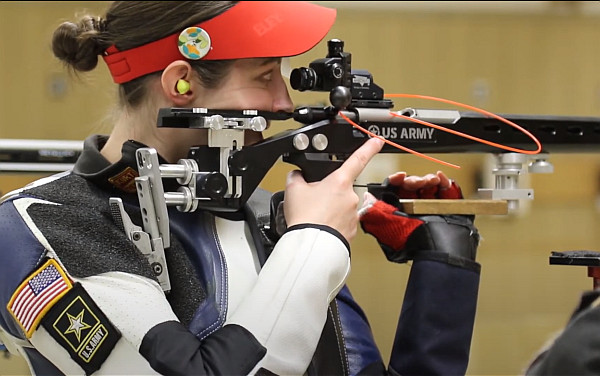
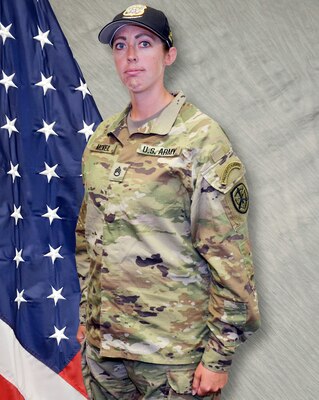
For today’s Sunday GunDay story, we feature a very talented young lady shooter, U.S. Army Staff Sergeant (SSG) Erin McNeil. Erin, who started shooting as a young teen in a 4H program, is now one of the leading service rifle and high power shooters in the nation. Erin McNeil claimed the 2021 Interservice Individual Rifle Championship with an impressive score of 996-52X, beating out 86 other service members (mostly guys BTW). That score also earned Erin the title of High Woman.
The 2021 Interservice Rifle Championships (IRC) continued with other events, including the 1000-yard match. Shown below is SSG McNeil competing in the IRC 1K Match. CLICK HERE for more match photos.
Staff Sgt. Erin McNeil hails from Fort Wayne, Indiana. She has a B.S. in Mathematics from Texas Christian University (TCU), and holds the military occupational specialty of battle management system operator. With the USAMU, SSG McNeil has served on the International Shooting Team and the Service Rifle Team. As a USAMU team member, SSG McNeil has earned the President’s 100 Tab, Rifleman’s EIC Badge, and Bronze Medal at the 2014 World Championship in 3-Position/50m Smallbore Rifle.
Along with centerfire shooting, Erin enjoys smallbore competition. She won the Bronze Medal competing in 3-Position/50m Smallbore Rifle at the 2014 World Championships.
Erin enjoys shooting competition because “It’s really between you and the gun. It’s a very mental game. I think shooting is a great sport… as long as you are able to compete within yourself.”
McNeil started shooting through a 4-H program while in the 8th grade and then shot in college with the TCU Rifle Team. Now, she serves as a shooter/instructor on the USAMU International Rifle Team. In the video below, SSG McNeil talks about her career in competitive shooting, and what she enjoys most about rifle competition — both smallbore and High Power. She notes she enjoys instructing young high school and collegiate shooters (see video below):
SSG Erin McNeil of the USAMU (left) competes in NTI match with a young lady shooter.
Like Father, Like Daughter — Both Great Shooters
Erin noted: “My father was very influential in my shooting career. As a child, I looked up to him. I knew that he had been a world-class shooter in his youth. He asked me a few times if I would be interested in starting the 4H Rifle program. He was excited when I started showing interest in the program. Although he never coached me for fear of crossing the father/daughter relationship with the athlete/coach relationship, but he was always my biggest supporter and even gave assistance when I asked for it. I had a natural talent for shooting and ended up joining my high school’s Army JROTC. I was given a NCAA scholarship to TCU during my senior year. After completing college, I was accepted into the USAMU. My dad [was] the quiet, proud encourager of my shooting career[.]”
Words of Praise for SSG Erin McNeil from Facebook
“Congrats Sergeant McNeil from an old shooter from the 1964 ARADCOM Interservice Rattle Battle matches at Fort Carson Colorado, Ft. Campbell, Ft Sheridan, et cetera. You make me proud of all you folks who carry on the tradition.” — Walter Colbert
“I’ve watched Erin shoot while I was calling the matches from the Tower at the Camp Perry smallbore championships. [She was] never bothered and never ruffled. Just keeps shooting those Xs.” — Ken Kelley
SSG Erin McNeil of the USAMU
Staff Sergeant Erin McNeil, an international rifle shooter with the U.S. Army Marksmanship Unit, Fort Benning, Georgia, has distinguished herself through her many accomplishments. Erin started shooting in 2001 and has numerous shooting accomplishments.
Her awards include the Army Commendation Medal, three Army Achievement Medals, two Army Good Conduct Medals, National Defense Service Medal, Global War on Terrorism Medal, Military Outstanding Volunteer Service Medal, two Noncommissioned Officer Professional Development Ribbons, Army Service Ribbon, President’s 100 tab, and Distinguished Excellence in Competition Rifleman’s Badge.
After graduating from Texas Christian University with a B.S. in Mathematics in 2010, Erin enlisted in the Army on February 15, 2011. After she completed Basic Combat Training at Fort Jackson, South Carolina, and Advanced Individual Training as a battle management system operator at Fort Sill, Oklahoma, she was assigned to the U.S. Army Marksmanship Unit, where she has competed in smallbore, service rifle, and long range disciplines, and she also serves as a marksmanship instructor.
SSG McNeil Offers Lessons to Junior Shooters
SSG Erin McNeil, as the noncommissioned officer in charge of the Fort Benning junior shooters club, enjoys sharing her skills and knowledge with the next generation. “You cannot come to one of these without learning something.” The photo shows SSG McNeil during the 2014 Montgomery Bell Academy Rifle Classic in Nashville, Tennessee. At that event, Erin and other top USAMU shooters provided instruction/coaching to High School competitors from all over the Southeast. “The kids who know us, and know of us, come to every clinic and benefit from them. You cannot come to one of these [clinics] without learning something.”
For today’s Saturday at the Movies special, we provide a selection of videos showcasing rifle and pistol cartridge types — from tiny .17 caliber cases to huge 20mm cases. Two of the videos use advance computer animation to provide 3D views of dozens of cartridge types. Then there are some expert commentaries by Jerry Miculek and Ron Spomer discussing the characteristics and performance of various cartridge types. Finally, we provide two videos that discuss rimfire cartridges and show how .22 LR rounds are produced in a modern CCI factory.
90 Different Rifle Cartridge Types in Computer Animation
In this rifle ammunition comparison animation there are 90 different cartridge types, from very small (.22 Flobert) to very, very big (20mm Vulcan). This video employs sophisticated, 3D CAD animation to showcase 90 different rifle cartridges, one after the other, in sequence. It covers from .17 Caliber up to 20mm. Obviously a lot of time and effort went into this video, but it really is cool to see so many different cartridge types in one 3.5-minute video.
After the full line-up is complete at 1:41, the video then provides other smaller comparison, such as multiple large hunting cartridges (2:15) and .22 Caliber cartridges (2:45, see above). All the cartridge models are made using Autodesk Inventor software, and then the “line-up” animation was completed with Autodesk Showcase.
Cartridge Types Included (in Caliber Order, then Metric Order):
1) .17 HM2
2) .17 HMR
3) .204 Ruger
4) .218 Bee
5) .22 Flobert
6) .22 Hornet
7) .22 LR
8) .22 Magnum
9) .22 PPC
10) .22 Short
11) .220 Jaybird
12) .223 Rem/5.56x45mm
13) .223 WSSM
14) .224 Weatherby Magnum
15) .225 Winchester
16) .240 Weatherby Magnum
17) .243 Winchester
18) .25 Remington Auto
19) .250 Savage
20) .25-06 Remington
21) .256 Winchester Magnum
22) .257 Roberts
23) .260 Remington
24) .264 Winchester Magnum
25) .270 Weatherby Magnum
26) .270 Winchester
27) .280 British
28) .280 Remington
29) .284 Winchester
30) .30 Carbine
31) .300 H&H Magnum
32) .300 Rem Ultra Magnum
33) .300 Savage
34) .300 Winchester Magnum
35) .300 Win Short Mag (WSM)
36) .30-06 Springfield
37) .303 British
38) .30-30
39) .308 Norma Magnum
40) .308 Winchester
41) .32 Winchester Special
42) .325 WSM
43) .338 Lapua Magnum
44) .35 Whelen
45) .350 Remington Magnum
46) .375 H&H Magnum
47) .376 Steyr
48) .408 Cheyenne
49) .416 Remington Magnum
50) .416 Weatherby Magnum
51) .444 Marlin
52) .450 Marlin
53) .450 Nitro Express
54) .458 Win Magnum
55) .45×70
56) .460 Weatherby Magnum
57) .465 H&H Magnum
58) .470 Nitro Express
59) .50 BMG / 12.7×99 NATO
60) .500 jeffery
61) .505 Gibbs
62) .577 Nitro Express
63) .577 Tyrannosaur
64) .600 Nitro Express
65) .700 Nitro Express
66) .950 JDJ
67) 4.6×30 mm
68) 4.6x30mm
69) 5.6×50 Magnum
70) 5.7x28mm
71) 5mm/SMc
72) 6mm LEE
73) 6.5×55 Swedish
74) 6.5×6 mm Schuler
75) 6.8mm Remington SPC
76) 6mm PPC
77) 6×45 mm
78) 7mm Weatherby Magnum
79) 7mm Remington Magnum
80) 7mm Rem Ultra Magnum
81) 7.62×39 mm FMJ
82) 7.7×58 Arisaka
83) 7.95×57 Mauser
84) 8mm Remington Magnum
85) 9.3×62 mm
86) 9.3×64 Brenneke
87) 14.5×114 mm
88) 20mm Vulcan
89) 25mmx137mm
90) 30mmx173 mm
Ammunition Size Line-Up — from Tiny to Massive
This animation video shows the size comparison of ammunition from a 2.34mm rimfire caliber to the massive 800mm caliber shell of the Schwerer Gustav railway cannon used by German forces in World War II. This video includes many common rifle and pistol cartridges/calibers, but also includes large artillery ammunition. This video has very good CGI Graphics. Below is part of the line-up from the .17 Remington Fireball (far left) to the famed .50 BMG (far right):
Ammunition Types Showcased in this video:
2.34mm rimfire
2.7mm Kolibri
3mm Kolibri
4.25 mm Liliput
.17 Hornady Mach 2
.17 Remington Fireball
.17 Hornady Magnum Rimfire
.22 Long Rifle
.22 Winchester Magnum Rimfire
HK 4.6×30mm
4.6×36 Loffelspitz
5.45mmx18 MPTs
5.7×28mm SS190
.280 British 7×43
.297/230 Morris Short
.297/230 Morris Long
.30 Pedersen 7.65×20mm
7.92×33mm Kurz
.300 Winchester Short Magnum
8×50mmR Mannlicher
.499 LWR
.577/450 Martini–Henry
.600 Nitro Express
.470 Nitro Express
.50 Beowulf
.50 BMG
20×102 M55A3
25×137 M793
Popular Cartridges/Calibers for Self-Defense and Hunting
This video focuses on popular calibers/cartridges used for self-defense and hunting. It provides a quick but informative overview of the capabilities (and intended uses) of many types of pistol, rifle, and shotgun ammunition. The video discusses the pros/cons of various cartridge types and explains how you would select ammo for a particular purposes (e.g. skeet loads vs. defense shotshells). If you are considering buying a carry pistol and are undecided about caliber choice, this is a good video to watch.
Flattest-Shooting Cartridges by Caliber (Ron Spomer)
In this 15-minute video, hunting expert Ron Spomer examines a variety of standard and wildcat cartridges from .17 caliber all the way to .338 caliber. For each caliber, Ron picks a flat-shooting “winner” and provides some ballistics comparison tables. This video is quite popular, with over 550,000 views on YouTube.
Ammo Types and Calibers — Jerry Miculek Explains the Basics
In this video, legendary shooter Jerry Miculek talks about popular types of pistol and rifle ammunition and the various bullet options used for plinking, competition, and self-defense. Jerry, one of the greatest pistol shooters on the planet, provides useful insights on cartridge selection and bullet choices. Jerry notes: “There are a TON of different types of ammunition” so he explains the basics. And Jerry answers common questions such as: “What is the difference between ball and hollow-point bullets?” and “What type of gun takes rimmed cartridge versus rimless?”.
.22 Caliber Rimfire Cartridges — Some Key Facts Revealed
We recommend all .22 rimfire shooters watch this video from Old English Outfitters. It explains some important facts and clarifies some common misconceptions about to .22 caliber ammunition. To learn more about modern .22 LR rimfire ammo, we also recommend the video below, which shows how CCI .22 LR ammunition is manufactured, start to finish.
BONUS Video — How .22 LR Ammunition Is Made
YouTube host 22Plinkster toured the CCI/Speer production facility in Lewiston, Idaho. While touring the plant, 22Plinkster was allowed to capture video showing the creation of .22 LR rounds from start to finish. This is a fascinating video, well worth watching.
This revealing video shows all phases of .22 LR ammo production including cupping, drawing, annealing, washing, drying, head-stamping, priming, powder charging, bullet seating, crimping, waxing, inspection, and final packaging. If you’ve got ten minutes to spare, we really recommend you watch the video from start to finish. You’ll definitely learn some new things about rimfire ammo.
In April 2020, the National Rifle Association (NRA) launched NRAWomen.com, a website dedicated to the fastest-growing group of firearm owners — America’s women. This website serves the increasing number of female gun owners, huntresses, and competitive shooters. Female involvement in firearms is growing significantly. Consider these numbers: Statistica estimates that 19% of women in the USA owned firearms in 2020, while 23% of women surveyed in a 2011 Gallup Poll stated they owned a gun.
Here are four videos from the NRAWomen.com website, all worth watching. For each example, click the links to read the related articles on NRAWomen.com.
1. How to Sight-In Your Hunting Rifle
This video and related article offer good basic advice for sighting-in a hunting rifle. There are a series of six points covered. Here’s Tip #1: “Find a safe place to shoot your rifle with a backstop. If possible, use a bench and a rock-solid shooting rest. Sighting-in is all about consistency, so the less human error you have, the better. For safety, be sure to also bring ear and eye protection.” READ FULL ARTICLE on NRAWomen.com.
2. Buying Your First Handgun — Factors to Consider
Buying your first firearm can be overwhelming, with all the choices available. And personal preference/fit are especially important with handguns that may be carried on your person. This video follows two first-time buyers as they select their first handgun. The video explains factors to consider: Ergonomics, Accuracy, Caliber, Concealability, Recoil, Reliability, and Price. RELATED Articles on NRAWomen.com.
3. Cartridge Case Material Varieties — Brass, Nickle-Plated Brass, Aluminum, Steel Alloy
The case of a cartridge holds bullet, powder, and primer. Brass cases are most popular, but nickle-plated brass cases are also common and reloadable (though they generally don’t last as long as plain brass). Major manufacturers produce aluminum-cased pistol ammo, such as CCI Blazer. Aluminum pistol cases can shoot great, but are not (normally) reloadable. Finally, some large manufacturers, mostly foreign, produce steel-cased ammo. All different case types have certain advantages and disadvantages, though conventional brass is definitely the best choice for hand-loaders. This video explains pros and cons of each type of cartridge case construction. RELATED Articles on NRAWomen.com.
4. Modular Safes — Smart Option for Easier Moving
This article features a great video showing how to assemble a modular safe in under 30 minutes. This article also explains the benefits of modular gunsafes — primarily easier transport and installation. “Modular safes have been around for a few years now and are becoming more popular. Here’s why: The safe comes delivered to you in panels, so you can bring them into your home one at a time and put it together anywhere you like. This makes it easy to carry up and down stairs, onto elevators or anywhere! Security — Is it as secure as one that comes pre-assembled? The answer is, absolutely.” READ FULL ARTICLE on NRAWomen.com.


 Installation in Zeiss Rings




 SSG Erin McNeil of the USAMU


