On Wednesdays, The U.S. Army Marksmanship Unit regularly publishes reloading “how-to” articles on the USAMU Facebook page. One “Handloading Hump Day” article, part 5 of a 6-part series, relates to reloading on Progressive Presses. This article concerns proper procedures for Auto-Indexing Progressives, which advance the shell-plate with every pull of the handle. Auto Progressives are very efficient, but they also require special attention and focus, because so many things are happening at once. You need to train yourself to watch every station. If you run a progressive press now, or are considering getting a progressive, we recommend you read this article. Visit the USAMU Facebook page for other helpful handloading guidance.
Progressive Loading Presses — Self-Advancing Shellplate Type
Recently, we addressed manually-operated progressive presses for the beginning handloader. This type press requires one to manually advance the shellplate after each handle stroke. An advantage for beginners is that nothing happens at any station until the loader wants it to. This helps users avoid problems from clearing malfunctions without noticing that the shellplate has advanced itself. (Read Previous USAMU Article on Manual Progressives.)
The next, more luxurious type progressive press advances the shellplate automatically whenever the handle is cycled. [Editor: This is also called an “Auto-Indexing” Progressive Press.] Typically, each stroke automatically sizes and primes a case, operates the powder measure (if used) and seats a bullet. Some also have case feeders that automatically put a new case in the shellplate with every cycle. Others require the loader to insert a case each cycle. With both types, the loader usually puts a bullet on each sized/primed/charged case.
[CAVEAT: While our Handloading Shop has several progressive presses, ALL of our powder charges are thrown/weighed by hand. We do not use powder measures on our presses. Our progressives are used for brass preparation, priming, seating, etc., but not for fully-progressive loading.]
The manually-advanced press can be a boon to beginners, but as one gains experience it can be a mixed blessing, depending on one’s style. If one pays close attention to every operation and loads without distractions, the manual press is very reliable and allows full scrutiny of each round as it is loaded. However, if one easily drifts into day-dreaming, or isn’t focused on paying careful attention at all times, the manual progressive can be a bit of a liability. The opportunity for forgetting a powder charge, leading to a squib load, is ever-present. [Editor: A lock-out die can help reduce the risk of a squib load, or a double-charge. See below.]
The automatically-advancing progressives help prevent this by ensuring a powder charge will be dropped each time the handle is operated. Experienced handloaders often appreciate this feature due to the savings of time and effort. Individual preferences between the two press styles are influenced by several factors. These include one’s comfort with more- vs. less-complicated mechanisms, how often one changes calibers (case feeders often must be converted, in addition to dies and shellplates), how many rounds one loads annually, relative ease of changing primer mechanisms from small to large, etc. Automatic progressives and their caliber conversion kits tend to be significantly more expensive than manual progressives and caliber conversions from the same maker.
One USAMU handloader, who likes simple, bullet-proof machines and maximum efficiency when converting presses, owns two manually-advanced progressives. One is set up for large primers, and the other for small primers. He can change calibers in the twinkling of an eye. As he loads for many different calibers, this fits his style. Another handloader here is just the opposite. He loads for a few calibers, but in larger quantities. He much prefers his self-advancing press with case-feeder for its speed. He makes large lots of ammo in a given caliber before switching, to improve overall efficiency. His caliber conversion kits are more expensive than those for the manually-advanced progressive, but he uses fewer of them.
Whichever type one chooses, it is VERY important to buy quality gear from a manufacturer with a long, well-established track record for quality, durability and good customer support. Avoid jumping on the “latest, greatest” model until it has a proven track record. For example, this writer knows a loader who got a brand-new, expensive, self-advancing model press some years back, shortly after its introduction. As is too often the case these days, the manufacturer released it before all the “bugs” were worked out.
Better Safe Than Sorry — the RCBS Lock-Out Die
RCBS Makes a “Lock-Out Die” that senses the powder charge. This will halt the Progressive press if you have a double charge, or an undercharge. Your Editor has the Lock-Out Die on his RCBS Pro 2000. It has “saved his bacon” a half-dozen times over the years. It can be used on Dillon and Hornady progressives as well as RCBS machines.
It would not fully seat primers to the correct depth. No amount of adjustment, extra force, or fiddling would do better than to seat primers barely flush with the case head. Any inattention could result in a slightly “high” primer, protruding above the case head. It created a risk for slam-fires, particularly in semi-autos without spring-retracted firing pins, such as the M1 or M1A. In desperation, he had a machinist buddy study the problem and machine a new part to correct it. No dice. Its engineering didn’t permit full primer seating, even with extended parts. He now wishes he’d heeded his shooting buddies’ advice to stick with the “tried and true,” reliable performer they all used.
Whichever press one selects, see if the maker has a kit or list of commonly-replaced parts. Having needed springs, pins, etc. on hand in the rare event that one breaks or “goes missing” can save the day when one is busy loading for a match! Another tip for improving one’s overall loading efficiency (rounds loaded with minimal set-up/tear-down time) is to plan one’s handloading by primer size. For example, if your machine is set to use small primers, load all the calibers that you intend to that take small primers, before converting the press to load large-primer calibers.
In our next chapter, we’ll discuss peculiarities of progressive loading for rifle cartridges, with remedies for problems such as excessive cartridge-case headspace variation when sizing, tips for ensuring best powder charge consistency, and so on. Until then, be safe, and good shooting!
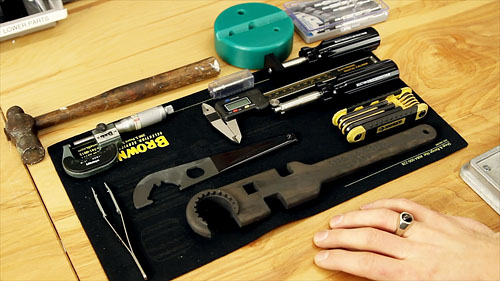
Here are the main tools you’ll need to assemble an AR-platform rifle
In these challenging times, many Americans are buying an AR-type rifle, or starting an AR project — assembling the rifle from available uppers, lowers, and parts kits.
If you are planning to put together an AR-platform rifle or upgrade your AR with a new barrel, stock, or trigger group, here’s a tip. Check out the AR-15 Rifle Build DVD from our friends at UltimateReloader.com. This DVD covers all the details of a custom build, using high-resolution video sequences, and helpful supporting graphics.
In this DVD, Gavin Gear guides you through the entire process including selecting components, acquiring and using the necessary tools, assembly steps and details for each component, and even mounting a scope. Building an AR-15 can be overwhelming, but with the right guidance and help it’s not difficult and can be very rewarding. With this DVD you’ll be able to build your AR-15 with confidence.
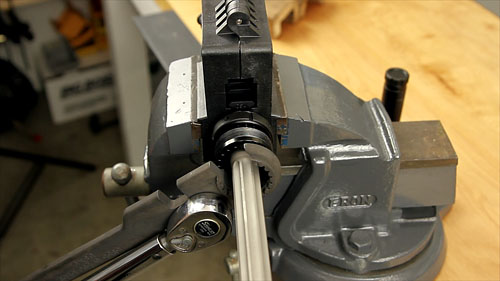
Upper: Barrel / Gas Block / Gas Tube
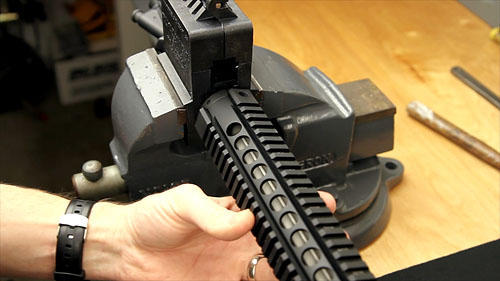
Upper: Handguard Installation
UltimateReloader.com’s AR-15 Build DVD is available just $9.90 (plus $3.80 shipping/handling). This DVD can pay for itself many times over by showing you how to do your own gunsmithing (and get quality AR components at attractive prices).
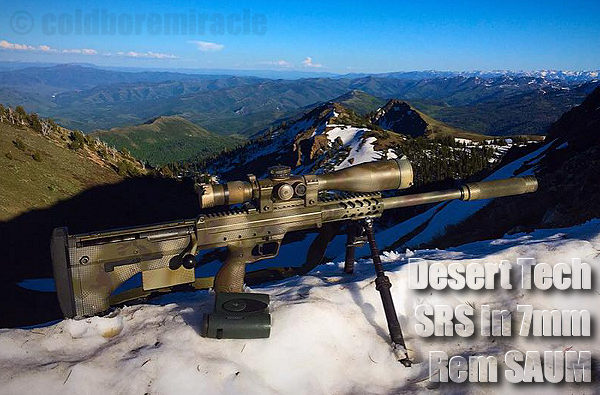
Here is the view from 9500 feet ASL. The SRS in 7mm Rem SAUM almost outran the Swarovski laser…
7mm RSAUM in a bolt-action bullpup? Yes it works. A talented shooter, who calls himself “ColdboreMiracle” in social media, has a Desert Tech SRS-A1 rifle chambered for the 7mm RSAUM, and it hammers. The 7mm Remington SAUM (Short Action Ultra Magnum) is popular with F-Open competition shooters. It can also work well for long-range hunting and tactical tasks. Learn more about the 7mm Remington SAUM in our 7mm Cartridge Guide.
ColdboreMiracle owns the SRS-A1 “covert” model, which has a shorter handguard than the standard SRS-A1 model shown below. Desert Tech now offers an SRS-A2 model which has an M-LOK handguard and some refinements to the chassis.
Here is a detailed video review of a Desert Tech SRS chambered in .308 Win. You can see a close-up of a 100-yard 5-shot group at time-mark 6:25:
Here is a review of the newer SRS-A2 Covert (shorter model), after 1000 rounds. The reviewer believe the SRS bullpup’s shorter length offers some advantages for precision shooters:
ColdboreMiracle says the bullpup design has many advantages: “The Stealth Recon Scout (SRS) rifle from Desert Tech is a bullpup-configured precision rifle with a shorter length than many carbines. The SRS has a multitude of barrel options that can be swapped in under a minute — all of them come with a 1/2-MOA accuracy guarantee and return to zero. The SRS’s bullpup design puts the rifle’s COG closer to the shoulder, making the rifle balance better off-hand. The straight-line geometry of the SRS makes recoil seem lighter, and barrel hop is reduced, allowing the shooter to stay on target better. It takes a little getting used to, when converting from a traditionally-configured bolt gun. But once you do, you won’t go back.” To learn more about this rifle (and other Desert Tech arms), visit ColdboreMiracle’s Facebook Page and YouTube Channel.
The 7mm RSAUM — Why It Was Chosen for this SRS
ColdboreMiracle explains how he selected the 7mm Rem SAUM chambering for his Desert Tech SRS Bullpup: “I just did a comparison between barrel life, velocity, brass, etc. and came to the SAUM. I can tell you this, if you go with one for your SRS, make sure you use long bullets like the 183 or 195, and seat them long. That will aid in smooth cycling.”
Mr. ColdboreMiracle tested the new generation 183gr Sierra MatchKings (item # 1983). These impressive projectiles are “tipped” at the factory. Claimed G1 BC is a lofty 0.707 (at 2300 fps and above). We have heard other reports that these bullets “hold waterline” exceptionally well at 1000 yards. That indicates the bullet-to-bullet BC is very consistent. No doubt the factory uniforming/pointing of the bullet tips helps in that regard.
As you can see, these 183-grainers shoot well in ColdboreMiracle’s SRS rifle. Here are five shots at 100 yards. That’s very impressive for a tactical-style rifle shot from a field-type bipod.
ColdboreMiracle says: “This is the only reason I need to shoot Sierra bullets. On the right (above) you can see the results of the 183gr SMK from my 7mm SAUM. Five shots at 100. A huge thanks to Mark at Short Action Customs, LLC for [chambering this barrel] for my Desert Tech SRS.”
7mm Remington SAUM — Key Considerations
In some respects, the 7mm SAUM cartridge may be better than the 7mm WSM. The 7mm SAUM holds less powder — but that’s a good thing, since the capacity is more than adequate to do the job. You can drive the 180s at 3000 fps with a SAUM using less powder than with a WSM. Additionally, the SAUM case has a slightly longer neck. This gives you greater flexibility in bullet seating. With a long neck you can set the throat so the long 180+ graing bullets are above the neck shoulder junction, yet you can still seat shorter hunting bullets close to the lands. Additionally, long case necks, some believe, cause less throat erosion than shorter necks. That’s not “hard science” but it is certainly a view shared by many experienced shooters. The long neck is one reason many varminters favor the 6mm Remington over the .243 Winchester.
7mm RSAUM Is More Efficient than 7mm WSM
7mm RSAUM shooter Steven Ikeeda tells us: “I decided that some type of 7mm was the ticket for doing well at 1000-yard matches, especially if one could drive the high-BC bullets at 2900+ fps. Looking over various 7mm cartridges that could produce those velocities (and didn’t require case-forming), I was impressed by the 7mm SAUM and the 7mm WSM. According to the load manuals, the 7mm WSM offered a bit more velocity than the 7mm SAUM. However, to achieve its small velocity advantage, the larger 7mm WSM had to burn 7-10% more powder than the 7mm SAUM. (The 7mm WSM has 81.0 grains of capacity vs. 73.6 grains for the 7mm SAUM.) The SAUM is a very efficient case. It looks like a 6.5×47 Lapua on steroids.”
In many states, schools have been closed and citizens have been ordered to stay at home for days or weeks, as a response to the Coronavirus health issue. With more gun owners at home with their kids for extended periods, firearms safety is more important than ever. Given that fact, the NSSF reminds gun owners to keep their guns locked up so they cannot be accessed by children.
The National Shooting Sports Foundation (NSSF) and its partners urge gun owners to keep firearm safety a top priority and are making safety resources widely available as gun and ammunition sales increase, especially among first-time firearm purchasers.
“During this stressful time and with children spending more time at home, the firearm industry reminds gun owners that protecting yourself and your family includes making sure your firearms are stored securely when not in use”, said Joe Bartozzi, NSSF President and CEO. “The last thing any firearm owner wants is to have their gun fall into the wrong hands, particularly those of a child or someone at risk of harming themselves.”
For anyone considering buying a gun, Project ChildSafe’s Road To Responsible Firearm OwnershipMany Paths to Firearm Safety video series helps gun owners determine the best safe storage device for their home/lifestyle. You also view the Safe Storage Options chart.
NSSF encourages gun owners and non-gun owners to use the firearm safety resources available on its Project ChildSafe website. These include the McGruff Gun Safety videos for young children and this educational video explaining how to discuss gun safety with children:
“More parents are assuming the role of educators in their homes, so it’s a good to time have a talk with your kids about gun safety, even if you don’t own a gun”, Bartozzi said. “If you do own a firearm, be sure your family understands the safety rules regarding firearms in your home, and always store guns responsibly when not in use.”
Savage Arms has completed a major overhaul of the Savage website. Now the SavageArms.com site is more mobile-friendly and easier to navigate. Savage has expanded information on its rifle products, and also updated the Expert Advice area. This section of the website offers informative technical articles/videos, as well as numerous helpful tips for hunters.
You’ll find 30 informative topics in the Expert Advice section of the updated Savage Arms website. Below are FIVE of our favorites. Click each item to view the full text and linked VIDEOS. Even if you don’t own a Savage, these features are useful. And all new shooters should definitely check out the Advanced Optics selection. This features a good video covering mirage and light refraction.
1. Advanced Optics — Stan Pate
Light refraction can wreak havoc on your ability to connect with a target at extreme long range. Stan Pate offers some good advice concerning mirage and refraction.
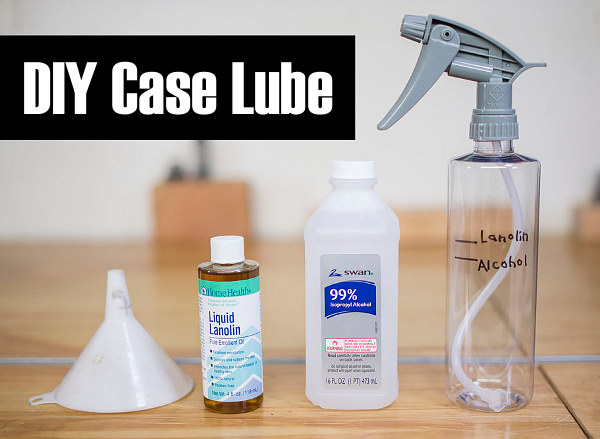
Tired of spending $15-$25 for a can of spray lube that doesn’t last that long? For about the same price as a single 10 oz. can you can make your own effective spray lube that should last for multiple seasons and lube thousands of cases quickly and easily.
In the YouTube video embedded below, our friend Gavin Gear of UltimateReloader.com shows how to make your own case lube using simple, inexpensive ingredients. As recommended by the 6.5 Guys, this Liquid Lanolin + Isopropyl Alchohol mix works well and is very cost-effective. You can make a pint of this home-brew Lanolin case lube that will lube thousands of cases — many more than a typical commercial aerosol spray can (that’s mostly compressed air).
Gavin describes the exact mixing process on his Ultimate Reloader website. Gavin says this lube mix is a good complement to the Hornady One-Shot (pistol) and Dillon DCL (rifle) lubes he has used for pistol and rifle reloading sessions. CLICK HERE to read more.
If you have ever competed in NRA High Power, Silhouette, or Long Range disciplines, you know the name David Tubb. Arguably the greatest rifle marksman in American history, David has recorded 11 High Power Rifle Championships, 6 Long Range National Championships, and 7 High Power Silhouette National Championships. Over his career David has won 130 NRA trophies for various competitions. No one has even come close to that number of Championships and honors in rifle competition.
David Tubb Biography Video
Click the video above to view a great new documentary which covers David Tubb’s career in competitive shooting. Called America’s Rifleman, this fine documentary by filmmaker Sheldon Charron takes you inside the life and mind of legendary shooting champion David Tubb.
Learn how David evolved into the most successful rifleman in the history of competitive shooting, the challenges he faced, and how he overcame them on his road to success, both at the range and in his business, Superior Shooting Systems.
David Tubb Competition Shooting Accomplishments:
11 Time – NRA National High Power Rifle Champion – Camp Perry
6 Time – NRA Long Range Rifle (600-1000 yard) National Champion
7 Time (Consecutive) – NRA National High Power Rifle Silhouette Champion
6 Time – NRA National High Power Hunting Rifle Silhouette Champion
4 Time – NRA National Smallbore Hunting Rifle Silhouette
7 Sportsmen’s Team Challenge Championships
2 Time – Wimbledon Cup Winner
2019 ELR World Record Holder recognized by 50 Cal. Shooters Association
2019 NRA ELR Heavy Gun Winner
Over 130 NRA Championship Event Trophies (Individual Match Winner)
David Tubb with the ELR Adaptive Target Rifle (ATR) he designed which has set ELR records. You can see David shoot this rig in the video below:
“America’s Rifleman” Movie Credits:
Production Company: Enter360 Media
Producer/Director/Editor: Sheldon Charron
Production Assistant: Christie Tubb
SHOT Show 2020 Special Episode
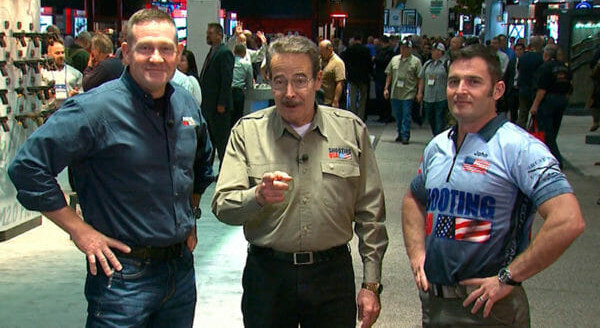
This week, Shooting USA features a full hour of SHOT Show coverage. If you watch just one episode of Shooting USA this year, it should be the SHOT Show 2020 Special which runs today, March 5th at 3:00 pm ET on the Outdoor Channel. Jim Scoutten’s team works hard every January, bringing you highlights from the gun industry’s largest trade show. Jim, son John Scoutten, and other staffers prowled the 12 miles of aisles in the Sands Convention Center in Las Vegas, visiting many of the 1,600+ exhibitors. This episode provides a “first look” at the new guns, optics, and gear introduced for 2020. Click HERE to learn more about this week’s 2020 SHOT Show episode.
2020 SHOT Show Highlights: Colt Python, Hornady A-Tip bullets, Volquartsen Summit .17 WSM, Ruger-57 Pistol, Pinnacle Precision Rifle, HK SP5, Impact Sport Muffs, Laugo Arms Alien Pistol, Vortex 1-10X Scope, Glock 44 Pistol, and much more.
Shooting USA’s SHOT Show 2020 will air today, Thursday, March 5 at 3:00 pm ET on the Outdoor Channel. Look for Shooting USA on the Outdoor Channel. In addition, you can watch all episodes of Shooting USA on the VIMEO channel by subscription. The SHOT Show 2020 edition is jsut $0.99.
Here are some of the 50+ new products featured on the SHOT Show Special. Click Images for detailed product information.
In this video, Anette Wachter (the 30CalGal) offers tips for shooting from bipod.
Our friend Anette Wachter, aka “30CalGal”, stars in a smart video from NRAWomen.TV. In this episode of Tips & Tactics, Anette talks about the “mental game” in competition. Specifically she explains how to “visualize success”:
I have found that a lot of my success in competition has come through what I call a ‘mental rehearsal’. I actually visualize every stage of the match and I visualize the success of the match and winning the match.
I actually visualize that round going downrange into the target, and the target coming up with a dead-center ‘X’. I visualize this over and over. If you visualize success you will achieve success.
Visualization is a process of mental preparation that is done before you get to the range. Many of the greatest shooting champions have used this technique to get ready for big matches, and to optimize their performance during record fire. If you want to enhance your “mental game” through pre-match visualization, we strongly recommend Lanny Bassham’s book, With Winning in Mind.
As a competitive smallbore 3P shooter, Bassham developed a mental management system. Using this system, Lanny Bassham won 22 world individual and team titles, set four world records, and captured an Olympic Gold Medal in Montreal in 1976. His techniques have been embraced by professional and Olympic athletes in many sports. With Winning in Mind covers a complete system of “mental management” techniques used by Olympians and elite champions.
About 30CalGal Life is short. Go Shoot! — Anette Wachter
Along with being a talented competitive shooter, Anette has her own Gun Blog, 30CalGal.com, and she writes for several gun publications including GunUp Magazine, Shooting Sports USA, Sure Shots Magazine, and Wide Open Spaces. She also designs and crafts custom jewelry items, sold through her AW Collections webstore.
Many readers may not know this, but the Ruger Precision Rimfire rifle is now available in two additional rimfire chamberings: .17 HMR and .22 WMR. While .22 LR ammo is considerably cheaper, .17 HMR and .22 WMR shoot flatter and deliver much more energy. This makes the Ruger rig way more suitable for varminting. In fact we think this .17 HMR transforms the Ruger Precision Rimfire into a very good “carry-around” varmint rifle. We really like the .17 HMR — it’s our favorite rimfire cartridge for small varmints out to 160 yards.
Both cartridge types, .17 HMR and .22 WMR, also offer higher velocities, less wind drift, and flatter trajectory than the .22 LR. This is a benefit when cross-training. You can shoot at more distant targets with considerably less elevation dialed in your scope. And the windage corrections will be less extreme.
Ruger says: “Faster, flatter and with high-performing bullets, .17 HMR and .22 WMR cartridges expand the capabilities of the Ruger Precision Rimfire platform. Like its .22 LR predecessor, these new magnum offerings maintain the same ergonomics, trigger and manual of arms as the larger centerfire Ruger Precision Rifle.”
Here’s an excellent video review of the .17 HMR Ruger Precision Rimfire rifle by YouTuber 22 Plinkster. The reviewer was impressed with the rifle’s accuracy with 17gr ammo.
Both Ruger Precision Rimfire rifles feature 18″ hammer-forged barrels threaded for muzzle devices, including the Ruger® Silent-SR®. The 15″ free-float handguard with Magpul M-LOK slots provides generous scope clearance and easy mounting of M-LOK-compatible rails and accessories.
Like its .22 LR version, the magnum Ruger Precision Rimfire models featured an adjustable bolt throw (that can emulate a centerfire action if desired), along with trigger that adjusts from 2.25 to 5 pounds. The .17 HMR and .22 WMR models ship with a 0 MOA Picatinny rail and one, 15-round BX-15 Magnum magazine or one, 9-round JMX-1 rotary magazine. The BX-15 Magnum is a natural pairing for the new Ruger Precision Rimfire in magnum calibers. It is also compatible with Ruger 77/17®, Ruger 77/22® and Ruger American® Rimfire rifles chambered in .17 HMR and .22 WMR.







 In some respects, the 7mm SAUM cartridge may be better than the 7mm WSM. The 7mm SAUM holds less powder — but that’s a good thing, since the capacity is more than adequate to do the job. You can drive the 180s at 3000 fps with a SAUM using less powder than with a WSM. Additionally, the SAUM case has a slightly longer neck. This gives you greater flexibility in bullet seating. With a long neck you can set the throat so the long 180+ graing bullets are above the neck shoulder junction, yet you can still seat shorter hunting bullets close to the lands. Additionally, long case necks, some believe, cause less throat erosion than shorter necks. That’s not “hard science” but it is certainly a view shared by many experienced shooters. The long neck is one reason many varminters favor the 6mm Remington over the .243 Winchester.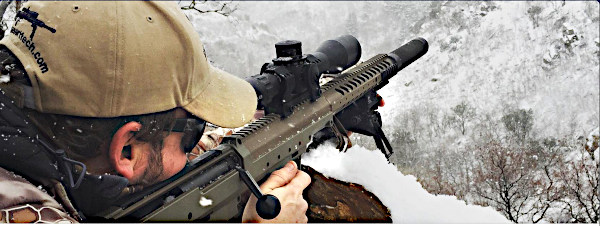



 David Tubb Biography Video




 Our friend
 Many readers may not know this, but the Ruger Precision Rimfire rifle is now available in two additional rimfire chamberings: .17 HMR and .22 WMR. While .22 LR ammo is considerably cheaper, .17 HMR and .22 WMR shoot flatter and deliver much more energy. This makes the Ruger rig way more suitable for varminting. In fact we think this .17 HMR transforms the Ruger Precision Rimfire into a very good “carry-around” varmint rifle. We really like the .17 HMR — it’s our favorite rimfire cartridge for small varmints out to 160 yards.


