There’s a great new way to apply an eye-catching finish to fiberglass and synthetic stocks. Water Transfer Printing (aka Hydro-Dipping) can apply beautiful, stylized patterns to your stock, and the process costs less than a custom paint job. Hydro-dipping is ideal for applying amazing photo-realistic effects such as stone, wood burl, snakeskin, or faux carbon fiber. Hydro-dipping requires no harsh chemicals or high heat so there are no negative side effects. You just end up with an amazing, patterned finish on your stock.
Hundreds of different patterns are available. We like the carbon-look finish on benchrest guns and the snakeskin patterns on hunting and varmint rifles. Natural snakeskin designs, in this Editor’s opinion, are perhaps the most effective camouflage for the largely arrid backcountry in the American southwest.
Hydro-Dip of Idaho Does Great Work
While there are a half-dozen companies offering water transfer printing for rifle stocks, Forum member Francis B. recommends Hydro-Dip, LLC of Meridian, Idaho. Examples of Hydro-Dip’s work are shown above. Francis writes: “Scott, Adam, and old man Rod Springer own and run Hydro-Dip. This is a company that will ‘paint’ your rifle, tool box, trailer, airplane, whatever and will do an excellent job while doing it. Check out their archives of jobs done. You will be amazed. I’ve not had one of their jobs done for any of mine (yet) but I’m considering it. Those who have had their rifles done tell me the cost is very reasonable. I have seen a few stocks done and they are works of art.”
Hydro-dipping (water transfer printing) can be performed on virtually any metal or plastic surface. You can Hydro-dip car parts, archery gear, rifle stocks — you name it. Watch the process in the video:
To be honest, when we read the description of Trijicon’s new Ventus device, we thought it sounded like science fiction. This quad-collimated laser rangefinder/wind-reading gizmo seems like something Captain Kirk would use on Star Trek. According to Trijicon, the Ventus is “the world’s first advanced wind-mapping and range-detecting handheld device.” That’s right folks, this is a rangefinder that also “measures three-dimensional wind velocities at multiple distances out to 500 yards”. Combined with a claimed 5000-yard ranging ability (on reflective objects), Trijicon says its new Ventus gives “shooters and hunters previously unattainable data about their environment for long-range accuracy.”
The Ventus unit is designed with a Doppler LIDAR engine that can measure headwind, tailwind, crosswind and vertical wind components at six different distances, in any weather condition. The higher-end Ventus X Model also includes an onboard ballistics solver which communicates, via Bluetooth, with the Trijicon Ballistics App. This allows Ventus-X users to store shooter and target geographic locations, calculate ballistic solutions, and display wind maps.
The Ventus utilizes an advanced Doppler LIDAR engine and four collimated lasers sent out in a cone to measure wavelength interaction with dust particles at up to six different distances.
Four Collimated Lasers Read the Wind via Doppler LIDAR
How does the wind-reading work? Trijicon states: “Thanks to a fiber optic collimated laser capable of returns through dust, fog, sleet, and snow, the Ventus offers extreme, all-weather performance. Four collimated lasers [are] sent out in a cone to measure wavelength interaction with dust particles at up to six different distances. This technology allows the Ventus to calculate for head, tail, cross and vertical wind, giving shooters an incredibly accurate wind reading.”
Ventus X Model Includes Advanced Ballistics Solver
The Ventus comes in two models: Ventus and Ventus X. The basic Ventus handles ranging duties. The upgraded Ventus X adds a state-of-the-art, onboard ballistics solver. An onboard sensor suite captures all necessary data — range, wind, atmospheric temperature, stratospheric pressure, and incline angle — to provide a very advanced ballistic solution.
The Ventus X also communicates via Bluetooth to the advanced Trijicon Ballistic application, soon to be available for both iOS and Android. The Ballistic App stores shooter and target geographic locations, provides a ballistic solution, and displays a wind map overlay of readings.
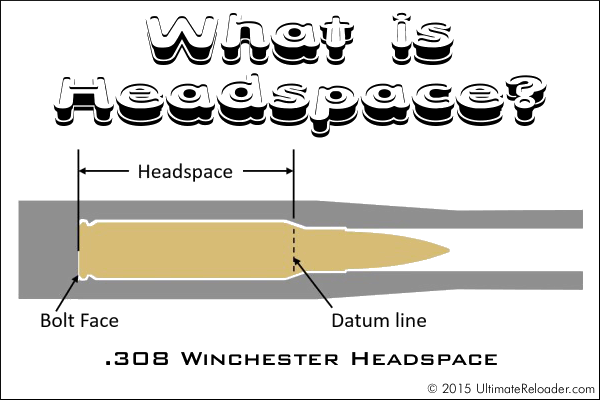
This illustration shows headspace measurement for the popular .308 Winchester cartridge, which headspaces on the shoulder. Image copyright 2015 Ultimate Reloader.
In this Brownells Tech Tip, Brownells gun tech Steve Ostrem explains what headspace is and why it’s one of the most critical measurements for nearly all firearms. Even if you’re an experienced rifle shooter, it’s worth watching this video to refresh your understanding of headspace measurements, and the correct use of “GO” and “NO-GO” gauges.
Headspace Definition
In firearms, headspace is the distance measured from the part of the chamber that stops forward motion of the cartridge (the datum reference) to the face of the bolt. Used as a verb, headspace refers to the interference created between this part of the chamber and the feature of the cartridge that achieves the correct positioning. Different cartridges have their datum lines in different positions in relation to the cartridge. For example, 5.56x45mm NATO ammunition headspaces off the shoulder of the cartridge, whereas .303 British headspaces off the forward rim of the cartridge.
If the headspace is too short, ammunition that is in specification may not chamber correctly. If headspace is too large, the ammunition may not fit as intended or designed and the cartridge case may rupture, possibly damaging the firearm and injuring the shooter. (Source: Wikipedia)
Headspace Gauges
Headspace is measured with a set of two headspace gauges: a “Go” gauge, and a “No-Go” gauge. Headspace gauges resemble the cartridges for the chambers they are designed to headspace, and are typically made of heat-treated tool steel. Both a “Go” and a “No-Go” gauge are required for a gunsmith to headspace a firearm properly. A third gauge, the “Field” gauge, is used (as the name implies) in the field to indicate the absolute maximum safe headspace. This gauge is used because, over time, the bolt and receiver will wear, the bolt and lugs compress, and the receiver may stretch, all causing the headspace to gradually increase from the “factory specs” measured by the “Go” and “No-Go” gauges. A bolt that closes on “No-Go” but not on “Field” is close to being unsafe to fire, and may malfunction on cartridges that are slightly out of spec. (Source: Wikipedia)
To learn more, read Brownell’s longer article Headspace Gauges and How to Use Them. Among other things, this explains the relative lengths of “Go”, “No-Go”, and “Field” gauges. The “Field” is actually the longest: “The GO gauge corresponds to the SAAMI (Sporting Arms & Ammunition Manufacturer’s Institute) minimum chamber length, while the FIELD gauge usually matches the maximum chamber depth, or slightly less. NO-GO gauges are an intermediate length between minimum and maximum, that, technically, is a voluntary dimension. A firearm that closes on a NO-GO gauge and does not close on a FIELD gauge may not give good accuracy and may have very short cartridge case life from the ammunition re-loader’s standpoint.”
Creedmoor Sports has released a series of helpful “how-to” videos in its new InfoZone web page. In the latest InfoZone video Bill Gravatt shows how to seat bullets using L.E. Wilson Hand Dies and an Arbor Press. The basic process is simple, particularly with a micrometer-top seating die. That makes it easy to adjust and set seating depth. Before you start seating bullets, you want to adjust the height of the arbor so the stroke is appropriate to the height of your die.
Bill Gravatt Shows How to Use Hand Seating Dies — Creedmoor INFOZONE
ARBOR PRESS TECHNIQUE: When using an arbor press, smooth is good. You don’t want to slam the handle down quickly. Try to repeat the same motion each time. You can also experiment by seating the bullet part way, then rotate the cartridge (in the die) and do the final seating with a second stroke. If your arbor press has a force gauge, note both the max value of the gauge needle and how it moves as you seat the bullet. If the needle spikes too rapidly, or bounces back and forth irregularly, set that cartridge aside and/or mark it. You could have neck tension issue with that case or some other fault. You might even have a bad bullet. That’s rare, but can happen. The key to success is moving the press arm in a smooth motion every time, maintaining the same down-pressure with each cartridge.
Here Bill Gravatt Offers a Simple Tip for Adjusting Wilson Seating Dies
One of our Forum readers asked “How can I get a custom in-line seater for my new rifle?”. First, we would say that, if you are not shooting an unusual Wildcat, check first to see if L.E. Wilson makes a stainless Micrometer Seater Die for your rifle. These dies are a joy to use, and we’ve found the fit to be exceptionally good with many calibers. Typically priced from $90-$100, Wilson stainless micrometer-top seaters are available for dozens of cartridge types: .204 Ruger, 20 BR, .222 Rem, .223 Rem, 22 PPC, 22 BR, .22-250, .223 WSSM, 6 PPC, 6mmBR, 6XC, 243 Win, .243 WSSM, 25 WSSM, 6.5×47 Lapua, 6.5 Creedmoor, 6.5-284, 26 Nosler, .270 WSM, 7mm-08, .284 Win, 28 Nosler, 7mm RUM, 30 BR, 30 IHMSA, .308 Win, .300 WinMag, .338 Edge (and MORE).
If you do want a custom seater die, the process is relatively simple. Purchase a die blank from Wilson and have your gunsmith run the chambering reamer in. Forum member Gunamonth explains: “I start with a Wilson seating die blank. They’re available from Sinclair and other vendors. Just run the reamer in. For some of my rifles, where I wanted the stainless die with the micrometer adjustment, I bought a smaller die and had the smith ream it with the chamber reamer. That’s how I had my 6 Dasher and 6mm AI seaters made. With the Dasher I stared with a 6mmBR Micrometer die.”
SEATER STEM TIP: If, on your seated bullets, you are seeing a sharp line around the jacket near the ogive, you may want to smooth out the leading edge of the Wilson seater stem (see above left). Do this by putting a little lapping compound on one bullet and manually spin this around in the stem. Without much effort you’ll have a smooth bullet/stem interface.
Micrometer Top Add-on
We really like micrometer tops on a seating die. But what if Wilson doesn’t make a micrometer top seater for your chambering? Don’t despair, Sinclair Int’l sells a $39.99 micrometer top that can be added to Wilson standard seaters or to a custom seater die made from a Wilson die blank.
22Plinkster Tours CCI/Speer Idaho Factory
Trickshot artist and YouTube host 22Plinkster recently got a chance to tour the CCI/Speer production facility in Lewiston, Idaho. This large plant produces both rimfire and centerfire ammunition. While touring the plant, 22Plinkster was allowed to capture video showing the creation of .22 LR rounds from start to finish. This is a fascinating video, well worth watching.
This revealing video shows all phases of .22 LR ammo production including cupping, drawing, annealing, washing, drying, head-stamping, priming, powder charging, bullet seating, crimping, waxing, inspection, and final packaging. If you’ve got ten minutes to spare, we really recommend you watch the video from start to finish. You’ll definitely learn some new things about rimfire ammo.
Field & Stream Tours Federal Ammo Plant in Minnesota
Note to Viewers — After Starting Video, Click Speaker Icon to HEAR audio!
Last year a Field & Stream writer toured the Federal ammunition production facility in Anoka, Minnesota. This large plant produces both rimfire and centerfire ammunition. While touring the plant, the reporter was allowed to capture video showing the creation of .22 LR rounds from start to finish. This is a fascinating video, well worth watching. Click speaker icon for sound.
The Manufacturing Process for .22 LR Rimfire Ammunition Shooting Sports USA explains: “Rimfire cartridge cases are the oldest self-contained cartridge in existence, having been in continuous production since the mid-1850s. Rimfire cases are drawn from a thin piece of brass and formed with a hollow rim. A priming compound is then forced into the case using centrifugal force, where it is charged with powder and a bullet is seated in the mouth of the case. The case is then crimped around the bullet to ensure sufficient push and pull when the round is fired. When the firing pin strikes the thin brass rim of the case, the hollow rim is crushed and the primer is ignited.” Source: SSUSA.org 9/2/2017.
Buried in CCI Rimfire Ammo
22Plinkster was literally up to his neck in ammo while touring the CCI/Speer Idaho ammo plant. He says: “This was truly a dream come true for me. I can’t thank the people at CCI and Speer enough for allowing me to do this. I couldn’t possibly show everything that went on at the factory. However, hopefully I showed you enough for you to grasp the concept of how rimfire [ammo] is made.”
History — Speer Brothers Brought Ammo Production to Lewiston
Here is an interesting historical footnote. Today’s large CCI/Speer operation in Idaho can be traced back to the companies founded by the Speer brothers. After settling in Lewiston in 1944, Vernon Speer started Speer Bullets. A few years later, in 1951, Vernon’s brother Dick (with partner Arvid Nelson) started Cascade Cartridges Inc., a producer of small-arms ammunition and primers. Yes, as you may suspect, Cascade Cartridges Inc. is now CCI, a Vista Outdoor company, and one of the largest manufacturers of primers and loaded ammunition. Today, the CCI/Speer Lewiston plant produces both Speer bullets and CCI-branded ammunition and primers. Vista Outdoor’s predecessor, ATK, acquired the plant in 2001. Vernon Speer died in 1979, and Dick Speer died in 1994.
The U.S. Army Marksmanship Unit (USAMU), in cooperation with Shooting USA TV, has created a series of instructional Pro Tip pages covering a wide range of shooting disciplines. All totaled, there are more than 50 USAMU Pro Tips. Most relate to rifle marksmanship but there are also numerous tips for shotgunners and pistol shooters. Each Pro Tip entry includes multiple photos and 6-15 paragraphs, in an easy-to-follow format. Many Pro Tips also include an instructional video produced by Shooting USA. Here are three Pro Tip videos, and links to seven more Pro Tip web pages.
USAMU TOP TEN PRO TIPS
1. Reading the Wind with SGT Sherri Gallagher.
Apart from gravity, wind has the most pull on the bullet as it travels down range. Being able to accurately read the wind and mirage will greatly enhance your performance on the rifle range. National Champion, SGT Gallagher gives you some of her tips.
2. Angle Shooting with SFC (Ret.) Emil Praslick.
SFC Praslick shows you how to determine the angle to your target, and then how to include that to change your data necessary to hit your target on the first shot.
3. Rifle Grip, Stance and Body Position for 3-Gun with SFC Daniel Horner.
Professional 3-gun marksman SFC Daniel Horner, U.S. Army Marksmanship Unit (USAMU), give tips on how to properly handle a semi-automatic rifle, including grip, stance and body position.
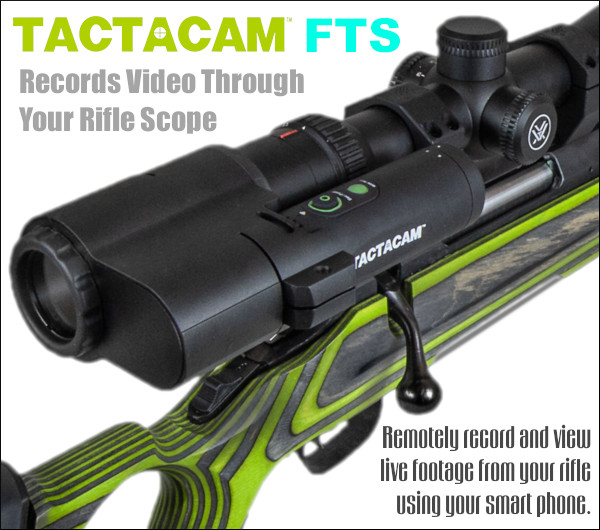
Would you like to record what your eyes are seeing through your scope, during a practice session or hunt. Here is a very highly-reviewed product that will do the job superbly for under $430.00 on Amazon. The impressive Tactacam FTS 5.0, that allows you to film directly through your rifle scope. The FTS 5.0 unit, produced by Tactacam in Minnesota, has earned high praise from users. In September 2019, reviewer Joe Rhea declared: “This Tactacam 5.0 is the best scope cam system I have seen or used”. Likewise reviewer Scott Gregg states: “This is THE BEST Action Camera for hunting.”
Tactacam Live Streaming AND Recording
What you see through your riflescope can be recorded to your mobile device as well as viewed live. We think this is an important technology for marksmanship training. In addition, this is great for hunters who may want to record a successful hunt sequence.
The Tactacam FTS combines high definition capture with the high-power zoom of a rifle scope. This lets you remotely view and record live footage from your rifle on your smartphone or mobile device. Simply couple your scope and your camera together with the Tactacam FTS components. Then sync the camera to the Tactacam APP on your smart phone for live viewing.
You continue to watch your target through the normal optical axis of the rifle scope. The camera records via the offset FTS camera mount. The output of the FTS camera system can then be viewed, in real time, via a live feed to a smartphone. After setup, the Tactacam FTS allows the riflescope to operate normally with no additional adjustment or modification.
4K Resolution, Remote Control, Slo-Mo, Wifi Viewing and More
Tactacam’s innovative camera systems allow easy, in-the-field recording of hunts and shooting sessions. The latest Tactacam 5.0 unit provides 4K resolution with outstanding image quality. Other features include WiFi and APP viewing options, remote control activation, slow motion, and live-streaming capabilities. Camera output can be viewed both in the App and on external WiFi-capable devices.
The Tactacam FTS system can attach to nearly all conventional rifle scopes. This system is less expensive and easier-to-mount that most other through-the-scope viewing systems. Importantly, your valuable smartphone remains separate, i.e. NOT attached to the rifle. Hence it cannot be harmed by recoil or muzzle blast. That’s important.
As part of the NRA Mentor Program, the NRA offers a helpful video about using sights. This covers all types of sighting systems — blade sights, aperture sights, V-notch sights, red dot sights, shotgun bead sights, and telescopic sights with reticles. For new shooters, this video can be helpful — it explains sight basics in very clear and comprehensible terms. And even for experienced shooters, this can provide some helpful tips on sight alignment, particularly when shooting pistols.
Additional information about using sights is contained in the NRA’s free Guide for New Shooters. This helpful 14-page digital publication provides the key firearms safety rules, explains range etiquette, and even has a section on gun cleaning. CLICK HERE to download Guide for New Shooters.
Training With Lasers — Trigger Control
Training with laser sights helps diagnose and improve trigger control errors by showcasing the importance of “surprise break” and follow-through. Working with gun-mounted lasers, which put a red or green dot right on the target, can quickly diagnose errors such as recoil anticipation, jerking the trigger, and breaking the wrist. This video shows how handgunners can use pistol-mounted lasers to correct bad habits and shoot more consistently.
Tumblers and walnut/corncob media are old school. These days many shooters prefer processing brass rapidly with an ultrasonic cleaning machine. When used with the proper solution, a good ultrasonic cleaning machine can quickly remove remove dust, carbon, oil, and powder residue from your cartridge brass. The ultrasonic process will clean the inside of the cases, and even the primer pockets. Tumbling works well too, but for really dirty brass, ultrasonic cleaning may be a wise choice.
Our friend Gavin Gear recently put an RCBS Ultrasonic cleaning machine through its paces using RCBS Ultrasonic Case Cleaning Solution (RCBS #87058). To provide a real challenge, Gavin used some very dull and greasy milsurp brass: “I bought a huge lot of military once-fired 7.52x51mm brass (fired in a machine gun) that I’ve been slowly prepping for my DPMS LR-308B AR-10 style rifle. Some of this brass was fully prepped (sized/de-primed, trimmed, case mouths chamfered, primer pockets reamed) but it was gunked up with lube and looking dingy.”
UltimateReloader.com Case Cleaning Video (7.5 minutes):
Gavin describes the cleaning exercise step-by-step on UltimateReloader.com. Read Gavin’s Cartridge Cleaning Article to learn how he mixed the solution, activated the heater, and cycled the machine for 30 minutes. As you can see in the video above, the results were impressive. If you have never cleaned brass with ultrasound before, you should definitely watch Gavin’s 7.5-minute video — it provides many useful tips and shows the cleaning operation in progress from start to finish.
Ultra Dry Necks After Ultrasonic Cleaning — Some Suggestions
The Ultrasonic cleaning process gets cartridge brass so “squeaky clean” that increased force may be required to seat your bullets, or they may “grab” as they go in the necks. To reduce bullet-seating effort, you may benefit from adding a little dry case lube inside the case-neck before loading (use a nylon brush). Another trick is adding a teaspoon of Ballistol lube to the cleaning solution. That provides a trace lubricant inside the necks, but does not interfere with powder ignition in any way.
The latest Gen2 RCBS ultrasonic cleaning machine has a large 6.3-quart capacity. That’s nearly 100 percent larger than the first generation machine in Gavin’s video. The Gen2 machine, $322.02 on Amazon, features a second ceramic heater and transducer to better clean brass cases and firearm parts. The LED is easily programmable, and the timer can be set for up to 30 minutes of cleaning. The original 3.2 quart capacity RCBS ultrasonic machine, as shown in Gavin’s video, is still available for $166.56 at Midsouth Shooters.
New Year’s Eve is just four days away. Perhaps you’ve been getting ready for the big event, getting Champagne (and sparklers) to celebrate the New Year, and the opening of a new decade. 2020 will also be a Presidential election year, by the way — so make sure you’re registered to vote.
Recently at Thorton Winery in Temecula, California, a champagne vintner, we were shown the best way to open a champagne bottle. We were told you should hold the bottle nose up at an angle then rotate the BOTTLE slowly while holding the cork. That works great… but it’s not as stunning as the way sharpshooter Kirsten Joy Weiss opens a bottle of bubbly.
A former competitive smallbore rifle shooter, ace trigger-puller Kirsten Joy Weiss tried a special New Year’s trick shot a few seasons back. In keeping with the festive New Year’s spirit, Kirsten attempted to shoot the cork off a champagne bottle. After a few unsuccessful tries, she managed to hit the cork with at least two shots. But alas the cork did not fly. She actually hit the cork, but it did not release. That was surprising…
Undaunted, Kirsten changed her strategy, aiming for the neck of the bottle. This duplicates the process of “sabering” a champagne bottle — a method of liberating the bubbly by slashing off the end of the neck with a blade. Aiming for the neck of the bottle, Kirsten successfully blew off the top of the bottle. (Apparently, when “sabering” it is actually the pressure within the champagne bottle which does most of the work).



 Headspace Gauges
 One of our Forum readers asked “How can I get a custom in-line seater for my new rifle?”. First, we would say that, if you are not shooting an unusual Wildcat, check first to see if




 A former competitive smallbore rifle shooter, ace trigger-puller Kirsten Joy Weiss tried a special New Year’s trick shot a few seasons back. In keeping with the festive New Year’s spirit, Kirsten attempted to shoot the cork off a champagne bottle. After a few unsuccessful tries, she managed to hit the cork with at least two shots. But alas the cork did not fly. She actually hit the cork, but it did not release. That was surprising…


