Pyramyd Air is running a great contest the summer — the Backyard Brawl. There will be nearly $10,000 in CASH PRIZES. Plus the Grand Prize Winner receives a product prize package worth $3000.00! Act soon — the entry deadline is August 31, 2019. CLICK HERE for complete Contest Rules.
This Backyard Brawl contest is a bit unusual. To enter you need to shoot a set of mini silhouettes and then make a video. The silhouette targets are free with code BRAWL19 (shipping extra). Once you receive the targets, knock ‘em down with your airgun, and upload a video to YouTube or Vimeo. You MUST upload a video to be entered in the contest.
How to Enter Backyard Brawlin’ Contest
Order Air Venturi Airgun Slynger Metal Silhouette Targets, FREE with promo code BRAWL19 (shipping extra). Then upload a video of you shooting the targets with an air rifle or air pistol. Limit one entry per person. Contest ends August 31, 2019, and winners will be announced on/around the week of September 2, 2019.
Backyard Brawl Contestant Videos
Here are two videos recently uploaded by Backyard Brawl contest entrants. You’ll see some pretty good shooting with interesting airguns. Can you make a more entertaining video?
Here Matt Coulter shoots a .22 Caliber Royale with JSP Express Jumbo pellets at about 580 fps.
In this video, UpNorthAirGunner shoots a Benjamin Marauder .177 Field & Target, a Broom-Handle Mauser clone full-auto BB Pistol, and a Seneca “Dragon Claw” .50 caliber air rifle.
The 17 Mach 2 (aka “17 HM2″) is making a come-back. We’re glad. This high-velocity round fits actions and magazines designed for the .22 LR, so it’s an easy barrel-swap upgrade for most rimfire bolt-guns (semi-autos are more complicated). The 17 Mach 2 cartridge doesn’t deliver the velocity of the 17 HMR, but it is still way faster than a .22 LR. Expect 2000-2100 fps with 17 Mach 2 compared to 1250 fps for “High-Velocity” .22 LR ammo. And, importantly, 17 Mach 2 ammo is much less expensive than 17 HMR. If you shop around, you can get 50 rounds of 17 Mach 2 for about $6.50. That’s 35% cheaper than the average $10 price of 17 HMR — a significant savings!
17 Mach 2 Major Selling Points:
1. 60% more velocity than typical “High-Velocity” .22 LR ammo.
2. 35% less cost than average 17 HMR ammo.
3. 17 Mach 2 OAL is compatible with .22 LR receivers and magazines.
17 Mach 2 Rifle Reviews
Gun-makers have taken notice of the availability of 17 Mach 2 ammo, introducing new models chambered for this versatile little rimfire round. For a high-volume, small-species varminting, the 17 Mach 2 is much more effective than the .22 LR, and much less expensive than the larger 17 HMR.
New Savage A17 in 17 Mach 2
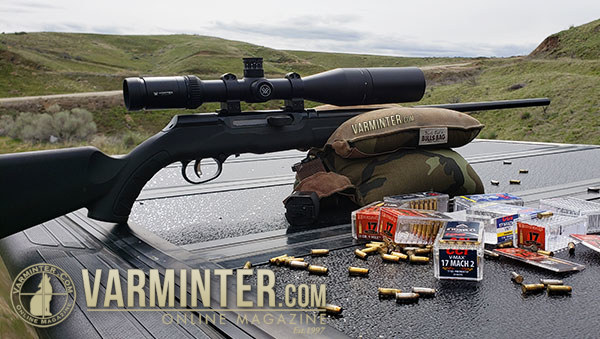
There are a number of reviews on new-generation 17 Mach 2 rifles. Recently Varminter.com reviewed the Savage A17 in 17 HM2. Editor Eric Mayer wrote: “This new addition to the A17 line comes at a time when the 17 Mach 2 round is experiencing a resurgence, with ammo now available from CCI and Hornady, including the lead-free NTX round from Hornady. This means … you don’t have to break the bank to buy a current, functioning, semi-auto 17 Mach 2 and you don’t have to … convert your 10/22.”
Eric shot four different types of 17 Mach 2 ammo, putting 1000+ rounds through the Savage. He was impressed: “I am very excited that Savage Arms has chambered their A17 rifle in the 17 Mach 2 / 17 HM2 round. After shooting the prototype, I can confidently say that this new A17 will become my go-to 17 Mach 2 rifle. This new rifle is a great option for varminters everywhere!”
Toggle Bolt Volquartsen Summit in 17 HM2
It’s rare for us to see a new rimfire that we’d really like to own, but the new Summit from Volquartsen fits the bill. This versatile rifle features a cool, straight-pull toggle bolt, similar to those on elite Biathalon rifles. You can see how this gun shoots in this informative 22 Plinkster video:
22 Plinkster Tests Volquartsen Summit Rifle in 17 Mach 2
The 17 Mach 2 (17 HM2) is making a comeback. Now leading manufacturers are offering this efficient little rimfire cartridge in some nice rifles. Both Anschutz and Volquartsen will offer new 17 Mach 2 rifles in 2019. The Volquartsen Summit features a lightweight, carbon fiber-wrapped barrel threaded 1/2-28 for brakes or suppressors. The Summit boasts a nice 1.75-lb trigger pull. The Summit’s CNC-machined receiver features a +20 MOA Rail. NOTE: The video shows a silhouette-style laminated wood stock. However, the Summit comes standard with a composite Magpul stock that actually works better for shooting from a bench.
17 Mach 2 — Best Rimfire Bang for the Buck?
If you are looking for a capable, squirrel-busting round or a fun plinking round, you should definitely consider the 17 Mach 2, especially since CCI has committed to production of the little cartridge. CCI recently rolled out its “Gen 2″ 17 Mach 2 VNT Ammo with polymer tip (see top of article).
Considering that 17 HMR ammo is now running $10 to $12 a box, the 17 Mach 2 is an excellent value by comparison. It is available from many vendors for under $6.50 per 50ct box. That’s just $0.13 per round. When you consider overall “bang for the buck”, for many shooters, it makes sense to use the 17 Mach 2 rather than a 17 HMR. You save money, barrel life is a little longer, and the 17 Mach 2 is still a much more potent cartridge than the .22 LR. Check out this comparison, and note how the 17 Mach 2 has a much flatter trajectory than the .22 LR. For varmint shooting, the 17 Mach 2 is clearly the better choice.
Hornady’s 17 Mach 2 has a 2100 FPS muzzle velocity vs. 1255 FPS for “High-Velocity” .22 LR.
Many thousands of hand-loaders, including this Editor, acquired the original RCBS ChargeMaster 1500 powder scale/dispenser. Mine has worked well for many years. Yes I do have to watch for scale drift, and I use a high-end Force-Restoration scale when loading for major matches, but the original ChargeMaster has served me well, throwing thousands of charges over the years.
RCBS ChargeMaster Lite Reviews
A couple years ago, RCBS introduced a new version of the ChargeMaster, the RCBS Chargemaster Lite. This newer unit has some features we really like. The new touch screen is easy to use and the powder tray cover slips off easily — no more hinges to fight. Most importantly the CM Lite has a redesigned, fluted dispensing tube which delivers powder kernels in a smooth flow with no clumps. The RCBS Rep told us “No more McDonald’s straw required”. We tested the unit and it does seem like the newly-designed dispensing tube is better. In fact, this new design will be adapted to the next generation of larger ChargeMasters. The ChargeMaster Lite ships complete with calibration check weights and cleaning brush. MSRP is $299.95 with “street price” around $238.00 at Amazon.
If you’re interested in the RCBS ChargeMaster Lite, here are three recent video product reviews. By watching these videos you can see all the features of the ChargeMaster Lite demonstrated. In the third video, the host also “compares and contrasts” the ChargeMaster Lite with the original ChargeMaster 1500, explaining the differences between the two units. Have at it:
Panhandle Precision ChargeMaster Lite Bench Test and Demo (Good Detailed Review):
Here is the RCBS Press Release: “The new RCBS ChargeMaster Lite packs unparalleled powder-measuring accuracy in a compact package. The one-piece unit features an LCD touchscreen display that ensures accurate data input. The hopper holds nearly a pound of smokeless powder, and can dispense anywhere between 2 to 300 grains with a +/-0.1-grain accuracy.”
UltimateReloader ChargeMaster Lite Unboxing:
Original ChargeMaster 1500 vs. ChargeMaster Lite:
Worth Considering Also — the Frankford Arsenal Platinum Series Intellidropper
Frankford Arsenal has a new electronic powder scale/dispenser, the Intellidropper. This unit dispenses quickly, loads can be controlled with a Mobile App. We recently did an in-depth Intellidropper Review. If you are in the market for a powder scale/dispenser, you should definitely consider the Intellidropper as well as the RCBS Chargemaster Lite. Watch this video to see how it works:
The Intellidropper is the latest automated powder scale/dispenser to hit the market. This new-for-2019 machine offers a unique powder calibration mode and the first-ever, mobile APP-controlled powder dispensing system. With a retail price under $200, the new Intellidropper is $30-$40 less than the ChargeMaster Lite.
Do you carry a handgun for self-defense, or maybe keep a firearm in your vehicle “just in case”? Then you may want to attend the upcoming NRA Personal Protection Expo in Fort Worth, Texas. The event will be held September 6-8, 2019, at the Fort Worth Convention Center.
The NRA Personal Protection Expo (formerly NRA Carry Guard Expo) is a three-day trade show for individuals interested in increasing their knowledge and skills of personal protection, concealed carry and home defense. This event showcases “the products, skills, knowledge and mindset necessary to be prepared to respond when a threat arises.”
This Video Review Various Insurance Options for CCW Holders:
Expo Seminar Topics
Expo visitors can attend more than 120 seminars and workshops. These will include self-defense techniques, home defense and preparedness, situational awareness, concealed carry techniques and lifestyle, medical and trauma training, and much more. The Expo will also conduct a Concealed Carry Fashion Show for concealment clothing and gear designed for men and women.
The World of Compact Handguns for Concealed Carry
There are literally hundreds of choices for carry handguns, starting with deringers and going all the way up to full-size rigs. Both semi-auto pistols and wheelguns (revolvers) are popular. Among wheelguns, we like the Smith & Wesson Model 638 Airweight, a 5-shot Aluminum-frame snubnose, with cockable, shielded hammer. You can shoot it rapidly double-action, but you still have the option of cocking the hammer for slow, precise fire.
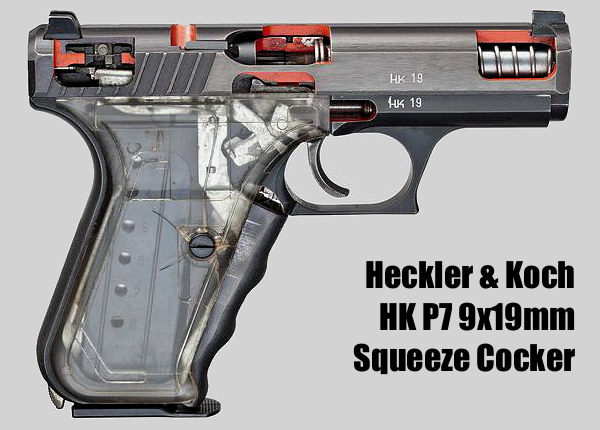
Many experts consider the Heckler & Koch P7m8 one of the very best carry pistols ever. On HK’s famous fixed-barrel “squeeze-cocker”, the striker is cocked by squeezing the grip, and then de-cocked when pressure on the grip is released. This makes it extremely safe to carry.
If you are looking for a great deal on a reliable 9mm subcompact, consider the S&P M&P Shield. Right now this fine little pistol is just $249.99 at Palmetto State Armory — a $100 Savings!
To learn more about the NRA Personal Protection Expo, visit the EXPO Website. Check back regularly for updates on training opportunities, and seminars scheduled for the event.
Shooters from across the nation and many foreign competitors competed last month at the CAAFTC held at the Rochester Brooks Int’l Skeet and Trap Club.
For nearly 10 years, dedicated air gun competitors from around the globe have taken part in the Crosman All-American Field Target Championship. This year was no different. In late June, 85 competitors participated in the popular 3-day event. “The Crosman All-American Field Target Championship is one of the must-attend events for Field Target airgunners”, said Mark DeBoard of Velocity Outdoor.
The winner of the All-Around prize for the highest score over all three days in 2019 was Bill Rabbit. Bill topped both the Hunter PCP and Hunter Piston Divisions. That’s Bill (left below) receiving his prize from Mark DeBoard, the Shooting Services Manager of Velocity Outdoor. Greg Shirhall won the Open PCP Division while Paul Porch won the WFTF PCP class.
Big Airgun Event in Upstate New York
The Crosman All-American Field Target Championship (CAAFTC) is the largest field target event in the USA. This very popular airgun event took place June 21-23, 2019 in upstate New York at the Rochester Brooks International Skeet and Trap Club in Rush, New York. This event attracted top Airgunners from across the nation (and some foreign countries). Along with regular Field Target matches, there were specialty side matches, plus a factory tour.
This Video Explains the Basics of Field Target Competition:
The 3-day competition featured multiple shooting matches including the main 2-day rifle event. There were four divisions for competitors: Open, Hunter, WFTF, and Pistol. In addition to the main rifle event, there was a pistol match, the Pyramyd Air Gunslinger match, and the popular Quigley Bucket Match. This Bucket match re-creates a famous scene in the movie Quigley Down Under in which the lead character shoots a bucket at 700 yards. Here the distances are scaled down a wee bit (wink-wink). Competitors, using iron sights only, got 5 shots at a 1.75″ bucket placed at 55 yards.
Tech Talk: Why the Big Side-Wheels on the Scopes?
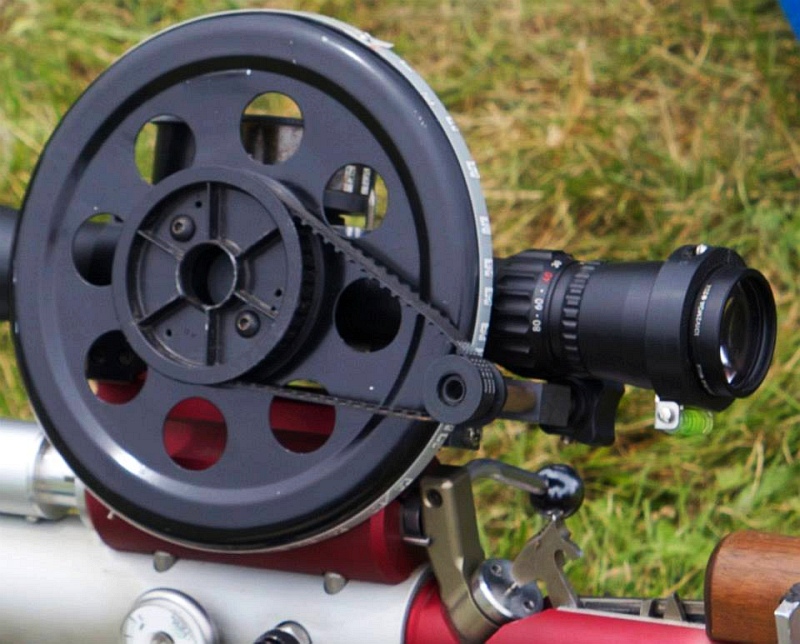
Field Target rifles shoot pellets propelled by compressed air. These light-weight, low-BC projectiles drop very quickly, with a looping trajectory. In order to hit targets at distances out to 50 yards or so, you have to adjust your scope to compensate for pellet drop. But you can’t set the scope correctly without knowing the precise range to the target.
This is the function of the big wheels on the side of the scope. Field Target Competitors use the parallax adjustment on high-magnification scopes to determine target range. The big wheel allows quick, yet precise parallax adjustment. Markings on the wheel show the shooter the scope settings required for the distance “dialed-in” via the over-size parallax wheel.
The CAAFTC, sanctioned by the American Airgun Field Target Association, is a featured AAFTA Grand Prix event. The 120-shot match had four rifle divisions based on allowable gun and support equipment, along with a Hunter Pistol class. Here are the main air rifle classifications:
Hunter PCP Division – Rifle fires at a maximum 20 foot pounds of energy (FPE), shooter may use a non-attached bipod, non-restrictive clothing, and sitting stool. Hunter Piston Division – Like Hunter PCP but with piston charging. Open Division – Maximum 20 FPE rifle, shooter may wear a body harness, no bipod, 6″ max height seat. World Field Target Federation (WFTF) – Similar to Open but shooters compete according to international standard of maximum 12 FPE for rifles.
Emil Praslick III is widely recognized as one of the greatest wind wizards on the planet — a master at identifying wind value and direction, and predicting wind cycles. As coach of the USAMU and top civilian teams, Emil has helped win many high-level championships. In the three videos we feature today, Emil, who works with Capstone Precision Group (Berger, Lapua, SK, Vihtavuori) and Team Applied Ballistics, explains how to determine wind direction and velocity using a variety of indicators. Praslick, now retired from the U.S. Army, was an 18-time National and 2-time World Champion coach with the USAMU.
Video ONE: Wind Theory Basics — Understanding “Wind Values”
In this video from UltimateReloader.com, Emil explains the basics of modern wind theory. To properly understand the effect of the wind you need to know both the velocity of the wind and its angle. The combination of those variables translates to the wind value. Emil also explains that the wind value may not be constant — it can cycle both in speed and velocity. Emil also explains some of the environmental conditions such as mirage that can reveal wind conditions.
Video TWO: Determining the Direction of the Wind
Key Point in Video — Find the Boil
Emil explains how to determine wind direction using optic. The method is to use spotting scope, riflescope, or binoculars to look for the “Boil” — the condition in mirage when the light waves rising straight up. The wind will generate that straight-up, vertical boil in your optics when it is blowing directly at you, or directly from your rear. To identify this, traverse your scope or optics until you see the boil running straight up. When you see that vertical boil, the direction your optic is pointing is aligned with the wind flow (either blowing towards you or from directly behind you).
Video THREE: The No Wind Zero Setting
In this second video, Emil defines the “No-Wind Zero”, and explains why competitive shooters must understand the no-wind zero and have their sights or optics set for a no-wind zero starting point before heading to a match. In order to hit your target, after determining wind speed and direction, says Emil, “you have to have your scope setting dialed to ‘no wind zero’ first.”
Coach of Champions — Emil Praslick III
SFC Emil Praslick III, (U.S. Army, retired) works with Berger Bullets and Applied Ballistics. Emil served as the Head Coach of the U.S. National Long Range Rifle Team and Head Coach of the USAMU for several years. Teams coached by Emil have won 33 Inter-Service Rifle Championships. On top of that, teams he coached set 18 National records and 2 World Records. Overall, in the role of coach, Praslick can be credited with the most team wins of any coach in U.S. Military history.
Ever wish you could look inside your rifle, to see how the trigger and fire-control system work? Well now that is possible with the magic of 3D computer graphics. Modern software allows detailed “cutaway” side-views (see below), as well as 3D views with 360° rotation. The software can also provide X-Ray-type views into the gun’s internals — as you can see above. And computer animation can show the complete firing process from trigger pull to chambering of the next round.
Rem 700 Cutaway View from Right Side
This article covers two different animations — a bolt-action, and a self-loading “gas gun”. The first video features the popular Rem 700 action, probably the most successful American bolt-action ever created. The second video offers a lengthy exploration of the AR15/M16 platform.
READERS — Take the time to watch these videos! The Rem 700 animation is really outstanding! EVERY bolt-action shooter should watch this video all the way through.
Cutaway 3D Animation of Rem 700 Action — Watch Video
The Model 700 series of bolt-action rifles have been manufactured by Remington Arms since 1962. All are based on basically the same centerfire bolt action. They are typically sold with an internal magazine depending on caliber, some of which have a floor-plate for quick-unloading, and some of which are “blind” (no floor-plate). The rifle can also be ordered with a detachable box magazine. The Model 700 is a development of the Remington 721 and 722 series of rifles, which were introduced in 1948.
The Rem 700 is a manually-operated bolt action with forward, dual opposed lugs. It features “Cock On Opening”, meaning the upward rotation of the bolt when the rifle is opened cocks the firing pin. A cam mechanism pushes the firing pin’s cocking piece backward. The bolt face is recessed, fully enclosing the base of the cartridge. The extractor is a C-clip sitting within the bolt face. The ejector is a plunger on the bolt face actuated by a coil spring. The bolt is of 3-piece construction, brazed together (head, body. and bolt handle). The receiver is milled from round cross-section steel.
This video was made with the help of the World of Guns: Gun Disassembly interactive encyclopedia with 3D rendering. This remarkable web-based software allows users to view the inner workings of hundreds of different rifles and pistols — everything from a .22 LR Ruger to a .55-caliber Boys Anti-Tank rifle. There are also 25,000+ parts diagrams. This is a remarkable technical resource. SEE MORE HERE.
Cutaway 3D Animation of AR15/M16 Action — Watch Video
The AR platform rifles are a semi-automatic version of the M16. These feature distinctive upper and lower receivers which can be readily separated via front and rear pins. The upper includes the barrel, handguard, forward gas tube, and bolt assembly, while the lower contains grip, trigger group, fire selector, and mag well. In addition the lower is attached to the stock which encloses the buffer assembly.
The original ArmaLite AR-15 was a select-fire, air-cooled, gas-operated, magazine-fed rifle designed by American gun manufacturer ArmaLite in 1956. It was based on Armalite’s AR-10 rifle chambered for the 7.62×51 NATO (.308 Win). In 1959, ArmaLite sold its rights to the AR-10 and AR-15 to Colt. Some key modifications were made — most notably, the charging handle was re-located from under the carrying handle to the rear of the receiver. The redesigned rifle was adopted by the U.S. military as the M16 carbine, which went into production in March 1964.
These videos found by Boyd Allen. We welcome reader submissions.
After the 2019 King of 2 Miles competition last weekend, some readers asked whether it’s possible to shoot Extreme Long Range with a regular factory rifle — a rig that costs thousandths less than the full custom 40-lb ELR beasts used by top KO2M teams. The answer is a definite yes. Here’s a story from Forum member Mark Dalzell. A few seasons back, Mark showed what can be done with a factory Savage 110 BA at extreme long range — 1760 yards (one mile). Mark did a great job with the video, which features multiple camera views so you can see the shooter and the target at the same time. Enjoy!
This video by Mark Dalzell demonstrates the long-range capabilities of the Savage 110 BA chambered in .338 Lapua Magnum. Mark took his “BadAss” rig out to the southwest Nevada desert just north of Jean Dry Lakes. He placed a 2’x3′ target way, way out there — a full mile (1760 yards) away. At that range, flight time to target was 3.75 seconds! Sighting with a Nightforce 5-22x50mm NXS scope, Mark needed a few shots to get on target, but eventually made multiple hits, using 67 MOA of elevation and 2.25 MOA left windage. You can view the hits starting at 1:56 time-mark on the video. (Mark had a second camera set up closer to the target — this displays frame in frame in the video, and if you watch carefully you can see the strikes.) The ammo was HSM 250gr HPBT match with a 3.600″ COAL. The shooting was done at 8:13 in the morning, with clear conditions, very light winds. Temp was 57°, humidity 24.5, Density Altitude 3666. Video soundtrack is La Grange by ZZ Top.
PLAY BUTTON
LISTEN TO MARK TALK about One Mile Shooting:
CLICK Play Button to hear Mark Dalzell TALK about his .338 LM Savage 110 BA and how he scored hits at 1760 yards.
Good Shooting Mark. That’s darn good for a factory rifle. You also had the elevation dialed in real close before the firing started! That shows a good knowledge of your ammo’s long-range ballistics. We also noticed how effective that muzzle brake was. Recoil looked about the same as an un-braked .308 Win.
If you thought Mark’s 1760-yard shooting was impressive, Mark has produced another video that shows a session at even greater distances — out to 2300 yards. Watch Mark Dalzell Shoot at 2300 Yards.
Great Case Trimmer for under $130.00
We think Lyman’s new Case Trim Xpress will be a “game changer” for hand-loaders. If you’re like most of us, trimming your brass to length has been a dull, laborious and time-consuming process unless you shell out $500 or more for a top-of-the-line unit. Lyman has broken that mold by releasing an accurate, easy-to-adjust, shoulder-indexing, carbide-bladed, and SPEEDY case trimmer for under $130.00! Given its outstanding performance for the price, the Lyman Case Trim Xpress is a definite winner.
CLICK photo for full-screen view of Case Trim Xpress unit.
Lyman Case Trim Xpress “Hands-On” Review
Review by F-Class John
Case trimming can be one of the most boring and tedious steps in the reloading processes. This is largely because of outdated tools that either require manual turning, clunky pilot systems, or difficult adjustments. In order to overcome these obstacles, you might have to spend $500 for some premium systems. But that has changed with Lyman’s introduction of the new Case Trim Xpress. This bright orange wonder delivers premium trimming performance at a budget price. Available for around under $130, this trimmer offers an easily-adjustable cutting head plus a smart, shoulder-indexing bushing system to improve consistency and speed up the trimming process.
Video Shows How Carbide Cutter Head Adjusts Easily with Index Wheel
The Lyman Case Trim Xpress comes with the main trimming unit, power cord, and 10 bushings in a storage case. These 10 orange bushings let you trim more than 50 popular cartridge types (yes including the 6mmBR, 6.5 Creedmoor, and .308 Win of course). Set-up was simple and straight-forward. Install the bushing you need, turn the unit on and slowly push a piece of brass towards the cutting head. Once the brass is fully depressed, you can start adjusting the dial one click at a time until the case makes contact. Then you start making progressive adjustments and trim until you reach your desired length. The process is so simple that it’ll leave you wondering how you ever used anything else.
Once the machine was adjusted for our brass, we were amazed at how easily and quickly cases could be trimmed. The unit is fairly hefty, so we found it pretty stable just sitting on the bench. If you wish, the unit can also be screwed down for added stability, using the holes in the lower “wings” of the orange housing. There’s a dial adjustment on the side that controls cutter rotation speed (RPM). In our testing, the trimmer worked well across its entire RPM range. These means you can do fast, quick cuts or make slow and precise cuts, as you prefer. And you can adjust the cutter speed to the type of brass you are trimming.
As for trim length control, the adjustment dial has good, positive clicks and the trim length holds very constant. Even after trimming 80+ pieces of brass, we observed trim consistency held within .001″.
One of the things that sets the Case Trim Xpress apart from most trimmers is how it indexes off the shoulder. This ensures that case lengths from mid-shoulder to end of neck are identical for every case (whether they have been sized or not). This is critical for consistent reloading results and will help ensure that every case is optimally positioned in your chamber. A cutting system that indexes off the shoulder is arguably better than a system than merely trims to a given case OAL for both fired and unfired cases.
Another great feature is that this trimmer can be mounted flat on a bench-top, on the underside of a shelf, or even on a vertical wall surface (if oriented horizontally). You can choose different mountings because the clear plastic shroud that catches brass shavings can rotate. This allows the shavings exit port to be orientated to any point on the circle. We liked being able to choose various mounting configurations. Employing little-used wall or shelf space opens up precious bench-top real estate.
Summary — Outstanding Performance for the Price
Overall the Case Trim Xpress is hard to beat for the price. It is one of the few power trimmers we can recommend without hesitation. The machine trims quickly and accurately, the cutter-depth control is precise and easy to use. And the variable speed control is great. Of course we do wish the machine could also de-burr and chamfer brass. But of course that would add quite a bit to the cost, and would probably require a completely different cutting system. For trimming-to-length only, Lyman’s Case Trim Xpress is probably the best trimmer currently available for under $200. This unit should definitely be on the short list of anyone shopping for a variable-speed motorized trimmer.
34th Annual Fifty Caliber Championship Coming Soon
The 34th Annual Fifty Caliber Shooters Association (FCSA) 1000/600 Yard World Championship will be held July 4, 5 and 6, 2019 at the Whittington Center in Raton, New Mexico, a beautiful facility. The FCSA Championship takes place right after the 2019 King of 2 Miles event, running June 29 – July 1, 2019.
Looking downrange at the 1000-yard line. Note the fan and air hose for cooling the barrel.
Competitor’s POV perspective from a FCSA Match. Note the mirage.
By James Patterson This article first appeared in Sinclair International’s Reloading Press Blog
For a number of years I drooled over every .50 BMG caliber rifle that I came across, I read every article I could find and determined that ‘Someday’ I was going to have one. Well I finally took the plunge and in 2002 I purchased my first ‘Big 50’. Almost immediately I joined the Fifty Caliber Shooters Association (FCSA) and I have since come to immensely enjoy shooting this challenging cartridge and associating with some of the best people on earth.
FCSA Founded in 1985 The FCSA, started in 1985, is an international organization with members in 22 countries. Headquartered in Monroe, Utah, the FCSA has a membership of approximately 4000. While the FCSA provides a service to military and law enforcement with research and instruction as well as an active liaison in both communities, the primary charter of the FCSA is the promotion of the sporting use of the 50 BMG cartridge and its wildcat derivatives. It has been the FCSA and its members who have lead the way in refining .50-caliber cartridges, rifles, and 1000-yard plus shooting know-how. Members enjoy a quarterly magazine, a suppliers directory, an active website with great photo galleries, and access to literally the best repository of 50 BMG information on the planet. If you are interested in Mr. John Browning’s big 50, you should seriously consider joining the FCSA.
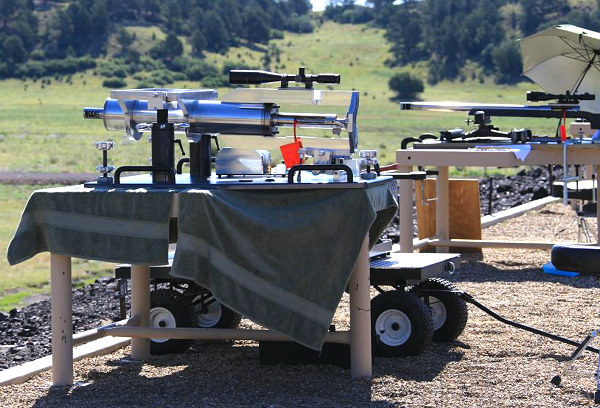
This interesting .50 Cal rig features a liquid-cooled barrel and unusual scope mounting arrangement.
While all aspects of the 50 BMG are promoted by the FCSA, the primary sport is 1000-yard competition. In 2010, there were 16 separate official matches scheduled across the USA, and many more ‘fun-shoots’. This sport is an incredible mix of the science, skill, and art of extreme long range accuracy. I had been actively shooting rifles and hunting for well over 40 years and had always considered myself a “rifle man”. But I had no idea of the learning curve that [faced me] when I first joined the FCSA.
Historically, 1000-yard shooting has been primarily a benchrest activity but in the past several years we have seen a tremendous interest in ‘Hunter Class’ competition; this is shot prone using a bipod. This form of long range match shooting is excellent preparation for long range hunting. The required skill set [for ultra-long-range hunting] is guaranteed to humble even the most experienced rifleman.
Cost of Big-Bore Shooting
Is owning and shooting a 50 BMG caliber rifle expensive? Relatively speaking yes, but one must put it into perspective. Rifles may run from $2500 to $8000, maybe even more for a top of the line custom rifle. A premium long-range scope will set you back $1800 to $3500. And while excellent .50 BMG commercial ammo is available, it runs $5 to $6 per round! Most serious shooters start reloading for the rifle as soon as practical, not only for the economics of reloading but also for the ability to fine tune custom ammo for their specific rifle. It’s a very rare match that is won shooting commercial ammo.








 This video was made with the help of the


 The FCSA, started in 1985, is an international organization with members in 22 countries. Headquartered in Monroe, Utah, the FCSA has a membership of approximately 4000. While the FCSA provides a service to military and law enforcement with research and instruction as well as an active liaison in both communities, the primary charter of the FCSA is the promotion of the sporting use of the 50 BMG cartridge and its wildcat derivatives. It has been the FCSA and its members who have lead the way in refining .50-caliber cartridges, rifles, and 1000-yard plus shooting know-how. Members enjoy a quarterly magazine, a suppliers directory, an