Rifle accuracy is pointless unless you can see your target and aim precisely. That’s why good optics are so important for precision shooting — from 50 yards out to a mile and beyond. Today’s premium scopes can be very expensive — you’ll see optics costing $3000 or more on many competition F-Class and PRS rifles. This article covers important “Riflescope Knowledge”, including how to adjust for parallax, and how to properly sight-in your scoped rifle. In addition there’s a helpful video defining Minute of Angle (MOA) plus two videos showing how to mount scopes.
Rifle Sight-In Process — Start to Finish
Here Ryan Cleckner shares his process for sighting in a scoped rifle. This helpful video covers the full process: bore-sighting, 25-yard shot confirmation, shooting groups, making adjustments at 100 yards, and finding mechanical zero. Looking for more valuable rifle instruction? Then check out Ryan Cleckner’s book, Long Range Shooting Handbook.
How to Adjust for Parallax
Most precision rifle scopes have parallax adjustment, but what is it and why do you need to adjust it? In this Shooting USA video, John Paul of JP Rifles defines parallax and explains why you need to set parallax correctly for the distance to your target. The video then show how to adjust parallax correctly. a process which should start with the scope’s ocular focus.
Understanding Minute of Angle (MOA)
In this video, Ryan Cleckner explains the measurement term “minute of angle” (MOA) and how to use MOA adjustments on your scope to compensate for bullet drop at varying distances. MOA is an angular measurement, used often in long range shooting, that is 1/60th of one degree of a circle. One MOA represents 1.047″ at 100 yards and 10.47″ at 1000 yards. Want to learn more? Read Ryan Cleckner’s article Understand and Using Minute of Angle.
How to Mount a Riflescope
When mounting a scope you want to use quality rings, and ensure that the scope is leveled properly. In addition, you need to adjust the fore/aft position of the scope so that eye relief is correct. Ideal scope position may be different when shooting from the bench vs. shooting prone. In this Shooting USA video John Paul of JP Rifles reviews scope mounting basics.
Scope Mounting on a PRS Precision Rifle
Here the MasterPiece Arms (MPA) Academy experts show how to mount a scope on a PRS-type tactical rifle. Special considerations for tactical shooters are discussed. The video also shows recommended tools for scope mounting operations.
Here’s the super-speedy way to turn case-necks. Our friend Erik Cortina figured out how to turn his match cartridge case-necks using his milling machine. Erik told us: “While in Raton, Mid Tompkins told me that he turns his brass on milling machine. He said he could do about 500 in two hours, so I decided to try it.”
Erik fitted a Don Nielson “Pumpkin” neck-turner to the mill, and he used a modified 21st Century case holder to secure the brass. As you can see from this video, Erik was very successful with the process. The tool spins at 1500 rpm, turning Lapua 6.5-284 cases that have been necked up to 7mm.
Video Shows Erik Cortina Neck-Turning Cases with Milling Machine:
Cartridge Brass: Lapua 6.5-284 necked up to 7mm
Lubricant: Lithium grease inside and outside of neck
Neck-Turner: Nielson Pumpkin running at 1500 RPM
It’s hard to argue with Erik’s results. Here are his turned Lapua cases, which have neck-wall thickness consistent to two ten-thousandths of an inch. Think you could do better turning manually?
Some of Erik’s Facebook friends had questions about this process:
Q: Who makes the shell-holder?
Erik Cortina: I did! The shell-holder you can get from 21st Century. I Tig-welded a punch as a handle.
Q: I love the idea of working smarter not harder! Any galling issues? What are your mitigation techniques?
Erik Cortina: No issues. I use lithium grease in spray can. Makes a foam that I dip necks into.
Q: Shouldn’t either the case or the cutter be floating to allow most precise neck turning?
Erik Cortina: Up until [I tried this] I believed the same thing. I was going to build a floating case holder but decided to try rigid setup on a few cases before I built it. Results were great. Neck thickness doesn’t vary more than .0002″, which is same as when I was doing it with floating case holder on the lathe.
Q: Any problems with the Pumpkin changing the cut as it heats up?
Erik Cortina: No — there were no issues with that.
NOTE: Erik Cortina is a very skilled machinist who custom-crafted fittings used for this process. This kind of neck-turning with a milling machine may not be for the everyday hand-loader!
Nielson “Pumpkin” Neck-Turner
The circular orange cutting fixture on Erik’s Milling Machine is a Don Nielson “Pumpkin” neck-turning tool. Don designed this tool to be used by hand or with power. The Pumpkin boasts an eccentric mandrel that allows the cut to be adjusted easily in precise .0001″ increments. Benchresters like this as it allows for very precise control of cut depth and neck-wall thickness.
Jason C., commenting on Erik’s YouTube video stated: “I have a couple of those too. Nothing cuts like a Pumpkin. [Don Nielson] made the best cutter tool ever.” These are still available if you ask around. The photo shows Don with a case-holder mounted to a power assembly. A talented machinist and tool-maker, Don has also been a successful short- and long-range benchrest shooter, who has won NBRSA 600-Yard Championships. CLICK HERE to read about Don’s success with the 6.5×47 Lapua.
Nielson Neck Turner with carbide mandrel. Photo Courtesy Butch’s Reloading.
The NEW AutoTrickler V3 features an all-new motorized powder dispenser, an updated AutoTrickler base, and mobile APP control via Bluetooth.
If you want to throw powder with single-kernel precision, the AutoTrickler is perhaps the most advanced and efficient system you can buy. And now Adam MacDonald’s AutoTrickler is better than ever, with the release of the third generation AutoTrickler V3. This new AutoTrickler V3 has many major hardware enhancements, plus integrated software that lets you control all operations with your mobile device.
How fast does it work? CLICK HERE to visit the AutoTrickler website and watch the embedded video. You can see a 47.50 grain charge thrown and weighed in under 16 seconds.
Once you place the empty cup on the scale, the AutoThrow will automatically cycle to drop the bulk charge, and then the AutoTrickler ramps down to finish precisely within +/- 0.02 grains (about one kernel) of your target weight. The device’s inventor says: “With a little practice and fine tuning, you can expect to charge 50 cases to the kernel in less than 15 minutes.”
New Powder Thrower Increases Speed and Uniformity
The big hardware upgrade with the AutoTrickler V3 is the motorized powder dispenser. The V3 AutoThrow has been completely re-engineered with motorized operation in mind. Instead of modifying an off-the-shelf powder measure, the AutoTrickler V3 employs an original CNC-machined motorized thrower that cycles smoothly with a wider variety of powders.
Ball bearings hold the rotating aluminum drum against a nylon and rubber seal which ensures that fine powders like CFE223 will not leak internally and no manual adjustments are needed. The V3 AutoThrow will reliably providing a bulk starting charge within 0.1 grains for the AutoTrickler to finish to the kernel.
Software Functionality — APP Control via BlueTooth
With any smartphone or tablet supporting Bluetooth 4.0, you can set your target charge weight, increment the target on the fly, or manually operate the motors for easier setup and cleaning. The FREE AutoTrickler V3 APPS for iOS and Android will soon be available on the Apple App store and Google Play store.
Here’s an interesting statistic — according to an NSSF survey, the percentage of gun owners who are female has increased dramatically since 2005. Seven years ago (in 2005), just 13% of U.S. gun owners were women. By 2012 that number had risen to 23% — a huge increase in less than a decade.
The vast majority of first-time female gun buyers acquire a handgun for defensive purposes. However, the statistics also show that many new female gun owners are also getting involved in sport shooting and/or competitive shooting. That’s a good thing.
In the video below, NRA News host Cam Edwards interviews Celia Bigelow, who has written about the rise of gun ownership among ladies on the Townhall.com website. Celia explains why American women are arming themselves, and why the Second Amendment safeguards a key fundamental right.
Celia writes: “As the number of proposed gun-control measures increase rapidly across the country, the amount of women purchasing guns is increasing even faster. While folks in the media are blaming the spike on the guns-and-glam advertising, women — including myself — have a different reason. It’s self-defense, stupid. [T]he logic is simple: Women want to protect themselves and their family, and guns are the great equalizer between sexes[.]”
Celia notes that liberals propose that women defend themselves using “call boxes, ball-point pens, whistles, buddy systems … as long as it isn’t very sharp and doesn’t have a trigger.” Celia is not convinced: “As a young, 22-year-old, 140-lb woman, I know that call boxes, pens, and whistles won’t do much good if [I am] ever faced with a crazed man twice my size. What frustrates these male elitists the most is that women are arming themselves, and it’s working.”
Product Review by F-Class John
Case preparation is critical for precision reloading. One must trim cases, debur/chamfer case mouths, clean necks, spruce up primer pockets and do other important tasks. Complete case prep can involve many separate processes, each requiring its own tools. With each of those tools comes additional cost as well as the need for more storage and bench space. To make case prep easier, faster, and more convenient Lyman created the Case Prep Xpress. The Case Prep Xpress, introduced a few years back, combines up to five prep stages into one well-built, stable, versatile unit. Watch this video to see the machine in action:
The Case Prep Xpress features five (5) independently-turning spindles all with the common 8/32 thread. This allows you to attach multiple tools supplied with the unit PLUS many other screw-on prep tools. For our testing we started out using a variety of the 12 included tools and found they cover the majority of case prep tasks. Lyman supplies deburr and chamfer tools, pocket uniformers, reamers and cleaners, as well as an assortment of neck brushes.
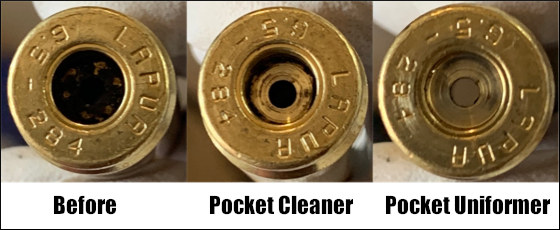
The deburr and chamfer tools worked really well, creating beautiful bevels all while leaving a nice flat edge across the top of the neck which is critical for accuracy and brass life. We found the primer pocket cleaning tool did a good job, but for truly clean pockets we recommend using the primer pocket uniforming tool, which very efficiently removes even hard residues.
The benefit of having interchangeable heads is that you can add your own accessories. We like to use a bore brush with bronze wool wrapped around it for use inside our necks. This worked perfectly once we screwed it in. In fact, we couldn’t think of any 8/32-threaded accessory that wouldn’t work well on this machine. Another great design feature is how all the accessories are oriented straight up. This allows for perfect visual alignment of your cases onto the tools which is critical — especially when performing cutting operations such as primer pocket uniforming.
Along with the five power stations there are six female-threaded storage spots on the sides where tools can be placed to ensure they don’t get lost. We like this feature since there will be more than five accessories you want to use and having them easily available is a great feature. You can keep 11 tools right on the machine (5 on top, 6 on the sides). That way you don’t have to dig through storage bins.
The Case Prep Xpress has a removable front bin to hold brass shavings, and there are two circular trays on either side of the bin. In front is a long tray that holds the provided brush. This makes it relatively easy to clean off brass shavings and other debris from case prep processes.
SUMMARY — Versatile Case Prep Xpress Is A Great Value
For the money, Lyman’s Case Prep Xpress is tough to beat. It performs multiple tasks well while being stable and easy-to-use. Yes there are some multi-spindle prep centers that offer variable or fast/slow RPM spindles while the Lyman’s spindles are all fixed RPM. (See, e.g. the RCBS Brass Boss). However those other systems don’t include all the convenient on-board storage of the Case Prep Xpress, and are more expensive. The Lyman Case Prep Xpress sells for $130-$150 “street price” ($129.59 at Amazon). This makes the Lyman Case Prep Xpress a great value — it offers great versatility while saving space and saving money compared to buying five or more separate, powered tools.
Firing line at 2019 Super Shoot. Photo courtesy Armeria Regina.
What components do world-class, short-range group benchrest shooters use? BAT actions, Krieger barrels, and Bix’n Andy triggers (and Jewells) are the components of choice. And barrel tuners are now widely used by the top shooters. As for powder, Vitavuori N133 is still the choice of virtually all top competitors. And yes the 6PPC definitely rules the roost. Every Top 20 shooter at the 2019 Super Shoot shot a 6PPC. Every one. Read on to learn more about the Top 20 Equipment used at this year’s Super Shoot.
We recently reviewed the Top 20 Equipment List for the 2019 Super Shoot at the Kelbly’s Range in Ohio. This Top 20 List reveals the gear choices for the 13.5-lb Heavy Varmint Class and the 10.5-lb Light Varmint/Sporter Class (20 entries for each division). Here are notable gear choices for Top 20 Competitors (both divisions) at the 2019 Super Shoot:
Actions: 14 of 20 HV and 16 of 20 LV/SP shooters used BAT actions. So there were 75% BATs for both classes combined. Barrels: 10 of 13 listed HV barrels and 9 of 12 listed LV/SP barrels were Kriegers. Overall, of the barrels identified in the Top 20 Equipment lists, 76% were Krieger. That’s dominance! [Note: We have been informed that entries with no barrel-maker listed may have been Bartlein barrels.] Triggers: Notably 10 of 20 HV triggers were Bix’n Andy — 50%. For the other class, 7 of 19 listed triggers were Bix ‘N Andy. All others were Jewells. Tuners: In HV Class, 12 of 20 shooters used tuners, mostly Bukys. 11 of 20 LV/SP shooters had tuners. Overall that is 57.5% tuner usage for both classes combined.
Cartridge: For both classes, every single Top 20 competitor shot the 6PPC. ‘Nuf said. Powders: 19 of 20 HV Shooters used Vihtavuori N133. Likewise 19 of 20 LV/SP shooters used VV N133, with one not reporting. That is total dominance for N133.
Bullets: There was a wide selection of bullets used in both classes. Custom bullets by “boutique” bullet makers were certainly favored by Top 20 shooters. Sta Moy 65s were popular, as were Hottenstein 68s and Bart’s bullets among others.
Every serious shooter shoot have a borescope — whether an classic optical unit, or the newer type with digital camera and viewing screen, such as the Lyman Borecam.
A quality borescope or Borecam lets you look inside your barrel to check the effectiveness of your cleaning and determine how the barrel is wearing. To learn how a borescope can help you diagnose barrel issues, you should read a Rifle Shooter magazine feature story, What the Eye Can See.
In this article, writer Terry Wieland explains how to inspect for defects in new barrels, how to recognize different kinds of fouling (in both barrels and brass), and how to spot throat erosion in its early stages. Terry uses a Gradient Lens HawkEye BoreScope. The current generation of HawkEyes can be attached to a still or video camera to record digital images of your bore. The most interesting part of the article is on the second page. There, author Wieland provides photos of various types of internal flaws that can appear in barrels. This will help you spot pitting, excessive land wear, rust damage, and damage from corrosive primers.
Wieland notes that BoreScopes aren’t just for barrels: “The borescope has other uses as well. It can be used to examine the interior of a cartridge case to look for the beginnings of a case separation or to examine the interior of a loading die that is giving you trouble. When you consider the number of tubular objects that play such an important role in rifle shooting, it is a wonder we were ever able to function without such a method of studying bores.”
This Gradient Lens video shows how to correctly borescope your barrel:
The 47th Annual Firearms Industry Super Shoot is underway right now at the Kelbly’s Range in North Lawrence, Ohio. This major annual event, held May 21-24 this year, attracts hundreds of the world’s top short-range benchrest-for-group shooters. At the Super Shoot, you’ll find the world’s best on the long firing line, including legends like Tony Boyer and Lester Bruno, and many other Hall of Fame PPC pilots.
The weather has been cold and blustery this year. But the group sizes have still been impressively small. Photo from Kelbly’s Range in Ohio courtesy Berger Bullets.
Past Super Shoot Highlights Video (Watch This — It’s Very Well Done!)
If you’ve never attended the Super Shoot before, and don’t know what to expect, Capstone Precision Group President Bill Gravatt offers some insights into this great event:
Super Shoot — What It’s All About
The excitement and anticipation leading up to a Super Shoot can be hard to explain to those who haven’t been to one. Every year, some shooters arrive at the Super Shoot a week early to dial in their rifles, learn wind conditions for the range, and enjoy the camaraderie of their fellow shooters. As the match draws closer, campers and RVs fill the area behind the range, and shooters stake out turf all over the property with their reloading and cleaning equipment setups.
Many shooters choose to load cartridges in the main barn directly behind the 60-bench firing line, while others decide to work in pop-ups, campers and other outbuildings around the facility. Benchrest shooters tend to load in small batches, and some most load cartridges between each match. Many shooters clean their rifles after each match, while others sometimes go two or three matches between cleanings, depending on the number of rounds they fire.
Another part of high-level benchrest competition that will amaze first-time attendees is the quality and amount of equipment benchrest shooters use. Just in front of the shooting benches and the targets, range flags of all kinds sprout up, from the typical “daisy wheel” flags to very sophisticated velocity indicators that show varying wind intensity. Shooters adjust their flags to align with the particular target in front of a specific bench, just slightly below the path of the bullet but still partially visible in the high-powered scopes.
The rifles represent a variety of actions, usually custom, with heavy benchrest barrels by various barrel makers. The most popular cartridge used is the 6mm PPC, but occasionally you will run into someone using a Grendel necked to 6mm or 6mmBR-based case. Rifle rests used are typically heavy tripods or plate rests. You see a lot of Sinclair rests, Farley rests, SEB Rests, and a variety of others, including a few homemade rests. Bags are typically Edgewood, Protektor, and now some Lenzis.
Super Shoot — Runners, Pickers and the Pursuit of Perfection
The techniques vary between shooters, and they are interesting to observe. Some shooters “run” their targets and will shoot a quick sighter and then run all 5 shots as fast as they can before conditions change. Others are “pickers” and shoot each shot carefully, going back and forth between the record target and the sighter target to verify wind conditions and bullet drift. These guys will sometimes shoot up to 10 sighters and use the full seven minutes. Both styles of shooting work and many shooters use both techniques depending on the match conditions[.]
Savage Arms has completed a major overhaul of the Savage website. Now the SavageArms.com site is more mobile-friendly and easier to navigate. Savage has expanded information on its rifle products, and also updated the Expert Advice area. This section of the website offers informative technical articles/videos, as well as numerous helpful tips for hunters.
You’ll find 30 informative topics in the Expert Advice section of the updated Savage Arms website. Below are FIVE of our favorites. Click each item to view the full text and linked VIDEOS. Even if you don’t own a Savage, these features are useful. And all new shooters should definitely check out the Advanced Optics selection. This features a good video covering mirage and light refraction.
1. Advanced Optics — Stan Pate
Light refraction can wreak havoc on your ability to connect with a target at extreme long range. Stan Pate offers some good advice concerning mirage and refraction.
Action shooting fans should check out this week’s Shooting USA episode featuring the Fort Benning Multi-Gun Challenge. This is the only 3-gun match where civilians can run-and-gun on an active U.S. Army installation. The U.S. Army Marksmanship Unit at Fort Benning, Georgia hosts a very tough and challenging multi-gun matches, one of the best 3-Gun events of the year.
On this episode you can watch top competitors move through difficult stages that test strength and agility as well as marksmanship. Today’s Episode runs at 9:00 pm Eastern and Pacific, 8:00 pm Central.
Multi-gun competition tests shooters’ skills with rifle, pistol, and shotgun, running stages “on the clock”. You must be fast AND accurate to successfully complete a course of fire. Check it out:
Getting Started in 3-Gun Competition
Thinking of getting started in 3-Gun competition? In this NSSF video, Top Shot Finalist Chris Cerino reviews the hardware you’ll need for multi-gun matches. Chris talks about carbine configurations — including barrel, handguard, and optics options. In reviewing shotguns, Chris discusses shotshell caddies and the high-capacity extended tubular magazines now available. Cerino also demonstrates pistol techniques and explains the key features of a belt/holster rig for 3-Gun competition.
3-Gun Champ Offers Advice on 3-Gun Gear and Safety
SFC Dan Horner, a past winner of the 3-Gun Nation Championship, is one of the country’s best multi-gun competitors. A USAMU stand-out for many years, Horner now shoots (as a civilian) for Team SIG Sauer. Here Horner offers some tips on 3-Gun hardware and safety procedures:
Adapting to New Equipment
There’s a lot of hardware in 3-Gun Competition. To succeed you need mastery of ALL the tools: “New competitors should know how to operate all their equipment. They should spend time getting familiar with their equipment. I spend exponentially more time ensuring the gear is right than I do shooting.”
Safety in 3-Gun Competition
Everyone practicing with shotguns, rifles and pistols must keep safety as top priority. “Obviously, safety is the No. 1 priority, but after that, the focus should be on developing specific skills,” noted Horner. A good three-gunner must not only be fast, but he or she must also be accurate and be able to adapt to a wide variety of shooting positions. And strategy is involved too. Successful 3-gunners develop a ‘plan of attack’ for each stage.


 The circular orange cutting fixture on Erik’s Milling Machine is a Don Nielson “Pumpkin” neck-turning tool. Don designed this tool to be used by hand or with power. The Pumpkin boasts an eccentric mandrel that allows the cut to be adjusted easily in precise .0001″ increments. Benchresters like this as it allows for very precise control of cut depth and neck-wall thickness.


 Celia writes: “As the number of proposed gun-control measures increase rapidly across the country, the amount of women purchasing guns is increasing even faster. While folks in the media are blaming the spike on the guns-and-glam advertising, women — including myself — have a different reason. It’s self-defense, stupid. [T]he logic is simple: Women want to protect themselves and their family, and guns are the great equalizer between sexes[.]”




 Every serious shooter shoot have a borescope — whether an classic optical unit, or the newer type with digital camera and viewing screen, such as the


