As part of the NRA’s Tips & Tactics video series, Kristy Titus explains how to prepare for a hunt. Titus, co-host of the Team Elk TV show, is a certified instructor has hunted around the globe. She grew up in the outdoors, running pack mules in Oregon with her father. In this video, Kristy discusses fitness training and demonstrates field positions that can be employed during a hunt.
Kristy explains: “Hunting can lead you into some steep, rough country. It’s really important that you train both your body and your mind to handle the elements and the rigors of hunting. With no two hunting situations being the same, we must train to be adaptable and make the most of every opportunity. The most important aspect of hunting success, ultimately, is the person behind the rifle. So, if you plan on going on a mountain hunt, get out and train your body. Train with your firearm. Get off the bench and have some fun with this. Do some positional shooting or, if you want to add a stress dynamic… have someone put you under a time parameter.”
“When it comes to bolt-action rifle fit, there is no ‘one size fits all’,” says Titus. “When picking out your rifle [consider options] after the purchase to ensure you are as comfortable as possible.”
Story Tip from EdLongrange. We welcome reader submissions.
Shoot Better by Maintaining Physical Fitness
Even at age 68, Vera Koo was one of the top female shooters in the action pistol game. An 8-time Bianchi Cup Women’s Champion, Vera knows what it takes to win. She credits her success not just to dedicated practice, but also dedication to personal health. Vera has always regarded personal fitness as a key priority that helps her achieve competitive success. In this video, Vera explains the benefits of fitness training. Shooting practice combined with physical fitness training can bring your performance to the next level, says Vera. And Vera adds that shooting sports (or any competitive activity), provides key motivation to exercise — which will provide long-term health benefits.
“You cannot perform your best, if you are not AT your best. Stick with an exercise program that you enjoy, and see your strength and stamina develop. And then see your scores go up!
I noticed all the top shooters are in great physical condition. Since I entered the sport at a rather late age — at 47 — I took up weight lifting and aerobic excercise. My exercise programs have helped me gain strength and stamina that allows me to focus and shoot well.” — Vera Koo
The Competitive Mindset — Focus on the Victories
Along with physical fitness, mental “fitness”, i.e. having the proper competitive mindset, is also important to success in the shooting sports. In this second video, 8-Time Bianchi Cup Lady’s Winner Vera Koo explains how she works to develop focus, calmness, and self-confidence when she competes. Vera explains one needs to adopt a “Warrior Mindset”.
“Champions spend hours practicing for the smallest improvements. Even when they are good, they strive to be great. The common characteristic among [all Champions] is that they are all strong of heart — they are all warriors.” — Vera Koo
Learning from Vera Koo, video host Gabby Franco concludes: “Our mind is one of the most powerful tools we have to achieve our goals”.
Whether it’s getting involved in competitive shooting or firing a gun for the very first time, Vera Koo has overcome the fears that come along with new experiences. True champions are those who, like committed warriors, never give up. Vera encourages shooters to focus on each victory — no matter how small — in order to keep growing and improving.
Jerry Miculek — that name is synonymous with revolvers. But Jerry is also one heck of a rifleman, as he demonstrates in this video.
Three Shots Standing at 400 Yards in 4.37 Seconds
For those of us who usually shoot from the bench, hitting a silhouette target at 400 yards from an standing position (unsupported) would be a big challenge. Here Jerry Miculek makes it look easy.
In this video, Jerry hits not one but THREE c-zone targets at 400 yards. And — get this — he does this in under 4.4 seconds starting with his rifle laying on a support. It took Jerry two tries (on his first run he hit 2 out of 3 in 4.65 seconds). On the second attempt (see video starting at 2:19), it takes Jerry just 4.37 seconds to shoulder his rifle, aim, and fire three shots, each hitting a separate steel target. Wow. That’s truly remarkable. Most of us would need ten seconds (or more) just to get the scope on the first target.
Trust us folks, this ain’t easy. It takes remarkable marksmanship skills to shoot with this kind of precision at this kind of pace. As Jerry would say himself, “Not bad for an old guy who needs glasses”.
It’s hunting season in many areas of the country already. If you’re planning a fall hunt you want to do your homework — make sure your gear is checked out, your rifle zeroed, and your hunting grounds plotted. You’ll want to sight in your rifle, get the right clothing, make sure you have your hunting license, deer tags, and other needed paperwork.
Cabela’s has a ton of helpful information for hunters on its Deer Nation website. You’ll find numerous videos as well as articles from expert guides and experienced hunters.
This episode of Cabela’s Whitetail Season highlights ground hunting. While some hunters prefer a stand, the cover provided by the background and tall grasses can help with your stalks.
In this video, Bill Winke, host of Midwest Whitetail, shows how he hunts over small food plots.
Cabela’s Deer Nation portal offers over 100 informative articles for hunters. Here are six of our favorite features:
Our New Zealand friends who created the advanced, computer-controlled AMP Annealing system have a remarkable upgrade available. The new AMP MATE is a clever, automated case-handling device that loads and retrieves your brass cartridges during the AMP induction annealing process. The AMP MATE installs right on top of a basic AMP Annealer, and takes all the manual labor out of the process. Once you set up the AMP MATE for your specific cartridge type, and adjust the AMP’s “brain” for your brass, then the AMP MATE takes over. Simply load your brass into the hopper, hit the start button and your brass comes out perfectly annealed. See how this works in this video:
The system essentially works automatically — feeding and retrieving cartridge brass. During initial set-up, you many need adjust the carriage system geometry and cycling rate. These functions are covered in the AMP MATE video. If you have other questions regarding how to set up and use the AMP MATE, email the manufacturer: info [at] ampannealing.com .
Annealing Made Perfect (AMP) Basics
If you’re not familiar with the AMP (Annealing Made Perfect) induction annealing system, here’s a video that explains how the system works. Basically, a micro-processor controls an electrical coil. As electricity flows into the coil, the process of induction transfers heat to the cartridge brass. With exact control over the flow of electricity, this anneals the brass precisely each time. Specific profiles can be created for your brand of cartridge brass — with the exact duration and amount of heat for ideal results.
A new video series featuring NFL legend Brett Favre and USA Shooting competitors is now available on GetZone.com. This series showcases the best aspects of our sport — the dedication and hard work of young shooters, including paralympian marksmen. Host Brett Favre talks with Olympic and Paralympic competitors about their challenges and achievements. In each episode, Favre and the featured athletes conduct shooting drills and share tips and tactics.
Episode 1 — Brett Favre talks with two-time Olympic shotgun bronze medalist Corey Cogdell-Unrein. She explains that more financial support is needed: “I’ve watched so many of my teammates struggle, and scratch, and fight to pay just their training expenses, and go in debt financially to pursue this sport. I’ve thought, how good could we be if we had the funding that we needed?”
Episode 2 — In the second episode, Marco De La Rosa details his journey from service in the U.S. Marine Corps to competing for the USA as a Paralympian pistol shooter: “I traveled everywhere to find myself — then I found this — I found shooting,” said De La Rosa. “I didn’t get into this for myself. I’m representing the Corps, and the Army guys, and everybody at the VA. That’s what I’m about, I represent America,” he added.
Episode 3 — In the third episode, Brett Favre interviews Paralympic Rifle shooter McKenna Dahl, who explained: “Shooting gives me a purpose and a passion for life that I don’t think I ever would have found if it weren’t for the sport. It’s an honor to be able to go out and wear the American Flag on your shoulder. I wouldn’t be where I am in life today if it weren’t for the sport and… this country, and I’m really thankful for that.” [Editor: Compare this young woman’s ethics and dedication to a certain ex-NFL quarterback who is now being glorified by Nike for kneeling during the National Anthem. She honors the country, while he dishonors it. Yet he gets paid millions by Nike.]
NOTE: We’re proud to report that McMillan Firearms stepped up as one of the first major sponsors for the series, and will be featured in an upcoming episode of “USA Shooting Presented by 4Outdoors”.
Report by Craig Arnzen, Area 419
As the PRS and other tactical/practical competitions continue to grow, a guy tends to wonder, just how good are the top competitors? And what are they actually doing (and viewing) as they complete a stage? Well, a great video from the new Long Range Precision Shooters YouTube Channel let us see what the best in the sport see through their scopes when they shoot.
This video features Dave Preston, 2015 National Champion and perennial powerhouse, shooting the PRS Skills barricade. Dave Preston is widely considered the best in the nation running this PRS stage. Dave nearly always shoots 100% with the fastest recorded time. In this video you’ll see him successfully engage all eight shots in under 43 seconds — that’s crazy fast. This includes a POV sequence (4:35 time-mark) showing the actual view through Dave’s scope as he completes the stage.
Watch this video! Dave offers excellent advice on gun-handling and body positioning for barricades. Listen to what he says and you WILL shoot better.
This video features the PRS Skills Barricade, an 8-round, 4-position stage featured at the majority of PRS matches throughout country. It’s called a “Skills Stage” as it is run the same way at every national match and gives shooters the ability to compare skill levels based on hit percentage and speed.
The target is a 10″ plate at 400 yards. There are four different positions, with two shots each. Most people run this stage in about 70 seconds, some in the mid-60s, the greats in the high 50s, and Dave does it in the low 40s… mighty impressive!
The Right Gear Aids Stability and Lets You Shoot Faster
Let’s also take a look at two pieces of gear that really helped Dave Preston get stable and shoot fast.
1. BARRICADE BAG — To Get Stable, Really Stable
In the video Dave is using a Solo Sac from Short Action Precision This bag was designed by USMC Solomon Mansalala, and $5 of every purchase goes to help the Marine Scout Snipers buy gear. It’s a very soft/dense bag and is popular at matches.
The other bag that sees a LOT of use, and is far and away the most used, is the patented Gamechanger Bag from Reasor Precision Solutions and Armageddon Gear.
2. MUZZLE BRAKE — To Make Your Follow-Up Faster
You’ll notice that in the video the rifle is very steady through firing, even though he is not applying a lot of pressure to the rifle. Dave is using a Hellfire Muzzle Brake from Area 419. Combined with the soft-recoiling 6mmBR cartridge he is able to spot his impacts and make adjustments, and can also make very fast follow-up shots as his rifle hasn’t bounced way off target.
More Long Range Precision Shooters Videos Coming Soon
I think this series from Long Range Precision Shooters (LRPS) will be a good one. They already have a couple more videos ready to release including one with 2018 King of 2 Miles Champion Robert Brantley. CLICK HERE for the LRPS YouTube Channel.
Looking for something really different for your next range visit — something fun to shoot with the kids or grand-kids? Then check out the new Game Series of paper targets from Action Target, a leading manufacturer of steel targets and shooting supplies.
Inspired by arcade games, tabletop gaming, circus themes, and team sports, the new Game Series paper targets are designed to be engaging — to involve the shooter in a fun process, rather than just aiming at dots on paper. The sports targets let you enjoy Baseball and Hockey. The nostalgic arcade target designs capture the fun of an amusement park. Some targets, such as ‘Alien Invasion’ (below), feature fluorescent colors that “glow” when used indoors with black lights.
The selection of games is impressive — there are currently 18 different Game Series targets — really something for everyone. NOTE: These Game Series targets are not inexpensive. A single Game Series target costs $1.12. However, with a 25-Pack, the cost per target goes down to $0.62, a 45% savings.
More Fun Targets from EZ2C Targets
Action Target’s new Game Series targets aren’t the only arcade-style targets you can buy. EZ2C Targets offers very bright, high-contrast targets printed with eye-popping fluorescent red/orange and Deep Black Inks. EZ2C’s Battleship Target (Style 22) would be great for precision rifles at 100 or 200 yards. The red circles are about 3/4″ in diameter. That’s 0.36 MOA at 200 yards. That’s a good test for an accurate rifle (and for any shooting pals who boast that their guns can shoot “1/4 MOA all day long”.) The Dartboard target is great for a two-man shooting competition. You can shoot the numbers in order, or for more challenge, shoot the red rings (for each number), from the outer diameter to the middle. Just as in a real darts game, there are many variations.
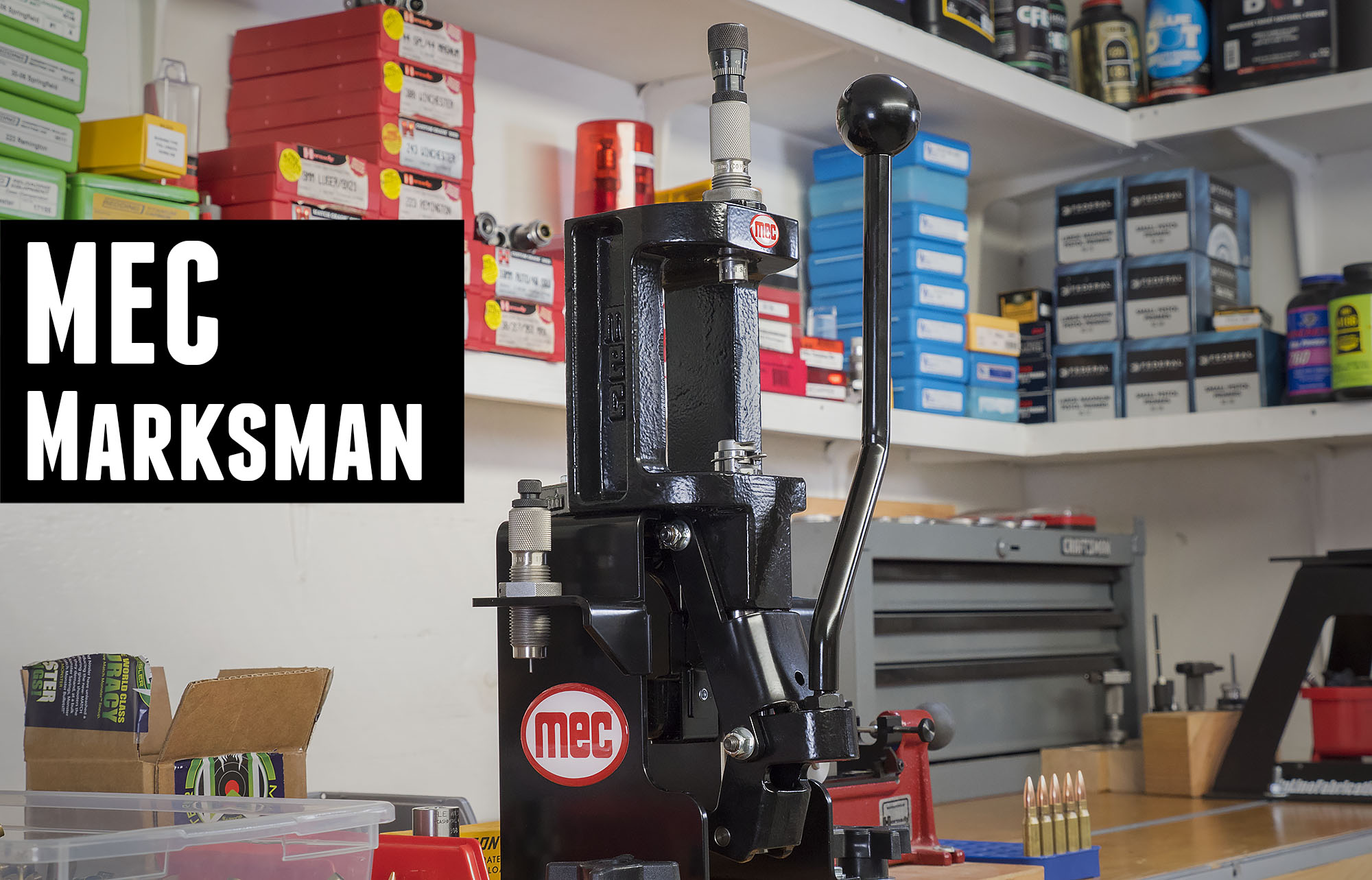
If you are looking for a new, full-size single-stage reloading press, definitely consider the MEC Marksman. Created by the makers of the popular MEC shotshell reloading systems, the MEC Marksman combines a sturdy cast-iron frame with a modern open-front design. With a $189.99 street price the Marksman press cost roughly $30 more than an RCBS Rock Chucker, but the MEC offers some distinct advantages — such as an open front plus a floating shell-holder system.
Our friend Gavin Gear got his hands on a MEC Marksman press and put it through its paces. He came away impressed with the product, saying it delivers excellent performance, and has many impressive features. Gavin tells us: “Cast iron tools and machines are a lifetime investment. The made-in-USA MEC Marksman features ductile cast-iron construction, an open-front frame design for easy cartridge access, a new floating shell-holder design with a unique retention system, and ambidextrous handle setup.”
Gavin liked the Marksman’s system for holding spent primers. A tray sits behind the ram to catch spent primers exiting from a hole near the bottom of the ram. This is more foolproof than the plastic primer cups on some other single-stage presses. Expect less spent primer “spillage”.
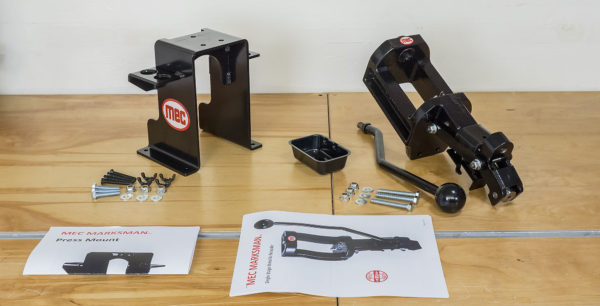
The Marksman is sold as a stand-alone unit. However MEC also offers a very nice steel mount/riser for the Marksman. Gavin tested the Marksman with this riser, and he says it was sturdy and well-built. Gavin liked the riser. He said that elevating the Markman press up above the benchtop made it easier to handle cases and to operate the handle. The riser also has “wings” on the left and right, providing a pair of handy die-holders on each side.
It’s hunting season already in many areas of the country. Improve your chances of a successful hunt by working on your position shooting skills before heading into the backcountry. Here are tips from Team USA Olympian and ISSF World Cup Winner SFC Michael McPhail.
One of the world’s best smallbore shooters, McPhail is also an avid hunter, who enjoys harvesting game with centerfire rifles. In this excellent short video from the USAMU, McPhail shows how competition shooting positions can be adapted for hunters. McPhail shows how well-established positions can provide a more stable platform for hunters in the field. That can help ensure a successful hunt. McPhail demonstrates three positions: kneeling, supported prone, and sitting in a tree-stand.
Watch SFC McPhail Demonstrate Positions for Hunters (Good Video):
McPhail first demonstrates the kneeling position. Michael notes: “I like kneeling. It’s a little bit of an under-utilized position, but it’s almost as stable as prone. It allows you get up off the ground a little bit higher to [compensate for] vegetation. For kneeling start by taking your non-dominant foot and put that towards the target, while at the same time dropping down to a knee on the dominant leg. At the same time … wrap the sling around wrist and fore-arm, lean slightly into the target and take the shot.”
McPhail shows a nice “field expedient” use of your backpack. He shows how the basic prone position can be adapted, using the pack as a front rifle support. McPhail recommends pulling your dominant (strongside) leg forward, bent at the knee. According to Michael, this takes pressure off the abdomen, helps minimizes heart beat effects, and helps with breathing.
Last but not least, McPhail shows some clever treestand tricks. McPhail recommends a position with your weakside leg pulled up and firmly braced on the front rail of the treestand. You can then rest your support arm on your leg. (That would be the left arm for a right-handed shooter). This provides a rock-solid position when shooting from a stand. The second half of the video shows how this works.