What if you could see a speeding bullet in the milliseconds it exits the muzzle of a pistol? How cool would that be… Well, the Mythbusters folks (Adam Savage and Jamie Hyneman) have made that possible. Using an exotic Phantom super-high-speed camera running at 73,000 frames per second, the Mythbusters recorded a .45 ACP bullet being fired from a 1911-type handgun.
Watch Mythbusters Super-Slow-Motion Pistol Video:
What unfolds is spectacular. First you see a ball of flame as the bullet emerges from the barrel of the 1911, then two distinct, separate swirling clouds form as the bullet races toward the target. Watch the video a couple times — it’s mesmerizing.
Co-host Adam Savage is nearly rendered speechless by the remarkable slow-motion footage from the Phantom. Filmed at 73,000 frames per second, the video reveals a dance of pressure and fire that would otherwise be missed by the unaided eye.
Field Test and Review by Colton Reid
For years my “go-to” optic for hunting mule deer has been a high-quality set of Swarovski porro prism binoculars. They offer a sharp image, good low light performance, and were about half the price of a comparable roof prism design. I also carry a small, handheld laser rangefinder in my pocket while hiking. This setup has been “good enough” for a long time despite the inconvenience of separate optics and having to scramble for the rangefinder every time I spotted a buck.
But as I get older this setup becomes less favorable and my reasons for upgrading to binoculars with rangefinding capability are outweighing my reasons against. Accordingly, I decided to test if rangefinder (RF) binoculars could really deliver an improvement over separate binoculars and LRF. Fortunately, AccurateShooter.com acquired a new Zeiss Victory 10×42 RF and let me field test it. This is a premium unit, with a premium price tag. The 10×42 Victory RF currently sells for $3399.99.
First impressions were good. The Victory RF employs an Abbe-Koenig roof prism with a comfortable-to-hold black body that has a padded soft-touch surface. The Victory RF is marginally heavier than my older porro prism binocs. The central focus wheel is large, easy to turn, and is positioned to allow index and middle fingers to simultaneously work the focus wheel and rangefinder.
Great Glass with Excellent Low-Light Performance
Diopter adjustment was a bit more complicated due to the built-in rangefinder display, but once set didn’t require further adjustment. When all knobs were adjusted, optical performance was excellent. Compared with my tried and true Swarovski Habicht 10×40 porro prism binoculars, the Zeiss Victory RF exhibited an equally sharp image that was also brighter in the fading daylight. Additionally, the Victory RF had a narrower depth of field than the old Swaro porro. This produced a noticeable “3D” effect that helped the target pop out of its surroundings. The optics alone make the Victory RF an excellent product, but the Victory RF’s built-in rangefinder made these binoculars truly exceptional.
Testing the Victory RF Laser Rangefinder Capability
Having rangefinder functionality inside quality optics was remarkably convenient. This allowed spotting and ranging targets without having to re-acquire an image using separate optics. It also ensured that the image for ranging was the same magnification and quality as the binoculars. Beyond just convenience, the Victory’s ranging capability was superb.
During one testing session at dusk, distances out to an astonishing 2600 yards could be repeatedly measured. To dispel my skepticism I verified all ranges with Google Earth (Google earth image + range image). Ranging game-sized objects beyond 800 yards required a stable surface (or tripod) to hold the red dot on target. However, the rangefinder had no problem ranging trees or large boulders at longer distances by hand. Measurement to measurement variation was within about 5 yards, which is likely due to movement from the user, especially at long distances.
In most outdoor environments I’ve hunted, ranging nearby vegetation or rocks gives enough accuracy in distance to obtain a satisfactory ballistic solution. In my experience, the vast majority of hunters are taking their shots inside 300 yards. At that distance or closer, hand-holding the Victory RF works well. For shots that exceed 300 yards, where bullet drop is a concern for hunters, the rangefinder is able to incorporate ballistics profiles from the Zeiss Hunting App running on a smart-phone, and deliver a precise ballistic solution visible IN the binoculars.
[Editor: Press a button and right in the glass you can see the calculated elevation correction in inches or cm, with clicks in MILS or MOA. A Long-Range Only video review confirmed how well this works: “The sync was almost immediate. Gives you custom drop right in your binoculars, with one push of a button.” The Zeiss RF also calculates true horizontal distance for angled shots.]
The Victory RF was able to range larger objects at 2000 yards and beyond with the unit placed on tripod or solid support. In the example above, the Victory RF was targeted on a specific object on a ridge over one mile away. The Victory RF’s 1928-yard read-out was confirmed with a Google Earth GPS trace.
Smart RF Binoculars with Built-in Ballistics Solver
Customized ballistics data can be transferred to the Victory HF’s display via a Bluetooth connection with the Zeiss Hunting Application*.
The Zeiss Hunting App deserves its own full review. But I can say the interface is clean, minimal, and FREE. There is much to be desired from the notes section, but the Ballistics Calculator makes it one of the better hunting apps I’ve used. Because ballistics data can be transferred to the rangefinder display, the App is a “must-have” accessory for the Victory RF.
KEY FEATURES: Ballistics Solver, GPS Tagging, Weather Forecast, Field Notes with Photos
Comments on Zeiss Victory RF
Despite the Victory RF’s excellent optics and impressive ranging performance, there is some room for improvement in this product. The red rangefinder display proved difficult to see against a tan/brown backdrop during bright daylight hours. Also I noted that, if you look away from the center of the field of view, the read-out seems to dim. At full LED brightness the red dot target was always visible but still showed a tendency to blend in with a tan backdrop. [Editor: The Zeiss RF does offer 11 brightness curves, and the manufacturer notes the unit features an automatic brightness control.]
Setting the dual eyepiece diopters was also a bit more complex than a single diopter system. The “trick” was to first focus the rangefinder display using the right diopter wheel. After that the central wheel and left diopter could be focused as needed. The accompanying neck strap and binocular case were well made and may work well for birding or nature hikes, but would not be preferred for hunting. When performing extreme physical activity, a shoulder harness or chest pack carrying case such the Badlands Bino X (shown below) is needed for support and fast extraction.
CONCLUSION — Superb Binoculars with Outstanding Rangefinding Capability
All together the Victory 10×42 RF is one of the finest binoculars I have had the pleasure of using. The crisp image coupled with a reliable long-distance rangefinder gave me the confidence to spot and stalk game over a mile away. As a hunter who spends 70% of his time behind optics I am convinced that with the Victory RF my ability to observe and plan in the field has dramatically improved. And with a little bit of care, these binoculars will be a reliable field favorite for years to come.
Zeiss Victory RF Binoculars Features:
– Laser Ranging capability from 16 to 2,500 yards
– On-board B.I.S. II ballistic calculator with integrated sensors
– Custom ballistics input via smartphone or tablet
– Bluetooth connectivity
– Holds custom ballistic profiles
– Measures angle, temperature, and air pressure
– Calculates equivalent horizontal distance
– Displays holdover in inches/cm, MOA, MIL and clicks
– Features Scan and Target modes
– Automatic LED brightness adjustment (11 brightness curves)
– User-Programmable ontrol buttons and display
– One-touch ranging (right or left hand)
– Syncs personal settings and ballistic profiles to and from the RF
– Large focusing wheel for minimal rotation
– FL glass, ZEISS T and LotuTec® coatings
About the Author, Colton Reid, Ph.D.
Colton Reid is a hunter and outdoorsman, who is also an optics expert. A Ph.D. engineer in the high-tech industry, Colton works with high-resolution electro-optical measuring devices for microchips. Raised in Colorado, Colton’s favorite activity is a backcountry hunting adventure. AccurateShooter.com is fortunate to have Colton review optics products.
* The Zeiss Hunting App integrates many useful features — ballistics solver, compass, GPS tagging, hunt history. The “Field Notes” function can record a wide variety of info — save photos, record shots and hits, log animal sightings, and even plot game locations on a map. Shots can be tagged via GPS through the shooter’s and the target’s position, and then displayed on a map. The Field Notes hunt diary shows all entries in chronological order.
Ruger has produced an interesting Big Magnum that combines a nice stock with a quality 5R barrel with muzzle brake. The new-for-2018 Ruger Hawkeye Long Range Target (LRT) rifle offers outstanding bang for the buck in a large magnum chambering. MSRP for the LRT is $1279.00 while best “street price” is now under $1000.00. Honestly you could easily pay twice that much and not get a .300 Win Mag that shoots significantly better.
The Hawkeye LRT has some nice features, including:
– Barrel (26″) with 5R Rifling and Hybrid Muzzle Brake
– Target Stock with two-way Adjustable Comb and Adjustable LOP
– Flush-mounted Lower M-LOK® Rail for bipod or bag-rider
– Angled +20 MOA Picatinny Scope Rail
– AI-compatible Detachable Box Magazine
– 2-Stage Target Trigger adjusts to 2.4 pounds
– Mauser-style 3-position Safety
Video of New Hawkeye Long Range Target in .300 Winchester Magnum
3/4-MOA Three-Shot Accuracy with Factory Ammo Ammoland.com gunwriter L.P. Brezny recently field-tested the Ruger Hawkeye LRT with a variety of factory .300 Win Mag ammunition. Most of his three-shot groups were in the 3/4-MOA range: Norma ECO Strke 150gr, 0.652″; Federal Premium BT Edge 200gr, 0.834″; Winchester Power Core 150gr, 0.726″. Handloads with 155gr Sierra TMKs did even better: 0.496″ for three shots.
Tester Brezny was impressed with this rifle, saying: “I predict that like the [Ruger Precision Rifle], the Ruger Hawkeye Long-Range Target rifle that has been enhanced as an advanced tactical design at less than one-third the cost of most better-grade long range rifles, is going to see a whole lot of sales as a professional as well as civilian use in the year or two ahead.”
Solid Value and Good Features
With a tempting $1000 “street price”, we think this Ruger offers a lot of performance for the price. Accuracy is very good for a factory rifle. We like the two-stage trigger. It’s nice to have a +20 MOA scope rail. The toe of the stock works well with a rear sand-bag and the front M-LOK rail can be used to attach a 3″-wide bag-rider. This makes the gun very suitable for bench target use.
Too Heavy for Hunters?
The .300 Win Mag chambering is excellent for big game, but we doubt the LRT will actually harvest many big beasts. The reason? At 11 pounds before optics, (figure 13 lbs. with scope, rings, and sling) we doubt many Hawkeye LRT owners will carry this gun in the field.
However, for guys looking to punch paper and ring steel at 1000-1700 yards, this is an interesting option. We expect the main market for this rifle will be shooters who want to experiment with long-range (1000 yards and beyond) target shooting, without breaking the bank.
The Hawkeye Long Range Target rifle features a Mauser-style 3-position safety, plus a large, Mauser-type bolt release on the left side of the action:
Have you ever expanded a .22 or 6mm cartridge all the way up to .30-caliber? If so, you know this can be a difficult procedure that stresses the case necks and neck-shoulder junction. A significant neck-size expansion done in one big jump can increase run-out, cause doughnuts, or worse yet, even split the brass. Therefore you want to proceed in increments, increasing the neck diameter in stages. One smart way to do that is to use a Progressive Press. This article explains how…
The most successful short-range brenchrest-for-score cartridge is the 30 BR. That cartridge, as well as 30 BR variants such as the 30 BRX, all start with the 6mmBR Norma parent cartridge, typically with Lapua 6mmBR brass. To get a nice 30 BR case you want to expand in stages, increasing the inside neck diameter incrementally from .243 to .308.
Darrell Jones of DJ’s Brass Service creates thousands of 30 BR cases each year. He has found a clever way to speed up the process — Darrell uses a Progressive Press. He runs his 6BR brass through four (4) separate Hornady neck-sizing dies with expander mandrels. First there is a .257 die, followed by .264 (6.5mm), .284 (7mm), and then .308. Then a fifth and final K&M die provides one last, slight expansion so the newly-fashioned 30 BR cases perfectly fit the arbor of Darrell’s neck-turning tool.
So to repeat, the case starts as .243 (6mm), then moves in up stages .257, .264, .284, and .308, with a final “finishing” step prior to neck-turning. You can see the expansion in this video, which starts with 6mmBR brass that was first hydro-formed to 6 BRX:
Watch 6mm Cases Expanded to 30-Caliber (6BRX to 30 BRX)
For this demo video, Darrell expands just one case at a time. However, he can also put multiple cases in the progressive — one per station. This takes a little more effort, Darrell says, but the results are still excellent. Darrell tells us: “I do put multiple cases in the progressive to save time. The results are the same — I just wanted to show a single-step process and how it reduces run-out by not stressing the shoulder with one big expansion from 6mm straight to 30 caliber. Doing the operation in multiple stages avoids binds and helps keep the shoulders concentric.”
This same multi-stage procedure can be use to expand other cartridge types. For example you could take .221 Fireball brass in stages up to .308 to create 300 Blackout brass.
Darrell uses caliber-specific, Hornady neck-sizing-only dies with elliptical expanders. Darrell tells us: “The Hornady elliptical expander has a reduced bearing surface that puts less strain on the brass when expanding the necks to the next size.” The fitting at the bottom of the die is the Lock-N-Load die bushing that allows fast die changes.
These particular cases used in the video were first hydro-formed to 6BRX then expanded to 30 BRX before neck turning. DJ’s Brass offers hydro-forming for many popular wildcat cartridges such as 6 PPC, 6mm Dasher, and .284 Shehane.
Here is a video every shooter should watch. It reminds us that our sport demands 100% attention. Lose track of individuals down-range and the results could be tragic. This video will give you chills (starting at about the 0:25 mark). We need to remember to follow all the firearms safety rules, and apply them all the time. At the range, all it takes is one brief moment of inattention to create a life-threatening situation. Never assume the downrange area is safe. Use your own eyes and ears.
This video shows a competitor shooting a stage at an action pistol match. He starts when instructed by the Range Safety Officer (RSO). But unbeknownst to both RS0 and competitor, a volunteer is downrange working on targets. Watch carefully. At 0:27 the shooter sweeps left to right, engaging a paper silhouette target to his right. Then, at 0:30, as he begins a mag change, his head turns downrange. A few yards away is a white-shirted range worker! The shooter yells “Hey what’s going on?!”
What’s going on indeed… The RSO should have ensured that nobody was downrange before the shooter even stepped up to the firing line. If other competitors standing to the side had been alert, they might have seen the worker changing targets and called for a halt. And the target-worker himself — even if he was wearing earmuffs, he should have noticed that live fire had commenced just yards away…
We also have to wonder about the stage design. This set-up made it very difficult to see downrange. The white panels (see 0:10-0:20) definitely hid the target worker from view. In hindsight, given the way the stage was laid out, this was truly an “accident waiting to happen”. It’s fortunate that no one got injured in this incident. But this chilling video provides a lesson to all shooters — “Safety First”.
How could this “near-fatality” have been averted? Post your comments below.
With the recent IBS 100/200 Group Nationals in Pennsylvania, we thought our readers might like to learn more about the short-range Benchrest game. Seeing the tiny groups 6 PPC aces produce, it’s easy to think the precision is all about the equipment. But there is a lot more involved. A talented human still has to watch the flags, run the gun properly, and tune his loads for the conditions. Here are some tips from one of the world’s best benchresters, Charles Huckeba.
Texan Charles Huckeba was the top individual shooter at the 2013 World Benchrest Championships (WBC) held near Sydney Australia in October 2013. In this video, 2013 WBC Two-Gun Overall winner Charles shoots a 1/8th MOA group at 200 yards — “a little bitty dot” as a fellow Team USA shooter observes. That’s impressive. If you can describe Huckeba’s style in a nutshell it would be “smooth, consistent, and rapid but not hurried”.
Charles also employed some unusual hardware. In the video, take a close look at the joystick on the Farley Coaxial front rest. There’s no knob at the end. In its place is a small, wood ammo caddy. Charles removed the standard knob from the handle of his Farley rest and replaced it with a home-made wood block that holds cartridges for the record target. The 10.5-lb Light Varmint rifle is chambered in 6PPC with a BAT Machine Action and a composite wood and carbon-fiber stock.
Watch Charles Huckeba Shoot 1/8 MOA, 200-yard group at World Benchrest Championships
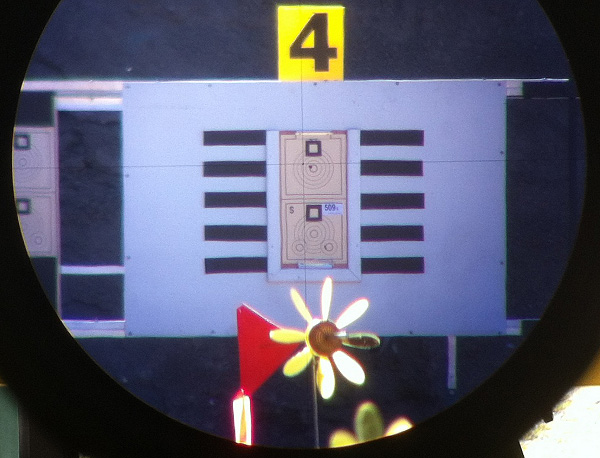
Here is the actual 200-yard, 5-shot group Charles shot in the video. Photo (by Stuart Elliot) taken through the lens of Huckeba’s 50X March scope (reticle has 1/16th MOA Dot).
Analyzing the Fine Points — What Makes Huckeba So Good
Short-range benchrest shooter Boyd Allen saw some interesting things in Huckeba’s WBC performance, as captured on video. Boyd noticed Huckeba’s smooth gun-handling and efficient loading. But Boyd also spied some interesting equipment, including an innovative joystick “handle-caddy”.
1. Low Friction Bags — When Huckeba slid his rifle, there was very little apparent friction. The front bag features the new 3M material (ScotchLite) on the sliding surfaces. The rear Protektor bag has ears of the same low-friction material.
2. Pause Before Chambering — While he was watching the flags and deciding when to start firing, Charles kept his first round in the action, but out of the barrel’s chamber, probably so as not to heat the cartridge and change the round’s point of impact.
3. Ammo Caddy on Joystick Arm – Charles shoots a Right Bolt/Left Port action, so he pulls his rounds with his left hand. Note that Huckeba’s record rounds rest in a small, wood ammo caddy attached to the end of the joystick shaft. Look carefully, you’ll see the wood ammo block in place of the normal black ball at the end of the joystick. That allows Charles to pull shots with the absolute minimum of hand movement. Ingenious! Huckeba is very fast, with a great economy of motion. I believe that because his ammo was literally at hand, Charles was better able to keep his focus on aiming and the flags.
4. Smooth-Cycling BAT Action — Note how smoothly Huckeba’s action operates. When Charles lifts the bolt handle (to extract a round and cock the firing pin), this does not disturb the rifle. Likewise, as he closes the bolt, the gun doesn’t wobble. The smooth action allows Charles to hold point of aim even when shooting relatively quickly. Huckeba’s BAT action is chrome-moly steel. Some shooters believe this metal makes for a smoother action than stainless steel or aluminum.
5. Long-Wheelbase Stock — The wood and carbon fiber stock is light, long, and stiff. Yet, importantly, the stock is also well-damped. The longer-than-average stock length (with extended forearm) seems to help the gun track well without jumping or rocking. The longer forearm allows a longer “wheelbase”, effectively shifting the weight distribution rearward (less weight on the front, more weight on the rear). This places a greater share of the gun’s weight on the rear bag, as compared to a more conventional benchrest stock. Huckeba’s stock, built by Bob Scoville, is at the cutting edge of short-range benchrest design. Its light-weight balsa wood and carbon fiber construction provides a combination of stiffness and vibration damping that allows its relatively long fore-end to be fully utilized to increase the weight on the rear bag (always an issue with 10.5-pound rifles).
To learn more about this benchrest stock design, read the comments by stock-builder Bob Scoville in our PPC with Pedigree story in our Gun of the Week Archives. Bob observed:
“There is a lot more to the structure of the stocks than meets the eye. The carbon fiber skin with which I cover the stocks creates a light, tough exterior surface. However, this contributes very little to the overall performance of the stocks. The real strength and stiffness is the result of an internal beam utilizing balsa core/carbon fiber technology.
This type construction can be found in aircraft, race cars, powerboats, and sailboats. It is interesting to note, balsa has the highest strength to weight ratio of all woods and carbon fiber is one of the lowest stretch (modulus of elasticity) relative to weight of all materials. The marriage of these two materials is common in the high-performance world. Additionally, balsa is used commercially for vibration dampening and sound reduction.”
Video find by Boyd Allen. Video by Stuart Elliot of BRT Shooters Supply, Brisbane, Australia.
The question of barrel break-in is controversial. Some folks advocate an elaborate, lengthy cycle of shooting and brushing, repeated many times — one shot and clean, two shots and clean and so on. This, it is argued, helps barrels foul less and shoot more accurately. Others say minimal break-in, with patching and brushing after 10-15 rounds, is all you need. Still others contend that break-in procedures are a total waste of time and ammo — you should just load and shoot, and clean as you would normally.
We doubt if there will ever be real agreement among shooters concerning barrel break-in procedures. And one must remember that the appropriate break-in procedure might be quite different for a factory barrel vs. a custom hand-lapped barrel. This Editor has found that his very best custom barrels shot great right from the start, with no special break-in, other than wet patches at 5, 10, and 15 rounds. That said, I’ve seen some factory barrels that seemed to benefit from more elaborate break-in rituals.
What’s the best barrel break-in procedure? Well our friend Eric Mayer of Varminter.com decided to ask the experts. A while back Eric interviewed representatives of three leading barrel manufacturers: Krieger, Lothar-Walther, and Shilen. He recorded their responses on video. In order of appearance in the video, the three experts are:
Do I Need to Break-In a New Rifle Barrel?
Eric Mayer of Varminter.com says: “That is a simple question, [but it] does not necessarily have a simple answer. Instead of me repeating my own beliefs, and practices, on breaking-in a new rifle barrel, I decided to answer this one a bit differently. While we were at the 2016 SHOT Show, we tracked down three of the biggest, and most popular, custom barrel makers in the world, and asked them what they recommend to anyone buying their barrels, and why they recommend those procedures. We asked the question, and let the camera run!” Launch the video above to hear the answers — some of which may surprise you.
Long-Term Barrel Care — More Experts Offer Opinions
Apart from the debate about barrel break-in, there is the bigger question of how should you clean and maintain a barrel during its useful life. Some folks like aggressive brushing, other shooters have had success with less invasive methods, using bore foam and wet patches for the most part. Different strokes for different folks, as they say. In reality, there may not be one solution for every barrel. Different fouling problems demand different solutions. For example, solvents that work well for copper may not be the best for hard carbon (and vice-versa).
“Why worry about a little barrel fouling when the throat is subjected to a brutal 5,600° F volcano at 55,000 PSI? To investigate these and other questions about taking care of a match barrel, we spoke with a dozen experts and share their knowledge in this first of a series of articles.
After listening to folks who shoot, build barrels or manufacture cleaning solvents for a living, we concluded that even the experts each have their own unique recommendations on how to care for a match barrel. But they all agree on one thing — the gun will tell you what it likes best. Because the life expectancy of a match barrel is about 1,500 to 2,500 rounds, the objectives of cleaning one should include: preserve accuracy, slow the erosion, and remove fouling — all without damaging the gun. This article doesn’t claim that one cleaning method is better than the next. Rather, we set out to interject a little science into the discussion and to share some lessons learned from experts in the field.” — Chip Lohman
As part of NRA Women TV, hunting guide Kristy Titus hosts a series of videos that explain important strategies and shooting skills for hunters. Titus, co-host of the Team Elk TV show, is a certified instructor who has hunted around the globe. She grew up in the outdoors, running pack mules in Oregon with her father. In these videos, Kristy discusses demonstrates field positions that can be employed during a hunt. She also explains preparation for a hunt, including fitness training.
Click each link below to watch other Kristy Titus Hunting Videos.
“When it comes to bolt-action rifle fit, there is no ‘one size fits all’,” says Titus. “When picking out your rifle [consider options] after the purchase to ensure you are as comfortable as possible.”
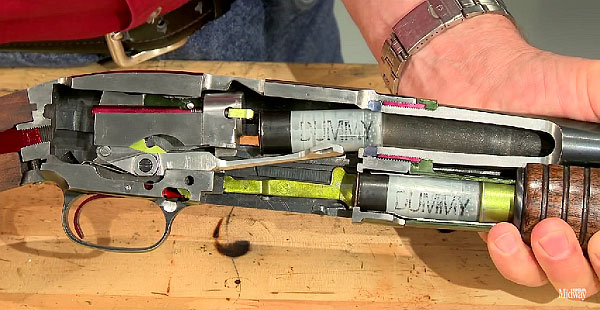
Even wonder how a pump shotgun works? Then watch this fascinating video from MidwayUSA. The operation of a pump-action shotgun is illustrated with a special cut-away version of a Winchester Model 12. The shotgun has been modified to reveal the inner workings. This cut-away Model 12 still loads and ejects dummy shells, but you can see how the lugs, slides, locks, ramps, springs and other internal parts work. You’ll be amazed how complicated this old pump-gun is. (The Model 12, Winchester’s first hammerless shotgun, is one of the most popular scatterguns ever made. Over 2,000,000 were sold.)
Skip Ahead to 3:00 to See Cut-Away in Action
To see how the Model 12 works, you can skip forward to the 3:00 minute mark in the video. The first part of the video shows how the Model 12 was “sliced and diced” to expose the inner workings. Larry Potterfield of MidwayUSA explains that “the factories often used cut-aways as sales tools to show how a specific model operated”. In addition the U.S. Military used cut-aways for training purposes.
Here is the cut-away completed. Even the pump grip has been sliced to reveal the inner workings.
A round has been picked up from the feed tube, and then is lifted into the chamber.
Here’s a very cool 3D Animation showing pistol rounds being fired. Computer-generated graphics provide a look inside the cartridge at the moment of ignition as the primer fires and the flame front moves through the ignited powder. It’s really kind of mesmerizing. If you’ve every wondered just what happens inside your cartridges the moment that firing pin strikes, then watch this video…
Watch Video to See Handgun Ammo Being Chambered and Fired:
Mute Enabled — Click Speaker Icon to Hear Audio. Firing Sequence Starts at 1:28.
This animated video from German ammo-maker GECO (part of the Swiss RUAG group of companies) reveals the inside of a pistol cartridge, showing jacket, lead core, case, powder and primer. Employing advanced 3D rendering and computer graphics, the video shows an X-ray view of ammo being loaded in a handgun, feeding from a magazine.
Then it really gets interesting. At 1:28 – 1:50 you’ll see the firing pin strike the primer cup, the primer’s hot jet streaming through the flash-hole, and the powder igniting. Finally you can see the bullet as it moves down the barrel and spins its way to a target. This is a very nicely-produced video. If you’ve ever wondered what happens inside a cartridge when you pull the trigger, this video shows all. They say “a picture’s worth a thousand words”… well a 3D video is even better.


 Solid Value and Good Features



 3. Ammo Caddy on Joystick Arm – Charles shoots a Right Bolt/Left Port action, so he pulls his rounds with his left hand. Note that Huckeba’s record rounds rest in a small, wood ammo caddy attached to the end of the joystick shaft. Look carefully, you’ll see the wood ammo block in place of the normal black ball at the end of the joystick. That allows Charles to pull shots with the absolute minimum of hand movement. Ingenious! Huckeba is very fast, with a great economy of motion. I believe that because his ammo was literally at hand, Charles was better able to keep his focus on aiming and the flags.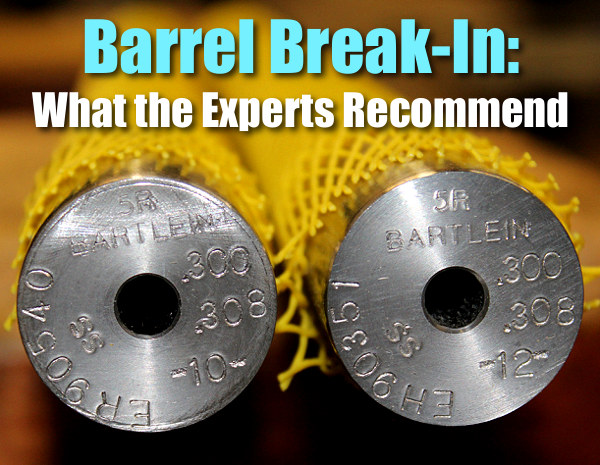
 Do I Need to Break-In a New Rifle Barrel?



 This animated video from German ammo-maker


