Chart created with Ammoguide’s Visual Comparison Tool. Visit Ammoguide.com to learn more.
One of our forum members was looking for a very accurate, mid-sized 6.5mm cartridge for target working and coyote hunting. There are many great options including the 6.5 Grendel, 6.5×47 Lapua, 6.5 Creedmoor, and Remington .260 (a 6.5-08). If you are considering the 6.5×47 you should read our 6.5×57 Cartridge Guide authored by the 6.5 Guys. This and other 6.5mm cartridges are covered in this introduction to 6.5 mm cartridges prepared by Eben Brown, President of Eabco.com.
Quick Guide to 6.5mm Cartridges
by Eben Brown, EABCO.com, (E. Arthur Brown Co. Inc.)
The current popularity of 6.5mm cartridges in the USA has been a long time in coming. I won’t go into my opinions on why it took so long to catch on. The important thing is that it finally HAS caught on and we’re now so fortunate to have a wide selection of 6.5mm cartridges to choose from!
6.5mm Grendel – Developed by Alexander Arms for the AR15 and military M4 family of rifles. The Grendel fits the dimensional and functional requirements of these rifles while delivering better lethality and downrange performance. [Editor: The little 6.5 Grendel delivers a lot of performance from a small package. This is one of the most accurate cartridge options for the AR15 platform.]
6.5mm BRM – Developed by E. Arthur Brown Company to give “Big Game Performance to Small Framed Rifles” — namely our Model 97D Rifle, TC Contender, and TC Encore. Velocities of 2400-2500 fps with 140gr bullets puts it just under the original 6.5×55 Swede performance.
6.5mm x 47 Lapua – Developed by Lapua specifically for international 300m shooting competitions (with some interest in long-range benchrest as well). Case capacity, body taper, shoulder angle, and small rifle primer are all features requested by top international shooters. You can expect velocities of 2500-2600+ with 140 gr bullets.
6.5mm Creedmoor – Developed by Hornady and Creedmoor Sports, the 6.5mm Creedmoor is designed for efficiency and function. Its shape reaches high velocities while maintaining standard .308 Winchester pressures and its overall length fits well with .308 Win length magazines. You can expect velocities of 2600-2700+ fps with 140gr bullets. [Editor: Yep, we know some PRS guys are loading hotter than that in bolt guns. We recommend you try the 120-130 grain bullets also with this cartridge. That may put you in a better accuracy node.]
This video reviews 6.5 Creedmoor Cartridge Brass options:
.260 Remington – Developed by Remington to compete with the 6.5mmx55 Swedish Mauser that was (finally) gaining popularity in 1996. By necking down the 7mm-08 Remington to 6.5mm (.264 cal), the .260 Remington was created. It fit the same short-action [receivers] that fit .308 Win, .243 Win, 7mm-08 Rem, etc. You can expect velocities of 2600-2700 fps with 140gr bullets in the 260 .Remington.
[Editor’s Note: In the .260 Rem, try the Lapua 120gr Scenar-Ls and/or Berger 130gr VLDs for great accuracy and impressive speeds over 2950 fps.]
6.5mm x 55 Swedish Mauser – This was the cartridge that started the 6.5mm craze in the USA. It is famous for having mild recoil, deadly lethality on even the biggest game animals, and superb accuracy potential. Original ballistics were in the 2500 fps range with 140gr bullets. Nowadays handloaders get 2600-2700+ fps.
[Editor’s Note: Tor from Scandinavia offers this bit of 6.5x55mm history: “Contrary to common belief, the 6.5×55 was not developed by Mauser, but was constructed by a joint Norwegian and Swedish military commission in 1891 and introduced as the standard military cartridge in both countries in 1894. Sweden chose to use the cartridge in a Mauser-based rifle, while Norway used the cartridge in the Krag rifles. This led to two different cartridges the 6.5×55 Krag and 6.5×55 Mauser — the only real difference being safe operating pressure.”]
6.5-284 Norma — This comes from necking the .284 Winchester down to .264 caliber. Norma standardized it for commercial ammo sales. The 6.5mm-284 was very popular for F-Class competition and High Power at 1,000 yards. However, many F-Class competitors have switched to the straight .284 Win for improved barrel life. 6.5-284 velocities run 3000-3100+ fps with 140gr bullets.
.264 Winchester Magnum – Developed by Winchester back in 1959, the .264 Win Mag never really caught on and may have delayed the ultimate acceptance of 6.5mm cartridges by US shooters (in my opinion). It missed the whole point and original advantage of 6.5 mm cartridges.
The Original 6.5mm Advantage
The special needs of long-range competition have skewed things a little. However the original advantages of 6.5mm cartridges — how deadly the 6.5mms are on game animals, how little recoil they produce, and how easy they are to shoot well — still hold true today.
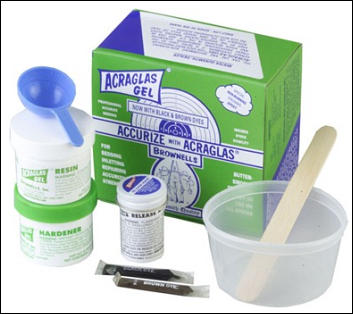
The NRA’s American Rifleman showcased an interesting project this week — an upgraded Ruger American Rifle Predator in 6.5 Creedmoor. The video below shows how a laminated wood stock from Boyds Gunstocks was adapted for the Ruger. A Boyds Prairie Hunter model in gray laminate was selected. This was custom-bedded to the Ruger’s action using Brownell’s Acraglas.
All Ruger American Rifle models employ dual aluminum V-Blocks to support the action. These fit slots in the underside of the action. Boyds makes its own version of these V-Blocks which were installed in the Boyds stock to secure the action.
Project leader Joe Kurtenbach says the size, shape, and geometry of the Boyds V-Blocks is very accurate, so they fit the Ruger action well. To further support the action, Acraglas bedding compound was applied to the inside of the stock, after release compound was applied to the barreled action. With this DIY bedding job, the Boyds laminated stock is definitely an improvement over this original “Tupperware” factory stock.
DIY Bargain Hunter Upgrade
American Rifleman states: “The Ruger American has some great features—hammer-forged barrel, reliable action, crisp trigger — but many would not consider the molded, polymer stock to be among them. Luckily, there are aftermarket options to enhance the rifle’s utility and aesthetics. A durable, attractive stock from Boyds Gunstocks and some DIY action bedding, using Brownells Acraglas, is the next step in the precision-driven hunting rifle build.”
Choice of Gun and 6.5 Creedmoor Chambering
For this project, American Rifleman’s Joe Kurtenbach selected one of his favorite cartridges, the 6.5 Creedmoor. Introduced in 2007 by Hornady, the accurate, flat-shooting 6.5 Creedmoor has proven very popular with both hunters and tactical/PRS shooters. The Ruger American Rifle Predator was chosen for its affordable price, reliable action, and Ruger Marksman adjustable trigger.
In this video, Kurtenback explains how and why the 6.5 Creedmoor chambering and Ruger American Rifle were chosen for the Precision Hunter rifle build project.
GRS stocks are produced in Norway. These stocks are known for their comfortable fit and ergonomics, but they are also strong and durable — thanks to attention to detail, careful construction, and premium materials. While GRS Riflestocks AS now produces excellent composite stocks, the majority of its products are still crafted from laminated wood. That’s not surprising because the GRS stock business evolved from a family furniture company.
This excellent video shows every stage of GRS Stock production. Worth Watching — Honest! Sawing Blanks: 0:15 | CNC Milling 0:20 | Surface Sanding 0:30 | Dip Finishing 1:00
Making a GRS Laminated Stock
GRS stocks start off with blocks of laminated wood. There are potentially 1700 combinations given the number of colors, models, and inlets. The first stage employs a band saw to shape the rough outer shape and dimensions. Then each stock goes into a computer-controlled CNC machine for precision milling. From the CNC-machine, the rifle stock is handed over to GRS craftsmen who hand-finish the stock (photo below). Depending on design, GRS stocks can be delivered with up to 40 different inlets.
GRS Stocks — Ergonomically Designed Good ergonomics have always been a key GRS design objective: “All our rifle stocks are adjustable, because people are different. If you make a fixed stock, it will always be a compromise for your shooting position. Also, your ergonomics change in different shooting positions. There is a big difference between standing, sitting and laying on the ground. It’s not rocket science, but we recognized this a long time ago. And that is why we made the adjustment system the way it is. Obviously, having the correct length of pull, and a full contact with the cheek-piece, adds a lot of stability into the shooting position.”
When you handle a GRS stock, and get into shooting position, you notice it feels comfortable immediately. And the LOP and cheek-piece height can be adjusted easily, without tools.
The GRS grip design is distinctive — for important reasons: “The grips that we have (which off-centered and angled out) remove tension in your arms. So when you shoot you are more relaxed. And the recoil transfers neatly in your body.”
About GRS Riflestocks AS — A Family Company Run by Serious Shooters
GRS Riflestocks AS is run by two brothers, Håvard and Oscar Haugen. Oscar served in the Norwegian military for a decade as a QRF Sharpshooter (sniper) and Sharpshooter Team Leader. Oscar’s military experience has helped GRS design better rifle stocks: “I was a Sharpshooter for the Norwegian army for a long time, both as a soldier and instructor. So we knew what worked in the field. And we knew production. So we took something traditional, as a rifle stock is, and introduced something new into it. This way, the ergonomics and the adjustment systems became key features of the GRS rifle stocks.”
Håvard Haugen (L) and Oscar Haugen (R), founders of GRS Riflestocks AS.
GRS Riflestocks AS has become very successful. The company now ships stocks to 45 countries worldwide. Oscar Haugen says: “I smile every day knowing more and more hunters and shooters gets to know GRS. We make them shoot more accurately because their rifles fit them better [with our stocks]. What more could we ask for?”
GRS Stocks are produced in Hornindal, Norway. Watch the video to see beautiful Norwegian scenery: “A short walk from the factory, you’re in the woods. You can go fishing, hunting … whatever you like”.
Do you neck-turn hundreds of cases annually? Then you deserve this outstanding tool. This innovative neck-turning system is truly a game-changer. The 21st Century Shooting Powered Neck-Turning Lathe is quite simply the best system ever created for quickly and precisely uniforming (and reducing) the neckwall thickness of cartridge brass. We have the original manual 21st Century neck-turning lathe, and can attest that it works great. But with the new powered system you can turn necks faster and more efficiently, with less effort. This is like going from a stick shift to an automatic transmission. The cases feed very smoothly and the results are beautiful. Once you’ve tried the Powered Neck-Turning Lathe you won’t want to use anything else. Watch this video to see how it works:
Power is activated by the red button on the end of the blue, horizontal feed handle:
Click the Speaker Button on video frame to play with sound (audio).
The Powered Neck-Turning lathe is a modular system. Swing the bar from right to left to feed the case. The power head (with case holder) glides on stainless steel rails for smooth movement. This allows very precise feed rate. Power is supplied via a button that is built into the end of the feed handle. Push the red button to make the case spin. It’s as simple as that.
The folks at 21st Century Shooting explain why the system works so well: “The floating design of our Neck Turner and Case Driver allows the case mouth (bore) to run on the arbor absolutely concentric. This, therefore, allows the outside diameter to be turned concentric with the inside diameter.”
Here is another video that shows how the lathe system operates:
Click the Speaker Button on video frame to play with sound (audio).
Complete Powered Neck-Turning Lathe System
The powered neck-turning system comes with everything you need, starting at $679.00. This includes: Motor Assembly, Lathe Base, “L” bracket, Neck-Turning Tool, Cutter, Case Holder, Driver, Turning Arbor, Expander Die Body, and Expander Mandrel. 21st Century currently offers a choice of nine popular calibers: .17, .20, .22, .243 (6mm), .264 (6.5mm), .270, .284 (7mm), .30, and .33. The case holders are appropriately sized for the common rim sizes in that caliber. Choose either stainless arbor and mandrel or Titanium Nitride-coated arbor and mandrel (for $20 more). Some of the larger calibers cost a bit more.
Report By Boyd Allen, IBS Vice President Huge credit to Ken Frehm for all of the photos and most of the information.
On July 14th and 15th, at the Camillus Sportsmen’s Club, Camillus, NY, thirty-two shooters vied to win the Two Gun (and Class titles) at the NY State IBS Championship & 19th Annual Pro-Am Group Shoot. The Pro-Am is a cash match. Twenty-five of thirty-two shooters participated in the cash option — five dollars per gun per day. They were the Professionals. The remaining seven were the Amateurs.
The weather was balmy and mild, the prize table and cash awards were generous, and the new range improvements were extensive, expensive, and well executed. Overall temperatures were seasonally moderate and the wind, while not difficult, was challenging enough that there were no Teen Aggregates shot in any class.
IBS Competitors Talk about their Sport
Definitely check out this video — it is excellent, and well worth your time. It shows the Camillus Club Range and features informative interviews with many shooters:
The Two-Gun Overall match winner was Bob Brushingham, with Don Francis in second place, and Bob White in third. Don, who finished with a .2600 Grand Agg, edged Bob (.2601) by a mere .0001! That’s close! (SEE Full Two-Gun Results).
Two Gun top finishers (L to R): Bob White (3rd), Bob Brushingham (1st), Don Francis (2nd)
Click image for large version.
Below are the LV and HV Class winners, Class Top Ten results, and respective equipment lists.
Light Varmint top finishers were (above, L to R): Bob Brushingham (2nd LV 100), Henry Miller (1st LV 200), Don Francis (1st LV 100, 3rd LV Grand), Leonard Burdick (2nd LV 200, 2nd LV Grand), Don Jeffers (3rd LV 100, 1st LV Grand).
Click image for large version.
Heavy Varmint top finishers were (above, L to R): Bruce Lachapelle (1st HV 100), Robert Blanchard (3rd HV 100), Bob Brushingham (2nd HV 200, 1st HV Grand), Don Francis (2nd HV 200), Ron Burdick (2nd HV 100, 3rd HV Grand), and Bob White ( 1st HV 100, 2nd HV Grand).
Click image for large version.
Here is the winning Pro-Am Team: Jennaro (Jerry) Corigliano (1st Amateur), Bruce Lachapello (1st Pro).
IBS 100/200-Yard Benchrest Competition
As with all Registered IBS 100/200-yard Group Matches, the N.Y. Championships at Camillus employed moving backers. This system ensures that a completed group includes the requisite five shots. With extremely small groups in the “ones” and “zeros” it may be impossible to distinguish five holes.
Although pre-loading is not uncommon, most 100/200-yard group shooters typically load at the match, often between relays. This enables them to tune their loads for the current conditions. Nearly all competitors in this short-range discipline shoot the 6mm PPC cartridge, or a PPC variant.
With group sizes so small, and group dimensions listed to the thousandth of an inch, precise measurement is an important part of the process.
The Camillus Sportsmen’s Club Range
This is not just a benchrest club, but a complete, multi-discipline shooting sports facility. To my California eyes, the Camillus range is a thing of beauty, with a vast expanse of well-trimmed grass between the firing line and the berms, and a substantial wooded hill beyond. The club has just completed a host of brand new improvements that required a significant investment and, I am sure, a lot of hard work. I believe that this was the first time that an event was held after they were finished. The improvements include a new shooting pavilion (firing line cover), with the latest safety features, new all masonry benches, new berms, new target boards, and may others that are too numerous to mention.
Backing up the range berm is a 120-foot high wooded hill. Behind the firing line, running northwest along the club’s western boundary, is the old, abandoned Erie Canal. The Club’s land is relatively flat, which has allowed it to be well-utilized for multiple shooting sports. See Google Map.
Parting Shot… I had to smile at this picture of the target crew. Evidently the club has excellent relations with the Syracuse Police Department.
Shooting USA will broadcast a great episode today, August 1, 2018. There are three segments worth watching. First the TV show spotlights the popular GAP Grind, a Pro-Am PRS event at the K&M Precision complex in Tennessee. Then this episode covers the CMP Western Games at Ben Avery in Phoenix. Finally John Scoutten reviews two new 6.5 Creedmoor Savage rifles.
This Shooting USA Episode airs August 1, 2018 (Wednesday) at 9:00 Eastern and Pacific; 8:00 Central.
Part One: GAP Grind Pro-Am PRS Match
Lots of Action, with 20+ Stages
The GAP Grind, the biggest PRS match in the country, is a notoriously challenging, “high tempo” match with minimal down-time between stages. Over the course of 20+ stages, competitors will fire 200+ shots at a variety of steel, paper, moving, and reactive targets out to 1,200 yards. Targets vary in size/difficulty based on the shooter’s position, distance, and time allotted. Most stages include “stressors” — i.e. time limits or required movement(s).
The GAP Grind attracts over 300 competitors — half experienced shooters and the other half newcomers to the sport. The key to growing the shooting sports is attracting new shooters. The best way to bring in “new blood” seems to be the Pro-Am type format. At the GAP Grind, experienced shooters guide the new shooters through the competition and hopefully keep them coming back.
Here is Shooting USA Host John Scoutten (in Blue/White shirt)
John Scoutten is paired with new shooter Kevin Nassery who says he thinks the biggest advantage is not necessarily the course of fire, or the targets, it’s the spotting. “Pros don’t get any support to know where they hit or missed. They have to see everything themselves. I think that’s the biggest difference between the courses of fire”.
Part Two: CMP Western Games
The Civilian Marksmanship Program (CMP) was established by act of Congress in 1903, with the purpose of teaching shooting skills to American citizens. The Western Games at the Ben Avery Facility North of Phoenix draws enthusiasts from many Western states for competition with Service Rifles, vintage military rifles, M1 Carbines, and Rimfire Sporter rifles. Along with numerous matches (including the Vintage Sniper Team match), the Western Games features Small Arms Firing School (SAFS) shooting clinics.
“Our mission is to teach marksmanship and give the citizens of the United States the opportunity to learn marksmanship, with an emphasis on youth”, states Mark Johnson, CMP Chief Operating Officer.
Vintage Sniper Rifle Match competitors try to keep cool
A Small Arms Firing School (SAFS) is conducted each year.
Checking out the line-up of M1 Garands at the CMP Sales tent.
The CMP’s rifle and ammo sales programs fund the CMP activities. The M1 Garand has been the CMP’s most popular centerfire rifle over the years. Mark Johnson calls it “the ’57 Chevy of firearms. If you like firearms, you have to have an M1 Garand.”
Part Three: Savage 6.5 Creedmoor Rifles Review
In this review segment of today’s Shooting USA episode, John Scoutten reviews two new 6.5 Creedmoor rifles from Savage Arms. The Model 10 BA Stealth is a short action bolt gun priced at $1,207 MSRP. The MSR 10 Long Range is am AR-platform semi-auto priced at $2,284 MSRP. Both rifles showed good accuracy with factory ammunition. For this test both Savage rifles were topped with Bushnell Elite LRTS optics.
When we first ran this story a few seasons back, it proved immensely popular with our readers. In case you missed it the first time around, check out what can be done with a factory Savage 110 BA at extreme long range — 1760 yards (one mile). Shooter Mark Dalzell did a great job with the video, which features multiple camera views so you can see the shooter and the target at the same time. Enjoy!
This video by Mark Dalzell demonstrates the long-range capabilities of the Savage 110 BA chambered in .338 Lapua Magnum. Mark took his “BadAss” rig out to the southwest Nevada desert just north of Jean Dry Lakes. He placed a 2’x3′ target way, way out there — a full mile (1760 yards) away. At that range, flight time to target was 3.75 seconds! Sighting with a Nightforce 5-22x50mm NXS scope, Mark needed a few shots to get on target, but eventually made multiple hits, using 67 MOA of elevation and 2.25 MOA left windage. You can view the hits starting at 1:56 time-mark on the video. (Mark had a second camera set up closer to the target — this displays frame in frame in the video, and if you watch carefully you can see the strikes.) The ammo was HSM 250gr HPBT match with a 3.600″ COAL. The shooting was done at 8:13 in the morning, with clear conditions, very light winds. Temp was 57°, humidity 24.5, Density Altitude 3666. Video soundtrack is La Grange by ZZ Top.
PLAY BUTTON
LISTEN TO MARK TALK about One Mile Shooting:
CLICK Play Button to hear Mark Dalzell TALK about his .338 LM Savage 110 BA and how he scored hits at 1760 yards.
Good Shooting Mark. That’s darn good for a factory rifle. You also had the elevation dialed in real close before the firing started! That shows a good knowledge of your ammo’s long-range ballistics. We also noticed how effective that muzzle brake was. Recoil looked about the same as an un-braked .308 Win.
If you thought Mark’s 1760-yard shooting was impressive, Mark has produced another video that shows a session at even greater distances — out to 2300 yards. Watch Mark Dalzell Shoot at 2300 Yards.
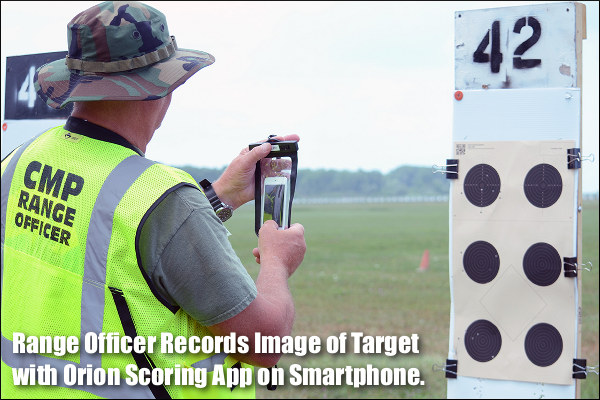
Elite smallbore competition returned to the summer National Matches in high-tech style this year. New Orion scoring software was used to enhance and speed up the scoring process. Range officers simply snapped photos of targets after each relay using the Orion App on smartphones. The software then identified the bullet holes and logged the shot location in the scoring rings. This handy new software was used for 3P and prone smallbore competition. It will also be used tomorrow, July 22nd, at the hugely popular Rimfire Sporter Match.
Story based on Camp Perry Report by Ashley Brugnone, CMP Writer
A staple during the National Matches season for over half a century, high-level Smallbore Matches returned to Camp Perry this summer (after the NRA moved the Smallbore Championships to Camp Wa-Ke’-De in Indiana in 2016).
“We had a lot of competitors who wanted smallbore to return to Camp Perry” said Match Director Brad Donoho. “This year, we tried to give everybody the opportunities they were used to at Camp Perry and try to stay true to history while also being innovative at the same time.”
The CMP’s new National Matches Smallbore series kicked off July 17 on Camp Perry’s Rodriguez Range with the Three-Position Day 1 event. Competitors in the event fired 40 shots onto paper targets at three positions: prone, kneeling and standing.
For the Camp Perry smallbore matches, new image-based software was used for scoring. Orion Scoring System developed scoring software that can read shots from photos captured with smartphones. The Orion Smartphone App links directly to the Orion Scoring system, which then identifies shots on the target and scores accordingly based on shot placement in scoring rings.
Range Officers snap photos of targets with Orion Scoring App.
Once all firing was completed for each stage at the National Matches events, range officers on the line walk downrange with a mobile device loaded with the Orion Scoring System App. The new scoring system drastically slashed competition time while also easing the scoring element for both competitors and match workers.
CMP verifiers reviewed the targets on computers before posting the results online, all in a matter of minutes. The physical paper targets were also retained — just in case a challenge was brought forward by a competitor.
“The hope is, at its best, we should be able to have scores posted online before firing begins for the next stage, which would be pretty revolutionary for paper targets at Camp Perry,” said Donoho.
The electronic Orion Scoring System will also be used to score the National Rimfire Sporter rifle competition, set to take place at Camp Perry on Sunday, July 22. “This is the first step to allow Orion users to use this at their home range”, noted Donoho. An extensive amount of testing was conducted on the Orion electronic scoring system in the months leading up to the National Matches. It performed admirably this past week at Perry
3P Finals and Prone Elimination Match on Electronic Targets
Another exciting element added to the prone match is a prone elimination event, fired on CMP’s electronic targets on the Petrarca Range — another first for a National Match smallbore event. “We wanted to do something new – something creative,” said Donoho. “Hank Gray, from the USAMU suggested an elimination event where we start with a full range of shooters and start elimination shooters after the first stage of fire to get them down to the Top 10.” The Three-Position finals was also fired on the CMP’s Petrarca Range electronic targets at Petrarca Range during the Matches.
Video Demonstrates Kongsberg Electronic Target System Installed at Camp Perry:
These electronic targets have sensors on the target frame that plot each shot’s point of impact in the bullseye. Shot location and score value are calculated instantly with results visible on a monitor placed next to the shooter. This is faster than the Orion system, but it is also much more expensive. The advantage of the Orion system is that it can work with conventional paper targets on standard target frames. Orion scoring does not give instant results, however, unlike the Kongsberg system.
The AutoTrickler/AutoThrow system dispenses powder with 1-2 kernel accuracy in just 10-12 seconds.
Review by Craig Arnzen of Area419.com
Guys in the PRS world are finally ready to admit — the more accurate we want to be, the more we should borrow practices from the F-Class and Benchrest worlds. There are no better examples of this that have popped up in the last year than the widespread adoption of highly accurate powder dispensers and high-end annealing techniques.
I’ll talk about the annealers another time, but today I want to introduce you to the powder dispenser contraption that is popping up on reloading benches everywhere — the AutoTrickler plus AutoThrow running with an A&D FX-120i magnetic force restoration scale.
The setup is priced firmly between the standard RCBS Chargemaster and the high-end $3,800 Prometheus powder dispensers. Depending on how you outfit it, and where you buy it, an AutoTrickler/AutoThrow setup will cost between $900 and $1,200. Figure $500-$525 for the A&D scale, $399.00 for AutoTrickler + AutoThrow (for A&D), and up to another $300 for Area 419 accessories.
The AutoTrickler V2 by itself is $229-$269 (depending on scale model), while the AutoThrow is $199.00 purchased separately. Current AutoTrickler owners can add the AutoThrow as an upgrade. It’s worth it — the AutoThrow speeds up the dispensing process dramatically. Watch this video with the smart guy who invented the AutoTrickler and AuthoThrow systems, Adam McDonald:
AutoTrickler Inventor Adam McDonald Demonstrates the AutoThrow System:
How the AutoTrickler + AutoThrow System Works
The “brain” of this system is a micro-processor that controls the motors on the AutoThrow powder dispenser and the AutoTrickler, taking more than 100 readings per second from the scale. The process starts with the AutoThrow first dropping 90% of the charge directly into the pan via a vertical drop tube. Then the AutoTrickler finishes dispensing the charge with super precision, using its horizontal tube. This two-stage process allows the system to throw powder within a kernel or two of your target weight every time — in just 10-12 seconds.
Powder is dispensed onto an A&D FX-120i scale (other models, including a Sartorius Entris 64-1S can also be used) that is able to detect and register the weight of individual kernels very quickly, providing data back to the “brain”. The initial powder drop from the AutoThrow gets you within about 2 grains and then the AutoTrickler finishes in just a few seconds with amazing accuracy. When set up right, this system can weigh repeatably to within one or two kernels of powder.
Area 419 Accessories for AutoTrickler and AutoThrow
The system can also be outfitted with milled aluminum accessories from Area 419, adding adjustability, stability, and ergonomics to the process. We sell a base for the AutoTrickler that adds weight (to reduce movement when the stepper motor runs) and has adjustable feet to help tune the powder flow, a larger cup with handle (to reduce powder splashing when dumped from above) and upgrades for the auto-throw that enhance powder capacity and reduce noise and vibration.
All in all, this is one of the most popular new ways to throw powder of the last year, and these systems are becoming common enough that we think they are here to stay. This video review by the 6.5 Guys offers some tips for setting up your AutoTrickler System with Area 419 base.
AutoTricker with Billet Base and AutoThrow Review by 6.5 Guys:
With the Fifty Caliber Shooting Association (FCSA) 2018 World Championships being in the news lately, we thought our readers might enjoy a report on some amazing 50-Caliber technology. For the past few years, the U.S. Defense Advanced Research Projects Agency (DARPA) has been developing a guided 50-Caliber projectile. No this is not an April Fools joke — this is for real boys and girls — DARPA has produced a guided bullet. Read on to learn how DARPA did it…
Imagine if you could “steer” your bullet to the target, after the projectile leaves the muzzle. That has been a dream of marksmen ever since the first rifle was invented. Well that dream is now one step closer to reality, thanks to DARPA.
DARPA has developed a manueverable .50-caliber rifle bullet. DARPA’s Extreme Accuracy Tasked Ordnance (EXACTO) program recently conducted the first successful live-fire tests demonstrating in-flight guidance of .50-caliber bullets. Inside EXACTO bullets are optical guidance systems, aero-actuation controls, and multiple sensors. The top-secret technology permits the trajectory of the bullet to be altered in flight, allowing the bullet to move left or right, or even fly in an arc around an obstacle.
A few years back, DARPA released a video showing EXACTO 50-caliber bullets in flight. Watch carefully and you will see the tracked trajectory appear to bend off in one direction in the last segment of the bullet’s flight. Here is the DARPA Video:
According to DARPA: “This video shows EXACTO rounds maneuvering in flight to hit targets that are offset from where the sniper rifle is initially aimed. EXACTO’s specially-designed ammunition and real-time optical guidance system help track and direct projectiles to their targets by compensating for weather, wind, target movement, and other factors that could impede successful aim.”
DARPA states: “For military snipers, acquiring moving targets in unfavorable conditions, such as high winds and dusty terrain commonly found in Afghanistan, is extremely challenging with current technology. It is critical that snipers be able to engage targets faster, and with better accuracy, since any shot that doesn’t hit a target also risks the safety of troops by indicating their presence and potentially exposing their location.”
The Extreme Accuracy Tasked Ordnance (EXACTO) system seeks to improve sniper effectiveness and enhance troop safety by allowing greater shooter standoff range and reduction in target engagement timelines. The objective of the EXACTO program is to revolutionize rifle accuracy and range by developing the first ever guided small-caliber bullet. The EXACTO 50-caliber round and optical sighting technology expects to greatly extend the day and nighttime range over current state-of-the-art sniper systems. The system combines a maneuverable bullet and a real-time guidance system to track and deliver the projectile to the target, allowing the bullet to change path during flight to compensate for any unexpected factors that may drive it off course.
Technology development in Phase II included the design, integration and demonstration of aero-actuation controls, power sources, optical guidance systems, and sensors. The program’s next phase includes a system-level live-fire test and technology refinement[.]


 .260 Remington – Developed by Remington to compete with the 6.5mmx55 Swedish Mauser that was (finally) gaining popularity in 1996. By necking down the 7mm-08 Remington to 6.5mm (.264 cal), the .260 Remington was created. It fit the same short-action [receivers] that fit .308 Win, .243 Win, 7mm-08 Rem, etc. You can expect velocities of 2600-2700 fps with 140gr bullets in the 260 .Remington.

 All Ruger American Rifle models employ dual aluminum V-Blocks to support the action. These fit slots in the underside of the action. Boyds makes its own version of these V-Blocks which were installed in the Boyds stock to secure the action.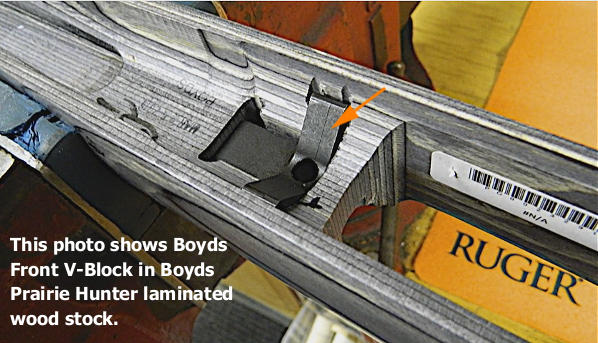


 Good ergonomics have always been a key GRS design objective: “All our rifle stocks are adjustable, because people are different. If you make a fixed stock, it will always be a compromise for your shooting position. Also, your ergonomics change in different shooting positions. There is a big difference between standing, sitting and laying on the ground. It’s not rocket science, but we recognized this a long time ago. And that is why we made the adjustment system the way it is. Obviously, having the correct length of pull, and a full contact with the cheek-piece, adds a lot of stability into the shooting position.”


 This is not just a benchrest club, but a complete, multi-discipline shooting sports facility. To my California eyes, the Camillus range is a thing of beauty, with a vast expanse of well-trimmed grass between the firing line and the berms, and a substantial wooded hill beyond. The club has just completed a host of brand new improvements that required a significant investment and, I am sure, a lot of hard work. I believe that this was the first time that an event was held after they were finished. The improvements include a new shooting pavilion (firing line cover), with the latest safety features, new all masonry benches, new berms, new target boards, and may others that are too numerous to mention.


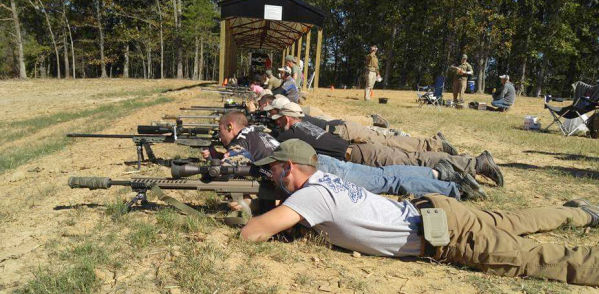
 The Civilian Marksmanship Program (CMP) was established by act of Congress in 1903, with the purpose of teaching shooting skills to American citizens. The Western Games at the Ben Avery Facility North of Phoenix draws enthusiasts from many Western states for competition with Service Rifles, vintage military rifles, M1 Carbines, and Rimfire Sporter rifles. Along with numerous matches (including the Vintage Sniper Team match), the Western Games features Small Arms Firing School (SAFS) shooting clinics.


 In this review segment of today’s Shooting USA episode, John Scoutten reviews two new 6.5 Creedmoor rifles from Savage Arms. The




 Imagine if you could “steer” your bullet to the target, after the projectile leaves the muzzle. That has been a dream of marksmen ever since the first rifle was invented. Well that dream is now one step closer to reality, thanks to DARPA.


