The National Shooting Sports Foundation (NSSF) has produced a very useful educational resource, a video explaining “How to Talk to Your Kids about Firearm Safety”. The video, starring champion shooter Julie Golob, encourages parents to have “the talk” about firearm safety with their kids sooner rather than later, and provides tips for how to have a helpful discussion.
“As a mother, I know full well how challenging this conversation can be,” Golob said. “It’s crucial that parents set an example and teach their kids about firearm safety so children don’t learn about guns solely from what their friends say or what they see on video games and TV.”
“Too often, children don’t know what to do if they find a gun,” said Steve Sanetti, President and CEO of NSSF, which developed and sponsors the Project ChildSafe firearm safety education program. “This video opens a door for honest conversation and empowers parents to be the authority on gun safety for their kids, whether they have guns in their homes or not.”
The “How to Talk to Your Kids about Firearm Safety” video was created as a resource to start positive and constructive conversations by encouraging discussion rather than lecture, and helps parents responsibly demystify the subject of guns. For more information, visit Projectchildsafe.org.
Here’s an entertaining video from Fog Ammunition. Starting with boxes of bullets and bags of cartridge brass, this video shows how components are bulk-sorted, then .223 Rem ammunition is produced on a modern, linear multi-stage loading machine. In assembly-line fashion, cases are primed, powder is added, bullets are placed, final seating depth is set, and then the case is crimped.
If you’ve never seen an automated loader in action you should definitely watch this video. With this kind of machine, a new round is produced every second or so (see video 1:15 to 1:55). The .223 Remington ammunition featured in this video is loaded with Sierra BlitzKing bullets. Fog offers both rifle and pistol ammo loaded with quality components.
Video Shows Automated Loading Process Start to Finish (Worth Watching):
Turn a Rough Factory Rifle into an Accurate Hunting Rig
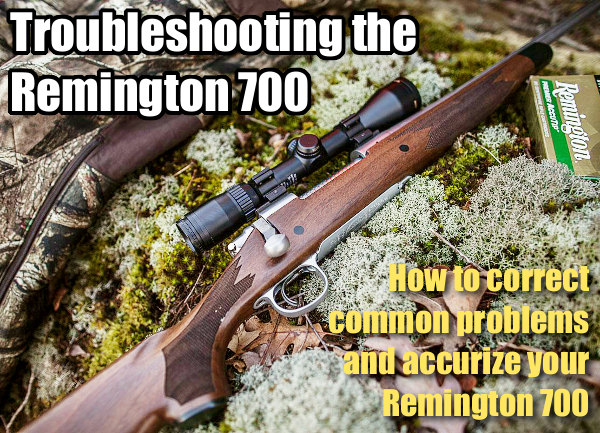
Kiwi Nathan Foster has produced a good video for hunters with “under-performing” Remington Model 700 rifles. In this video, Nathan helps a client turn a badly-behaving Rem 700 into a reliable tack-driver. A customer had sent Nathan this rifle to rectify stubborn copper fouling. After bedding the rifle, the customer discovered that the rifle produced terrible groups due to the stubborn bore.
Nathan told us: “This was a grand opportunity to study what can go wrong with the M700 rifle with regards to both do-it-yourself work and flaws within rifle production. To help structure the video, we used the chapters of our Accurizing Book as reference steps for the video. This footage also works in conjunction with our free Remington bedding tutorials on YouTube.
Those who have watched the full M700 Troubleshooting video say this is one of the most helpful videos yet released on problem-solving with a factory hunting rifle. This video is especially helpful for those just getting into the accuracy game, as it walks the viewer through the basics of rifle tuning, then proceeds to more advanced methods of improving a badly-behaving rifle.
This video focuses on the Remington M700 and Rem clones, such as the Bergara rifle. However the lessons and techniques in the video can apply to any type of bolt-action rifle suffering heavy copper fouling. The video features detailed footage of barrel break-in and barrel-lapping procedures. These procedures may be beneficial for rough factory barrels. IMPORTANT! AccurateShooter.com recommends different break-in and maintenance regimes for custom, hand-lapped premium barrels — be conservative with fine custom barrels. Our best custom barrels have all shot superbly with minimal break-in and zero use of abrasives during break-in.
Troubleshooting the Remington 700 Rifle with Nathan Foster
NOTE: This is a free 70-second trailer video. The FULL Remington Troubleshooting Video is 1 hour, 16 minutes long and can be streamed through Vimeo-on-Demand for $12.00. Access Full Video HERE.
Nathan Foster of Terminal Ballistics Research in New Zealand, is a expert hunter and highly-respected author of a series of hunting and long range shooting books. Nathan’s first book, The Practical Guide to Long Range Hunting Rifles, is a classic — one of the best treatises ever written on choosing and using a hunting rifle.
The Remington 700 is the most popular bolt-action rifle in America, according to Gunbroker.com sales figures for new and “previously-owned” rifles. So, chances are that you (or a family member) have a Rem 700 of some vintage sitting in the gunsafe. Click the link above for a PDF version of the Remington 700 Owner’s Manual (also covers models Seven, and 673).
Nosler created the 22 Nosler cartridge to wring the highest possible ballistic performance from a .22-caliber, AR-compatible cartridge that also provides adequate barrel life and maximum ease of conversion. The 22 Nosler achieved these objectives and much more — it delivers far better performance than the .223 Remington and even out-runs the 224 Valkyrie.
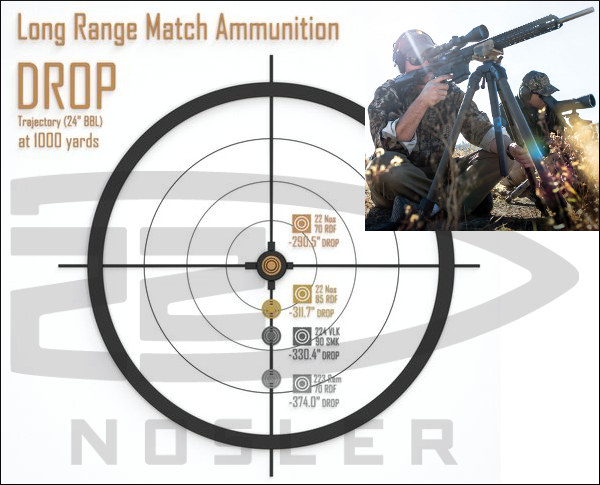
In ballistics, there’s no free lunch. Larger powder capacity at similar operating pressures equates to higher velocity potential. In the case of the 22 Nosler, this is evidenced by a 4-5 grain capacity increase over the tried and true .223 Remington, and a 2-3 grain capacity advantage over the newly-introduced 224 Valkyrie. This larger “engine room” allows the 22 Nosler to deliver higher velocities. That translates to less drop (flatter trajectory) at long range.
Faster than .223 Rem and 224 Valkyrie
When loaded with 80 grain low-drag match bullets and fired from the same 24″ barrel (bolt actions, not gas guns) the 22 Nosler outruns the 224 Valkyrie by about 150 fps. Compared to the .223 Remington, the difference is even more remarkable — the 22 Nosler runs over 300 fps faster! These velocity improvements give the 22 Nosler a clear advantage in long-range trajectory and downrange energy retention.
How to Run the 22 Nosler in Your AR-Platform Rifle
Converting your AR to 22 Nosler is as simple as a barrel and magazine change, and there are countless AR-platform MSRs in circulation with the proper 0.378” (.223 Rem) sized bolt face. By comparison, to make the swap to 224 Valkyrie, you must purchase a dedicated .224-Valkyrie upper (not cheap!), or at the minimum add a new barrel, modified bolt with proper bolt face, and 6.8 SPC-compliant mags.
This video compares the specifications of the 22 Nosler and .223 Remington. Bolt face dimensions are identical for the 22 Nosler and the 223 Rem / 5.56 NATO at 0.378″, so no bolt swap is required.
Many Factory Ammo Options — from 55 to 85 grains
Nosler offers a variety of factory loads in 22 Nosler, suited to a wide range of applications. Will you be shooting long range targets? Try the 70 or 85 grain RDFs loaded in Nosler Match Grade Ammunition. Are hogs or deer on the menu? Choose Nosler Trophy Grade Ammunition, with either the 55 grain E-Tip (non-lead) bullet or the 70 grain AccuBond®. Taking out varmints or predators? Nosler’s Varmageddon with 62 grain Hollow Point or Trophy Grade Varmint ammo with 55 grain Ballistic Tip (the world’s first polymer tipped varmint bullet) — will stop any varmint in its tracks.
If you want to turn your AR-platform MSR into a completely different animal, the 22 Nosler can open up a whole new level of performance.
Our friend Anette Wachter (aka 30CalGal) is profiled this month on the NRA Family website. Annette talks about how she got into the shooting sports (though a challenge from her ex-husband), and how she has advanced along the way. She is now one of the top female Palma shooters in the nation. She also now competes regularly in Precision Rifle matches — tactical style competitions. She enjoys the challenge of PRS events, and she also competes in 3-Gun matches, with pistol, rifle, and shotgun.
Anette writes about the shooting sports for many publications. She also offers tips and gear reviews through her popular website, 30CalGal.com.
NRA: What type of shooting do you do, and what makes you like it so much?
Anette: Mostly long-range rifle disciplines. I don’t shoot High Power much anymore, but of course I am on the U.S. National Rifle Team and the Palma Team, so that occupies much of my time. My new love is Precision Rifle. This is the new hot and trendy shooting sport that is taking over the industry. It is like a sniper challenge. All unknown distances and usually the matches are out in the field. I also compete in 3-Gun, which is a ton of fun.
NRA: What advice do you have for new shooters who want to get into these sports?
Anette: If you want to get in to any discipline of competition I always suggest going to a local match to watch first. With the Internet you can find out your state competition information. Look for local organizations like the USPSA. See the type of equipment shooters are using and how the sport is run. Ask a lot of questions. Shooters are a very generous culture as well, in my experience. When I started out I was loaned almost everything to try it out.
NRA: From what you have seen, are there a lot more women getting involved in the shooting sports these days?
Anette: I started shooting and competing in 2006. I remember going to NRA Nationals at Camp Perry and, out of almost a thousand competitors, I was one of maybe 20 to 30 women. At local matches I would be one of two. In the past five or six years and especially in the last three, I have seen the numbers jump like crazy. Three years ago a few women in the 3-Gun market decided to put on the first Ladies 3-Gun ProAm in Georgia. We were wondering if anyone would show up. Over 200 women competed. Any of us that had extra guns and equipment were loaning them out. For many of the women it was their first match ever. It changed lives.
In this video Anette offers smart tips for shooting with bipod:
About the 30 Cal Gal Life is short. Go Shoot! — Anette Wachter
Along with being a talented competitive shooter, Anette has her own Gun Blog, 30CalGal.com, and she writes for several gun publications including GunUp Magazine, Shooting Sports USA, Sure Shots Magazine, and Wide Open Spaces. She also designs and crafts custom jewelry items, many of which utilize cartridge cases or other shooting-themed components. You can purchase Anette’s jewelry through her AW Collections webstore.
Watch the video below to learn about the kneeling position, as explained by National Paralympic Coach Bob Foth and 2012 Olympian Amanda Furrer. Three-time Olympian and Silver Medalist Bob Foth details the proper techniques (both body position and gun-handling) for kneeling position shooting. Putting Foth’s coaching tips into practice, three-Position smallbore shooter Amanda Furrer demonstrates how to properly shoot from a kneeling position using a .22LR match rifle.
Amanda, a member of the 2012 U.S. Olympic team, shows how to set up the right body position when kneeling, how to support the rifle, and how to relax breathing to steady the shot. This takes practice, but remarkable accuracy can be achieved from the kneeling position by top-level shooters. This is a great video, well worth watching.
The video uses superimposed graphics and diagrams to show rifle hardware/sights, and key aspects of the head position, sling set-up, and hold. If you are a position shooter, this is a “must-watch” video. Narrated by Olympian Bob Foth, it is very informative.
Watch Kneeling Position Video
As a member of the U.S. Olympic Team, Amanda Furrer competed in the Womens 3P 50m event at the 2012 Olympics, finishing 15th. Amanda first started shooting at 11 years old with the Spokane Junior Rifle Team. Shooting is a family sport and all compete and shoot guns together. Furrer’s father shoots tactical matches and her mom shoots pistols. Amanda qualified for the national team as a member of the 2007 Pan American Team at the age of 16. She won bronze in the 2011 National Championships. Amanda is currently a student at Ohio State’s Fisher College of Business, majoring in Finance and competing on the Rifle Team.
There’s no question that females can shoot as well as men. In fact, quite a few shooting instructors have told us that women progress faster than men because females are better listeners. Also ladies are less likely to let egos interfere with the training process. Competitive shooting is one of the few sports where ladies compete directly with guys, and the women are fully capable of winning it all. Just ask Nancy Tompkins and her daughter Sherri Gallagher — both past National High Power champions.
To help female shooters improve their game, the Babes with Bullets (BWB) group offers a series of ladies-only shooting seminars around the country. There are both rifle programs and handgun programs. At these camps, BWB supplies all the equipment — including the firearms. The seminar “tuition” covers all expenses — instructor salaries, range fees, lunches, loaner guns, ammo, targets, and other required equipment.
Babes with Bullets Rifle and Handgun Camp
The BWB Rifle and Handgun Camp is for advanced beginner and intermediate shooters. Taught by an all-female team of national and world shooting sports champions, the three-day Handgun Rifle Camp is a wonderful fit for women looking to improve their handgun and holster skills while also learning more about handling a .22 or .223 caliber modern sporting rifle (MSR).
Camp fees cover instructors, range fees, lunches at the range, complementary loaner guns and other equipment. Registration is open for the upcoming Babes with Bullets Handgun Rifle Camp, October 19-21, 2018 at the CMP Talladega Marksmanship Park, Talladega, Alabama.
Babes with Bullets Handgun Camps
Whether an experienced shooter or a newbie to the firearms scene, the Babes with Bullets Handgun Camp is a great place for women to develop and improve their marksmanship skills. Taught by an all-female team of national and world shooting sports champions, these three-day handgun camps are designed to teach women to handle and operate a handgun safely and confidently. Camp fees cover instructors, range fees, lunches at the range, complementary loaner guns and other equipment.
Registration is open for the following BWB Handgun Camps:
July 6-8, 2018 at Buffalo Chip Range, Sturgis, SD
July 20-22, 2018 at Birchwood Recreation & Shooting Park, Chugiak, AK
Sept. 14-16 at Cardinal Shooting Center near Columbus, OH
Nov. 2-4, 2018 at Fresno Rifle & Pistol Club, Fresno, CA
Babes with Bullets Diamond Camp (Pistol, Rifle, Shotgun)
The Diamond Camp — the ultimate Babes camp experience — features expert handgun, rifle, and shotgun training, combined with great luxuries: a celebrity chef, a masseuse, yoga instruction, hosted bar. Plus each of the 10 campers receives aa gift certificate for a Thompson Center bolt action rifle. Taught by an all-female team of national and world shooting sports champions, the four-day Diamond event is perfect for novice through advanced shooters who want a luxurious holiday along with their firearms training. It’s pricey at $2800, but comparable with a deluxe hunting lodge.
The 2018 BWB Diamond Camp features a Celebrity Chef, Massage, Yoga instruction, and more.
This year’s Diamond Camp will be based at the Wild Game Inn, in Darby, Montana, about 90 minutes from the Missoula Airport. The Inn offers ATV rides, fishing, hiking, skeet shooting, and more. Camp will start the afternoon of Wednesday, August 15, with range mornings on Thursday, Friday, and Saturday.
Displayed are results with Federal Gold Medal Match — quite impressive accuracy!
Criterion Barrels has published an interesting Ammo Comparison Test, shooting seven (7) different varieties of .223 Rem ammunition out of an AR15 fitted with Criterion Barrel. Each ammo type was chronographed (10-shot string), then five-shot groups were shot at 100 yards. Along with handloads (69gr Sierra MK + Varget), six (6) types of commercial ammo were tested:
PREMIUM Type Ammo:
Federal Gold Medal Match (69gr SMK)
Creedmoor 75gr HPBT
Prime 77gr OTM (Open Tip Match)
BULK Type Ammo:
Federal American Eagle XM193 (55gr FMJ)
Wolf Gold (55gr FMJ)
Wolf Polyformance Steel Case (55gr FMJ)
Here are the results for the four best commercial ammo types tested: Federal Gold Medal Match (GMM) with 69gr SMK, Prime 77gr OTM, Creedmoor 75gr HPBT, and American Eagle XM193 (55gr FMJ). The Gold Medal Match shot the best of all factory ammo tested. In fact, the GMM even shot slightly better than the handloads, which averaged 0.79″ for the three accurized groups.
The results are quite interesting. The Federal GMM actually shot the best, beating “untailored” handloads. Basic accurizing efforts and a much better rest set-up showed significant benefits with most ammo types (but not the bulk Wolf Ammo). As you would expect, the more expensive ammo shot best: “Chart 1.2 [below] showcases the average [after accurizing] five-round group sizes with each type of ammunition at 100 yards, while Chart 1.3 lists the price per round of each ammunition type. It becomes immediately evident by reviewing these two graphs that there is an inverse relationship between group size and factory ammunition price.”
Accurizing Improvements — Better Scope, Better Rests, Accu-Wedge
As you would expect, some basic accurizing efforts improved accuracy with the better ammo. The accurizing process included: 1) Swapping to a Vortex Viper PST Gen 1 6-24x50mm optic; 2) Adding an Accu-Wedge; 3) Improving fitment during reassembly, and 4) Switching from Harris bipod to a Sinclair Front Rest and Edgewood rear bag for added stability. The same 1:8″-twist Criterion barrel was used throughout the testing process.
If you shoot an AR15, or even shoot a .223 Rem bolt gun with factory ammo, you should probably read this test in full. Criterion put a lot of time into the testing, and experimented with a variety of AR options showcased in a series of YouTube videos. SEE: Accurizing the AR-15 Video Playlist.
UPDATE: At approximately 6:00 pm CT, the Brownells YouTube Channel was restored. We don’t know why or how — but apparently protests from Brownells customers many have played a part in getting YouTube to relent. Brownells just issued this statement via Facebook:
PREVIOUSLY…
The Brownells YouTube channel has been terminated (shut down) without warning or notice from either YouTube or its parent company, Google. On June 9, 2018, at roughly 2:00 am, the Brownells channel was pulled from YouTube. This removed ALL Brownells YouTube content, including videos that cover firearms safety, hunting skills, firearms maintenance, and marksmanship. YouTube didn’t simply block Brownells’ gun sales-related videos — it shut down the entire Brownells channel, which had offered nearly 1800 helpful videos. The Brownells channel had acquired over 67,000 subscribers since its launch in January 2007.
History of YouTube Policies on Firearms Content
No specific reason for the Brownells shut-down was provided by YouTube, but this is part of a policy shift by YouTube. For quite some time, YouTube has been de-monitizing firearms-centric YouTube channels. As a result, gun video producers no longer receive advertising revenues, or receive a fraction of what they were once paid. Then in late March, YouTube announced tough new policies limiting the type of firearms content allowed. Gun content producers feared YouTube’s new policies might doom their channels. With the Brownells ban, it appears those fears were correct…
Ars Technica reported: “YouTube is placing more restrictions on weapons-related videos, focusing on guns with new, forthcoming policy changes. According to a Bloomberg report, YouTube intends to ban videos that ‘promote or link to websites selling firearms and accessories’, including bump stocks, beginning this April. The new policy will also prohibit instructional videos that detail how to build firearms. YouTube took similar action after the Las Vegas shooting last year by banning gun-modification tutorials.
‘We routinely make updates and adjustments to our enforcement guidelines across all of our policies,’ a YouTube representative said in a statement to Bloomberg. ‘While we’ve long prohibited the sale of firearms, we recently notified creators of updates we will be making around content promoting the sale or manufacture of firearms and their accessories’.”
YouTube prohibits certain kinds of content featuring firearms. Specifically, we don’t allow content that:
Intends to sell firearms or certain firearms accessories through direct sales (e.g., private sales by individuals) or links to sites that sell these items. These accessories include but may not be limited to accessories that enable a firearm to simulate automatic fire or convert a firearm to automatic fire (e.g., bump stocks, gatling triggers, drop-in auto sears, conversion kits), and high capacity magazines (i.e., magazines or belts carrying more than 30 rounds).
Provides instructions on manufacturing a firearm, ammunition, high capacity magazine, homemade silencers/suppressors, or certain firearms accessories such as those listed above. This also includes instructions on how to convert a firearm to automatic or simulated automatic firing capabilities.
Shows users how to install the above-mentioned accessories or modifications.
GunsAmerica just released a detailed review of the recently-upgraded Kestrel 5700 Elite with LiNK, a software-enabled weather meter. If you compete in practical/tactical events (with targets at multiple distances), or campaign a wide selection of rifles, or shoot at Extreme Long Range, you may want to get this device. It offers unrivaled capabilities in a small package. This impressive handheld device combines weather-monitoring capabilities with a full-featured, very sophisticated ballistics solver that now calculates out to 5,500 yards. Using Bluetooth and LiNK technology it communicates with your mobile device as well as LiNK-enabled laser rangefinders.
Why You May Want to Buy the Kestrel 5700 Elite with LiNK:
— The Device can hold up to 30 different rifle/cartridge profiles, each with its own BC and muzzle velocity for ballistic calculations.
— The Device registers current windspeed, wind direction, air temp and pressure, and other variables, and then sends that info via Bluetooth to your smart-phone, updating the ballistic solution. It essentially updates your drop chart in real time.
— The Device “talks” to your smart-phone, providing a large, convenient display that can show both elevation clicks and wind corrections. The display essentially replaces your data card. The Smartphone integration also makes it easy to modify your different rifle/ammo profiles.
— The Device gives you come-ups and wind corrections for multiple targets (at various ranges). These can be displayed in a list, ordered by distance. This is a great feature, check it out:
Quick and Accurate Solutions for all Cartridge Types — Big and Small
The Kestrel 5700 Elite can work for everything from a .22 LR to a .50 BMG. In fact, GunsAmerica’s tester used the Kestrel 5700 for a 6.5 Creedmoor shooting out to 1070 yards, and then used the solver for a .22 LR match out to 300 yards. The data for the 6.5 CM was spot on, but even more remarkably, the holdover for the .22 LR was precise to 0.2 mils at 300 yards. The GunsAmerica Reviewer, Ian Kenney, was impressed:
“I think the best testament to the capabilities of the Kestrel 5700 Elite were on display at a recent range trip where I was getting my modified Ruger 10/22 ready for an upcoming precision rimfire match. I started out with a sort of hodgepodge of information, using an unconfirmed BC [for Eley Force ammo] that I’d heard from a friend along with a muzzle velocity that another friend had gotten with the same ammo. I created a new profile using this assortment of data and entered in target distances for 200 and 300 yards. Imagine the smile on my face then when I got hits at both distances with the elevation setting only being 0.2 mils off at the farthest target.
It’s impressive that the technology allowed me to only be 0.2 mils off with .22 LR ammunition at 300 yards, which is only about two inches, all the while starting out with imperfect data. If that’s not an exquisite demonstration of the versatility of this technology, to be able to toggle between such diverse calibers and get accurate data to long distances, I don’t know what is.”
Kestrel 5700 Elite Special Capabilities
The LiNK Ballistics App lets you set up multiple targets for single-screen viewing. The Kestrel 5700 Elite can also be wirelessly paired with LiNK-compatible laser rangefinders. Being able to instantly accees exact target range data allows a more rapid and and more precise ballistic solution.
In addition to the ballistics solver capabilities, the Kestrel 5700 Elite is a comprehensive weather meter that monitors all key variables including: wind speed and direction, temperature, humidity, heat index, pressure, and altitude. Your data log can be transferred to a iOS/Android device wirelessly with the LiNK wireless communication option and Kestrel LiNK app. The 5700 Elite now uses a single AA Battery housed separately from the circuit board.
More Features of the Kestrel 5700 Elite
The Kestrel 5700 elite has almost too many features to list. One notable capability allows you to quickly “tune” a profile by entering field-confirmed data. Kenney explains: “You can go into the gun profile and calibrate the muzzle velocity by telling it how much elevation you used to get a hit, effectively truing your dope in short order. This is ten times faster than logging it in your data book, going back to an online solver, and making adjustments[.]”
Ian Kenney’s Kestrel 5700 Elite Review is very thorough, and contains many more details and insights than we can cover here. For anyone considering purchase of a high-end Kestrel, we strongly recommend you read Kenney’s review. Ian concludes: “I’m not going to lie… with an MSRP of $699, I recognize [the Kestrel 5700 Elite] may not be for everyone. Considering how often I shoot long range and the number of rifles that I have, it makes sense for me[.] The Applied Ballistics solver also gives me the confidence that my dope is going to be accurate no matter what conditions I might find myself in. So for me… this Kestrel delivers the goods.”
Kestrel 5700 Elite Advanced Features (Partial List)
Kestrel LiNK Apps for iOS and Android
Wireless Bluetooth for Mobile Devices
Connects with LiNK Compatible Range Finders
Temperature Sensor (Patented External Isolated)
Integrated Applied Ballistics Calculator
Applied Ballistics G1/G7 Drag Model Profiles
Applied Ballistics Custom Drag Models
Average and Peak Wind Correction
Muzzle Velocity Calibration
Supports Mil, MOA Click Values
Create and store up to 30 Gun/Bullet Profiles
Create and store up to 10 Targets
Moving Target Lead Correction
Aerodynamic Jump Correction
High Angle Shot Correction
Target Range Estimator
Spin Drift Correction
MV-Temp Table
Digital Compass
Range Card






 Watch the video below to learn about the kneeling position, as explained by National Paralympic Coach Bob Foth and 2012 Olympian Amanda Furrer. Three-time Olympian and Silver Medalist Bob Foth details the proper techniques (both body position and gun-handling) for kneeling position shooting. Putting Foth’s coaching tips into practice, three-Position smallbore shooter Amanda Furrer demonstrates how to properly shoot from a kneeling position using a .22LR match rifle.


