The NRA (with help from Smith & Wesson) has created a compelling video explaining how and why women use firearms for hunting, sport, and self-defense.
The video features many of our friends, including pistol champion Julie Golob and ace 3-Gun competitor Maggie Reese. The video spotlights women who value their Second Amendment rights, understanding that a firearm remains the “great equalizer”, allowing women to protect themselves and their families. The video challenges the anti-gun politicians and media “talking heads” who want to disarm women: “These authorities that I’ve never met, they’ll never know me, they’ll never know my circumstances, they’ll never know what I’m up against”, says Natalie Foster.
“So many things can change when we start losing our civil rights, and our most basic civil rights of self-defense.” — Julianna Crowder.
“I want to protect my child in any way that’s possible. And I want them to have that right to protect… our future. It’s not just about Washington… it’s about sharing your sport, sharing your passion, sharing your desire to protect yourself.” — Julie Golob
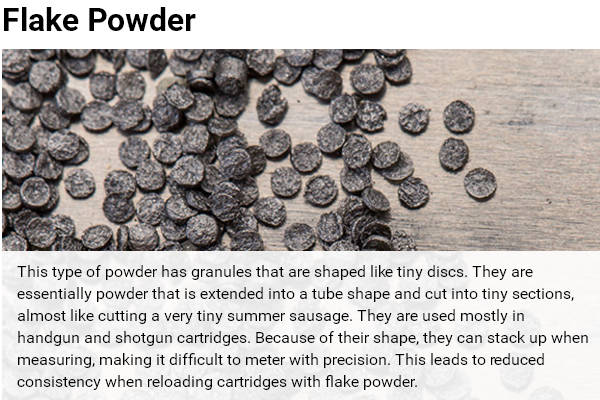
Widener’s Reloading & Shooting Supply recently published a helpful introduction to reloading powders. Widener’s online Guide to Smokeless Powders shows the various types of powders, and explains how the differences in powder kernel/flake size and shape, and burn rate affect performance. We recommend you visit Widener’s website and read the Powder Guide in full.
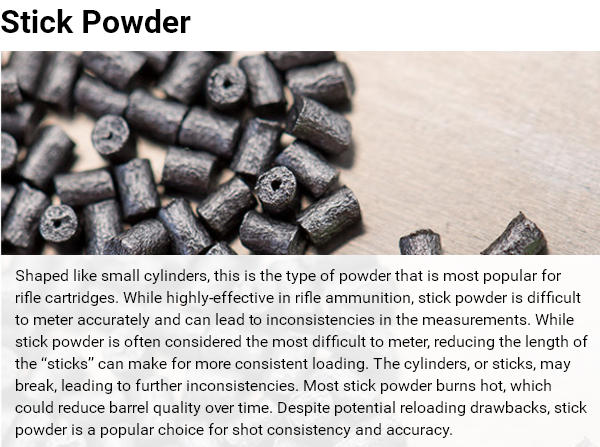
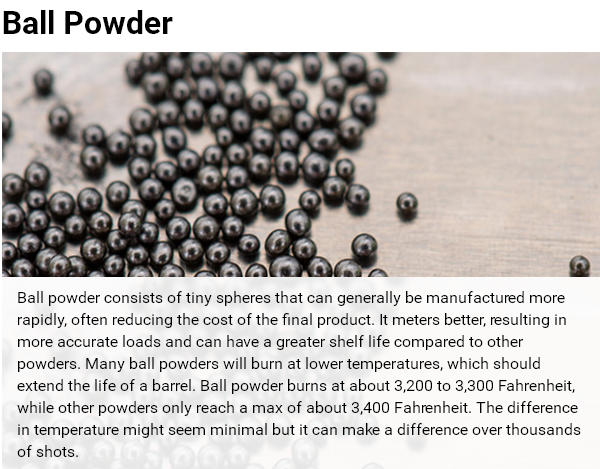
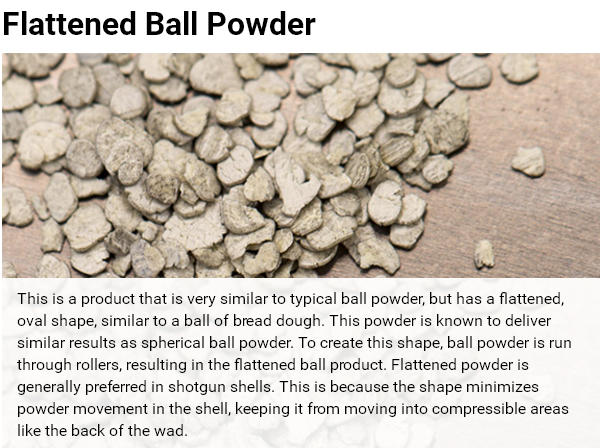
Take a close look at these illustrations which show the key differences between the four main powder types: extruded (stick) powder, ball (spherical) powder, flattened ball powder, and flake powder.
Burn Rate Basics
Widener’s Guide to Smokeless Powders also has a useful discussion of Burn Rate (a confusing topic for many hand-loaders). Wideners explains: “While a gun powder explosion in the cartridge seems instantaneous, if you slow it down you will actually find that each powder has a different ‘burn rate’, or speed at which it ignites.” This video shows powders with two very different burn rates. Watch closely.
Different burn rates suit different cartridge types notes Widener’s: “In general a fast-burning powder is used for light bullets and low-speed pistols and shotguns. Medium-rate powders are used for magnum pistols, while high-velocity, large bore rifle cartridges will need slow powders[.]
It should be noted that burn rate does not have a standardized unit of measurement. In fact, burn rate is really only discussed in comparison to other powders; there is no universal yardstick. Specifics will change by cartridge and bullet types[.]”
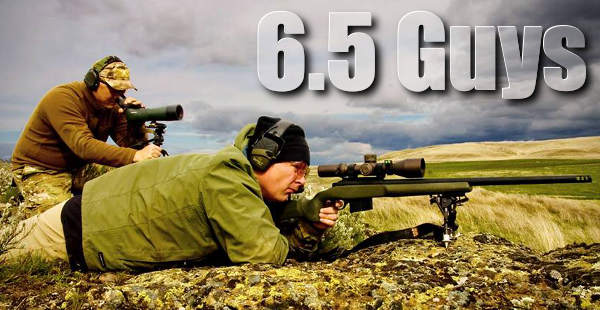
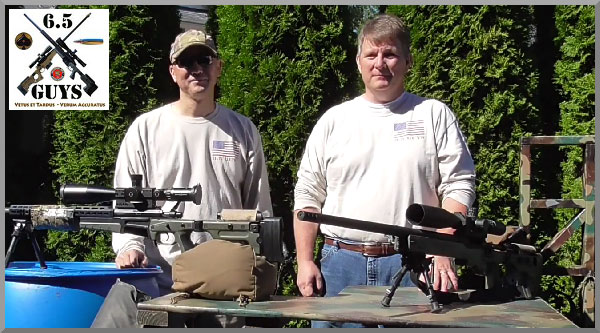
Gearlocker.nz, a New Zealand outdoor sports website, recently interviewed our friends Ed and Steve, aka the “6.5 Guys”. In this Gearlocker Video Interview, Ed and Steve cover many topics including Precision Rifle Series matches, gear selection, and effective hand-loading techniques. Kerry, the creator of Gearlocker.nz, writes: “The 6.5 Guys are Steve and Ed, two guys who decided to start documenting their progress in long-range practical precision shooting. They have built a dedicated following on YouTube and Facebook. Consistently putting out high-quality content [covering] their equipment choices and use, the 6.5 Guys have created a fantastic resource for anyone involved in shooting.”
Click image below to watch 6.5 Guys interview on Gearlocker.nz:
Who are the 6.5 Guys? They are Steve (left) and Ed (right), a pair of avid shooters based in the Pacific Northwest. They have released dozens of helpful videos on the 6.5 Guys YouTube Channel.
You can check out the 6.5 Guys’ website at www.65Guys.com. Below is a sample from one of the 6.5 Guys’ best articles — Five Tips on getting started in practical/tactical matches.
We often meet people who are new to long range precision shooting, and want to improve their knowledge and skill level. However, they aren’t sure if they are ready to sign up to compete in a match. They often ask, “What knowledge or skills [and gear] are necessary to compete in a match?”
TIP ONE: Make Plans and Commit to Go
First you need to start by finding a match to attend. We recommend starting with any match that may be within a reasonable driving distance. This may likely be a local “club” match, many of which are held on a regular basis. Once you decide on the match you want to attend, do your homework. This means finding out if you need to pre-register or pre-pay the match fee. Commit to going by registering for the match and putting it on your schedule.
The Coriolis Effect comes into play with extreme long-range shots like this (2100 yards at Raton, NM). The rotation of the earth actually moves the target a small distance (in space) during the long duration of the bullet’s flight.
When you’re out at the range, the Earth seems very stable. But it is actually a big sphere zooming through space while spinning around its axis, one complete turn every 24 hours. The rotation of the earth can create problems for extreme long-range shooters. During extended bullet flight times, the rotation of the planet causes an apparent deflection of the bullet path over very long distances. This is the ballistics manifestation of the Coriolis Effect.
Bryan Litz of Applied Ballistics has produced a short video that explains the Coriolis Effect. Bryan notes that Coriolis is “a very subtle effect. People like to make more of it than it is because it seems mysterious.” In most common shooting situations inside 1K, Coriolis is not important. At 1000 yards, the Effect represents less than one click (for most cartridge types). Even well past 1000 yards, in windy conditions, the Coriolis Effect may well be “lost in the noise”. But in very calm conditions, when shooting at extreme ranges, Bryan says you can benefit from adjusting your ballistics solution for Coriolis.
Bryan explains: “The Coriolis Effect… has to do with the spin of the earth. You are basically shooting from one point to another on a rotating sphere, in an inertial reference frame. The consequence of that is that, if the flight time of the bullet gets significantly long, the bullet can have an apparent drift from its intended target. The amount [of apparent drift] is very small — it depends on your latitude and azimuth of fire on the planet.”
Coriolis is a very subtle effect. With typical bullet BCs and velocities, you must get to at least 1000 yards before Coriolis amounts to even one click. Accordingly, Bryan advises: “Coriolis Effect is NOT something to think about on moving targets, it is NOT something to think about in high, uncertain wind environments because there are variables that are dominating your uncertainty picture, and the Coriolis will distract you more than the correction is worth.”
“Where you could think about Coriolis, and have it be a major impact on your hit percentage, is if you are shooting at extended range, at relatively small targets, in low-wind conditions. Where you know your muzzle velocity and BC very well, [and there are] pristine conditions, that’s where you’re going to see Coriolis creep in. You’ll receive more refinement and accuracy in your ballistics solutions if you account for Coriolis on those types of shots. But in most practical long-range shooting situations, Coriolis is NOT important. What IS important is to understand is when you should think about it and when you shouldn’t, i.e. when applying it will matter and when it won’t.”
The Coriolis Effect — General Physics
The Coriolis Effect is the apparent deflection of moving objects when the motion is described relative to a rotating reference frame. The Coriolis force acts in a direction perpendicular to the rotation axis and to the velocity of the body in the rotating frame and is proportional to the object’s speed in the rotating frame.
A commonly encountered rotating reference frame is the Earth. The Coriolis effect is caused by the rotation of the Earth and the inertia of the mass experiencing the effect. Because the Earth completes only one rotation per day, the Coriolis force is quite small, and its effects generally become noticeable only for motions occurring over large distances and long periods of time. This force causes moving objects on the surface of the Earth to be deflected to the right (with respect to the direction of travel) in the Northern Hemisphere and to the left in the Southern Hemisphere. The horizontal deflection effect is greater near the poles and smallest at the equator, since the rate of change in the diameter of the circles of latitude when travelling north or south, increases the closer the object is to the poles. (Source: Wikipedia)
This important video shows what really happens when loaded ammunition burns. You will probably be surprised. Contrary to Hollywood notions, the ammo doesn’t ignite in a massive explosion. Far from it… basically the rounds “cook off” one by one, and the bullets release at relatively low velocity. We’ve featured this SAAMI research project before, but it is worth reprising for those who have not yet seen the burn tests.
A couple years back, SAAMI released an important video concerning ammo and fire. With professional fire-fighters standing by, over 400,000 rounds of ammo were incinerated in a series of eye-opening tests. If you haven’t had the chance to view this video yet, you should take the time to watch it now
The Sporting Arms and Ammunition Manufacturers’ Institute (SAAMI) has produced an amazing 25-minute video that shows what actually happens to sporting ammunition involved in a fire. This video shows the results of serious tests conducted with the assistance of professional fire crews. We strongly recommend you watch this video, all the way through. It dispels many myths, while demonstrating what really happens when ammunition is burned, dropped, or crushed.
Watch SAAMI Ammunition Testing Video
Video Timeline
2:10 Impact Test (ignited outside firearm)
3:40 65-foot Drop Test
5:08 Bullet Impact (.308 Win firing)
7:55 Blasting Cap Attacks
9:55 Bulldozer and Forklift Tests
12:20 Boxed Ammo Bonfire
15:37 Bonfire without Packaging
17:21 Retail Store Simulation Burn
20:55 Truck Trailer Burn
Over 400,000 rounds of ammunition were used in the tests. Some of the footage is quite remarkable. Testers built a bonfire with 28,000 rounds of boxed ammo soaked in diesel fuel. Then the testers loaded five pallets of ammo (250,000 rounds) in the back of a semi-truck, and torched it all using wood and paper fire-starting materials doused with diesel fuel.
The video shows that, when ammo boxes are set on fire, and ammunition does discharge, the bullet normally exits at low speed and low pressure. SAAMI states: “Smokeless powders must be confined to propel a projectile at high velocity. When not in a firearm, projectile velocities are extremely low.” At distances of 10 meters, bullets launched from “cooked-off” ammo would not penetrate the normal “turn-out gear” worn by fire-fighters.
We are not suggesting you disregard the risks of ammo “cooking off” in a fire, but you will learn the realities of the situation by watching the video. There are some amazing demonstrations — including a simulated retail store fire with 115,000 rounds of ammo in boxes. As cartridges cook off, it sounds like a battery of machine-guns, but projectiles did not penetrate the “store” walls, or even two layers of sheet-rock. The fire crew puts out the “store fire” easily in under 20 seconds, just using water.
Additional Testing: Drop Test, Projectile Test, Crush Test, Blasting Cap Test
Drop Test
The video also offers interesting ammo-handling tests. Boxes of ammo were dropped from a height of 65 feet. Only a tiny fraction of the cartridges discharged, and there was no chain-fire. SAAMI concludes: “When dropped from extreme heights (65 feet), sporting ammunition is unlikely to ignite. If a cartridge ignites, it does not propagate.”
Rifle Fire Test
SAAMI’s testers even tried to blow up boxes of ammunition with rifle fire. Boxes of loaded ammo were shot with .308 Win rounds from 65 yards. The video includes fascinating slow-motion footage showing rounds penetrating boxes of rifle cartridges, pistol ammo, and shotgun shells. Individual cartridges that were penetrated were destroyed, but adjacent cartridges suffered little damage, other than some powder leakage. SAAMI observed: “Most of the ammunition did not ignite. When a cartridge did ignite, there was no chain reaction.”
Bulldozer Crush Test
The test team also did an amazing “crush-test” using a Bulldozer. First boxes of loaded ammo, then loose piles of ammo, were crushed under the treads of a Bulldozer. A handful of rounds fired off, but again there was no chain-fire, and no large explosion. SAAMI observed: “Even in the most extreme conditions of compression and friction, sporting ammunition is unlikely to ignite. [If it does ignite when crushed] it does not propagate.”
Blasting Cap Test
Perhaps most amazingly, the testers were not able to get ammunition to chain-fire (detonate all at once), even when using blasting caps affixed directly to live primers. In the SAAMI test, a blasting cap was placed on the primer of a round housed in a large box of ammo. One cartridge ignited but the rest of the boxed ammo was relatively undamaged and there was no propagation.
What’s the next best thing to a stockpile of gleaming, freshly-loaded ammo? How about a movie showing gleaming, freshly-loaded ammo being made — from start to finish? The five-minute video below shows the ammunition production process at the Lake City Army Ammunition Plant, a division of ATK. Lake City is the largest producer of small arms ammunition for the U.S. military, producing roughly four MILLION small-caliber rounds every day.
This promotional video does go overboard at times (too many smiling employees gushing about quality control). Still, it is fascinating to watch the process of creating cartridges — from the drawing (or extrusion) of raw brass into casings to the placement of projectiles and primers.
Quick History of Lake City Ammunition Plant Lake City Army Ammunition Plant (LCAAP) is a 3,935-acre government-owned, contractor-operated facility in Independence, Missouri that was established by Remington Arms in 1941 to manufacture and test small caliber ammunition for the U.S. Army. The facility has remained in continuous operation except for one 5-year period following World War II. As of July 2007, the plant produced nearly 1.4 billion rounds of ammunition per year. Remington Arms operated the plant from its inception until 1985, when operations were taken over by Olin Corporation. Since April 2001, it has been operated by Alliant Techsystems (ATK).
Throughout the cinematic history of Hollywood, guns have been popular elements. You’ll find firearms featured in all sorts of movies — westerns, historical war dramas, spy flicks, and action thrillers. The National Firearms Museum has a Hollywood Guns exhibit dedicated to some of cinema’s most iconic firearms. Think you can name these famous guns found in the exhibit? Take the quiz and put your knowledge to the test. It will take a good knowledge of cinema AND guns to do well. FWIW, Your Editor just did this quiz on the NRA Blog Website and got 6 out of 7 answers correct. Can you beat that score?
NOTE: The quiz skips one question. You’ll see a reference to “Question Eight” but there are actually only seven (7) questions.
Team USA Olympian and ISSF World Cup Winner SFC Michael McPhail is one of the world’s best smallbore rifle shooters. He is also an avid hunter, who enjoys harvesting game with centerfire rifles. In this excellent short video from the USAMU, McPhail shows how competition shooting positions can be adapted for hunters. McPhail shows how well-established positions can provide a more stable platform for hunters in the field. That can help ensure a successful hunt. McPhail demonstrates three positions: kneeling, supported prone, and sitting in a tree-stand.
Watch SFC McPhail Demonstrate Positions for Hunters (Good Video):
McPhail first demonstrates the kneeling position. Michael notes: “I like kneeling. It’s a little bit of an under-utilized position, but it’s almost as stable as prone. It allows you get up off the ground a little bit higher to [compensate for] vegetation. For kneeling start by taking your non-dominant foot and put that towards the target, while at the same time dropping down to a knee on the dominant leg. At the same time … wrap the sling around wrist and fore-arm, lean slightly into the target and take the shot.”
McPhail shows a nice “field expedient” use of your backpack. He shows how the basic prone position can be adapted, using the pack as a front rifle support. McPhail recommends pulling your dominant (strongside) leg forward, bent at the knee. According to Michael, this takes pressure off the abdomen, helps minimizes heart beat effects, and helps with breathing.
Last but not least, McPhail shows some clever treestand tricks. McPhail recommends a position with your weakside leg pulled up and firmly braced on the front rail of the treestand. You can then rest your support arm on your leg. (That would be the left arm for a right-handed shooter). This provides a rock-solid position when shooting from a stand. The second half of the video shows how this works.
Billed as “a gun show that you can shoot at”, Shockwave In The Desert takes place October 29 and 30 2016 at the Cowtown Range in Peoria, Arizona. The first Shockwave In The Desert was held in 2013 and drew 400 visitors. Now the unique Shockwave gathering has become one of the largest “hands-on” shooting events in the Western States. The third Shockwave In The Desert is expected to draw more than 1,500 attendees. Firearms fans turn out in droves for the chance to try out new firearms, including many select-fire machine guns.
Shockwave In The Desert will take place on Saturday, October 29 from 10 a.m. to 6 p.m. and Sunday, October 30 from 10 a.m. to 4 p.m. The Cowtown Range is located at 10402 W. Carefree Hwy, in Peoria. Parking is free.
View Highlight Reel from 2015 Shockwave in the Desert Event: (NOTE: Loud Gunfire Sounds)
The event is open to the public. You can pre-order tickets at $10 for 1-day access or $16 for a 2-day pass. Admission on event day will cost $15 per person with no discount for multiple days.
Shockwave Line-Up of Hands-On Firearms Demonstrations
Bay 1: Mr. Silencer / Desert Design Development LLC (D3LLC)
Bay 2: AZ Armory / American Spirit Arms
Bay 3: Full Time Open Shooting Bay
Bay 4: We Plead The 2nd / KE Arms – Full Auto Rentals
Bay 5: Apex Tactical / Broken Arrow Tactical Training
Bay 6: Independence Training / KE Arms / Mini Gun
Long Range: Independence Training
The Ruger Precision Rifle (RPR) has been a big hit. Since its introduction in 2015, this modular rifle has become the top-selling, tactical-style bolt gun in the USA. And now RPR owners have a new trigger option for their rifles. Timney Triggers has just released an affordable drop-in, two-stage RPR trigger. We expect many RPR owners will choose to upgrade their rifles with this new trigger, priced at $219.95 MSRP for either curved or straight trigger shoe. The trigger comes pre-set with a 1.5-lb total pull with one pound in the second stage. Timney is now taking orders for the RPR trigger via TimneyTriggers.com.
These triggers are crafted with advanced production methods. For example, the sear is wire EDM-cut and then Teflon-nickel coated.
Here is Timney’s Product Description for the New RPR Trigger:
The new Timney RPR trigger is a self-contained, 100% drop-in trigger ready to install in your Ruger Precision Rifle for an exceptionally smooth, crisp, two-stage trigger pull. No gunsmithing, fitting, or adjusting required.
The pull weight is factory-calibrated for a half-pound first stage and a one-pound second stage. The first stage is user-adjustable from 1/2 pound to one pound and the second stage is user-adjustable from 1/2 pound to two pounds. The trigger is offered in straight and curved trigger shoe models.
The trigger housing is constructed of military-grade, 6061 T6 alloy that is CNC-machined using state-of-the-art robotics and is anodized for superior durability. The trigger is also CNC-machined, heat-treated and coated. The sear is wire EDM cut, heat-treated to 58-60 Rockwell and Teflon-nickel coated for lubricity and dependable, long-lasting service life.
Timney RPR Trigger Review on Shwat.com
The folks at the Shwat.com blog got their hands on an early-model Timney RPR trigger. In a detailed review, Shwat.com’s testers showed how to install and adjust the new trigger, and then put it through its paces. Timney’s new RPR trigger earned high praise: “The Ruger Precsion Rifle … factory trigger is excellent and well-suited to most uses. But if you are accustomed to the feel of a more traditional trigger, this Timney is your ticket. Excellent, reliable, consistent and repeatable — it has the same precision feel and operation you expect from Timney. Installation is simple and easy with no special tools needed.”


 The NRA (with help from Smith & Wesson) has created a compelling video explaining how and why women use firearms for hunting, sport, and self-defense.



 When you’re out at the range, the Earth seems very stable. But it is actually a big sphere zooming through space while spinning around its axis, one complete turn every 24 hours. The rotation of the earth can create problems for extreme long-range shooters. During extended bullet flight times, the rotation of the planet causes an apparent deflection of the bullet path over very long distances. This is the ballistics manifestation of the

 The Sporting Arms and Ammunition Manufacturers’ Institute (
 We are not suggesting you disregard the risks of ammo “cooking off” in a fire, but you will learn the realities of the situation by watching the video. There are some amazing demonstrations — including a simulated retail store fire with 115,000 rounds of ammo in boxes. As cartridges cook off, it sounds like a battery of machine-guns, but projectiles did not penetrate the “store” walls, or even two layers of sheet-rock. The fire crew puts out the “store fire” easily in under 20 seconds, just using water.
 What’s the next best thing to a stockpile of gleaming, freshly-loaded ammo? How about a movie showing gleaming, freshly-loaded ammo being made — from start to finish? The five-minute video below shows the ammunition production process at the Lake City Army Ammunition Plant, a division of ATK. Lake City is the largest producer of small arms ammunition for the U.S. military, producing roughly four MILLION small-caliber rounds every day.


