Report by Craig Arnzen, Area 419
As the PRS and other tactical/practical competitions continue to grow, a guy tends to wonder, just how good are the top competitors? And what are they actually doing (and viewing) as they complete a stage? Well, a great video from the Long Range Precision Shooters YouTube Channel let us see what the best in the sport see through their scopes when they shoot.
This video features Dave Preston, 2015 National Champion and consistent top performer, shooting the PRS Skills barricade. Dave Preston has been considered among the very best in the nation running this PRS stage. Dave nearly always shoots 100% with the fastest recorded time. In this video you’ll see him successfully engage all eight shots in under 43 seconds — that’s crazy fast. This includes a POV sequence (4:35 time-mark) showing the actual view through Dave’s scope as he completes the stage.
Watch this video! Dave offers excellent advice on gun-handling and body positioning for barricades. Listen to what he says and you WILL shoot better.
This video features the PRS Skills Barricade, an 8-round, 4-position stage featured at the majority of PRS matches throughout country. It’s called a “Skills Stage” as it is run the same way at every national match and gives shooters the ability to compare skill levels based on hit percentage and speed.
The target is a 10″ plate at 400 yards. There are four different positions, with two shots each. Most people run this stage in about 70 seconds, some in the mid-60s, the greats in the high 50s, and Dave does it in the low 40s… mighty impressive!
The Right Gear Aids Stability and Lets You Shoot Faster
Let’s also take a look at two pieces of gear that really helped Dave Preston get stable and shoot fast.
1. BARRICADE BAG — To Get Stable, Really Stable
In the video Dave is using a Solo Sac from Short Action Precision This bag was designed by USMC Solomon Mansalala. It’s a very soft/dense bag and is popular at matches.
The other bag that sees a LOT of use, and is far and away the most used, is the patented Gamechanger Bag from Reasor Precision Solutions and Armageddon Gear.
2. MUZZLE BRAKE — To Make Your Follow-Up Faster
You’ll notice that in the video the rifle is very steady through firing, even though he is not applying a lot of pressure to the rifle. Dave is using a Hellfire Muzzle Brake from Area 419. Combined with the soft-recoiling 6mmBR cartridge he is able to spot his impacts and make adjustments, and can also make very fast follow-up shots as his rifle hasn’t bounced way off target.
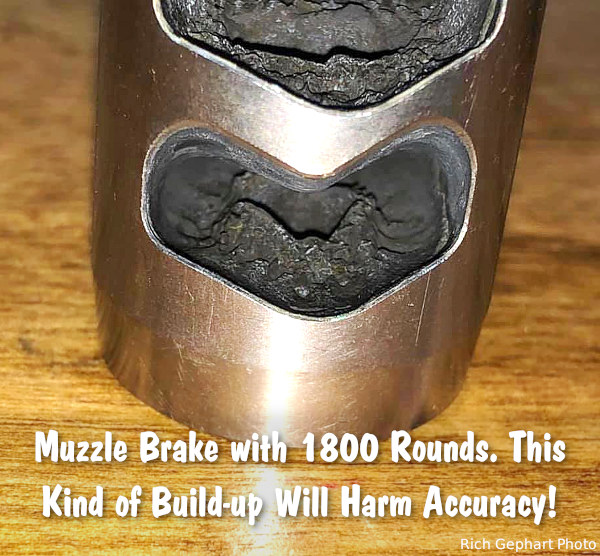
Many hunters and precision rifle competitors use muzzle brakes because these ported devices reduce felt recoil significantly. That make s real difference getting back on target for quick follow-up shots. While many rifle owners appreciate the benefits of muzzle brakes, they may also neglect their brakes, allowing hard carbon and powder residue to build up. Not good. You should regularly clean your muzzle brake to remove fouling and carbon build-up.
As Mark Edgreen posted: “Carbon build up on the crown and in the brake is a recipe for poor accuracy.” And another gunsmith reported that customers complained about guns that “shot out way too early” but they only needed to have the brakes cleaned.
Gunsmith and PRS/NRL competitor Jim See recently reminded his Facebook Fans about the importance of cleaning muzzle brakes: “How many times do I have to say it? You need to maintain your rifles. Clean your muzzle brakes people!”. Jim, who runs Elite Accuracy LLC, notes that hard carbon build-up in brakes can definitely harm accuracy. Look at this example:
Muzzle Brake Cleaning Methods
There are various methods for cleaning a brake, we list a variety of techniques, but we would start with NON-corrosive ultrasound. You’ll want to remove the muzzle device before doing these tasks.
1. Use Ultrasonic Cleaning Machine with cleaning solution. This may be the most efficient method: “I place my brake in the ultrasonic cleaner. Shiney as new.” (Jim Moseley).
2. Spray with commercial Carb Cleaner and brush. Then apply anti-corrosion coating.
3. Soak in half hydrogen peroxide and half vinegar. Suggestion: “Let sit over night and carbon melts off. Brush remaining carbon off, rinse and put the brake back on.” Apply anti-corrosive before mounting.
4. Soak in 50/50 solution of water and white vinegar and brush. (Be sure to apply anti-corrosion coating, such as Eezox, after soaking).
5. Tumble in liquid solution with stainless pins. Comment: “Comes out slightly faded, but perfectly clean on stainless, non-painted brakes though.” Warning — do NOT do this with threaded brakes — tumbling could affect threads of screw-on brakes. Also, tumbling can harm painted or Cerakote finishes.
Gunsmithing Tip: By fitting the muzzle brake so that the barrel crown is slightly forward, it is easier to wipe carbon fouling off the end of the barrel. See photo:
Jewell triggers are still the most-used triggers on competition benchrest and F-Class rifles and they are also popular for hunting, varmint, and tactical rifles (with or without safeties). While a Jewell trigger can work for years with minimal maintenance, if the trigger becomes gunked up, it may be necessary to disassemble the trigger for a thorough cleaning. Our friends Ed and Steve, aka the 6.5 Guys, have produced a helpful video that shows how to disassemble and then reassemble a Jewell trigger.
Why You May Need to Disassemble Your Jewell Trigger — the 6.5 Guys
Jewell triggers are a popular choice in the sport of long range precision shooting, and like everything else require regular cleaning and maintenance. In most cases they can be cleaned with charcoal lighter fluid or dropped into an ultrasonic cleaner. Should the situation require, they can be completely disassembled according to the Jewell Trigger Manual.
We ran into a situation where we had to dissemble a trigger due to the entrapment of some sticky dirt that couldn’t be removed with an ultrasonic cleaner. Our first step was to find some step-by-step instructions but we couldn’t find anything.
Recognizing that other shooters might be in the same situation we produced a step-by-step guide and video, published in full on 65Guys.com. These instructions will work with a left- or right-handed trigger. In our case we worked with a left-handed BR model trigger with safety and bolt release.
Step-by-Step Instructions are provided on 65Guys.com website. We recommend you read all the instructions carefully before you even think about disassembling your trigger. This video explains the process so you can get a sense of what is involved.
If you are considering purchasing a progressive reloading press — you’ve struck gold. Today’s Saturday at the Movies article showcases the most comprehensive video ever created about progressive presses. Hosted by Gavin Gear of UltimateReloader.com, this remarkable 79-minute video covers a dozen presses from six leading manufacturers: Dillon, Frankford Arsenal, Hornady, Lee, Mark 7 (Lyman), and RCBS.
Set aside plenty of time, because there is a wealth of information — the “mother lode” of progressive press coverage. Along with the big comparison video, Gavin has prepared a detailed, 17-page online article which covers all of the presses in the shootout. This 17-page article also includes many product-specific videos. We link to five of these videos below.
12 Progressive Presses are compared in this comprehensive video:
Here it is! Ultimate Reloader’s long-awaited Progressive Press Shootout. This online article and accompanying video represent the most exhaustive and most in-depth look at progressive press reloading equipment. The Ultimate Reloader Progressive Shootout covers a dozen different progressives from Dillon, Frankford Arsenal, Hornady, Mark 7 (Lyman), and RCBS. Reviewer Gavin Gear demonstrates how each press works and provides data on costs, output rates, capabilities, and accessories so that potential buyers can make informed purchasing decisions.
MORE INFO — Progressive Press Shootout Online Article
To accompany the remarkable 79-minute Progressive Press Shootout Video, Gavin Gear has posted a ton of information on his UltimateReloader.com website. A lengthy online article provides detailed information on the particular presses, press mounts, and lighting, as well as general details such as cost of ownership. We provide links to particular topics below. This is a GREAT RESOURCE — it’s like getting an entire chapter of a technical book all for FREE!
Below we provide links to each product-specific online page, along with the corresponding time-link to the related segment of the 79-minute Progressive Shootout video.
NOTE: Along with the presses featured in these six videos, the Ultimate Reloader Progressive Press Comparison video covers six other presses (12 total), in a comprehensive 1 hour 19 minute video linked at the top of this article.
Gun Storage Check Week is the time to ensure your firearms are stored safely and securely. NSSF, the Firearm Industry Trade Association, is promoting Gun Storage Check Week, June 1-7, 2025, to remind gun owners to review their storage practices to prevent accidents, suicides and thefts. During this week, check your gun safe(s), and ensure your firearms are stored correctly and locked down properly. Also use secure gun cases when transporting firearms to the range. When traveling by air, use proper TSA-approved gun cases and comply with transport rules.
“Securely storing guns when they’re not in use can save lives. It’s really that simple,” said Joe Bartozzi, President and CEO of NSSF. “No one wants their gun in the hands of an unsupervised child, a person in crisis, someone who does not understand how to safely operate firearms, or a thief. If something bad happens because your gun isn’t stored securely, you’ll regret it, probably forever.”
This video covers gun safety rules and secure storage of firearms.
Gun Storage Check Week’s safety resources highlight many options to store firearms securely so that guns are off limits to unauthorized persons. Secure gun storage devices include:
Cable Locks — Available free of charge through NSSF’s Project ChildSafe® program Lock Boxes — Secure storage solution for guns kept for home security and in vehicles Lockable Gun Cases — for security, portability, and travel Full-size Gun Safes — For owners with multiple firearms to protect against fire and theft.
Enter to Win Product Prizes in June
Each week in June 2025, you can enter to win firearm storage units and other safety equipment thanks to Regal Products, Vault Pro, and ShotLock. Storage equipment prize packages are valued up to $499 and change weekly. Shown below is the first set of prizes. Go to GunStorageCheck.org to register. One winner per week will be chosen. The contest restarts each week, so you can enter up to four times in June.
Metal Madness is a great rimfire shooting discipline where shooters engage dozens of steel targets set up in a grid. This fun, action shooting contest for all skill levels runs at the Grand Rivers Shooting Range in Kentucky. Next month, on June 28-29, 2025, the Metal Madness Shooting Sports Association (MMSSA) will hold its major event of the year, the Metal Madness Homecoming match at the Grand Rivers range.
Metal Madness is a fun and challenging form of rimfire shooting. Whether you’re young or just young at heart, you’ll love the satisfying ping of hitting steel targets — no prior experience or special equipment required. Most .22 firearms will do just fine! To learn more about Metal Madness, visit MMSSA.net. Watch the video below to learn about the course of fire and the scoring system. There are ten lanes with five targets in each lane.
MMSSA is a rimfire shooting sport offering the instant gratification of ringing steel targets. No special or fancy “raceguns” are needed — most any .22 LR firearm will work.
What is Metal Madness?
Metal Madness is a speed and accuracy-based shooting sport where participants shoot rimfire rifles or pistols at steel plates. Each competitor will shoot through 10 stages, moving to a new shooting lane each time. Each lane has randomized numbered metal plates, which must be shot in numerical order.
Scoring is time-based, plus penalties for missed plates or shooting plates out of sequence. With misses costing 2 seconds each, hitting plates in the proper order is extremely important. The eight fastest times from ten lanes fired are added together for each shooter’s bracket time.
This video shows action at the 2024 Metal Madness Homecoming event held last June in Kentucky.
$40 Per Entry — Prizes for Registered MMSSA Members
At the June 2025 Metal Madness Homecoming event, competitors will fire through 10 different shooting lanes, with each lane featuring multiple steel targets. Entry fee is $40.00. Competitors may participate in multiple sessions, with the same gun or different guns. All .22 caliber firearms are allowed to shoot Metal Madness. Membership is required to participate in MMSSA prize events. Prizes are drawn (by random picks) on Sunday afternoon at the end of the event. CLICK HERE to Register.
Grand Rivers Shooting Range Address: 787 Dover Road, Grand Rivers, Kentucky
Could you hit an 18″ x 24″ target at a distance of 400 meters (437 yards)? Sure, you’re thinking, that would be easy with a good rifle fired from the bench or prone position. OK, now think about making that shot, OFF-HAND with a pistol. That’s something entirely different. We doubt many marksman would wager they could hit a plate 400 meters away with a handgun.
That’s exactly the challenge legendary shooter Jerry Miculek undertakes in this interesting video. Shooting a Smith & Wesson 9mm M&P pistol with a red-dot optic, Jerry makes the 400m shot look easy, hitting the steel plate with his first shot. This takes good eyes, a solid grip, perfect trigger control (and a bit of luck). Jerry was shooting 115gr Hornady HAP® ammunition.
25 Feet Hold-over to Make Shot at 437 yards!
The shot wasn’t dead center, but Miculek still hit the steel plate on the first try. This is doubly impressive because Miculek had to hold well over the target. In fact Jerry figured he was aiming “25 feet over [the target]”. The lesson to be learned here is that a good pistol, in the hands of a master, may be capable of astonishing long-range accuracy — as long as you work out the ballistics in advance. Jerry knew that he had to hold high to arc the bullet into the target.
Tumblers and walnut/corncob media are old school. These days many shooters prefer processing brass rapidly with an ultrasonic cleaning machine. When used with the proper solution, a good ultrasonic cleaning machine can quickly remove remove dust, carbon, oil, and powder residue from your cartridge brass. The ultrasonic process will clean the inside of the cases, and even the primer pockets. Tumbling works well too, but for really dirty brass, ultrasonic cleaning may be a wise choice.
Our friend Gavin Gear has evaluated an RCBS Ultrasonic cleaning machine using RCBS Ultrasonic Case Cleaning Solution (RCBS #87058). To provide a real challenge, Gavin used some very dull and greasy milsurp brass: “I bought a huge lot of military once-fired 7.52x51mm brass (fired in a machine gun) that I’ve been slowly prepping for my DPMS LR-308B AR-10 style rifle. Some of this brass was fully prepped (sized/de-primed, trimmed, case mouths chamfered, primer pockets reamed) but it was gunked up with lube and looking dingy.”
UltimateReloader.com Case Cleaning Video (7.5 minutes):
Gavin describes the cleaning exercise step-by-step on UltimateReloader.com. Read Gavin’s Cartridge Cleaning Article to learn how he mixed the solution, activated the heater, and cycled the machine for 30 minutes. As you can see in the video above, the results were impressive. If you have never cleaned brass with ultrasound before, you should definitely watch Gavin’s 7.5-minute video — it provides many useful tips and shows the cleaning operation in progress from start to finish.
Ultra Dry Necks After Ultrasonic Cleaning — Some Suggestions
The Ultrasonic cleaning process gets cartridge brass so “squeaky clean” that increased force may be required to seat your bullets, or they may “grab” as they go in the necks. To reduce bullet-seating effort, you may benefit from adding a little dry case lube inside the case-neck before loading (use a nylon brush). Another trick is adding a teaspoon of Ballistol lube to the cleaning solution. That provides a trace lubricant inside the necks, but does not interfere with powder ignition in any way.
The latest Gen2 RCBS ultrasonic cleaning machine has a large 6.3-quart capacity. That’s nearly 100% larger than the first generation machine in Gavin’s video. The Gen2 machine, $434.52 on Amazon, features a second ceramic heater and transducer to better clean brass cases and firearm parts. The LED is easily programmable, and the timer can be set for up to 30 minutes of cleaning. The original 3.2 quart-capacity RCBS ultrasonic machine, as shown in Gavin’s video, is still available for $213.99 at Midsouth Shooters.
Each year, on the last Monday in May, Americans honor the sacrifices of military men and women who paid the ultimate price in their service to our nation. More than 1.35 million American men and women have died in military service during wartime, including more than 666,400+ combat deaths. On May 26, 2025, we again pay tribute to these men and women and remember their service to their country.
This is what Memorial Day symbolizes — a time Americans take a clear look at both our past and our future. One day each year, when we acknowledge the debt we owe to those men and women who — because they so cherished peace — chose to live as warriors.
Could anything be more contradictory than the lives of our soldiers? They love America, so they spend long years in foreign lands far from her shores. They revere freedom, so they sacrifice their own that we may be free. They defend our right to live as individuals, yet yield their individuality in that cause. Perhaps most paradoxically of all, they value life, and so bravely ready themselves to die in the service of our country. — Deborah Y. Parker
Moment of Remembrance
Memorial Day Observances will range from parades to memorial ceremonies and organized moments of silence. The Memorial Day National Moment of Remembrance honors America’s fallen warrriors. Established by Congress in 2000, the “Moment” asks Americans, wherever they are at 3:00 p.m. local time on Memorial Day, to pause for one minute, in an act of national unity and respect for the fallen.
What Is Memorial Day?
Memorial Day is a federal holiday in the United States for remembering the men and women who died while serving in the country’s armed forces. The holiday, which is celebrated every year on the last Monday of May, was formerly known as Decoration Day and originated after the American Civil War to commemorate the Union and Confederate soldiers who died in the war. By the 20th century, Memorial Day had been extended to honor all Americans who have died while in the military service.
On Memorial Day, the United States flag is traditionally raised to the top of the staff, then solemnly lowered to half-staff position until noon, when it is raised again to full-staff for the rest of the day. The half-staff position is to remember the more than one million men and women who have given their lives for this country.
Flags placed in Arlington National Cemetery by members of the 3rd Infantry Regiment, the “Old Guard”.
Many people visit cemeteries and memorials, particularly to honor those who have died in military service. Many volunteers place an American flag on each grave in national cemeteries.
You know that Zeiss riflescopes boast superb glass, excellent controls, and a rock-solid warranty. What you may not realize is how rugged Zeiss scopes are. Zeiss optics are designed for the toughest conditions that hunters may experience. Zeiss understands that hunting optics can be exposed to extreme temperatures, moisture, shock, and vibration.
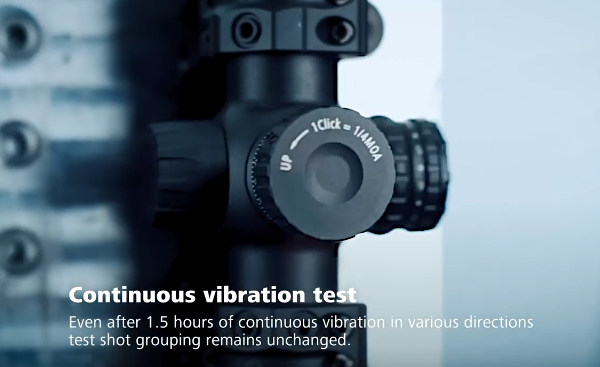
To ensure Zeiss scopes perform in the toughest conditions, Zeiss tests production-line optics with rigorous testing procedures unrivaled in the optics industry. Zeiss runs Impact Shock Tests with 800 impact cycles at high G-forces. In addition, Zeiss does a continuous vibration test for 1.5 hours. Scopes are also tested in a salt spray environment to confirm corrosion resistance. But there is more — test optics are immersed in water for two HOURS at depth and the scopes are also lab-tested at -40° F in a climate chamber and also subjected to “temperature shocks” from -13° to +122° F. Now that’s some serious testing.
Zeiss does all this elaborate scope testing to ensure its optics perform in all situations, in all environments. View all these tests in this Zeiss video. We think you’ll be VERY impressed:
Impact Shock Test — 800 Cycles
Continuous Vibration Test — 1.5 hours
Water Immersion Test — Validated Waterproof for 2 hours at 13 feet
Temperature Testing — Extreme Temp Shock Test and Sub-Zero Freeze Chamber
Corrosion Resistance Test — 24 Hours in Salt Spray Environment