Lever-action rifles have been an important element of American history. These were truly the rifles that “Won the West”. Today, lever-action rifles remain popular with hunters and cowboy-action shooters. And rimfire lever guns are fun for short-range shooting at reactive targets. Easy to carry, lever guns can also be very effective on varmints. For this Saturday-at-the-Movies installment, we feature eight videos about lever-action rifles. These videos review modern lever guns as well as historic 19th-century lever-action rifles. Three of these videos features sophisticated 3D computer animation so you can look inside the rifles to see how the internal mechanisms function to feed, fire, and eject cartridges.
How a Lever-Action Rifle Functions
This video shows the inner mechanisms of a classic lever-action rifle. It shows how the lever actuates case-feeding from the under-barrel tube, then how the hammer is cocked/fired, and finally how the ejection works after the shot is fired. This video also covers lever-action rifle history, looking at the Winchester 1873 as well as popular modern lever-action firearms.
Classic American Lever-Action Rifles — Hickok45’s Insights
Hickok45 is one of the more knowledgeable YouTube gun reviewers, and he personally owns a number of lever guns. In this video, which has over 2.5 million views, Hickok45 first showcases the original Henry Rifle, and the brass-receiver model 1866 (aka “Yellowboy”). Then he reviews Winchester’s model 1873 and model 1876 (Centennial). Next comes Winchester designs by J.M. Browning — the model 1886, model 1892, model 1894, and lastly the distinctive model 1895 with vertical magazine. The Model 1895 was a favorite of President Theodore Roosevelt.
This insightful Hickok45 video has garnered 2.5 million YouTube views. If you can take the time to watch the entire 37-minute video, this is a great history lesson for 19th-century lever guns. In the video, Hickok45 also shows cartridges used in the various rifles.
Top Five Lever-Action Rifle for Hunting and Home Defense
This video combines reviews from multiple YouTube hosts, including .22 Plinkster. It is a good starting point if you are considering purchase of a modern, lever-action rifle for hunting or home defense. We recommend, prior to purchase, that you go to a gun store to inspect the rifles and work the actions. Some lever guns are significantly smoother in operation than others. You’ll also want to check the triggers, and see the options for mounting optics. This video provides a quick look at a variety of lever guns including: Henry Side Gate Lever Rifle; Winchester Model 1866 Short Rifle (replica); Browning BLR Lever Rifle; Marlin Dark Model 336; and Marlin 1895 Custom Shop 45-70.
Seven Reasons to Own a Lever-Action Rifle
We own a variety of lever-action rifles, including Marlins well as handsome replica Uberti 1866 and 1873 rifles. There is much to be said about the lever gun design. Compared to typical modern bolt-actions, lever guns are narrower and lighter. With a little tuning, the replica 19th-century lever-action rifles cycle very quickly and smoothly. And the modern lever guns are good choices for hunters, with their ability to mount scopes and fire modern high-velocity cartridges. This video reveals the reasons every serious shooter should have at least one lever-action rifle in his or her collection.
How a Winchester 1873 Works
This video has over 16 million views on YouTube. The Model 1873 was one of the most successful Winchester rifles of its day, with Winchester marketing it as “The Gun that Won the West”. The original Model 1873 was manufactured between 1873 and 1923, and it is still available today in replica versions. The 1873 was originally chambered for the .44-40 cartridge, the first significant centerfire cartridge. The 1873 was later produced in .38-40 and .32-20, all of which later became popular handgun cartridges of the day. The Model 1873 was produced in four variations: a 24-inch barrel rifle, a 20-inch barrel carbine, and a “musket”—which was aimed at military contracts and only made up less than 5% of production. The standard rifle-length version was most popular in the 19th century, although Winchester would make rifles to order in any configuration the customer wished, including longer barrels or baby carbines with barrels as short as 12 inches, octagonal-shaped barrels, color case-hardened receivers and fancy engraving.
The Henry Big Boy Lever-Action .44 Magnum
Here’s good, thorough 16-minute review of a modern Henry Big Boy side-gate lever-action rifle chambered for the potent .44 Magnum round. This rifle shows the benefits of modern manufacturing methods, and shows good fit and finish. The review puts the rifle through its paces, show how quickly a modern lever gun can be cycled. We think this would be a good choice for a home defense rifle that could share ammunition with a defensive revolver.
American Classic Reborn — Smith & Wesson Model 1854
This video shows the features of the impressive Smith & Wesson Model 1854, which was introduced in early 2024. S&W calls this an “American classic — redefined for the modern user.” This rifle is offered in three main versions with different finishes and stocks. The version shown above features a rugged stainless-steel bead-finish with M-LOK-capable polymer stock and Picatinny optics rail. There is also also a dark Armornite-finish version with Walnut stock. And there is a third “Stealth Hunter” model with a dark finish, shorter 16.5″ barrel, and extended top rail. A variety of chamberings are offered: .357 Magnum, .44 Magnum, .45 Colt, and 45-70.
And if you’ve got some serious bucks there is a Model 1854 .44 Magnum Limited Edition with handsome highly-figured Walnut buttstock and foreend. This limited edition costs a whopping $3849.00 and ships in a special display case (see above).
Marlin 336 XLR Tactical-Style Lever-Action Rifle
And now for something a bit different… Here a Marlin 336 XLR lever-action rifle has been updated with a tactical-style forearm, rail-mounted optic, and suppressor. The reviewer noted how well the rifle functioned: “Recently I got my hands on this 336 XLR from Marlin and all of my preconceptions of tactical lever action rifles has now changed. What I found was a very modern and capable twist to an old school platform.”
More Information on Lever-Action Rifles
Want to learn more about lever-action rifles? RifleShooter magazine has published an interesting article, the 10 Greatest Lever-Action Rifles of All Time. Writing for RifleShooter, Brad Fitzpatrick examined a wide selection of lever guns produced in the past 150 years, and came up with this list of ten “all-star” lever-action rifles:
Savage Model 99
Winchester Model 1873/73
Winchester Model 1888/88
Winchester Model 1892/92
Winchester Model 1894/94
As with all “Top 10″ lists, this will be controversial. Where is the Winchester model 1866 “Yellowboy”, the favorite of Native Americans? Where is the iconic Winchester model 1895, the beloved gun Teddy Roosevelt called “Big Medicine”? But other choices are hard to fault. The classic 1860 Henry Rifle surely belongs on the list. And, believe it or not, the Winchester Model 94 is the best-selling sporting rifle of all time in the USA, according to RifleShooter.
Lapua offers a FREE Ballistics App. This was the first mobile ballistics App utilizing the 6DOF calculation model, making it one of most accurate ballistics Apps on the market. With this free App you can calculate trajectories, range, bullet drop, turret adjustments and more. Lapua Ballistics offers up-to-date, Doppler-measured Lapua cartridge and bullet data. It also includes the option to define custom bullets manually.
Lapua’s sophisticated FREE Ballistics App has many great features — much more than you’d expect for a free App. If you do much shooting past 300 yards, or use a wide variety of bullets and/or cartridge types, definitely download the App and give it a try. For more details, read the Lapua Ballistics App User Manual. This handy PDF file explains how to set up the App and utilize all its powerful features.
Utilizes 6DOF, the most accurate calculation method
Always available with latest Lapua cartridge / bullet information
Quick and easy to change inputs like distance, wind speed and angle
Several result outputs available, with numerical, reticle, table and graph views
Create and clone your own firearm / reticle combinations
Choose between metric and imperial values
Set Point Blank-range to different sight-in distances and impact windows
Set Aiming point to moving target
Add custom bullets (calculations based on BC G1 or G7 and Siacci method)
Features include Sight-in-POI, Coriolis, Max Range and Cant Angle calculation
Compare up to 3 Lapua cartridge/bullet performances to each other
Custom trajectory tables
After downloading the FREE Lapua Ballistics App for Android device or Apple iPhone/iPad, you’ll want to access the Lapua Ballistics App Guide which shows how to use all the features and options. In addition, Lapua offers a handy FAQ Page with User Tips and Answers to frequently Asked Questions. After downloading the FREE App, you should definitely go to the FAQ page. It has helpful illustrations showing how to set up the App for your firearms and cartridge types. Also check out the page explaining the Sight-In POI feature which allows profiles of different bullet weights in the same firearm.
Watch Video for Explanation of Lapua Ballistics App Features
2025 Lapua Ballistics App Updates
Lapua has added some significant 2025 updates to its Ballistics App. New features include:
Range Presets: Create ranges, with angles, and quickly move between them. Output Units: Set the unit of the calculation output to clicks, MRAD, or MOA Device Compass for Shooting Direction: When getting wind data or getting location in Coriolis tab, shooting direction is taken from device compass. Wind Direction Correction: When changing shooting direction, ether by Coriolis tab or Get wind data button, wind direction is corrected by the new shooting direction.
Creedmoor Sports is a leading vendor of products for competitive shooters and serious hand-loaders. Along with great gear, Creedmoor Sports provides informative content for its customers. The Creedmoor InfoZone provides Reloading Tips, Gear Reviews, Shooting News, and basic gunsmithing information.
Bill Gravatt, President of Creedmoor Sports, is an expert on reloading processes and gear. He developed many of the popular tools marketed by Sinclair Int’l, and he brings that expertise to Creedmoor Sports. Bill hosts a series of “how-to” videos produced for the Creedmoor InfoZone.
In this video, Bill Gravatt demonstrates several methods to clean your cases. Bill tells us: “Powder residue should be removed before you insert your cases into your reloading dies. There are several ways to clean your cases. Many shooters use a combination of various methods…”
1. Manual Cleaning — You can use 0000 Steel wool for the outside of the case and a Case Neck brush for the inside. A paper towel can remove any remaining residue. This is a handy way to clean if you load at the range.
2. Vibratory Tumbling — This traditional method works well, particularly for pistol brass. Experiment with both Corn Cob and Walnut media. You can get a brighter shine by putting a small amount of liquid brass polish in the media.
3. Wet Tumbling with Stainless Media — This process can get your brass clean inside and out. Do check to ensure no pins are stuck in the flash-holes. Watch for peening of case mouths that can occur over time.
4. Ultrasonic Cleaning — Ultrasonic cleaning works great for small parts as well as brass. The ultrasonic process removes all carbon and traces of lube, which can leave the inside of case necks too dry. To smooth bullet seating, try putting a tablespoon of Ballistol in the cleaning solution.
Cleaning Reloading Dies
Cleaning your reloading dies is something that many hand-loaders neglect. In this 60-second Tech Tip, Bill Gravatt provides some smart advice on cleaning your dies. Bill notes: “After heavy use, case lube and carbon can build up in your reloading dies. It’s important to keep them clean. Also, with new dies, give them a good cleaning before first use, because they ship with a corrosion inhibitor.”
1. Step 1 — Prior to cleaning, disassemble the die and spray it with a good degreaser. Do this with brand new dies too.
2. Step 2 – Take a patch and run it in the die to remove old lube and gunk. Don’t forget the decapping assembly and other internal parts.
3. Step 3 — After cleaning the die, but before reassembly, spray the die with a good corrosion inhibitor, such as Corrosion-X or Starrett M1.
OK this is no novice. But even champion pistol shooter Jessie Harrison, Captain of Team Taurus, had to start with the basics. Jessie says that safety should always be your number one priority.
At AccurateShooter.com, our primary focus is precision target shooting with rifles. But it’s definitely fun to shoot pistols too, and we bet most of our regular readers own handguns. Here are six tips for shooting safely and accurately with handguns. These pointers will help you advance your skills and have more fun with your pistols and revolvers.
1. Make Sure Safety Is Number One
Whether you own one gun or one hundred, gun safety must always be your main priority. In this video, Smith & Wesson Team Captain Julie Golob covers the basics of gun safety.
2. Start with a .22 LR Handgun
We strongly recommend that new pistol shooters start off with a .22 LR rimfire handgun. The .22 LR cartridge is accurate but has very low recoil, less “bark” than a centerfire, and very little smoke and muzzle flash. New shooters won’t have to fight muzzle flip, and won’t develop a flinch from the sharp recoil and muzzle blast common to larger calibers. With the .22 LR, the trainee can focus on sight alignment, breathing, and trigger pull. When he or she has mastered those skills, move on to a .38 Special or 9mm Luger (9x19mm).
What gun to use? We recommend the 10-shot Smith & Wesson Model 617. Shooting single action, slow-fire, this is ideal for training. Shown above is the 4″-barrel Model 617version which balances well. There is also a 6″-barrel version. It has a longer sight radius, but is a little nose-heavy. Both are great choices. They are extremely accurate and they boast a very clean, precise trigger.
If you prefer a semi-auto .22 LR pistol, we recommend the Browning Buck Mark series. Buck Marks are very accurate and very reliable. This rimfire pistol is available in a variety of models starting at under $350.00. Like the S&W Model 617, a good Buck Mark will serve you for a lifetime.
5. Use Quality Targets with Multiple Aim Points
It’s common for new pistoleros to start shooting at cans or clay birds at a public range. That can be fun, but it’s better to start with proper targets, placed at eye level, at 7-10 yards. We like to use targets with large, brightly colored circles. Focus on putting 5 shots in a circle. We recommend targets that have multiple bullseyes or aiming points — that way you don’t have to constantly change your target. There are also special paper targets that can help you diagnose common shooting problems, such as anticipating recoil. EZ2C makes very good targets with bright, red-orange aim points. You can also use the bright orange Birchwood Casey stick-on Target Dots (right). These come in a variety of diameters. We like the 2″ dot at 10 yards.
3. Shoot Outdoors If You Can
We recommend that new pistol shooters begin their training at an outdoor range. There are many reasons. First, the light is better outdoors. Indoor ranges can be dark with lots of shadows, making it harder to see your target. Second, sound dissipates better outdoors. The sound of gunfire echoes and bounces off walls indoors. Third, an outdoor range is a more comfortable environment, particularly if you can get out on a weekday morning. Indoor ranges, at least in urban areas, tend to be crowded. Many also have poor ventilation. If you can make it to an outdoor range, you’ll be happy. Many outdoor ranges also have some steel pistol targets, which offer a fun alternative to paper. When shooting steel however, we recommend polymer encased or lead bullets to avoid ricochets.
Too many new pistol shooters try to move right to rapid fire drills. It’s better to start slow, practicing the basics, under the guidance of a good mentor. If you belong to a club, ask if there are certified instructors who will help out. This Editor learn pistol shooting from a seasoned bullseye shooter, who got me started with a .22 LR revolver and very close targets. Over the course of a few range sessions we progressed to farther targets and faster pace. But the fundamentals were never forgotten. When starting your pistol training, it’s wise to view some instructional videos. Top Shot Champion Chris Cheng hosts an excellent Handgun 101 Series produced by the NSSF. We’ve linked one of these Handgun 101 videos for Tip #6.
6. SLOW DOWN — This Is Not a Race
When you learned to ride a bicycle, you started slow — maybe even with training wheels. The same principle applies to pistol shooting. When you get started with handguns, we recommend you shoot slowly and deliberately. Start with the handgun unloaded — just work on your sight alignment and breathing. With snap caps in place, try some dry-firing drills. Then progress to live fire. But be deliberate and slow. With the target at 20 feet, see if you can get three successive shot-holes to touch. Believe it or not, many common pistols are capable of this kind of accuracy (but you won’t see many shooters at indoor ranges who pursue that kind of precision). Once you master your form and accuracy, then you can work on your speed.
It’s easy to lust for those rare showpiece rifles at high-end auctions, but the author cautions readers to target the best deals, stick to your plan, and honor your monetary limits.
Buying at Gun Auctions — Be Crazy, Crazy Good
By Dave Buffington
“They’re crazy!” — You hear that all the time about live gun auctions. People love to rant about how people pay too much money for too many guns at too many auctions. It’s natural. And wrong.
I’ve been attending live gun auctions regularly for more than a decade — as many as 40 a year. I’ve learned that for every item that sells for a silly price, several sell for fair money and some — more than a few — have turned out to be great buys.
Two years ago, I bought a competition-grade STI 1911 in excellent condition for $670 at a live auction. And at the height of the gun-buying frenzy a while back, I scored a highly desirable, rarely-found Anschütz 54.18 MSR in new-in-box condition for just $1,800. I then flipped that Anschütz for $3,000 just two weeks later. That $1200 gain represents a 66% profit — not bad for a little savvy shopping at an auction.
This beautiful SAKO L461 Vixen was a great auction buy … and it is half-MOA accurate as well.
Sweet SAKO L461 Score at Auction
Can you score an awesome deal at a live auction? Absolutely. Above is a .222 Rem SAKO L461 Vixen I got at auction for $1500.00 including Leupold Vari-X II 3-9x40mm scope. Note the highly-figured stock. My SAKO L461 is the “deluxe” model with rosewood forearm tip and grip cap. A similar .222 Rem SAKO L46 (below) with fairly plain wood (and no scope) is selling for $3995.95 at the Custom Shop, a Montana purveyor of fine firearms. I got my SAKO for 38% of the Custom Shop price! SAKO fans will note that the L461 has an internal top-loading 5-shot magazine while the older L46 has a 3-round removable clip. And most folks believe that the newer L461 model (like mine) has a better trigger.
Compare the author’s $1500 Auction-purchased SAKO L461 (above) with this $3995.00 Custom Shop Inc. SAKO L46. This is proof that live auctions can deliver some impressive bargains:
Can you make a mistake? Yes, I’ve bought junk and paid too much for it. But I’ve learned that knowledge is the best vaccine against gun buying mistakes. That’s our next topic.
Know The Auctions
Finding live auctions takes a bit of research, especially during the pandemic. But estates still need to be settled, collections still need to be shrunk and so, guns still need to be sold. Read your local newspaper and shoppers guides. Use online auction search services like AuctionZip.com.
And once you’ve found an auction, know the auctioneer’s rules. Some do background checks. Some don’t. Some charge sales tax. Some don’t. Some charge a “buyer’s premium”. Some don’t. If you’re not sure, ask.
Know Your Targets — Stick to Your List and Avoid Impulse Buys
Especially at the all-gun auctions, it’s easy to be entranced by all the handsome-looking hardware, but some of my worst gun buys have been the impulse buys made at auctions.
So start with a list of guns you want — for target shooting, collecting, whatever — and stick to it. Get to know those guns, research them and for goodness sake, know the potential pitfalls. Some Winchester 52s are prone to the “crack of death”. Certain Brownings from the late 60s and early 70s are afflicted with “salt wood”. You need to know which ones.
Know The Bidding Process
Auction newbies tend to worry a lot about how to bid. I know I did. But don’t. Remember, it’s the job of the auctioneer to get your bid, and once a good auctioneer spots you as a bidder, believe me, he won’t lose you.
The key is to get spotted. So don’t be shy. The auctioneer will likely start the bidding at some reasonable number. As a matter of theater, he’ll then start going down until someone actually bids. Then he’ll start going up again. When you’re ready to jump in, raise your hand and make sure the auctioneer spots you. If you’re not sure, shout something. (“Here!” works fine.) After that, don’t fuss about technique. Just nod yes or no the next time the auctioneer looks at you. (Ziegler Auction photo by Nathan Merkel)
Do understand one small but important detail: The price the auctioneer calls is the price he is looking for, not the price he has. For example, if you’ve bid $250, you’ll then hear him calling for the next increment up — such as “$300, $300, do I hear $300?”.
Misunderstanding that process can lead you to bid against yourself. 99% of auctioneers won’t let it happen, but as I can attest, it’s still embarrassing.
Know Your Price Limits
Auction fever is much like buck fever. You’re struggling to be still while you’re heart is doing its best rendition of “Wipe Out”. So you must, absolutely must, agree with yourself on the maximum price you’ll bid for a gun before the bidding starts. And be sure that maximum price reflects the true purchase cost, including sales tax, background check fees, and the buyer’s premium, if any.
Sticking to that limit is critical. First, because you don’t want to end up spending the mortgage money, but also, because there’s always another opportunity around the corner.
For example, on a cold, damp day last fall, I went to a small outdoor auction in hopes of getting a good buy on a Mauser-made, numbers-matching K98k. Ha! Despite the fact there were fewer than 50 bidders braving the drizzle, the gun sold for a whopping $3,200. (I bailed at $1,500.)
Is this the K98k that sold for $1,200? Or $3,200? The Karabiner 98 kurz (German for “carbine 98 short”), often abbreviated Kar98k or K98k, is a bolt-action rifle chambered for the 7.92×57mm Mauser cartridge.
But just two weeks later, I went to a warm, dry indoor auction with more than 200 bidders in the building. Yet I still managed to get a Mauser-made, numbers-matching K98k for just $1,200, a difference of a whopping $2,000. Crazy? Yes… Crazy good.
Here’s a really great video about firearms crafting produced by Beretta, a legendary Italian gun-maker founded in 1526 — nearly 500 years ago. This movie, entitled “Human Technology”, is one of most impressive videos we’ve ever featured on this site. It’s that good. You’ll see an amazing blend of modern technology along with old-world artisanship — “a mesmerizing meld of the high-tech and the traditional”. (Daniel Xu, Outdoor Hub.)
Video set to auto-play. Click speaker icon to hear sound.
“Human Technology is a singular and symbolic movie, its cast entirely made up of Beretta workmen, thus illustrating the perfect synthesis between craftsmanship and technology,” Beretta writes. This artistic movie by Ancarani Studio illustrates all the aspects of the manufacturing of a high-end Beretta shotgun. This video is a study in contrast. The movements of robotic assembly machines are juxtaposed with the centuries-old craftsmanship of stock carvers. Beautifully filmed and edited, this video should amaze and entertain anyone who loves fine firearms. (Full-screen HD Recommended.)
Beretta — Incredible history. Beretta was founded in 1526, almost five centuries ago. Remarkably, the enterprise is still owned by the Beretta family.
AccurateShooter.com is more about rifles than pistols. But we know that the majority of our regular readers own handguns, and many also have concealed carry (CCW) permits. And with the prospect of social unrest following the election, we expect more reader than ever will be “packing” a sidearm. Accordingly, we’ve found a great resource for CCW holders that can help you select a holster. On the Shooting Illustrated website you’ll find a detailed review of 30 different holster types. Each holster is illustrated, with pros and cons explained. These are all EDC holsters, meaning those designed for “Every Day Carry”.
Shooting Illustrated calls this article “HolsterPallooza” and it really does provide a ton of helpful information. Most other holster reviews on the web may feature a half-dozen holsters at the most. In this Holsterpallooza article you can see 30 holsters, with a wide variety of materials, designs, and applications. There are small molded IWB holsters for CCW, conventional on the belt holsters, leather shoulder holster rigs, and even ankle holsters. This is a great place to start if you are in the market for a holster.
Here’s sample of the many holster options reviewed, an innovative hybrid IWB holster constructed with leather over Kydex. That gives you the “best of both worlds” — the secure fit/retention of a molded Kydex shell, with an attractive leather exterior.
Shooting Illustrated explains: “As the interface between your gun and your body, the holster is a vital component of your carry rig. In many cases, the circumstances of your daily life will determine the method of carry you choose. This, in turn, will determine what type of holster you need, which may end up determining the handgun you carry. Therefore, choosing the method and type of holster may be as, or even more important than, choosing a firearm.”
MORE Reviews — Hickok 45 Reviews 15 CCW Holsters:
If you want to see even MORE holsters for “Every Day Carry” (EDC), check out this video from Hickok 45. This popular YouTube host looks at 15 different IWB holsters from a number of manufacturers. Hickok 45 examines many hybrid holsters that combine Kydex or plastic with leather for increased comfort. He has his favorites… and they might not be what you’d expect. NOTE: As this video has been watched over 900,000 times, you may also want to read the viewer comments. There are many helpful suggestions from CCW holders who carry daily.
Project by Shiraz Balolia, President of Grizzly Industrial
The lowboy stock you see above started as an experiment. I had an extra Masterclass F-Class stock that had gone through two actions, four beddings, and multiple modifications over the years. I figured that there was nothing to lose if the experiment did not work out.
After deciding on the design, the stock was carefully leveled in every direction and milled to the precise dimensions for attaching the side pieces, which would be glued to the original stock.
Curly Maple and Bubinga wood were laminated to get the exact thickness of the side pieces so that the total width of the fore-end would be just under the total width allowed for F-Open stocks.
Two guide pins made of Bubinga were drilled through each side so that the sides would not move when glued to the milled stock.
Once the sides were glued to the blank, the stock was once again trued on the mill so it was perfectly flat and square with the back (see below).
The stock was then sent to Keith Weill at KW Precision who did an incredible bedding job on the new BAT M action. The stock was then sent out for spraying a clear finish. Normally I spray my own stocks, but I did not have time for this stock, so that part was subbed-out. The finger grooves and “Shiraz” inlay had been done by me a few years prior during the old stock’s heyday.
Modified Stock Has Significantly Lower Center of Gravity
The rifle was then assembled, a March 10-60x56mm High Master scope was installed, and break-in was completed on the new barrel. At the range, the stock performed great. The stock rides one-half-inch lower in the front bag and really feels good.
Bartlein Barrel Is Chambered in .300 WSM
I was pleased to find that the Bartlein barrel I have on this gun cleaned up very well during barrel break-in and this “experiment” may turn into this being one of my best-performing guns. All of my F-Open match guns are .300 WSM (Winchester Short Magnum), and so is this one.
Do you have a friend who is getting started in hand-loading? Or would you like a refresher course in some of the more important aspects of reloading? Today’s video showcase provides a wealth of information. In these videos, Philip Massaro, Editor-in-Chief of the Gun Digest Annual, explains the techniques handloaders should employ to create safe and accurate pistol and rifle ammunition. These videos are part of an 11-Video Reloading Series from Gun Digest.
After the intro video, there is a video on case resizing, with a focus on full-length sizing. Next Massaro explains how primers work and he demonstrates how to seat primers. There is a video dedicated to bullet choice, followed by a video on bullet seating, both with and without crimping. Today’s video showcase concludes with a helpful video on troubleshooting, showing how to check your ammo and disassemble rounds when something isn’t right.
Basics Of Reloading
What goes into reloading ammo? Here are the five basic handloading steps — removing the primer, resizing the case, inserting a new primer, adding powder, and seating a new bullet. Gun Digest also has a related video on Reloading Tools, explaining the basic tools you’ll need: dies, press, scale, powder measure or powder-dispensing machine, and measuring tools.
Case Prep and Resizing
The reloading process starts with your cartridge brass. You need to remove carbon from the case exterior, check for case damage and signs of incipient separation. And it often makes sense to clean the primer pockets. It’s also wise to check case length, and chamfer/debur the case necks (as needed). Then the cases should be resized before loading. We recommend full-length resizing for rifle rounds.
Primer Types Explained
What is the difference between a large rifle primer and a magnum large rifle primer? Can you use magnum primers in standard cartridges and vice versa? These are among the topics discussed in this video.
Priming Procedures — Using Press or Hand Tool — and Powder Throwing
In this video, Philip Massaro tackles primer installation, the first process of assembly in reloading and case charging. Learn the differences between large and small primers, and how to use a primer cup accessory on a single stage press. Then Massaro shows various methods to dispense the correct powder charge.
Bullets — How to Select the Right Projectile for your Application
Not every bullet is appropriate for every job. Find out what projectile you’ll need to win a shooting match or put meat on the table. Not all bullets are created equal — hunting bullets are different than match bullets and varmint bullets are different than big game projectiles. With this in mind, Phil Massaro examines different bullet designs — including a look at Nosler’s line of projectiles.
Cartridge Completion — Bullet Seating
In this installment, Philip Massaro covers the final step in cartridge assembly, bullet seating. He covers how to use a micrometer seating die for reloading, as well as various ways to crimp handgun bullets. Massaro demonstrates seating bullets for the .357 Mag, .45 ACP, .30-06 Springfield, and .458 Win Magnum cartridges. The video also covers using a roll-crimp and taper crimp.
Reloading Troubleshooting
This is a very important video, that shows how to troubleshoot potential problems with handload ammunition. The host shows how to check for potential case head separation and other brass problems. He shows how to get stuck cases out of dies using the drill and tap procedure. Also covered are collet bullet pullers and inertia hammers for removing seated bullets from cases. This is necessary if you mistakenly seat too deeply or forget to charge the case with powder.
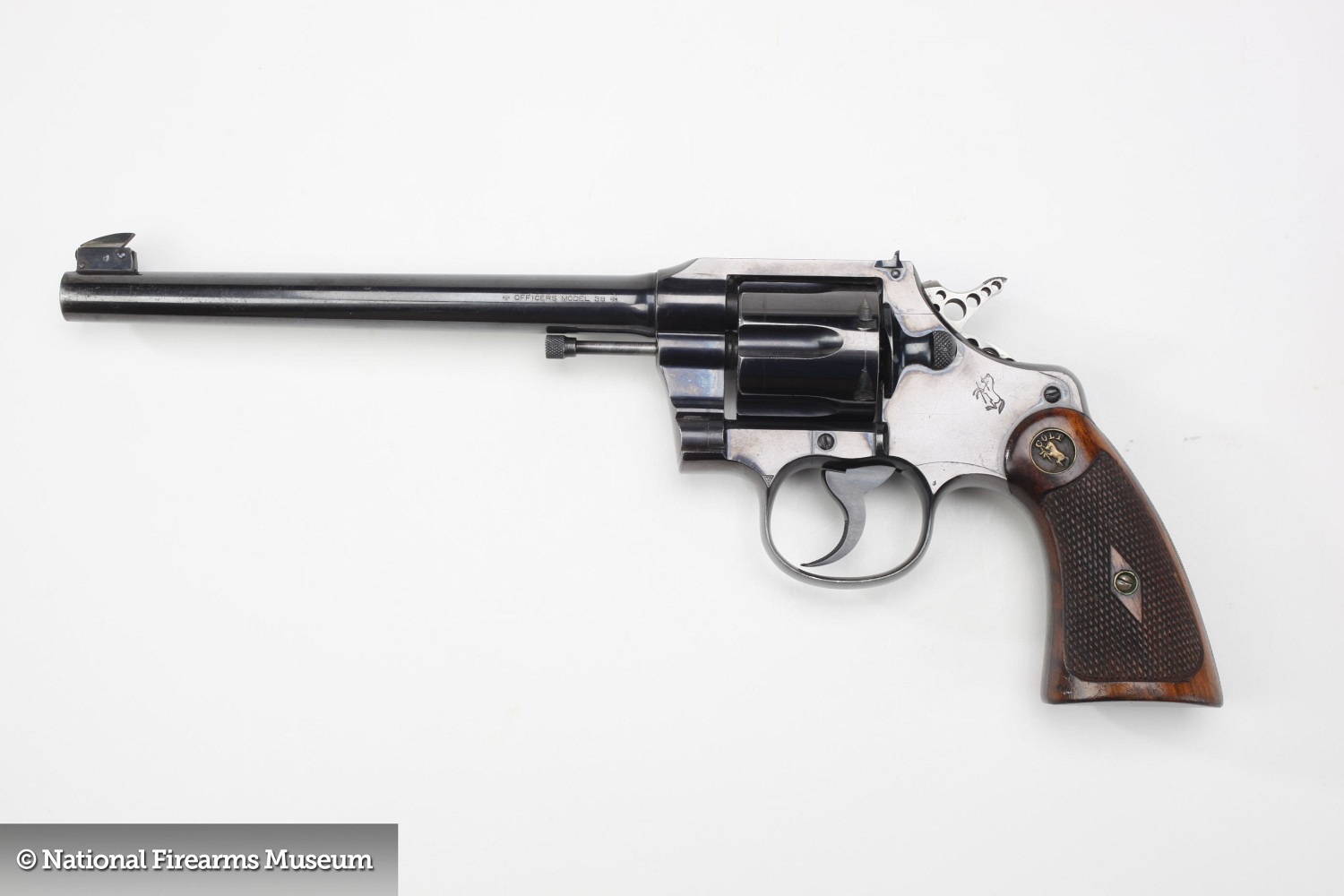
A.P. Lane’s Gold Medal-Winning Colt Revolver
This Colt Officer’s Model revolver, factory-fitted with a skeletonized hammer, belonged to legendary Olympic shooter A. P. Lane, who was known as the “Pistol Wizard”. Lane used this Colt Revolver to win FIVE Olympic Gold Medals — three in 1912 and two in 1920.
A.P. Lane was one of the greatest pistol shooters of his generation. He shot scores that were typically 25-50 points higher than those of his competitors. And he exhibited true Corinthian spirit. At the 1912 Olympics, Lane shared his match ammunition with another competitor who used that ammo to capture the Silver Medal (Lane won the Gold).
This revolver, factory-fitted with a skeletonized hammer, was used by American A.P. Lane in winning five Olympic Gold Medals in the 1912 and 1920 Olympic Games. It’s a .38 caliber, Officer’s Model centerfire revolver from the early 20th century. Olympian A.P. Lane’s Gun can be found in Gallery 13, Firearm Traditions for Today, at the NRA National Firearms Museum in Fairfax, Virginia. The Museum exhibit includes a panoply of Lane pieces – his revolver, his five Gold Medals, and the five Olympic certificates that went along with them.


 It’s common for new pistoleros to start shooting at cans or clay birds at a public range. That can be fun, but it’s better to start with proper targets, placed at eye level, at 7-10 yards. We like to use targets with large, brightly colored circles. Focus on putting 5 shots in a circle. We recommend targets that have multiple bullseyes or aiming points — that way you don’t have to constantly change your target. There are also special paper targets that can help you diagnose common shooting problems, such as anticipating recoil. EZ2C makes very good targets with bright, red-orange aim points. You can also use the bright orange Birchwood Casey stick-on Target Dots (right). These come in a variety of diameters. We like the 2″ dot at 10 yards.


 Know The Bidding Process
 Know Your Price Limits


 A.P. Lane’s Gold Medal-Winning Colt Revolver