What is Parallax?
Parallax is the apparent movement of the scope’s reticle (cross-hairs) in relation to the target as the shooter moves his eye across the exit pupil of the riflescope. This is caused by the target and the reticle being located in different focal planes.
Here’s a good explaination of scope parallax. This video has been watched over 790,000 times.
Why is it Important?
The greater the distance to the target and magnification of the optic, the greater the parallax error becomes. Especially at longer distances, significant sighting error can result if parallax is not removed.
How to Remove Parallax
This Nightforce Tech Tip video quickly shows how to remove parallax on your riflescope.
While keeping the rifle still and looking through the riflescope, a slight nod of the head up and down will quickly determine if parallax is present. To remove parallax, start with the adjustment mechanism on infinity and rotate until the reticle remains stationary in relation to the target regardless of head movement. If parallax has been eliminated, the reticle will remain stationary in relation to the target regardless of eye placement behind the optic.
S&W Model 617 now has a 10-round cylinder, but early models were six-shooters.
In recent years, the ranks of first-time gun buyers have grown dramatically. Millions of Americans have purchased their first-ever handgun. With so many handgun options (from derringers to Desert Eagles) many first-time buyers have trouble making a choice. What should those millions of new gun buyers have acquired first? Perhaps it should have been a rimfire revolver. Here is why…
The Argument for a Rimfire Revolver
Some years back, a close relative contacted this Editor. Wanting to get started in handgunning, he sought my advice on purchasing his very first handgun. “Should I get a Glock?”, he asked. “No” was my response. “Well how about an M&P?” he inquired. “Better ergos” I said, “but ‘No’ is still my reply.” “OK, how about a KelTec, they’re cheap…” “Absolutely not”, I replied.
I could tell he was getting annoyed, when he said “OK, Mr. know-it-all, so what handgun should I get?” Calmly, I replied: “Get a .22-caliber rimfire revolver. You will never out-grow it. You will learn sight alignment and trigger control. You can practice with inexpensive ammunition. A good .22 revolver will be considerably more accurate than 90% of the self-loading pistols you could buy. If you get a Smith & Wesson, you will keep the gun for the rest of your life and pass it on to your kids. If you or your heirs ever wear out the barrel or cylinder, Smith & Wesson will replace the parts for free, forever.”
First Handgun Choice — Consider a .22 LR Wheelgun
A very good choice for a first handgun is a Smith & Wesson .22 LR revolver, such as the S&W Model 617. The model 617 is extremely accurate, with a crisp trigger and good sights. Choose either a 4″ or 6″ barrel. The current model has a handy, 10-round cylinder.
This Editor’s first really accurate handgun was a .22 LR Smith & Wesson Model 617 that could easily stack ten shots in a dime at 10 yards. It remains my favorite and most-used handgun. What can we say about the Model 617? The single-action trigger pull is superb, and the accuracy surpasses most any semi-auto rimfire pistol, except for a few, very expensive target pistols. We like the 6″ version for the longer sight radius, but the 4″-barrel 617 is also very accurate, and it balances better.
You can learn all the fundamentals with this ultra-reliable handgun, shooting inexpensive .22 LR ammo. The model 617 is rugged, durable, and can give you a lifetime of shooting fun. Once you have mastered the basics of shooting with a .22 LR, you can move on to larger caliber handguns suitable for self-defense. Below is a slide-show illustrating a S&W model 617 ten-shot, with 6″ barrel. S&W also makes a 4″-barrel version of this revolver. (See: Shooting Demo Video with 4″ model 617.)
Another .22 Revolver Option, the Smith & Wesson Model 63
The current S&W Model 63 is a J-Frame .22 LR with 3″ barrel and fiber optic front sight. The Model 63 is compact enough for comfortable carry and well-balanced. The older Model 63, aka the “Kit Gun”, is an appreciating classic.
This popular video, viewed 3.8 million times on YouTube, provides a clear explanation of Minute of Angle (MOA) and how that angular measurement is used. Among novice shooters, there is much confusion over this term. In this NSSF Video, Ryan Cleckner, a former Sniper Instructor for the 1st Ranger Battalion, defines the term, “Minute of Angle” (MOA) and explains how you can adjust for windage and elevation using 1/4 or 1/8 MOA clicks on your scope. This allows you to sight-in precisely and compensate for bullet drop at various distances.
For starters, Ryan explains that, when talking about angular degrees, a “minute” is simply 1/60th. So a “Minute of Angle” is simply 1/60th of one degree of a central angle, measured either up and down (for elevation) or side to side (for windage). At 100 yards, 1 MOA equals 1.047″ on the target. This is often rounded to one inch for simplicity. Say, for example, you click up 1 MOA. That is roughly 1 inch at 100 yards, or roughly 4 inches at 400 yards, since the target area measured by 1 MOA increases in linear fashion with the distance.
More Minute of Angle (MOA) Explanatory Videos
This Gunwerks video explains that Minute of Angle subtends approximately 1″ for each 100 yards (well, 1.047″ to be more precise). That means a Minute of Angle increases in actual measured size the greater the distance of the target from the shooter.
This lengthy (24-minute) video defines Minute of Angle, and uses multiple diagrams to illustrate how MOA angular measurements works. The video also how MOA-based click values translate to point-of-impact changes at various distances.
When most shooters think of biathlon, they imagine the winter sport which combines cross-country skiing with rimfire rifle shooting. Now there’s a new type of biathlon, a true “run and gun” competition with rifles and pistols. The Gun Run competitors move on foot over natural terrain, with 5-8 shooting stages over the course, typically 5 km (about 3 miles).
The Gun Run is a two-gun, centerfire biathlon. It is designed to test your physical fitness, marksmanship, and equipment. Competitors will carry their rifle, pistol, ammunition, mags and anything they believe they need to complete the course. They will travel over various distances depending on the match — but most often a 5 kilometer marked course consisting of natural terrain, roads, and trails. There will be anywhere from 5 to 8 shooting stages. There are night events, two-person team events, and even a land navigation event where you must use map and compass to complete the course.
The Gun Run is not a CrossFit competition and it’s not USPSA. This is a challenging event that test personal fitness and marksmanship with both rifle and pistol.
How to Participate in The Gun Run Events
Click below for the list of The Gun Run 2025 Events with links to sign-up pages. The next competition is the Gun Run Land Nav slated for May 24, 2025 at DeWitt’s Outdoor Sports in Ellerbe, North Carolina. This is a special, more challenging event. Instead of following a 5k course marked with signs, competitors will navigate an unknown distance course using a map and compass. After, that, the next Gun Run event will be held June 21, 2025 at The Sawmill Training Complex in Laurens, SC 29360.
Origins of The Gun Run
This isn’t a new concept … matches like this originated in Texas 20 years ago and have spread all over the country. Prior to that, Colonial Era Americans would gather on the village green sometimes multiple times a week and conduct close order drill with rifle marksmanship competitions. Shooting is as old a past time for this country as this country is old.
Fitness Challenge
Carrying all your gear in 90 degree weather up and down hills is not easy. Having the best gear and being a good marksman can help but having a level of fitness where you can maneuver with gear on is extremely important. The end result of all of this is improving your training plan. Whether it be physical or on the range, every event you compete in should give you areas to work on. Sometimes new kit needs to be bought but most often it is our fitness that needs the most improvement.
Team Smith & Wesson shooter Julie Golob has a message for Mother’s Day (Sunday, May 12th). Julie writes: “While some are using Mother’s Day week to push a gun control agenda, I’d like to encourage moms to ‘Take a Moment’. Talk to your kids about firearms safety. Help them learn what to do around firearms and have an open, honest discussion about guns and gun safety.
I truly believe that, no matter if you are pro-gun or anti-gun, everyone should know and understand the basic rules of firearm safety. It is equally important for parents to have the discussion about guns and what to do if your child finds one. Both the NSSF’s Project ChildSafe and the NRA’s Eddie Eagle GunSafe® Program are excellent. They offer resources for parents, educators, and child care providers to help ensure kids stay safe.
In this video, Julie encourages parents to have “the talk” about firearm safety with their kids sooner rather than later, and provides tips for how to have a helpful discussion. Sherra Scott, a mom and a certified NRA instructor, agrees with Julie: “Whether you have firearms in your home or not, if you have children in your life, please watch this video and talk WITH them about firearm safety and what to do if they come into contact with a firearm.”
Bolt Action Reloading is a popular YouTube channel that has amassed 97,000 subscribers. For this Saturday Video Showcase we are featuring seven (7) interesting videos. If you’re getting started in reloading, definitely watch the video on Five Common Mistakes. And all handloaders can benefit from the videos which covers affordable tools, all under $50.00 (at time of filming).
Getting Started in Reloading — Lessons Learned
This is a very helpful video for anyone getting started in reloading. The host summarizes the important lessons he has learned over the years. Here he covers some of the common issues handloaders face and how to avoid problems as you get started. As he notes: “When you are getting started reloading, some things you learn the hard way. In this video I cover things that I wished I knew before I got started [reloading]. There were several things that held me back when I started and in this video we cover 10+ of them.”
Five Common Mistakes Made by Novice Handloaders
This video spotlights five (5) common mistakes made by people when they get started hand-loading ammunition. These are some of the most common errors and misconceptions that affect “newbie” reloaders. Here are the five common problems encountered by folks getting started in handloading:
1. Not Using LOAD DATA from a Reliable Source — Use verified, properly developed load data from a powder maker or bullet maker. Don’t trust private social media posts. And always start conservatively.
2. Inconsistent Case Sizing — this can be the result of sloppy die set-ups or not knowing how to measure cases correctly.
3. Cartridge Overall Length (COAL) Variances — Don’t assume that COAL book values apply to your ammo. You should measure your own cases based on your chamber, headspace, and bullet choice. AccurateShooter.com recommends you use QuickLoad or Gordon’s Reloading Tool software to help adjust loads for different COAL.
4. Hand-Loading Is Not Always a Money-Saver — For a cartridge you don’t shoot much (say a .30-06 for hunting only), hand-loading might not save you money once you count the cost of dies and tools.
5. Reloading Kits Are NOT Complete — Don’t assume that the $500 reloading kit you acquired (with press, powder measure, scale etc.) has all the components and tools you actually need. You will still need dies, comparators, and many other tools.
Primer Pocket Uniforming — Is It Worth the Time and Effort?
With Lapua and Peterson brass we have had very good results — great accuracy and with low ES and SD — using brass that has NOT had the primer pockets uniformed with some kind of cutter. We always do check to make sure there are no flakes or obstructions in the flash holes, but we generally do NOT need to cut into the pockets. But with lesser brands of brass you can benefit from uniforming your primer pockets. And yes there are some top shooters who DO uniform pockets even on premium-brand brass. That is up to you. This video explains the process for primer pocket uniforming and looks at some test results.
Developing a Load — OCW vs. 10-Round Ladder
This video talks about two methods of determining an accurate load. We include this video here because many people are curious about Optimal Charge Weight (OCW) load development. Frankly, however, we believe there are better, more reliable ways to find a good load — many people have wasted many hours and much barrel life on the OCW quest. NOTE: With a good cartridge of known accuracy, such as a 6mmBR or 6mm Creedmoor using top-quality brass, we really do NOT advocate either method described in this video. We suggest you do a search to find the best bullet choice and powder choices. Then, if you are shooting from the bench with a custom barrel, consider starting in the lands, about .003-.005 past first touch. NOT full jam!! If you are shooting in conditions where you may have to unload a round during a match, start .020″ back from first touch. Chronograph every round. Shoot three-shot groups at 100 yards, looking to keep all shots touching. Many people doing OCW waste a ton of time (and barrel life). And one bit of advice for people with average factory barrels — it may be pointless to expect anything much under 1 MOA from that barrel no matter what you do.
Handloading Cool Tools — All Under $50.00
Along with powder measure, dies, and reloading press, there are a wide variety of tools that can help achieve good results when handloading ammo. This Bolt Action Reloading video identifies ten (10) tools that can be acquired for $50.00 or less. Here is the list:
1. Check Weights (00:20) — These help ensure your scale is measuring properly.
2. Digital Calipers (00:57) — You can spend $200+ on calipers, but you can get good results from caliper that cost less than $50.00, and every reloader should have a back-up set of calipers.
3. Comparator Sets (01:26) — These are fittings that attach to calipers. Bullet Comparators are sized to fit a bullet diameter to get reliable base-to-ogive measurements. Case comparators fit the neck of the cartridge, allowing you to measure shoulder bump.
4. Stock Case Remover (02:48) — This allows you to remove a brass case that may be stuck in a die.
5. Imperial Sizing Die Wax (03:20) — There are many types of case lubricants, but Imperial Die Wax is still a popular choice and very affordable.
6. LEE Cutter and Lock Stud (03:44) — This is a cheap way to trim cases. We prefer a Forster trimmer or a deluxe power trimmer but LEE system is inexpensive.
7. Chamfering and Deburring Tools (04:38) — After brass is trimmed to length you need to chamfer and deburr the case necks. Good chamfering/deburring tools are “must have” items for hand-loaders.
8. Case Neck Brushes (05:50) — If you don’t tumble your brass it’s a good idea to brush the inside of your fired cases before seating bullets. A couple swipes is all it takes — and you may find you get more consistent seating if you leave a bit of carbon in the necks.
9. Primer Pocket Swage Gauge (Ballistic Tool) (06:24) — These little tools let you check the dimensions of your primer pockets.
10. Decapping Die (06:57) — The decapping die removes spent primers without sizing the case. This is very handy if you want to remove primers before tumbling brass. NOTE: If your cases have small-diameter flash-holes you need to check the diameter of the decapping rod.
11. Powder Trickler (07:40) — A good trickler is an absolute “must have” when manually weighing each charge. The trickler allows you to add a couple grains at a time.
12. Powder Funnel with Drop Tube (08:45) — While most folks have a basic funnel, a deluxe funnel with a drop tube helps to get a full charge and more consistent powder density.
13. Kinetic Bullet Puller (09:36) — This is like a hammer that holds a loaded round. Using kinetic energy this tool can unseat a bullet with a couple of whacks. However, if you must unload a large quantity of rounds you’ll want a cam-lock bullet puller (09:58) that works with your press.
14. Caliber Specific Reloading Trays (10:28) — These are handy if you are loading specific cartridges. There is less wobble for each round.
Setting Neck Tension with Expanders and/or Bushings
There are three main ways (in addition to collet dies), by which you can set the neck diameter on cartridge brass and thereby control neck tension or the “grip” on the seated bullet. First, the sizing die itself can reduce the neck diameter. This can be a fitted die with the neck honed to a precise diameter. Or, the die can take neck bushings, which allow a range of neck tensions via different bushing internal diameters. Because they allow a wide range of tension settings, bushing dies are popular and effective. You can also have a die that takes the neck dimension down a few thousandths, but then have an expander mandrel that brings the neck inside diameter to an exact dimension. This has the advantage of keeping the INSIDE of the neck perfectly round, with any variances in neck-wall thickness pushed to the outside. This Bolt Action Reloading video explains the use of neck bushings and expander mandrels.
Full-Length-Sizing vs. Neck-Sizing of Cases
NOTE: At AccurateShooter.com we recommend that handloaders always full-length size their brass for many important reasons. Virtually all champion shooters in multiple disciplines full-length size their brass. Full-length sizing can achieve record-setting accuracy, and, importantly, it offers consistent shoulder bump with each loading. But we know that people are curious about neck-sizing, so we are including this video.
This video compares identical charge-weight loads tested with full-length-sized 6.5 Creedmoor brass vs. neck-sized 6.5 Creedmoor brass. The tester states: “I use the 142gr Sierra Match King HPBT loaded with Alliant Reloder 16. There is velocity and group data at 150 yards. FYI, we recommend always full-length sizing most cartridge brass, bumping the shoulder about .003″ (or more if required in a semi-auto).”
Shooting Sports USA Editor John Parker presents Rob Leatham with NRA Golden Bullseye Competitor Award at the 2025 NRA Annual Meetings and Exhibits. SSUSA photo by Peter Fountain.
Rob Leatham Wins Golden Bullseye Award
Renowned competitive pistol shooter Rob Leatham has received the inaugural (first-ever) Shooting Sports USA Golden Bullseye Competitor Award. Leatham received the award at the 2025 National Rifle Association Annual Meetings & Exhibits in Atlanta, Georgia. CLICK HERE for full story.
Winners of NRA Golden Bullseye Awards are determined by NRA Media staff, who represent more than a century of collective experience in the shooting industry. In particular, the NRA Golden Bullseye Competitor Award recognizes a competitive shooter who has displayed outstanding performance in competition and has “given back” to the shooting sports world by providing guidance and support to the next generation of competitive shooters.
“This award honors the highest level of achievement in competitive shooting — and there is no one more deserving to receive it first than Rob Leatham”, said John Parker, Editor-in-Chief ofShooting Sports USA. “For more than 40 years, Rob has set the bar — not just with his championship titles, but with his relentless pursuit of excellence, his sportsmanship and his influence on generations of competition shooters. He’s a competitor, a pioneer and a true ambassador of the shooting sports.”
Interview with Rod Leatham for The Armory Life
Competing since 1978, Leatham has amassed a remarkable record of success over the past four decades — eight-time IPSC World Champion, 11-time NRA Bianchi Cup Action Pistol Champion, 34-time USPSA/IPSC National Champion (Overall & Aggregate), eight-time Steel Challenge World Speed Shooting Champion, seven-time IDPA champion, and more.
Rob Leatham, By the Numbers:
34X USPSA / IPSC NATIONAL CHAMPION (Overall and Aggregate)
11X NRA BIANCHI CUP ACTION PISTOL CHAMPION
8X IPSC WORLD CHAMPION
4X USPSA CLASSIC NATIONALS AGGREGATE CHAMPION
14X USPSA / IPSC NATIONAL “SENIOR” CHAMPION
10X IPSC WORLD “TEAM” CHAMPIONS #TeamUSA
19X SINGLE STACK CLASSIC CHAMPION
3X AMERICAN HANDGUNNER WORLD SHOOTOFF CHAMPION
8X STEEL CHALLENGE WORLD SPEED SHOOTING CHAMPION
7X IDPA NATIONAL CHAMPION
2019 IDPA WORLD SENIOR CHAMPION
2006 ICORE INTERNATIONAL REVOLVER WORLD CHAMPION – LIMITED DIVISION
“I am truly honored to have been selected as the first recipient of this new award from NRA’s Shooting Sports USA,” said Rob Leatham. “I have loved shooting all my life, and I’m humbled and thankful that I’ve had the opportunity to do this for a living with Springfield Armory. Thank you to Dennis Reese and the Springfield Armory team for making my dreams come true.”
Rob Leatham has more than four decades behind the trigger as a professional shooter, trainer and expert. It is this background that has earned him the moniker of “The Great One”, or simply TGO. In fact, Springfield Custom created the “TGO 1″ handgun named in his honor and designed by the man himself. This special edition featured the Rob Leatham signature on the wood grips.
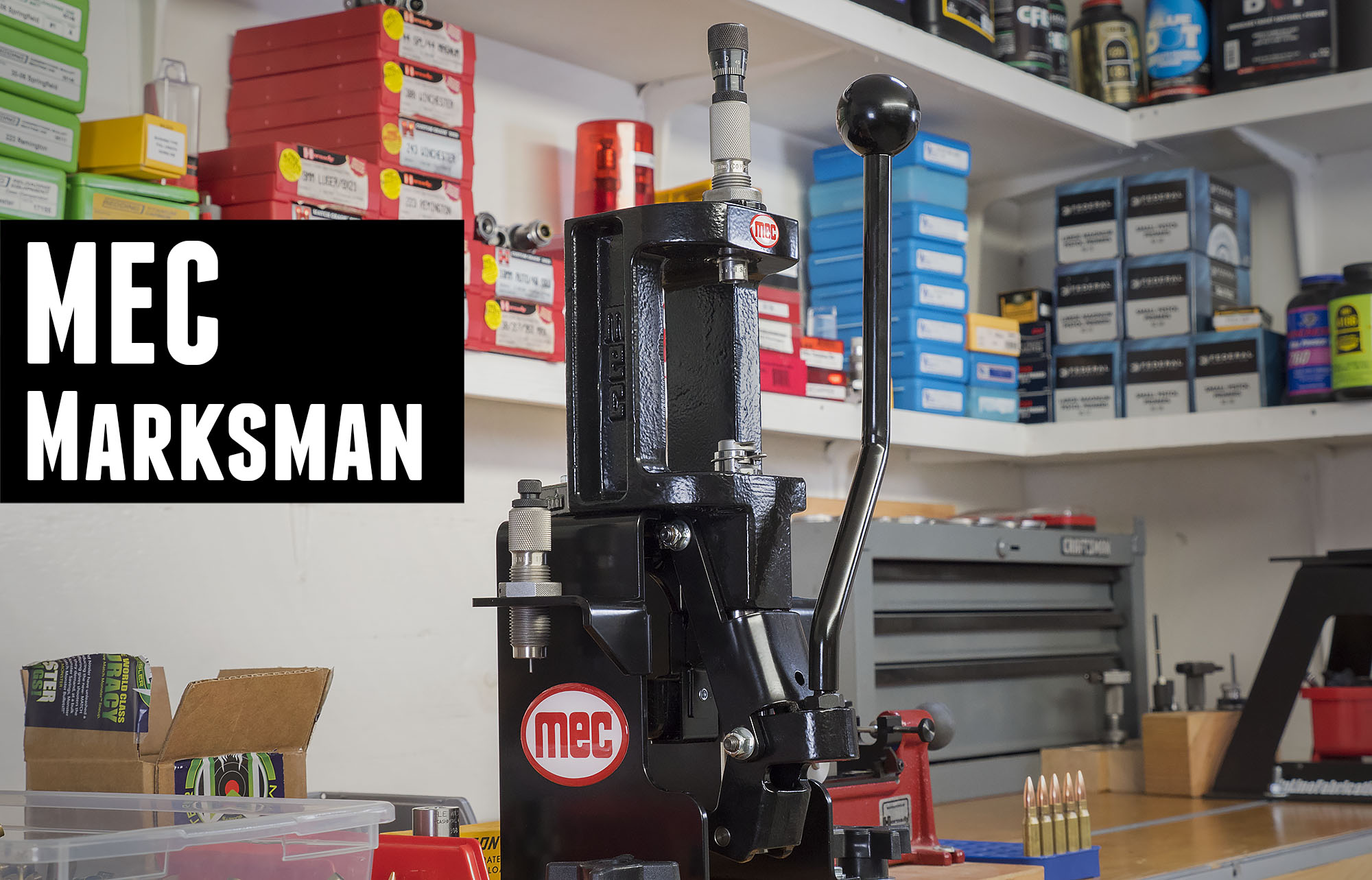
If you need a heavy-duty, single-stage reloading press, definitely look at the MEC Marksman, a beefy black single-stage unit with many impressive features. MEC, noted for its shotshell reloading machines, now offers the cast-iron MEC Marksman press, offering many features we really like. First, the rugged, cast-iron frame is strong enough for the toughest reloading jobs. Second, the Marksman features an OPEN front — that smart design makes it easier to insert and remove cartridge cases. It also makes it much easier to place your bullets during the seating stage.
This open-front design makes good sense — note that Hornady’s LNL single-stage press also has an open-front layout. Importantly, the MEC Marksman has an innovative, self-centering shell-holder. This patented design should help hand-loaders reload more efficiently.
We are impressed with the MEC Marksman press. The Marksman combines a sturdy cast-iron frame with a smart, user-friendly open-front design. The Marksman ($257.54 at MidwayUSA) costs $30 more than an RCBS Rock Chucker ($227.61 at MidwayUSA). However the MEC Marksman offers some distinct advantages — such as the open front plus the patented floating shell-holder system.
MEC Marksman Press Review by Ultimate Reloader
UltimateReloader’s Gavin Gear got his hands on a MEC Marksman press and put it through its paces. He came away impressed with the product, saying it delivers excellent performance, and has many impressive features. Gavin tells us: “Cast iron tools and machines are a lifetime investment. The made-in-USA MEC Marksman features ductile cast-iron construction, an open-front frame design for easy cartridge access, a new floating shell-holder design with a unique retention system, and ambidextrous handle setup.”
Gavin liked the Marksman’s system for holding spent primers. A tray sits behind the ram to catch spent primers exiting from a hole near the bottom of the ram. This is more foolproof than the plastic primer cups on some other single-stage presses. Expect less spent primer “spillage”.
The Marksman is sold as a stand-alone unit. However MEC also offers a very nice steel mount/riser for the Marksman. Gavin tested the Marksman with this riser, and he says it was sturdy and well-built. Gavin liked the riser. He said that elevating the Markman press up above the benchtop made it easier to handle cases and to operate the handle. You also get extra left- and right-side die-holders.
Manufacturer’s Product description: The MEC Marksman® is made from ductile cast iron for superior quality and durability. Our patented shell holder self-centers each cartridge. The MEC Marksman® is compatible with all 7/8-14 thread dies to change calibers quickly. Reloading .22 Hornet to .416 Rigby can all be done with one convenient machine.
British Lee-Enfield Model SHT’22/IV Rifle, courtesy www.iCollector.com.
Our friend Dennis Santiago was a technical advisor for History Channel’s Top SHOT TV show. One of the notable Top Shot episodes involved the “Mad Minute”, a marksmanship drill practiced by the British Army in the decades preceding World War I. Dennis observed that the Top Shot competitors didn’t fare too well in their “Mad Minute” attempts, not scoring many hits in the allotted one-minute time period. That prompted Dennis to give it a try himself — seeing how many hits he could score in one minute with an authentic Lee-Enfield rifle. So, a while back, Dennis ran the drill at a range in California.
Dennis, an active high power rifle competitor and instructor, explained that a “Mad Minute” exercise takes practice to perfect: “Here is a ‘Mad Minute’ drill, done using a period correct Lee-Enfield (SMLE) No.1 Mk III rifle and Mk VII ammo. I got to the Queen’s Regulations (15 hits in one minute) on the second run and put a good group on the target at 200 yards. This is ‘jolly good fun’ to do every once in a while. This is ‘living history’ — experiencing a skill from a time when the sun never set on the British Empire.”
“Mad Minute” was a pre-World War I term used by British Army riflemen during training at the Hythe School of Musketry to describe scoring a minimum of 15 hits onto a 12″ round target at 300 yards within one minute using a bolt-action rifle (usually a Lee-Enfield or Lee-Metford rifle). It was not uncommon during the First World War for riflemen to greatly exceed this score. The record, set in 1914 by Sergeant Instructor Alfred Snoxall, was 38 hits. (From WikiPedia.)
History of the MAD MINUTE Commentary by Laurie Holland, UK Shooter
The original military requirement of the “Mad Minute” saw the soldier ready to fire with a round in the chamber, nine in the magazine, safety on. This course of fire is still followed by the GB Historic Breechloading Arms Association and other bodies in their recreated “Mad Minute” competitions.
The first 10 would go quickly, but reloads were critical, this not done by a magazine change as Gary did with the RTM or in a modern tactical or semi-auto rifle, but through slick use of ‘chargers’. It is this aspect which fouls so many of my colleagues up as it is very easy to cause a jam and a large part of 60 seconds can go in sorting it out!
Charger clips were selected for those that just held the rounds firmly enough to stop then falling out, were sand-papered and polished with a stove / fireplace polish called ‘Zebrite’ so that the rimmed rounds would slip through the clips like corn through a goose.
If you’re unfamiliar with the cock-on-closing Enfield action, it seems clumsy. With intensive practice it is very smooth and can be operated incredibly quickly. The trick is to whip the bolt back onto its stop and initiate a rebound movement that takes it and the cartridge well into the chamber thereby reducing the effort required to close the bolt and chamber the round.
The MAD MINUTE Training Standards and Target
“Mad Minute” was a pre-World War I term used by British Army riflemen during training at the Hythe School of Musketry to describe scoring a minimum of 15 hits on a target at 300 yards within one minute using a bolt-action rifle (usually a Lee-Enfield or Lee-Metford rifle). It was not uncommon during the First World War for riflemen to greatly exceed this score. The record, set in 1914 by Sergeant Instructor Alfred Snoxall, was 38 hits.
Royal Scots Fusiliers soldiers train with SMLE Mk III Lee–Enfield rifle.
Listed as “Practice number 22, Rapid Fire” of The Musketry Regulations, Part I, 1909, this drill required at least 15 shots on the Second Class target at 300 yards. The exercise was just one of several annual tests to classify a soldier as a sharpshooter, first or second class shooter depending on the points achieved.
Research indicates the Second Class target was a 48″ x 48″ square with 24″ inner circle and 36″ outer circle. The sight mark was a central 12″ x 12″ shape representing a soldier. ALL hits scored points (3 for center circle, 2 for outer circle, 1 for outer square). NOTE: Though some sources say the Mad Minute drill used a 12″-diameter round target, this appears to be a mistake from Ian Hogg’s book “The Encyclopedia of Weaponry”. No other source mentions a 12″ circle, which would be a mere 3.82 MOA. In reality the true drill target was a 48″ x 48″ square, roughly 15 times larger. (From No.WikiPedia.)
Keanu Reeves, the A-List Hollywood actor who starred in The Matrix, Speed, Point Break, and other hit movies, is a talented shooter. For his role in the popular John Wick series of movies, Reeves has done extensive training with our friend Taran Butler, one of the nation’s top 3-Gun competitors. Check out this video showing Keanu Reeves running through some multi-gun stages. The actor’s speed on target is outstanding, and his transitions are very fast. We’ve run some multi-gun matches in the past. Trust us, it takes a lot of training and dedication to get this fast. You also need good equipment.
Watch Keanu Reeves Display Impressive Multi-Gun Speed in this Video:


 Team Smith & Wesson shooter


 If you need a heavy-duty, single-stage reloading press, definitely look at the MEC Marksman, a beefy black single-stage unit with many impressive features. MEC, noted for its shotshell reloading machines, now offers the cast-iron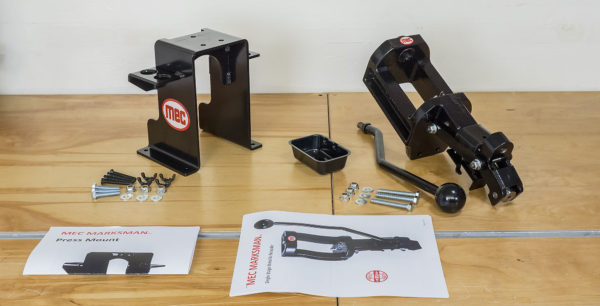


 Lee-Enfield No. 4 Rifle (1943), courtesy


 Research indicates the Second Class target was a 48″ x 48″ square with 24″ inner circle and 36″ outer circle. The sight mark was a central 12″ x 12″ shape representing a soldier. ALL hits scored points (3 for center circle, 2 for outer circle, 1 for outer square). NOTE: Though some sources say the Mad Minute drill used a 12″-diameter round target, this appears to be a mistake from Ian Hogg’s book “The Encyclopedia of Weaponry”. No other source mentions a 12″ circle, which would be a mere 3.82 MOA. In reality the true drill target was a 48″ x 48″ square, roughly 15 times larger. (From


