Though some manufacturers introduce new rifles mid-year, many officially launch new rifles at SHOT Show each January, though often with late fall previews before the actual show. There have been some very innovative rifles introduced recently, including the Nosler Carbon Chassis Hunter shown above and the new PWS UXR featured in a separate article.
In today’s Saturday Showcase, we feature seven videos that cover a huge variety of rifle types — from air rifles to long-range, large-caliber ELR rigs. The first video below covers 11 different rifles, and the other six videos cover more than two dozen other rifles. Watching these videos is a good way to see a host of different rifle options in a short period of time.
11 New/Recent Rifles with Factory Promo Videos
This videos features new offerings from Mossberg, Benelli, Stag Arms, Bergara, and more. There’s also the return of a classic, the Marlin 336.Rifles listed in this video (with video times):
When you’re in mountainous backcountry pursuing big game, you don’t want to be hauling around a 12-pound rifle. Thankfully, with carbon fiber and other modern materials, there are quality hunting rifles at 6 pounds or less. The host of this video notes: “When you go hunting, the last thing you want is to carry a heavy gun with you that gets you tired and weighs you down. The good news is that this is not necessary anymore. In times of titanium carbon fiber, and Kevlar, hunting rifles get lighter and lighter while keeping all the high-quality, reliability, and accuracy that you expect of them. So, without further ado, let’s take a look at these lightweights that will serve you well.”
Savage Arms KLYM Light Rifle
Here is innovative engineering from Savage Arms. The impressive new Savage KLYM rifle employs carbon fiber components for major weight savings. The HuntStand team had a chance to field test the new KLYM rifle series: “Based on a new carbon-fiber platform, Savage KLYM cuts weight so you can go farther in your quest for beasts off the beaten path.” With its Proof Research carbon fiber-wrapped stainless barrel and FBT carbon fiber stock, the new KLYM is listed as weighing under 6 pounds.
Recommended Take-Down Camp Rifles
We think every avid hunter can use a take-down rifle. Able to separate into two shorter sections, a good take-down rifle can be carried conveniently in a day pack, yet assembled easily in a minute. This video covers a variety of take-down rigs, most of which are chambered for rimfire cartridges. Some of these rifles are ultra-light, weighing less than 4.5 pounds without optic.
Accurate .22 LR Rifles for 2024
This PewPew Zone video showcases multiple .22 LR rifles. Shown above is the CZ 457 with Manners Precision stock. The rimfire rifles featured in this video (in order) are: Lithgow LA 101, Anschutz 1761, Tikka T1x MTR, CZ 457 Varmint Precision Trainer, Savage Mark II FV, and Ruger Precision Rimfire.
Long Range Rifles
This video focuses on larger-caliber rifles intended for long-range target shooting and tactical applications. Rifles featured in this video include: Barrett MRAD MK22, Howa 1500, Bergara B14, Accuracy Int’l AXSR, Tikka T3X TAC A1, Daniel Defense Delta 5, Ruger Precision Rifle. Unfortunately, the interesting rifle shown on the static intro frame is more of a teaser and is not separately tested.
Best Air Rifles for 2024
Air rifles are fun and very inexpensive to shoot. There are a variety of air rifle disciplines now: from benchrest competition, 3-position shooting, air rifle silhouette, tactical matches, and the popular Field Target Competition. You can shoot air rifles for a small fraction of the cost of centerfire firearms.
A radical new tactical rifle, the UXR (User Xchange Rifle) was just introduced by PWS (Primary Weapons Systems). This unique, revolutionary rifle allows users to quickly switch chamberings by exchanging just three parts: barrel, magwell, and bolt head. Initially available in 5.56×45 and .300 BLK variations, the UXR platform will also be available in .308 Win and 8.6 BLK configurations later this year.
Our friend True Pearce of GunsAmerica Digest Tests the new PWS UXR:
The new UXR rifle has a unique, patent-pending Xchange system. The upper receiver of the UXR is the only serialized part of the setup, enabling the shooter to easily transition from configuration to configuration, caliber to caliber. Adaptability is the core principle of the UXR, showcased in its many customizable features such as an adjustable buttstock that can fold left or right, an adjustable cheek plate, and ambidextrous-able selector switch, magazine release and even the charging handle.
The UXR platform also features a proprietary “modified long-stroke piston system” which allows the rifle to run reliably with any UXR barrels regardless of caliber. This internal system allows the user to swap calibers and barrels without needing to adjust the gas system each time. And the newly-designed Bore Evacuator reduces back pressure, especially when a suppressor is being used, making the UXR a good choice for suppressed shooting.
For more information on the UXR, visit Primaryweapons.com/firearms/uxr. PWS will have the UXR at the Industry Day at the Range on January 22, 2024, and it will be showcased at SHOT Show 2024.
The RCBS Lock-Out Die can also be used with some Dillon and Hornady progressive presses.
If you load pistol or rifle ammo with a progressive press, we strongly recommend you get a Lock-Out Die from RCBS. This unique reloading die will prevent your progressive press from advancing if the dispensed powder charge is more or less than about 0.3 grains too high or too low. The Lock-Out Die really works. Your Editor uses it on his RCBS 2000 progressive press. I can affirm that a Lock-Out Die has “saved my bacon” a half-dozen times over the years when there was an over-charge (which could cause a Kaboom) or a low charge (which could cause a squib load).
The Lock-Out Die works by using a central die detection rod that sets its vertical position based on the height of the powder column in the case. Through an ingenious design, if the powder column height is too low or too high, the rod locks in place as you start to pull the press handle. This halts the press before the ram can lift and the cartridge plate can advance. Unlike a beeping alarm system (which can be ignored or defeated), the Lock-Out Die physically stops the movement of the press ram and prevents a bullet being seated in the “problem” case.
It takes a bit of tweaking to get the Lock-Out Die detection rod setting just right, but once it is correctly positioned, the Lock-Out Die works smoothly in the background. The Lock-Out Die won’t interfere with the loading process unless it detects a high or low charge — and then it positively stops the progressive loading cycle.
While crafted for use in RCBS progressive presses, the RCBS Lock-Out Die can also be used on a Dillon XL Progressive (see video below) or Hornady Lock-N-Load progressive — though it does take up one station which could otherwise be used for a final crimp die (after the seating die). The RCBS 2000 has one more station than a Dillon 550/650, so it’s an ideal platform for using the Lock-Out Die.
Learn More at UltimateReloader.com
On the UltimateReloader.com website, run by our friend Gavin Gear, you’ll find an excellent two-part series on the function and set-up of the RCBS Lock-Out Die. Part One explains how the Lock-Out Die functions, using cut-away illustrations. Part Two shows how to install and adjust the Lock-Out Die on various progressive presses. The Ultimate Reloader video at the top of this article shows setup of the RCBS Lock-Out Die on the Dillon XL-650 progressive press, while the Reloading Bench video below shows the Lock-Out Die on a Hornady LnL progressive.
Ever wish you could look inside your rifle, to see how the trigger and fire-control system work? Well now that is possible with the magic of 3D computer graphics. Modern software allows detailed “cutaway” side-views (see below), as well as 3D views with 360° rotation. The software can also provide X-Ray-type views into the gun’s internals — as you can see above. And computer animation can show the complete firing process from trigger pull to chambering of the next round.
Rem 700 Cutaway View from Right Side
This article provides some very cool 3-D “Cutaway View” animations of the popular Remington 700 action, probably the most successful American bolt-action ever created.
READERS — Take the time to watch the video! The Rem 700 animation is really outstanding! EVERY bolt-action shooter should watch this video all the way through.
Cutaway 3D Animation of Rem 700 Action — Watch Video
The Model 700 series of bolt-action rifles have been manufactured by Remington Arms since 1962. All are based on basically the same centerfire bolt action. They are typically sold with an internal magazine depending on caliber, some of which have a floor-plate for quick-unloading, and some of which are “blind” (no floor-plate). The rifle can also be ordered with a detachable box magazine. The Model 700 is a development of the Remington 721 and 722 series of rifles, which were introduced in 1948.
The Remington 700 is a manually-operated bolt action with forward, dual opposed lugs. It features “Cock On Opening”, meaning the upward rotation of the bolt when the rifle is opened cocks the firing pin. A cam mechanism pushes the firing pin’s cocking piece backward. The bolt face is recessed, fully enclosing the base of the cartridge. The extractor is a C-clip sitting within the bolt face. The ejector is a plunger on the bolt face actuated by a coil spring. The bolt is of 3-piece construction, brazed together (head, body. and bolt handle). The receiver is milled from round cross-section steel.
This video was made with the help of the World of Guns: Gun Disassembly interactive encyclopedia with 3D rendering. This remarkable web-based software allows users to view the inner workings of hundreds of different rifles and pistols — everything from a .22 LR Ruger to a .55-caliber Boys Anti-Tank rifle. There are also 25,000+ parts diagrams. This is a remarkable technical resource. SEE MORE HERE.
If you are evaluating a firearm for self-defense use, you should consider three main factors: Reliability, Functionality (sights, trigger, ergonomics), and Effectiveness (ability to halt/neutralize threats). Regarding effectiveness, you need to consider what happens when the projectiles from your firearm reach the target. That involves penetration and terminal ballistics.
A 12ga shotgun is very effective inside 20 yards, with less risk of over-penetration* vs. a centerfire rifle.
You’ve probably heard the term “Terminal Ballistics”. But do you really know what this refers to? Fundamentally, “Terminal Ballistics” describes the behavior of a projectile as it strikes, enters, and penetrates a target. Terminal Ballistics, then, can be said to describe projectile behavior in a target including the transfer of kinetic energy. Contrast this with “External Ballistics” which, generally speaking, describes and predicts how projectiles travel in flight. One way to look at this is that External Ballistics covers bullet behavior before impact, while terminal ballistics covers bullet behavior after impact.
The study of Terminal Ballistics is important for hunters, because it can predict how pellets, bullets, and slugs can perform on game. This NRA Firearm Science video illustrates Terminal Ballistics basics, defining key terms such as Impact Crater, Temporary Cavity, and Primary Cavity.
External Ballistics, also called “exterior ballistics”, is the part of ballistics that deals with the behavior of a non-powered projectile in flight.
Terminal Ballistics, a sub-field of ballistics, is the study of the behavior and effects of a projectile when it hits its target.
*This Shooting Illustrated article discusses over-penetration risks with a variety of cartridge types. “A bullet passing through a threat and continuing with the potential to cause unintentional damage to a bystander or object is a situation commonly described as over-penetration.”
Keith Glasscock is one of America’s greatest F-Class shooters, as well as a highly respected wind coach. A High Master, Keith finished second overall at the 2021 NRA F-Class Long Range Championship in F-Open division. He also finished second at the 2020 F-Open Nationals, and second at the 2019 F-Open Nationals. His consistency is unrivaled, which means he definitely knows the secrets of competition shooting and loading ultra-accurate ammo. Recently Keith has started PRS/NRL competition, bringing his shooting skills to those popular tactical disciplines.
Keith has a great YouTube Channel with new content every week. On Keith’s Winning in the Wind channel, Keith offers 190+ informative videos on a wide range of topics including wind reading, reloading, component selection, load development, and training. For today’s Video Showcase, we offer four of our favorite Keith Glasscock videos. Each video has important points that can benefit any competitive rifle shooter, whether you shoot in local 100-yard fun matches or compete at the National Level in F-Class, LR Benchrest, Palma, or High Power.
How to Reduce Extreme Spread (ES) and Standard Deviation (SD)
Having minimal Extreme Spread (ES) does not necessarily guaranteed optimal accuracy. Some PPC shooters accept a relatively high ES for a load that shoots best at 100/200 yards. But very low ES — i.e. having bullets all exit the muzzle at virtually the same FPS speed — can definitely reduce vertical dispersion at long range (assuming consistent bullet BCs). In this video, Keith talks about various methods to reduce ES and SD. This can include seating depth, primer choice, powder charge weight, brass prep, bullet seating methods and more. Our tip is to have good smoothly-chamfered case mouths, use a quality arbor press with seating force measurement, measure powder loads very precisely, and use the highest-quality brass you can find.
Keith notes that, to achieve the lowest ES, you need to look at multiple processes, including precision powder weighing, careful seating, brass annealing, and primer selection. Another factor is bullet selection. Not all bullets of the same nominal caliber and weight class have exactly the same bullet diameter or shape. Sometimes you can get better accuracy AND lower ES by trying a different brand of bullet. We have found bullet diameters, of the same stated caliber, can vary by up to .0008″ (eight ten-thousandths). Some barrels like the fatter bullets, while other barrels may favor the skinny bullets.
Top 10 Methods to Improve Your Shooting Accuracy
To shoot top scores, you need great skills and great hardware. This video covers 10 things that can improve accuracy, starting with the most important. The #1 item, notes Keith, is rifle shooting skill — you need to be able to hold on target properly and run the rifle consistently shot after shot. The second most important thing is an accurate rifle — you need a rifle with an excellent barrel, quality components, and top-tier inherent accuracy. Third, you need very accurate ammo, and this means you need to perfect your reloading skills. You need precise powder measurement and good, consistent bullet seating. Fourth in the list is related to ammo — you need the ability to do effective load development to pick the best load for your particular barrel. Number 5 is the “right bullet”. You need a high-quality, ultra-consistent bullet that is a good match for your particular barrel and discipline. Watch the video for the other five items.
Balance Beam vs. Advanced Electronic Scale with AutoTricker
Here Keith evaluates the performance of ammo loaded with a conventional balance beam scale vs. ammo loaded with a precision, electronic force-restoration scale fitted with an AutoTrickler V4. It turns out that the balance-beam loaded ammo was actually quite accurate and consistent. Keith concluded that balance-beam ammo may well be good enough for PRS/NRL competition. However for other disciplines, such as benchrest and F-Class, Keith suggest it may be worth the investment. But the key factor is also time — with the precision scale and AutoTrickler Keith can load large quantities of competition-grade ammo much, much faster. Keith points out he puts value on his time, reminding us that, indeed, “time is money”.
Barrel Break-In Procedure for Match Barrels
In this video, Keith explains his procedure for breaking-in his match barrels. He starts by bore-scoping the barrel and cleaning it. If he finds some burrs he may use some JB Bore Paste, a patch, and a worn brush and “give that throat a little scrub” (See 1:30 time-mark). He used different stroke lengths to avoid putting a “step” in the throat. When he’s satisfied he goes to the range. He fires the first five rounds, then cleans. He then fires quite a few rounds before cleaning the barrel again and beginning load development (See 8:25 time-mark).
Bullet Sorting Methodology — Effective Methods
Bullet sorting can improve scores and accuracy, particularly for long-range competitions. There are various methods for sorting — weight, base-to-ogive measurement, bearing surface length, tip condition, and max diameter. In this video Keith explains the pros and cons of various methods. The best choice can also depend on the brand, design, and caliber of each bullet. Some bullets show significant base to ogive variance, other bullets (such as Lapua Scenars), have been extremely consistent. Overall, if you are a long-range competitor, is it probably useful to bullet sort, and you can use outliers for fouling shots.
Tripod Options for PRS/NRL Competition
Over the past two seasons, Keith has added PRS/NRL shooting to his competition resume. Along with his stellar F-Class skills, Keith now has considerable experience with tactical competitions. And he’s learned that having a good tripod will make a difference over the course of a match. In this video, Keith looks at various tripod options and explains the ways you can use a tripod for PRS/NRL centerfire and rimfire competition. While the tripod can obviously be used to support the rifle, it can also be used for various other functions, as shown in the video.
Some custom barrel makers are now honing barrels (after drilling) to improve bore diameter uniformity, smooth the interior finish, and reduce barrel lapping times. For years, large-scale manufacturers of hammer-forged barrels have employed honing. Now the process is being used by smaller, “boutique” barrel-makers. This article explains how and why barrel honing is done. Take the time to watch the video. For anyone with an interest in barrel-making, this video from Sunnen Products Co. is an eye-opener.
Barrel Honing Process Demonstrated (Worth Watching!):
For custom barrel makers, honing is a time-saver and cost cutter. A few minutes on a honing machine can cut lapping times in half, leaving a cross-hatched surface finish in single or low double-digit Ra. Honing is the same process used to make diesel fuel injectors with bore roundness and straightness controlled to fractions of a micron (<0.000040"), with surface finish Ra ≤0.15 µm (6 µin).
A key manufacturing process used for hammer-forged barrels is now getting attention from the makers of custom button-rifled barrels. This process is precision bore-honing. Honing produces a high-quality bore surface fast, which is critical to hammer forging. (Why is honing so important with hammer forging? Surface finish is the one feature of the barrel that cannot be controlled in hammer forging. Surface imperfections in a barrel blank tend to be amplified as the blank is formed on the rifling mandrel. And if the bore is chromed afterwards, imperfections in the surface finish become even more obvious.)
Honing dramatically improves bore diameter size uniformity and accuracy, surface finish and roundness throughout the length of the barrel. It can certainly be used in place of a pre-rifling lap. The chief difference between a lapped and honed bore is the direction of the finish lines in the bore. Honing leaves fine spiraling crosshatch lines, while a lap leaves lines going longitudinally in the bore. After rifling the manufacturer can remove the crosshatch finish with a quick lap if desired. Honing is fast, accurate, and can be automated. Its surface quality and geometry can duplicate lapping, except for the longitudinal lines of the lapped finish.
In 2015 Frank Green of Bartlein Barrels told us: “We worked with Sunnen and we did all the initial testing on the prototype machine for them. The machine works great! We ordered and received … a new manufactured machine with the changes we wanted on it and [subsequently] ordered a second one.”
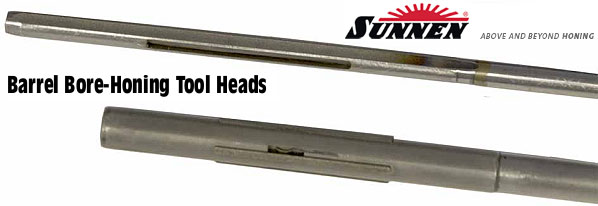
The Sunnen hone secures the barrel blank in a 3-jaw chuck, with honing oil pumped into one end while the tool works from the opposite end. Sunnen’s specialized Long Bore Tool uses metal-bond diamond or CBN superabrasives to quickly remove reamer marks, waviness, tight spots and other imperfections left by upstream processes.
Sunnen states that: “Honing is an ideal replacement for hand-lapping barrel blanks before rifling. It quickly removes reamer scratches and surface waviness without labor-intensive hand lapping. By producing a consistent bore diameter (±0.0001″ or less), parallelism, roundness and surface finish end to end, honing yields more consistent performance from rifling buttons and cutters, resulting in a constant groove depth. The ideal bore geometry reduces distortion of the bullet shape.”
Computer-Controlled Bore-Honing
Honing can be done with great precision through the use of advanced, computer-controlled honing machines. Sunnen Products Company offers an advanced machine for .17 to .50-caliber barrels (see control panel below). The spindles on this machine can correct bore size imperfections so small only an air gauge can measure them. The consistency this allows improves bore uniformity, which, in turn, produces more accurate barrels for the precision market.
Sunnen Products Company is the world’s largest vertically-integrated manufacturer of honing systems, tooling, abrasives, coolants, and gauging for precision bore-sizing and finishing. Sunnen’s customers include manufacturers of diesel and gas engines, aerospace components, hydraulic components, oil field equipment, and gun/cannon barrels. Sunnen employs more than 600 people worldwide.
Here’s a very cool 3D Animation showing pistol rounds being fired. Computer-generated graphics provide a look inside the cartridge at the moment of ignition as the primer fires and the flame front moves through the ignited powder. It’s really kind of mesmerizing. If you’ve every wondered just what happens inside your cartridges the moment that firing pin strikes, then watch this video…
Watch Video to See Handgun Ammo Being Chambered and Fired:
Mute Enabled — Click Speaker Icon to Hear Audio. Firing Sequence Starts at 1:28.
This animated video from German ammo-maker GECO (part of the Swiss RUAG group of companies) reveals the inside of a pistol cartridge, showing jacket, lead core, case, powder and primer. Employing advanced 3D rendering and computer graphics, the video shows an X-ray view of ammo being loaded in a handgun, feeding from a magazine.
Then it really gets interesting. At 1:28 – 1:50 you’ll see the firing pin strike the primer cup, the primer’s hot jet streaming through the flash-hole, and the powder igniting. Finally you can see the bullet as it moves down the barrel and spins its way to a target. This is a very nicely-produced video. If you’ve ever wondered what happens inside a cartridge when you pull the trigger, this video shows all. They say “a picture’s worth a thousand words”… well a 3D video is even better.
The Rimfire Challenge Shooting Association (RCSA) is now an official partner of the +ONE Movement, a mentorship program organized by the National Shooting Sports Foundation (NSSF). “RCSA is looking forward to a long relationship with NSSF,” stated RCSA Board President Peter Swenson.
NSSF +ONE programs encourage mentorship related to firearm safety, firearm basics, shooting sports, and hunting. The +ONE program focuses on peer-to-peer development in shooting sports and hunting.
About the Rimfire Challenge Shooting Association
Designed to introduce new shooters to shooting sports in an exciting, family-friendly format, Rimfire Challenge matches focus on competition with .22 LR rifles and pistols. Matches are open to shooters of all shooting experience levels, with events conducted at ranges nationwide. The annual RCSA World Championship takes place each October. See match action in the video below. The RCSA promotes rimfire competition nationwide, supports beginning competitors and clubs, and solicits support for rimfire events from industry businesses.
Watch Action from the 2023 Rimfire Challenge Championship at Cavern Cove Range in Alabama
Programs that inspire mentoring can make a huge difference. According to recent research, if just one out of three target shooters and hunters can introduce someone new to the shooting sports, we can help to secure a strong future for generations to come.
The NSSF encourages shooting sports enthusiasts and hunters to join the +ONE movement and invite someone to the range or afield. Learn more about the +ONE Movement by visiting LetsGoShooting.org and LetsGoHunting.org.
This article is Copyright 2023 AccurateShooter.com. No reproduction on any other site is permitted.
Do you have a friend or family member who is a first-time gun owner? Then show them this article. It provides important guidelines for new gun owners. There’s an Infographic printed below. And, there’s a helpful Firearm Storage and Safety Assessment Quiz. This walks gun owners through questions related to safe handling and storage of firearms. Here is Part One of the Quiz. If you click on this part, you can complete the entire Quiz and see how you score.


 If you load pistol or rifle ammo with a progressive press, we strongly recommend you get a Lock-Out Die from RCBS. This unique reloading die will prevent your progressive press from advancing if the dispensed powder charge is more or less than about 0.3 grains too high or too low. The Lock-Out Die really works. Your Editor uses it on his RCBS 2000 progressive press. I can affirm that a Lock-Out Die has “saved my bacon” a half-dozen times over the years when there was an over-charge (which could cause a Kaboom) or a low charge (which could cause a squib load).


 This video was made with the help of the



 This animated video from German ammo-maker


