SIG Sauer has a new .22 LR rimfire handgun — the P322-COMP pistol. Designed for speed, accuracy, and flat shooting (low muzzle flip), this new rimfire pistol from SIG SAUER is ready for competition right out of the box. It comes with a red dot optic, barrel-mounted compensator, slide-mounted racker, good trigger, and high-capacity (20- and 25-rd) magazines. READ P322 Manual.
We think this would be a good choice for fun action pistol matches. One YouTube viewer noted: “I applaud SIG… basically [the P322-COMP is] the first RFPO (Rimfire Pistol Open) factory option for Steel Challenge. Every other gun on the market you have to buy the optic, thumb rest, and compensator.”
SIG P322-COMP — Components and Features Video
NOTE: This 44-second video from SIG Sauer has detailed illustrations of all components with 3D rotation of the pistol so you can see it from all angles.
SIG Sauer states: “The P322-COMP ships with a factory-installed ROMEO Zero ELITE Red Dot optic for fast target acquisition, is designed with a slide mounted racker and sport takedown lever as value-added fun features. It has a barrel-mounted compensator to reduce muzzle rise making the P322-COMP a fast, fun, and [flat-shooting pistol].
The SIG SAUER P322-COMP is a competition-ready .22 LR rimfire pistol with class-leading 25+1-round and 20+1-round capacity. It has a threaded barrel equipped with a 2-port compensator and comes with a factory-installed ROMEO Zero Elite Red Dot Optic. The polymer grip features an extended magazine catch, adjustable trigger shoe, sport takedown lever, 1913 rail, and integrated magwell. The Single Action Only hammer-fired action on the P322-COMP is completely enclosed in a two-tone competition alloy slide with a high viz fiber-optic front sight, plus front, rear, and top cocking serrations. The ambidextrous, slide-mounted racker ensures easy slide manipulation. The pistol ships with (1) 20-round magazine and (1) 25-round magazine.
P322-COMP Specs:
Caliber: .22 LR
Capacity: 20+1, 25+1
Barrel length: 4 inches
Sight Radius: 6 inches
Weight (w/magazine): 19.8 oz.
22Plinkster Review of P322-COMP Pistol
Note how fast 22Plinkster can hit multiple targets with this new brake-equipped pistol. No question this rimfire pistol would be fun to shoot on steel targets.
TheHumbleMarksman Review of P322-COMP Pistol
This video starts with close-up, slow-motion footage of the pistol. Components and magazines are illustrated at 0:55-1:30 time segment, and there’s a good explanation of how the compensator works at the 6-minute mark.
Creedmoor Sports has released a series of helpful “how-to” videos in its new InfoZone web page. In the latest InfoZone video Bill Gravatt shows how to seat bullets using L.E. Wilson Hand Dies and an Arbor Press. The basic process is simple, particularly with a micrometer-top seating die. That makes it easy to adjust and set seating depth. Before you start seating bullets, you want to adjust the height of the arbor so the stroke is appropriate to the height of your die.
Bill Gravatt Shows How to Use Hand Seating Dies — Creedmoor INFOZONE
ARBOR PRESS TECHNIQUE: When using an arbor press, smooth is good. You don’t want to slam the handle down quickly. Try to repeat the same motion each time. You can also experiment by seating the bullet part way, then rotate the cartridge (in the die) and do the final seating with a second stroke. If your arbor press has a force gauge, note both the max value of the gauge needle and how it moves as you seat the bullet. If the needle spikes too rapidly, or bounces back and forth irregularly, set that cartridge aside and/or mark it. You could have neck tension issue with that case or some other fault. You might even have a bad bullet. That’s rare, but can happen. The key to success is moving the press arm in a smooth motion every time, maintaining the same down-pressure with each cartridge.
Here Bill Gravatt Offers a Simple Tip for Adjusting Wilson Seating Dies
One of our Forum readers asked “How can I get a custom in-line seater for my new rifle?”. First, we would say that, if you are not shooting an unusual Wildcat, check first to see if L.E. Wilson makes a stainless Micrometer Seater Die for your rifle. These dies are a joy to use, and we’ve found the fit to be exceptionally good with many calibers. Typically priced from $95-$115, Wilson stainless micrometer-top seaters are available for dozens of cartridge types: .204 Ruger, 20 BR, .222 Rem, .223 Rem, 22 PPC, 22 BR, .22-250, .223 WSSM, 6 PPC, 6mmBR, 6XC, 243 Win, .243 WSSM, 25 WSSM, 6.5×47 Lapua, 6.5 Creedmoor, 6.5-284, 26 Nosler, .270 WSM, 7mm-08, .284 Win, 28 Nosler, 7mm RUM, 30 BR, 30 IHMSA, .308 Win, .300 WinMag, .338 Edge (and MORE).
If you do want a custom seater die, the process is relatively simple. Purchase a die blank from Wilson and have your gunsmith run the chambering reamer in. Forum member Gunamonth explains: “I start with a Wilson seating die blank. They’re available from Sinclair and other vendors. Just run the reamer in. For some of my rifles, where I wanted the stainless die with the micrometer adjustment, I bought a smaller die and had the smith ream it with the chamber reamer. That’s how I had my 6 Dasher and 6mm AI seaters made. With the Dasher I stared with a 6mmBR Micrometer die.”
SEATER STEM TIP: If, on your seated bullets, you are seeing a sharp line around the jacket near the ogive, you may want to smooth out the leading edge of the Wilson seater stem (see above left). Do this by putting a little lapping compound on one bullet and manually spin this around in the stem. Without much effort you’ll have a smooth bullet/stem interface.
Micrometer Top Add-on
We really like micrometer tops on a seating die. But what if Wilson doesn’t make a micrometer top seater for your chambering? Don’t despair, Brownells sells a $39.99 Sinclair Micrometer Top that can be added to Wilson standard seaters or to a custom seater die made from a Wilson die blank.
The December issue of Shooting Industry (SI) magazine features new products from many leading companies including Sig Sauer, CZ, Marlin, MDT, Springfield Armory, Savage, Garmin, Taurus and more. Part One of SI’s 2024 New Product Showcase features cool, new products from over 60 brands. This month’s product feature is the first of a three-part series, with other segments slated for January and February.
Here are some of the most noteworthy new guns and gear items featured in the December Shooting Industry Magazine Issue which can be accessed for free on the web:
CZ 600 American Rifle
The CZ 600 American is an American-style bolt-action centerfire rifle fitted with a nice Turkish walnut stock. The handsome CZ 600 American is offered in a wide range of popular chamberings including: .223 Rem, .243 Win, 6.5 Creedmoor, .308 Win, .270 Win, .30-06 Sprg, and .300 WinMag. Notably, CZ offers a sub-MOA accuracy guarantee with the CZ 600.
CZ 600 AMERICAN features:
Guaranteed sub-MOA accuracy (3-shot groups at 100m with match-grade ammunition)
All metal components treated with CZ’s patented anti-corrosion finish
Steel receiver with a Rem 700-type mounting interface
User-adjustable trigger pull weight (CZ patent)
Symmetrical stock made of Turkish walnut
Thin profile, cold hammer forged barrel
Locking, double-stack magazine
New MDT 26 oz. HNT26 Hunting Rifle Chassis
MDT now offers a super lightweight HNT26 Chassis System for Remington 700-based medium actions. The HNT26 Chassis System is specifically designed for hunting, providing great functionality along with light weight. Weighing just 26 oz., the HNT 26 combines a magnesium alloy base with carbon fiber components for durability without compromising on weight. Features include a foam-filled carbon fiber buttstock section, and a carbon fiber fore-end with an optional integral ARCA rail. The chassis works with AICS magazines for smooth and reliable feeding.
Garmin Xero C1 Pro Compact Radar Chronograph
The Garmin Xero C1 Pro is a new compact chronograph which has proven both highly accurate and easy to use with a handy smartphone App. The Xero C1 Pro can capture velocity data for arrows, crossbow bolts, shotgun slugs, paintballs and airsoft devices. It can display projectile speed and shot count, as well as average speed, standard deviation (SD) and extreme spread (ES). Very compact, the Xero C1 Pro is easy to transport and sets up easily on a small Garmin tripod.
SIG Sauer CROSS Magnum Rifle .300 Win Mag
The new bolt-action SIG SAUER CROSS Magnum is chambered in .300 Win Magnum with a 24″ user-changeable 5R barrel. This rugged rifle features a modern receiver with two-stage Match trigger and AICS magazine. The handsome aluminum Coyote anodized frame boasts a free-floating handguard (M-LOK and ARCA compatible), with PRS-style grip. The folding buttstock adjusts for length and cheek height. This CROSS Magnum rifle weight 8.9 pounds with a 45.2″ overall length.
Taurus Judge TORO Revolver
The optics-ready Taurus Judge TORO wheelguns are available in four different setups. These all have a 3″ barrel, double-action trigger, plus a fiber optic front sight. Models offered include stainless or matte black with a cylinder that accepts 2.5″ .410 shotshells, and stainless and matte black models that accept 3″ .410 shotshells. The standard Judge TORO and Magnum Judge TORO have optics plates that fit the Holosun K-series or Shield RMSc Red Dot sight footprints. “TORO” stands for “Taurus Optic Ready Option”.
Along with the 60 New Product descriptions, the December 2023 Shooting Industry issue has a number of informative articles. First, SI Editor Jade Moldae offers the SHOT Show 2024 Preview as well as a recap of the 2023 NASGW Expo.
In another article, B.A. Stear explains how to zero a rifle indoors within a relatively short distance. In 100-Yard Zero On A 25-Yard Range? Stear explains the procedure (and calculations) needed to zero a rifle at an indoor range to simulate a longer outdoor distance.
The What’s Next For The Ammo Market? feature by Bryan Hendricks assesses the potential impact ammunition retailers may face from the pending sale of Vista Outdoors’ Sporting Products segment to the Czechoslovak Group A.S. (CSG).
Kulzer Sets Eight IBS 1000-Yard IBS Benchrest Records with 6 BRA Rifle Report by Alex Wheeler
In 2021, Glenn Kulzer of Dillon, Montana had a season that will go down in 1000-Yard Benchrest history. Glenn set eight IBS records in 2021 at the Deep Creek range in Missoula, and then was named IBS 1K Shooter of the Year. What makes this so incredible is not just the number of records but the records themselves. Normally when a world record small group is shot that’s a singular event — never accompanied by Aggregate records set by the same shooter. Glenn’s IBS record small group wasn’t a one-time lucky string. Consider this — Glenn nailed that historic small group, but also recorded multiple IBS Aggregate records in 2021. And Glenn set these IBS Heavy Gun records actually using his 6 BRA (6mmBR Ackley) Light Gun! Mighty impressive.
[Editor: These were impressive records that have stood the test of time. A quick search of the IBS record site shows Glenn Kulzer still holds six of the ten listed IBS 1000-yard Heavy Gun records. Plus, Glenn broke the Light Gun 20-Target Agg group record, but that was later bettered by Tom Mousel.]
1000-yard Benchrest Aggregate records represent a series of targets shot over the course of multiple matches during a season. That really takes any luck out of the equation. You have to keep the rifle shooting at its peak all year long. It’s the ultimate test of accuracy. But the small groups do get the most notice and Glenn also broke the small group record with a remarkable 2.6853″ 10-shot group (photo below).
Eight IBS Records Set by Glenn Kulzer in 2021
Date: 06/13/2021
Class: Heavy Gun
Record: 10-Shot Group, 2.6853″
Date: 06/13/2021
Class: Heavy Gun
Record: 10-Shot Score 100/2.6853″
Date: 2021
Class: Heavy Gun
Record: 6-Match Group Aggregate, 4.349″
Date: 2021
Class: Heavy Gun
Record: 6-Match Score Aggregate, 99.167/4.679″
Date: 2021
Class: Heavy Gun
Record: 12-Target Group Aggregate, 4.529″
Date: 2021
Class: Heavy Gun
Record: 12-Target Score Aggregate, 98.583/5.058″
Date: 2021
Class: Heavy Gun
Record: 20-Target Score Aggregate, 95.2/6.422″
Date: 2021
Class: Light Gun
Record: 20-Target Group Aggregate, 5.202″
NOTE: Two of these records have been broken. The HG 20-Target Score Aggregate record is now 95.55, set by Blake Wilson. And the LG 20-Target Group Agg record is now 4.3825″, set by Tom Mousel.
This IBS record 1000-yard group, and Glenn’s other IBS records, were shot with Roy Hunter’s 103gr “A” bullet, Hodgdon H4895 powder, CCI BR4 primers, and Alpha Munitions 6 BRA brass. However, Glenn does use Lapua brass for some other 6 BRA rifles.
Glenn’s record-setting rifle is a Light Gun with a common setup used in long range Benchrest. The rig features a Borden BRM drop-port action with a Bix’n Andy trigger. The action is glued and screwed into a industrial wood laminate Deep Creek Tracker stock, a predecessor of the McMillan LRB. The Krieger barrel is a 4-groove, 1:8″-twist Heavy Varmint contour chambered for the 6 BRA (6mmBR Ackley) cartridge. All of Glenn’s rifles are topped with Vortex Golden Eagle scopes. Glenn notes that his Vortex Golden Eagles have show excellent point-of-aim stability when tested with a scope checker. The front rest was a Sinclair competition with Edgewood front bag, Field & Cave outfitters front rest plate, and speed screw. For rear support Glenn uses an Edgewood LRB rear bag.
Loading Procedures for Record-Setting 1000-Yard Shooting
Glenn’s loading process is pretty simple. He full-length sizes every time, bumping the shoulders back about .003″. Powder is weighed to the kernel, and bullets are seated with a Wilson seater. NOTE: Glenn does does not anneal his brass. He sorts primers by weight but does not otherwise measure them by dimensions. He seats the primers by feel using a relatively inexpensive primer seating tool — nothing fancy.
Glenn worked up a trim-and-point recipe for this lot of bullets based on group size. Load development is all performed at 1000 yards using the group ladder method. Glenn’s record load ended up being 30.3 grains of H4985 powder with the 103gr bullet seated very far into the rifling with .005″ of neck tension. This gave a velocity of 3030 fps in the 28″ Krieger.
Glenn shot Alpha Munitions 6 BRA brass all year with the .080″ flash hole. This year he shot Roy Hunter’s 103gr “A” bullet set quite deep into the rifling. NOTE: This deep jam has proven to be very stable IF you barrel likes it. Glenn used CCI BR4 primers and Hodgdon H4895 with .005″ of neck tension. His load delivered 3030 fps out of a 28″ barrel. NOTE: This is a “HIGH NODE” that may not be possible in an average barrel with different brass. Many 6 BRA shooters are reaching a 3000+ fps node, but you should always start low and work up. Some 6 BRA barrels will max out at 2950 FPS with 103-108gr bullets.
Glenn Interview Part I — All About the Rifle that Set Eight 1000-yard Records
Glenn Interview Part II — Load Development Process and Loading Methods
Glenn Interview Part III — Barrel Cleaning Discussion
Glenn Kulzer also shot his impressive 6 BRA at the 2021 IBS Nationals at Deep Creek (shown above). This Deep Creek range photo is by Forum member Dave Way.
Setting Records in June 2021 Report by Alex Wheeler
It was a typical match for June, nothing unique about it. Saturday was actually looking to be a really great day. Overall it was good but not great. Sunday had a clear blue sky with bright sun. I looked through a couple of scopes before the match and it was milky. I probably would have shot that relay at 30-35 power. But somehow Glenn Kulzer was able to pull off the best heavy gun group ever shot in 1000-yard IBS competition. With that group Glenn also broke the 6-match Group Aggregate record. The group was no fluke, this rifle also shot great in previous matches with small groups at 1000. To my knowledge this may be the only time a small group record AND an Aggregate record were broken in the same season by the same gun. The ultimate achievement.
On June 13, 2021, Glenn shot a 2.6583″ 10-shot group, all shots in the 10 Ring for a 100 score. This now stands as the current IBS Heavy Gun 1000-Yard 10-shot group record AND score record. It is also part of new Aggregate Records listed above.
About Glenn Kulzer — Rising Star in the Long-Range Benchrest Game by Alex Wheeler
Kulzer is a pharmacist in Dillon, Montana. The attention to detail required for his job crosses over to Long-Range Benchrest. He started off a very competitive shooter right from the start. I have said it many times, but benchrest is not an elitist sport. Hard work and dedication will always rise to the top. Glenn took the sport seriously from the beginning. Accordingly, he displayed a rapid learning curve and quickly surpassed some of his mentors in match results. Glenn tunes mostly at 1000 yards using the Deep Creek variation of ladder testing. He will also load and tune at the range to try and nail the best tune for the conditions. Again, it all about the work done by competitors. But Glenn’s success shows that a bright, hard-working shooter can rise to the top of the game in just a few seasons.
As noted in Shooting Industry Magazine, “optics-ready” handguns have become increasingly popular. These pistols have slides configured to mount Red Dot optics. Some of these handguns are sold with Red Dot optics pre-installed, ready to go. For example, the Smith & Wesson Performance Center M&P 9 Shield Plus (above) is sold with a Crimson Trace Red Dot optic mounted on the slide.
The new FN Five-seveN MRD is an optics-ready pistol chambered in 5.7x28mm. (Image: FN America)
For IDPA and gun games, a Red Dot sight can definitely help with rapid target acquisition. And for a defense gun, the Red Dot assists aiming at night, even in the dark. And unlike a pistol-mounted laser, the Red Dot does not have a bright, visible beam that pinpoints the gun owner’s location.
The Shooting Industry article explains how optics-equipped pistols have become much more popular: “It wasn’t too long ago optics-ready handguns were little more than a novelty. But today, it’s difficult to talk about the handgun segment without delving into the increasing number of guns coming from the manufacturers with optics already installed, or ready to accept one.”
Massad Ayoob, a respected shooting instructor and gun writer, says optics-equipped pistols are now very popular: “Carry optics are burning up the handgun market today. Some of my fellow instructors tell me they have general defensive shooting classes where more than half the students show up with guns wearing carry optics, a compact version of Red Dot sights. Police departments are going to them [optics equipped pistols] in droves.” READ FULL Story.
If you are interested in a wide selection of optics-ready handguns, check out the Modern Carry: Best Optics-Ready Pistols article in the CheaperThanDirt Blog. This highlights ten production pistols from Canik, CZ, FN, Hechler & Koch, Keltec, SCCY, SIG Sauer, Smith & Wesson, Springfield Armory, and Taurus. Below is the Taurus G3 T.O.R.O (Taurus Optic Ready Option), a full-frame pistol with 17+1 9mm capacity.
Learn More about Red Dot and Reflex Sights for Pistols
Want to learn more about pistol optics? There is an excellent article on the NRA’s American Rifleman website that explains how Mini Reflex/Red Dot Sights function. The huge advantage is that the shooter can simply put the Red Dot on target. He does not have to align front and rear sights. That allows MUCH faster target acquisition: “Red-dot-style sights are faster than irons and better in low light. But they’re also more accurate, particularly at ranges past 50 yards, thanks to fine dots and triangles, generally representing 2 to 13 MOA, that are more precise than the front posts of modern pistols.” SEE AmericanRifleman.org article.
The first Red Dot sights were created by Aimpoint: “In the 1970s the reflex sight as we know it was brought to market by the Swedish firm Aimpoint. It contained a battery-powered, light-emitting diode (LED) that allowed these compact, tube-enclosed reflex sights to function in darkness. Its glowing ‘red dot’ soon became this sight’s nickname. It took a little while longer for a few cutting-edge handgunners to discover the red-dot sight’s advantages.”
While Accurateshooter.com concentrates on high-accuracy rifles, we know that many of our readers enjoy handguns. We are often asked “What is your favorite handgun — Glock? HK? SIG Sauer?” The answer to that question may be surprising. This Editor’s favorite handgun, at least the one that gets shot most often, is a rimfire revolver — that’s right, a wheelgun.
This Editor’s first really accurate handgun was a .22 LR Smith & Wesson Model 617 that could easily stack ten shots in a dime at 10 yards. It remains my favorite and most-used handgun. What can we say about the Model 617? The single-action trigger pull is superb, and the accuracy surpasses most any semi-auto rimfire pistol, except for a few, very expensive target pistols. We like the 6″ version for the longer sight radius, but the 4″-barrel 617 is also very accurate, and it balances better.
S&W Model 617 now has a 10-round cylinder, but early models were six-shooters.
We recommend that new pistol shooters start off with a .22 LR rimfire handgun. The .22 LR cartridge is accurate but has very low recoil, less “bark” than a centerfire, and very little smoke and muzzle flash. New shooters won’t have to fight muzzle flip, and won’t develop a flinch from the sharp recoil and muzzle blast common to larger calibers. With the .22 LR, the trainee can focus on sight alignment, breathing, and trigger pull.
Smith & Wesson Model 617 (6″ and 4″ Barrels)
CC-BY-SA-2.0 and photographs by Dennis van Zuijlekom.
Here are three video reviews of the Smith & Wesson Model 617, both 4″-barrel and 6″-barrel versions. All three videos demonstrate the 617’s great accuracy. The reviewers concede that this handgun is pretty expensive, but all agree that the Model 617 will last a lifetime, and hold its value.
Hickok 45 Demos “Wonderful revolver”, a 4″ Model 617. See also Hickok 45 m617 Part 2:
Popular YouTube Host 22 Plinkster Tests Model 617 with 6″ Barrel:
22 Plinkster loves the Model 617, “one of [his] favorite revolvers in the whole entire world — a great choice”. He reports it “shoots straight [and] functions pretty much flawlessly” with nearly any .22 LR ammo. In this video, 22 Plinkster tests a wide variety of rimfire ammo types including CCI .22 LR Std Velocity, .22 Shorts, .22 LR Shotshells, .22 Stingers, .22 Super Colibri, and .22 LR tracers.
This Video Features the Smaller 4″-Barrel Model 617:
Other Rimfire Revolvers — from Colt, Ruger, and S&W
If you’re considering a rimfire revolver but would like to see other options, read our Buyers Guide to Rimfire Revolvers. Along with the S&W Model 617, this covers the Ruger GP100 10-shot (5″ bbl), Ruger LCRx 8-shot (3″ bbl), Classic S&W Model 17 6-shot (blued 6″ bbl), and S&W Model 63 (3″ bbl).
Colt King Cobra Target .22 LR Revolver
At the NRA Annual Meetings in 2022, Colt Manufacturing introduced an impressive new rimfire revolver — the King Cobra Target 22 LR. Colt states: “From competition to plinking and small game hunting, this baby Cobra does it all and packs 10-rounds of .22 LR in its cylinder”. The King Cobra Target 22 LR is available with 4.25-inch and 6-inch barrel lengths, both with 1:16″ RH rifling twist. MSRP is $999.00.
This TFB Showtime episode examines the .22 LR rimfire Colt King Cobra Target. The King Cobra Target 22 LR boasts a 10-shot cylinder, and the same adjustable target sights as the .357 Magnum version.
The King Cobra Target 22 LR features USA-forged stainless steel construction. Designed and crafted for outstanding accuracy, new King Cobra Target 22 LR features a one-piece barrel/shroud with fiber optic front sight. The cylinder holds ten (10) rounds. The frame is fitted with an adjustable target rear sight and Hogue overmolded rubber grips.
Ruger GP100 .22 LR 10-Shot Revolver
Ruger offers a big stainless .22 LR wheelgun to compete with the S&W Model 617. This rimfire wheelgun is based on Ruger’s trusted GP100 platform. The Ruger GP100 chambered in .22 LR looks to be a good firearm — strong, versatile, and intelligently engineered. In the video above, the late Jeff Quinn of Gunblast.com tests the Ruger revolver and gives it high marks: “It’s a good hefty gun [42.6 oz.], but not overly large or heavy for a good trail gun. It’s just a really nice, well-made revolver from Sturm Ruger.” The gun Jeff tested had a 3.7-lb SA trigger pull and a 9.8-lb DA pull.
The .22 LR GP100 features a windage and elevation adjustable rear sight with a white outline, a light-gathering fiber optic front sight and the original full-size GP100 rubber grips with hardwood inserts. With all stainless-steel construction, the rimfire GP100 is easy to maintain. Just keep the cylinder chambers and barrel clean and this gun should run forever.
This Review of the .22 LR GP100 by Hickok45 has over 6.8 Million Views:
The 10-shot Ruger GP100 in .22 LR is a durable, well-engineered wheelgun. Ruger’s engineers optimized the GP100’s innards to deliver a smooth double-action pull: “The new GP100 has an improved fire-control system that uses a lighter mainspring than previous Ruger double-action .22 LR revolvers … we’ve done a lot of development on the firing pin location and geometries so that we’re able to put a lighter trigger pull in this gun than you would find in other .22 LR [handguns]. We’ve got a half-underlug barrel, and it’s a smaller diameter so the gun balances real well. We’ve added a narrow-spur hammer and a smooth trigger.”
Smith & Wesson Model 648 in .22 WMR
We love Smith & Wesson rimfire revolvers. We have put thousands of rounds through S&W Model 617 revolvers, with 4″ and 6″ barrels. These stainless .22 LR handguns are accurate, superbly reliable, and they hold their value. In general we’ve found that Smith & Wesson rimfire revolvers may be less fussy with ammo, and more trouble-free than typical semi-auto rimfires. Bottom line, we feel that everyone should have an S&W rimfire wheelgun in their collection.
Along with its .22 LR wheelguns, S&W now offers another very impressive Rimfire Revolver option — the “revived” Model 648 in .22 WMR (Winchester Magnum Rimfire). This stainless Model 648 brings a more powerful cartridge to S&W rimfire revolver fans.
What’s the next best thing to a stockpile of gleaming, freshly-loaded ammo? How about a movie showing gleaming, freshly-loaded ammo being made — from start to finish? The five-minute video below shows the ammunition production process at the Lake City Army Ammunition Plant in Independence, Missouri. Lake City is the largest producer of small arms ammunition for the U.S. military, producing roughly four MILLION small-caliber rounds every day.
This promotional video does go overboard at times (too many smiling employees gushing about quality control). Still, it is fascinating to watch the process of creating cartridges — from the drawing (or extrusion) of raw brass into casings to the placement of projectiles and primers.
Quick History of Lake City Ammunition Plant Lake City Army Ammunition Plant (LCAAP) is a 3,935-acre government-owned, contractor-operated facility in Independence, Missouri that was established by Remington Arms in 1941 to manufacture and test small caliber ammunition for the U.S. Army. The facility has remained in continuous operation except for one 5-year period following World War II. Remington Arms operated the plant from its inception until 1985. Then Winchester took over the facility from 1985-2000.
Prior to its acquisition by Northrup Grumman in 2018, Orbital-ATK ran the plant since late 2000, initially as Alliant Techsystems (ATK). Recently Olin Corporation announced that its ammunition division, Olin Winchester, LLC, has been selected by the U.S. Army to operate and manage the Lake City Army Ammunition Plant for the next seven years — Winchester will assume full operational control of the Lake City plant on October 1, 2020.
With the Whidden Click-Adjustable Sizer Dies, you can change shoulder bump by .001″ (one-thousandth) with a simple click. Fast. Easy. Precise.
As handloaders have become more aware of shoulder bump and proper adjustment of the sizer die in recent years, there has become a need for an easier way to adjust the sizer die properly. For most folks, with their conventional dies, it takes lengthy trial trial and error to get the shoulder setback correct. Anyone who has done this can attest that it can be a slow and annoying job.
Whidden Gunworks has solved the problem with the innovative Click Adjustable Sizer Die. Patent No: 10,393,488. This die and lock ring work together to give the user a clicking feel to the adjustment just like a high end rifle scope. Each click moves the shoulder bump exactly .001″ so you can easily find the exact shoulder bump that you desire.
The Click Adjustable option is available on Whidden Custom Sizer dies as well (7/8”-14 format dies only)! Included with the Click Adjustable Sizer Die is a Shoulder Bump Gauge. This gauge attaches to standard calipers and allows measurement from the case shoulder to the base. Using the Shoulder Bump Gauge with the Click Adjustable Sizer Die will make the proper sizer die setup easier than ever before.
Click-adjustable die sets are available with both bushing and non-bushing configurations. Along with these complete die sets, Whidden Gunworks offers a separate click-adjustable ring to use with existing dies. Priced at $58.99, the Whidden Click-Adjust Lock Ring represents a modest investment for a major gain in die ease-of-use and precision adjustability.
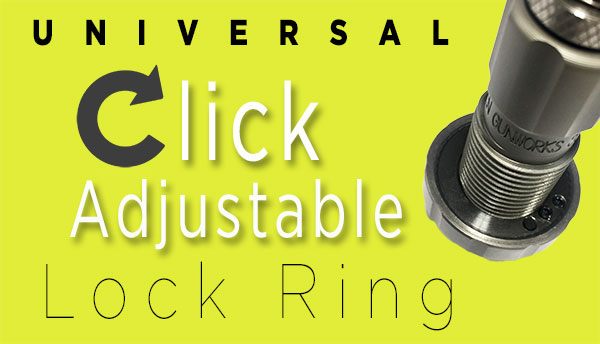
The Whidden Universal Click Adjustable Lock Ring you can instantly turn your sizer die into a Click Adjustable Die. This ring works with any 7/8 OD sizer of any brand with adjustable shoulder bump. Simple in design, the inner and outer ring can rotate independently of each other. Each click is metered in true 1 thousandths adjustment and has 0.100″ total available travel. These work great with nearly all sizing 7/8 OD sizing dies, and one verified purchaser noted: “Not only are they useful on reloading dies, but it’s the cat’s meow on the Giraud Power Trimmer Case Holders.”
Dillon Users Take Note: The Whidden Click Adjustable Sizing Die will not work with the Dillon 550 or 650 progressive reloading press systems. The Universal Click Adjustable Lock Ring is not compatible with the Dillon floating toolhead.
Ryan Cleckner is a former U.S. Army sniper instructor, and a highly respected outdoor journalist and firearms industry attorney with GunUniversity.com. Cleckner is also the author of the outstanding Long Range Shooting Handbook resource. A skilled shooter, and a very effective communicator, Ryan Cleckner is the host of a great 2023 series of NSSF videos about rifle optics.
There are 14 videos in the Cleckner NSSF Optics series, all worth watching. Among the 14 Ryan Cleckner Optics videos, here are our “pick six” of the most informative and helpful videos, which range in length from one to fifteen minutes. Key topics covered include: First Focal Plane vs. Second Focal Plane, Parallax Correction, Ocular (eyepiece) Focus, and Reticle Options.
First Focal Plane vs. Second Focal Plane Scopes
With a First Focal Plane (FFP) scope, the reticle grows and shrinks as magnification is adjusted up and down. This means that hash marks on the FFP reticle always cover the same angular scale (in MOA or Mils). That’s useful for PRS/NRL shooters and hunters who must shoot at multiple distances and quickly calculate hold-offs and hold-overs. With a Second Focal plane scope, the reticle is always the same size/thickness in the field of view no matter what the magnification. SFP Reticle hash marks define a particular defined angular division (such as 2 MOA), at one specific magnification level (such as 25X). At high magnifications, a SFP scope is less “busy” and so is generally preferred by target and benchrest shooters, who take a string of shots at a specific distance.
Parallax Explained and How to Use Parallax Controls
Parallax occurs when the target and reticle are on different planes within the scope. It is detectable when you move your head or eye around while looking through the scope, and the reticle appears to move or swim around the object at which you are aiming. To correct for parallax, you want to adjust the parallax control, commonly located on the left side of the scope. CLICK HERE for Nightforce tips on how to avoid parallax errors.
Understanding the Features of Modern Riflescopes
Modern riflescopes have multiple controls that alter focus, magnification, and reticle placement relative to the viewed target. Typically on top is an elevation control knob with clicks in 0.1 Mils or one-eighth or one-quarter MOA. On the right side (from shooter’s perspective), is a windage control, again with MIL or MOA-segmented clicks. On most current scopes, there will be a parallax control on the left side. In the rear, on zoom scopes, there will be a magnification control. Finally, many scopes will have a rotating eyepiece section for ocular focus.
Scope Reticle Types for FFP and SFP Optics
There are a wide variety of reticle types for both FFP and SFP scopes and for different applications (short range, long range, hunting, benchrest, F-Class, PRS/NRL, handguns). A 3-9x40mm hunting scope may have a very simple reticle with medium thickness lines and a couple vertical hold-over marks. By contrast, a 45X optic for short-range benchrest may have razor-thin lines and a very small, central target dot.
At the other end of the spectrum a modern FFP PRS/NRL optic may have a very complex reticle that looks like a Christmas tree — check out the Horus H425 reticle at right. This will have multiple hold-over and windage marks for multiple distances. That helps a shooter nail a 500m target just seconds after engaging a plate at 100m.
How to Adjust Eyepiece to Optimize Ocular Focus
Ocular focus refers to the sharpness of the reticle image you see through the eyepiece. Typically you’ll see a plus/minus marking near the rear part of the scope. This allows the eyepiece section to rotate clockwise and counter-clockwise. The purpose of this ocular focus is to help tailor the scope optimally for the particular shooter’s vision. March Scopes explains: “By adjusting the eyepiece, you will be setting the right diopter value which differs by person. The goal of adjusting the eyepiece to the proper diopter setting, is to see the reticle clearly and crisply.” For March scopes: “If you are near-sighted, rotate the eyepiece body counter-clockwise. If you are far-sighted, rotate the eyepiece body in the + direction, clockwise.”
Four of the 14 Ryan Cleckner optics videos cover scope mounting. Above is the main video of the four. This major 15-minute video covers the basics of scope mounting, including ring placement, fastener torque control, and reticle alignment. The additional three Cleckner scope mounting videos are:
Part 1: How to Mount a Scope — Components
Part 2: How to Mount a Scope — Tools
Part 4: How to Mount a Scope — Trouble Shooting
The NSSF First Shots program helps ranges get new participants involved in the shooting shorts. First Shots provides free targets, eye and ear protection, rimfire ammo, and other resources. In addition, the NSSF recently announced that it can provide enhanced direct funding. Participating ranges will get $15 for each new shooter, up to $1500 maximum. To qualify, ranges must host at least 3 First Shots events, and provide event reports. More information about First Shots is available at NSSF.org/firstshots.
New Direct Funding for Ranges — up to $1500
NSSF funding for First Shots partners, which was previously limited to marketing co-op efforts, is now available to qualifying NSSF member ranges, instructors, and shooting sports organizations to help cover expenses related to First Shots hosting efforts. Hosts are eligible to receive $15 per First Shots participant, up to a maximum of $1,500.
To enroll as a First Shots host and sign up for the new First Shots incentives program, contact Ann Gamauf at agamauf@nssf.org or Zach Snow at zsnow@nssf.org.
Traditional First Shots Program Support In addition to the new incentives listed above, First Shots host ranges can receive the program’s regular no-cost support materials, including:
— Eye and ear protection
— Rimfire ammunition
— Birchwood Casey Shoot-N-C targets
— Up to $500 annually in monetary support for clay target and shotgun ammunition expenses
— First Shots handbooks and other firearm safety literature for each student
— $25 rewards coupon for each student for completing a survey, cost covered by NSSF, to use at the host range
— Up to $3000 in annual co-op advertising funds to promote your First Shots event offerings


 The SIG SAUER P322-COMP is a competition-ready .22 LR rimfire pistol with class-leading 25+1-round and 20+1-round capacity. It has a threaded barrel equipped with a 2-port compensator and comes with a factory-installed ROMEO Zero Elite Red Dot Optic. The polymer grip features an extended magazine catch, adjustable trigger shoe, sport takedown lever, 1913 rail, and integrated magwell. The Single Action Only hammer-fired action on the P322-COMP is completely enclosed in a two-tone competition alloy slide with a high viz fiber-optic front sight, plus front, rear, and top cocking serrations. The ambidextrous, slide-mounted racker ensures easy slide manipulation. The pistol ships with (1) 20-round magazine and (1) 25-round magazine.
 One of our Forum readers asked “How can I get a custom in-line seater for my new rifle?”. First, we would say that, if you are not shooting an unusual Wildcat, check first to see if


 Glenn worked up a trim-and-point recipe for this lot of bullets based on group size. Load development is all performed at 1000 yards using the group ladder method. Glenn’s record load ended up being 30.3 grains of H4985 powder with the 103gr bullet seated very far into the rifling with .005″ of neck tension. This gave a velocity of 3030 fps in the 28″ Krieger.


 What’s the next best thing to a stockpile of gleaming, freshly-loaded ammo? How about a movie showing gleaming, freshly-loaded ammo being made — from start to finish? The five-minute video below shows the ammunition production process at the Lake City Army Ammunition Plant in Independence, Missouri. Lake City is the largest producer of small arms ammunition for the U.S. military, producing roughly four MILLION small-caliber rounds every day.


 Ryan Cleckner is a former U.S. Army sniper instructor, and a highly respected outdoor journalist and firearms industry attorney with
  There are a wide variety of reticle types for both FFP and SFP scopes and for different applications (short range, long range, hunting, benchrest, F-Class, PRS/NRL, handguns). A 3-9x40mm hunting scope may have a very simple reticle with medium thickness lines and a couple vertical hold-over marks. By contrast, a 45X optic for short-range benchrest may have razor-thin lines and a very small, central target dot.


