CCI and Federal Premium are both brands of Vista Outdoor. Most CCI rimfire is produced in Idaho, while other Federal-branded rimfire ammo is produced in Federal’s Anoka, Minnesota facilities. Here we feature videos from both CCI and Federal ammo plants. Watch and learn how rimfire ammo is made.
Field & Stream Tours Federal Ammo Plant in Minnesota
A reporter for Field & Stream recently got a chance to tour the Federal ammunition production facility in Anoka, Minnesota. This large plant produces both rimfire and centerfire ammunition. While touring the plant, the reporter was allowed to capture video showing the creation of .22 LR rounds from start to finish. This is a fascinating video, well worth watching.
Note to Viewers — After Starting Video, Click Speaker Icon to HEAR audio!
This revealing video shows all phases of .22 LR ammo production including cupping, drawing, annealing, washing, drying, head-stamping, priming, powder charging, bullet seating, crimping, waxing, inspection, and final packaging. We recommend you watch the video from start to finish. You’ll definitely learn some new things about rimfire ammo.
.22 LR Ammo Production at CCI Ammo Plant in Idaho
Back in 2016, YouTuber 22Plinkster was able to tour the CCI Ammo plant in Lewiston, Idado. Here is the rimfire production video he produced.
The Manufacturing Process for .22 LR Rimfire Ammunition Shooting Sports USA explains: “Rimfire cartridge cases are the oldest self-contained cartridge in existence, having been in continuous production since the mid-1850s. Rimfire cases are drawn from a thin piece of brass and formed with a hollow rim. A priming compound is then forced into the case using centrifugal force, where it is charged with powder and a bullet is seated in the mouth of the case. The case is then crimped around the bullet to ensure sufficient push and pull when the round is fired. When the firing pin strikes the thin brass rim of the case, the hollow rim is crushed and the primer is ignited.” Source: SSUSA.org 9/2/2017.
While there are many very, very talented women shooters, it’s still a bit unusual to see many ladies on a long-range firing line. It’s even more unusual to find a women shooter who regularly beats all the “good ol’ boys”. This week we feature Katy from California, who has competed in Varmint Silhouette matches with a very stylish and accurate Stolle 6BR. Along with husband/spotter Don (who shoots a 6mm Dasher), she has been one of “Top Guns” at the popular Pala Shooting Range in North San Diego County. Here’s a view of the Pala facility, looking down-range at the rows of silhouette targets:
Pala — A Mecca for Southern California Shooters
Near the Indian Casino and Resort in Pala, California is one of the longest rifle ranges in the state. Pala hosts a wide variety of shooting matches — cowboy action, lever action silhouette, black powder silhouette, hi-power silhouette, tactical pistol and rifle matches, to name a few. The black powder buffalo and tactical rifle matches use the longest range with 900-meter targets. Katy and her husband Don have competed in Varmint Rifle Silhouette matches, which were held monthly in years past. Range Info: Range.palatribe.com.
Katy tell us: “These Varmint Silhouette matches are a lot of fun! It’s very satisfying to see the little critters fly off the rail. A good spotter will note how the target flies when hit–‘Did it turn right or left? Did it lift up or fall back?’ Steel targets reveal more about real world ballistics than just a hole in a piece of paper. And nothing beats reactive targets for fun shooting.”
For Katy and Don, shooting is a family affair: “I started shooting the varmint rifle silhouette at the encouragement of husband Don. He bought/built himself a 6mmBR to shoot the varmint rifle match and re-barreled an old Hart-sleeved Remington 700 to fast-twist .223 for me to use. I did pretty well for a beginner, winning a match after just a few months of competition. Winning with that .223 had competitors scratching their heads. Frankly, it was just a fortuitous combination of great spotter, steady hold, and a good rifle. That .223 was certainly a very accurate piece. I always expected the bullet would hit right where the rifle was aimed, if we called the wind right. But like all good things, with time the .223’s accuracy began to fade. As the barrel finally gave up the ghost, a replacement was ready–a bright red Panda bear chambered in 6mm BR.
Beating the Guys at their Own Game
With my old .223, I won five varmint matches between December 2000 and April 2002. I also won my class (Master) in June, 2001. However, with the 6BR Panda, I shoot higher scores and have now had four match wins between May, 2003 and August 2004. And I won my class twice in 2003. Over time, as our competitors’ skills and firearms have improved, the criteria for shooter classification has been upgraded. Originally, one could miss 10% of the animals and qualify as a “Master” shooter. A few years ago, the criteria was tightened to 5% misses to earn “Master” status. This 6mmBR has kept me up in Master class.
I’ve done well enough with my little Red Panda that folks have been asking me about my shooting technique. Both Don and I shoot free recoil. We keep everything off the rifle except the trigger finger and thumb. Keep your shoulder back from the butt, and make sure your cheek doesn’t contact the stock and that your shooting cap doesn’t hit the scope. Fine-tune your elevation by squeezing on the rear bag. I use a front rest forearm stop to keep the rifle in the same place on the front rest. After firing, pushing the rifle back against the front stop usually verifies rifle tracking and allows a quick check of how far off the sighter shot’s impact was from point of aim.”
The Female Perspective — Katy’s Views on Shooting
We all know women can be crack shots. The little lady in the picture proved that more than a century ago. Competitive shooting is one of the few sports where women can and do compete head-to-head with men — and often win. [Amanda Elsenboss recently won the National High Power Championship and the National Long Range Championship. And Nancy Tompkins and her daughter Sherri Gallagher have won National shooting titles.] But the fact remains shooting is still very much a male-dominated sport. Here are some of my thoughts on how that might change.
Beneficial Aspects of Shooting
The first and most important benefit of competitive shooting is learning to handle a rifle/firearm safely. We’re well past the time when women should have conquered their fears of guns. An added benefit would be increasing a woman’s ability to respond to any threats. I remember when I was in college and we took my anti-gun roommate out to the range for a shooting lesson. She had a great time shooting away. She learned that firearms are not just “scary”, but also an enjoyable tool.
How to Get More Women Involved
Since we aren’t going to get the silencer legislation changed to improve women’s enjoyment of the sport, we will have to promote other aspects of shooting. I think shooting sports can increase self-confidence, giving women a sense of accomplishment and inner strength to remain calm under stress. It is very satisfying to see a positive result (at very long distance) of your focused efforts. Developing skill at any sport can improve one’s self-image and coordination. Encourage the women in your life to join you at the range. Believe it or not fellows, your wives and girl friends like to spend time with you. At Pala, some of the wives make the best spotters, even though they don’t shoot.
I find these varmint silhouette matches ideal from the standpoint of a woman’s participation. First, you get to lay down and shoot–that’s much more relaxed than classic position-shooting. Second, the really heavy rifle is supported on front and rear rests so that all you need to do is carefully guide the rifle, concentrate on the sight picture and pull the trigger when everything lines up. And, by the way, I clean house and prepare the meals, while my husband Don cleans the rifles and prepares the ammunition.
Dealing with Noise Pollution
The first thing a women notices at the range is how much noise these rifles make. How can anyone carry on a decent conversation, much less think with all the racket? Practice days are the worst–there is just constant gunfire with very few ceasefires. Matches are fine, because there is only gunfire during warm-up and then for 8 minutes during each relay. On the firing line, I wear both fitted earplugs and ear muffs to tolerate the decibels. Being heard and understood is always a problem during the match.
Shooters’ Techno-Babble–I Guess It Really Is a “Guy Thing”
One of my fellow female shooters commented that, at the range, the guys never seem to talk about anything but firearms and their accouterments at the range. Although I am familiar with the term “minutes of angle” I have gotten sloppy in my speech and generally just report how many clicks one needs to adjust for the wind or the sighter shot. Reading Don’s equipment discussion confused me when he kept referring to MOA. I have been with non-shooting friends several times when knowledgeable shooters start talking firearms. It is as if they are speaking a different language, and my friends look to me with a puzzlement on their faces. Well, in fact it has its own language and I think I’m getting finally getting able to speak it.
Katy’s 6BR — Technical Primer by Hubby and “Loadmaster” Don
Way back in 1990 a Precision Shooting magazine “Trading Post” advertisement offered a low-mileage, Panda-actioned .262″ neck, 6mm BR rifle and all the reloading accouterments. This light-varmint class rifle was built in the mid-1980’s around an unusual round Panda action with straight-fluted bolt. As configured, the gun had performed very well indeed–shooting many groups in the zeros. The action is glued into a Lee Six thumbhole BR stock and uses externally accessible pins to hang the 3 oz. trigger. The scope is an older 36X Leupold BR model, held by Kelbly rings on a Davidson base. The original barrel was a 4-groove, 14-twist, apparently made by Pat McMillan. A hand-written information tag taped to the underside of the barrel was discovered upon its removal, and indicates the barrel was fitted by JACO, April 1986. Anyone know who that is?
The 14-twist barrel could not stabilize any bullets greater than about 80 grains. It would keep an 80-grain Starke inside 0.4″ at 200m with a velocity of 3120 fps using 31.8 grains of Varget. However, the 80-grain bullets were blown all over by the winds out to 500 meters.
Past success with Pac-Nor pre-fit barrels inspired me to order a 28″, 4-groove, 8.6″-twist barrel chambered with their .262” neck 6mm BR reamer. Pac-Nor crowned and chambered the barrel; and, in this case, threaded it to fit a Panda action. After we installed the barrel on the action, we found that the bolt nose touched the conical barrel breech face. 0.010” needed to be removed from the cone face so that the bolt closed with a perfect fit. Headspace is now just right at 1.167″.
Load Development
My experience with a couple of other fast-twist 6BRs, one also chambered with Pac-Nor’s .262″ reamer, suggested that the 95gr Berger VLDs would work well the estimated 0.060″ freebore in Katy’s rifle. The goal was to get 2800-2900 fps velocity with inherent accuracy no worse than half the smallest silhouette size. That meant we needed a load that delivered repeatable 0.4 MOA accuracy or better.
A new batch of Lapua 6mm Norma BR brass was neck-turned to 0.0083″ wall thickness to fit the chamber and fire-formed during barrel break-in, following Pac-Nor’s guidelines. We tried a bunch of different moly-coated bullets at 200 meters, most with moderate charges of H322. The results of the bullet-testing ranged from poor (over an inch) to astonishing (68-grain, flat-base Eubers over 29.7 grains of H322 went into about .25″ at 200 meters!) But these flat-based bullets lacked the high ballistic coefficient we wanted for the varmint silhouette match. So we tried the 95-grain VLD Bergers (0.5+ BC) and produced several good loads, all sparked by Federal 205m primers. The best load seemed to be 28.2 grains H322 at 2860 fps, followed by 30.4 grains N135 at 2920fps, and 31.0 grains of Varget at 2890 fps.
All loads shot better than 0.4 MOA, but the H322 seemed a little more accurate, and about twice as much H322 was on hand. So, after about 120 shots the barrel was conditioned, brass formed and a match load selected for the 95 VLD Bergers. Bullets are seated about 0.010″ into the rifling for a typical cartridge LOA of 2.325”, which puts the heel of the 95 VLD boat-tail just below the case neck-shoulder line. Cases are sized with a Wilson neck bushing die that works only the upper 2/3 of the case neck to support the bearing surface of the seated bullet.
Don’s Handy Guide to Varmint Silhouette Shooting
Varmint Silhouette–Origins and Basics
Over a decade ago, a metallic silhouette match was devised for typical varmint rifles at the North County Shootist Association range near the hamlet of Pala, in north San Diego County, California. The course of fire used the conventional rifle silhouette range with banks of 10 special varmint targets sized 0.8 to 1.0 MOA (Minute of Angle) in width. At five different yardages, ten steel “critter” targets are set as follows: 200 Meters – Field Mice (“pikas”); 300 meters – Crows; 385 meters – Ground Squirrels; 500 meters – Jack Rabbits; 600 yards – Prairie Dogs. The folks at Pala run a tight ship, cycling multiple relays efficiently, so everybody gets to shoot 50 targets (10 each at five different yardages), and the show is usually completed by 1:00 pm. There’s a one-hour sight-in period starting at 8:00 am, and the match starts at 9:00 am sharp. Newcomers should definitely arrive no later than 7:45 am, because you may need that full sight-in period to acquire solid zeros at all five yardages.
Firearms are limited to field-portable, varmint-caliber rifles in either custom or factory class, and having a maximum 6.5mm bore, but bullets must weigh no more than 107 grains. You can shoot prone or from a bench using a front rest and bag rear. For more information, visit Range.palatribe.com.
Match Rules and Shooting Procedures
Matches are fired as a team — shooter and spotter. The course of fire typically consists of 10 steel, knock-down varmint animal targets at each of the five distances. After firing a sighter, targets are taken from left to right, one shot per target. Missed targets remain standing. Any target struck out of sequence is also a “miss”. The shooter’s objective is to sequentially knock-off (clean) all 10 targets. The spotter’s duties are to support the shooter in all aspects of shot preparation. First and foremost, the spotter tries to see each shot impact and call appropriate windage and elevation adjustments for the shooter. In shifty conditions, a good spotter is vital.
Let’s start at the beginning. Before the match there is usually an opportunity to fire a few fouling shots and check sight settings for load and distance. An initial read on conditions–mostly wind direction, strength and consistency–is also made. The spotter should checklist the shooter to make sure they are set up for the relay distance and have adjusted their sights to the correct elevation and windage.
It could be argued that for the shooter, the first shot at a given distance, the sighter shot, is the most important shot fired. Since the sighter targets are fixed (don’t fall over) and freshly painted, bullet impact is obvious to both shooter and spotter. If the bullet hits where expected–point of aim–the spotter then tracks and calls observed changes (mostly wind) relative to the shooter’s initial scope settings. If point of impact shifts on subsequent record targets or the shooter misses, appropriate sight adjustments are recommended to the shooter. Admittedly, it is sometimes difficult or impossible to see the point of impact on these small, reactive targets. However, an estimate of bullet strike can be made from target behavior such as rotation and/or impact trajectory.
The Guacamole Connection
Katy and Don are avocado farmers. From time to time they’d bring a few avocados to the range to give to the other shooters. In addition, on some months, Katy would bring some home-made Guacamole made from the avocados on their ranch. Katy says “Fellow shooters appreciate a batch of guacamole so much they bring their own chips to go with the dip. I keep getting suggestions that I go into the business of making and selling guacamole. Guess I could start by selling it at the range.”
Katy’s Guacamole Recipe
4 ripe avocados, peeled and pitted
1/2 lemon squeezed (I use Meyer lemons, lime juice is also good)
1/2 cup fresh salsa — your favorite variety
1 tsp garlic salt or fresh garlic chopped
All of the above quantities can be adjusted for taste. Mash the ingredients with a potato masher. Serve with chips, fresh vegetables (carrot sticks, celery, broccoli), or as garnish for tacos, burritos, taquitos, etc., and as special treat – spread on warm buttered toast for breakfast.
Good Shooting and Bon Appetit! — Don & Katy
No reproduction of any content is allowed without advanced permission in writing.
Introduction — What You Need in a Security Gun Safe
If you own firearms, you need a gun safe. In some states, such as California, if you don’t own a safe, you face potential liability if your firearms are stolen. Purchasing a safe is no easy decision however. There are dozens of safe manufacturers and countless design options. Sorting out the facts from the marketing claims can be difficult.
Today’s seven Saturday Showcase videos explain the most important qualities you should look for in a safe, and help you with the tough decisions, such as “Should I get a digital lock or a dial lock?”, “What kind of fire-proofing is most effective?”, “How big a safe do I really need?”, and “What interior works best with long-barreled scoped rifles?” You’ll find reviews of full-size safes, modular safes, and smaller handgun safes. Plus you’ll find expert advice on how to install your safe in your home and how to keep the contents free from rust.
Budget $1200-1500 for a safe from a major maker, with external hinges, and an interior at least 58″ high. That gives you room for 30″-barreled rifles with a top shelf for handguns and other valuables. A rotary rack and slide-out drawers are great additions.
Keypad or Dial? We favor rotary dial locks. With minimal maintenance they will function flawlessly for decades. But the digital locks offer quick-access and convenience. If you go digital, get a commercial-grade unit.
Fire-lining is worth getting, but a thin layer of sheet-rock doesn’t make a safe truly “fire-proof”.
Interior at least 58″ High and 30″ wide Overall Weight 750+ Pounds 8 Gauge or Heavier Wall Thickness Double-Wall, Composite Door with Relockers Minimum UL RSC Rated. TL-15 or TL-30 Rating is Desirable External Hinges
Mechanical UL Group II (or better) Lock with Standard Dial Or UL Type 1 Commercial-Grade Electronic Lock
Custom Interior Suitable for Scoped Guns with Long Barrels On-Door Storage System for Non-scoped Long Guns OR Rotary Gun Rack for Scoped Rifles and ARs
Internal (sandwiched) Insulator, Reinforced if Sheet-rock Palusol? Heat-Activated Expanding Door Seals
Slide-out Drawers for Handguns Fire-lined Inner Safe for Paper and Media
Low Gloss, Rust-resistant External Finish Pre-Drilled holes for Lag Bolts and in Rear for Electric Cord Overhead Fluorescent Lamp and/or LED Mini-lights on Strings
Advice for Gun Safe Buyers — Seven Key Things to Consider
This video covers key gun safe features — Seven Things to Consider Before Buying a Gun Safe. Not all gun safes are created equal. There are many variables — fire ratings, burglar ratings, colors, lock choices, internal capacity, door storage, and more. And with the recent controversy involving Liberty Safes, you should check the safe-maker’s policies regarding digital passcodes — you don’t want your passcode revealed without a warrant and/or without your consent.
DOs and DON’Ts of Safe Buying
DO purchase a safe that is bigger than you think you need.
Your gun collection is bound to grow over time. A good safe is more than just a gun locker–it becomes a secure storage device for your family’s other valuables as well. You’ll find you quickly fill up even a large safe. Spend the money for the size, protection, and features you want. Your gun collection may be worth many tens of thousands of dollars. Some people who visit this site wouldn’t hesitate to spend $1300 for a custom action or $1800+ for a competition scope, yet they don’t want to spend more than a few hundred dollars on a safe. That’s not common sense. If you’re on a tight budget, consider a used safe. Unlike many other products, safes don’t really wear out over time. When businesses change locations, you can get a very high quality commercial safe for little more than the cost of removing it.
DO spend more for a safe that offers fire-resistance.
But you have to do your homework–you can spend a lot of money for “fire-proofing” that actually is not very effective. Make sure if sheet-rock is used that it is properly installed. If you have valuable documents and media files, it’s not a bad idea to purchase a smaller, commercial-grade fire safe to put inside the gun safe. This gives you double protection.
DO look at many different brands of safes before you buy.
There ARE significant differences among brands. For example, Browning offers a unique (patent-pending) door-mounted rifle rack. Zanotti offers slide-out drawers and a modular design that is much easier for an owner to move. Ft. Knox uses an advanced method to secure and stabilize its fire-proofing layers within the safe. Brown offers custom exotic wood interior shelving and safes with commercial-grade burglary protection (much thicker steel with heavy composite doors and walls). Amsec offers a proprietary “DryLight” poured concrete-type fire insulation with greater structural strength than typical sheet-rock panels.
DO investigate the safe’s specifications.
Just because a safe is big and heavy doesn’t mean it’s particularly secure. Heavy-gauge steel is much more resistant to cutting and drilling than light 12- or 14-gauge steel. Some safes on the market have walls so thin they can be penetrated with a fire ax. We recommend 10-gauge steel at a minimum, and 8 gauge is much better. The safe should carry a UL RSC (Underwriters Laboratories “Residential Security Container”) or better rating.
DO ask about the safe’s safeguards against tampering.
A quality safe will feature extra armor or devices to defeat drilling. Low-grade safes can be opened in a few minutes with simple, battery-powered hand tools. All safes should have relockers to help ensure the safe remains locked in the case of a burglary. Relockers are hardened pins that are triggered during an attack, and cannot be retracted without hours of drilling. The number of relockers on a safe ranges from 2-10+ depending on the safe’s size and burglary grade.
DON’T store powder in your safe. A tightly-sealed metal box with a large quantity of powder inside is a bomb. Store powder in a separate, lightly-constructed cabinet or plastic box. The main thing for powder is to keep it dry and away from moisture and light.
Don’t Make the Mistake of Buying an Undersized Safe
The most common mistake people make when buying a gun safe is getting a safe that’s too small. This video explains why you should probably invest in a bigger safe. First, the rated gun capacity is exaggerated — rifles with mounted optics, long barrels, wide forearms and/or pistol grips take up considerably more space than a small rimfire rifle or a lever gun with iron sights. Second, your gun collection will likely grow in years to come. Third, you may want to store other valuables in the safe — such as vital documents, jewelry, watches, and pricey electronics. In this video the host notes: “Get a much larger safe than you think you’ll need at first. This will guarantee that you will have enough room for future purchases and all the guns and equipment you currently have.”
What Happens in a Fire and Deluxe Features
This video shows what can happen INSIDE a gun safe during a fire. This Winchester safe did not fare well during a major hourse. That’s why you want to buy a safe with a good fire rating.
This video shows the features of a large Superior Safe Co. gunsafe with internal organizers and door storage for handguns and accessories.
Modular Safes — Smart Option for Easier Moving
This article features a great video showing how to assemble a modular safe in under 30 minutes. This article also explains the benefits of modular gunsafes — primarily easier transport and installation. “Modular safes have been around for a few years now and are becoming more popular. Here’s why: The safe comes delivered to you in panels, so you can bring them into your home one at a time and put it together anywhere you like. This makes it easy to carry up and down stairs, onto elevators or anywhere! Security — Is it as secure as one that comes pre-assembled? The answer is, absolutely.” READ FULL ARTICLE on NRAWomen.com.
Five Good Gun Safes Under $500
We know some readers have a tight budget. This video looks at some recommended lower-cost safes under $500.00 list price. Note, however, that this video was produced in 2022. Now in 2023, with Bidenflation, the actual gun safe prices may be higher. For a full-size safe, we do recommend you spend quite a bit more — the investment in a higher quality safe, with better fire rating, is worth it.
Locking Device–Mechanical Dial vs. Digital Locks Recommendation: UL Group II mechanical dial lock or commercial-grade electronic.
For gun safes, we prefer rotary-combination dial locks, although commercial-grade electronic locks are now very good. While less convenient, and slower to open than electronic locks, combination locks are still more durable and trouble-free than the digital locks found on many low- to medium-cost gun safes. Among the combination locks, the Sargent & Greenleaf model 6730 (UL Group II) remains an industry standard. The director of Sturdy Safes noted: “An S&G 6730 will be working fine when your grandchildren have grandchildren.” For home use, we also recommend the standard, high-visibility “front-read” white on black dial.
Avoid the cheap, imported electronic locks. These are known for failing relatively quickly–the keypad internals just wear out. With some of these designs, if the lock fails while the door is closed, you’ll have to employ a professional gunsmith to drill your safe and replace the locking assembly and keypad. With any electronic lock, re-program your combination now and then so that keypad wear patterns don’t reveal the numbers you push to open the safe. But when you change the combination, be sure to record the new setting.
With a dial lock, choose a design that meets UL Group II (or better) certification. If you choose a digital lock, we strongly recommend that you select a UL Type I, Commercial Grade lock from LaGard, Sargent & Greenleaf, or Kaba Mas. Commercial-grade locks, such as the S&G Comptronic” 6120 or LaGard “SafeGard” are much more robust and are designed to be used 20 times a day or more in retail and banking environments. A good commercial digital keypad lock should give 10 years or more of continuous use before replacement is required. With any digital lock, however, you should replace the battery at least once a year. Normally this can be done without professional assistance.
A rapid-access bedside safe is a great way to keep your pistol secure, but also readily available, close at hand. Not all rapid-access pistol safes are created equal, however. In this video, John of Pew Pew Tactical explains what to look for in a small pistol safe, and points out the pros and cons of the four safes tested:
Fort Knox FTK-PB Simplex Pistol Box
Strong case, reliable no-battery locking system. Very good safe, but expensive ($299.00 on Amazon).
Vaultek Electronic Pistol Safes
Multiple styles, thin profile, 5-button electronic ($159.99 on Amazon), or Biometric VT10i + 5-button ($269.99 on Amazon), both with rechargeable batteries.
GunVault SpeedVault Handgun Safe
Designed for vertical mount under desk on vehicle, One gun only, requires batteries, $142.00 on Amazon.
How and Why to Create a Dummy Round
When you have a new custom rifle built, or a new barrel fitted to an existing rifle, it makes sense to create a dummy round. This should have your preferred brass and bullet types, with the bullet positioned at optimal seating depth. A proper dummy round helps the gunsmith set the freebore correctly for your cartridge, and also ensure the proper chamber dimensions.
Respected machinist, tool-maker, and gunsmith Greg Tannel of Gre-Tan Rifles explains: “I use the dummy round as a gauge to finish cut the neck diameter and throat length and diameter so you have [optimal] clearance on the loaded neck and the ogive of the bullet just touches the rifling.” He recommends setting bullet so the full diameter is just forward of the case’s neck-shoulder junction. “From there”, Greg says, “I can build you the chamber you want… with all the proper clearances”.
Greg Tannel has created a very helpful video showing how to create a dummy round. Greg explains how to measure and assemble the dummy and how it will be used during the barrel chambering process. Greg notes — the dummy round should have NO Primer and No powder. We strongly recommend that every rifle shooter watch this video. Even if you won’t need a new barrel any time soon, you can learn important things about freebore, leade, and chamber geometry.
Must Watch Video — This has been viewed over 790,000 times on YouTube:
This has been a very popular video, with 782,000 views! Here are actual YouTube comments:
That is the best explanation I’ve ever seen. Thank you sir. — P. Pablo
Nice video. You do a very good job of making this easy for new reloaders to understand. I sure wish things like this were available when I started reloading and having custom rifles built. Once again, great job, and your work speaks for itself. — Brandon K.
Beautiful job explaining chambering clearances. — D. Giorgi
Another Cool Tool — The Stub Gauge
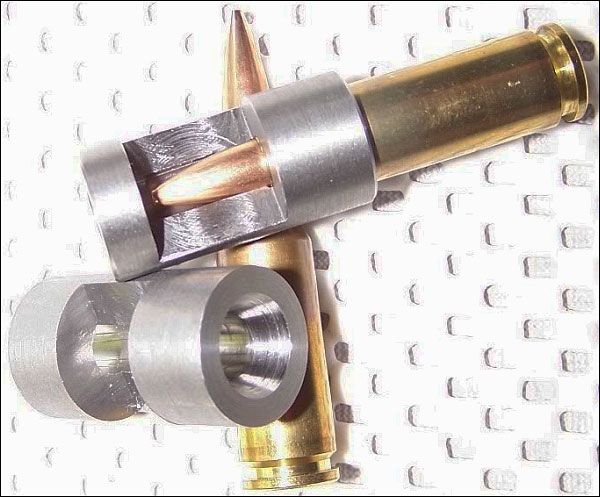
When you have your gunsmith chamber your barrel, you can also have him create a Stub Gauge, i.e. a cast-off barrel section chambered like your actual barrel. The stub gauge lets you measure the original length to lands and freebore when your barrel was new. This gives you a baseline to accurately assess how far your throat erodes with use. Of course, as the throat wears, to get true length-to-lands dimension, you need take your measurement using your actual barrel. The barrel stub gauge helps you set the initial bullet seating depth. Seating depth is then adjusted accordingly, based on observed throat erosion, or your preferred seating depth.
The CMP Western Games “Fall Classic” event — featuring CMP Highpower Rifle and CMP Pistol Matches — takes place next week, October 10-15, 2023 at the Ben Avery Shooting Facility near Phoenix, Arizona. This year, the CMP decided to move the Western CMP Games back to its original October timeslot. Although the CMP’s most recent Western Games were held in March of 2023, there will also be a fall Western Games this year, as was the tradition in past years.
The decision to move Western Games back to October was reached after the CMP conducted a survey of competitors. Though the results (155 submissions) indicated spring was favorable (65%) versus fall (34%), the final decision was based on cost to host the event. Spring training for baseball causes inflated expenses for hotels, rental cars, and flights in the earlier months of the year. An October event allows more affordable travel/accommodations for Western Games participants. That should allow more competitors to enjoy the events at Ben Avery.
The 2023 October Western Games will have a condensed schedule of events:
Garand, Springfield, Vintage & Modern Military Matches
Carbine Match
Rimfire Sporter Match
Mid-Range 3X600
80 Shot Rifle
2-Man Rifle Team
EIC Service Rifle
CMP Match Pistol 2700
EIC Service Pistol
.22 Rimfire Pistol
EIC Service Revolver
Military & Police Service Pistol
and 1911 As-Issued Pistol Match
The Western CMP Games will feature three days of Garand/Springfield/Vintage & Modern Military Matches, a Carbine Match, a Rimfire Sporter Match, a Vintage Sniper Match, and a Rifle Basic Class. The CMP Highpower Rifle Matches include the CMP Team HP Clinic with Live Fire, a 4-Man Team Match, three days of CMP 800 Aggregate Matches and a CMP Service Rifle EIC Match. The Highpower Rifle portion of the Western Fall Classic will include a 2-Man Team Match, two days of CMP 800 Aggregate Matches, a CMP Service Rifle EIC Match and a Mid-Range 3×600 event. For educational purposes, a Rifle & Pistol Marksmanship 101 Classes with introductory EIC Matches are also part of the October lineup. There will also be a GSM New Shooter Clinic, a Highpower Rifle Clinic, and an M1 Maintenance Clinic.
Handgun shooters can compete in 4 days of Pistol Matches including CMP Match Pistol 2700, CMP .22 Rimfire Pistol EIC Match, CMP EIC Service Pistol Match, CMP 1911 As-Issued Pistol Match, Military & Police Service Pistol Match and the NEW CMP Service Revolver EIC Match.
M1 Garand
Line-up of M1 Garands at the CMP Sales tent.
This CMP Video Explains the Process for Ordering an M1 Garand from the CMP:
M1 Carbine
CMP M1 Carbine Matches — Growing in Popularity
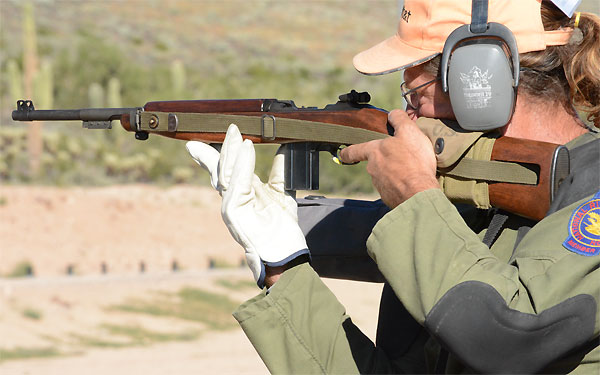
The CMP M1 Carbine Match is part of the CMP Games program that already includes Garand, Springfield and Vintage Military Rifle Matches. “As-issued” U. S. Military M1 Carbines are fired over a 45-shot course of fire at 100 yards on either the old military “A” target or the “SR” target. The course includes 5 sighters and 10 shots for record prone slow fire in 15 minutes, a 10-shot rapid fire prone series in 60 seconds, a 10-shot rapid fire sitting series in 60 seconds and 10 shots slow fire standing in 10 minutes.
Modern Service Rifle (AR15 Family)
Vintage Sniper Match Rifles
All competitors firing on the Highpower range will be firing on Kongsberg Electronic Targets (KTS) (see above center). The KTS system registers each shot and relays the location and score value to a monitor beside each shooter.
A good riflescope is essential for many types of competition, and the vast majority of hunters have scoped rifles. Some F-Class and benchrest competitors are now using optics with up to 60X magnification. Over the past 30 years, scopes have continued to evolve with improved glass, more reticle types, vastly increased elevation travel, bigger main tubes, FFP and SFP options, and even built-in electronics.
When shopping for a riflescope, it’s useful to understand how scopes work — how the internal mechanisms control windage and elevation, how parallax controls work, and how magnification levels are controlled.
Basics of How Riflescopes Work
This Burris video (above) covers the key aspects of scope function: zoom magnification, windage control, elevation control, parallax control (front or side mount), and ocular lens focus. There are some tips on getting a new scope running smoothly — it’s wise to rotate the power control a few times as well as both windage and elevation knobs. The video below also explains how to set ocular focus controls optimally.
Scope Break-In Methods and Diagnosing Issues — Great Video
We recommend that all serious shooters watch this video start to finish. A very knowledgeable scope engineer, Leupold’s Mike Baccellieri, explains the fine details of scope operation — with very useful recommendations on how to ready a new scope for use (See 36:50 time-mark). With a new optic he advises to run the controls multiple times to full travel. Also, take your time to get the diopter control just right (See 26:40 time-mark).
The video also explains why, with a new scope or one that hasn’t been used much, it is sometimes effective to rotate the elevation PAST the desired setting then come back a click (See 35:40 time-mark). In addition, near the end of the video, the expert explains how you can use a mirror to determine if the scope mount (base and/or rings) is NOT aligned with the bore axis, forcing excess travel to get on target (See 42:00 time-mark). We have seen this caused by scope rails attached slightly off axis.
Large diameter turrets make windage and elevation markings easier to see, and the click “feel” may be more noticeable given the greater diametrical travel between clicks.
First Focal Plane (FFP) vs. Second Focal Plane (SFP)
The main visual difference between First Focal Plane (FFP) and Second Focal Plane (SFP) scopes is the appearance of the reticle (and its hash marks) at different magnification levels. With a FFP scope, the reticle increases in visible size (and line thickness) with increased magnification. This is so the angular hash marks remain constant (in Mils or MOA angular span) at all magnification levels. So, on a 10-30X FFP scope, a 0.1 Mil hash mark represents the SAME angular measurement at 10X, 20X, or 30X (or any magnification). The downside of the FFP system is that the reticle lines can appear very thick at high magnification. But for a PRS/NRL match, with targets at multiple distances, it is important that the hash marks represent the same angular measurement at all power settings.
On a Second Focal Plane (SFP) scope, by contrast, the reticle lines (and hash marks) appear visually (in thickness) the same at all magnification levels. This means the hash mark divisions will only be precise at one magnification level, as designed by the manufacturer. For example, you could have exact 1 MOA Hash marks at 10X. But zoom the scope to 20X and the same reticle hash mark would then cover 2 MOA. SFP scopes are popular with competition shooters who shoot at specific known distances. Not having thick reticle lines at 25X to 50X is an advantage when aiming at precise benchrest and F-Class targets.
ZEISS now makes excellent FFP Scopes with both MOA and Milrad options
Minute of Angle (MOA) vs. Milliradian (MILRAD or MIL)
This video also explains MOA vs. MRAD (Milliradian) controls. A Minute of Angle (MOA) is an angular measurement that represents 1.047″ at 100 yards. Modern MOA scopes are typically configured with 1/4 MOA or 1/8 MOA clicks. A Milliradian (MRAD) is another angular measurement defined as one-thousandth of a radian. Milrad scopes are commonly configured with 0.1 Milrad clicks. How much is a 0.1 mil at 100 yards? One mil equals 3.6 inches at 100 yards; therefore, 1/10th of that, 0.1 Mil, equals 0.36” – roughly a third of an inch – at 100 yards. That’s pretty close to the common quarter-inch (1/4 MOA) increment found on MOA riflescopes.
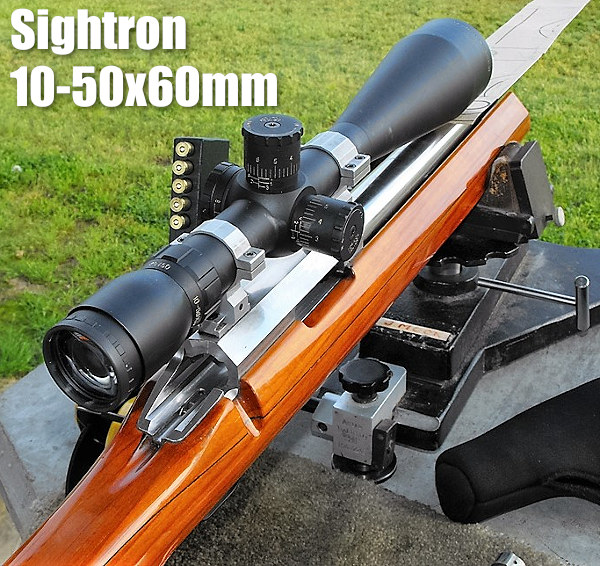
Sightron makes excellent high-magnification SFP zoom scopes favored by many competitors. These have proven quite reliable and offer very good performance for the price.
Scope Mounting Method and Alignment
When mounting a scope, you want to make sure the scope is aligned properly, so that vertical travel is precisely up and down, not offset. Begin by supporting the rifle with a good front and rear rest. Use a portable level to ensure the rifle is not tilting slightly left or right around the barrel bore axis. Then you want to align your scope’s vertical axis. For this, we recommend setting up a plumb bob — a weighted line that hangs straight down. This can be set up indoors or outdoors. Align your reticle’s vertical axis precisely with the plumb bob line, making sure not to move the rifle.
One caution — we have seen some riflescopes that are internally off-axis by up to 4 degrees. In this case, you can align the reticle’s vertical axis with the plumb bob line but then find that your turrets are slightly titled. That is a scope manufacturing fault that will result in some error when you input a large click value (e.g. 10+ MOA up or down).
When mounting your scope, another key factor to consider is the eye relief — the distance of the rear “ocular” lens to your eye. When mounting the scope, put your head in the position at which you normally shoot. NOTE: As your optimal head position may be quite a bit different when shooting prone vs. shooting from a bench, you may want to adjust the scope placement for different shooting positions. This Editor had to move his comp rifle scope about an inch rearward when local club matches changed from prone to bench.
This article originally appeared in the Sierra Bullets Blog.
Sierra Bullets asked a few hand-loaders to reveal their favorite reloading tool or accessory: “What is your favorite ‘don’t know how you ever lived without it’ piece of reloading equipment?” Some of the answers are listed below. We were interested to see some high-tech, micro-processor items mentioned, such as the AMP Annealer, and the AutoTrickler powder dispenser. Old standbys, such as the rugged RCBS Rockchucker and Dillon 650, also made the favorites list.
What Is Your Favorite Piece of Reloading Equipment?
Bill, Editor of Rifleshooter.com, answered: “I have so many favorite reloading tools, it’s hard to pick one. But if I had to, it would be my Forster Co-Ax press. I like the ease [with which] you can change dies and that it doesn’t require traditional shell holders. It’s a great tool to have!”
Sierra Bullets Ballistic Technician Philip Mahin answered: “A comparator gauge to measure from the base of a case to the ogive of the bullet. This bypasses the tip of the bullet, so I can repeat the same seating depth the next time I visit a specific combination.”
Ballistic Technician Carroll Pilant answered: “Dillon 550 and 650 presses.”
Ballistic Technician Rich Machholz answered: “My universal decapping die is as handy as a pocket on a shirt.”
Ballistic Technician Philip Mahin answered: “A comparator gauge to measure from the base of a case to the ogive of the bullet. This bypasses the tip of the bullet, so I can repeat the same seating depth the next time I visit a specific combination.”
Jon Addis answered: “Putting an A&D FX-120i scale with AutoTrickler and Auto-Throw on the bench has changed the way I reload. It’s kernel accurate in about 15 seconds. Saves time and reduces a variable. And of course, the system is made better by the Area 419 Billet Adjustable base for the trickler and Billet Powder Cup.”
This video shows the AutoTrickler V3 System
Ballistic Technician Paul Box answered: “The Lee hand priming tool.”
Former Ballistic Technician Robert Treece answered “My homemade dental pick. I use it to check incipient case-head separations. We all see the ‘bright ring’ down close to the case head, that’s natural, but after several firings could be starting to split apart. If the pick hooks into a crevice — DON’T TRY TO SIZE THE CASE. It will pull apart in your die.”
Dan Blake answered: “My Annealing Made Perfect (AMP) annealer. With consistent neck tension being one of the largest contributions to small Extreme Spread on muzzle velocities, I believe this induction annealer is truly the best on the market.”
This manufacturer-produced video shows how the AMP annealing machine operates:
Process Engineer David Palm answered: “Homemade case lube.”
Plant Engineer Darren Leskiw answered: “Beyond the normal equipment, I’d say my electronic scale. Using the beam balance for the past 9 years was ok, but nowhere as easy as using an electronic scale.”
There were many votes for the classic RCBS Rock Chucker single-stage press:
Ballistician Gary Prisendorf answered “RCBS Rockchucker Press, it’s built like a tank, and it will last me a lifetime.”
Production Manager Chris Hatfield answered: “RCBS single stage reloading press.”
Maintenance & Machine Shop Lead Craig Westermier answered: “RCBS Rock Chucker.”
Production Resource Manager Dan Mahnken answered “RCBS Rock Chucker! Buy one and it lasts a lifetime.”
Sierra Bullets Ballistic Technician Duane Siercks answered: “I don’t know that you would actually call this equipment, but the item that comes to mind would be my reloading room/shoot house. I had always had to squeeze everything into a corner or even an unheated shed. After we bought our current house, I built a garage and placed it so that I had a window looking down a 250-yard range. I built a dedicated room with heat and A/C. It contains my reloading bench and a shooting bench. The shooting bench lets me slide open the window and shoot down the range. It is very handy to not have to load everything up to go to the range. It also makes load development a lot simpler and efficient. I don’t know how I ever got along without it.
I also wonder what I did before I acquired the Lyman 1200 DPS Powder Dispenser. This has made the process so much simpler and much easier. I also have a Lee Precison Universal Decapping Die that I would gladly spend the money on again. This may be a small thing, but it certainly is handy. The Lee would accommodate some very large cases that some of the others were too small for.”
Ever wanted to see how Nosler bullets and cartridges are made? Here’s your opportunity. The Rocky Mountain Elk Foundation (RMEF) has produced a video (“Quality First”) that offers a behind-the-scenes look inside Nosler’s Oregon factory that produces bullets, brass, and ammunition.
Video Showcases Nosler Production Facility and Ballistics Lab
RMEF representatives were provided with unprecedented access into Nosler’s famously-guarded manufacturing plant to show the technology used by Nosler to produce bullets and ammunition. The “Quality First” video showcases Nosler’s complex production processes that include technologically advanced machinery, and stringent quality control measures.
After the intro, this video illustrates Nosler’s bullet construction techniques with a cool animation sequence. The video then showcases the Nosler ballistics lab, inspection room, and packaging line.
The “Quality First” video starts with the history of the company, tracking Nosler’s development from the 1940s. Then the video shows the bullet construction techniques followed by a ‘walk-though’ in the factory, showing the sophisticated machinery used to make bullets, brass, and ammunition. “‘Quality First’ isn’t just a saying that’s printed on our factory walls, it’s the guiding principle that affects every decision we make” says Mason Payer, Senior Marketing Manager at Nosler.
Information Resources — Load Data and Nosler Blog
The enhanced Nosler website also features comprehensive LOAD DATA, plus informative content in the Nosler Blog. The Load Data page works well on smartphones. Go to the Load Data Index Page, then simply scroll down to a caliber. Then select your cartridge type and bullet weight(s). The rifle listings are quite comprehensive, covering .17 caliber up to .458 caliber. Here are examples of Nosler load data for the 6mm Creedmoor with popular 105-107gr bullets, along with the .284 Winchester with 175gr bullets.
About Nosler and Support for Rocky Mtn. Elk Foundation
Founded in 1948, Nosler, Inc. is a family-owned company located in Bend, Oregon. Nosler is most known for hunting bullets such as the Partition®, Ballistic Tip®, AccuBond®, E-Tip® and most recently the AccuBond® LR and RDF. Nosler manufactures premium component bullets, reloading brass, ammunition and semi-custom rifles for domestic and international customers.
A long-time proponent of the Rocky Mountain Elk Foundation, Nosler donates a portion of the proceeds from the sale of five Partition bullets to benefit RMEF’s mission and recently added proceeds from Trophy Grade® and Expansion Tip™ ammunition to increase support.
Video find by ELR Researcher. We welcome reader submissions.
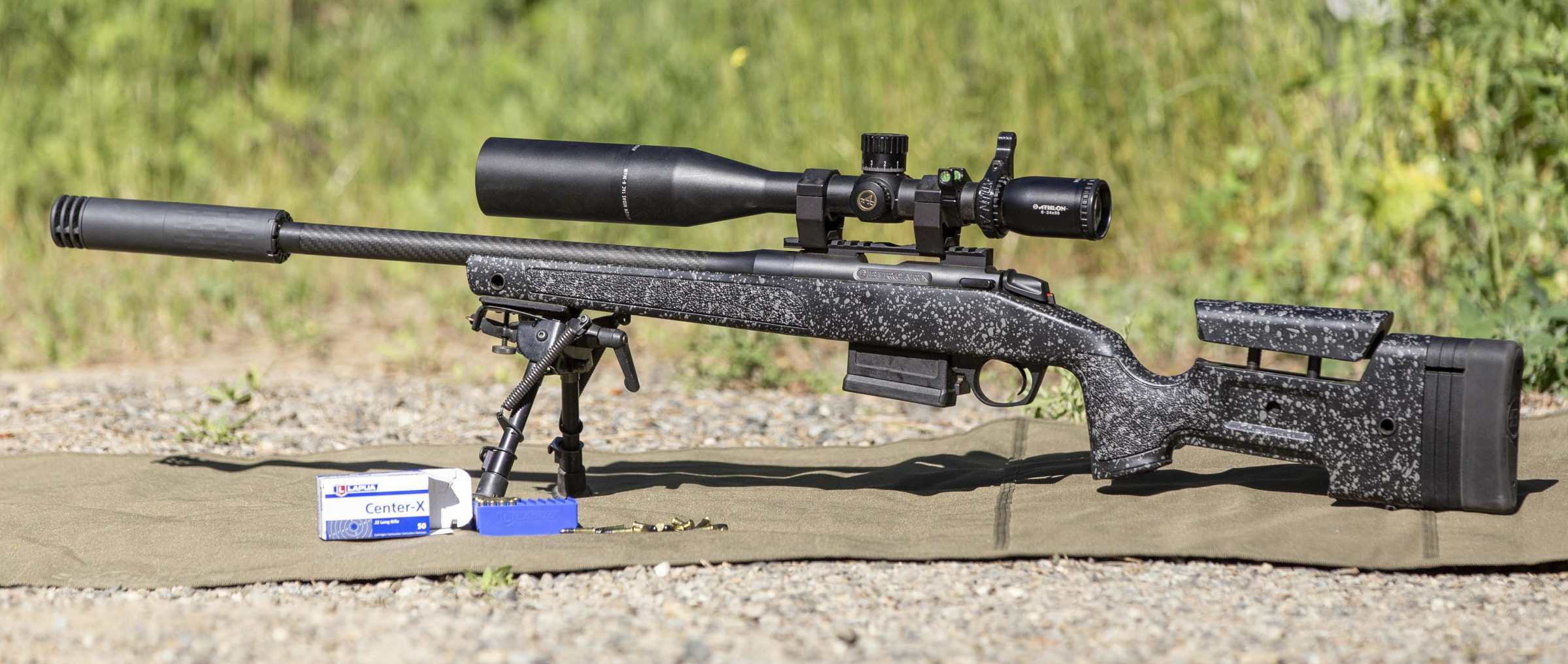
The Bergara B14-R is a high-quality, accurate .22 LR rimfire bolt-action rifle. The rifle’s accuracy and functionality make it a good choice for NRL22 competition. And with stock geometry and ergonomics that duplicate a full-size centerfire rifle, the Bergara B14-R is also an excellent choice for cross-training. By training with a rimfire rifle, you can get essential “trigger time” while saving money. Good centerfire ammo can cost $1.50 per round or more. Decent rimfire ammo can be found for $6.00 per 50rd box. That’s just 12 cents per round.
Click above photo to load full-screen high-rez image.
To find out how well the Bergara B14-R can perform, Gavin Gear of UltimateReloader.com recently tested a B14-R (carbon-covered barrel version) at his private range. Using a variety of Lapua and SK Ammo, this rig delivered impressive results. Watch this video to see the B14-R in action.
“The B14-R is a great shooter, and for me it felt very familiar. Just like shooting one of my centerfire match guns, but without all of the recoil!” — Gavin Gear
Gavin reports: “At the 2020 SHOT Show, Bergara announced the B14-R trainer. The concept? Take the B14 HMR series centerfire rifle formula, and adapt it for rimfire. The result is a .22 LR rifle you can shoot all day long without wearing out your arm or your wallet! It looks/feels like a centerfire long-range precision rifle. And that’s what makes this rifle a GREAT training platform for serious long-range shooters.”
The B14-R comes with a 18″-long 1:16″-twist threaded barrel. The single-stack .22 LR magazine is the same size as a short action AICS mag. The Bergara B14-R shares Rem 700 specs, so it is compatible with Rem 700 stocks and aftermarket triggers. Weight with standard barrel is 9.2 pounds without optics, or 8.1 pounds for the carbon version seen here. MSRP for basic version is $1150.00 and street price is $950.00.
Gavin told us: “I couldn’t wait to get the B14-R out to my new 50-yard ridgeline range to see how it would perform with premium .22 LR ammunition. Once I shot this rifle suppressed, I didn’t want to take off the can. The 18″ barrel really works well with the SilcencerCo suppressor to help keep the overall length reasonable, and balance is spot-on.” NOTE: This rifle has the optional carbon-covered barrel.
As tested, the rifle was equipped with these components:
Athlon Midas TAC 6-14x50mm FFP Scope with MK Machine lever, Lone Star bubble level SilencerCo Omega 300 Suppressor with 1/2×28 direct thread mount Harris S-BRM 6″-9″ Bipod with aftermarket swivel tension lever
Outstanding Accuracy with Lapua and SK .22 LR Ammo
Remarkable accuracy for a factory rifle earned this Bergara its Sunday GunDay selection. Shooting with bipod and rear sandbag, Gavin was able to achieve multiple, sub-half-inch groups at 50 yards. The best group shot with SK Match ammo was a remarkable 0.22″ as measured by Ballistic-X software (see below). That’s an impressive 0.42 MOA at 50 yards. If you watch the video above, starting at 14:40 time-mark, you can watch Gavin shoot that 0.22″ group.
Here are two more groups, both under 0.5″ at 50 yards. Lapua Center-X on left, SK Match on right. Gavin says that “with good conditions, 0.35″ 5-shot groups at 50 yards are easily attainable.”
B14-R Trigger Tested with TriggerScan TS-11
Gavin tested the Bergara’s trigger with the TriggerScan TS-11 from DVORAK Instruments, a very sophisticated, high-tech device. Gavin states: “This trigger works well, and mine was adjustable down to just over 2-lb peak force for pull weight. I ran a 3-scan pass on the B14-R trigger with the pull weight set to minimum [barely over 2 pounds].”
Gavin notes: “You can see how consistent this trigger is by how well the scan graph plots overlap! This trigger is great for an out-of-the-box rifle like this, and it’s great to know that I can always swap out triggers and use the same exact Remington 700-compatible trigger that I’m running in my match guns.”
Gavin Gear’s Closing Thoughts — More to Come
The Bergara B14-R rimfire trainer has been a great rifle to shoot and has exceeded my expectations. The B14-R feels like a full-size PRS rifle, has the same basic features, but is chambered in .22 LR. I have been amazed by the accuracy I’ve achieved with this rifle with Lapua and SK match ammunition — it’s very confidence inspiring.
This rifle feels right and shoots great. I can’t wait to get more steel targets setup, and to go deeper into calculating dope for the ammunition I will shoot with this rifle. Perhaps I’ll think about competing in an NRL22 match at some point. If you are looking for a rimfire trainer, look at the Bergara B14-R for sure. It checks all of my boxes for this type of rifle!
We’ve always liked the capacious, durable range boxes from MTM Case-Gard. And MTM offers a special “Tactical” version for AR shooters. This detachable-lid Tactical Range Box features a magwell-filling “action block insert” to support your AR securely during cleaning. Magwell posts like this have been used for years by AR gunsmiths. It’s a fast and convenient way to secure your AR.
The Tactical Range Box also comes with two adjustable cradles that will support most conventional bolt-action rifles and lever guns. These plastic cradles are gentle on fancy stocks, and they can be removed and stowed in the bottom of the box during transport.
The Tactical Range Box uses a two-piece design. The removable top storage compartment holds oils, solvents, brushes, patches, and small accessories. Unlatch the top box to reveal a large, deep storage area that will hold tools, earmuffs, ammo boxes and other larger items. MTM Range Boxes are big enough to hold pretty much everything you need at the range, except your front rest and rear sandbag. Midsouth Shooters Supply offers the MTM Tactical Range Box (item 008-TRB40) for just $50.71. Like MTM’s standard Shooting Range Box (RBMC-11), the Tactical Range Box is well-built and much less flexy than generic plastic tool-boxes. Check out the features of this range box in the video below.
Practical USER TIP — Keep some heavy items in the box for more stability. Forum member Tom Alvez explains: “I have one of those range boxes… It’s a great product, really. But, unless there is some pretty heavy stuff in the box when the rifle cleaning starts it may get pretty skittery. Maybe [add] a block or two of lead — that could come in handy later.”
For more info, contact MTM® Molded Products at (937) 890-7461 or visit MTMCase-gard.com.


 Beating the Guys at their Own Game
 Beneficial Aspects of Shooting
 Load Development

 Firearms are limited to field-portable, varmint-caliber rifles in either custom or factory class, and having a maximum 6.5mm bore, but bullets must weigh no more than 107 grains. You can shoot prone or from a bench using a front rest and bag rear. For more information, visit
 Let’s start at the beginning. Before the match there is usually an opportunity to fire a few fouling shots and check sight settings for load and distance. An initial read on conditions–mostly wind direction, strength and consistency–is also made. The spotter should checklist the shooter to make sure they are set up for the relay distance and have adjusted their sights to the correct elevation and windage.
 Katy and Don are avocado farmers. From time to time they’d bring a few avocados to the range to give to the other shooters. In addition, on some months, Katy would bring some home-made Guacamole made from the avocados on their ranch. Katy says “Fellow shooters appreciate a batch of guacamole so much they bring their own chips to go with the dip. I keep getting suggestions that I go into the business of making and selling guacamole. Guess I could start by selling it at the range.”

 For gun safes, we prefer rotary-combination dial locks, although commercial-grade electronic locks are now very good. While less convenient, and slower to open than electronic locks, combination locks are still more durable and trouble-free than the digital locks found on many low- to medium-cost gun safes. Among the combination locks, the Sargent & Greenleaf model 6730 (UL Group II) remains an industry standard. The director of Sturdy Safes noted: “An S&G 6730 will be working fine when your grandchildren have grandchildren.” For home use, we also recommend the standard, high-visibility “front-read” white on black dial.








 Plant Engineer Darren Leskiw answered: “Beyond the normal equipment, I’d say my electronic scale. Using the beam balance for the past 9 years was ok, but nowhere as easy as using an electronic scale.”




 We’ve always liked the capacious, durable range boxes from


