KEY FEATURES: Ballistics Solver, GPS Tagging, Weather Forecast, Field Notes with Photos
Hunters, here’s a great FREE mobile APP for both Apple and Android systems. The ZEISS Hunting App offers many practical functions: full-featured ballistics calculator, field notes with photo archive, compass function, GPS tagging for documentation of hunting experiences, and a detailed weather forecast service. The Hunting App is offered as a FREE download for Android and iOS (iPhone/iPad) mobile devices.
Three Minute Video Explains Zeiss Hunting App Features:
The Zeiss Hunting App integrates multiple useful features — ballistics solver, compass, GPS tagging, hunt history. The “Field Notes” function can record a wide variety of info — you can save photos, record your shots and hits, log animal sightings during the hunt, and even plot game locations on a map. Zeiss explains: “This allows users to optimally record events, the game population in the hunting territory, and their own hunting experiences.” Shots can be tagged via GPS through the shooter’s and the target’s position, and then displayed on a map. The Field Notes hunt diary shows all entries in chronological order.
Full-Featured Ballistics Solver
The integrated ballistic calculator allows hunters to easily customize the settings to suit their favorite cartridges. You can enter your own data, or choose bullet/cartridge info from a database containing over 7000 ammunition types from a variety of manufacturers. The ballistics solver can be programmed for for current weather conditions (temp/humidity), and the angle (inclination) of the shot.
Weather Functions
The weather tool offers a Five-Day Forecast, and you can choose multiple locations. In addition to the current location, users can also display the weather for their hunting areas of choice. The weather forecast includes temperature, precipitation, wind direction, wind speed, humidity, and air pressure. (Note: For precise ballistics solutions, you must input the ACTUAL conditions at your shooting location).
This video explains how to define a hunting zone and set GPS location tags on the map:
Hunt Log and Photos
The Field Notes function can do many things. You can log all your shots and hits, and you can plot game sightings during the hunt. Events can be augmented with photos and GPS data. With the Field Notes mapping function, you can even locate game populations in the hunting territory. A compass and automatic night mode round off the list of smart features.
One of the most unique and popular air rifle matches in the world takes place next week in Arizona. The Extreme Benchrest Championship, hosted by Airguns of Arizona, takes place October 6-9, 2022 in Phoenix, Arizona. This is the 11th annual Championship and Airguns of Arizona plans on making this the biggest and best one yet. NOTE: The event name is a bit of a misnomer. This is NOT just a benchrest match. In fact this event encompasses multiple airgun disciplines — Benchrest, Silhouette, Field Target, and Action Steel — with targets at 50, 75, and 100 yards.
About the Extreme Benchrest Championship in Arizona
Extreme Benchrest earns its name with airguns being shot as far as 100 yards outdoors where the elements will test the best in ammunition, air rifle, and shooter. With very few limitations on equipment, this all-inclusive match is exciting and truly a test of marksmanship. This multi-discipline event tests shooters in precision as well as speed and adaptability in the field. Along with traditional Benchrest shotoing, the event includes Speed Silhouette, Big Bore, Field Target, and Action Steel shooting. Manufacturers from across the globe are providing top level prizes and awards. Competitors will participate with some of the finest air-gunners in the country. CLICK HERE for more information.
This video is WORTH WATCHING — it shows multiple disciplines and many airgun types:
Sightron Will Be Major Sponsor of Extreme Benchrest Championship for Air Rifles
“We are very excited to be the official optics sponsor of this incredible championship,” said Mack Matsumoto, President of Sightron. “Sightron optics are made to compete at the highest level. The SII Blue Sky 20-60×85 HD spotting scope will definitely be a huge advantage for the competitors utilizing them. The new S6 series of riflescopes among others will be on display during the championship.” To learn more about the complete Sightron product line, go to Sightron.com or visit Sightron’s Facebook Page.
Sightron will be sponsoring the attendee goodie bag with several promotional items. Sightron is also providing a $2899.99 SVIII 5-40x56mm ED Illuminated LRM riflescope for the raffle. Sightron will bring multiple SII Blue Sky 20-60×85 HD angled spotting scopes for viewing by spectators. Several of these will be linked to televisions in the attendee shooting area.
Today we feature a big-caliber rifle used for the most prestigious Extreme Long Range (ELR) competition, the King of 2 Miles. This rifle was built for Derek Rodgers, a talented shooter with amazing credentials. An F-TR World Champion, Derek is the only shooter to have won the F-Open USA National Championship AND the F-TR USA National Championship. Derek also won the 2017 King of 2 Miles competition. Last Sunday GunDay we featured the 33XC rifle used by Clay Rhoden to capture the inaugural American King of 1 Mile competition. That story was quite popular, so this Sunday we offer an even more powerful rig, Derek’s .416 Barrett with a massive 40″ barrel.
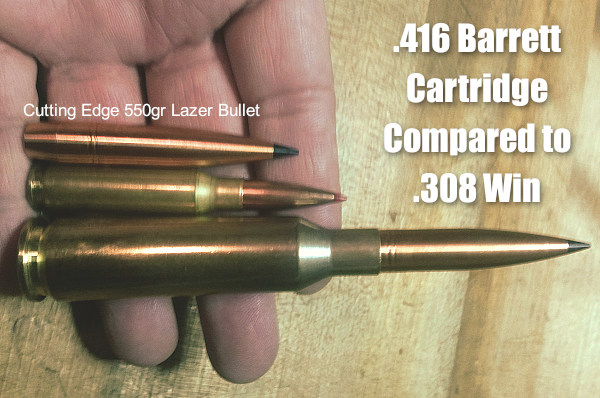
Derek Rodgers won the King of 2 Miles competition in 2017, so he knows all about Extreme Long Range (ELR) shooting. While Derek won his 2017 KO2M title shooting the .375 CheyTac cartridge, Derek decided that something even bigger was in order. So Derek commissioned this impressive ELR rifle chambered for the jumbo .416 Barrett cartridge. This big round drives heavy Cutting Edge solid bullets from 475 to 550 grains in weight.
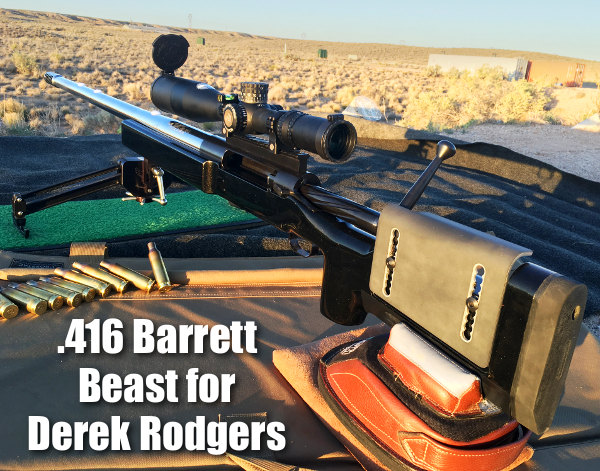
Here’s the Big Rig that delivers those .416-caliber projectiles. This monster rifle weighs 40+ pounds and sports a 40″ Bartlein barrel — more length for more velocity. Derek’s ELR rifle features a McMillan Beast 2 stock, BAT EX action, and Nightforce ATACR 7-35x56mm scope. Derek explained why he moved up to a bigger caliber: “I built a new rifle with the anticipation of seeing impacts easier. It was not just a larger caliber being more effective on hitting ELR targets, but rather hoping that a missed shot would have a much larger impact. Impacts beyond a mile become harder to see due to terrain and vegetation. So any added dust or splash erupting from the earth is a decisive benefit over an equally-accurate smaller caliber.” Here is Derek’s full report on his .416 Barrett rifle.
Derek Rodgers Campaigns a .416 Barrett
Report by Derek Rodgers Cartridge Choice — I chose a standard .416 Barrett cartridge as it allows for bullets up to and slightly exceeding 550 grains. It really does bridge the gap between the .375 variants and a 50 BMG. There are several great solid ELR bullet options from manufactures like Cutting Edge that range from 475-550 grains. These offer a variety of extremely high BC options for barrels that have different twist rates. Most loads will utilize the slowest burn rate powders commercially available. Good options are Vihtavuori 20N29, RL50, H50BMG and other powders with a similar burn rate.
Shooting the .416 — Tamer than Expected
An initial observation is that the rifle is very controllable and feels much like a larger F-TR gun. The rifle weighs 40+ pounds, balanced and stays on target very well. The recoil is manageable and linear. This seems to give a straight rearward impulse that does not affect positioning. This allows for quick repositioning into battery and faster follow-up shots.
Image courtesy ELR competitor Corbin Shell.
Rifle Details — BAT EX Action, Bartlein 40″ Barrel, McMillan Beast 2 Stock
Derek’s .416 Barrett ELR Rig features a BAT EX action with a Bix’N Andy trigger. Out front is a gigantic 40″ long, 1:9″-twist Bartlein barrel fitted with a Terminator T5 muzzle brake. The handsome McMillan Beast 2 stock combines a lower center of gravity design with a higher butt location. Given that high butt geometry, McMillan cleverly fitted the higher buttpad with a port allowing the cleaning rod to pass through (see photo below). On top is a Nightforce ATACR 7-35x56mm scope in NF rings on a +60 MOA rail, with Holland 34mm bubble level. The stock is supported by a Phoenix bipod and rests in an Edgewood bag designed for the McMillan Xit F-TR stock.
Note the extended Buttpad height. That helps with recoil in prone position. This McMillan Beast 2 stock includes a pass-through hole for the cleaning rod.
Derek Rodgers Wins 2017 Ko2M with 3368-Yard Hit
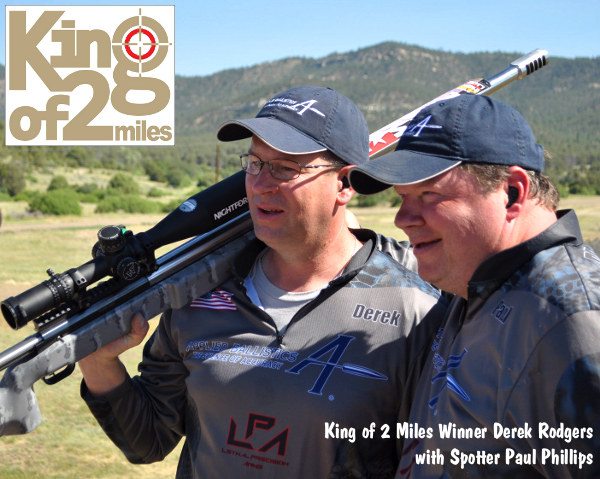
Back in 2017, Derek Rodgers won the King of 2 Miles Competition at Raton, New Mexico. Derek, shooting with Team Applied Ballistics, was the first KO2M marksman in history to hit the target at the maximum 3368-yard (1.91 mile) distance. Here’s that historic shot:
At the 2017 K02M, with his McMillan-stocked .375 CheyTac rifle, Derek shot brilliantly from the start. He was perfect — without a miss — at the first three yardages: 1543, 1722, and 1888. He had some misses at 1953 and 2667 yards, but then he out-shot all competitors at 3028 yards, going two for five. No other shooter managed a single hit at 3028 yards. Then it all came down to the big one — the last (and greatest) challenge, the target at 3368 yards (1.91 miles). Derek nailed it… and the celebrations began.
Here’s Derek with his 2017 Ko2M-winning .375 CheyTac rifle. Now he’s stepped up in bore size.
Gunsmithing by Blake Barrel and Rifle in Arizona
Derek’s rifle was built and chambered by Bryan Blake of Blake Barrel and Rifle in Phoenix, Arizona. The chambering was done with a Manson Precision reamer. Derek explains: “Bryan and his family have been in the machine shop business for several generations and have the expertise and equipment to handle larger barrel diameters associated with F-Class to ELR-type rigs. I tried to consider all angles and potential pitfalls that might occur during the building process. However, Bryan added his own touches to make the project his own. He truly created a work of art and supplied a turn-key rifle that is meticulously built from the inside out and looks as great as the tolerances it holds.”
Deer hunting photo courtesy NSSF.
Today, Saturday, September 24, 2022, is National Hunting and Fishing Day. Every year, this event is held the 4th Saturday of September. First recognized by President Nixon in 1972, this is now the 50th year the event has been celebrated across the USA. To help mark this day, we are offering six informative videos for hunters. These cover planning your hunt, selecting good optics, and optimizing your rifle. There are also hunting stories from Africa and Norway.
How to Sight-In Your Hunting Rifle
This video and related article offer good basic advice for sighting-in a hunting rifle. There are a series of six points covered. Here’s Tip #1: “Find a safe place to shoot your rifle with a backstop. If possible, use a bench and a rock-solid shooting rest. Sighting-in is all about consistency, so the less human error you have, the better. For safety, be sure to also bring ear and eye protection.” READ FULL ARTICLE on NRAWomen.com.
Comparison of Seven Popular Deer Hunting Scopes
This is summary review of seven (7) popular hunting scopes, as available in 2020 (there may be newer variants). This video consist mostly of manufacturer-created marketing content with a few minutes of independent reviews. Consider this video a place to start when shopping for a new hunting optic. You’ll want to check independent reviews when you select a particular model. The seven riflescopes featured in the video are: Athlon Optics Argos BTR, Leupold VX-3i 3.5-10x50mm, Leupold VX-R 4-12x40mm, NightForce SHV 5-20x56mm, Nikon Buckmasters II, Vortex Crossfire II, Vortex Viper HS SFP.
Prepare For Your Hunt — Get Fit and Practice Positions
As part of the NRA’s Tips & Tactics video series, Kristy Titus explains how to prepare for a hunt. Titus, co-host of the Team Elk TV show has hunted around the globe. She grew up in the outdoors, running pack mules in Oregon with her father. In this video, Kristy discusses fitness training and demonstrates field positions that can be employed during a hunt.
Kristy explains: “Hunting can lead you into some steep, rough country. It’s really important that you train both your body and your mind to handle the elements and the rigors of hunting So, if you plan on going on a mountain hunt, get out and train your body. Train with your firearm. Get off the bench and have some fun with this. Do some positional shooting or, if you want to add a stress dynamic… have someone put you under a time parameter.”
Kudu Hunting in Africa
Pieter “Piet” Malan is a South African precision rifle shooter and hunter who has created an impressive YouTube Channel with over 300 videos. While Pieter’s Impact Shooting Channel focuses primarily on tactical PRS/NRL type disciplines, his channel also includes dozens of videos of interest to hunters. Here is Pieter’s excellent video about Kudu hunting — Kudu Hunting Paradise Part 2. After watching this, with the exotic game and stunning terrain, you’ll probably want to book an African Safari.
Deer Hunting in Norway’s Fjord Mountains
Here’s a video with some truly stunning scenery. Watching this video is like taking a virtual vacation to Norway, where you can explore the scenic mountains in the Fjord region. Forum member Kenneth Skorpen (aka “Sal”) has created a cool video of a deer-hunting trip he took in Norway. He didn’t bag a buck on this trip, but the walk in the Fjordland mountains took Kenneth through some spectacular scenery. (At the 11:25 time mark you’ll see an amazing sunset over the Fjord.)
Kenneth did encounter a doe that had fallen down the mountain, and apparently broken its neck (14:35 time mark). The terrain is very steep, and Kenneth observed that: “I feel fortunate to be able to do this, but I also feel very tired in my legs. Did you know that the hares around here have shorter left legs due to the steep hills?”
Load Development for .308 Win Hunting Rifle
In this video, F-Class ace Keith Glasscock shows load development with a .308 Winchester hunting rifle. Here Keith uses a large X-type sandbag for a front support. He is shooting a Remington 700 bolt-action rifle, with Barnes TSX solid copper bullets, PPU Brass, Federal 210m primers, and AR Comp powder. Keith said the Barnes bullets were excellent — he commented that these bullets were “match quality in terms of precision”. Keith achieved some very small three-shot groups with AR Comp and the TSX projectiles. Keith did note that point-of-impact shifted up significantly with increases in charge weight (see 6:20-7:10). With thinner-contour hunting barrels, this is not unexpected. But POI change should be observed carefully during load development, as you may need to adjust your zero after completing testing.
In support of America’s military veterans, in memory of those who sacrificed their lives, Andy Wickstrom, President of Henry Repeating Arms Company presented a $50,000 check to the American Legion at its recent national convention in Milwaukee, Wisconsin. American Legion National Commander Paul E. Dillard was also given an engraved Henry Military Services Tribute Edition rifle in appreciation for Dillard’s service with the organization.
Respected YouTube host 22Plinkster reviews five popular Henry lever-action rifles.
“Henry Repeating Arms believes in the American Legion’s principles and mission of strengthening America by upholding American values, fostering patriotism, giving back, and we respect their many extraordinary accomplishments”, said Wickstrom. He added, “Thank you to all who have served, to those who are currently serving. We are forever indebted to you and the sacrifices you have made.”
Henry Repeating Arms Co. Pledges One Million Dollars for Charitable Causes
Celebrating its 25th anniversary this year, Henry Repeating Arms’ CEO and Founder Anthony Imperato made a $1,000,000 pledge for the company’s charitable branch, Guns For Great Causes. This program’s beneficiaries include children’s hospitals, military veteran organizations, 2nd Amendment advocacy groups, shooting sports and hunter education organizations, and wildlife conservation agencies. In the coming weeks, Henry Repeating Arms will a limited-edition Golden Boy Silver Anniversary Edition rifle with 100% of the proceeds benefitting the organizations and charities supported by Guns For Great Causes.
About the American Legion: Chartered by Congress in 1919, the American Legion is America’s largest wartime veterans service organization, with over two million Legionnaires serving the motto, “Veterans Strengthening America”. Legionnaires seek to improve the well-being of their fellow veterans, their families, their communities, and the country through services and programs including youth mentorship, homeless veteran assistance, and quality-of-life improvements for wounded veterans.
Product Review by F-Class John
Case preparation is critical for precision reloading. One must trim cases, debur/chamfer case mouths, clean necks, spruce up primer pockets and do other important tasks. Complete case prep can involve many separate processes, each requiring its own tools. With each of those tools comes additional cost as well as the need for more storage and bench space. To make case prep easier, faster, and more convenient Lyman created the Case Prep Xpress. The Case Prep Xpress, introduced a few years back, combines up to five prep stages into one well-built, stable, versatile unit. Watch this video to see the machine in action:
The Case Prep Xpress features five (5) independently-turning spindles all with the common 8/32 thread. This allows you to attach multiple tools supplied with the unit PLUS many other screw-on prep tools. For our testing we started out using a variety of the 12 included tools and found they cover the majority of case prep tasks. Lyman supplies deburr and chamfer tools, pocket uniformers, reamers and cleaners, as well as an assortment of neck brushes.
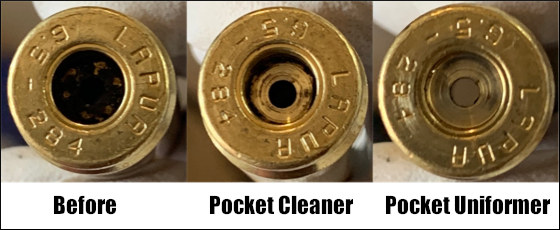
The deburr and chamfer tools worked really well, creating beautiful bevels all while leaving a nice flat edge across the top of the neck which is critical for accuracy and brass life. We found the primer pocket cleaning tool did a good job, but for truly clean pockets we recommend using the primer pocket uniforming tool, which very efficiently removes even hard residues.
The benefit of having interchangeable heads is that you can add your own accessories. We like to use a bore brush with bronze wool wrapped around it for use inside our necks. This worked perfectly once we screwed it in. In fact, we couldn’t think of any 8/32-threaded accessory that wouldn’t work well on this machine. Another great design feature is how all the accessories are oriented straight up. This allows for perfect visual alignment of your cases onto the tools which is critical — especially when performing cutting operations such as primer pocket uniforming.
Along with the five power stations there are six female-threaded storage spots on the sides where tools can be placed to ensure they don’t get lost. We like this feature since there will be more than five accessories you want to use and having them easily available is a great feature. You can keep 11 tools right on the machine (5 on top, 6 on the sides). That way you don’t have to dig through storage bins.
The Case Prep Xpress has a removable front bin to hold brass shavings, and there are two circular trays on either side of the bin. In front is a long tray that holds the provided brush. This makes it relatively easy to clean off brass shavings and other debris from case prep processes.
SUMMARY — Versatile Case Prep Xpress Is A Good Value
For the money, Lyman’s Case Prep Xpress is tough to beat. It performs multiple tasks well while being stable and easy-to-use. Yes there are some multi-spindle prep centers that offer variable or fast/slow RPM spindles while the Lyman’s spindles are all fixed RPM. (See, e.g. the RCBS Brass Boss). However those other systems don’t include all the convenient on-board storage of the Case Prep Xpress, and are more expensive. The Lyman Case Prep Xpress sells for $150-$170 “street price”. It’s currently on sale for $146.99 on Amazon. This makes the Lyman Case Prep Xpress a fine value — it offers great versatility while saving space and saving money compared to buying five or more separate, powered tools.
This Saturday, September 24, 2022, is National Hunting and Fishing Day.
There are over 9.2 million hunters in the United States. The fees paid by hunters are essential to support conservation efforts and to protect/maintain habitats.
These infographics explain the vital role that American hunters play in protecting wild species in North America. Currently 60% of state Fish & Wildlife Agency funding comes from excise taxes and licensee fees paid by hunters and anglers. The system has provided billions of dollars for conservation over the past nine decades. Since the late 1930s, hunters, target shooters and the firearms industry have been the nation’s largest contributors to conservation, paying for programs that benefit America’s wildlife.
The Pittman-Robertson Act generates $700 million annually, which is distributed by the U.S. Fish and Wildlife Service to state fish and game agencies across America.
To help serve America’s many millions of new gun owners, Winchester has created a good online information site for first-time ammunition and firearms buyers as well as those just getting started in the shooting sports. Winchester’s New Shooters Site has many helpful articles plus a series of videos.
A novice long-range competitor is now the first-ever USA King of 1 Mile. Clay Rhoden, the talented head honcho of Longshot (target cameras), won the match with a superb performance. Clay hit every single shot, without a miss, for the first five targets, all the way out to 1699 yards. There were two additional targets beyond one mile — Target 6 at 1909 yards and Target 7 at 2391 yards. Clay went 4 for 10 at these longer distances, but his perfect shooting out to 1699 yards still gave him a comfortable margin of victory.
Amazing FACT: Clay Won the 2022 USA Ko1M in only his sixth shooting match ever!
In winning the 2022 Ko1M match, Clay beat some living legends, including David Tubb, a 6-time NRA Nat’l Long Range Champion and 2019 NRA ELR HG Champ. Clay’s remarkable victory is doubly impressive if you consider that Clay had previously shot only five other rifle matches (at any distance) in his whole life. This was truly a stellar win for a new shooter. Huge congrats to Clay and his Global Precision Group (GPG) team. Clay’s GPG teammate Ray Gross took second overall.
Clay earned his one-mile Ko1M title shooting a very accurate 33XC rifle with BAT action, Bartlein barrel, Manners ELR Light stock, Bix’N Andy trigger, and a Nightforce ATACR 7-35x56mm scope. The ammo, which was developed and loaded by Paul Phillips, featured Berger 300gr Hybrid OTM bullets in Peterson brass pushed by Vihtavuori N565 powder and Federal 215 primers.
2022 King of 1 Mile USA Championship — The Winning Formula
Report by Clay Rhoden, Longshot Target Cameras
The 2022 (first ever) USA King of 1 Mile event is a match I will not soon forget! Before going any further, I want to thank Jay Monych and Alex Cordesman for putting this match together and for opening each day with prayer and the Pledge of Allegiance.
This was only my sixth match ever to shoot and boy was it a blast! I had no expectations going into the match and my focus was on trying to stay calm and collected. I didn’t shoot until the second day, but my teammate, Ray Gross, shot on the first day. I thought we did OK during his qualification run, but I felt that I let him down as a spotter by under-doping the wind calls on the first two targets. Regardless, it was enough to get him into the finals and gave him another shot at the win.
When it was my turn to shoot, I did my best to keep my heart rate down and keep from getting excited. I also prayed throughout the day and prior to shooting, asking the Lord to help me win if it was His will, and to help me gracefully accept the loss if it wasn’t. Additionally, I asked that If I won, He use the win to His glory, and He has and is! My wife and I are going through the beginning stages of the domestic adoption process and the first bit of real money will be due soon and what do you know, it just so happens to be $4,000, the exact amount of money that I won in the match!
The top 19 shooters advanced to the Ko1M FINAL (Targets 5,6,7). In 20th, Paul Phillips just missed out.
My prayers were answered, and I was the only shooter to pull off a flawless run during the qualifier, going 3 for 3 on Targets 1-4. That secured us the top spot going into the finals and after randomizing the list, I remained at the top as 1st shooter in the finals and Ray as the 3rd. Conditions during the finals were worse as it was later in the day and the mirage had really come out to play. I was able to continue my flawless run onto T5 going 5 for 5, then I got 1st, 3rd, and 5th round impacts on T6, and a 4th round on T7. Thankfully, that was enough to secure the win.
Rifle, Scope, and Ammo
I was shooting a brand new 33XC rifle that had about 30 rounds through the barrel from practicing before the match. The gun has a BAT Machine left-hand feed, right-hand eject action, Bartlein barrel, sitting in a Manners F-Class stock with a modified custom TCS weight-tuning butt system. On top was a Nightforce ATACR 7-35x56mm FFP MOAR scope with NF high rings. The BAT action was bedded by Alex Sitman with machine work by GA Precision. The stock allowed me to add a good bit of weight to the back of the gun. That combined with a Tubb 5-star muzzle brake created a smooth and predictable recoil that allowed me to stay on target and help spot my impacts.
Team GPG Captain Paul Phillips loaded all the Ammo for Clay Rhoden and other Team GPG members.
Equally important if not more important than the rifle is the ammunition, and I have to give credit where credit is due. Paul Phillips loaded all the ammunition for the whole team and it shot lights out. We used Peterson Brass, Federal 215M primers, Vihtavuori N565 powder, and Berger 300gr Hybrid OTM bullets. During the match we observed that the guns and ammo performed so consistently shot after shot, that if we got an impact, we just need to run the same hold because the gun is going to put the next round in the exact same spot as the last one.
I was asked “What did your wife and kids say when you put on your crown?” The first thing my wife said when I put it on was, “You look like a whitewalker from Game of Thrones.” I’m not sure what to think of that but she did have a point. My kids thought it was cool and I tried tell them that I was a King now and that they were going to have to listen better, but they saw straight through that.
Preparation for the King of 1 Mile Match
I received my rifle a few weeks before the match and shot it for the first time only a couple of days before the match during a team practice at the Kaian Vista Ranch, a central Texas ranch owned by GPG teammate James Devoglaer. Upon arriving at his ranch, we zeroed the guns, confirmed velocities, and checked to make sure that everything was level. After that, we practiced team communication and spotting on the KVR’s long-range hunter course with 6.5 Creedmoors and then did a couple simulated matches with our competition rifles on the KVR’s ELR course. This allowed us to practice communication between shooter and spotter, as well as verify the predictions from our Kestrels. This practice significantly boosted my confidence going into the match!
Wind Calls and Spotting
In ELR, this is where the team really comes into play, and thankfully, Team GPG just happens to have some of the best wind callers in the world. I shot on the second day of the match and while I was doing my best to stay calm before shooting, my teammates were discussing the wind and the anomalies they had experienced when they shot and factoring all of that into our starting wind calls. Once our time began, it was up to Ray and I to get it right and Ray was on top of it! We were able to make first-round impacts on Targets 1 (1263 yards) through Target 6 (1909 yards). On T7 (2391 yards) our assumption about what the wind was wrong and cost us a couple impacts but thankfully, we were able to parlay those learnings and capitalize on them when it was Ray’s turn to shoot. Ray and I were shooters 3rd and 1st respectively in the finals, which was good from the perspective of applying what we had just learned from when I shot, but bad for me because I was the wind guinea pig for everyone in the finals.
Becoming Part of Team GPG
I lucked into being part of Team GPG last year when I went to help Paul run our Longshot cameras during a team practice. After the practice Paul asked if I wanted to shoot his .416 Barrett and of course I couldn’t say no to that, so I got behind the gun and shot a 4″ group at 2000 yards. A few weeks later, Paul asked if I wanted to join the team and the rest is history. I was just fortunate enough, as a completely inexperienced shooter, to get on a team with some of the best shooters in the world!
Being part of a team and trusting your teammates is such a critical part of ELR and I couldn’t ask for a better team. Each one of us comes from a different background and has different specialties, and we do an excellent job of leveraging all of that to perform at the highest level. Paul and Ray have years of experience shooting competitively. James has years of experience with competitive shooting, hunting, and training, while I have experience with cameras and technology that helps to verify our impacts. Additionally, we are all shooting clone rifles and can instantly leverage what we learn during the match from one shooter to the rest of the team. Paul Phillips even also helped design the new Manners ELR Light stock we used.
Big Prize Table and Major Cash Awards
The sponsors really stepped up for this match and donated $65,000 – $70,000 worth of prizes plus $5,500 in cash! It was an awesome experience being called up first, getting a trophy, belt buckle, and giant check for first place. I also got to walk the prize table first and got an amazing custom lightweight hunting rifle in .30 Nosler from Alamo Precision Rifles (see photo). At this point, I think it’s definitely fair to say that I’m hooked!
Now it’s time to prepare for our next match, the King of 2 Miles. Hopefully, Lord willing, Team GPG will be able to pull off more podium finishes at the end of September.
Conclusion: Philippians 4:13 states “I can do all things through Christ, who gives me strength.” There is no way I could have done this without my faith in God and without my team! I am so blessed and grateful to be able to say that I won the King of 1 Mile!
Longshot Products — How They Are Employed for ELR
There is no way that I would have been in this sport or even aware of the sport if it weren’t for the products we make at Longshot. Originally, rather than buying a spotting scope or binoculars, I developed our long-range camera system to solve the problem of seeing my shots at 100 yards to help zero my first rifle. Shortly thereafter, I was introduced to the idea of 1000-yard shooting. Then, not too long after, I was introduced to Extreme Long Range (ELR) shooting.
For all these disciplines, our Longshot target cameras solve the problem of being able to see and confirm impacts, no matter the condition. And the “reach” of the system is great. The current Longshot LR-3 UHD camera has a guaranteed 2-mile range with open terrain.
As a relatively new shooter and novice long-range and extreme long-range shooter, Longshot cameras have played a critical role in my development as a shooter. With our cameras, I’m able to instantly and precisely associate environmental conditions or a breakdown in fundamentals to a specific result on the target. I truly believe that this along with the people that I have met while running this business have helped me to achieve so much so quickly.
Longshot Hawk Spotting Scope Cameras Used During Ko1M Match
While our long range UHD targets cameras can only be used for scoring during a match, Team GPG uses Longshot’s Hawk Spotting Scope Camera to take pictures of the targets prior to the match and create plot books for each shooter. We then use these to take notes and call corrections during the match. This process helped me get a fourth round impact on T7 during the match. We were able to see a super small poof of dust, plot it on our sheet and call a precise correction to bring us on target.
Click Arrow to Watch Hawk Spotting Scope Camera Video
Background Report from Paul Phillips, Team GPG Captain
Team GPG approached the 2022 inaugural USA King of 1 Mile event the same as we approached the 2019 King of 2 Miles where we finished 1st, 3rd, and 4th out of 80 shooters. This year, at the Ko1M in Texas, we had the same amazing results with first-place and second-place finishes out of 94 Ko1M competitors.
Our team GPG approach begins with making sure our rifles and ammunition are producing half-MOA or better accuracy along with single-digit SDs. We then make sure we have very accurate 100-yard zeros and our optics are plumb and level.
We then utilize a custom PDM (Personalized Drag Model) from Applied Ballistics and verify all of our ballistics with multiple Kestrels and Applied Ballistics analytics.
Once this all matches up, then we simply input all of the distances and environmentals and we are ready for competition. For wind calling we use the Kestrel for wind speed and direction and use analytics to get the values. Just before we shoot we register any last second pick-ups or let-offs to start shooting.
For team communications and team work we spent the day at the KVR ranch located in Lometa, TX owned by Team GPG member James Deboglaer. James put us through his hunter course and we used this as a way to communicate and make sure we were on the same page.
With good elevations and wind along with great team work and communications we were able to produce our first- and second-place results.
Paul Phillips Crafted All the Ammunition and Did Load Development
Paul told us: “I’m doing all of the load development, loading ammo, ballistics and initial wind estimations for my shooters. I also did all the ballistics solutions using AB Analytics.”
Rifle Specifications and Components
All the team’s guns and ammo were GPG spec 33XC builds, with ammunition loaded by Paul Phillips. Clay’s 33XC round has the 300gr Bergers running 3250 FPS MV. GPG team rifles feature these components:
BAT actions
Bartlein barrels
Bix’N Andy triggers
Manners ELR Light stock
Nightforce ATACR scopes
Accutac bipod
GA Precision Gunsmithing
Paul Phillips Load Dev
Alex Sitman bedding
Manson Reamers
Hollands level
Tubb brakes
Berger 300gr Hybrid OTM .338 Cal bullet
Peterson cartridge brass
Vihtavouri N565 powder
Fed 215 primer
Hunting season is here. For hunters that means many hours may be spent searching for animals through spotting scopes and binoculars — “glassing” for game. And when the hunter does find a good buck or doe, he’ll need to know the animal’s precise distance, so that demands a good laser rangefinder. Being carried in the field, the scopes on hunting rifles need to be tough and durable, and every hunting scope should have good low-light performance. And when the hunter finally takes his shot, his scope better be properly zeroed. Today’s Saturday at the Movies showcase is all about Hunting Optics. We offer eight great videos that help you select the right riflescope, spotting scope, rangefinder, and binoculars for your next hunt.
Comparison of Seven Popular Deer Hunting Scopes
This is summary review of seven (7) popular hunting scopes, as available in 2020 (there may be newer variants). This video consist mostly of manufacturer-created marketing content with a few minutes of independent reviews. Consider this video a place to start when shopping for a new hunting optic. You’ll want to check independent reviews when you select a particular model. The seven riflescopes featured in the video are: Athlon Optics Argos BTR, Leupold VX-3i 3.5-10x50mm, Leupold VX-R 4-12x40mm, NightForce SHV 5-20x56mm, Nikon Buckmasters II, Vortex Crossfire II, Vortex Viper HS SFP.
Optics Selections for Mountain Hunts
Here’s a good video by an avid hunter who treks in remote, mountainous zones. The host has learned what works… and what’s worth the weight to carry: “I’ve found that the combination of 10×42 binoculars and a 27–60x80mm spotting scope is the sweet spot for mountain hunting. This pairing balances weight with reach, allowing me to keep moving but also reach out and see well-hidden animals. In some cases, I will make use of an 18×56 binocular, but this is reserved for non-backpack hunts. With 25 years of mountain hunting experience, I can whole-heartedly recommend my preferred binocular pair as a fantastic and versatile set-up for northern mountain hunts at the very least.”
Ultimate Spotter Test — 19 Spotting Scopes Reviewed
The producers of this remarkable 19-product spotting scope comparison state: “If you are looking at choosing the best spotting scope for hunting… you are in the right place! We tested these 19 spotting scopes to find the best compact spotting scope, best 65mm spotting scope, and best 85mm spotting scope out there. We also wanted to find the best values on the market, and I think we definitely did that. While we certainly couldn’t test them ALL, we were able to put together this incredible lineup of some of the best spotting scopes out there to help you find what is going to work for your specific needs.”
First Focal Plane vs. Second Focal Plane Scopes
For the last century, Second Focal Plane (SFP) scopes have been most common on hunting rifles. Now there are an increasing number of First Focal Plane (FFP) optics favored by hunters. The main reason is that the reticle mark values (in Mils or MOA) are constant relative to the target size at all magnification levels. That is handy for hold-offs and hold-overs. On the other hand, a SFP scope maintains a constant reticle size and line thickness at all zoom values. For most hunting shots, taken inside 300 yards, that really should be fine. Many hunters feel they can spot their prey more easily without a busy reticle that obscures small details at higher magnification. This video explains the pros and cons of both reticle types. The final decision is up to you — much will depend on the terrain you hunt and the distances you shoot.
The Complete Optics Selection for For Deer Hunting
In this video, Vortex optics techs explain the optics package deer hunters will want to take into the field. Along with a good medium-power zoom riflescope, you’ll want binoculars and (probably) a spotting scope. You’ll also want a Laser Rangefinder (LRF) or laser-equipped binoculars. As the team points out, the LRF is not just to range your prey right before you take a shot. A top-quality LRF can range a reflective object as far as 1500 yards away. That helps you decide whether you want to hike a mile to reach that buck you see way out on the next ridge.
MOA vs. MIL — What you Need to Know
These days, scope manufacturers offer a wide selection of both MIL (Milliradian) and MOA (Minute-of-Angle) based optics. We do think that MOA is still predominant in the lighter-weight, lower-cost (sub-$500) scopes marketed for hunters. There are pros and cons for both angular measurement systems. One MIL is 3.6″ at 100 yards, while one MOA is 1.047″ at 100 yards. If you grew up thinking in inches, a 1/4-MOA click-value hunting scope might work best. If you shoot PRS or have other MIL scopes you may prefer a MIL-value optic for your hunting rifle. Both choices will do the job.
Comparison of Eight Laser Rangefinders
The Backfire team purchased eight rangefinders and tested them in the field. Most of the products are under $500. This is a good review if you are looking for a compact LRF at a moderate price. Looking at performance for the price, for the hunting market, the reviewers favored the Leupold RX-1600 and the waterproof Vortex Ranger 1800. COMMENTARY: If you can afford it, we recommend that serious hunters consider top-end laser rangefinder-equipped binoculars such as the ZEISS Victory RF and Leica Geovid.
How to Zero Your Hunting Rifle Efficiently
Last but not least, here’s a great video from Vortex that shows you how to quickly and efficiently sight-in and zero your hunting rifle before heading out into the field. This video explains a simple procedure that lets you get a solid zero in just three shots. Of course you probably want to fire a few more rounds to confirm your zero before you head off to your hunting grounds, but this will let you get on-target with a minimum amount of time and ammo expended. This helpful video has over 3 million views on YouTube!
Fouling Shots and Cold Bore Condition
If you recently cleaned your rifle, you may want to fire two or three fouling shots before you start this procedure. But keep in mind that you want to duplicate the typical cold bore conditions that you’ll experience during the hunt. If you set your zero after three fouling shots, then make sure the bore is in a similar condition when you actually go out hunting.









 Here’s a video with some truly stunning scenery. Watching this video is like taking a virtual vacation to Norway, where you can explore the scenic mountains in the Fjord region. Forum member Kenneth Skorpen (aka “Sal”) has created a cool video of a deer-hunting trip he took in Norway. He didn’t bag a buck on this trip, but the walk in the Fjordland mountains took Kenneth through some spectacular scenery. (At the 11:25 time mark you’ll see an amazing sunset over the Fjord.)




 Being part of a team and trusting your teammates is such a critical part of ELR and I couldn’t ask for a better team. Each one of us comes from a different background and has different specialties, and we do an excellent job of leveraging all of that to perform at the highest level. Paul and Ray have years of experience shooting competitively. James has years of experience with competitive shooting, hunting, and training, while I have experience with cameras and technology that helps to verify our impacts. Additionally, we are all shooting clone rifles and can instantly leverage what we learn during the match from one shooter to the rest of the team. Paul Phillips even also helped design the new Manners ELR Light stock we used.


